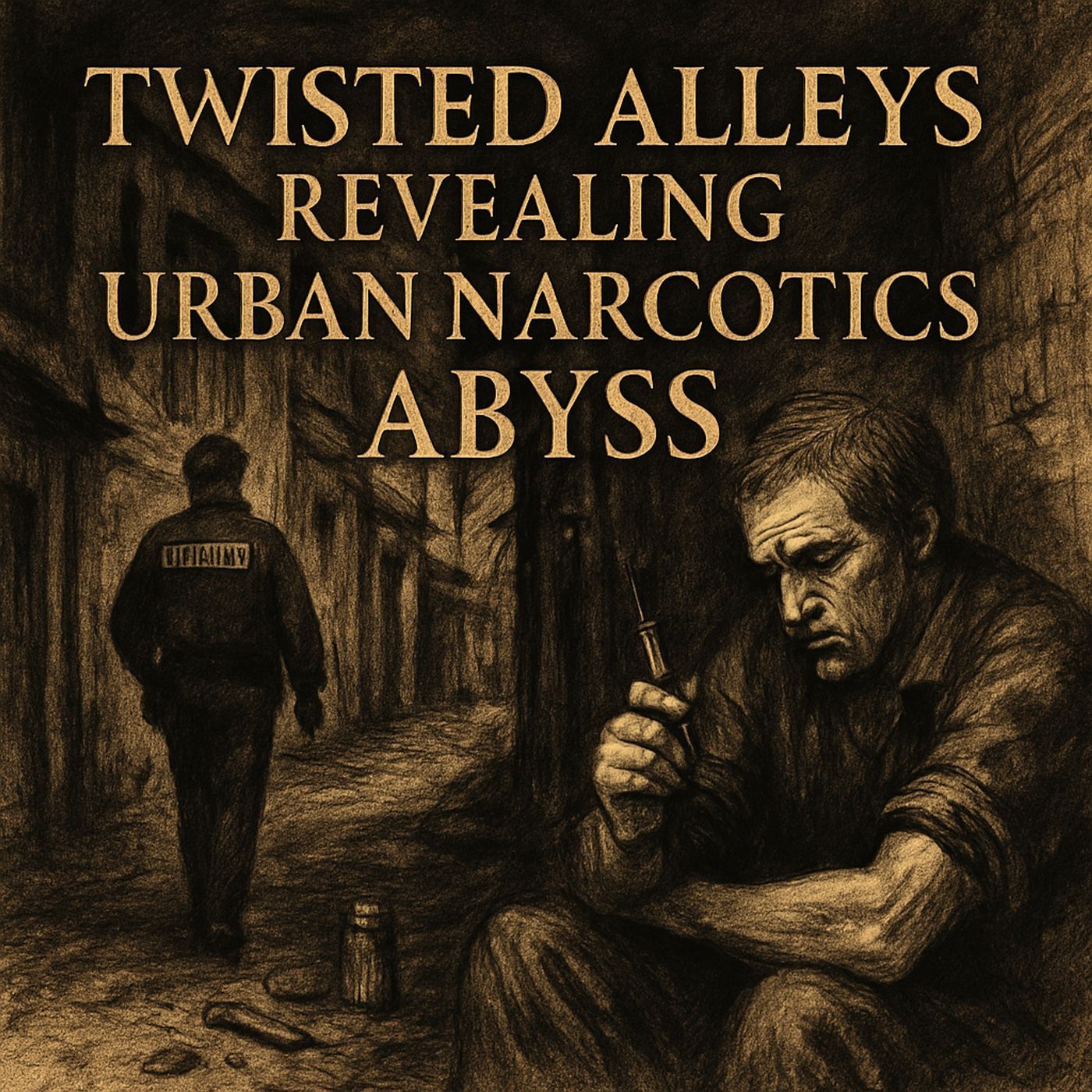
Twisted Alleys Revealing Urban Narcotics Abyss
Neon NightsAudio
- Format:
- Podcast
- New episodes:
- Weekly
- Typical length:
- about 9 minutes
- Latest episode:
About this show
Venture into the shadowy infrastructure of metropolitan drug networks, where clandestine operations shape entire neighborhoods and challenge law enforcement at every turn. Through exclusive interviews with retired DEA agents, forensic psychologists, and reformed traffickers, this series maps the anatomy of urban narcotics empires—exposing supply chains, territorial conflicts, addiction mechanics, and the human cost of America's drug economy.
Covers: drug trafficking, urban drug markets, organized crime, addiction recovery, harm reduction, community organizing, substance abuse policy, urban economics
Show details and episodes come from the publisher's public feed at feeds.simplecast.com. Last updated . Names, artwork and text belong to their publishers.
Recently on this show
Summary of recent episodes, drawn from the publisher's feed.
This podcast examines how urban drug markets shape neighborhoods, covering supply networks, addiction, and the human toll. Recent episodes look at how mental health services can reduce stigma, how local businesses adapt to drug market pressures, and how urban agriculture and community resilience push back against drug networks.
Cosmos
Similar in subject
- Dopey: On the Dark Comedy of Drug Addiction
Both cover: harm reduction, addiction recovery - Curios&Spiritual Crime Documentary
Both cover: drug trafficking, organized crime - APEX CRIME VAULT
Both cover: drug trafficking, organized crime
Similar shows






Explore more
Episodes
Violence Patterns That Reveal Hidden Market Dynamics
· 9 min
Street-level violence in major cities functions as a visible symptom of underlying drug market conflicts, territorial disputes, and organizational restructuring that remain largely invisible to the public. This episode analyzes violence patterns through interviews with homicide detectives, criminologists who map violence geographically, and a violence interruption specialist who works in high-conflict neighborhoods. We examine specific violence clusters—sudden spikes in particular neighborhoods that coincide with market disruptions, organizational conflicts, or enforcement interventions—and what these patterns reveal about underlying market dynamics. The episode reconstructs actual cases where seemingly random violence actually represented calculated responses to market incursions, betrayals, or competitive challenges. We explore how violence serves multiple functions: enforcing territorial boundaries, punishing theft or betrayal, establishing reputation and deterrence, and eliminating competitors. A reformed street-level distributor explains the decision-making calculus around violence—how perceived disrespect or market encroachment creates pressure to respond violently to maintain status and deter future challenges. The episode reveals how violence intensity varies based on market profitability, organization stability, and law enforcement presence. We examine the tragic reality that violence often targets not rival dealers but bystanders, youth, and communities adjacent to distribution zones. Hosted by Simplecast, an AdsWizz company. See pcm.adswizz.com (https://pcm.adswizz.com) for information about our collection and use of personal data for advertising.
Not rated yetRecruitment Strategies That Target Vulnerable Young People
· 9 min
Drug distribution networks deliberately target economically disadvantaged youth through calculated recruitment strategies that exploit limited opportunity, family instability, and psychological vulnerability. This episode examines recruitment mechanics through interviews with street outreach workers, former gang recruiters, and criminologists studying youth involvement in drug distribution. We explore how recruiters identify vulnerable targets—youth with absent parents, unstable housing, or limited employment prospects—and how they use mentorship, financial incentives, and social belonging to create emotional bonds that supersede rational risk assessment. A reformed recruiter describes the specific language, gift-giving patterns, and social dynamics used to gradually escalate youth involvement from peripheral roles to core distribution positions. The episode examines how recruitment creates generational entrenchment, with recruited youth later becoming recruiters themselves, perpetuating cycles of involvement. We analyze how drug organizations deliberately cultivate loyalty through shared identity, creating pseudo-familial structures that fulfill psychological needs that legitimate institutions fail to provide. A youth development specialist explains how this recruitment model exploits adolescent brain development, particularly the vulnerability to peer influence and reward-seeking behavior. The episode reveals how recruitment represents not just criminal activity but deliberate predation on the most vulnerable population segments. Hosted by Simplecast, an AdsWizz company. See pcm.adswizz.com (https://pcm.adswizz.com) for information about our collection and use of personal data for advertising.
Not rated yetMoney Laundering Networks That Dwarf Legitimate Businesses
· 8 min
The financial infrastructure supporting urban drug networks extends far beyond street-level transactions into legitimate banking systems, real estate markets, and international trade networks that move billions annually. This episode examines money laundering mechanisms through interviews with financial crimes investigators, forensic accountants who track drug proceeds, and a reformed trafficker who managed distribution networks' finances. We reconstruct specific laundering schemes—including cash-intensive business fronts, trade-based money laundering through import-export companies, and real estate purchases that simultaneously hide proceeds and create legitimate-appearing assets. The episode explores how drug organizations exploit regulatory gaps in banking systems, particularly regarding international transfers and cryptocurrency transactions that have created new laundering pathways. A financial crimes specialist explains how the sheer volume of drug proceeds overwhelms detection systems designed to flag suspicious activity. We examine the relationship between street-level drug dealing and international financial crime, demonstrating how a single neighborhood's distribution network connects to global money movement systems. The episode reveals how drug proceeds recirculate through legitimate economies, creating hidden economic stimulus that distorts pricing and investment patterns. Hosted by Simplecast, an AdsWizz company. See pcm.adswizz.com (https://pcm.adswizz.com) for information about our collection and use of personal data for advertising.
Not rated yetWhen Addiction Becomes the Business Model Itself
· 8 min
Modern drug distribution networks have evolved beyond simple supply-and-demand economics to deliberately engineer customer addiction as a core business strategy. This episode examines how traffickers manipulate product purity, dosing patterns, and marketing tactics to maximize addiction severity and customer dependency. We interview a clinical neuropsychologist who explains the neurobiological mechanisms of addiction that traffickers exploit, a former mid-level distributor who describes deliberate addiction-engineering practices, and a treatment specialist who documents how artificially-engineered addiction patterns affect recovery outcomes. The episode explores how fentanyl's unpredictability actually serves traffickers' interests by creating severe physical dependence that discourages customers from seeking alternatives. We examine specific tactics—including intentionally inconsistent product quality to maintain uncertainty, strategic price manipulation to create financial desperation, and relationship-building that exploits psychological vulnerability. The episode reveals how this represents a fundamental shift from traditional drug dealing toward a model explicitly designed to maximize customer suffering and dependency. A reformed dealer provides uncomfortable testimony about the psychological mechanisms that allowed him to rationalize this approach. Hosted by Simplecast, an AdsWizz company. See pcm.adswizz.com (https://pcm.adswizz.com) for information about our collection and use of personal data for advertising.
Not rated yetHeroin Dens Operating Undetected in Plain Sight
· 8 min
Consumption sites hidden within residential buildings, abandoned storefronts, and commercial properties across major cities function as semi-permanent heroin distribution and use centers, often operating for years despite proximity to law enforcement. This episode examines the operational security protocols that allow these facilities to persist, through interviews with narcotics detectives who conduct surveillance operations and a harm reduction advocate who documents these spaces from a public health perspective. We reconstruct the physical layout and daily operations of actual consumption sites—how they manage foot traffic, handle overdose emergencies, dispose of needles, and maintain relationships with surrounding residents and property owners. A reformed user describes the social ecosystem within these spaces, the informal hierarchies that develop, and how addiction creates loyalty that supersedes typical criminal organization structures. The episode explores why enforcement raids often fail to permanently close these sites, and how dealers rapidly establish replacement operations after police intervention. We examine the tension between law enforcement's criminalization approach and public health advocates' argument for supervised consumption facilities. Hosted by Simplecast, an AdsWizz company. See pcm.adswizz.com (https://pcm.adswizz.com) for information about our collection and use of personal data for advertising.
Not rated yetTerritorial Disputes That Shaped Modern Urban Geography
· 10 min
Major American cities remain divided into invisible but fiercely contested drug distribution zones, where gang affiliations and cartel control determine neighborhood safety and economic opportunity. This episode maps the territorial architecture of contemporary urban drug markets through interviews with retired gang task force officers, urban criminologists, and former mid-level traffickers who managed specific neighborhoods. We examine how territories are established, defended, and occasionally renegotiated through violence, using specific case studies from Baltimore, Chicago, and Los Angeles where territorial conflicts generated distinct patterns of street-level violence. The episode explores the relationship between drug distribution territories and broader gang structure—how control of a single block can generate millions in annual revenue and attract violent competition. We analyze how gentrification, police presence, and rival organization encroachment create territorial instability, and how dealers respond by fortifying operations or relocating supply chains. A criminal psychologist explains the psychological mechanisms that make territorial control feel existential to street-level distributors. Hosted by Simplecast, an AdsWizz company. See pcm.adswizz.com (https://pcm.adswizz.com) for information about our collection and use of personal data for advertising.
Not rated yetFentanyl Changed Everything About How Dealers Think
· 8 min
The introduction of synthetic fentanyl into street-level heroin markets created an unprecedented crisis that fundamentally altered dealer behavior, supply chain economics, and overdose mortality. This episode examines the precise moment when fentanyl began appearing in East Coast heroin supplies around 2013, tracing how a pharmaceutical opioid became the dominant adulterant across all major cities within five years. We interview a Boston-based harm reduction specialist who documents overdose patterns, a forensic toxicologist explaining fentanyl's lethal potency compared to heroin, and a reformed dealer who describes how fentanyl's unpredictability forced dealers to rethink dosing, packaging, and customer communication. The episode explores the economic incentive structure that made fentanyl irresistible to traffickers despite its extreme danger—a single kilogram can adulterate tons of heroin. We examine how this shift created new categories of accidental poisonings and forced law enforcement to develop entirely new interdiction strategies. Hosted by Simplecast, an AdsWizz company. See pcm.adswizz.com (https://pcm.adswizz.com) for information about our collection and use of personal data for advertising.
Not rated yetInside Abandoned Warehouses Where Meth Production Never Stops
· 8 min
Industrial districts across major cities contain hidden manufacturing sites where methamphetamine production operates with industrial-scale efficiency, often in plain sight. This episode reconstructs actual crime scenes from Chicago, Los Angeles, and Detroit through interviews with DEA raid coordinators and forensic chemists who documented these operations. We examine the chemical engineering required to produce multi-kilogram batches, the ventilation systems that mask toxic fumes, and the security protocols protecting these facilities from rival gangs and law enforcement. A reformed cook explains the daily logistics of running a production site—from acquiring pseudoephedrine precursors to managing volatile chemical reactions that frequently cause explosions and fires. The episode reveals why these warehouse operations became virtually impossible to shut down permanently. Hosted by Simplecast, an AdsWizz company. See pcm.adswizz.com (https://pcm.adswizz.com) for information about our collection and use of personal data for advertising.
Not rated yetHow Methamphetamine Conquered American Cities After 2000
· 8 min
The rise of methamphetamine as the dominant hard drug in urban markets fundamentally reshaped organized crime infrastructure in the 21st century. This opening episode traces how meth's chemical accessibility and high profit margins displaced traditional heroin networks, creating a decentralized production model that overwhelmed law enforcement. We examine the shift from Mexican cartel-controlled supply chains to domestic basement labs, interview a retired DEA chemist about precursor smuggling networks, and explore why meth's neurotoxic properties made it uniquely suited to destabilizing entire communities. The episode establishes how this single substance became the economic engine driving contemporary urban drug markets. Hosted by Simplecast, an AdsWizz company. See pcm.adswizz.com (https://pcm.adswizz.com) for information about our collection and use of personal data for advertising.
Not rated yet