

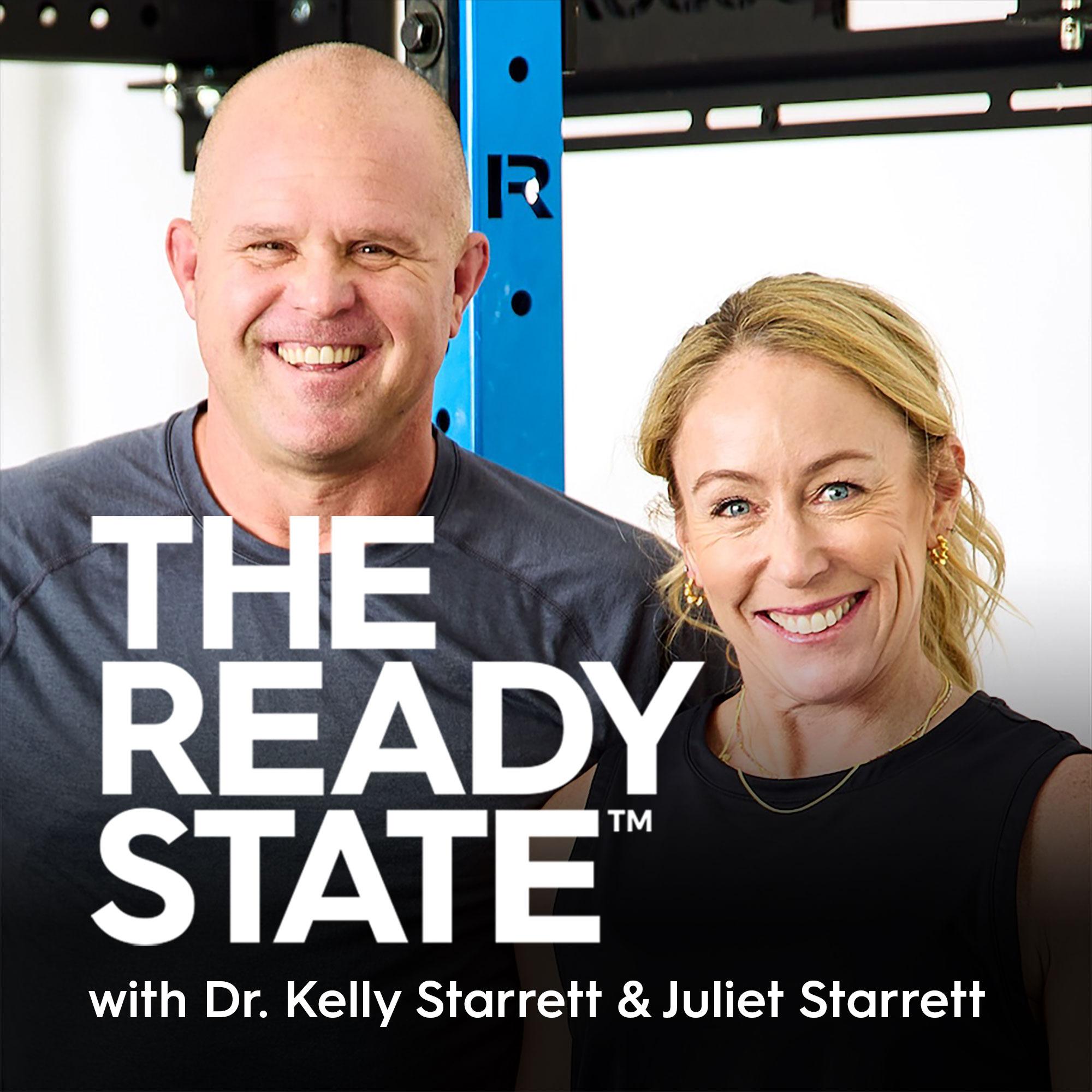
The Ready State Podcast
Kelly Starrett & Juliet StarrettAudio
- Format:
- Podcast
- New episodes:
- Weekly
- Typical length:
- about 1 hour
- Latest episode:
About this show
A podcast about health, aging, fitness, recovery, nutrition, parenting, and living well, featuring conversations with leading experts, coaches, and thought leaders. Each episode brings warmth, humor, and real-world perspective to the conversation, turning expert insight into practical tools for building a stronger, more durable life — and living in your Ready State.
Covers: health, fitness, aging, longevity, nutrition, recovery, sports medicine, parenting, youth sports
Show details and episodes come from the publisher's public feed at feeds.blubrry.com. Last updated . Names, artwork and text belong to their publishers.
Recently on this show
Summary of recent episodes, drawn from the publisher's feed.
The Ready State Podcast covers health, aging, fitness, recovery, nutrition and parenting, with conversations with experts and coaches. Recent episodes cover social isolation as a longevity risk, a pill for GLP-1 muscle loss, the 800-gram protein challenge, and RED-S and bone health for female athletes.
Cosmos
Similar in subject
- The Model Health Show
Both cover: longevity, health, fitness - The Genius Life
Both cover: longevity, health, fitness - The Extramilest Podcast
Both cover: recovery, sports medicine
Similar shows






Explore more
Episodes
RECESS: Kate Courtney's Road Cycling Takeover, Surgery Nutrition, Fueling Elite Athletes, and the Coffee Wars
· 34 min
In this episode of RECESS, Juliet and I open with a massive shoutout to local legend Kate Courtney — who, after winning mountain biking world championships, the Leadville 100 record, and a long course world title, has now casually taken over road cycling too. We also get into something that came up close to home: Juliet watched the Barceloneta men's water polo team — European Champions League winners — practice on virtually no food or water, which opened up a real conversation about how you change deeply embedded fueling habits in elite sport. Spoiler: athletes have to feel the difference themselves. Then we dig into surgery nutrition — a topic that affects way more people than elite athletes. Muscle loss after orthopedic surgery runs about 1% per day, with up to 18% loss in the quads and hamstrings within six weeks. We break down protein timing, pre-surgical carbohydrate loading, and how to protect your body going in and coming out. Plus: Kelly's ACL and "sprain plus" knee update, Haute Route hike prep, and an ongoing domestic dispute about whether Stumptown Holler Mountain is the peak of human coffee achievement or just the beginning of the search. New episodes of The Ready State Podcast drop every Thursday. What You'll Learn in This Episode- Why Kate Courtney's move from mountain biking to road cycling is one of the most remarkable athletic pivots happening in sport right now - How intra-session carbohydrate fueling is changing across elite sports, and why winning teams are often the hardest to convince to change - What the research says about muscle loss after orthopedic surgery: up to 1% per day and 18% loss in six weeks - Why protein needs jump to 1.2–2g per kilogram of bodyweight in the pre- and post-surgical window - How consuming ~50g of carbohydrates two hours before surgery may reduce post-surgical insulin resistance by 50% - Why "three limb training" matters during recovery and why you can't just wait for healing to happen - How Kelly is rehabbing a torn ACL, MCL, high-grade fibular sprain, torn calf, and two menisci, and still calling it a "sprain plus" - What the Haute Route from Chamonix to Zermatt demands physically, and how Kelly is prepping for 10 days of mountain hiking Key Highlights: (00:00) Welcome back to RECESS; Kate Courtney shoutout — local legend, mountain biking world champion, and now national road cycling champion (01:30) How Kate Courtney broke the factory racing model, started her own team, won Leadville 100 with a course record, and took the long course world championship, and most recently the US National Road Championship (04:43) The mutant athlete era: Kate, Pauline Ferrand-Prévot, Puck Pieterse, and why cyclists switching disciplines is making the sport more exciting than ever (06:00) Water polo and intra-session fueling: watching the Barceloneta European champions practice under-fueled, and a conversation with Heather Petri about how far sport nutrition has come (07:50) How you actually change fueling dogma in elite sport: showing athletes the data, letting them feel the difference, and why winning teams are hardest to convince (08:25) Intra-session carb targets across sports: from 30–50g for recreational athletes to 100g+ per hour for elite endurance, and what the Tour de France taught us about gut training (16:40) Kids and fueling: why youth athletes are chronically under-fueled and what parents can do about it (17:30) The coffee wars: Stumptown Holler Mountain vs. the challengers — Monmouth, Kimbo, Doma Roasters Chronic, and the Aeropress experiment (21:10) Haute Route prep: hiking Chamonix to Zermatt, 10 days, 8–10 hour hiking days, and how Kelly is training his "sprain plus" knee for the Alps (26:55) Kelly's injury breakdown: torn ACL, torn MCL, high-grade fibular sprain, torn calf, both menisci — and why he chose to delay ACL repair to make the trip (28:00) Surgery nutrition: the research on muscle loss post-orthopedic surgery, why protein needs spike, and the…
Not rated yetThe Science of Stress, Safety, & Nervous System Regulation | Dr. David Rabin
· 1 hr 23 min
View This Week's Show Notes (https://thereadystate.com/trs_podcast/strength-conditioning-youth-athlete-development-jack-brown/?utm_source=Podcast&utm_medium=Referral&utm_campaign=Episode195) Start Your 7-Day Trial to Mobility Coach (https://thereadystate.com/trial?utm_source=Podcast&utm_medium=Referral&utm_campaign=Episode197) Join Our Free Weekly Newsletter: The Ambush (https://thereadystate.com/the-ambush?utm_source=Podcast&utm_medium=Referral&utm_campaign=Episode197) What if the key to better sleep, recovery, focus, and lasting behavior change isn't another productivity hack – but feeling safe in your own body? In this episode, Kelly and Juliet Starrett sit down with psychiatrist, neuroscientist, and Apollo Neuroscience co-founder Dr. David Rabin to explore the hidden role the nervous system plays in stress, learning, trauma, performance, and recovery. Drawing on more than two decades of research, Dr. Rabin explains why modern life keeps us trapped in a state of chronic overstimulation – and how that affects sleep, resilience, chronic pain, emotional health, and our ability to learn. They also dive into the science of the vagus nerve, heart rate variability, fear extinction, human connection, and simple tools that help us feel safer, calmer, and more adaptable. What You'll Learn in This Episode- Why feeling physiologically safe is the foundation for learning, healing, and peak performance - How chronic stress affects sleep, recovery, immunity, and the body's ability to function - The difference between top-down thinking and bottom-up nervous system regulation - Why touch, movement, music, breathwork, and human connection are powerful tools for reducing stress - How modern technology and constant stimulation may be making us less resilient, less focused, and less connected Key Highlights:(0:00) Intro: Gen Z Cognitive Regression & Technology Warning (0:37) Meet Dr. David Rabin: Psychiatrist & Apollo Neuroscience Co-Founder (2:20) Bottom-Up vs. Top-Down Learning (4:41) The Neuroscience of Learning and Safety (7:06) Maslow's Hierarchy and Physiological Safety (12:27) The Role of Touch as Our First Language (18:47) The Vagus Nerve: Governor of Rest and Recovery (27:32) Apollo Wearable: Activating Safety in Seconds (29:07) Kelly's Sleep-Anywhere Superpower & Sleep Science (33:08) Belief, Biology, and the Dream Catcher Story (41:06) The Amygdala as a Contrast Detection Center (47:35) PTSD as a Learned Fear Disorder (56:14) What Apollo Actually Does and How It Works (1:04:26) Apollo + Oura Ring Sleep Study – 1,000+ People, 3 Years (1:12:49) Managing Overstimulation in a Tech-Driven World (1:14:53) Smartphone Addiction and Misdiagnosis of ADHD (1:16:12) Book Highlights and Education System 50 Years Outdated (1:18:19) AI Should Not Replace Human Teaching and Healing (1:20:28) Infinite Shelf: The Four Agreements by Don Miguel Ruiz (1:23:13) Closing Thoughts Huge thanks to our sponsors, LMNT (https://bit.ly/Drink-LMNT) and Momentous (https://bit.ly/Live-Momentous).
Not rated yetRECESS: GLP-3s, College ROI for Women, Fake Fitness Influencers, and the Existential Dread of Liminal Spaces
· 29 min
Welcome back to RECESS — our bi-weekly look at what we’re learning, trends we’re seeing in the health and fitness space, and how we’re building more play into real life. The fitness industry is facing its biggest shake-up yet, and it's coming from a syringe. In this episode of RECESS, we cover a lot of ground: from Caroline's high school graduation and a wild weekend of sports (Knicks championship! Water polo! World Cup!) to the questions keeping health and fitness professionals up at night. The centerpiece of this episode is a candid conversation about GLP-1, GLP-2, and the newly trialed GLP-3 drug Retatrutide — and what near-30% body weight loss results mean for the future of personal training, nutrition coaching, and the entire weight loss industry. Is weight loss about to become a purely medical intervention? And if so, what does that mean for coaches, trainers, and wellness brands like ours? We also take on a viral debate about AI-generated fitness influencers crowding out real coaches on social media, break down the data on whether women should skip college in the age of AI (spoiler: the numbers say no), and share our take on Backrooms, the buzzy horror film directed by a local kid who built the concept as a high schooler. If you've ever felt the existential dread of liminal spaces, this one's for you. What You'll Learn in This Episode- Why Caroline Starrett's observation that "muscles are the new skinny" might be the most important trend call in fitness right now - How GLP-3 drug Retatrutide achieved nearly 30% average body weight loss in Phase 3 trials, and what that means compared to Ozempic and ZepBound - What happens to the fitness industry if weight loss becomes a purely pharmaceutical intervention - The hidden dangers of GLP-1 drugs: muscle and bone mass loss, weight regain after stopping, and the return of extreme thinness culture - Why AI-generated fitness influencers are getting millions of views while real coaches struggle for reach, and what to do about it - The data behind college ROI for women: why the gender pay gap and VC funding stats make a compelling case for staying in school - Why the most successful female founders (Rent the Runway, Stitch Fix, 23andMe, Tory Burch) share one thing in common - A local director's Backrooms, worth seeing even if you hate horror Key Highlights: (00:00) Welcome back to RECESS; Caroline's high school graduation and becoming (almost) empty nesters; the "open nest" philosophy (01:50) A massive weekend of sports: Knicks championship, Stanley Cup, World Cup, water polo tournaments, and shoutouts to Cal athletes competing in European club championships (05:35) The viral Canadian coach's Instagram post: AI-generated fitness influencers vs. real coaches, the algorithm problem, and a defense of making content that's actually fun (07:45) Why real coaches deserve your engagement: the difference between AI-driven content and educators who've spent years building free resources (11:17) College ROI debate: a prominent female entrepreneur suggests skipping college; Juliet and Kelly push back with data — 65–75% higher lifetime earnings for college grads, and the gender pay gap closes with education (16:00) Female founders and elite credentials: why the women who actually break through in VC-backed startups almost universally have top-tier degrees; notable examples and one cautionary tale (18:00) Caroline's insight: "muscles are the new skinny" — when anyone can change their body composition with a GLP drug, muscle becomes the differentiator (19:29) Breaking down the GLP-3 trial results for Retatrutide: 70+ lbs average loss, nearly 30% body weight reduction, and how it compares to GLP-1 and GLP-2 drugs (20:40) How GLP drugs are splitting the fitness industry: some coaches relieved, some threatened, and the legacy weight loss brands already pivoting (22:45) The dark side: muscle and bone mass loss, Hollywood's return to extreme thinness, and what happens when people…
Not rated yetThe Future of Youth Sports: Building Stronger, Healthier, & More Durable Athletes | Jack Brown
· 1 hr 32 min
View This Week's Show Notes (https://thereadystate.com/trs_podcast/strength-conditioning-youth-athlete-development-jack-brown/?utm_source=Podcast&utm_medium=Referral&utm_campaign=Episode195) Start Your 7-Day Trial to Mobility Coach (https://thereadystate.com/trial?utm_source=Podcast&utm_medium=Referral&utm_campaign=Episode195) Join Our Free Weekly Newsletter: The Ambush (https://thereadystate.com/the-ambush?utm_source=Podcast&utm_medium=Referral&utm_campaign=Episode195) “Strength training will make swimmers slow.” “Water polo players should stop lifting before big competitions.” "Young athletes just need more time in the pool.” These ideas have shaped aquatic sports for decades… but what if they’re actually holding athletes back? In this episode of The Ready State Podcast, Kelly and Juliet Starrett sit down with strength and conditioning coach Jack Brown, founder of Aqua Strength Performance, to challenge some of the biggest myths in swimming and water polo. Drawing from his own experience as an injured athlete and years spent coaching everyone from middle school beginners to Division I athletes, Jack explains why strength training may be one of the most overlooked tools for improving performance, reducing injuries, and helping athletes stay in the sport longer. The conversation goes far beyond the weight room. Jack shares why sprinting, jumping, mobility work, sleep, nutrition, and recovery are essential pieces of athletic development—and why many youth athletes are training harder than ever while missing the fundamentals that matter most. Whether you're a swimmer, water polo player, coach, or parent of a young athlete, this episode offers a fresh perspective on what it really takes to build stronger, healthier, and more resilient competitors. What You'll Learn- Why strength training doesn't make swimmers and water polo players bulky or slow – but more resilient and powerful - Why sprinting, jumping, and strength work belong in every athlete's development plan - How strength and conditioning can reduce injury risk and improve long-term athletic durability - Why sleep and nutrition may have a bigger impact on performance than adding more training volume - What parents should look for in a quality youth strength and conditioning program Key Highlights(0:00) Common myths about strength training for aquatic athletes (0:28) Jack Brown’s Story and Finding His Path (7:20) Building Aqua Strength and identifying a gap in youth sports (10:33) Why swimming and water polo have resisted strength training (15:13) What parents should look for in a youth S&C program (22:01) The importance of sprinting and jumping for athletic development (26:26) Creating a gym culture athletes enjoy (34:08) Bone health and loading for aquatic athletes (35:18) Why strength training prepares athletes for college sports (43:34) What “strength and conditioning” actually means (52:44) Red flags in youth sports programs (56:10) Training volume, overuse, and recovery (1:01:35) Sleep, screen time, and athlete responsibility (1:06:21) Myth #1: Strength training makes swimmers slow (1:07:46) Myth #2: Athletes should stop lifting during a taper (1:16:00) Myth #3: You need a sport-specific strength coach (1:22:53) The future of aquatic athlete development (1:28:16) Infinite Shelf recommendation Huge thanks to our sponsors, Momentous (https://bit.ly/Live-Momentous) and LMNT (https://bit.ly/Drink-LMNT).
Not rated yetRECESS: Cancer Shaming, Youth Sports Nutrition, and NARP Moms
· 28 min
Welcome back to RECESS — our break from the serious stuff to talk about what we’re learning, what’s making us laugh, and how we’re building more play into real life. In this episode, we talk about everything from terrible coffee decisions and animal attack close calls to youth sports nutrition, cancer shaming in the wellness world, and the Enhanced Games. We also discuss why parents may be unintentionally under-fueling their young athletes, the growing divide between personal health optimization and public health, and a new term we can’t stop thinking about: NARP Moms. Along the way, we reflect on Caroline’s graduation week, the challenges of raising healthy athletes, the strange culture surrounding performance enhancement in sports, and why compassion—not blame—should guide conversations about health and disease. What You'll Learn in This Episode- Why Kelly’s coffee experiments nearly caused a household revolt - Our take on the Enhanced Games and what they say about the future of sport - Why “cancer shaming” is becoming a troubling trend in wellness culture - What Juliet learned from being diagnosed with cancer at 19—and again later in life - The difference between personal health optimization and public health - Why many young athletes are dramatically under-fueled - How “NARP Moms” might be affecting their kid's sports performance - Why carbs are still king for growing athletes - What fewer kids reading books could mean for the next generation - Reflections on parenting through graduation season Key Highlights: (00:00) — Welcome back to RECESS (00:30) — Juliet’s latest near-animal attack and Kelly’s divorce-worthy coffee experiments (02:52) — Caroline’s signing day and graduation season reflections (05:04) — The Enhanced Games: spectacle, performance, and the future of sport (11:39) — Follow-up on nicotine pouches and European bans (14:12) — Zach Coen and cancer shaming in the wellness community (16:20) — Juliet’s experience as a two-time cancer survivor (18:18) — Brad Ludden and First Descents (18:55) — Why blaming people for cancer is dangerous and misguided (20:28) — Introducing the “NARP Mom”, Shannon Mendez (22:08) — Why youth athletes need dramatically more calories than adults (24:45) — Carbs, under-fueling, and sports performance (25:45) — Soman Chainani's new book, Young World — and how the data shows that fewer kids are reading books (27:33) — Graduation week and sending another kid off to college
Not rated yetHow Breathing Shapes Sleep, Stress, Performance, & Longevity | Patrick McKeown
· 1 hr 56 min
View This Week's Show Notes (https://thereadystate.com/trs_podcast/nasal-breathing-sleep-performance-patrick-mckeown/?utm_source=Podcast&utm_medium=Referral&utm_campaign=Episode193) Start Your 7-Day Trial to Mobility Coach (https://thereadystate.com/trial?utm_source=Podcast&utm_medium=Referral&utm_campaign=Episode193) Join Our Free Weekly Newsletter: The Ambush (https://thereadystate.com/the-ambush?utm_source=Podcast&utm_medium=Referral&utm_campaign=Episode193) In this episode of The Ready State Podcast, breathing expert Patrick McKeown joins Kelly and Juliet Starrett for a mind-expanding conversation about something you do 20,000 times a day but probably haven’t thought deeply about: your breath. From asthma and anxiety to sleep quality, athletic performance, focus, and recovery, Patrick explains why the way you breathe may be quietly shaping nearly every aspect of your health. The conversation dives into the surprising science of CO2 tolerance, why most people are chronically over-breathing, and how simple shifts – like nasal breathing, breath holds, and slowing your exhales – can dramatically change your nervous system and performance. Patrick also breaks down why women experience breathing and sleep differently than men, how poor breathing affects kids’ development and behavior, and why many sleep disorders may be going undiagnosed. Most importantly, this episode is packed with practical tools you can start using immediately – whether you’re trying to sleep better, feel calmer, improve endurance, or simply function better under stress. What You'll Learn in This Episode- Why most people are chronically over-breathing and how it impacts stress, sleep, and performance - How nasal breathing and CO2 tolerance can improve endurance, recovery, and focus - The surprising connection between breathing patterns, anxiety, panic attacks, and nervous system regulation - Why women experience sleep-disordered breathing differently than men, especially during menopause - How mouth breathing in children may affect sleep, behavior, facial development, and long-term health Key Highlights: (0:00) Intro: Men vs. Women in Breathing & Sleep (0:22) Patrick McKeown: Breathing Expert & Founder of Oxygen Advantage (2:46) Kelly's History with Asthma & Breathing (10:39) Exercise-Induced Asthma & Hyperventilation (15:32) The BOLT Score Explained (17:00) The Science of CO2 & Oxygen Delivery (23:59) Kipchoge’s Closed-Mouth Marathon (28:01) Women’s Breathing, Hormones & Sleep (32:21) Why Women Get Misdiagnosed in Sleep Studies (34:46) The Hidden Sleep Disorder Affecting Women (38:07) Breathing Practices for Brain Health (44:31) Dysfunctional Breathing & Mental Health (46:05) Panic Attacks, CO2 & the Paper Bag (1:04:38) Falling Asleep Faster with Breathwork (1:12:54) Breathing Warmups for Athletes (1:20:51) Mouth Breathing & Facial Development (1:33:43) Children, Sleep & ADHD (1:44:55) Breath Holds, Altitude & Hematocrit (1:54:09) Infinite Shelf & Glymphatic Breathing Huge thanks to our sponsors, LMNT (https://bit.ly/Drink-LMNT) and Momentous (https://bit.ly/Live-Momentous).
Not rated yetRECESS: Juliet & Kelly Starrett on Social Connection, School Recess Guidelines, Rachel Entrekin’s Self-Talk, and Prom Maxxing
· 30 min
Welcome back to RECESS — our weekly break from the serious stuff to talk about what we’re learning, what’s making us laugh, and how we’re building more play into real life. In this episode, we unpack why social connection may be the single biggest predictor of healthy aging and longevity, reflect on new pediatric guidelines pushing for more school recess, and talk about how adults desperately need more play too. We also dive into Rachel Entrekin’s mindset during her historic Cocodona 250 win, Kelly’s emotional experience eulogizing his mom, and the rise of “prom maxxing” — and why it gives us the ick. What You'll Learn in This Episode- Why social connection may matter more than anything else for longevity - How play and movement create stronger communities and healthier adults - Why the American Academy of Pediatrics says recess is not optional - Rachel Entrekin’s powerful self-talk strategy during her record-setting ultramarathon - What Kate Courtney’s career shift teaches about identity and reinvention - Why “third places” like gyms, clubs, and community spaces matter so much - Juliet and Kelly’s thoughts on “prom maxxing” and modern parenting culture - What Kelly learned from giving the eulogy at his mother’s memorial Key Highlights: (00:00) — Welcome back to RECESS (00:40) — Kelly reflects on eulogizing his mom (02:52) — Travel, burnout, and speaking at a longevity conference (04:06) — Why adults need more play and movement (05:43) — The Harvard Longitudinal Study (https://news.harvard.edu/gazette/story/2017/04/over-nearly-80-years-harvard-study-has-been-showing-how-to-live-a-healthy-and-happy-life/) and the importance of social connection (06:18) — The “Six Points of Connection (https://www.chamberofconnection.org/6pointsofconnection)” and building real community (10:15) — Kate Courtney, identity shifts, and elite performance (12:33) — New school recess guidelines (https://apnews.com/article/recess-american-academy-pediatrics-kids-schools-0dd47c0392edb58f6c6086d72433560e) from the American Academy of Pediatrics (15:23) — Why adults need recess too (17:23) — Rachel Entrekin’s (https://www.instagram.com/reels/DYCMjl_oUrs/) self-talk during her historic Cocodona 250 win (21:01) — “Happy to be here” vs. competing to win; Tia Toomey's (https://thereadystate.com/trs_podcast/tia-toomey-champion-mindset/) Champion's Mindset (24:00) — Prom maxxing, parenting culture, and losing the plot (29:02) — What we’re living for right now
Not rated yetDr. Jeffrey Bland, Father of Functional Medicine, on Inflammation and Longevity
· 1 hr 13 min
View This Week's Show Notes (https://thereadystate.com/trs_podcast/jeffrey-bland-functional-medicine/?utm_source=Podcast&utm_medium=Referral&utm_campaign=Episode191) Start Your 7-Day Trial to Mobility Coach (https://thereadystate.com/trial?utm_source=Podcast&utm_medium=Referral&utm_campaign=Episode191) Join Our Free Weekly Newsletter: The Ambush (https://thereadystate.com/the-ambush?utm_source=Podcast&utm_medium=Referral&utm_campaign=Episode191) What if the biggest thing holding your health back isn’t what you’re doing, but how you’re thinking about it? Most of us have been trained to see the body in silos: diagnose the problem, treat the symptom, move on. But what if that model is missing the bigger picture? In this episode of The Ready State Podcast, Dr. Jeffrey Bland – widely recognized as the father of functional medicine – joins Juliet and Kelly Starrett to unpack a more complete, systems-based approach to health. From a simple (and surprisingly accessible) blood test that can reveal your inflammatory status, to the real role of inflammation as both a healing response and a hidden driver of chronic disease, this conversation challenges everything you thought you knew about “being healthy.” Dr. Bland also shares the deeply personal story that reshaped his entire career and led him to question conventional medicine’s focus on downstream symptoms instead of root causes. You’ll walk away understanding why everyday choices – like sugar intake, sleep, stress, and even your sense of self-agency – play a far bigger role in longevity than most people realize. Because at the end of the day, health is something you actively create. What You'll Learn in This Episode- Why chronic inflammation is both a healing response and a hidden driver of disease - How a standard blood test (CBC) can reveal your body’s inflammatory state - The difference between treating symptoms vs. addressing root causes (upstream vs. downstream health) - Why your body is a system – and not a set of isolated problems to fix - How everyday habits like sugar intake, stress, and sleep quietly accelerate aging Key Highlights: (0:00) Intro & Teaser Clips (0:35) Introducing Dr. Jeffrey Bland, Father of Functional Medicine (3:11) Dr. Bland Joins the Show / Earth Day Connection (3:50) How Dr. Bland's Career Began in 1970 (7:33) What's Most Urgent for People to Understand About Health Today (9:13) Systems Thinking vs. Siloed Medicine (12:43) A Seismic Life Event That Changed Everything (15:19) Finding Purpose After Tragedy — The Birth of a Mission (17:35) Origins of the Term "Functional Medicine" (19:03) Functional Medicine in The Lancet — 1874 (31:15) Understanding Good vs. Chronic Inflammation (38:30) The Ibuprofen Epidemic in Youth Athletes (39:59) The Functional Medicine Model: Antecedents, Triggers & Mediators (42:47) Big Bold Health & Testing for Inflammaging (43:33) The CBC with Differential — A $6 Test Everyone Already Has (45:08) The SIRI Index — Calculating Your Inflammatory Status (46:25) Immune Cells Renew Every 90–120 Days (56:03) The 850-Person Clinical Trial on Food & Immune Health (56:56) Tartary Buckwheat — A 3,500-Year-Old Immune Superfood (1:02:57) The Healthcare System Isn't Working — A Seismic Change Is Coming (1:08:13) Rapid Fire: Blue Zones & Eating a Rainbow of Polyphenols (1:09:47) The #1 Lever for Aging Well — Starting With How You See Yourself (1:10:56) Where to Find Dr. Jeff Bland & Closing Thoughts Huge thanks to our sponsors, Kreatures of Habit (https://bit.ly/TRS-KOH), LMNT (https://bit.ly/Drink-LMNT), and Momentous (https://bit.ly/Live-Momentous).
Not rated yetRECESS: Juliet & Kelly Starrett on NCAAs, Healthy Aging, Dean Potter, and the Meowfia
· 33 min
Welcome to the first episode of RECESS, a new, more personal series from us, Juliet and Kelly Starrett. In these shorter, looser conversations, we’re pulling back the curtain on what’s going on in our lives, what we’re learning, what’s making us laugh, and what we’re thinking about across health, movement, longevity, performance, parenting, and everything in between. In this episode, we talk about Kelly’s experience coaching Cal Women’s Water Polo at the NCAA championship and what it’s like to compete at that level. We unpack the “bronze medal mindset” and some of the biggest lessons we’ve learned from elite sport. We also dive into the Dean Potter documentary and reflect on our own experiences in 90s extreme sports culture. Plus, we share why we’re concerned about nicotine being normalized in wellness and what stood out to us at the Stanford Healthy Aging Conference. And of course, we get into some lighter moments—including Kelly’s definitely-not-a-cat-group: the Meowfia. What You'll Learn in This Episode- Why we’re still debating whether Kelly is in a cat group - What Kelly learned from coaching at the NCAA championship - How we think about loss, silver medals, and the bronze medal mindset - Why the Dean Potter documentary hit close to home for us - Why we’re concerned about nicotine products in wellness culture - What stood out to us at the Stanford Healthy Aging Conference - How we’re processing our youngest daughter’s senior-year milestones Key Highlights: 00:00 — Why we’re starting RECESS 01:17 — The Meowfia, taco cat, and the funny-off 03:15 — Bringing fun back into health and longevity 03:58 — Kelly’s reflections from the NCAA women’s water polo championship 09:03 — Losing gold, winning silver, and the bronze medal mindset 13:51 — Red Vines, fat-free diets, and 90s athlete nutrition 17:24 — Dean Potter, Dark Wizard, and extreme sports culture 22:45 — Nicotine pouches, health washing, and wellness influence 27:34 — Our biggest takeaways from Stanford Healthy Aging 29:02 — Strength training, creatine, isometrics, and old cat syndrome 32:28 — Parenting, graduation, and figuring out how to cook for two
Not rated yetHow Constraints Boost Creativity, Focus & Performance | David Epstein
· 1 hr 24 min
View This Week's Show Notes (https://thereadystate.com/trs_podcast/david-epstein-contraints-boost-creativity/?utm_source=Podcast&utm_medium=Referral&utm_campaign=Episode189) Start Your 7-Day Trial to Mobility Coach (https://thereadystate.com/trial?utm_source=Podcast&utm_medium=Referral&utm_campaign=Episode189) Join Our Free Weekly Newsletter: The Ambush (https://thereadystate.com/the-ambush?utm_source=Podcast&utm_medium=Referral&utm_campaign=Episode189) In this episode, David Epstein explores a powerful idea: constraints don’t limit us – they make us better. Drawing from his book Inside the Box, he explains why too much freedom often leads to overwhelm, indecision, and worse outcomes. Whether it’s creativity, productivity, or everyday decisions, we perform better when we narrow the field and work within clear boundaries. Through stories – from failed tech startups with too many ideas to elite performers who thrive under restrictions – he shows how constraints help us prioritize, think differently, and follow through. Even creativity, he argues, doesn’t come from endless freedom, but from being boxed in just enough to spark better solutions. If you’ve ever felt stuck, scattered, or overloaded with choices, this episode offers a simple reframe: you don’t need more options – just better constraints. What You'll Learn in This Episode- How constraints improve creativity, focus, and performance - Why too much choice leads to overwhelm and worse decisions - Why creativity thrives with fewer options - How distractions are training your brain to lose focus - Why doing less often leads to better results Key Highlights: (0:00) Intro – Constraints, Overwhelm, and Why This Matters (3:37) Meet David Epstein (6:19) From Range to Constraints (8:18) The Dizziness of Freedom (12:05) The Creativity Myth (14:04) The Green Eggs and Ham Effect (16:32) Constraints-Led Approach Skill Learning (19:38) Futsal & Constraints in Sport (21:16) The General Magic Story (32:53) HARKing in Science (51:51) Think Slow, Act Fast (55:57) Creativity vs. Originality (1:00:26) Constraints in Parenting (1:10:19) Commitment Devices (1:16:06) Make Your Commitments Visible (1:16:52) Reclaiming Your Attention (1:21:49) Book Recommendation & Closing Huge thanks to our sponsors, LMNT (https://bit.ly/Drink-LMNT), Momentous (https://bit.ly/Live-Momentous), Vitality (https://bit.ly/TRS-Vitality), and Kreatures of Habit (https://bit.ly/TRS-KOH)
Not rated yetHow to Stay Sharp, Creative, and Focused in the Age of AI with Steven Kotler
· 1 hr 18 min
View This Week's Show Notes (https://thereadystate.com/trs_podcast/steven-kotler-ai-flow-state/?utm_source=Podcast&utm_medium=Referral&utm_campaign=Episode188) Start Your 7-Day Trial to Mobility Coach (https://thereadystate.com/trial?utm_source=Podcast&utm_medium=Referral&utm_campaign=Episode188) Join Our Free Weekly Newsletter: The Ambush (https://thereadystate.com/the-ambush?utm_source=Podcast&utm_medium=Referral&utm_campaign=Episode188) What happens when human biology collides with exponential technology? In this wide-ranging and deeply relevant conversation, Steven Kotler – NYT best-selling author and founder of the Flow Research Collective – joins The Ready State to unpack how AI, information overload, and rapid technological change are reshaping the way we think, work, and live. Steven breaks down the growing mismatch between our ancient brains and today’s hyper-accelerated world – and why it’s leading to burnout, fractured attention, and loss of meaning. But this isn’t a doom-and-gloom conversation. Instead, he offers a powerful reframe: the future belongs to those who can harness flow, think creatively, and collaborate at scale. From practical strategies for using AI without losing your cognitive edge… to why attention is your most valuable currency… to how group flow may be the key to solving humanity’s biggest challenges, this episode is both a wake-up call and a roadmap. If you’ve ever felt overwhelmed, distracted, or unsure how to keep up in today’s world, this conversation will change how you think about performance, purpose, and possibility. What You'll Learn in This Episode- Why our brains are overwhelmed – and the hidden chain reaction leading to burnout and identity collapse - How AI can either enhance your thinking… or quietly erode your cognitive abilities - The role of flow state in boosting creativity, productivity, and long-term resilience - Why attention is the real battleground of the modern world – and how to train it - How “group flow” and cooperation at scale may be the key to thriving in the future Key Highlights: (00:00) Intro & Teaser: The AI Attention Warning (02:56) Meet Steven Kotler & We Are As Gods (04:18) The World Is 286% Faster Than in 2012 (05:29) Global vs. Linear: How Our Brains Fell Behind (11:59) Understanding Cognitive Load & Information Overload (14:17) Exponential Leadership Syndrome Explained (14:53) The Chain: Overload, Burnout, & Identity Collapse (17:36) When Is AI Helping vs. Making Us Weaker? (18:49) The Brain Predicts the Future to Save Calories (23:54) Cognitive Offloading: The Real AI Problem (26:00) Rule #1: Always Do Your Thinking First (28:37) Interoception as the Antidote to AI Overuse (38:35) What Is Flow State? The Full Breakdown (39:07) Flow Makes You 500% More Productive (40:48) Why AI Can't Do Lateral Thinking (But Humans Can) (43:57) The Key To Maximum Creativity (46:05) You Need Better Personal Filters – Here's Why (51:48) The Human Attention Span Is Now 3 Seconds (52:35) Match Your Screen Time with Meditation Time (57:51) Challenge & Friction Are Features, Not Bugs (58:40) The Challenge-Skills Balance and Flow Triggers (1:02:24) Rethinking Work: Creation vs. Survival (1:08:39) The Killer App of the 21st Century: Cooperate at Scale (1:13:02) Master Group Flow to Thrive in the AI Age (1:15:23) Infinite Shelf & Where to Find Steven Kotler Huge thanks to our sponsors, LMNT (https://bit.ly/Drink-LMNT), Momentous (https://bit.ly/Live-Momentous), Vitality (https://bit.ly/TRS-Vitality), and Kreatures of Habit (https://bit.ly/TRS-KOH)
Not rated yetCesalina Gracie on Self-Belief, Women’s Safety, and Staying Calm Under Pressure
· 1 hr 46 min
View This Week's Show Notes (https://thereadystate.com/trs_podcast/womens-safety-cesalina-gracie/?utm_source=Podcast&utm_medium=Referral&utm_campaign=Episode187) Start Your 7-Day Trial to Mobility Coach (https://thereadystate.com/trial?utm_source=Podcast&utm_medium=Referral&utm_campaign=Episode187) Join Our Free Weekly Newsletter: The Ambush (https://thereadystate.com/the-ambush?utm_source=Podcast&utm_medium=Referral&utm_campaign=Episode187) Imagine standing near the summit of Mount Everest during its deadliest season while battling the internal voice that tells you to turn back. Cesalina Gracie joins Kelly and Juliet Starrett for a powerful conversation about resilience, self-belief, and staying calm under pressure. Drawing on lessons from Brazilian Jiu Jitsu, Everest, and her work in women’s safety, Cesalina offers a grounded perspective on mindset, preparation, and performing when it matters most. In this deep dive, Cesalina shares her unique upbringing in the legendary Gracie family and how she translated those martial arts lessons into a successful summit of the world's highest peak. You will learn about the psychological traps of self-sabotage and how to reframe your internal dialogue to build unwavering self-belief. Cesalina explains why the mind-body connection is the most powerful tool you possess for navigating both the mats and the mountains. The conversation also covers vital practical skills from Cesalina's Modern Woman Safety System. From navigating Ubers and elevators to setting firm boundaries in social settings, this episode is packed with actionable advice for women to move through the world with more confidence and awareness. Whether you are an athlete, a parent, or someone looking to sharpen your mental edge, Cesalina's insights on faith and preparation offer a roadmap for personal growth. What You'll Learn in This Episode- Why self-belief is built before the moment that tests you - The dangerous pattern of self-sabotage — especially in high-achieving women - How jiu-jitsu teaches you to stay calm under pressure and find solutions - What surviving Everest reveals about fear, decision-making, and mental strength - Why asking “What else is possible?” can change everything - The reality of violence against women — and why awareness matters - Simple, actionable strategies to reduce vulnerability in everyday situations - How posture, voice, and presence impact how others perceive you - Why freezing is the default — and training creates options - The connection between physical practice, emotional resilience, and confidence Key Highlights: (0:00) Welcome to the Ready State Podcast (3:15) Healing through women empowerment workshops (8:40) Identifying and stopping self sabotage (13:50) Growing up in the Gracie family dynasty (19:15) The true mission of Brazilian Jiu Jitsu (24:40) Why physical connection and play matter (30:10) Using leverage and strategy in life (36:55) The transition from the mats to the mountains (43:20) Training for Everest in seven weeks (49:45) Mental toughness under extreme stress (55:30) Crossing the Khumbu Icefall ladders (1:01:10) Survival mindset and the death zone (1:07:45) A lesson in self sabotage at 8000 meters (1:14:20) The importance of betting on yourself (1:21:05) Why we need specific training for women's safety (1:28:40) Practical safety tips for Ubers and hotels (1:35:15) How to tell if someone has bad intentions (1:43:37) Closing thoughts and final advice Connect with CesalinaWebsite (https://cesalina.com/) | Instagram (https://www.instagram.com/cesagracie/) | YouTube (https://www.youtube.com/@cesalinagracie) | TikTok (https://www.tiktok.com/@cesagracie) Take Cesalina's brand new course the Modern Woman Safety System (https://safety.cesalina.com/)! In this women's safety course, you’ll learn awareness, posture, voice, controlling your environment, and self-defense techniques that work for all women no matter your experience, size, or…
Not rated yetBiocentric Lighting for Better Sleep, Recovery, and Performance with Kyle Harris of BrainLit
· 1 hr 5 min
View This Week's Show Notes (https://thereadystate.com/trs_podcast/biocentric-lighting-for-performance-kyle-harris/?utm_source=Podcast&utm_medium=Referral&utm_campaign=Episode186) Start Your 7-Day Trial to Mobility Coach (https://thereadystate.com/trial?utm_source=Podcast&utm_medium=Referral&utm_campaign=Episode186) Join Our Free Weekly Newsletter: The Ambush (https://thereadystate.com/the-ambush?utm_source=Podcast&utm_medium=Referral&utm_campaign=Episode186) Are you getting the right light signals to perform at your peak? Most of us spend nearly 90 percent of our time indoors, missing the critical biological triggers our bodies need for sleep, recovery, and focus. In this episode of the Ready State Podcast, we dive deep into the world of biocentric lighting and how you can optimize your environment to match your natural circadian rhythm. Kyle Harris, CEO of BrainLit, joins Kelly and Juliet Starrett to explain why light should be viewed as a biological signal rather than just a way to see. We explore the massive impact that light spectrum and modulation have on our health, from professional athletes in the NBA and NHL to surgeons and shift workers in hospitals. Learn how passive changes to your environment can act as a force multiplier for your health, helping you sleep better and recover faster without adding another task to your busy to do list. What You'll Learn in This Episode- Why light is a biological signal, not just something that helps you see - How modern indoor life disrupts circadian rhythms and melatonin production - The surprising statistic about how little time people spend outdoors - Why lighting design is becoming a pillar of performance in professional sports - How hospitals are using circadian lighting to improve patient recovery - Why shift workers struggle with health — and how lighting can help - The difference between light for sight vs. light for physiology - Simple ways to improve your lighting environment at home - Why bright mornings and dim evenings matter more than you think - How lighting may influence focus, reaction time, and sleep readiness Key Highlights:0:00 Intro to Biocentric Lighting and Sleep 3:45 Meet Kyle Harris of BrainLit 7:15 Light as a Biological Signal vs Visual Aid 11:30 Light as a Pillar of Health and Recovery 16:00 The Modern Indoor Environment Problem 20:15 Understanding Different Light Sources 24:30 Lighting in Hospitals and Surgery Centers 28:45 Feedback from Professional Sports Teams 33:15 Impact on Coaches and Staff Performance 37:00 The Red Light Experiment at Home 41:30 Light Volume vs Light Spectrum 45:45 Measuring Light for Health Outcomes 50:00 Creating an Ideal Light Day for Humans 54:15 Simple Home Lighting Hacks 58:30 Jet Lag Mitigation and Future Tech 1:02:00 Infinite Shelf and Closing Thoughts Connect with KyleWebsite (http://www.brainlit.com) | Instagram (https://www.instagram.com/tkharris1/) | YouTube (http://www.youtube.com/@brainlit1410) Huge thanks to our sponsors, Vitality (https://bit.ly/TRS-Vitality), LMNT (https://bit.ly/Drink-LMNT), and Momentous (https://bit.ly/Live-Momentous)
Not rated yetThe #1 Predictor of Dementia (Not Genetics) — How to Stimulate Your Mind & Prevent Alzheimer’s with Dr. Tommy Wood
· 1 hr 18 min
View This Week's Show Notes (https://thereadystate.com/trs_podcast/dementia-prevention-with-dr-tommy-wood/?utm_source=Podcast&utm_medium=Referral&utm_campaign=Episode185) Start Your 7-Day Trial to Mobility Coach (https://thereadystate.com/trial?utm_source=Podcast&utm_medium=Referral&utm_campaign=Episode185) Join Our Free Weekly Newsletter: The Ambush (https://thereadystate.com/the-ambush?utm_source=Podcast&utm_medium=Referral&utm_campaign=Episode185) What if the biggest predictor of dementia isn’t your genes — but your metabolic health? In this episode, neuroscientist and performance coach Dr. Tommy Wood reveals why blood sugar regulation and blood pressure are more powerful predictors of Alzheimer’s disease and cognitive decline than amyloid plaques or even genetics like ApoE4. For decades, Alzheimer’s has been framed as either a genetic lottery or the inevitable buildup of amyloid in the brain. But emerging research shows that metabolic dysfunction, insulin resistance, and vascular health may play a far greater role in determining long-term brain outcomes. Instead of focusing on fear, this conversation delivers a practical blueprint for building cognitive reserve and “cognitive headroom” — the brain’s ability to stay resilient, adaptable, and high-performing as you age. You’ll learn why crossword puzzles aren’t enough, how high-intensity exercise and resistance training stimulate brain-derived neurotrophic factors (BDNF), why lactate may act like “Miracle-Gro” for your neurons, and how to interpret early warning signs like subjective brain fog. What You'll Learn in This Episode- Why Alzheimer’s isn’t just about amyloid plaques - The powerful link between blood sugar and cognitive decline - How genetics (like ApoE4) increase risk — but don’t seal your fate - What “cognitive headroom” means and how to build it - Why high-intensity exercise may act as Miracle-Gro for the brain - The surprising role of resistance training in brain health - What subjective brain fog might be telling you - How menopause affects cognition — and what’s reversible - Why boredom and focus matter more than we think - The kinds of skills you should keep practicing as you age For women navigating perimenopause and menopause, Dr. Wood explains what cognitive changes are hormonally driven, what’s reversible, and how to protect long-term brain health. Whether your goal is preventing Alzheimer’s disease, improving focus and processing speed, or becoming a cognitive “superager,” this episode provides evidence-based strategies to help you build a brain that is robust, metabolically healthy, and built to last. Key Highlights: (00:00) – Brain Health & Cognitive Longevity Intro (00:35) – Brain Evolution & Survival Mechanisms (02:53) – Diabetes & Alzheimer’s Disease Link (07:31) – Genetic Risk & Dementia Family History (11:32) – Expanding Brain Capacity & Headroom (15:08) – Cognitive Reserve & Brain Resilience (19:55) – Preventing Age-Related Cognitive Decline (23:00) – Exercise Data for Brain Health (26:16) – Best Exercises for Cognitive Function (35:11) – Amyloid Plaques & Alzheimer’s Pathology (38:00) – Amyloid-Targeting Drugs & Treatments (40:31) – Subjective Cognitive Decline Measures (45:04) – Testing & Measuring Brain Performance (49:58) – Menopause & Female Brain Health (56:10) – Aging Brain, Wisdom & Intelligence (1:05:00) – Cognitive Processing Speed & Aging (1:07:07) – Benefits of Boredom for the Brain (1:12:17) – Book Recommendations for Mental Growth Connect with Dr. Tommy WoodWebsite (https://www.drtommywood.com/) | Substack (https://betterbrain.fitness/) | Instagram (https://www.instagram.com/drtommywood/) Pre-Order The Stimulated Mind (http://thestimulatedmind.com) for tons of extra perks! Huge thanks to our sponsors, Momentous (https://hubs.li/Q040Q5s30), Vitality (https://hubs.li/Q040Q59_0), and LMNT (https://hubs.li/Q040Q5sq0).
Not rated yetEvidence-Based Wellness Without the “Protocol Life” — Practical Longevity & What to Track with Dr. Rachele Pojednic
· 1 hr 17 min
View This Week's Show Notes (https://thereadystate.com/trs_podcast/evidence-based-wellness-with-dr-rachele-pojednic/?utm_source=Podcast&utm_medium=Referral&utm_campaign=Episode184) Start Your 7-Day Trial to Mobility Coach (https://thereadystate.com/trial?utm_source=Podcast&utm_medium=Referral&utm_campaign=Episode184) Join Our Free Weekly Newsletter: The Ambush (https://thereadystate.com/the-ambush?utm_source=Podcast&utm_medium=Referral&utm_campaign=Episode184) In a world obsessed with “optimal” routines, Dr. Rachel Pojednic cuts through the noise with a grounded, evidence-based approach to longevity and performance. This conversation is a reset for anyone overwhelmed by conflicting health advice, anxious about wearable scores, or stuck chasing perfect protocols that collapse under real life stress. You’ll learn what the science actually supports, what’s still uncertain, and how to build a simple, sustainable health strategy using the biggest levers first—movement, nutrition, sleep, stress, and relationships—before you bother with the “fun stuff.” Dr. Pojednic also shares what she’s learned studying wellness therapies in industry and academia, why most people misunderstand Zone 2, and what to track if you want a clearer picture of your health over time. What You'll Learn in This Episode- Why “protocol life” is making people more confused (and often less healthy) - The difference between big levers (high impact) and little levers (fine-tuning) for longevity - What to track that’s actually useful: A1C trends, fasting glucose, lipids, resting heart rate - Why wearable metrics can conflict—and how that can create anxiety and false certainty - A clearer, non-hype explanation of HRV and why “low” isn’t always “bad” - What Zone 2 is really for (and why it isn’t a magical mitochondrial hack) - How to think about supplement safety, including third-party testing and the “lead in protein powder” scare - A simple 7–30 day “one change” experiment to build habits that survive real life If you’ve ever felt like you’re “failing” health because you can’t follow a perfect routine—or you’ve been pulled in six directions by influencers, devices, and contradictory advice—this episode gives you something rare: a sane framework. You’ll walk away with fewer rules, better priorities, and a practical way to measure progress that doesn’t depend on hype, fear, or the latest trend. Chapters(00:00) - Intro (01:39) - The Problem with Protocols (05:29) - Rachele’s Backstory and Research Journey (13:06) - Rachele’s Research Focus (18:45) - Sponsor: Vitality Blueprint (20:40) - Science Communication and Social Media (23:24) - Getting Started in Science Communication (25:10) - Bridging Research and Real-World Applications (29:35) - New Lane for Performance Therapy (31:05) - Key Metrics to Track (32:07) - Importance of Observable, Measurable Data (34:34) - Need for Common Diagnostic Suite (40:19) - Current State of Healthcare and EHRs (42:32) - Momentous: Protein Powder Insights (44:44) - Subscribe to This Podcast (46:30) - Basics We Can All Agree On (47:10) - Regular Tracking Essentials (53:10) - Heart Rate Variability (HRV) (54:42) - Wearables and Big Games (57:06) - Desire to Train (59:28) - Big Opportunity and Challenges (1:00:30) - Rapid Fire: Zone 2 (1:03:02) - LMNT: Try a Personal Experiment (1:06:58) - Your Micro-Experiment (1:10:34) - Rachele’s “Infinite Shelf” Recommendation (1:14:55) - Join The Starrett System Website (https://www.rachelepojednic.com/)| Instagram (https://www.instagram.com/rachelepojednic) | Facebook (https://www.facebook.com/StrongProcess/) | YouTube (https://www.youtube.com/@RachelePojednic_PhD) Check our Dr. Rachele's courses at Strong Process (https://strongprocess.com/) Huge thanks to our sponsors, Vitality (https://hubs.li/Q040CvxY0), Momentous (https://hubs.li/Q040CvM90), and LMNT (https://hubs.li/Q040CvzK0).
Not rated yetMetabolism Myths and the Science That Challenges Popular Nutrition Beliefs — with Dr. Kevin Hall
· 1 hr 24 min
View This Week's Show Notes (https://thereadystate.com/trs_podcast/dr-kevin-hall-metabolism-myths-and-science/?utm_source=Podcast&utm_medium=Referral&utm_campaign=Episode183) Start Your 7-Day Trial to Mobility Coach (https://thereadystate.com/trial?utm_source=Podcast&utm_medium=Referral&utm_campaign=Episode183) Join Our Free Weekly Newsletter: The Ambush (https://thereadystate.com/the-ambush?utm_source=Podcast&utm_medium=Referral&utm_campaign=Episode183) In this episode of The Ready State Podcast, we’re joined by Dr. Kevin Hall—one of the world’s leading metabolism researchers and a longtime NIH scientist—for a wide-ranging conversation on what the research actually says about weight loss, energy balance, and the modern food environment. Dr. Hall explains what we’ve learned from real-world and tightly controlled studies, including his work following The Biggest Loser contestants, and why exercise doesn’t fully prevent the metabolic adaptations that can accompany major weight loss. We also unpack why “calories in, calories out” is both true in principle and often misunderstood in practice, how ultra-processed foods can drive overeating, and what GLP-1 medications may be changing in appetite biology. The episode also touches on Dr. Hall’s departure from a 21-year career at the NIH, following the censorship of his team's findings on ultra-processed foods when they didn’t align with preferred narratives—an experience he describes as chilling for scientific communication. Finally, we explore the practical challenges of doing high-quality nutrition research, why confident opinions can outpace the data, and what it will take to better understand—and ultimately prevent—diet-related chronic disease. What You'll Learn in This Episode- Why metabolism isn’t “broken” — and why larger bodies burn more calories at rest - What the Biggest Loser study actually revealed about weight loss and regain - Why exercise doesn’t “save” your metabolism during extreme dieting - How ultraprocessed foods change how much people eat — without acting like addictive drugs - Why calories in vs. calories is often misunderstood in practice - How genetics and environment interact to shape body weight - What GLP-1 drugs are really doing — and what they don’t fix - Why nutrition science is underfunded, politicized, and desperately needed Chapters(00:00) - Kevin Hall, PhD, Metabolism Researcher (01:01) - Dr. Hall on the Ready State Podcast (04:10) - Misconceptions About Metabolism (04:54) - The Biggest Loser Study & Metabolism Influence (13:09) - Challenges in Nutrition Research (19:10) - Metabolism's Role in Weight Loss (22:13) - Vitality Blueprint: Importance of Blood Work (25:45) - Calories In, Calories Out: Simplistic View? (30:45) - Understanding GLP-1 Agonists (32:20) - The Food Environment's Impact (36:05) - Ultra-Processed Foods and Caloric Intake (38:02) - The Complexity of Obesity (41:40) - Solutions for Our Food System (48:23) - Causes of Brain Fog (49:34) - Element: Nutritional Insights (51:39) - RFK Jr. Discussion (01:01:40) - Politics' Influence on Science (01:04:35) - Leaders in Nutrition Science (01:06:48) - Can Weight Loss Be Achieved? (01:08:10) - Universal Diets: Myth or Reality? (01:12:35) - Why Doritos Lead to Overeating (01:13:21) - Understanding Visceral Fat (01:14:04) - Momentous: Nutritional Products (01:20:25) - Book/TV Show/Music Recommendations (01:21:11) - Connecting with Dr. Hall (01:21:52) - Outro Connect with KevinWebsite (https://www.kevinhallphd.com/) | Bluesky (https://bsky.app/profile/kevinh-phd.bsky.social) | X (https://x.com/KevinH_PhD) | LinkedIn (https://www.linkedin.com/in/kevinhall4/) Book: Food Intelligence: The Science of How Food Both Nourishes and Harms Us (https://www.kevinhallphd.com/book) Check out The Biggest Loser Study (https://pmc.ncbi.nlm.nih.gov/articles/PMC4989512/) 2019 Study: Ultra-Processed Diets Cause Excess Calorie Intake and Weight Gain…
Not rated yetExcellence Without Burnout: Brad Stulberg on Escaping Hustle Culture
· 1 hr 15 min
View This Week's Show Notes (https://thereadystate.com/trs_podcast/brad-stulberg-excellence-without-burnout/?utm_source=Podcast&utm_medium=Referral&utm_campaign=Episode182) Start Your 7-Day Trial to Mobility Coach (https://thereadystate.com/trial?utm_source=Podcast&utm_medium=Referral&utm_campaign=Episode182) Join Our Free Weekly Newsletter: The Ambush (https://thereadystate.com/the-ambush?utm_source=Podcast&utm_medium=Referral&utm_campaign=Episode182) In a world that rewards constant stimulation and surface-level productivity, it’s become easier than ever to stay busy — and harder than ever to feel fulfilled. Many people aren’t burning out from doing too much, but from spending their days disconnected from the things that actually matter. The result is a numbing, restless state Brad Stulberg calls zombie burnout. In this episode of The Ready State Podcast, Juliet and Kelly Starrett sit down with author and coach Brad Stulberg to unpack what excellence really means in a chaotic, distraction-heavy world. Drawing from his latest book, The Way of Excellence, Stulberg challenges the myths of hustle culture and self-optimization, offering a grounded path toward ambition that’s aligned with values, sustained by rest, and rooted in deep, meaningful engagement. What You’ll Learn in This Episode- Why excellence has nothing to do with rigid routines or influencer “optimization” - The difference between happiness, satisfaction, and lasting fulfillment - How “zombie burnout” happens — even when you’re not technically overworked - What truly excellent environments have in common - Why process matters more than outcomes (without pretending outcomes don’t matter) - How rest and renewal are essential — not optional — for long-term excellence Key Highlights: (00:00) - Introduction (01:17) - What is Excellence (08:37) - What Excellence is Not (09:48) - Importance of Excellence (13:08) - Excellence vs. Happiness (17:54) - Aggregation of Marginal Gains (19:59) - Sponsor: Vitality (23:10) - Brad's Take on Heisman Winner (25:15) - Creating an Excellent Environment (33:18) - Zombie Burnout and Adult Pacifiers (35:50) - Combating Zombie Burnout (37:39) - Sponsor: LMNT (40:20) - Managing Distractions (43:22) - Zen and the Art of Motorcycle Maintenance (46:41) - Decline of Excellence (52:30) - Goal Setting Strategies (58:13) - Stress, Rest, and Growth (01:02:40) - Sponsor: Momentous (01:05:25) - Recovery Techniques (01:06:40) - Surprises After Writing the Book (01:08:34) - Meaningful Milestone for 2026 (01:10:38) - Brad's Addition to the Infinite Shelf (01:12:18) - Starrett System Huge thanks to our sponsors, Vitality (https://hubs.li/Q03-pRFG0), Momentous (https://hubs.li/Q03-pRZq0), and LMNT (https://hubs.li/Q03-pRZX0). Connect with BradWebsite (http://www.wayofexcellencebook.com) | Podcast (https://www.instagram.com/excellenceactually/) | Instagram (https://www.instagram.com/bradstulberg/) | YouTube (https://www.youtube.com/@excellence_actually) Pre-Order The Way of Excellence (https://wayofexcellencebook.com/)
Not rated yetBuilding Resilience Outside Your Comfort Zone with Ginger Naylor of Outward Bound
· 1 hr 2 min
View This Week's Show Notes (https://thereadystate.com/trs_podcast/ginger-naylor-outside-the-comfort-zone/?utm_source=Podcast&utm_medium=Referral&utm_campaign=Episode181) Start Your 7-Day Trial to Mobility Coach (https://thereadystate.com/trial?utm_source=Podcast&utm_medium=Referral&utm_campaign=Episode181) Join Our Free Weekly Newsletter: The Ambush (https://thereadystate.com/the-ambush?utm_source=Podcast&utm_medium=Referral&utm_campaign=Episode181) Discover the secret to thriving outside your comfort zone with Ginger Naylor, CEO of Outward Bound USA. In this inspiring conversation, Ginger shares how wilderness adventures help kids and adults build resilience, face discomfort, and uncover their true potential. Learn why stepping into the unknown fosters personal growth, how Outward Bound uses outdoor challenges to teach life-changing lessons, and the transformative power of "threshold moments." Whether you're an outdoors enthusiast or seeking ways to stretch your limits, this video will motivate you to embrace discomfort and grow stronger. We are particularly excited about joining Ginger for The Reset (https://www.outwardbound.org/thereset/), happening on January 24th and led by Outward Bound (https://www.outwardbound.org/thereset/). This is a nationwide invitation to step away from screens and schedules, get outside, move your body, and reconnect with the kind of challenge and perspective that only nature can provide. No apps, no optimization, no performance metrics. Just time outdoors, intentional discomfort, and the chance to reset your nervous system in the most human way possible. What You’ll Learn in This Episode- Why resilience doesn’t come from comfort — but from manageable challenge - How outdoor education helps kids discover identity, confidence, and capability - What “threshold moments” are — and why they drive real growth - Why reflection matters as much as the experience itself - How wilderness exposure shapes empathy, leadership, and perseverance - Why being alone without distraction is increasingly rare — and powerful Key Highlights: (00:00) – Intro (00:31) – Wilderness Awareness and Why It’s Fading (07:48) – What Outward Bound Really Is (And Isn’t) (11:16) – Threshold Moments and Why Growth Starts at the Edge (14:25) – Discomfort as a Skill, Not a Side Effect (19:08) – The Cultural Shift Away from Wilderness (23:04) – The Solo Experience: Being Alone With Yourself (28:38) – What Happens After Students Leave Outward Bound (32:10) – Why Reflection Turns Experience Into Growth (36:45) – Technology, Childhood, and Rebalancing Attention (41:22) – Wilderness as a Gateway to Conservation (46:08) – Parenting, Protection, and Letting Kids Struggle (51:14) – Resilience as a Life Skill, Not an Adventure Skill (56:02) – Why These Experiences Matter More Than Ever (1:01:10) – Final Reflections on Growth, Identity, and Independence Connect with Ginger and Outward Bound Website (https://www.outwardbound.org/) | Instagram (https://www.instagram.com/outwardboundusa/) | Facebook (https://www.facebook.com/OutwardBoundUSAPage) | YouTube (https://www.youtube.com/user/OutwardBoundUSA) Take The Reset Pledge (https://www.outwardbound.org/thereset/) with us!
Not rated yetMuscle for Longevity: Dr. Gabrielle Lyon On Why This Organ Is the Missing Link in Healthy Aging and Disease Prevention
· 1 hr 5 min
View This Week's Show Notes (https://thereadystate.com/trs_podcast/dr-gabrielle-lyon-build-muscle-for-longevity/?utm_source=Podcast&utm_medium=Referral&utm_campaign=Episode180) Start Your 7-Day Trial to Mobility Coach (https://thereadystate.com/trial?utm_source=Podcast&utm_medium=Referral&utm_campaign=Episode180) Join Our Free Weekly Newsletter: The Ambush (https://thereadystate.com/the-ambush?utm_source=Podcast&utm_medium=Referral&utm_campaign=Episode180) What if the key to longevity isn’t found in your heart, your brain, or your hormones — but in your muscle? In this episode of The Ready State Podcast, Dr. Gabrielle Lyon explains why skeletal muscle is the most overlooked organ in modern medicine and how its decline quietly drives aging, disease, and loss of independence. Drawing from her work in nutrition, geriatrics, and muscle-centric medicine, Lyon breaks down how strength training, protein intake, and daily movement protect metabolic health, resilience, and mental clarity as we age. From preventing sarcopenia to rethinking weight loss, GLP-1 drugs, and what it really means to age well, this conversation offers practical insights for anyone who wants to stay strong, capable, and useful for life. If you care about longevity, this episode reframes the conversation — starting with muscle! WHAT YOU'LL LEARN IN THIS EPISODE - Why cardiovascular disease, diabetes, obesity, and dementia often begin in skeletal muscle - What “muscle-centric medicine” means — and why it challenges modern healthcare - Why building muscle for longevity is the important thing you can do - How GLP-1 drugs could unintentionally accelerate muscle loss and sabotage longevity - Why body fat percentage misses the real metabolic problem - How resistance training protects the brain, joints, and metabolism - The protein framework Lyon uses in clinical practice - Why movement is the fastest path to physical and mental freedom TIMESTAMPS (00:00) - Dr. Gabrielle Lyon (01:20) - What Kind of Doctor Are You (06:45) - Muscle-Centric Medicine Explained (14:18) - Vitality Blueprint: $50 Off Plans (16:45) - Role of a Muscle-Centric Physician (19:15) - Muscle: The Organ of Longevity (24:04) - Muscle Mass and Dementia Prevention (27:10) - Fear of Resistance Training (29:55) - Concerns About Being Too Bulky (33:20) - LMNT (35:00) - Subscribe to the Podcast (32:50) - Importance of Healthy Muscle Mass (40:00) - Best Ways to Measure Health Aging (44:27) - Nutrition Insights (50:07) - Staying Forever Young (51:23) - Start Your Momentous Journey (53:20) - The Forever Strong Playbook (https://www.simonandschuster.com/books/The-Forever-Strong-PLAYBOOK/Gabrielle-Lyon/9781668085622) Overview (54:15) - Understanding GLP-1s (57:47) - Muscle-Centric Strength Program Overview (59:35) - Expectations from The Forever Strong Playbook (1:00:25) - Dr. Lyon’s addition to the Infinite Shelf (1:01:11) - Finding Dr. Gabrielle Lyon Huge thanks to our sponsors, Vitality (https://hubs.li/Q03Z7nl50), Momentous (https://hubs.li/Q03YVD0j0), and LMNT (https://hubs.li/Q03YVD5t0). Connect with Dr. Lyon Website (https://drgabriellelyon.com/) | Instagram (https://www.instagram.com/drgabriellelyon/) | YouTube (https://www.youtube.com/@DrGabrielleLyon) Pre-Order The Forever Strong PLAYBOOK (https://www.simonandschuster.com/books/The-Forever-Strong-PLAYBOOK/Gabrielle-Lyon/9781668085622) Order Forever Strong (https://drgabriellelyon.com/forever-strong/)
Not rated yetTraining for Life: Ben Bergeron on Longevity, Discipline, and Mental Fitness
· 1 hr 14 min
View This Week's Show Notes (https://thereadystate.com/trs_podcast/ben-bergeron-mental-fitness/?utm_source=Podcast&utm_medium=Referral&utm_campaign=Episode179) Start Your 7-Day Trial to Mobility Coach (https://thereadystate.com/trial?utm_source=Podcast&utm_medium=Referral&utm_campaign=Episode179) Join Our Free Weekly Newsletter: The Ambush (https://thereadystate.com/the-ambush?utm_source=Podcast&utm_medium=Referral&utm_campaign=Episode179) Discover how to become a humble, hungry, happy person, that kicks butt into your 90s. In this episode, world-class strength & conditioning coach Ben Bergeron shares his holistic approach to long-term fitness, strength, and mental resilience. Learn how creating supportive environments, building strong connections, and focusing on key pillars—eat, sleep, train, think, connect—can help you crush your goals and stay fit for life. Whether you're training for life's challenges or simply want to feel great and pain-free, Ben’s insights will inspire you to kick butt into your 90s. Don’t miss this motivational deep dive into optimizing health and happiness! What You'll Learn in This Episode- Why elite performance is about sustainability, not intensity - How discipline creates freedom in training and leadership - The difference between being busy and being effective - Why emotional regulation is a performance skill - How to avoid burnout while still pushing limits - What world-class athletes understand about consistency - Why values-based systems outperform motivation Key Highlights: (00:00) - Intro (02:49) - Key System Mistakes for Everyday Athletes (09:35) - Creating a Movement Rich Environment (10:44) - Feeling Seen and Sense of Belonging (17:45) - Building Community in Fitness (18:50) - Evolution of Training Philosophy (20:50) - Embracing "Yes, And" in Fitness (22:56) - Shifts in Ben’s Fitness Perspective (25:28) - Best Practices in Training Implementation (28:58) - Changes in the Fitness Landscape Over 20 Years (32:17) - Fitness as a Standalone Discipline (35:03) - Hydration with LMNT (37:35) - Momentous: Creatine Chews (46:01) - Importance of Fun in Training (47:00) - Squatting and Deadlifting After 40 (50:03) - Current Obsessions in Fitness (52:36) - Character vs Personality in Training (58:21) - Training Character Development (01:01:00) - Changing Your Mindset for Fitness (01:05:30) - Transformative Impact of Training Methods (01:09:40) - Infinite Shelf (01:11:39) - Finding Ben Online (01:13:06) - Join the Starrett System SponsorsThis episode of The Ready State Podcast is brought to you by LMNT (https://hubs.ly/Q03XtXHL0) and Momentous (https://hubs.li/Q03XtY5-0).
Not rated yet