

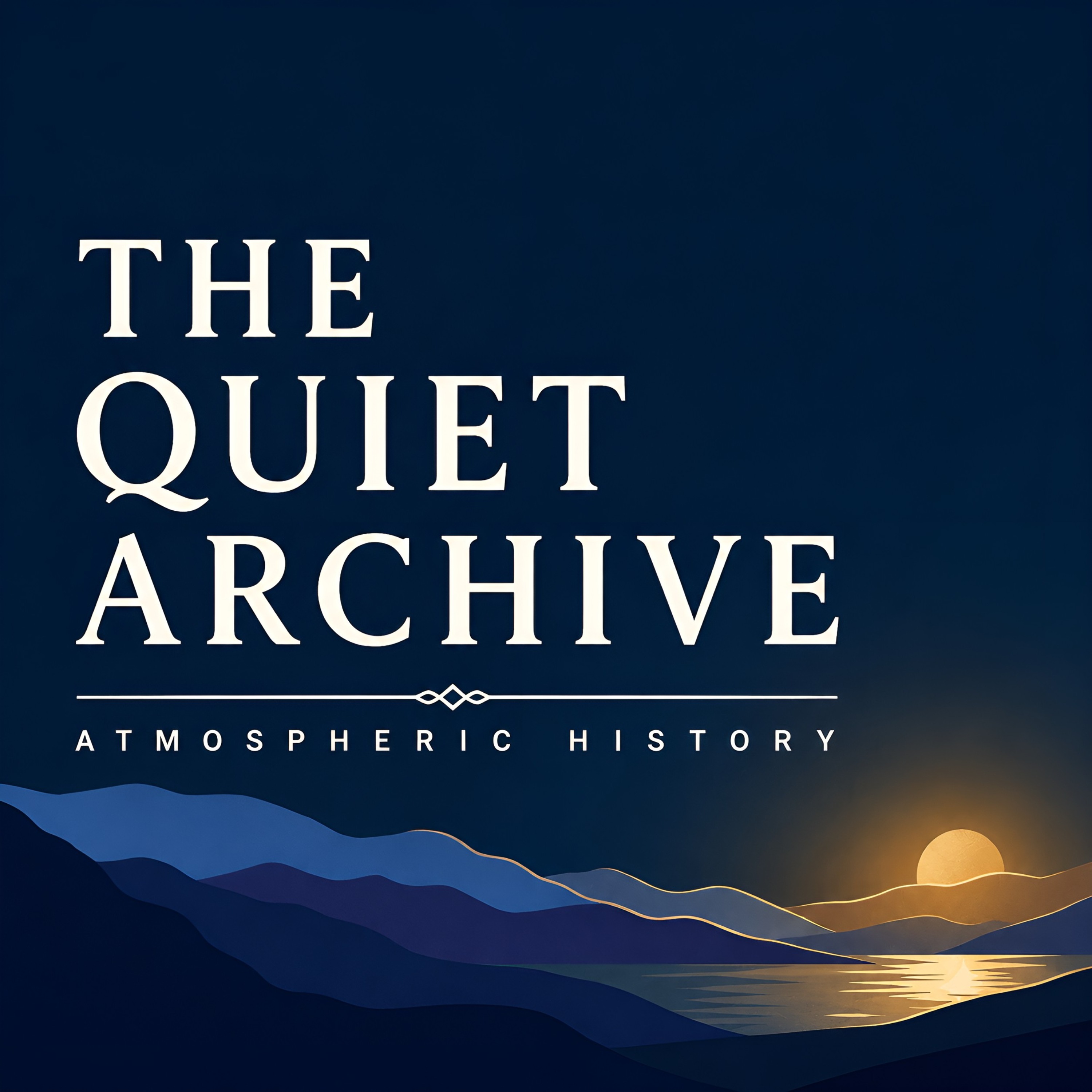
The Quiet Archive: Atmospheric History
The Quiet ArchiveAudio
- Format:
- Podcast
- New episodes:
- Several times a week
- Typical length:
- about 1 hour 30 minutes
- Latest episode:
About this show
Atmospheric History, Quietly Told
The Quiet Archive is an atmospheric history channel about how things change — and how ordinary that change often looked while it was happening.
An empire, a discovery, a decision, a way of life, a place, a passage. Not the loud version. The years, the rooms, the small choices, the moment no one recognized as the moment. Told before anyone knew there was no turning back.
◈ Close enough to feel human, far enough to see what changed
◈ One story at a time, told slowly, with room to think
◈ Quietly observed, carefully told, never overstated
◈ A conclusion the listener reaches alone
Narrated with restraint. Built for quiet listening as much as watching.
Atmospheric history, told with space to breathe.
✧ This channel features AI-assisted narration, produced for consistency and clarity.
─── ◈ ───
The archive is open.
Start where something already feels wrong.
Hosted on Acast. See acast.com/privacy (https://acast.com/privacy) for more information.
Covers: world history, medieval history, ancient history, social history, crime history, military history, European history, atmospheric narration
Show details and episodes come from the publisher's public feed at feeds.acast.com. Last updated . Names, artwork and text belong to their publishers.
Recently on this show
Summary of recent episodes, drawn from the publisher's feed.
The Quiet Archive is a podcast that retells history slowly and calmly, focusing on how ordinary moments often marked major change. Recent episodes cover the 1315 famine in northern Europe, the last Russian tsar, the Siege of Leningrad, the Salem witch trials, and the Göbekli Tepe site.
Cosmos
Similar in subject
- Humorously Dull History for Sleep
Both cover: social history, european history, medieval history - History’s Oddest Moments
Both cover: social history, medieval history, ancient history - Tales on the Timeline
Both cover: crime history, medieval history, world history
Similar shows



Explore more
Episodes
Napoleon Ruled Most of Europe. He Died a Prisoner.
· 2 hr 20 min
A boy of nine sits at a cold wooden desk, listening to a language he cannot understand. ⟡ This narration features AI-assisted voice production, carefully crafted for consistency and clarity. ─── ◈ ─── NAPOLEON RULED MOST OF EUROPE. HE DIED A PRISONER. He arrived in France as a stranger — poor, proud, mocked for his accent and his island. Within thirty years, kings waited outside his door and the borders of a continent moved at his command. This is the story of Napoleon: how he rose, how he fell, and what his rise cost everyone who stood close enough to feel it. ◈ A Corsican boy sent to a French military school, alone and far from home ◈ A young artillery officer who took Toulon and fired on the streets of Paris ◈ An emperor who lifted the crown from the altar and placed it on his own head ◈ An army of more than four hundred thousand men marching into Russia Every victory demanded another — until the road led to the snow, the mud of Waterloo, and a rock in the middle of the ocean. A historical narrative of Napoleon Bonaparte and the Napoleonic Wars — from Corsica and Brienne to Toulon, Austerlitz, Moscow, Waterloo and Saint Helena. History told with space to breathe. ─── ◈ ─── ✧ Support the project: https://linktr.ee/quietarchivum ✧ Help keep these stories alive — quietly, consistently. ─── ◈ ─── ✧ Subscribe for history told without noise. ✧ New stories arrive when they're ready — and not before. ✧ Leave a comment if this one stayed with you. #Napoleon #NapoleonBonaparte #NapoleonicWars #Austerlitz #Waterloo #Russia1812 #SaintHelena #FrenchRevolution #FrenchHistory #EuropeanHistory #MilitaryHistory #HistoryDocumentary #HistoryPodcast #Storytelling #History Hosted on Acast. See acast.com/privacy (https://acast.com/privacy) for more information.
Not rated yetAmerica's Last Slave Ship Landed in 1860. The Last Survivor Died in 1940.
· 1 hr 24 min
An old woman turns her cheek toward the light so a stranger can read what is written there. ⟡ This narration features AI-assisted voice production, carefully crafted for consistency and clarity. ─── ◈ ─── AMERICA'S LAST SLAVE SHIP LANDED IN 1860. THE LAST SURVIVOR DIED IN 1940. The trade had been illegal for fifty-two years. The law called it piracy, and piracy was punished by hanging. A schooner came up the bay in the dark anyway, put a hundred and ten people ashore in a canebrake, and was burned to the waterline before morning. This is the story of the last ship, and of the people it left behind in a country that had already forgotten how they got there. ◈ A young man of nineteen, taken from a walled town in the dry season, held three weeks in a barracoon at Whydah. ◈ A hundred and ten people put ashore at night in Alabama, and a schooner burned and sunk to erase that they existed. ◈ A town bought at a dollar a day, on land the family that took them had refused to give. ◈ A woman of seventy-three, walking fifteen miles to a courthouse with the only proof cut into her face. What crossed the Atlantic intact was not a possession. It was a language — and it was the one thing that did not survive. The Clotilda, Whydah and Dahomey, Mobile Bay and Africatown, Dallas County and Selma — Alabama, 1860 to 1940. History told with space to breathe. ─── ◈ ─── ✧ Support the project: https://linktr.ee/quietarchivum ✧ Help keep these stories alive — quietly, consistently. ─── ◈ ─── ✧ Subscribe for history told without noise. ✧ New stories arrive when they're ready — and not before. ✧ Leave a comment if this one stayed with you. #Clotilda #Africatown #CudjoLewis #MatildaMcCrear #Whydah #Dahomey #MobileAlabama #MiddlePassage #TransatlanticSlaveTrade #Barracoon #ZoraNealeHurston #AlabamaHistory #AmericanHistory #NarrativeHistory #AtmosphericHistory Hosted on Acast. See acast.com/privacy (https://acast.com/privacy) for more information.
Not rated yetChernobyl's Flaw Was Known for a Decade. Nobody Told the Operators.
· 1 hr 28 min
The glow on the far side of the city had colours in it that fire does not have, and the windows were open because the day was warm. ⟡ This narration features AI-assisted voice production, carefully crafted for consistency and clarity. ─── ◈ ─── CHERNOBYL'S FLAW WAS KNOWN FOR A DECADE. NOBODY TOLD THE OPERATORS. At twenty-three minutes past one in the morning, a reactor in the north of Ukraine came apart, and the men in the control room went on insisting it was still there. Three kilometres away, a city of fifty thousand people slept through it, and woke to an ordinary Saturday. This is the story of Chernobyl — of how the accident was built, how it was hidden for three days, and what it left in the ground. ◈ A reactor chosen because it was cheap, with a flaw that had already shown itself twice at other plants ◈ A safety test postponed for four years, handed at midnight to a shift that had not been briefed ◈ A city told to pack for three days, in an announcement that never used the word radiation ◈ Three thousand men on a roof, forty seconds each, throwing the core back into the hole it came from Then an alarm went off on a pair of shoes in Sweden, and the secret stopped belonging to the Soviet Union. The 1986 Chernobyl nuclear accident — Pripyat, Kyiv, Moscow, and the exclusion zone across Ukraine and Belarus. History told with space to breathe. ─── ◈ ─── 00:00:00 The Morning of the Twenty-Sixth 00:09:51 A Reactor Built for a Hurry 00:23:32 Twenty-Three Minutes Past One 00:37:00 Pack for Three Days 00:48:07 What Sweden Measured 01:00:48 Hospital Number Six 01:13:37 What Is Still Inside ─── ◈ ─── ✧ Support the project: https://linktr.ee/quietarchivum ✧ Help keep these stories alive — quietly, consistently. ─── ◈ ─── ✧ Subscribe for history told without noise. ✧ New stories arrive when they're ready — and not before. ✧ Leave a comment if this one stayed with you. #chernobyl #pripyat #chernobyldisaster #1986 #exclusionzone #liquidators #rbmk #nuclearaccident #sovietunion #ukrainehistory #belarus #coldwar #historydocumentary #atmospherichistory #thequietarchive Hosted on Acast. See acast.com/privacy (https://acast.com/privacy) for more information.
Not rated yetBritain Sent 827,000 Children Away in 3 Days of WWII. Some Never Came Home
· 1 hr 31 min
A woman writes her son's name on a luggage label, in the dark, so that a stranger will be able to read it. ⟡ This narration features AI-assisted voice production, carefully crafted for consistency and clarity. ─── ◈ ─── BRITAIN SENT 827,000 CHILDREN AWAY IN 3 DAYS OF WWII. SOME NEVER CAME HOME In the first three days of September 1939, Britain emptied its cities of children. They travelled without their parents, without knowing where they were going, with a gas mask in a cardboard box and a card tied to the coat. This is the story of the labels, the trains, and the childhoods that were spent in other people's houses. ◈ The village halls where local families walked along a line of children and chose the ones they wanted ◈ The letters home, written on the foster family's paper and posted by the foster family ◈ The ship that left Liverpool with ninety children aboard and ended the overseas scheme in a single night ◈ The station platforms of 1945, where children held on to the strangers who had raised them and refused to go Then the war that everyone had prepared for failed to arrive, and nine hundred thousand of them came home — months before the bombing began. Operation Pied Piper and the wartime evacuation of Britain: London, Stepney, Liverpool, Glasgow, Kent, Devon, Wales and the Channel Islands, 1939 to 1945. History told with space to breathe. ─── ◈ ─── ✧ Support the project: https://linktr.ee/quietarchivum ✧ Help keep these stories alive — quietly, consistently. ─── ◈ ─── ✧ Subscribe for history told without noise. ✧ New stories arrive when they're ready — and not before. ✧ Leave a comment if this one stayed with you. #OperationPiedPiper #Evacuees #BritishEvacuation #WW2History #HomeFront #TheBlitz #CityOfBenares #ChannelIslands #London1939 #SecondWorldWar #WWII #BritishHistory #SocialHistory #AtmosphericHistory #HistoryStorytelling Hosted on Acast. See acast.com/privacy (https://acast.com/privacy) for more information.
Not rated yetThe Stanford Prison Experiment Lasted Six Days. The Tapes Sat Unheard for 40 Years.
· 1 hr 7 min
A young man stands in a corridor with no windows, wearing a number that is not his name, and a chain that is attached to nothing at all. ⟡ This narration features AI-assisted voice production, carefully crafted for consistency and clarity. ─── ◈ ─── THE STANFORD PRISON EXPERIMENT LASTED SIX DAYS. THE TAPES SAT UNHEARD FOR 40 YEARS. In the summer of 1971, twenty-four young men answered a newspaper advertisement offering fifteen dollars a day. A coin decided which of them would be prisoners and which would be guards. What happened in a basement at Stanford University over the next six days became one of the most repeated stories in psychology — taught in schools, read into the record of Congress, and used decades later to explain a prison on the other side of the world. This is the story of what was recorded in that corridor, and how long it waited. ◈ Real police officers arresting nine students in their own doorways on a Sunday morning ◈ A cupboard two feet wide at the end of a corridor with no clock in it ◈ A man who screamed to be let out after thirty-six hours, and what he said about it fifty years later ◈ A full archive of tapes, transcripts and shift reports, catalogued and open to anyone who asked Nothing was hidden. That is the part that is difficult to hold. The Stanford prison experiment, Palo Alto, California, 1971 — Stanford University, Jordan Hall, and the archive that held the record. History told with space to breathe. ─── ◈ ─── ✧ Support the project: https://linktr.ee/quietarchivum ✧ Help keep these stories alive — quietly, consistently. ─── ◈ ─── ✧ Subscribe for history told without noise. ✧ New stories arrive when they're ready — and not before. ✧ Leave a comment if this one stayed with you. #stanfordprisonexperiment #zimbardo #paloalto #1971 #psychologyhistory #socialpsychology #prisonhistory #stanforduniversity #historydocumentary #atmospherichistory #narrativehistory #historystorytelling #truestory #archivestory #quietarchive Hosted on Acast. See acast.com/privacy (https://acast.com/privacy) for more information.
Not rated yetAlcohol Built Civilization. Now a Generation Is Walking Away.
· 1 hr 19 min
The basin holds forty gallons, and someone has to sit beside it through the night, watching a thing that cannot be hurried. ⟡ This narration features AI-assisted voice production, carefully crafted for consistency and clarity. ─── ◈ ─── ALCOHOL BUILT CIVILIZATION. NOW A GENERATION IS WALKING AWAY. Before the wheel, before writing, before the first city, people were already gathering around something that had made itself. It fed the crowds who raised the oldest temple on earth, and it was still being poured in offices three thousand years after the last pharaoh. This is the story of what we handed each other for ten thousand years, and what is happening now that a generation has begun to say no. ◈ The stone basins at Göbekli Tepe, cut for crowds who came back every season to move ten-ton pillars for nothing ◈ The hymn to Ninkasi — a Sumerian song that doubles as the oldest surviving recipe for beer ◈ The pyramid inspector whose logbook recorded, day by day, the bread and beer issued to forty men ◈ The winter of 1926, when the United States government ordered poison into the alcohol supply and the New York coroner said so in public Then the still arrived, and a limit that had held since the beginning quietly stopped existing. Ten thousand years of alcohol in human history — from Göbekli Tepe and Sumer to Giza, Athens, Rome, medieval England, Georgian London, the Royal Navy, Prohibition-era New York and the present day. History told with space to breathe. ─── ◈ ─── 00:00:00 The Accident in the Jar 00:09:08 The Song That Was a Recipe 00:20:32 The Room With the Door Off-Centre 00:32:43 One Cup, and No One Left Out 00:44:43 The Straw on the Cellar Floor 00:58:57 The Basement on First Avenue 01:12:34 The Glass Set Down ─── ◈ ─── ✧ Support the project: https://linktr.ee/quietarchivum ✧ Help keep these stories alive — quietly, consistently. ─── ◈ ─── ✧ Subscribe for history told without noise. ✧ New stories arrive when they're ready — and not before. ✧ Leave a comment if this one stayed with you. #historyofalcohol #gobeklitepe #ninkasi #sumerianbeer #ancientegypt #greeksymposium #ginlane #ginCraze #prohibition #charlesnorris #rumration #historyofbeer #atmospherichistory #historydocumentary #ancienthistory Hosted on Acast. See acast.com/privacy (https://acast.com/privacy) for more information.
Not rated yetAlexander the Great Never Lost a Battle. His Empire Died With Him.
· 1 hr 25 min
He asked the envoys about the roads. How far apart the stations were, and how long the journey took from the coast to the interior. He was ten years old. ⟡ This narration features AI-assisted voice production, carefully crafted for consistency and clarity. ─── ◈ ─── ALEXANDER THE GREAT NEVER LOST A BATTLE. HIS EMPIRE DIED WITH HIM. Four afternoons of battle, spread across eleven years. The rest was walking — season after season, past the last named place on every map he had been given, until the men who had followed him further than any army had ever followed anyone simply stopped, at a river, and said nothing at all. This is the story of a boy from a small kingdom in the north, and of the plain habit that carried him to the edge of the known world. ◈ A twenty-year-old inherits a throne, and marches an army from Macedon to the walls of Thebes in a fortnight. ◈ An army stops being an army for seven months and becomes a work crew, pushing a road of stone into the sea. ◈ Sixty days of desert kill more of his men than every battle he ever fought put together. ◈ The largest empire on earth is handed to a thirty-two-year-old, and comes apart within a generation of his death. The tomb was visited for centuries. Then the visits stop appearing in the record. The life of Alexander the Great, from Pella and Macedon to Persia, Egypt, Babylon and the rivers of India. History told with space to breathe. ─── ◈ ─── 00:00:00 — The Boy Who Asked About the Roads 00:10:13 — The Shadow Behind the Horse 00:28:42 — The Road Built Into the Sea 00:47:27 — The King in the Cart 01:04:26 — The River Where They Stopped ─── ◈ ─── ✧ Support the project: https://linktr.ee/quietarchivum ✧ Help keep these stories alive — quietly, consistently. ─── ◈ ─── ✧ Subscribe for history told without noise. ✧ New stories arrive when they're ready — and not before. ✧ Leave a comment if this one stayed with you. #alexanderthegreat #ancientgreece #macedon #persianempire #hellenistic #babylon #persepolis #alexandria #ancienthistory #militaryhistory #historydocumentary #atmosphericstorytelling #historypodcast #narrativehistory #thequietarchive Hosted on Acast. See acast.com/privacy (https://acast.com/privacy) for more information.
Not rated yetJapan Is the Only Country That Counts Its Criminals. The Yakuza Are Almost Gone.
· 1 hr 11 min
The plate was still bolted beside the door, the name painted where any passerby could read it. ⟡ This narration features AI-assisted voice production, carefully crafted for consistency and clarity. ─── ◈ ─── JAPAN IS THE ONLY COUNTRY THAT COUNTS ITS CRIMINALS. THE YAKUZA ARE ALMOST GONE. For three hundred years, Japan's underworld refused to hide. It kept offices with nameplates, printed business cards, and let itself be counted, by name, in a government ledger published every spring. This is the story of the criminals who operated in plain sight — and of the country that watched them, tolerated them, and slowly stopped seeing them at all. ◈ A losing hand in a card game that gave an entire underworld its name. ◈ A cup of sake shared between two men who became father and son, though no blood connected them. ◈ A syndicate that fed eight thousand people a day after the Kobe earthquake — and bought the ruined ground beneath them. ◈ A count that fell from 184,100 men to almost nothing, in living memory. Then the law reached past the gangster to everyone around him, and the nameplates began to disappear. The rise, reign, and long retreat of the yakuza — from the festival stalls and gambling dens of Edo Japan through the bubble years in Tokyo and Kobe to the vanishing syndicates of today. History told with space to breathe. ─── ◈ ─── ✧ Support the project: https://linktr.ee/quietarchivum ✧ Help keep these stories alive — quietly, consistently. ─── ◈ ─── ✧ Subscribe for history told without noise. ✧ New stories arrive when they're ready — and not before. ✧ Leave a comment if this one stayed with you. #yakuza #japanesehistory #organizedcrime #boryokudan #yamaguchigumi #japanhistory #truehistory #historystorytelling #atmospherichistory #yakuzahistory #japaneseculture #edoperiod #crimehistory #history #documentary Hosted on Acast. See acast.com/privacy (https://acast.com/privacy) for more information.
Not rated yetInside a Medieval Castle: The Reality No One Shows You
· 1 hr 15 min
He wakes before the others, on the cold floor, and blows on last night's embers until they catch. ⟡ This narration features AI-assisted voice production, carefully crafted for consistency and clarity. ─── ◈ ─── A MEDIEVAL CASTLE HELD UP TO 700 PEOPLE. ALMOST NONE OF THEM WERE EVER WARM. The stone drank in the winter and never gave it back. Hundreds of people lived pressed inside those walls — warm or cold, fed first or fed last, according to a rank no one ever had to say aloud. This is the story of what a castle really was, told from the inside, by the hundreds who lived it. ◈ The kitchen that woke hours before dawn to feed a hundred mouths, twice a day, without a single day off ◈ The single dark well shaft that decided more sieges than any sword ◈ The map of warmth that ran downhill from the lord's curtained bed to the servant on the bare floor ◈ The feast that lit the hall like a lantern a few nights a year — and the arithmetic of hunger waiting underneath it And when the grain ran low, the same castle that could stage a feast of thirty dishes had to decide who was worth keeping alive. The daily life, logistics, and hidden hierarchy of a medieval castle — its kitchens, wells, cold chambers, feasts, and sieges, across medieval England and Europe. History told with space to breathe. ─── ◈ ─── ✧ Support the project: https://linktr.ee/quietarchivum ✧ Help keep these stories alive — quietly, consistently. ─── ◈ ─── ✧ Subscribe for history told without noise. ✧ New stories arrive when they're ready — and not before. ✧ Leave a comment if this one stayed with you. #medievalcastle #medievalhistory #castlelife #middleages #medieval #history #medievallife #feudalism #darkhistory #europeanhistory #castlesiege #historytold #atmospherichistory #quietarchive #medievalengland Hosted on Acast. See acast.com/privacy (https://acast.com/privacy) for more information.
Not rated yetThe Black Death Killed a Third of Europe. The Survivors Became Priceless.
· 2 hr 1 min
The scythe still leaned in the doorway where he'd left it, and the wheat outside stood gold and uncut, waiting for hands that were not coming. ⟡ This narration features AI-assisted voice production, carefully crafted for consistency and clarity. ─── ◈ ─── THE BLACK DEATH KILLED A THIRD OF EUROPE. THE SURVIVORS BECAME PRICELESS. The dying did not end anything. It opened a door. A continent woke to find its fields intact, its churches standing, its ledgers full — and half its people gone. This is the story of the empty Europe, and of how the living, one reluctant choice at a time, inherited a world remade in their absence. ◈ A labourer who had always been worth nothing, suddenly worth more than the law would allow — and the branding iron waiting for him if he asked for it ◈ Whole villages that emptied and never woke, their streets still faint in the grass six hundred years on ◈ The forty days a plague-ship waited offshore, and the word we have counted by ever since ◈ Skeletons painted dancing hand in hand with emperors, because death had stopped respecting rank And beneath every gain, a shadow that would not lift for five hundred years. The story of Europe after the Black Death — from the emptied fields of England and the burning of Strasbourg to the quarantine ports of Ragusa and Venice. History told with space to breathe. ─── ◈ ─── ✧ Support the project: https://linktr.ee/quietarchivum ✧ Help keep these stories alive — quietly, consistently. ─── ◈ ─── ✧ Subscribe for history told without noise. ✧ New stories arrive when they're ready — and not before. ✧ Leave a comment if this one stayed with you. #BlackDeath #Plague #MedievalHistory #QuarantineOrigins #PeasantsRevolt #SecondSerfdom #DanseMacabre #MedievalEurope #Pandemic #14thCentury #DarkHistory #EuropeanHistory #History #HistoryStorytelling #TheQuietArchive Hosted on Acast. See acast.com/privacy (https://acast.com/privacy) for more information.
Not rated yetMedieval Europe Was Cleaner Than You Think. Its Saints Chose to Rot.
· 1 hr 18 min
In the dark of his cell, a holy man feels the first crawling begin beneath his shirt — and welcomes it. ⟡ This narration features AI-assisted voice production, carefully crafted for consistency and clarity. ─── ◈ ─── MEDIEVAL EUROPE WAS CLEANER THAN YOU THINK. ITS SAINTS CHOSE TO ROT. They soaked in scented water and combed the vermin from their hair. They judged a stranger by the smell he carried into a room. And a small number of them, in cells and cloisters and the wild places of the world, chose the exact opposite — filth as devotion, suffering as love. This is the story of an age far cleaner than its legend, and the holy few who made themselves rot on purpose. ◈ Public bath-houses counted by the dozen, warm and crowded at the end of the working week. ◈ Hands washed before every meal, teeth cleaned at first light, linen changed and worn with pride. ◈ Physicians who prescribed a warm soak for pain — and a bath at midnight to break a fever. ◈ A holy few who refused every comfort, and welcomed the crawling things as a form of prayer. And when one of them was murdered, the truth beneath his robes came crawling into the light. The true story of hygiene and holiness in medieval Europe — from the crowded bath-houses of its cities to the hairshirt hidden beneath an archbishop's robes at Canterbury. History told with space to breathe. ─── ◈ ─── 00:00:00 — The Warm Room 00:09:53 — Clean Hands at Dawn 00:21:09 — Scented Water and Fresh Linen 00:32:18 — What the Doctors Ordered 00:43:39 — The Creature in the Seam 00:53:48 — The Ones Who Chose It 01:02:21 — Beneath the Vestments 01:12:34 — The Relic ─── ◈ ─── ✧ Support the project: https://linktr.ee/quietarchivum ✧ Help keep these stories alive — quietly, consistently. ─── ◈ ─── ✧ Subscribe for history told without noise. ✧ New stories arrive when they're ready — and not before. ✧ Leave a comment if this one stayed with you. #MedievalHygiene #MedievalMedicine #MedievalLife #Bathhouses #MiddleAges #MedievalHistory #Hagiography #ChurchHistory #EuropeanHistory #Asceticism #DarkHistory #History #HistoryStorytelling #Documentary #TheQuietArchive Hosted on Acast. See acast.com/privacy (https://acast.com/privacy) for more information.
Not rated yetCarthage Surrendered Every Weapon It Had. Rome Destroyed It Anyway.
· 1 hr 8 min
They handed over every sword in the city, and still the messenger came back with one more demand. ⟡ This narration features AI-assisted voice production, carefully crafted for consistency and clarity. ─── ◈ ─── CARTHAGE SURRENDERED EVERY WEAPON IT HAD. ROME DESTROYED IT ANYWAY. A city six hundred years old, mistress of the western sea, emptied itself of iron on Rome's command — and then was told to walk away from its own gates forever. It said no. This is the story of the end of Carthage. ◈ The three demands that arrived one at a time, each survivable until the next one followed ◈ A disarmed city that rebuilt its war from melted gods and the hair of its own women ◈ Three years of siege, a hidden harbour, and a fleet that sailed from a city already strangling ◈ Six days of fire, fifty thousand sold into slavery, and a conqueror weeping at his own victory On a burning hill above the ruins, the man who gave the order saw his own city's future in the flames. The fall of Carthage and the Third Punic War, 149–146 BC — Utica, Byrsa, and the North African coast. History told with space to breathe. ─── ◈ ─── 00:00:00 — The Order Held in His Hands 00:03:33 — The Children Went First 00:09:42 — The Smell of Hot Metal 00:16:39 — The Wall That Healed in the Dark 00:23:21 — The City That Would Not Die 00:30:38 — The Sea Taken Away 00:38:35 — The Largest Cage in the Ancient World 00:45:45 — Six Days of Fire 00:53:41 — The Woman on the Roof 01:01:00 — The Tears of the Man Who Won ─── ◈ ─── ✧ Support the project: https://linktr.ee/quietarchivum ✧ Help keep these stories alive — quietly, consistently. ─── ◈ ─── ✧ Subscribe for history told without noise. ✧ New stories arrive when they're ready — and not before. ✧ Leave a comment if this one stayed with you. ─── ◈ ─── #carthage #punicwars #ancienthistory #rome #scipio #hannibal #ancientrome #history #romanempire #siege #ancientcivilizations #militaryhistory #northafrica #thirdpunicwar #historicalstorytelling Hosted on Acast. See acast.com/privacy (https://acast.com/privacy) for more information.
Not rated yetChina Banned the Self. Then It Made Children Report Their Parents.
· 1 hr 18 min
A father folds yesterday's newspaper into a neat square, and does not yet know it is the last ordinary morning his family will ever have. ⟡ This narration features AI-assisted voice production, carefully crafted for consistency and clarity. ─── ◈ ─── CHINA BANNED THE SELF. THEN IT MADE CHILDREN REPORT THEIR PARENTS. Between 1966 and 1976, one of the largest nations on earth tried to reach inside hundreds of millions of people and remake the self from the inside out. It did not stop at the streets. It came up the stairs, sat at the dinner table, and asked the family to turn on itself. This is the story of a self a country tried to erase — and the small, stubborn thing it could never quite reach. ◈ A teacher who believed that knowledge was a kind of shelter, on the morning the poster went up. ◈ A classroom where children were taught a new way to listen to their own parents. ◈ A woman sweeping an already-clean square, and filling a notebook with a crime that was only a life spent reading. ◈ A letter written by candlelight, read once, and held over the flame until nothing was left. And in the end, one small ember of the self that even a decade of silence could not put out. Cultural Revolution China, 1966–1976 — struggle sessions, sent-down youth, self-criticism, and the private cost of a public revolution. History told with space to breathe. ─── ◈ ─── 00:00:00 — The Overview: A Country Turns on Itself 00:09:20 — What the Children Heard 00:19:47 — The Sound of the Broom 00:29:22 — The Factory and the Field 00:39:36 — The Grammar of Survival 00:50:40 — The Mask on the Stage 01:01:22 — The Letter That Stayed Unsent 01:12:13 — What the Silence Left Behind ─── ◈ ─── ✧ Support the project: https://linktr.ee/quietarchivum ✧ Help keep these stories alive — quietly, consistently. ─── ◈ ─── ✧ Subscribe for history told without noise. ✧ New stories arrive when they're ready — and not before. ✧ Leave a comment if this one stayed with you. #CulturalRevolution #ChineseHistory #MaoZedong #China #ModernHistory #Communism #ColdWarHistory #History #ChinaHistory #20thCentury #HistoryDocumentary #StruggleSession #RedGuards #HistoricalStorytelling #AtmosphericHistory Hosted on Acast. See acast.com/privacy (https://acast.com/privacy) for more information.
Not rated yetThe Fire That Kept Them Alive Was Also Killing Them: How Medieval Peasants Survived Winter.
· 1 hr 15 min
She wakes in the black cold before dawn, reaches past the sleeping children, and feeds the fire before it can die. ⟡ This narration features AI-assisted voice production, carefully crafted for consistency and clarity. ─── ◈ ─── THE FIRE THAT KEPT THEM ALIVE WAS ALSO KILLING THEM: HOW MEDIEVAL PEASANTS SURVIVED WINTER Every autumn, the cold came down like a siege and did not lift for months. There was no furnace, no warm lit room to escape into — only a fire on the floor, the walls of a house, and everything a people had learned across generations about holding the warmth in and the dark out. This is the story of how they survived it, winter after winter, and what it cost them to reach the spring. ◈ A fire on the bare earth floor — the only warmth, guarded day and night, and never allowed to die ◈ Families and their cattle wintering under a single roof, trading breath and body heat in the dark ◈ A hot stone carried to bed, a cap pulled low, the whole household pressed close beneath the furs ◈ The hungry gap of late winter, when the woodpile and the food ran thin at the very same time And when the fire burned low, the cold went looking for the weakest in the room. A quiet look at winter survival in medieval Europe — the peasant's smoky hut, the cold stone hall of the lord, and the frozen rivers of the north. History told with space to breathe. ─── ◈ ─── 00:00:00 — The Breath That Would Not Fade 00:09:04 — The Flame on the Floor 00:20:06 — Wool, Linen, and a Stone from the Fire 00:30:12 — The Warmth of the Living 00:41:44 — A Coal Carried Into the Cold 00:50:28 — The Killing Time and the Frozen River 01:00:23 — When the Woodpile Fails 01:09:58 — The Water Moves Again ─── ◈ ─── ✧ Support the project: https://linktr.ee/quietarchivum ✧ Help keep these stories alive — quietly, consistently. ─── ◈ ─── ✧ Subscribe for history told without noise. ✧ New stories arrive when they're ready — and not before. ✧ Leave a comment if this one stayed with you. #MedievalWinter #MedievalHistory #MiddleAges #MedievalLife #WinterSurvival #Peasants #MedievalEurope #DarkAges #HistoryDocumentary #HistoricalStorytelling #Atmospheric #HistoryChannel #Medieval #WinterHistory #History Hosted on Acast. See acast.com/privacy (https://acast.com/privacy) for more information.
Not rated yetA City Abolished Money and Private Property. It Ended With Bodies in Iron Cages.
· 1 hr 21 min
The doors had no locks. That was the law now — to bolt a door was a crime against everyone. ⟡ This narration features AI-assisted voice production, carefully crafted for consistency and clarity. ─── ◈ ─── A CITY ABOLISHED MONEY AND PRIVATE PROPERTY. IT ENDED WITH BODIES IN IRON CAGES. Five hundred years ago, a walled city in Germany tore down the oldest wall of all — the one between mine and yours. For sixteen months, no one owned anything. Then the army came. This is the story of the people who tried to live without the word "mine," and of what was left behind when they failed. ◈ A sealed city that abolished money, emptied the churches, and unlocked every door ◈ A quiet community that shared not just its property, but the family itself, for thirty years ◈ A gentle farm of poets and dreamers, undone in a single winter night ◈ Three vanished worlds — and the three small, stubborn objects that outlived them all The wall between mine and yours was torn down with such hope. Again and again, it rebuilt itself. The rise and fall of history's forgotten communes — from the siege of Münster in Westphalia, to the Oneida Community in New York, to Brook Farm in Massachusetts. History told with space to breathe. ─── ◈ ─── 00:00:00 — The Cages on the Tower 00:08:37 — A City Begins to Boil 00:21:54 — The Tailor Who Would Be King 00:33:11 — The Gate Opens in the Dark 00:43:30 — The Quiet After the Iron 00:54:28 — The Last Strange Idea 01:05:19 — Poets Learning to Farm 01:16:46 — What the Objects Remember ─── ◈ ─── ✧ Support the project: https://linktr.ee/quietarchivum ✧ Help keep these stories alive — quietly, consistently. ─── ◈ ─── ✧ Subscribe for history told without noise. ✧ New stories arrive when they're ready — and not before. ✧ Leave a comment if this one stayed with you. #Munster #Oneida #BrookFarm #Anabaptists #Utopia #Communes #History #Reformation #AmericanHistory #Radical #ForgottenHistory #SocialHistory #Storytelling #Documentary #HistoryTold Hosted on Acast. See acast.com/privacy (https://acast.com/privacy) for more information.
Not rated yetThey Guarded the End of the World for Decades — and Couldn't Tell Their Own Families.
· 1 hr 6 min
The tea went cold beside him while, somewhere above his head, the sky did something ordinary he would not see for hours. ⟡ This narration features AI-assisted voice production, carefully crafted for consistency and clarity. ─── ◈ ─── A SIREN MEANT FOUR MINUTES TO LIVE. SO THEY BUILT A WORLD UNDERGROUND FOR A WAR THAT NEVER CAME. Beneath the ordinary world, behind a steel door half a metre thick, people spent their working lives breathing air made by machines and rehearsing the end of everything. The sun never reached them. The war they waited for never arrived. This is the story of the lives spent underground, on a promise that was never called in. ◈ The four-minute warning that taught a generation of children the sound of the end ◈ The men who breathed machine-made air and could not tell their own wives where they worked ◈ The larder stocked for years, its tins quietly outliving the war they were bought to survive ◈ The listening chair, kept manned through decades of silence, waiting for a message that never came And when the machine was finally switched off, everything was left exactly where it stood — a whole world, frozen in the moment the last person walked away. The story of the Cold War's underground bunkers and the ordinary lives buried inside them, from the nuclear age to the sealed rooms abandoned to the dark. History told with space to breathe. ─── ◈ ─── ✧ Support the project: https://linktr.ee/quietarchivum ✧ Help keep these stories alive — quietly, consistently. ─── ◈ ─── ✧ Subscribe for history told without noise. ✧ New stories arrive when they're ready — and not before. ✧ Leave a comment if this one stayed with you. #coldwar #nuclearbunker #coldwarhistory #bunker #nuclearwar #falloutshelter #undergroundbunker #darkhistory #forgottenhistory #militaryhistory #historydocumentary #atmospheric #history #storytelling #documentary Hosted on Acast. See acast.com/privacy (https://acast.com/privacy) for more information.
Not rated yetTesla Said He'd Built a Weapon to End All War. When He Died, the Government Seized His Papers.
· 57 min
A small card hung from the door of room 3327, asking the world to stay outside — and for two winter mornings, the world obeyed. ⟡ This narration features AI-assisted voice production, carefully crafted for consistency and clarity. ─── ◈ ─── TESLA SAID HE'D BUILT A WEAPON TO END ALL WAR. WHEN HE DIED, THE GOVERNMENT SEIZED HIS PAPERS. He had lit whole countries, and he died owing money he could not pay, alone in a rented room above a city that had slowly stopped printing his name. Within two days, men from a federal office arrived with boxes of their own. This is the story of what a government took from a dead inventor, who was sent to read it, and the one design that has never been found. ◈ An old man who lit the world, paying for his last room on credit and feeding the birds from a high window ◈ Eighty sealed trunks, carried across the city and catalogued under a law written for the property of foreigners and enemies ◈ A thirty-year-old engineer, given a few winter days to decide whether a life's work held a weapon — or only the ghost of one ◈ A golden sphere in a museum an ocean away, and a missing design the world has searched for ever since The man spent his life turning invisible forces into things we could use. At the end, the thing he cared about most turned invisible in the other direction. Nikola Tesla, the New Yorker Hotel, and the 1943 seizure of his papers by the Office of Alien Property — from Room 3327 in New York to the Nikola Tesla Museum in Belgrade. History told with space to breathe. ─── ◈ ─── 00:00:00 — The Card on the Door 00:08:39 — The Quiet That Changed Its Shape 00:18:06 — Alien Property 00:28:08 — The Stranger with the Lamp 00:37:54 — The Name with No Machine 00:47:49 — The Golden Sphere ─── ◈ ─── ✧ Support the project: https://linktr.ee/quietarchivum ✧ Help keep these stories alive — quietly, consistently. ─── ◈ ─── ✧ Subscribe for history told without noise. ✧ New stories arrive when they're ready — and not before. ✧ Leave a comment if this one stayed with you. ─── ◈ ─── #NikolaTesla #Tesla #Teleforce #DeathRay #OfficeOfAlienProperty #Room3327 #NewYorkerHotel #TeslaPapers #TeslaMuseum #Belgrade #HistoryMystery #ForgottenHistory #AtmosphericHistory #HistoryDocumentary #History Hosted on Acast. See acast.com/privacy (https://acast.com/privacy) for more information.
Not rated yetThe Inca Ran an Empire With No Money and No Writing. No One Starved.
· 1 hr 11 min
High on a cold pass, a man stands in a small stone shelter, listening for the sound of someone running toward him. ⟡ This narration features AI-assisted voice production, carefully crafted for consistency and clarity. ─── ◈ ─── THE INCA RAN AN EMPIRE WITH NO MONEY AND NO WRITING. NO ONE STARVED. For a few short reigns, a civilization of millions stretched from desert coast to frozen peak, bound into a single body by one road and held whole without coins, without markets, without a written word. It fed everyone. It counted everyone. It believed it would go on forever. This is the story of the Inca world in the last years it was still whole — and still entirely unaware. ◈ A road longer than any in the ancient world, crossing deserts and gorges without a single wheel to travel it ◈ Storehouses stacked to the roof and opened in hard years, in an empire that never made a coin ◈ A potato made deathless by the frost, and a whole winter folded onto a shelf to wait ◈ A civilization's entire memory — its counts, its histories, its laws — carried in knotted string and living minds, and nowhere else And then, along that same road, something began to move south that no offering could pay for. The story of the Inca Empire — Tawantinsuyu — across the Andes, from Cusco to the coast, in the final years before the Spanish arrived. History told with space to breathe. ─── ◈ ─── 00:00:00 — The Fish on the Mountain Table 00:05:39 — The Fields Cut From the Frost 00:22:53 — The Wall Without a Seam 00:40:17 — One Room, Before Dawn 00:57:21 — The Shelter No One Came to Fill 01:05:44 — The Road Still Waiting ─── ◈ ─── ✧ Support the project: https://linktr.ee/quietarchivum ✧ Help keep these stories alive — quietly, consistently. ─── ◈ ─── ✧ Subscribe for history told without noise. ✧ New stories arrive when they're ready — and not before. ✧ Leave a comment if this one stayed with you. #IncaEmpire #Tawantinsuyu #Inca #AndesHistory #Cusco #QhapaqNan #PreColumbian #AncientCivilizations #IncaHistory #SouthAmericanHistory #LostCivilizations #AncientHistory #Documentary #HistoryStorytelling #History Hosted on Acast. See acast.com/privacy (https://acast.com/privacy) for more information.
Not rated yetHaiti Freed Itself in 1804. France Made It Pay Until 1947.
· 1 hr 5 min
A woman in Paris stirs sugar into her coffee and never once thinks to ask where it came from. ⟡ This narration features AI-assisted voice production, carefully crafted for consistency and clarity. ─── ◈ ─── HAITI FREED ITSELF IN 1804. FRANCE MADE IT PAY UNTIL 1947. In 1804, an island of half a million enslaved people did the one thing the world swore could never be done — it rose in the dark and freed itself. Twenty-one years later, France came back. Not with an army this time, but with a bill. This is the story of the richest colony on earth, the only enslaved people who ever won their freedom outright, and the ransom they were made to pay for it — long after everyone who signed it was dead. ◈ The colony that produced more sugar and coffee than anywhere on earth — and worked the people who made it to death ◈ The night the plantations burned, and the army of the formerly enslaved that defeated Napoleon ◈ The warships of 1825, and the price France set on Haiti's freedom: one hundred and fifty million gold francs ◈ The debt that outlived every man who signed it, and was not paid off in full until 1947 For two hundred years, everything of value left this island in the very same direction. The story of the Haitian Revolution, the 1825 indemnity and the double debt — how the world's first free Black republic, from Saint-Domingue to Port-au-Prince, was made to buy its own liberty from France, and how that century of payments helped make Haiti one of the poorest nations on earth. History told with space to breathe. ─── ◈ ─── 00:00:00 — Sugar in a Paris Cup 00:07:39 — The Night the Fields Burned 00:19:57 — A Price for Being Free 00:35:37 — The Gold Sails North 00:50:43 — Where the Trees Stop 00:58:32 — The Account, Closed ─── ◈ ─── ✧ Support the project: https://linktr.ee/quietarchivum ✧ Help keep these stories alive — quietly, consistently. ─── ◈ ─── ✧ Subscribe for history told without noise. ✧ New stories arrive when they're ready — and not before. ✧ Leave a comment if this one stayed with you. ─── ◈ ─── #Haiti #HaitianRevolution #ToussaintLouverture #Dessalines #HaitianIndependence #1825Indemnity #DoubleDebt #SaintDomingue #FrenchColonialism #ColonialHistory #Slavery #Caribbean #History #Documentary #TheQuietArchive Hosted on Acast. See acast.com/privacy (https://acast.com/privacy) for more information.
Not rated yetThe Caribbean Destroyed the World's Greatest Armies — and Barely Fired a Shot
· 58 min
A soldier leaned against the ship's rail at first light and did not wake — and the whites of his eyes had turned a soft, terrible yellow. ⟡ This narration features AI-assisted voice production, carefully crafted for consistency and clarity. ─── ◈ ─── THE CARIBBEAN DESTROYED THE WORLD'S GREATEST ARMIES — AND BARELY FIRED A SHOT For nearly two centuries, the richest islands on earth swallowed the proudest armies the world could send. They came for sugar, and silver, and empire — in the largest fleets ever assembled — and they died in their thousands without ever meeting the thing that killed them. This is the story of the wars the Caribbean won before a shot was fired, and the small and silent enemy that decided the fate of a continent. ◈ The largest invasion fleet the world had yet seen, undone before it reached the walls of Cartagena — its victory medals struck in London months too early. ◈ A British triumph at Havana that killed nearly ten men by sickness for every one lost to enemy fire, then handed the city back within a year. ◈ Fifty thousand soldiers lost across a single decade in the sugar islands — a catastrophe so complete the history books let it slip away. ◈ Napoleon's finest army, destroyed on one island by a thing it never saw — and the sale of Louisiana that doubled the size of the United States. And behind every fleet, in the still water of the barrels the men drank from, something waited that no map had ever marked. The story of yellow fever and the fall of empires in the Caribbean — from Cartagena and Havana to Saint-Domingue, Haiti, and the Louisiana Purchase. History told with space to breathe. ─── ◈ ─── 00:00:00 — The Medals Struck Too Early 00:06:47 — The Victory That Rotted 00:19:26 — The Colour That Named It 00:30:33 — The Jewel of the Empire 00:40:41 — One Hundred and Sixty a Day 00:52:09 — The Smallest Conqueror ─── ◈ ─── ✧ Support the project: https://linktr.ee/quietarchivum ✧ Help keep these stories alive — quietly, consistently. ─── ◈ ─── ✧ Subscribe for history told without noise. ✧ New stories arrive when they're ready — and not before. ✧ Leave a comment if this one stayed with you. #Cartagena #Havana #SaintDomingue #HaitianRevolution #YellowFever #LouisianaPurchase #Napoleon #ToussaintLouverture #WarOfJenkinsEar #CaribbeanHistory #NavalHistory #ColonialHistory #MilitaryHistory #History #TheQuietArchive Hosted on Acast. See acast.com/privacy (https://acast.com/privacy) for more information.
Not rated yet