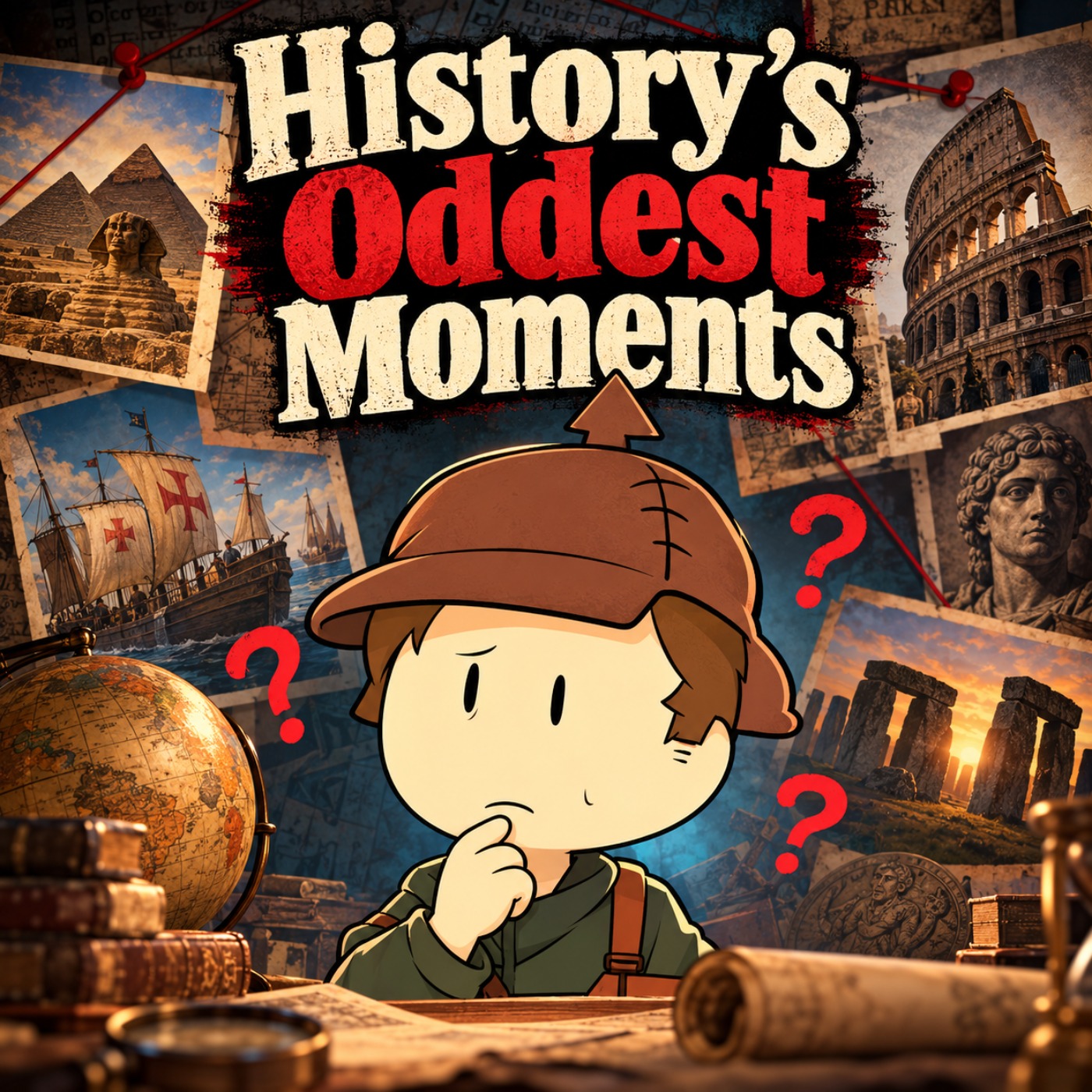
History’s Oddest Moments
Creators ObomediaAudio
- Format:
- Podcast
- New episodes:
- Several times a week
- Typical length:
- about 30 minutes
- Latest episode:
About this show
A dusty cabinet opens on a crooked hinge, and something small and absurd tumbles into view—a lost law, a forgotten festival, a headline that makes you laugh and then frown. Curiosity tightens like a string and won’t let go until the strange corners of the past are understood.
History’s Oddest Moments takes those moments seriously without taking itself too seriously. Each episode peels back one peculiar incident from the past and tells it with clear context, lively narration, and a touch of wry surprise. Episodes blend concise historical background with vivid anecdotes, eyewitness quotations when available, and careful explanation of why the moment mattered. The mood is curious and irreverent, aimed at listeners who love history’s quirks and want to learn while being entertained. Listeners get episodes that are short enough to fit into a commute and rich enough to spark conversation.
New episodes arrive on Martes, Viernes at 9:00 PM. Come back on those days to discover an unexpected story that reframes something you thought you already knew about the past. Follow History’s Oddest Moments so you never miss the next peculiar episode.
Hosted on Acast. See acast.com/privacy (https://acast.com/privacy) for more information.
Covers: history, ancient history, medieval history, world history, daily life history, engineering history, architecture history, military history, social history
Show details and episodes come from the publisher's public feed at feeds.acast.com. Last updated . Names, artwork and text belong to their publishers.
Recently on this show
Summary of recent episodes, drawn from the publisher's feed.
History's Oddest Moments is a podcast about strange episodes from the past, explained with background and a wry sense of humor. Recent episodes cover Saladin's respect from his enemies, a day in a Maori pa, Mansa Musa's impact on gold prices, and why Roman roads ran straight.
Cosmos
Similar in subject
- The Quiet Archive: Atmospheric History
Both cover: social history, medieval history, ancient history - History Rage
Both cover: social history, medieval history, ancient history - Just Sleep History
Both cover: daily life history, medieval history, ancient history
Similar shows







Explore more
Episodes
Why Saladin Was Respected by His Enemies
· 34 min
A rider crosses the dusty ground between two armed camps, carrying a covered cup of iced sherbet from a sultan to a sick enemy king. Tonight, we ask why Saladin, the Muslim ruler of Egypt and Syria, earned the respect of the very Christian knights he defeated. We'll follow the road from the limestone walls of Jerusalem to campaign tents and royal correspondence and the written accounts of men who were present. The story turns out to be stranger and more practical than the romantic legend suggests. Along the way we'll meet a meticulous biographer writing in a war camp and a treaty that neither side quite wanted to sign.Find a comfortable place to rest and let your breath slow. Calm history, told at night, is as good a way as any to let the world grow quiet around you.Tired of ads? Listen to this podcast and 200+ more ad-free on OBOMEDIA.Try it free for 7 days, cancel anytime: https://obomedia.com/en/gratis?ref=desc-6adcfac3959e7ea69dc5b60c© 2026 Created by an independent creator of the OBOMEDIA Network. All rights reserved.This episode and its content (audio, text, and related materials) are the property of their respective creator, who is solely responsible for them, and are distributed by the OBOMEDIA Network on platforms such as Apple Podcasts, Spotify, Amazon Music, and Pocket Casts. Reproduction, distribution, editing, or commercial use, in whole or in part, without the creator's prior written permission is prohibited. For permissions, licensing, and business inquiries: business@obomedia.com.This episode was created with artificial intelligence: AI-assisted script and AI-generated (synthetic) voice. Hosted on Acast. See acast.com/privacy (https://acast.com/privacy) for more information.
Not rated yetWhat a Day in an American Suburb Was Really Like
· 27 min
A lawnmower idles at the edge of a concrete drive in Levittown, New York, its handle resting against a Ford station wagon, no one behind it. Tonight, we follow a single day on a postwar American street and ask what that life actually felt like from the inside. We'll move through curved asphalt streets and bright Cape Cod kitchens and living rooms lit by early television sets, and meet the families, veterans, and builders who made it all run. It was stranger, more layered, and more complicated than the gleaming brochure suggested. Along the way you'll meet a developer who could finish a house every sixteen minutes and a child coasting home on a Schwinn as the sprinklers click on.Find a quiet place to settle in, and let the calm history of an ordinary American evening carry you gently toward sleep.Tired of ads? Listen to this podcast and 200+ more ad-free on OBOMEDIA.Try it free for 7 days, cancel anytime: https://obomedia.com/en/gratis?ref=desc-6adcfac3959e7ea69dc5b60c© 2026 Created by an independent creator of the OBOMEDIA Network. All rights reserved.This episode and its content (audio, text, and related materials) are the property of their respective creator, who is solely responsible for them, and are distributed by the OBOMEDIA Network on platforms such as Apple Podcasts, Spotify, Amazon Music, and Pocket Casts. Reproduction, distribution, editing, or commercial use, in whole or in part, without the creator's prior written permission is prohibited. For permissions, licensing, and business inquiries: business@obomedia.com.This episode was created with artificial intelligence: AI-assisted script and AI-generated (synthetic) voice. Hosted on Acast. See acast.com/privacy (https://acast.com/privacy) for more information.
Not rated yetHow Mansa Musa's Pilgrimage Flooded the World with Gold
· 33 min
A gold ingot rests on plain cloth in a warm receiving room in Niani, and the Mali empire holds more wealth than the Mediterranean world yet knows. Tonight, we follow how one emperor's act of faith quietly rewrote the price of gold across three continents. We'll travel the Saharan caravan roads and the crowded markets of Cairo, through the accounts of chroniclers and the memories of merchants who lived through the disruption. The story is stranger and slower than the famous image suggests, more organized, more consequential, and more quietly human. Along the way we'll meet a poet who became an architect and a market that took a decade to recover.Settle in and let the story find you in the dark. Calm history carries its own kind of weight, and tonight it's light enough to sleep on.Tired of ads? Listen to this podcast and 200+ more ad-free on OBOMEDIA.Try it free for 7 days, cancel anytime: https://obomedia.com/en/gratis?ref=desc-6adcfac3959e7ea69dc5b60c© 2026 Created by an independent creator of the OBOMEDIA Network. All rights reserved.This episode and its content (audio, text, and related materials) are the property of their respective creator, who is solely responsible for them, and are distributed by the OBOMEDIA Network on platforms such as Apple Podcasts, Spotify, Amazon Music, and Pocket Casts. Reproduction, distribution, editing, or commercial use, in whole or in part, without the creator's prior written permission is prohibited. For permissions, licensing, and business inquiries: business@obomedia.com.This episode was created with artificial intelligence: AI-assisted script and AI-generated (synthetic) voice. Hosted on Acast. See acast.com/privacy (https://acast.com/privacy) for more information.
Not rated yetWhat a Day in a Maori Pa on the North Island Was Really Like
· 25 min
A carved gateway post catches the first light above a harbor, its spiral face already watching as the pa stirs to life on a terraced North Island hillside. Tonight, we follow a full day inside a living, ordered eighteenth-century Maori pa, from the rangatira's dawn words to the elder's evening recitation. We'll meet the tohunga carver shaping timber with a nephrite adze, the woman building tukutuku panels from memory, and the stores of kumara that kept the whole settlement fed through uncertain seasons. The pa was stranger and more layered than the temporary war camp people often picture, a permanent community engineered over generations. Along the way we'll find a legal system spoken aloud by firelight and a trade network that moved at the speed of a paddler's arms.Let the low amber of the meeting house settle around you, and let the unhurried voice of the elder carry you gently toward sleep.Tired of ads? Listen to this podcast and 200+ more ad-free on OBOMEDIA.Try it free for 7 days, cancel anytime: https://obomedia.com/en/gratis?ref=desc-6adcfac3959e7ea69dc5b60c© 2026 Created by an independent creator of the OBOMEDIA Network. All rights reserved.This episode and its content (audio, text, and related materials) are the property of their respective creator, who is solely responsible for them, and are distributed by the OBOMEDIA Network on platforms such as Apple Podcasts, Spotify, Amazon Music, and Pocket Casts. Reproduction, distribution, editing, or commercial use, in whole or in part, without the creator's prior written permission is prohibited. For permissions, licensing, and business inquiries: business@obomedia.com.This episode was created with artificial intelligence: AI-assisted script and AI-generated (synthetic) voice. Hosted on Acast. See acast.com/privacy (https://acast.com/privacy) for more information.
Not rated yetHow France Measured the Earth and Made the Meter
· 39 min
A brass rule lies on a market stall in Paris, its edges worn smooth by years of dispute and commerce, while every vendor around it uses a different unit for the same word. Tonight, we follow the question of how one country decided to measure the entire Earth and give the world a single standard of length. We'll move through the cobblestone markets of Paris, the windy hilltops of the meridian survey and the quiet stone rooms where platinum bars were locked away and guarded. It was a stranger and slower transformation than any single invention story suggests, built from committees and hilltop camps and diplomatic argument across nearly a century. Along the way we'll meet a surveyor who hid a troubling number in his notebook and a chemist who defined the kilogram before the Revolution cut his work short.Settle in and let the slow, careful story of the meter carry you toward rest. There's nothing here that needs to be solved tonight, only listened to.Tired of ads? Listen to this podcast and 200+ more ad-free on OBOMEDIA.Try it free for 7 days, cancel anytime: https://obomedia.com/en/gratis?ref=desc-6adcfac3959e7ea69dc5b60c© 2026 Created by an independent creator of the OBOMEDIA Network. All rights reserved.This episode and its content (audio, text, and related materials) are the property of their respective creator, who is solely responsible for them, and are distributed by the OBOMEDIA Network on platforms such as Apple Podcasts, Spotify, Amazon Music, and Pocket Casts. Reproduction, distribution, editing, or commercial use, in whole or in part, without the creator's prior written permission is prohibited. For permissions, licensing, and business inquiries: business@obomedia.com.This episode was created with artificial intelligence: AI-assisted script and AI-generated (synthetic) voice. Hosted on Acast. See acast.com/privacy (https://acast.com/privacy) for more information.
Not rated yetWhat a Day on the Building Site of Notre Dame Was Really Like
· 24 min
Limestone dust rises from a freshly cut block on the Ile de la Cite, and a mason draws a chalk line across its face in the morning river light. Tonight, we follow a single working day at Notre Dame de Paris and ask how a city kept building the same cathedral for nearly two centuries. We'll move through the stone yard and the scaffold galleries, meeting the carvers, mixers, and master builders whose names are mostly gone. The construction was slower, stranger, and more improvised than the finished cathedral makes it appear. Along the way we'll meet the bishop who ordered the first stone laid and the architect who left his name in Latin on a transept wall.Let the details of the stone and the river settle around you tonight, and let this calm history carry you gently toward sleep.Tired of ads? Listen to this podcast and 200+ more ad-free on OBOMEDIA.Try it free for 7 days, cancel anytime: https://obomedia.com/en/gratis?ref=desc-6adcfac3959e7ea69dc5b60c© 2026 Created by an independent creator of the OBOMEDIA Network. All rights reserved.This episode and its content (audio, text, and related materials) are the property of their respective creator, who is solely responsible for them, and are distributed by the OBOMEDIA Network on platforms such as Apple Podcasts, Spotify, Amazon Music, and Pocket Casts. Reproduction, distribution, editing, or commercial use, in whole or in part, without the creator's prior written permission is prohibited. For permissions, licensing, and business inquiries: business@obomedia.com.This episode was created with artificial intelligence: AI-assisted script and AI-generated (synthetic) voice. Hosted on Acast. See acast.com/privacy (https://acast.com/privacy) for more information.
Not rated yetWhy Roman Roads Ran So Straight Across the Ancient World
· 31 min
A groma stands planted in pale Italian soil, its weighted cords barely swinging above the warm basalt of a road that runs south without a bend as far as the eye can reach. Tonight, we follow the question of why Roman roads cut so straight across hills, marshes and rivers, and what kind of thinking made that possible. We'll walk the Appian Way and visit the surveyors, the legions and the engineers whose records and tools still shape the roads we travel. It turns out the answer is more ordinary and more patient than the legend of Roman ambition suggests. Along the way we'll meet a simple wooden instrument and the soldiers who carried it from hilltop to hilltop.Settle in and let the slow work of two thousand years of road building ease you toward sleep. The straight road is already running ahead of you, and all you have to do is follow it.Tired of ads? Listen to this podcast and 200+ more ad-free on OBOMEDIA.Try it free for 7 days, cancel anytime: https://obomedia.com/en/gratis?ref=desc-6adcfac3959e7ea69dc5b60c© 2026 Created by an independent creator of the OBOMEDIA Network. All rights reserved.This episode and its content (audio, text, and related materials) are the property of their respective creator, who is solely responsible for them, and are distributed by the OBOMEDIA Network on platforms such as Apple Podcasts, Spotify, Amazon Music, and Pocket Casts. Reproduction, distribution, editing, or commercial use, in whole or in part, without the creator's prior written permission is prohibited. For permissions, licensing, and business inquiries: business@obomedia.com.This episode was created with artificial intelligence: AI-assisted script and AI-generated (synthetic) voice. Hosted on Acast. See acast.com/privacy (https://acast.com/privacy) for more information.
Not rated yetWhat a Day in the Life of William Shakespeare Was Really Like
· 23 min
A quill rests in an ink pot on a plain table in a rented room, and the man who filled the page beside it is already on his way to Bankside. Tonight, we follow an ordinary working day for Shakespeare, the playwright who was also a shareholder, a colleague, and a lodger on Silver Street. We'll trace the walk across London Bridge and into the Globe's open yard, the rehearsals, the afternoon crowd, and the nightly writing that kept the repertory fed. It was a more crowded and commercial life than the romantic picture suggests, shaped by plague closures, court schedules, and the cost of thatching a roof. Along the way we'll meet the leading actor who held a Southwark yard quiet and the company manager who kept the accounts and, years later, saved the plays. Find a comfortable place to settle and let the slow rhythm of a four-hundred-year-old working day carry you gently toward sleep.Tired of ads? Listen to this podcast and 200+ more ad-free on OBOMEDIA.Try it free for 7 days, cancel anytime: https://obomedia.com/en/gratis?ref=desc-6adcfac3959e7ea69dc5b60c© 2026 Created by an independent creator of the OBOMEDIA Network. All rights reserved.This episode and its content (audio, text, and related materials) are the property of their respective creator, who is solely responsible for them, and are distributed by the OBOMEDIA Network on platforms such as Apple Podcasts, Spotify, Amazon Music, and Pocket Casts. Reproduction, distribution, editing, or commercial use, in whole or in part, without the creator's prior written permission is prohibited. For permissions, licensing, and business inquiries: business@obomedia.com.This episode was created with artificial intelligence: AI-assisted script and AI-generated (synthetic) voice. Hosted on Acast. See acast.com/privacy (https://acast.com/privacy) for more information.
Not rated yetWhat a Day at the Great Exhibition in the Crystal Palace Was Really Like
· 30 min
The Crystal Fountain catches the first slant of morning light inside a building made almost entirely of glass, its iron columns and elm trees rising into a curved roof over Hyde Park. Tonight, we ask what it was really like to spend a day inside the Crystal Palace at the Great Exhibition of eighteen fifty one. We'll follow the crowds through the nave and the machinery court and into the afternoon shilling hours, and trace what the building became after the doors closed for the last time. It was stranger and more ordinary than the grand occasion it's remembered as, a place where working families read labels aloud and fell asleep on benches. Along the way we'll meet a design sketched on blotting paper and a fountain that kept pouring through it all.Let the hum of a summer crowd and the steady fall of water carry you somewhere slower tonight. There's nothing here to rush toward, only a long glass building and a day worth taking your time with.Tired of ads? Listen to this podcast and 200+ more ad-free on OBOMEDIA.Try it free for 7 days, cancel anytime: https://obomedia.com/en/gratis?ref=desc-6adcfac3959e7ea69dc5b60c© 2026 Created by an independent creator of the OBOMEDIA Network. All rights reserved.This episode and its content (audio, text, and related materials) are the property of their respective creator, who is solely responsible for them, and are distributed by the OBOMEDIA Network on platforms such as Apple Podcasts, Spotify, Amazon Music, and Pocket Casts. Reproduction, distribution, editing, or commercial use, in whole or in part, without the creator's prior written permission is prohibited. For permissions, licensing, and business inquiries: business@obomedia.com.This episode was created with artificial intelligence: AI-assisted script and AI-generated (synthetic) voice. Hosted on Acast. See acast.com/privacy (https://acast.com/privacy) for more information.
Not rated yetHow the Codex Gigas Got Its Devil and Its Legend
· 21 min
A cold stone scriptorium in medieval Bohemia holds a manuscript larger than any book you've likely seen, its pages made from the skins of roughly one hundred sixty donkeys and its weight enough to strain a table. Tonight, we follow the Codex Gigas from its origins to ask how a single enormous manuscript came to be known as the Devil's Bible. We'll travel through Bohemian monasteries, an emperor's treasury and a Swedish palace library, tracing the book through the hands of monks, collectors and soldiers. The truth turns out to be stranger and slower than the legend, built not from a single night but from something harder to explain. Along the way we'll meet a scribe who left only his name, and a portrait that has been stared at for eight centuries.Let the pages turn slowly tonight and let the cold Bohemian dark carry you somewhere quiet. There's nothing here but old ink, careful hands and a story that has been waiting a long time to be heard at rest.Tired of ads? Listen to this podcast and 200+ more ad-free on OBOMEDIA.Try it free for 7 days, cancel anytime: https://obomedia.com/en/gratis?ref=desc-6adcfac3959e7ea69dc5b60c© 2026 Created by an independent creator of the OBOMEDIA Network. All rights reserved.This episode and its content (audio, text, and related materials) are the property of their respective creator, who is solely responsible for them, and are distributed by the OBOMEDIA Network on platforms such as Apple Podcasts, Spotify, Amazon Music, and Pocket Casts. Reproduction, distribution, editing, or commercial use, in whole or in part, without the creator's prior written permission is prohibited. For permissions, licensing, and business inquiries: business@obomedia.com.This episode was created with artificial intelligence: AI-assisted script and AI-generated (synthetic) voice. Hosted on Acast. See acast.com/privacy (https://acast.com/privacy) for more information.
Not rated yetWhat a Day in a Dutch Polder Windmill Village Was Really Like
· 28 min
The sails of a polder windmill turn against a flat gray sky, their slow shadow sweeping a canal that sits visibly higher than the fields beside it. Tonight, we follow one full day in a seventeenth century Dutch polder village and find out how ordinary people kept a country below the sea from going under. We'll move through a working windmill, a farmhouse cheese room, the open peat fields and a candlelit drainage board meeting, meeting the miller, the cutter and the officials who kept the records. The windmill is far stranger and more legally burdened than the charming symbol most people picture. Along the way we'll meet a gear made of applewood and a ledger that still holds water readings from four centuries ago.Let the flat gray light of the polder settle over you as you listen. Calm history, one measured fact at a time, is here to carry you gently toward sleep.Tired of ads? Listen to this podcast and 200+ more ad-free on OBOMEDIA.Try it free for 7 days, cancel anytime: https://obomedia.com/en/gratis?ref=desc-6adcfac3959e7ea69dc5b60c© 2026 Created by an independent creator of the OBOMEDIA Network. All rights reserved.This episode and its content (audio, text, and related materials) are the property of their respective creator, who is solely responsible for them, and are distributed by the OBOMEDIA Network on platforms such as Apple Podcasts, Spotify, Amazon Music, and Pocket Casts. Reproduction, distribution, editing, or commercial use, in whole or in part, without the creator's prior written permission is prohibited. For permissions, licensing, and business inquiries: business@obomedia.com.This episode was created with artificial intelligence: AI-assisted script and AI-generated (synthetic) voice. Hosted on Acast. See acast.com/privacy (https://acast.com/privacy) for more information.
Not rated yetHow Hannibal Moved an Army Over the Roof of the World
· 28 min
A war elephant sets one broad foot on Alpine ice and breathes out a long white cloud in the thin, cold air. Tonight, we follow Hannibal Barca across the highest mountains in Europe and ask how an entire army survived it. We'll trace the march through Iberian harbors, Gallic river crossings and the ancient sources that tried to record what happened. The crossing was stranger and more punishing than the triumphant mountain charge most people picture. Along the way, we'll meet the generals on both sides and the one boulder that took two days to move.Settle in and let the story carry you through the cold and the quiet toward sleep. The mountains are far away tonight, and the pass is behind you.Tired of ads? Listen to this podcast and 200+ more ad-free on OBOMEDIA.Try it free for 7 days, cancel anytime: https://obomedia.com/en/gratis?ref=desc-6adcfac3959e7ea69dc5b60c© 2026 Created by an independent creator of the OBOMEDIA Network. All rights reserved.This episode and its content (audio, text, and related materials) are the property of their respective creator, who is solely responsible for them, and are distributed by the OBOMEDIA Network on platforms such as Apple Podcasts, Spotify, Amazon Music, and Pocket Casts. Reproduction, distribution, editing, or commercial use, in whole or in part, without the creator's prior written permission is prohibited. For permissions, licensing, and business inquiries: business@obomedia.com.This episode was created with artificial intelligence: AI-assisted script and AI-generated (synthetic) voice. Hosted on Acast. See acast.com/privacy (https://acast.com/privacy) for more information.
Not rated yetWhy a Drawer of Old Drain Maps Almost Disappeared Forever
· 32 min
A drop-cord bulb sways over a wooden cabinet in a concrete basement in Millfield, Ohio, in the summer of nineteen eighty-nine, and tied to the handle is a handwritten disposal tag that will change everything for six rural drainage districts. Tonight, we follow a twenty-two-year-old surveyor's assistant who stumbles onto a question he didn't know to ask: can a set of eighteen eighty-seven linen maps be saved before the county throws them away? We'll spend time in farmhouse kitchens and courthouse hallways and a flat road ditch in August heat, alongside a retired commissioner and a junior employee with no real authority. The story turns out to be slower and more procedural than it sounds, and the answer lives inside a spiral notebook no one has opened in years. Along the way you'll meet a rusted drain marker half-buried in weeds and a county clerk who knows exactly what a deadline looks like.Let the August heat settle, the coffee percolate, and the quiet work of an Ohio county carry you gently toward sleep.Tired of ads? Listen to this podcast and 200+ more ad-free on OBOMEDIA.Try it free for 7 days, cancel anytime: https://obomedia.com/en/gratis?ref=desc-6adcfac3959e7ea69dc5b60c© 2026 Created by an independent creator of the OBOMEDIA Network. All rights reserved.This episode and its content (audio, text, and related materials) are the property of their respective creator, who is solely responsible for them, and are distributed by the OBOMEDIA Network on platforms such as Apple Podcasts, Spotify, Amazon Music, and Pocket Casts. Reproduction, distribution, editing, or commercial use, in whole or in part, without the creator's prior written permission is prohibited. For permissions, licensing, and business inquiries: business@obomedia.com.This episode was created with artificial intelligence: AI-assisted script and AI-generated (synthetic) voice. Hosted on Acast. See acast.com/privacy (https://acast.com/privacy) for more information.
Not rated yetWhat Really Happened Along the Harwick Ditch
· 32 min
A brass disc stamped with the year eighteen eighty-nine sits half-submerged in a Kansas irrigation ditch, its numbers just legible above the waterline, while a woman in work boots pauses mid-stride on the caliche road above it. Tonight, we follow Peggy Cooper, a county agronomist, as she asks why the official founding date of the Harwick Ditch doesn't quite match what the land itself seems to remember. We'll trace her path through archive rooms and a retired surveyor's garage, and through the quiet machinery of county board meetings and sesquicentennial ceremonies. The story turns out to be stranger and more ordinary than the bronze plaque suggests, a question of who builds a thing and who gets to sign for it. Along the way you'll meet a fragile linen survey sheet that spent thirty-seven years in a flat-file drawer, and a brass disc that simply waited for a dry enough summer to be seen.Find a comfortable place and let the details of one county's long argument with its own past settle around you. The history here is calm, specific, and true enough to carry you gently toward sleep.Tired of ads? Listen to this podcast and 200+ more ad-free on OBOMEDIA.Try it free for 7 days, cancel anytime: https://obomedia.com/en/gratis?ref=desc-6adcfac3959e7ea69dc5b60c© 2026 Created by an independent creator of the OBOMEDIA Network. All rights reserved.This episode and its content (audio, text, and related materials) are the property of their respective creator, who is solely responsible for them, and are distributed by the OBOMEDIA Network on platforms such as Apple Podcasts, Spotify, Amazon Music, and Pocket Casts. Reproduction, distribution, editing, or commercial use, in whole or in part, without the creator's prior written permission is prohibited. For permissions, licensing, and business inquiries: business@obomedia.com.This episode was created with artificial intelligence: AI-assisted script and AI-generated (synthetic) voice. Hosted on Acast. See acast.com/privacy (https://acast.com/privacy) for more information.
Not rated yetHow One Volunteer Saved Records No One Thought Were Worth Saving
· 27 min
A flickering fluorescent light hums over a shelf of cloth-bound ledgers in a damp basement archive room, and Gloria Riley's hand rests on the spine of a June eighteen eighty-seven minute book while a clearance notice counts down eighteen days. Tonight, we follow whether a single retired schoolteacher with a volunteer badge and an eleven-year Tuesday habit can save something that no one with power believes is worth keeping. We'll move through a basement archive, a library reference room, and a kitchen table where a legal pad holds the only plan anyone has made. The story is quieter and more procedural than you might expect, turning on a clause in a volunteer agreement and a friend willing to press submit. Along the way you'll meet a building supervisor who reads situations carefully and a provisional accession number that matters more than anyone anticipated.Find a comfortable position and let the details settle over you slowly. This is a calm story, told at night, and there's nowhere it needs to rush.Tired of ads? Listen to this podcast and 200+ more ad-free on OBOMEDIA.Try it free for 7 days, cancel anytime: https://obomedia.com/en/gratis?ref=desc-6adcfac3959e7ea69dc5b60c© 2026 Created by an independent creator of the OBOMEDIA Network. All rights reserved.This episode and its content (audio, text, and related materials) are the property of their respective creator, who is solely responsible for them, and are distributed by the OBOMEDIA Network on platforms such as Apple Podcasts, Spotify, Amazon Music, and Pocket Casts. Reproduction, distribution, editing, or commercial use, in whole or in part, without the creator's prior written permission is prohibited. For permissions, licensing, and business inquiries: business@obomedia.com.This episode was created with artificial intelligence: AI-assisted script and AI-generated (synthetic) voice. Hosted on Acast. See acast.com/privacy (https://acast.com/privacy) for more information.
Not rated yetThe Map That Was Missing One Crossing
· 29 min
A young cartographic researcher named Debra Andrews spreads a county plat sheet across a diner window table on a Tuesday morning in early May and finds a blank rectangle right where an old postal road should cross the Lostine River. Tonight, we follow her as she races to document that missing crossing before a paving crew buries it forever. We'll move through a cold Oregon riverbed, a county courthouse hearing room, and the quiet stacks of a historical archive built on donated promises. The work of preserving how ordinary people once moved through the world turns out to be stranger and slower than anyone expects, caught in probate law and a misread field notebook. Along the way, you'll meet two grey cedar log stringers still lying in the river after more than a hundred years, and a three-by-five donor card filed in nineteen ninety-four.Find a comfortable position and let the rustle of old plat sheets and the sound of a pencil on graph paper carry you gently toward sleep.Tired of ads? Listen to this podcast and 200+ more ad-free on OBOMEDIA.Try it free for 7 days, cancel anytime: https://obomedia.com/en/gratis?ref=desc-6adcfac3959e7ea69dc5b60c© 2026 Created by an independent creator of the OBOMEDIA Network. All rights reserved.This episode and its content (audio, text, and related materials) are the property of their respective creator, who is solely responsible for them, and are distributed by the OBOMEDIA Network on platforms such as Apple Podcasts, Spotify, Amazon Music, and Pocket Casts. Reproduction, distribution, editing, or commercial use, in whole or in part, without the creator's prior written permission is prohibited. For permissions, licensing, and business inquiries: business@obomedia.com.This episode was created with artificial intelligence: AI-assisted script and AI-generated (synthetic) voice. Hosted on Acast. See acast.com/privacy (https://acast.com/privacy) for more information.
Not rated yetHow a Missing Deed Saved a Family's Water
· 32 min
In the basement of a county courthouse, a registrar named James Holmes stands very still over an open ledger, his finger resting on a dash where a document number should be. Tonight, we follow the quiet race to find a misfiled eighteen eighty-seven water-rights transfer before an administrative deadline erases a family's irrigation claim for good. We'll move through a cold deed room and a library chess table, alongside a man with failing eyes and one who has never before acted without permission. The search is slower and more procedural than you might expect, and the obstacle isn't a villain but a politely worded memo. Along the way you'll meet a retired surveyor's magnifier and a century-old cataloguer's filing habit.Find a comfortable position and let the hum of fluorescent lights and the smell of old paper carry you somewhere unhurried. This is the kind of history that happens in basements, and it's exactly the right pace for the end of a day.Tired of ads? Listen to this podcast and 200+ more ad-free on OBOMEDIA.Try it free for 7 days, cancel anytime: https://obomedia.com/en/gratis?ref=desc-6adcfac3959e7ea69dc5b60c© 2026 Created by an independent creator of the OBOMEDIA Network. All rights reserved.This episode and its content (audio, text, and related materials) are the property of their respective creator, who is solely responsible for them, and are distributed by the OBOMEDIA Network on platforms such as Apple Podcasts, Spotify, Amazon Music, and Pocket Casts. Reproduction, distribution, editing, or commercial use, in whole or in part, without the creator's prior written permission is prohibited. For permissions, licensing, and business inquiries: business@obomedia.com.This episode was created with artificial intelligence: AI-assisted script and AI-generated (synthetic) voice. Hosted on Acast. See acast.com/privacy (https://acast.com/privacy) for more information.
Not rated yetThe Missing Ledger That Could Save a Family Farm
· 27 min
Laura Vogel's gloved finger rests against a gap on a shelf where a livestock registry should stand, the dust on either side untouched as if the book simply stepped out. Tonight, we follow her search for a single missing volume and the question of whether it will surface before a vote closes the case forever. We'll travel through archive rooms and library microfilm readers and a cold barn where draft horses shift weight on plank floors. The search turns out to be slower and more ordinary than any drama would suggest, built from formal requests and careful notes and the hard clock of a cat's insulin schedule. Along the way, we'll meet a farm diary kept for a quarter century and an ink stamp that only ultraviolet light can read.Set your phone aside and let the rustle of old paper and the hum of fluorescent tubes carry you somewhere quiet. The story moves at the pace of careful hands, and there's nothing here that needs to be rushed.Tired of ads? Listen to this podcast and 200+ more ad-free on OBOMEDIA.Try it free for 7 days, cancel anytime: https://obomedia.com/en/gratis?ref=desc-6adcfac3959e7ea69dc5b60c© 2026 Created by an independent creator of the OBOMEDIA Network. All rights reserved.This episode and its content (audio, text, and related materials) are the property of their respective creator, who is solely responsible for them, and are distributed by the OBOMEDIA Network on platforms such as Apple Podcasts, Spotify, Amazon Music, and Pocket Casts. Reproduction, distribution, editing, or commercial use, in whole or in part, without the creator's prior written permission is prohibited. For permissions, licensing, and business inquiries: business@obomedia.com.This episode was created with artificial intelligence: AI-assisted script and AI-generated (synthetic) voice. Hosted on Acast. See acast.com/privacy (https://acast.com/privacy) for more information.
Not rated yet