
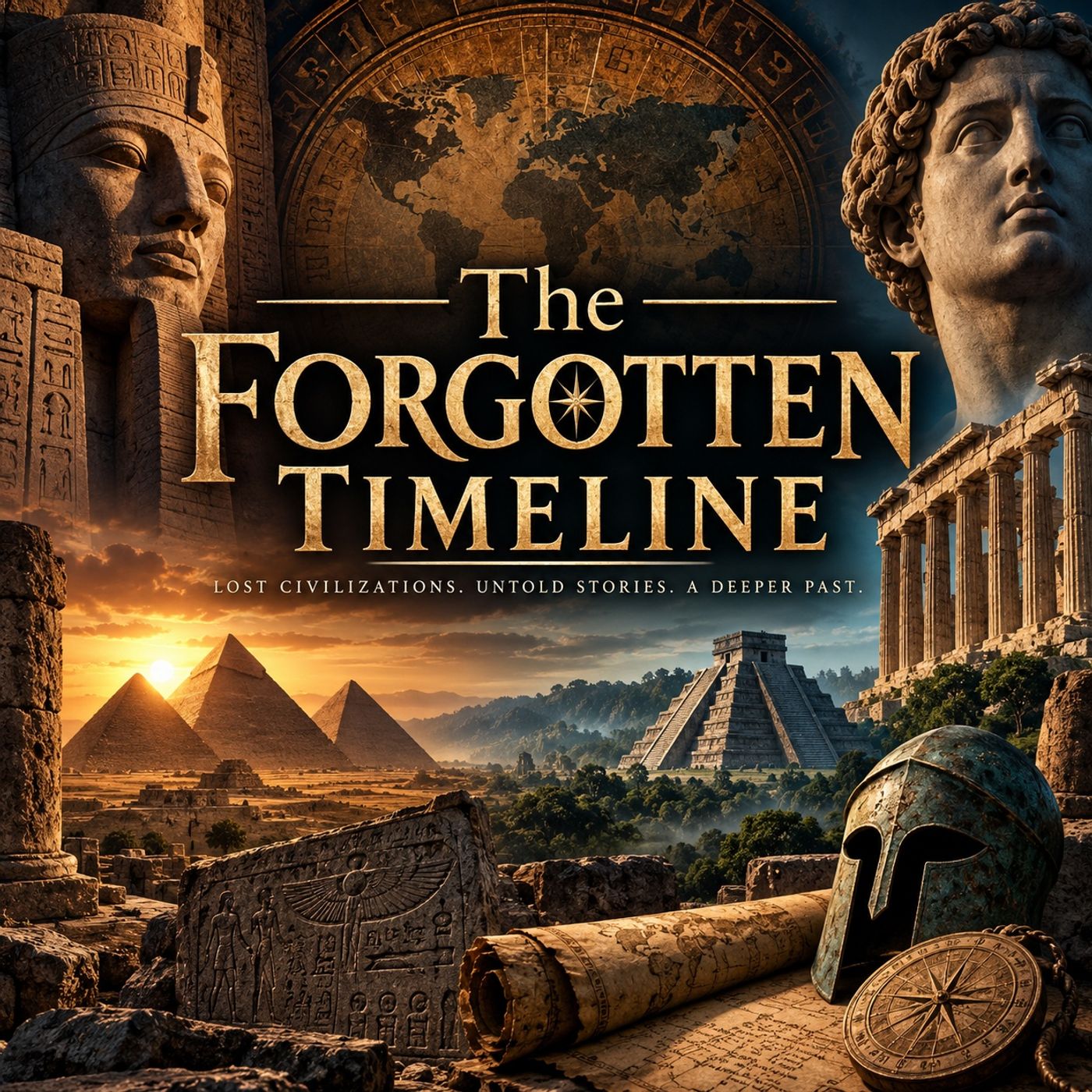
The Forgotten Timeline
AC WilsonAudio
- Format:
- Podcast
- New episodes:
- Daily
- Typical length:
- about 55 minutes
- Latest episode:
About this show
Step into the captivating world of history with "The Forgotten Timeline," a podcast that takes you on an immersive journey through the annals of time. Join us as we unravel the rich tapestry of human civilization, exploring the stories, events, and individuals that have shaped our world.
In each episode, we dive deep into a different era, culture, or pivotal moment in world history, shedding light on the triumphs, challenges, and enduring legacies that continue to resonate today. From the ancient civilizations of Mesopotamia to the revolutions that reshaped nations, from the conquerors who left indelible marks to the visionaries who forged new paths, "The Forgotten Timeline" offers a comprehensive and engaging exploration of our shared past.
Our expert hosts and guests bring history to life, offering fresh perspectives, intriguing anecdotes, and thought-provoking insights that will leave you both informed and inspired. Whether you're a seasoned history buff or just beginning your journey of discovery, this podcast is your passport to understanding the world's most fascinating stories.
Join us on "The Forgotten Timeline " and unlock the secrets, mysteries, and enduring lessons of world history. Subscribe now to embark on an unforgettable voyage through the ages.
The content presented in this history podcast is intended for informational and educational purposes only.
theforgottentimeline.com (https://theforgottentimeline.com)
Show details and episodes come from the publisher's public feed at spreaker.com. Last updated . Names, artwork and text belong to their publishers.
Cosmos
Similar by topic and creator
- Bonjour France Podcast
Shares the topic Arts and Culture and the creator AC Wilson. - Forensic Files Unsealed
Shares the creator AC Wilson. - Murder Files Unsealed
Shares the creator AC Wilson.
Similar shows







Explore more
Episodes
5 Masterpieces Painted by Leonardo da Vinci
· 45 min
Although Leonardo da Vinci left behind a very small catalog of completed paintings, these renowned Renaissance masterpieces share a fascinating history marked by extraordinary events. The famous Mona Lisa transformed into a global icon only after an audacious theft from the Louvre in 1911 sparked a massive worldwide media frenzy. Meanwhile, The Last Supper survived structural degradation, military abuse as a stable, and allied bombing raids that destroyed the surrounding church during World War II. Similarly, the portrait Lady with an Ermine endured wartime looting by the Nazis before being successfully recovered by the Monuments Men and returned to Poland. Furthermore, the elusive Salvator Mundi vanished for centuries, was later mistaken for a cheap copy, and ultimately shattered auction records before disappearing once again into a private collection. Finally, modern forensic technology revealed that The Adoration of the Magi, an unfinished work left behind when da Vinci relocated to Milan, conceals a completely different historical sketch beneath its dark layers of paint. "Those who cannot remember the past are condemned to repeat it". George Santayana This episode includes AI-generated content.
Not rated yetHow Christianity Divided the Roman Empire
· 37 min
During the height of the Roman Empire under Emperor Trajan, the burgeoning Christian movement was viewed as a dangerous threat to imperial authority. To discourage this growing religion and demonstrate absolute power, Roman authorities utilized brutal public executions in venues like the Colosseum, famously feeding believers to wild beasts. A prominent religious leader named Ignatius of Antioch was arrested and brought to Rome, documenting his journey and mindset through surviving letters. Rather than fearing this fate, Ignatius embraced the opportunity for martyred death, believing his willingness to suffer would ultimately help spread the gospel. Although Romans intended these horrific spectacles to terrify citizens and suppress dissent, the joyful sacrifice of the martyrs instead baffled observers and fueled the expansion of Christianity. "Those who cannot remember the past are condemned to repeat it". George Santayana This episode includes AI-generated content.
Not rated yetUniversity of Houston Archaeologists Discover Tomb of First King of Caracol
· 42 min
University of Houston archaeologists Arlen and Diane Chase have uncovered the tomb of Te K'ab Chaak, the foundational ruler of the ancient Maya metropolis of Caracol in Belize. This monumental find, marking the first identifiable leader's burial in forty years of excavation at the site, contains numerous artifacts such as pottery, jadeite jewelry, and a mosaic mask. Additionally, researchers discovered nearby burials and a cremation dating to approximately 350 AD that feature central Mexican items and customs. These early artifacts suggest that Caracol's royalty engaged in formal diplomatic relationships and ritual exchanges with Teotihuacan long before previously documented timelines. Throughout their decades-long career, the Chases have continuously transformed our understanding of Maya society by proving that Caracol was a heavily integrated, decentralized urban center. "Those who cannot remember the past are condemned to repeat it". George Santayana This episode includes AI-generated content.
Not rated yet7 of the Most Fascinating Archaeological Finds of 2025
· 42 min
The episode highlights seven remarkable archaeological discoveries from 2025 that shed light on ancient human history across the globe. Notable finds include the tomb of Egyptian pharaoh Thutmose II, a vibrant Pompeii banqueting room featuring mythological artwork, and a Neanderthal-marked stone bearing an ancient fingerprint. Researchers also uncovered the tomb of a founding Maya king in Belize alongside early Asian smoke-dried mummies preserved for millennia. Additionally, the list details prehistoric stone animal traps discovered in Slovenia and a submerged Ptolemaic pleasure barge near Alexandria. Together, these artifacts offer valuable insight into ancient cultural practices, royal lineages, and early human ingenuity. "Those who cannot remember the past are condemned to repeat it". George Santayana This episode includes AI-generated content.
Not rated yetBarbarossa: The Crusader Emperor
· 52 min
Emperor Frederick Barbarossa, born in 1122, rose to power as a member of the Hohenstaufen dynasty and sought to re-establish imperial authority across a heavily fragmented Holy Roman Empire. Throughout his nearly forty-year reign, his primary ambitions centered on subduing northern Italian cities and managing complex geopolitical conflicts, including participating in the Second Crusade and launching five distinct Italian campaigns. Although he faced significant military setbacks—most notably his defeat at the Battle of Legnano and his untimely death by drowning in the Saleph River during the Third Crusade—he successfully negotiated the Peace of Constance and forged crucial dynastic alliances. Ultimately, while Barbarossa temporarily rejuvenated the empire and left a lasting administrative legacy, the stability of his realm remained heavily dependent upon his own strong personal leadership. "Those who cannot remember the past are condemned to repeat it". George Santayana This episode includes AI-generated content.
Not rated yetThe Second Crusade and the Holy Land - (1147–1149)
· 59 min
The episode chronicles the Second Crusade spanning from 1147 to 1149, detailing its origins in the fall of Edessa and its ultimate failure in the Middle East. It highlights the preaching of Bernard of Clairvaux, the mobilization under King Louis VII of France and King Conrad III of Germany, and the severe logistical and strategic miscalculations that plagued the overland journey. The narrative also explores concurrent campaigns, including the successful, unplanned capture of Lisbon by northern European sailors and the parallel crusade against the Slavic Wends. Ultimately, the sources emphasize how internal divisions, poor leadership, and the catastrophic siege of Damascus inadvertently strengthened Muslim unity under leaders like Nur ad-Din, setting the stage for the eventual loss of Jerusalem. "Those who cannot remember the past are condemned to repeat it". George Santayana This episode includes AI-generated content.
Not rated yetPablo Escobar - Rise and Fall of the Cocaine Kingpin
· 54 min
Pablo Escobar built a massive criminal empire by pioneering the international cocaine trade, amassing billions of dollars, and operating with unprecedented efficiency. Despite funding community projects and winning political office, his organization relied on extreme violence, assassinating judges, politicians, and journalists to avoid American extradition. Following a major drug bust at a jungle laboratory named Tranquilandia, law enforcement relentlessly pursued the cartel leader. Although Escobar negotiated a brief, luxurious imprisonment at a custom facility called La Catedral, he eventually escaped and continued his illicit operations. His deep devotion to his family ultimately caused his downfall, as authorities tracked a lengthy phone call to his son and killed him during a rooftop raid in December 1993. "Those who cannot remember the past are condemned to repeat it". George Santayana This episode includes AI-generated content.
Not rated yetThe First Crusade - (1096–1099) Holy Land
· 1 hr 21 min
The episode chronicle the turbulent history of the First Crusade, beginning with Pope Urban II's 1095 call to arms in France and culminating in the brutal capture of Jerusalem in 1099. Driven by a mix of genuine religious fervor, political ambition, and the promise of spiritual salvation, tens of thousands of Europeans—ranging from impoverished commoners led by Peter the Hermit to heavily armored nobles like Bohemond of Taranto and Godfrey of Bouillon—embarked on a perilous 2,000-mile journey to the Holy Land. Along the way, the expedition was strained by deep mistrust between the Western knights and the Byzantine Empire, brutal sieges at Nicaea, Antioch, and Jerusalem, and fierce internal rivalries among the Christian leaders. These compounding conflicts ultimately resulted in the establishment of four Latin states in the Near East, a devastating massacre of the city's inhabitants upon its fall, and a profound, lasting impact on relations between the Christian and Muslim worlds. "Those who cannot remember the past are condemned to repeat it". George Santayana This episode includes AI-generated content.
Not rated yetMedieval Military History
· 1 hr 13 min
The episode outline four pivotal medieval and early modern sieges that shaped the geopolitical and religious struggle between Christian Europe and the Ottoman Empire. First, the Third Crusade is examined through the grueling two-year Siege of Acre, where Christian forces attempted to retake the Holy Land against Saladin, ultimately culminating in Richard the Lionheart's controversial execution of the city's garrison. Second, the text details the Siege of Rhodes in 1522, where the Knights Hospitaller, led by Philip Villiers de L'Isle-Adam, heroically defended their island stronghold against Suleiman the Magnificent before eventually negotiating an honorable surrender and relocating to Malta. Third, the narrative covers the legendary Great Siege of Malta in 1565, where Grandmaster Jean de Valette and a small band of Christian defenders successfully repelled an overwhelming Ottoman armada through remarkable resilience and a crucial moral victory. Finally, the episode describe the decisive Fall of Constantinople in 1453, where Sultan Mehmed II utilized massive cannons and extraordinary logistical feats to breach the city's legendary walls, marking the end of the Byzantine Empire and the Middle Ages. "Those who cannot remember the past are condemned to repeat it". George Santayana This episode includes AI-generated content.
Not rated yetThe Ancient History of Korea
· 1 hr 0 min
The episode chronicle the epic history of Korea from its prehistoric beginnings and foundational myths through centuries of dynastic rule, foreign invasions, and cultural achievements. They detail the rise and fall of major kingdoms such as Gojoseon, Goguryeo, Baekje, Silla, and Goryeo, highlighting notable periods of innovation like the creation of the Hangul alphabet under King Sejong. The narratives examine the profound hardships inflicted by foreign occupations, notably the devastating Japanese invasions and subsequent colonial rule. Additionally, the passages explore the tragic division of the peninsula following World War II and the outbreak of the Korean War. Ultimately, the sources trace how these historical trials shaped a single, resilient people into two distinct and heavily fortified modern republics. "Those who cannot remember the past are condemned to repeat it". George Santayana
Not rated yetThe Mystery of the Kruger Millions
· 1 hr 0 min
The episode examine the enduring myth of the Kruger Millions, a legendary fortune of gold coins supposedly buried during the Boer War by a vengeful soldier named Fritz DuCane. A South African businessman named Athol Stark became entangled in this obsession after local discoveries of historical gold, inadvertently sparking a massive modern gold rush in his small town. Historical analysis ultimately reveals that a centralized multi-million-pound hoard never existed; instead, the state's gold was largely spent on war debts or hidden in small caches by individual citizens fearing British forces. Despite the absence of a giant motherload, scattered buried coins continue to fuel popular imagination and treasure-hunting ambitions in the South African grasslands. "Those who cannot remember the past are condemned to repeat it". George Santayana
Not rated yetThe Untold Truth of the Ninjas
· 56 min
The episode explores the historical reality and cultural evolution of the ninja, contrasting the documented truth of these feudal Japanese operatives with their mythical pop-culture counterparts. Originating primarily as elite peasant warriors and minor samurai in the mountainous regions of Ega and Koga, these unconventional fighters specialized in espionage, intelligence gathering, and sabotage rather than supernatural combat. Historical manuals reveal that their true strengths relied heavily on pragmatism, psychological manipulation, disguise, and survival, while actual violence was considered a measure of last resort. As a period of prolonged peace rendered their covert services obsolete, organized clans dissolved and vanished from society. However, this historical fading gave rise to a global mythology heavily amplified by theater, literature, and Hollywood, transforming human strategists into supernatural action heroes. Ultimately, the episode highlight how the ninja's enduring legacy shifted from a pragmatic historical function into an immortal, imaginative symbol of stealth and mystery. "Those who cannot remember the past are condemned to repeat it". George Santayana This episode includes AI-generated content.
Not rated yetThe First Barbarian War - Rome: Rise And Fall Of An Empire
· 22 min
During the late second century BC, the Roman Republic faced an existential crisis when migrating tribes like the Cimbri and Teutones launched devastating invasions into Roman-controlled territories. Early military responses led by aristocratic generals such as Carbo ended in catastrophic failures and political corruption. In response to these overwhelming threats, Marius rose to power as a brilliant general who revolutionized the military by recruiting the landless poor rather than restricting service to wealthy property owners. By building a highly disciplined, professional fighting force known as Marius's mules, he successfully crushed the barbarian hordes at the battles of Aqua Sextae and Vercelli. However, his unprecedented consecutive consulships and reliance on military might ultimately undermined democratic norms. Consequently, Marius's legacy shifted the balance of power from the Senate to dominant warlords, paving the way for Rome's eventual transition into an absolute dictatorship. "Those who cannot remember the past are condemned to repeat it". George Santayana This episode includes AI-generated content.
Not rated yetThe Viking Age - The Rise and Fall of the Norse Warriors
· 51 min
The episode details the Viking Age, charting the rise, culture, and ultimate fall of the Norse warriors from Scandinavia. It describes their early, devastating raids on European monasteries like Lindisfarne, which shattered the illusion of security and initiated centuries of conflict. Beyond violence, the narrative emphasizes their sophisticated societal structures, including independent farming communities, elaborate art, governance through assemblies, and advanced longship technology that enabled exploration across open waters. The episode also highlight their extensive trading networks, spanning from Islamic silver routes in the east to the establishment of permanent settlements in Iceland, Greenland, and briefly North America. Finally, the text explains the gradual Christianization of the Norse world and the consolidation of power by kings like Alfred the Great and Canute, culminating in the historic turning point of 1066 that closed the era. "Those who cannot remember the past are condemned to repeat it". George Santayana This episode includes AI-generated content.
Not rated yetThe Entire History of York
· 56 min
The episode chronicles the two-thousand-year history of York, detailing its evolution from a Roman military fortress into a vibrant cultural and political hub. It highlights the city's tumultuous eras, including Viking colonization, the devastation of the Black Death, and severe wartime bombings, alongside periods of incredible architectural and educational growth. Through numerous trials such as rebellions, plagues, and fires, York has consistently rebuilt itself, eventually transforming from an ancient seat of power into a cherished modern tourist destination. "Those who cannot remember the past are condemned to repeat it". George Santayana This episode includes AI-generated content.
Not rated yetHow Vikings Became Brutal Norman Kings
· 56 min
The episode traces the remarkable transformation of Viking raiders into the dominant Norman rulers of medieval Europe. Originally feared as brutal maritime plunderers who terrorized Frankish monasteries, these northmen ultimately integrated into local society by adopting Christianity and intermarrying with the French nobility. Led by figures like Rolo and William the Conqueror, they forged a powerful duche in northern France before successfully launching the Norman Conquest of England in 1066. Through a combination of ferocious military strategy, architectural intimidation via stone castles, and shrewd political administration recorded in the Doomsday Book, the Normans fundamentally reshaped English society, language, and culture. "Those who cannot remember the past are condemned to repeat it". George Santayana This episode includes AI-generated content.
Not rated yetThe Mystery Of The Vampire Skeletons Buried In Ireland
· 49 min
Archaeologists and historians investigating unusual medieval graves across Europe have uncovered compelling evidence of a long-standing fear of the undead. Discoveries such as skeletons pinned down with boulders, staked through the heart, or forcefully silenced with stones indicate that ancient communities went to extreme lengths to prevent corpses from rising again. These aggressive burial practices, often labeled as deviant, reflect deep-seated superstitions that were frequently exacerbated by religious shifts and chronicled in medieval texts. Furthermore, striking parallels can be found between these historical measures and surviving folk traditions in modern rural Europe, where people still perform protective rituals against revenants. Ultimately, these findings reveal how centuries of superstition transformed from a medieval terror of reanimated corpses into our modern cultural fascination with vampires. "Those who cannot remember the past are condemned to repeat it". George Santayana This episode includes AI-generated content.
Not rated yetThe Forgotten Origins Of Medieval Britain
· 50 min
Following the collapse of Roman Britain, the region experienced significant societal transformation and the emergence of early medieval kingdoms like Wales, Cornwall, and Brittany. Archaeological evidence reveals how native populations transitioned from centralized Roman administration to decentralized local power structures, often occupying Iron Age hill forts such as Dinas Powys. Concurrently, regional folklore and legendary origin tales—including the myth of the Trojan warrior Brutus and the traditional stories collected in the Mabinogion—shaped a distinct Celtic identity. These surviving legends, alongside material artifacts like imported Mediterranean pottery and early Christian burials, highlight a complex era of cultural blending, trade, and myth-making following the retreat of the empire. "Those who cannot remember the past are condemned to repeat it". George Santayana This episode includes AI-generated content.
Not rated yetMONGOLIA: How People Live in 'The Emptiest Country on Earth'
· 39 min
Mongolia is presented as a land of extreme contrasts and enduring traditions, where vast steppes, harsh deserts, and towering mountains shape a uniquely resilient way of life. The episode explores the nation's rich history, from the legendary empire of Genghis Khan to the spiritual impact of ancient monasteries and Soviet-era influences. Traditional nomadic culture thrives through portable yurts, horsemanship, and close bonds with animals like camels, yaks, and golden eagles. Despite facing modern challenges such as severe winters and climate change, the Mongolian spirit persists, blending ancient customs with contemporary urban and democratic growth. "Those who cannot remember the past are condemned to repeat it". George Santayana This episode includes AI-generated content.
Not rated yetAntarctica - History and Secrets of the Frozen Continent
· 56 min
Antarctica serves as a mysterious frozen continent harboring ancient secrets beneath its massive ice sheets, including prehistoric forests, subglacial lakes, and anomalous geometric structures that inspire various conspiracy theories. While theorists speculate about hidden Nazi bases, subterranean civilizations, and extraterrestrial craft, mainstream researchers focus on its geological evolution and climate history captured within ancient ice cores. Historical expeditions like Operation Highjump and the signing of the Antarctic Treaty have fueled ongoing secrecy debates regarding the heavily restricted landmass. Furthermore, contemporary scientific observation reveals that rapid global warming is causing glaciers to melt and ice shelves to collapse, potentially allowing the continent to green again while threatening global sea levels. Ultimately, this isolated region functions as both a critical natural laboratory for understanding Earth's past and future climates and an unpredictable ecosystem vulnerable to non-native biological invasions. "Those who cannot remember the past are condemned to repeat it". George Santayana This episode includes AI-generated content.
Not rated yet