The Forgotten Timeline
AC WilsonAudio
- Format:
- Podcast
- New episodes:
- Daily
- Typical length:
- about 55 minutes
- Latest episode:
About this show
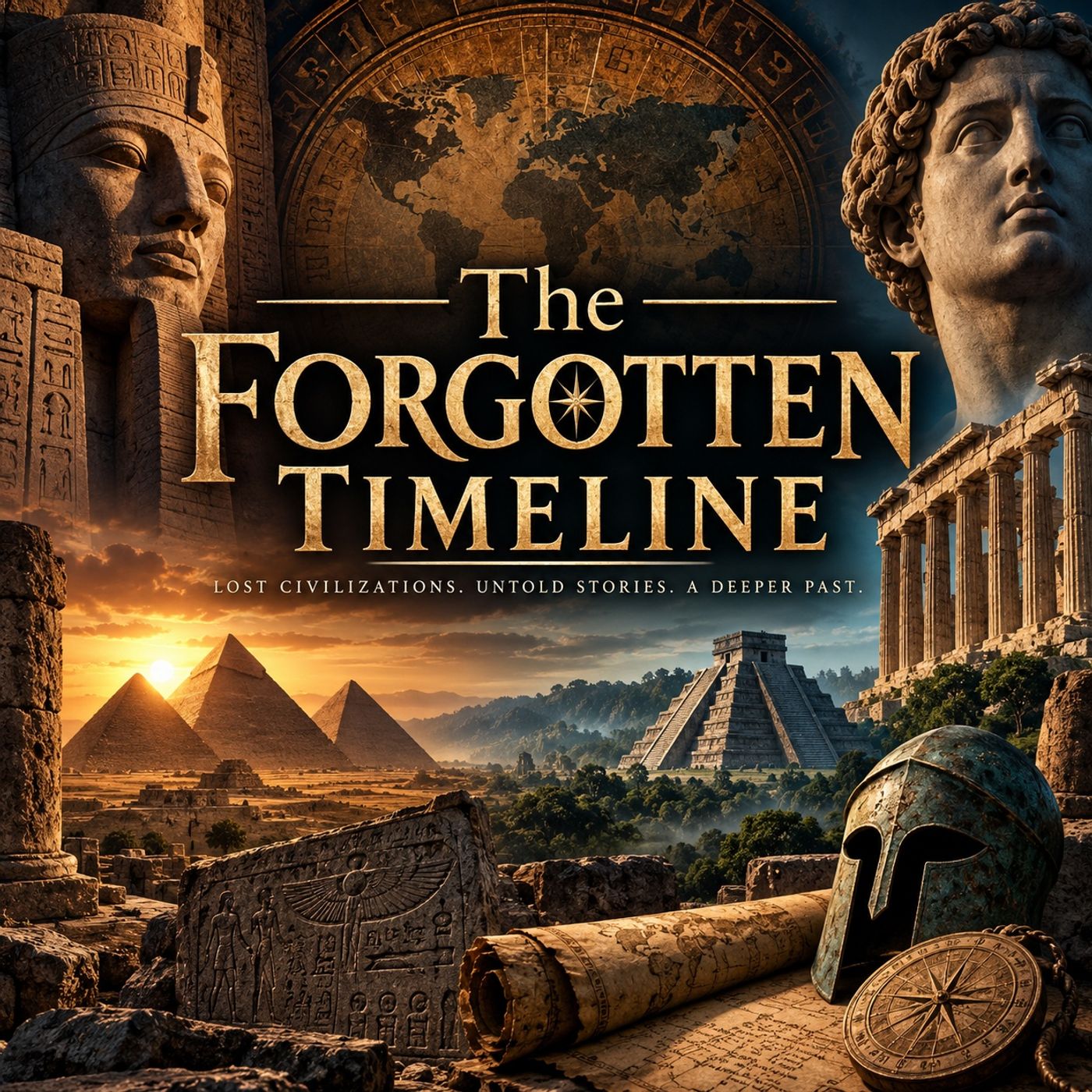
Step into the captivating world of history with "The Forgotten Timeline," a podcast that takes you on an immersive journey through the annals of time. Join us as we unravel the rich tapestry of human civilization, exploring the stories, events, and individuals that have shaped our world.
In each episode, we dive deep into a different era, culture, or pivotal moment in world history, shedding light on the triumphs, challenges, and enduring legacies that continue to resonate today. From the ancient civilizations of Mesopotamia to the revolutions that reshaped nations, from the conquerors who left indelible marks to the visionaries who forged new paths, "The Forgotten Timeline" offers a comprehensive and engaging exploration of our shared past.
Our expert hosts and guests bring history to life, offering fresh perspectives, intriguing anecdotes, and thought-provoking insights that will leave you both informed and inspired. Whether you're a seasoned history buff or just beginning your journey of discovery, this podcast is your passport to understanding the world's most fascinating stories.
Join us on "The Forgotten Timeline " and unlock the secrets, mysteries, and enduring lessons of world history. Subscribe now to embark on an unforgettable voyage through the ages.
The content presented in this history podcast is intended for informational and educational purposes only.
theforgottentimeline.com (https://theforgottentimeline.com)
Show details and episodes come from the publisher's public feed at spreaker.com. Last updated . Names, artwork and text belong to their publishers.
Cosmos
Similar by topic and creator
- Bonjour France Podcast
Shares the topic Arts and Culture and the creator AC Wilson. - Murder Files Unsealed
Shares the creator AC Wilson. - Forensic Files Unsealed
Shares the creator AC Wilson.
Similar shows







Explore more
Episodes
The Complete History Of Scotland Vs. England
· 56 min
The episode offer a comprehensive historical overview of the intense medieval conflicts between Scotland and England, focusing primarily on the pivotal Battle of Bannockburn in 1314 and the devastating Battle of Flodden in 1513. Through detailed accounts of shifting political allegiances, military strategies, and leadership dynamics, the episode highlight how Scottish monarchs like Robert the Bruce and King James IV navigated treacherous geopolitical landscapes against English sovereigns such as Edward I, Edward II, and Henry VII. The narratives emphasize the crucial roles that terrain, tactical preparation, and weaponry played in these defining engagements, ultimately shaping the pursuit of Scottish independence and national identity. "Those who cannot remember the past are condemned to repeat it". George Santayana This episode includes AI-generated content.
Not rated yetThe ENTIRE History Of The Vietnam War | 1862 - 1975
· 1 hr 8 min
The Vietnam War was a protracted and devastating conflict spanning over two decades, originating from centuries of foreign colonization and resistance against Chinese and French rule. Following the Geneva Conference of 1954, Vietnam was divided into the communist North led by Ho Chi Minh and the Western-backed South governed by Ngo Dinh Diem, ultimately igniting a major Cold War battleground for the United States. Despite massive military interventions, including aerial campaigns and ground operations, American forces struggled against the resilient guerrilla warfare tactics and extensive tunnel networks utilized by the Vietcong and North Vietnamese army. Mounting casualties and internal political corruption in the South severely damaged public trust, culminating in the shocking Tet Offensive of 1968 and widespread anti-war protests across the United States. Following the withdrawal of American troops under the Paris Peace Accords of 1973, North Vietnamese forces launched the Ho Chi Minh Campaign in 1975, successfully capturing Saigon and officially reunifying the nation under communist leadership. "Those who cannot remember the past are condemned to repeat it". George Santayana This episode includes AI-generated content.
Not rated yetThe Moon Landing - World's Greatest Hoax?
· 1 hr 4 min
The episode examines popular moon landing conspiracy theories and contrasts them with scientific evidence supporting the Apollo missions. Skeptics argue that the events were fabricated by NASA and Hollywood due to anomalies in photographs, technical limitations of 1960s computers, and the hazards of radiation. However, experts counter these claims by explaining optical phenomena, specialized equipment adaptations, and survival strategies used during space travel. Furthermore, the narrative highlights third-party verification, such as foreign radio tracking, satellite imagery, and lunar laser reflectors left on the surface. Ultimately, the sources conclude that faking such a massive historical event would have been far more difficult than actually traveling to the moon. "Those who cannot remember the past are condemned to repeat it". George Santayana This episode includes AI-generated content.
Not rated yetThe Irish Wars 1919-1923
· 54 min
Following Ireland’s War of Independence against Great Britain, the resulting Anglo-Irish Treaty created deep divisions that sparked a brutal Irish Civil War between 1922 and 1923. Anti-treaty republicans, led by figures like Eamon de Valera, rejected the newly established Irish Free State and its compromises, including the partition of Northern Ireland and required allegiance to the British Crown. Conversely, pro-treaty leaders such as Michael Collins viewed the agreement as a strategic stepping-stone toward total sovereignty and successfully built the National Army to suppress the rebellion. Despite holding initial advantages in guerrilla warfare, anti-treaty forces ultimately collapsed due to heavy government suppression, military executions, and a critical lack of public support. Ultimately, the conflict concluded with the defeat of the IRA, leaving a legacy of political division that foreshadowed decades of future unrest in the region. "Those who cannot remember the past are condemned to repeat it". George Santayana This episode includes AI-generated content.
Not rated yetWho Sank The Titanic? - The Secrets Behind the History
· 55 min
The tragic sinking of the RMS Titanic on April 14, 1912, was not merely the result of colliding with an iceberg, but rather the culmination of a disastrous chain of human errors, design flaws, and unfortunate circumstances. Built with lowered watertight bulkheads and a subpar grade of wrought iron rivets containing excessive slag, the supposedly unsinkable vessel suffered catastrophic hull failures upon impact. Compounding these structural vulnerabilities were fatal operational oversights, including a shortage of lifeboats, ignored ice warnings, missing binoculars for lookouts, and excessive speeds through treacherous waters. Ultimately, these compounding factors caused the magnificent ship to plunge to the ocean floor in a mere two hours, resulting in the needless loss of over 1,500 lives and forever altering maritime safety regulations. "Those who cannot remember the past are condemned to repeat it". George Santayana This episode includes AI-generated content.
Not rated yetWhat Was Life In Dark Age Britain Really Like?
· 54 min
Archaeological discoveries challenge the traditional narrative of the British Dark Ages as a time of violent barbarian invasions, cultural collapse, and economic ruin. Instead of being completely destroyed or displaced by Romans and Anglo-Saxons, native British society proved remarkably resilient, maintaining continuous agricultural practices, deep-rooted religious traditions, and expanding international trade networks with the Mediterranean and Byzantium. New scientific methods, such as DNA and isotope analysis, reveal that population changes were far more gradual and peaceful than previously believed, driven largely by shifting fashions, languages, and cultural assimilation rather than mass migration. Ultimately, historical sources crafted centuries later by figures like Bede created misleading origin myths that oversimplified Britain's past to establish a pure national identity. In contrast, actual historical evidence demonstrates that British identity was forged through centuries of successfully absorbing and adapting diverse foreign influences, proving that the nation's true strength lies in its cultural diversity. "Those who cannot remember the past are condemned to repeat it". George Santayana This episode includes AI-generated content.
Not rated yetThe 8,000-Year Empire of the Sacred Leaf
· 1 hr 0 min
The episode traces the remarkable eight-thousand-year history of the coca leaf, following its journey from ancient Andean survival tool and sacred Inca spiritual symbol to colonial exploitation and the global illicit drug trade. It highlights how the plant's isolated active compound, cocaine, revolutionized modern medicine as the foundation for local anesthetics and fueled the success of popular consumer products like Coca-Cola. Furthermore, the narrative details the devastating rise of cartels and mass violence in the twentieth century, alongside the sweeping socio-economic impacts of the war on drugs. Ultimately, the source concludes that while the plant itself has remained fundamentally unchanged for millennia, human society continually transforms its meaning through commerce, medicine, and conflict. "Those who cannot remember the past are condemned to repeat it". George Santayana This episode includes AI-generated content.
Not rated yetMalcolm X: The Rise and Fall of America's Most Enlightened Voice
· 1 hr 0 min
Malcolm X navigated a tumultuous journey from his impoverished childhood and criminal youth in Boston and New York to becoming a pivotal minister and influential leader within the Nation of Islam. His unwavering dedication to black self-reliance and racial separation eventually gave way to a broader international perspective on human rights following his historic pilgrimage to Mecca. After breaking ties with the Nation of Islam, he faced mounting death threats and political isolation before his tragic assassination in 1965 at the age of thirty-nine. Despite his untimely death, his revolutionary ideas and uncompromising critique of systemic racism continued to inspire global movements for black liberation and social justice for generations. "Those who cannot remember the past are condemned to repeat it". George Santayana This episode includes AI-generated content.
Not rated yetRoots of the British Empire
· 1 hr 2 min
The episode detail the global expansion and evolution of the British Empire, tracing its trajectory from early medieval conflicts in the British Isles to its emergence as a worldwide superpower. The texts chronicle significant historical milestones, including the unification of England and Scotland, early explorations and the establishment of colonies in the Americas, the Caribbean, and India, as well as the devastating impact of the transatlantic slave trade. Furthermore, the documentation highlights major geopolitical struggles such as the Seven Years' War and the American Revolution, alongside domestic religious reforms and the empire's ultimate reach across multiple continents. "Those who cannot remember the past are condemned to repeat it". George Santayana This episode includes AI-generated content.
Not rated yetHow Were the Americas Colonized?
· 1 hr 3 min
Christopher Columbus's historic voyage in 1492 initiated a massive wave of European expansion that transformed the Americas through violent conquest, forced religious conversion, and the devastating introduction of foreign diseases that decimated indigenous populations. Spain quickly established a vast and lucrative empire centered on gold and silver mining, while Portugal claimed Brazil and developed a dominant sugar economy driven by the transatlantic slave trade. Although competing powers like Britain, France, and the Netherlands initially faced severe struggles with harsh weather, starvation, and native resistance, they eventually carved out their own influential colonies through fur trading, agriculture, and plantation slavery. Over the following centuries, fierce geopolitical conflicts in Europe frequently spilled over into the New World, redrawing borders and continuously shifting the balance of colonial power among the rival empires. Ultimately, the growing self-reliance, prosperity, and deep-seated resentment of British colonists against imperial taxation culminated in the Declaration of Independence in 1776, forever altering the course of global history. "Those who cannot remember the past are condemned to repeat it". George Santayana This episode includes AI-generated content.
Not rated yetETHIOPIA: The Most Ancient Country on Earth
· 1 hr 18 min
Ethiopia stands as a remarkably ancient nation, recognized globally as a foundational birthplace of humanity where some of the earliest human ancestors and fossil discoveries originated. The country boasts dramatic, extreme landscapes ranging from the searing heat of the Danakil Depression to the jagged peaks of the Simien Mountains, which have profoundly shaped both local wildlife and human survival strategies. Steeped in deep religious and imperial history, the region features architectural marvels carved directly into solid rock, such as the famous monolithic churches of Lalibela and the cliffside sanctuaries of Tigray. Furthermore, Ethiopia holds a unique place in modern history by successfully resisting colonization, offering an inspiring bridge of peaceful coexistence between Christianity and Islam, and giving the world treasured cultural gifts like coffee. Today, this rapidly growing nation seamlessly balances its ancient traditions, diverse indigenous tribes of the Omo Valley, and rich heritage with rapid urbanization and a forward-looking modern skyline. "Those who cannot remember the past are condemned to repeat it". George Santayana This episode includes AI-generated content.
Not rated yetHow Close Nazi Germany Came To Conquering Europe - WW2
· 1 hr 13 min
Following World War I, the Treaty of Versailles imposed heavy financial and territorial penalties on Germany, creating deep resentment and economic instability that eventually enabled Adolf Hitler and the Nazi Party to seize absolute power in 1933. Simultaneously, global economic turmoil during the Great Depression fueled aggressive expansionism by Japan in Asia and Benito Mussolini’s fascist regime in Italy, while Allied democracies like Britain and France remained dangerously weak, hesitant, and isolationist. As Hitler initiated a rapid rearmament and aggressive territorial campaign—annexing Austria and the Sudetenland—the League of Nations proved entirely impotent to stop international aggression, ultimately culminating in the outbreak of World War II when German forces invaded Poland in September 1939. Despite initial stunning successes through Blitzkrieg tactics that conquered Western Europe and France by 1940, Germany faced a pivotal turning point after failing to defeat Britain in the Battle of Britain and launching a disastrous, overextended invasion of the Soviet Union via Operation Barbarossa. Ultimately, the resilience of Allied resistance, combined with critical intelligence breakthroughs at Bletchley Park and the immense industrial and military might of the entering United States, systematically dismantled Axis momentum and turned the tide of the war against Nazi Germany. "Those who cannot remember the past are condemned to repeat it". George Santayana This episode includes AI-generated content.
Not rated yetWhy Did Nazi Germany Abandon Their Plan To Invade Britain? World War II
· 55 min
Following the fall of France, Britain stood alone against Nazi Germany while preparing its defenses against a potential cross-channel invasion known as Operation Sea Lion. Despite being heavily outnumbered, the Royal Air Force successfully utilized radar and strategic deployments to withstand the German Luftwaffe during the Battle of Britain. Simultaneously, British codebreakers at Bletchley Park managed to decipher critical Enigma communications, providing the Allies with invaluable intelligence termed "Ultra." To counter the ongoing threat, Prime Minister Winston Churchill fostered a crucial relationship with President Franklin Roosevelt, securing vital American industrial and military aid through the Lend-Lease program. Ultimately, Britain bolstered its offensive capabilities by forming commando units and supporting European resistance networks, laying the groundwork for eventual victory alongside new allies. "Those who cannot remember the past are condemned to repeat it". George Santayana This episode includes AI-generated content.
Not rated yetLife Under Adolf Hitler: The First Years Of Nazi Germany
· 59 min
Adolf Hitler initially consolidated power in Germany by prioritizing economic recovery and public works, such as the autobahn, to reduce staggering unemployment and win over skeptical citizens. Beneath this prosperous facade, the regime systematically dismantled trade unions, suppressed political opposition, and engineered a pervasive national community designed to indoctrinate the populace. As economic strains and covert rearmament pushed the nation toward potential conflict, Hitler progressively escalated his ideological agenda against targeted groups. By exploiting manufactured crises and deploying intensive propaganda, the regime successfully shifted public sentiment and normalized severe persecution, culminating in violent state-sanctioned attacks like Kristallnacht. Ultimately, these calculated psychological and political strategies transformed ordinary German citizens into complicit participants in an increasingly radical racial state. "Those who cannot remember the past are condemned to repeat it". George Santayana This episode includes AI-generated content.
Not rated yet1918-1939: What Really Started World War 2?
· 53 min
Following World War I, the Treaty of Versailles reshaped European borders and burdened Germany with severe financial penalties, creating deep resentment and economic instability that ultimately paved the way for totalitarian regimes. During the global economic crisis of the Great Depression, aggressive leaders like Adolf Hitler in Germany and Benito Mussolini in Italy seized absolute power, systematically dismantling democratic institutions and rebuilding their military forces. Meanwhile, global peacekeeping organizations like the League of Nations proved entirely impotent, failing to stop imperialist expansions such as Japan's invasion of Manchuria, Italy's conquest of Abyssinia, and the fascist intervention in the Spanish Civil War. Major Western democracies like Britain and France, traumatized by past casualties and preoccupied with domestic turmoil, repeatedly chose appeasement over confrontation as Hitler brazenly annexed Austria and the Sudetenland. Finally, after signing a shocking non-aggression pact with the Soviet Union to secure his eastern front, Hitler invaded Poland in September 1939, plunging the world into a catastrophic global conflict. "Those who cannot remember the past are condemned to repeat it". George Santayana This episode includes AI-generated content.
Not rated yetHo Chi Minh: The Communist Who Defeated the West
· 1 hr 9 min
Born Nguyen Sinh Cung, Ho Chi Minh dedicated his entire life to securing independence and freedom for his native country through decades of anti-colonial resistance and political organizing. Operating under numerous aliases across the globe, he spent years in Europe, Asia, and the Soviet Union studying revolutionary tactics and eventually co-founding the Indochinese Communist Party to combat French and Japanese dominance. Although he embraced communism, he frequently prioritized national liberation over strict ideology, making tactical compromises and forging alliances with major global powers to achieve his goals. Following the founding of the Democratic Republic of Vietnam in 1945, he successfully guided his people through protracted military conflicts against both France and the United States. Although he passed away before witnessing the final unification of the country, his strategic vision and lifelong dedication ultimately shaped the emergence of the modern Socialist Republic of Vietnam. "Those who cannot remember the past are condemned to repeat it". George Santayana This episode includes AI-generated content.
Not rated yetWho Were the Taíno, the Original Inhabitants of Hispaniola
· 32 min
The episode highlights the inspiring journey of a woman who discovers her indigenous Taino heritage after decades of believing she was of Carib descent. Through genealogical research and connection with Roberto Mukaro Borrero, a kasike of the Guainia Taino Tribe, she learns to challenge the historical myth that the Taino people were rendered completely extinct following European colonization. Her personal quest culminates in her own appointment as a female kasike and the official federal recognition of the Taino community within the Virgin Islands after a decade of dedicated effort. Moving forward, the restored nation actively campaigns for land back initiatives to establish a cultural and educational village that preserves their ancestral history. Ultimately, this narrative celebrates indigenous resilience and survival, proving that modern descendants continue to honor and revitalize their rich cultural legacy. "Those who cannot remember the past are condemned to repeat it". George Santayana This episode includes AI-generated content.
Not rated yetThe Real Assassin's Creed: Deadliest Special Forces Of The Dark Ages
· 27 min
Medieval women actively participated in the workforce across a wide range of rigorous occupations, from dairy farming and brewing to professional baking, stonemasonry, and metalworking. Despite facing systemic limitations, such as exclusion from male-dominated guilds unless inheriting a family business, these women contributed significantly to society and the daily economy. Concurrently, medieval London functioned as a complex urban center composed of diverse, distinct communities—including lawyers, merchants, and marginalized groups—whose fortunes fluctuated based on their political and financial utility to those in power. Ultimately, both the diligent female laborers of the era and the shifting urban populace formed an interrelated tapestry that sustained medieval life and civilization. "Those who cannot remember the past are condemned to repeat it". George Santayana This episode includes AI-generated content.
Not rated yetFrank Lucas: The REAL Story of the Blue Magic Takedown
· 1 hr 2 min
During the late 1960s and early 1970s, a devastating heroin epidemic flooded the New York tri-state area with a lethal, high-grade product known as Blue Magic. Law enforcement authorities, spearheaded by Assistant US Attorney Dom Amarosa in New York and Assistant District Attorney Richie Roberts in New Jersey, launched aggressive and independent task forces to dismantle the criminal network responsible for the crisis. Investigators ultimately traced the illicit enterprise to Frank Lucas, a ruthless Harlem kingpin who controlled a vast territory using brutal family enforcers called the Country Boys. After uncovering crucial evidence, including financial ledgers and testimony from Lucas's own nephew, law enforcement successfully arrested the drug lord. Confronted with overwhelming proof and powerful emotional testimony from a victim's mother, Lucas was convicted and sentenced to decades in prison. Seeking reduced prison time, Lucas ultimately cooperated with authorities, exposing his suppliers and corrupt associates to bring a massive narcotics empire to an end. "Those who cannot remember the past are condemned to repeat it". George Santayana This episode includes AI-generated content.
Not rated yetJohn Wayne Gacy: The Serial Killer Clown
· 49 min
John Wayne Gacy maintained a facade of respectability as a successful businessman, community volunteer, and entertaining neighbor while concealing a dark identity as a prolific serial killer. Despite suffering from an abusive childhood and a difficult relationship with his father, Gacy leveraged his charm to lure young men and boys into a false sense of security before subjecting them to savage torture and murder. Although he previously served prison time for sexual assault, he managed to evade major suspicion for years by targeting vulnerable runaways and transient youths whose disappearances often went ignored. The gruesome reality of his crimes was finally uncovered in 1978 when police investigated the disappearance of teenager Robert Piest and discovered a hidden crawl space packed with dozens of decomposing bodies. Ultimately convicted of thirty-three murders, Gacy was sentenced to death and executed in 1994, leaving experts to debate whether his heinous actions stemmed from childhood trauma or an innate lack of conscience. "Those who cannot remember the past are condemned to repeat it". George Santayana This episode includes AI-generated content.
Not rated yet