

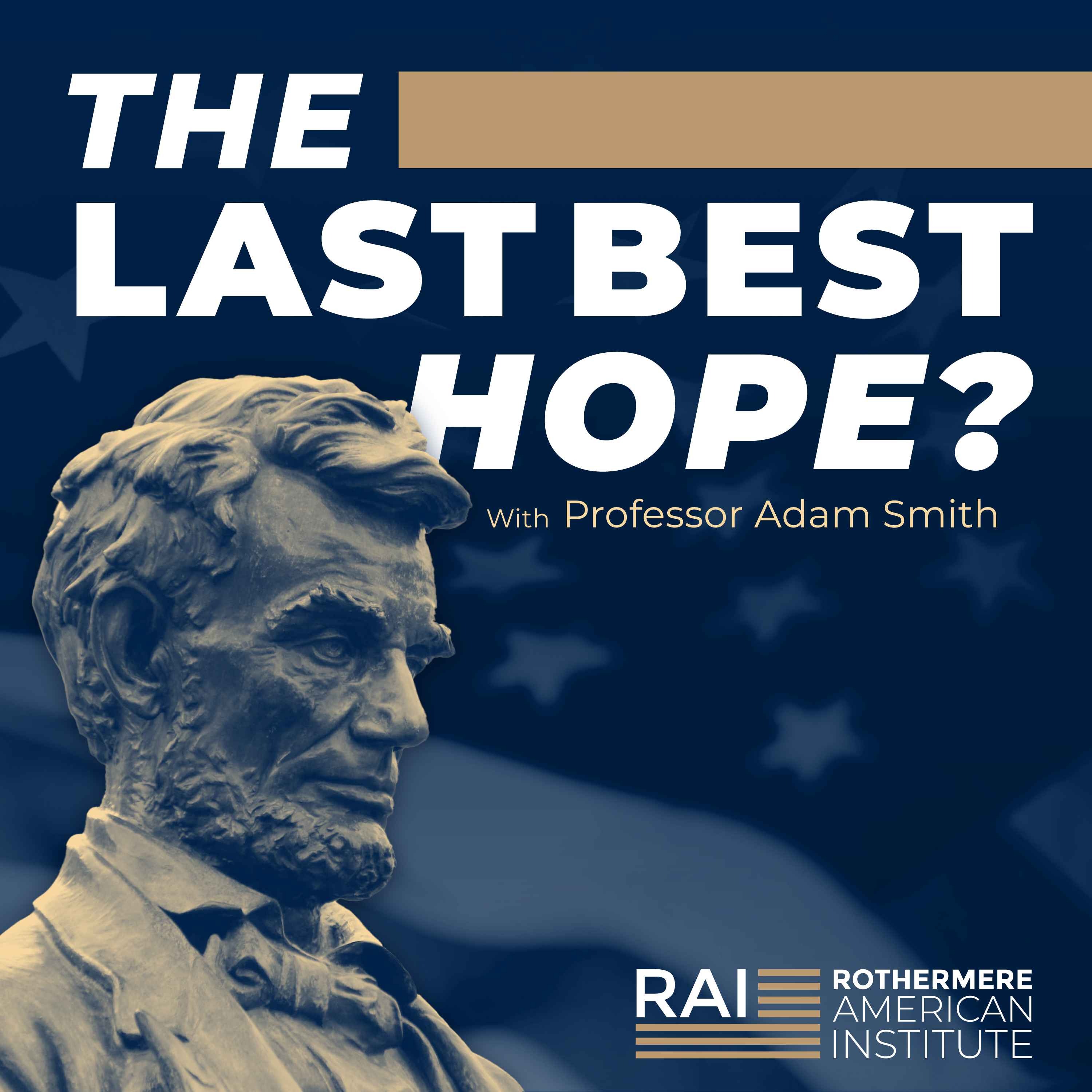
The Last Best Hope?
Adam SmithAudio
- Format:
- Podcast
- New episodes:
- Weekly
- Typical length:
- about 40 minutes
- Latest episode:
About this show
Abraham Lincoln called the United States “the last best hope of Earth.” In this podcast, we ask whether that claim still holds — and whether it ever did.
Each episode takes a figure, idea, or moment in American political history and asks what it tells us about the country’s understanding of itself, always with an eye to how America looks from the outside in. The Last Best Hope? takes ideas seriously: America as a creed, the arguments of the people who built and remade it, and what America has meant to the rest of the world. We take our subjects from history, not the news — though the present is rarely far away.
Hosted by Adam Smith, Orsborn Professor of American Political History and Director of the Rothermere American Institute at Oxford, The Last Best Hope? brings him into conversation with leading scholars and public figures, including Hillary Clinton, Annette Gordon-Reed, Eric Foner, David Frum, Heather Cox Richardson, Stacy Schiff, Jonathan Freedland, James Morone, Michael Kazin, Kevin Kruse, Julian Zelizer, Bruce Schulman, Ty Seidule, Liz Varon, Eric Rauchway, Phil Tinline, Emily Bazelon, Richard Carwardine, Rachel Shelden, Richard Blackett, Devin Fergus, and Dan Jackson.
“Adam Smith is one of the UK’s foremost historians of America, and communicates his expertise with zest, wit and unforced passion. The Last Best Hope? brings him together with fellow scholars to provide a unique insight we can’t do without.” — Phil Tinline, BBC radio documentary-maker and author
“The Last Best Hope is an absolutely brilliant podcast. Thoughtful, clever, engaging and accessible, Adam Smith always gets the best out of his guests, and I’ve learned an enormous amount from every episode. I love it.” — Dominic Sandbrook, historian and co-host of The Rest is History
“The must-listen US podcast.” — Nick Bryant, former BBC Correspondent in New York
Produced by the Rothermere American Institute, University of Oxford. https://www.rai.ox.ac.uk/home
Hosted on Acast. See acast.com/privacy (https://acast.com/privacy) for more information.
Covers: American history, US politics, American political history, US elections, declaration of independence, American revolution, American sports culture, religious history, impeachment, anglo-American relations
Show details and episodes come from the publisher's public feed at feeds.acast.com. Last updated . Names, artwork and text belong to their publishers.
Recently on this show
Summary of recent episodes, drawn from the publisher's feed.
Adam Smith's history podcast asks whether America's claim to be the world's last best hope still holds. Recent episodes cover Mormons and the republic, presidential impeachment, why presidents lose midterms, and why America doesn't love soccer.
Cosmos
Similar in subject
- Short Talk Bulletin
Both cover: declaration of independence, american revolution - The American Idea
Both cover: american revolution, us elections, american history - Washington Week PBS
Both cover: impeachment, us politics
Similar shows




Explore more
Episodes
The Geordie South: How Northumbrians shaped Appalachia
· 36 min
Half a million Northumbrians, the proud people of the English-Scottish border region, settled in the Appalachian mountains in the eighteenth century. And they left their mark in the song, speech and maybe even politics. Geordie culture: the often overlooked element in the forging of the American South. Adam talks to Dan Jackson, author of The Northumbrians: Northeast England and its People, and Ted Olson, Professor of Appalachian Studies at East Tennessee State University. Hosted on Acast. See acast.com/privacy (https://acast.com/privacy) for more information.
Not rated yetA City on a Hill: The exceptional history of a powerful metaphor
· 45 min
It is one of America’s most powerful founding myths – the pilgrims on an errand into the wilderness to create a new model society– “we shall be like a city upon the hill,” Massachusetts Bay Colony Governor Winthrop was supposed to have said in 1630, “the eyes of the world upon us”. Separated, yet visible – just like the ark, the responsibilities of such a community were awesome, the prospect of failure terrifying. What does the enduring power of this phrase tell us about American political culture? Adam is joined by Sam Haselby, a historian of religion and American nationalism, and senior editor at Aeon, and David Frum, Atlantic columnist, senior editor at Atlantic, and former speechwriter for George W. Bush. Hosted on Acast. See acast.com/privacy (https://acast.com/privacy) for more information.
Not rated yetWas there a Culture War in nineteenth century America?
· 47 min
The country is deeply polarised. Each party believes the other not just to be wrong on public policy questions but a profound threat to the nation. At stake are the most fundamental of questions about the values that underpin society. The US today? But also the US in the 1850s. Culture Wars are nothing new. In this episode Adam talks to two historians who have broken the mould of how to think about the Civil War era by recognising how cultural issues like gender could shape every other political issue: Lauren Haumesser, author of The Democratic Collapse: How Gender Politics Broke a Party and a Nation, 1856-1861, and Mark Power Smith, a Research Fellow at the RAI, and the author of Young America: The Transformation of Nationalism before the Civil War. So, how do culture wars start, why are they fought... and how do they end? Hosted on Acast. See acast.com/privacy (https://acast.com/privacy) for more information.
Not rated yetAre there lessons for Biden from the Presidency of Lyndon Johnson?
· 51 min
In 1968, an elderly Democrat President, with major legislative achievements behind him, who had served as Vice President to younger, more charismatic man, decided he could not win a second election. What lessons are there for Joe Biden from the troubled, truncated presidency of Lyndon B. Johnson? Adam talks to Kevin Kruse, the eminent Princeton historian, author of many books on postwar US political history, including most recently Myth America and Mark Lawrence, the Director of the LBJ Library in Austin, Texas, and author of The End of Ambition: The US and the Third World. Together they discuss how LBJ's legacy should be assessed today, and why he decided -- unlike President Biden -- not to seek a second full term. Leave us your best reviews wherever you get your podcast and please subscribe for more forward-thinking discussions of the American past. Hosted on Acast. See acast.com/privacy (https://acast.com/privacy) for more information.
Not rated yetLincoln's "House Divided" speech and the Coming of the Civil War
· 47 min
The speech that triggered the Civil War? In a speech in the State Capitol building in Springfield, Illinois, in 1858, Abraham Lincoln warned that a "house divided against itself cannot stand" and that the nation, like a house divided, could not remain "half slave and half free" but would have to become all one thing or all the other. The crisis had arrived; the choice was between complete freedom and complete slavery. Why did Lincoln say this, and what were the consequences? Adam travels to Springfield to find out. Featuring Professor Graham Peck, Distinguished Professor of Lincoln Studies at the University of Illinois, Springfield, and Christian McWhirter, Lincoln Historian at the Abraham Lincoln Presidential Library and Museum. Hosted on Acast. See acast.com/privacy (https://acast.com/privacy) for more information.
Not rated yetThe Second Amendment, with Saul Cornell
· 40 min
Why is gun control so hard to accomplish in American politics, despite the number of mass shootings now averaging one a week? Adam talks to Saul Cornell, the leading historian of the Second Amendment, about how the Constitution shapes the politics and culture of guns in the United States. Hosted on Acast. See acast.com/privacy (https://acast.com/privacy) for more information.
Not rated yetGettysburg and the "last best hope"
· 40 min
Why is Gettysburg the Civil War battle that everyone remembers? How did it come to be seen as the “turning point” of the war? Adam goes to the battlefield to find out. Hosted on Acast. See acast.com/privacy (https://acast.com/privacy) for more information.
Not rated yetPolarisation in American History, with James Morone
· 47 min
It is conventional to say that the US is more polarised now than ever before – at least since the Civil War. But intense partisanship has been a feature of American politics since the Revolution. So what is different about polarisation today? And if there is a “cold civil war” in America at the moment, how will it end? Adam talks about this with the political scientist James Morone, one of the shrewdest observers of America’s ever-divided soul. Hosted on Acast. See acast.com/privacy (https://acast.com/privacy) for more information.
Not rated yetPropaganda and the American Dream
· 37 min
Is 'fake news' new? Or have we always lived in a world of 'alternative facts'? Adam talks to John Maxwell Hamilton, who has written a book arguing that government propaganda started not in the age of social media or Donald Trump but with American entry into the First World War in 1917. Also joining Adam at the British Library's Breaking the News exhibition are curator Tamara Tubb and Professor Jo Fox from the University of London and one of the world's leading historians of propaganda. Hosted on Acast. See acast.com/privacy (https://acast.com/privacy) for more information.
Not rated yetBonus Episode: The Memorialising Covid Episode
· 30 min
Guest presenter Dr Alice Kelly explores the impact of the COVID-19 pandemic which has caused the deaths of over one million Americans to date. How have people memorialised their dead through grassroots memorials and how do we memorialise something that has affected different groups of people in vastly unequal ways? Should there be a national COVID memorial in the US and what form would it take? In this episode, RAI Fellow Dr Alice Kelly speaks to Professor Marianne Hirsch and Professor James Young about the challenges of a national memorial, the idea of ‘reparative memory’, and how we remember separately and together. Hosted on Acast. See acast.com/privacy (https://acast.com/privacy) for more information.
Not rated yet