

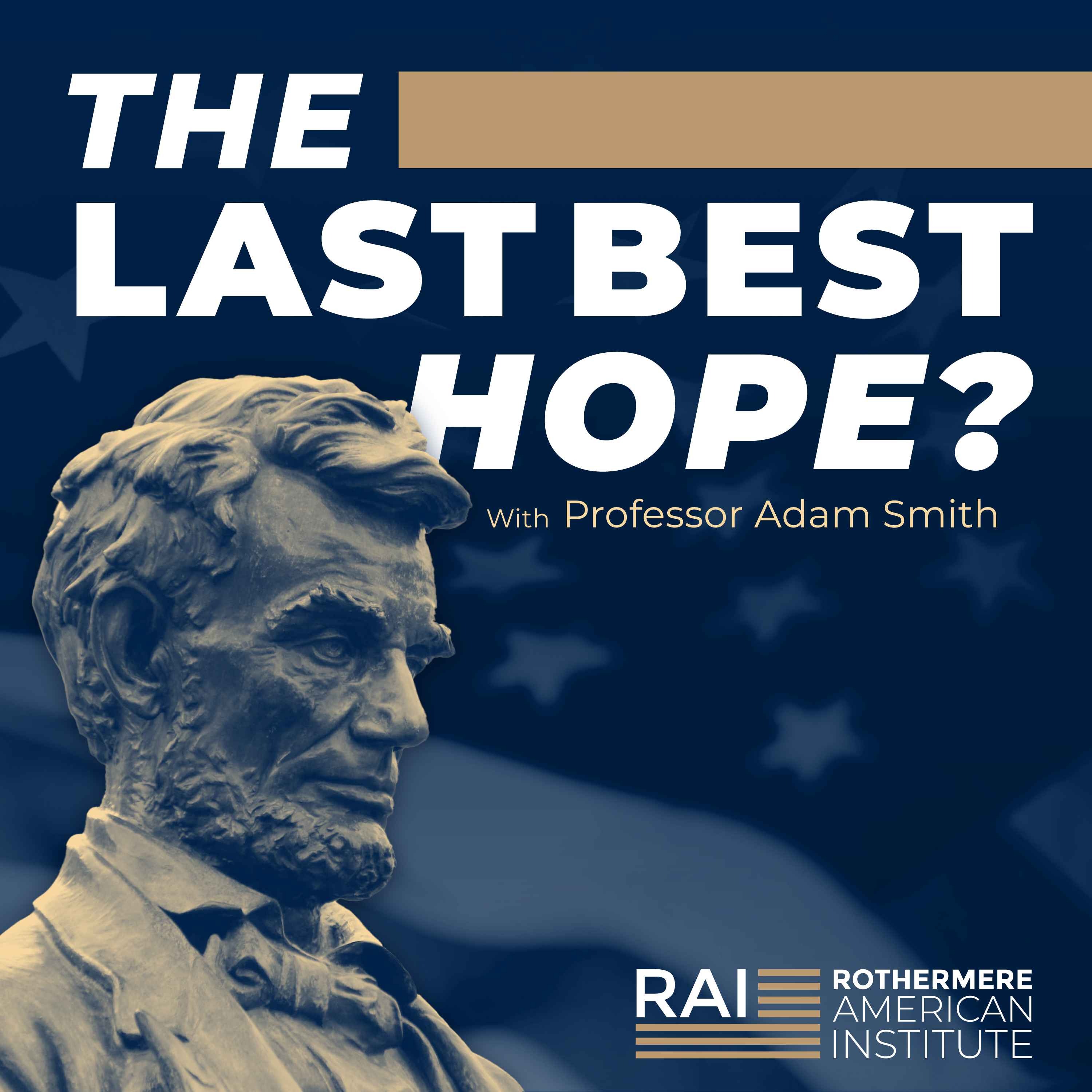
The Last Best Hope?
Adam SmithAudio
- Format:
- Podcast
- New episodes:
- Weekly
- Typical length:
- about 40 minutes
- Latest episode:
About this show
Abraham Lincoln called the United States “the last best hope of Earth.” In this podcast, we ask whether that claim still holds — and whether it ever did.
Each episode takes a figure, idea, or moment in American political history and asks what it tells us about the country’s understanding of itself, always with an eye to how America looks from the outside in. The Last Best Hope? takes ideas seriously: America as a creed, the arguments of the people who built and remade it, and what America has meant to the rest of the world. We take our subjects from history, not the news — though the present is rarely far away.
Hosted by Adam Smith, Orsborn Professor of American Political History and Director of the Rothermere American Institute at Oxford, The Last Best Hope? brings him into conversation with leading scholars and public figures, including Hillary Clinton, Annette Gordon-Reed, Eric Foner, David Frum, Heather Cox Richardson, Stacy Schiff, Jonathan Freedland, James Morone, Michael Kazin, Kevin Kruse, Julian Zelizer, Bruce Schulman, Ty Seidule, Liz Varon, Eric Rauchway, Phil Tinline, Emily Bazelon, Richard Carwardine, Rachel Shelden, Richard Blackett, Devin Fergus, and Dan Jackson.
“Adam Smith is one of the UK’s foremost historians of America, and communicates his expertise with zest, wit and unforced passion. The Last Best Hope? brings him together with fellow scholars to provide a unique insight we can’t do without.” — Phil Tinline, BBC radio documentary-maker and author
“The Last Best Hope is an absolutely brilliant podcast. Thoughtful, clever, engaging and accessible, Adam Smith always gets the best out of his guests, and I’ve learned an enormous amount from every episode. I love it.” — Dominic Sandbrook, historian and co-host of The Rest is History
“The must-listen US podcast.” — Nick Bryant, former BBC Correspondent in New York
Produced by the Rothermere American Institute, University of Oxford. https://www.rai.ox.ac.uk/home
Hosted on Acast. See acast.com/privacy (https://acast.com/privacy) for more information.
Covers: American history, US politics, American political history, US elections, declaration of independence, American revolution, American sports culture, religious history, impeachment, anglo-American relations
Show details and episodes come from the publisher's public feed at feeds.acast.com. Last updated . Names, artwork and text belong to their publishers.
Recently on this show
Summary of recent episodes, drawn from the publisher's feed.
Adam Smith's history podcast asks whether America's claim to be the world's last best hope still holds. Recent episodes cover Mormons and the republic, presidential impeachment, why presidents lose midterms, and why America doesn't love soccer.
Cosmos
Similar in subject
- Short Talk Bulletin
Both cover: declaration of independence, american revolution - The American Idea
Both cover: american revolution, us elections, american history - Washington Week PBS
Both cover: impeachment, us politics
Similar shows




Explore more
Episodes
Election 2024: What just happened?
· 1 hr 6 min
In this special episode of The Last Best Hope, we bring you a recording of a live event at the Rothermere American Institute in Oxford on Thursday, November 7. Adam Smith and guests discussed why the election turned out the way it did. The panellists are: Jason Casellas ABC News election decision desk. Jason Casellas is an Associate Professor of Political Science at the University of Houston. He is an expert in Latino politics and has published widely on state and local politics. Clare Malone New Yorker staff writer. Clare Malone reports on politics, media, and journalism for the New Yorker. She previously covered both the 2016 and 2020 Presidential campaigns as a senior political writer for FiveThirtyEight. Mike Murphy Republican political strategist and media consultant. Mike Murphy has worked on the presidential campaigns of George H.W. Bush and John McCain. He also co-hosts the popular politics podcast Hacks on Tap with David Axelrod. Kimberley Johnson John G. Winant Visiting Professor of American Government. Kimberley Johnson is a Professor of Social and Cultural Analysis at New York University and an expert on racial and ethnic, and suburban and urban politics. Hosted on Acast. See acast.com/privacy (https://acast.com/privacy) for more information.
Not rated yetThe Age of Polarization Election Special Part 4: 2016
· 41 min
The US is in an Age of Polarization. From the 1930s to the 1980s, voter allegiances were more fluid, and presidents sometimes won massive landslides (think Reagan in 1984 or Nixon in 1972). But for the last thirty years, a huge gulf between the parties -- at least rhetorically -- has opened up, and elections have been persistently nail-bitingly close. How did this happen? In this special series, we examine the campaigns and characters of the last 30 years and trace the emergence of the partisan alignment and bitter polarisation we see today. In this episode, the election of 2016. The shocking victory of Donald Trump and the final emergence, perhaps, of a new partisan alignment. Presenter: Adam Smith, Orsborn Professor of US Political History at Oxford and Director of the Rothermere American Institute Guests: Patrick Andelic of the University of Northumbria, author of Donkey Work: Congressional Democrats in Conservative America, 1974-1994, now out in paperback Ursula Hackett, Reader in Politics at Royal Holloway, University of London, author of America's Voucher Politics: How Elites Learned to Hide the State The Last Best Hope? is a podcast of the Rothermere American Institute at the University of Oxford. For details of our programming, go to https://www.rai.ox.ac.uk/events Producer: Emily Williams. Hosted on Acast. See acast.com/privacy (https://acast.com/privacy) for more information.
Not rated yetGod and Trump: Evangelicals and Politics in today's America
· 56 min
When the media talks about the evangelical vote today, what or to whom are they referring? Who are the people who self-identify in this way? Should we understand them as a group defined by their faith, their style of worship, by distinctive theological positions – or has the term evangelical itself become so politicised that in practice it is now most meaningfully understood as shorthand for a group of mainly white voters characterised by their opposition to abortion and LGBTQ rights? Presenter: Adam Smith, Orsborn Professor of US Political History at Oxford and Director of the Rothermere American Institute Guests: EJ Dionne, is a distinguished journalist and author, political commentator, and longtime op-ed columnist for the Washington Post. He is also a Senior Fellow in Governance Studies at the Brookings Institution, a government professor at Georgetown University, and co-author of the recent New York Times bestseller One Nation Under Trump, author of Souled Out, and Why the Right Went Wrong, among others. His most recent book, released last year, is Code Red: How Progressives And Moderates Can Unite To Save Our Country (https://us.macmillan.com/books/9781250261069). David Campbell is the Packey J. Dee Professor of American Democracy at the University of Notre Dame and the director of the Notre Dame Democracy Initiative. His research focuses on civic and political engagement, with particular attention to religion and young people. Campbell’s most recent book is Secular Surge: A New Fault Line in American Politics (with Geoff Layman and John Green), which received the Distinguished Book Award from the Society for the Scientific Study of Religion. Among his other books is American Grace: How Religion Divides and Unites Us (with Robert Putnam), winner of the award from the American Political Science Association for the best book on government, politics, or international affairs Kristin Kobes Du Mez is a New York Times bestselling author and Professor of History and Gender Studies at Calvin University. She holds a PhD from the University of Notre Dame and her research focuses on the intersection of gender, religion, and politics. She has written for The New York Times, The Washington Post, NBC News, Religion News Service, and Christianity Today, and has been interviewed on NPR, CBS, and the BBC, among other outlets. Her most recent book is Jesus and John Wayne: How White Evangelicals Corrupted a Faith and Fractured a Nation. The Last Best Hope? is a podcast of the Rothermere American Institute at the University of Oxford. For details of our programming go to rai.ox.ac.uk Producer: Emily Williams. Presenter: Adam Smith Hosted on Acast. See acast.com/privacy (https://acast.com/privacy) for more information.
Not rated yetThe Age of Polarization Election Special Part 3: 2008
· 44 min
AGE OF POLARIZATION ELECTION SPECIAL PART 3: 2008 The US is in an Age of Polarization. From the 1930s to the 1980s, voter allegiances were more fluid, and presidents sometimes won massive landslides (think Reagan in 1984 or Nixon in 1972). But for the last thirty years, a huge gulf between the parties -- at least rhetorically -- has opened up, and elections have been persistently nail-bitingly close. How did this happen? In this special series, we examine the campaigns and characters of the last 30 years and trace the emergence of the partisan alignment and bitter polarisation we see today. In this episode: The Election of 2008. The election of the first black president of the United States, which seemed at the time to be an utterly transformative moment, but which also fuelled deep currents of racial animosity; the success of a Democratic winning coalition that looked quite different from that which had elected previous Democrats. Presenter: Adam Smith Guests: Bruce Schulman, William E. Huntington Professor of History at Boston University Dan Rowe, Director of Academic Programmes, Rothermere American Institute The Last Best Hope? is a podcast of the Rothermere American Institute at the University of Oxford. For details of our programming go to rai.ox.ac.uk Producer: Emily Williams. Presenter: Adam Smith Hosted on Acast. See acast.com/privacy (https://acast.com/privacy) for more information.
Not rated yetThe Age of Polarization Election Special Part 2: 2000
· 37 min
AGE OF POLARIZATION ELECTION SPECIAL (PART 2) The US is in an Age of Polarization. From the 1930s to the 1980s, voter allegiances were more fluid and presidents sometimes won huge landslides (think Reagan in 1984 or Nixon in 1972). But for the last thirty years, a huge gulf between the parties -- at least rhetorically -- has opened up, and elections have been persistently nail-bitingly close. How did this happen? In this special series, we’ll be examining the campaigns and characters of the last 30 years and tracing the emergence of the partisan alignment and bitter polarisation we see today. In this episode: 2000 – the election in which Al Gore won the popular vote but George W. Bush won the presidency after the Supreme Court stopped ongoing recounts in Florida and awarded the electoral college votes to the Republican. A tight but relatively bland election campaign was followed by a bitter aftermath, destroying many people’s faith in the electoral process, generating surging conspiracy theories – a loss of basic trust that Donald Trump would later exploit. Presenter: Adam Smith, Orsborn Professor of US Political History at Oxford and Director of the Rothermere American Institute Guests: Patrick Andelicby of the University of Northumbria, author of Donkey Work: Congressional Democrats in Conservative America, 1974-1994, now out in paperback Ursula Hackett, Reader in Politics at Royal Holloway, University of London, author of America's Voucher Politics: How Elites Learned to Hide the State The Last Best Hope? is a podcast of the Rothermere American Institute at the University of Oxford. For details of our programming, go to rai.ox.ac.uk Producer: Emily Williams. Hosted on Acast. See acast.com/privacy (https://acast.com/privacy) for more information.
Not rated yetEugene V. Debs and America as the last, best hope for socialism?
· 39 min
Eugene V. Debs is a reminder of the possibility of a different kind of American politics. Five times the Socialist Party's candidate for president in the first two decades of the twentieth century, Debs argued that the promise of America -- the last best hope of earth -- could be fulfilled only through socialism. Debs lived in an era that, like our own, was characterised by dramatic economic dislocation, extremes of wealth and poverty, and high rates of immigration. So what is his legacy, and why does he still matter? Presenter: Adam Smith, Orsborn Professor of US Political History at Oxford and Director of the Rothermere American Institute Guests: Michael Kazin, Professor of History U of Georgetown, the author of War Against War: The American Fight for Peace, 1914-1918 (2017), American Dreamers: How the Left Changed a Nation (2011),The Life of Wm Jennings Bryan (2006), and most recently What it took to win: A history of the Democratic party (2022). Allison Duerk, Director of the Eugene V. Debs Museum, Terre Haute, Indiana. The Last Best Hope? is a podcast of the Rothermere American Institute at the University of Oxford. For details of our programming go to rai.ox.ac.uk Producer: Emily Williams. Presenter: Adam Smith Hosted on Acast. See acast.com/privacy (https://acast.com/privacy) for more information.
Not rated yetThe Age of Polarization Election Special Part 1: 1992
· 45 min
ELECTION SPECIAL (PART 1) The US is in an Age of Polarization. From the 1930s to the 1980s, voter allegiances were more fluid and presidents sometimes won huge landslides (think Reagan in 1984 or Nixon in 1972). But for the last thirty years, a huge gulf between the parties -- at least rhetorically -- has opened up, and elections have been persistently nail-bitingly close. How did this happen? In this special series, we’ll be examining the campaigns and characters of the last 30 years and tracing the emergence of the partisan alignment and bitter polarisation we see today. We begin in this episode in 1992 – the first post- Cold War election, the first to be won by a Democrat since 76, the passing of a generational torch to the 46-year old Arkansas Governor Bill Clinton, and the ringing declaration on the right that America was now convulsed in a culture war. Presenter: Adam Smith Guests: Bruce Schulman, William E. Huntington Professor of History at Boston University Dan Rowe, Director of Academic Programmes, Rothermere American Institute The Last Best Hope? is a podcast of the Rothermere American Institute at the University of Oxford. For details of our programming go to rai.ox.ac.uk Producer: Emily Williams. Presenter: Adam Smith Hosted on Acast. See acast.com/privacy (https://acast.com/privacy) for more information.
Not rated yetDark Money: Can billionaires buy elections in America?
· 44 min
Wealthy Americans have always found ways of spending money on political campaigns in the presumed expectation of a return on their investment. But in 2010, the Supreme Court’s Citizens United decision ruled that legislation that restricted how much money could be spent on influencing elections was unconstitutional, opening up vast new possibilities for wealthy individuals and corporations to support candidates. The Court's argument was that to stop someone spending as much as they liked to push an agenda or a candidate was a violation of the first amendment right to free speech. The official campaigns still have to be transparent about how much money they’re raising and from whom, but there are now effectively no limits at all on what people can spend trying to influence the outcome of an election in indirect ways. That’s where so-called “Super PACs” come in (the PACs is an acronym standing for Political Action Committee). It turns out that it’s really easy to hide a political donation by giving it a Super PAC rather than directly to a candidate. So the problem today – in the post-Citizens United world -- is not only the amount of money being spent but that we no longer know who’s spending it. Presenter: Adam Smith, Orsborn Professor of US Political History at Oxford and Director of the Rothermere American Institute. Guests: Ciara Torres-Spelliscy, a Brennan Center fellow and professor of law at Stetson University College of Law, where she teaches courses in election law. Her book Corporatocracy: How to Protect Democracy from Dark Money and Corrupt Politicians Hardcover – published by NYU Press- is out in November. Brody Mullins, a Pulitzer Prize-winning investigative reporter. He spent nearly two decades covering the intersection of business and politics for The Wall Street Journal. He’s the co-author of The Wolves of K Street The Secret History of How Big Money Took Over Big Government The Last Best Hope? is a podcast of the Rothermere American Institute at the University of Oxford. For details of our programming go to rai.ox.ac.uk Producer: Emily Williams. Presenter: Adam Smith Hosted on Acast. See acast.com/privacy (https://acast.com/privacy) for more information.
Not rated yetRigged! Anxiety about election integrity in America
· 49 min
For as long as there have been elections, there have been those who’ve refused to trust them. But anxiety about elections has peaked at particular moments in American history – in the run-up the Civil War, in the late nineteenth century, in the Civil Rights era, and again today. All periods when sections of the population became convinced that the rules were being bent in ways that robbed ordinary Americans of their political power – by new immigrants, African Americans, or liberal elites. At each moment of anxiety, attempts have been made to purify the electoral process, and all have had mixed and unintended consequences. In this episode, Adam discusses the long history of anxiety about election rigging with Frank Towers of the University of Calgary, an expert on electoral history, and Sarah Henry, the Chief Curator of the Museum of the City of New York, with whom Adam discussed a curious glass ballot box. Producer: Emily Williams. Presenter: Adam Smith. The Last Best Hope? podcast is a production of the Rothermere American Institute, University of Oxford. Hosted on Acast. See acast.com/privacy (https://acast.com/privacy) for more information.
Not rated yetPresidents and the Press
· 46 min
In 1787, the year of the Constitutional Convention, Thomas Jefferson wrote that if he had to choose between “a government without newspapers or newspapers without a government, I should not hesitate a moment to prefer the latter”. Easy for him to say – but in reality, US presidents and the press have always been locked in an embrace fusing mutual respect and mistrust, cosiness and outright conflict. Both feed off each other, but who’s in charge? But who has the power in that relationship? How does it work and how has it changed? From Woodrow Wilson, the first president to hold proper press conferences, to the present day, this is a story of how presidents sought to project themselves as presidential, using charm, threats and distraction techniques. Adam talks to Kathryn McGarr, author of City of Newsmen: Public Lies and Professional Secrets in Cold War Washington (https://press.uchicago.edu/ucp/books/book/chicago/C/bo181018743.html). And to Nick Bryant, former BBC correspondent in the US and author of multiple books including The Forever War: America’s Unending Conflict with itself. Hosted on Acast. See acast.com/privacy (https://acast.com/privacy) for more information.
Not rated yetThe Black Founders, America and the Claim of Equality
· 52 min
At the heart of the "promise" of the American Revolution and the new republic's claim to be the last, best hope of earth, is the assertion in the Declaration of Independence that "all men are created equal". How did Black Americans react to the Declaration? How did they seek to shape the character of the new Republic? And what was the relationship between the Black struggle for freedom and equality and the American Revolution? To examine this once-hidden history of Black Americans in the founding era, Adam is joined by Professor James Basker, the President of the Gilder Lehrman Institute of American History and the Richard Gilder Professor of Literary History at Barnard College. Jim is the editor, with Nicole Seary, of a remarkable new collection published by the Library of America called “Black Writers of the Founding Era” which contains texts – most previously unpublished – by more than 120 Black Americans. Readings in this episode were performed by Chelsi Campbell and Darius Jackson. Producer: Emily Williams. Presenter: Adam Smith. Hosted on Acast. See acast.com/privacy (https://acast.com/privacy) for more information.
Not rated yetMorning Again in America: The 1984 Election forty years on.
· 55 min
Forty years ago, a twinkly-eyed incumbent president ran for re-election despite concerns about his age. He did so by running a campaign steeped in the idea that America was the last, best hope of earth. Ronald Reagan was no Joe Biden, and no one today expects a landslide victory. Yet there are echoes in today's divided politics in the 1984 election, especially within the Democratic Party, which, back then, just as now, was struggling to keep together its warring constituencies. And might there be lessons for today's fractious politics from Reagan's famous campaign ad, "It’s morning again in America"? Adam talks to Bruce Schulman, William E. Huntington Professor at Boston University who was the Harmsworth Professor of American history at Oxford last year and the author of many books on twentieth-century America including a forthcoming volume of the Oxford History of the United States – and Dan Rowe, lecturer in American history at the Rothermere American Institute and the author of the forthcoming, State of Development: Preserving the American Economic Century in an Era of Anxious Capitalism to be published by Columbia University Press. Hosted on Acast. See acast.com/privacy (https://acast.com/privacy) for more information.
Not rated yetThe strange death and curious rebirth of American cricket
· 49 min
Cricket was once the most popular summer game in the United States – the first ever international match was played not, as you might expect between England and one of its colonies, but between Canada and the United States, in 1844. The first overseas England tour was to the US in 1859. The professional players earned the unheard-of sum of 90 pounds – America then, just as now, was an El Dorado of sporting riches. Yet just ten years later, after four years of civil war and the rebirth of a newly consolidated United States, the new sport of baseball had all but erased cricket from the New York sporting press. The prize money and betting markets that were once drawn to the cricket field now turned to the baseball diamond. As one old American cricketer sadly observed in his memoirs, “We had a large number of good young men playing the game up to the time when the war fever took hold of them. When hostility between North and South broke out, away went our players to the front and the cricket field was deserted. Those that returned from the war never took up the game again.” So, what went wrong? How can we explain the strange death of American cricket, and how should we explain its present-day partial revival? Adam talks to Ed Smith, former England cricketer and an award-winning journalist and to Joe Lynn Curator at The C. Christopher Morris Cricket Library at Haverford College. Hosted on Acast. See acast.com/privacy (https://acast.com/privacy) for more information.
Not rated yetHow have presidential primaries shaped modern US politics?
· 57 min
Presidential primaries – the circus that has traditionally wended its way from Iowa to New Hampshire and beyond every four years -- is one of the most distinctive features of American political life. From the insurgent campaigns of Jimmy Carter in 1976 to Barack Obama in 2008 and even Donald Trump in 2016, primaries have enabled the rise of politicians who could never have succeeded under the old boss-controlled system. US political parties are private organisations albeit without the formal membership of parties in other countries, yet their candidate nomination process is regulated by state law. So, how, why, and when did US political parties come to choose their presidential candidates in this way? How have primaries shaped elections and the trajectory of politics? And in a year in which both parties appear set to nominate unpopular candidates, does this reflect the failure of this system for presidential candidate selection? Adam talks about these issues with the leading historian of modern US politics, Professor Julian Zelizer of Princeton University, a CNN contributor and author or editor of fifteen books on political history. Hosted on Acast. See acast.com/privacy (https://acast.com/privacy) for more information.
Not rated yetHow are Latino voters changing America?
· 46 min
Today, Mexicans and people from Latin America make up about half of the total immigrant population and Latinos are now the single largest “non-white” block in the electorate – if, that is, they can be considered a coherent “block” at all. In the early years of the twenty-first century one of the axioms of American politics was that the ever-rising share of Latinos in the electorate would deliver Democratic majorities. That’s not exactly how things have panned out. So, who are we really talking about when we talk about Latino voters, what binds these 60 million people who are from, such different experience and such different histories together? How has their vote mattered in the past and how does it matter now? Joining Adam to discuss these issues are Jason Casellas of the University of Houston, currently Winant Professor of American government at Oxford, and Anna Sampaio, Santa Clara University. The Last Best Hope? is the podcast of the Rothermere American Insitute at the University of Oxford. Presenter: Adam Smith. Producer: Emily Williams. Hosted on Acast. See acast.com/privacy (https://acast.com/privacy) for more information.
Not rated yetAmerican Fascism
· 57 min
In 1930s America, fascism was on the march – not just right-wing politicians who might be pejoratively described like that, but actual fascists who embraced the title. And the core claim they made was that fascism was as American as motherhood, apple pie, and George Washington himself. Yet the US eventually entered the war against Naziism because fascism and Americanism were antithetical. To explore the fraught relationship and enduring appeal of fascist ideas in America, Adam talks to Sarah Churchwell, author of Behold America: A History of America First, and Will Hitchcock, host of the Democracy in Danger podcast who’s working on a book on the fascist threat and America’s path to World War II. The Last Best Hope? is the podcast of the Rothermere American Insitute (https://www.rai.ox.ac.uk/) at the University of Oxford. Presenter: Adam Smith. Producer: Emily Williams. Hosted on Acast. See acast.com/privacy (https://acast.com/privacy) for more information.
Not rated yetThe Destruction of the Tea, 250 Years On.
· 30 min
Two hundred and Fifty years ago, a group of men boarded three ships in Boston harbour and dumped their cargo of East Indian Company tea overboard. It was a dramatic defiance of the royal government in Massachusetts and of ministers in London who had levied a duty on the tea. Within eighteen months, the revolt against taxes imposed by a distant and unresponsive government had spiralled into armed rebellion. What is the long-term legacy for American political culture of this mass destruction of private property? Joining Adam to discuss the events originally known as "the destruction of the tea" and later re-named the "Tea Party", are acclaimed historian Benjamin Carp and Pulitzer Prize winner Stacy Schiff. Hosted on Acast. See acast.com/privacy (https://acast.com/privacy) for more information.
Not rated yetThe Kennedy Assassination and Conspiracy Culture
· 50 min
Sixty years ago, President John F. Kennedy was shot and killed in Dallas, Texas. It was quickly mythologised as an end-of-innocence moment, the death of "Camelot". It is natural to believe that big events must have big causes. Could such a shattering, shocking event really have been triggered--figuratively as well as literally--by one troubled man? The historians Phil Tinline and Steve Gillon join Adam to discuss how the assassination spawned the mother of all conspiracy theories and what that tells us about America. The Last Best Hope? is the podcast of the Rothermere American Insitute (https://www.rai.ox.ac.uk/) at the University of Oxford. Presenter: Adam Smith. Producer: Emily Williams. Hosted on Acast. See acast.com/privacy (https://acast.com/privacy) for more information.
Not rated yetWhat is a “Colorblind Constitution"?
· 47 min
You cannot begin to understand US politics without encountering the 14th Amendment, ratified in 1868 in the wake of the Civil War. On the surface, the Amendment seems straightforward: it guarantees the equal rights of citizens. But does that mean that race cannot be taken into account even in order to help ensure equality? In his concurring opinion in the affirmative action cases this year, Justice Clarence Thomas argued that the framers of the 14th Amendment intended to create a “colorblind” constitution. Any policy that took race into account – even if well-intentioned – was therefore unconstitutional. In her dissenting opinion, Justice Jackson took a very different view, arguing that the 14th Amendment justified programmes that gave Black people the leg up they needed to be truly equal. As so often in America, an argument about current politics is also an argument about history. Adam is joined by Professor Liz Varon, this year’s Harmsworth Visiting Professor at Oxford, and Emily Bazelon, staff writer for the New York Times Magazine and co-host of the Slate Political Gabfest. The Last Best Hope? is the podcast of the Rothermere American Insitute (https://www.rai.ox.ac.uk/) at the University of Oxford. Presenter: Adam Smith. Producer: Emily Williams. Hosted on Acast. See acast.com/privacy (https://acast.com/privacy) for more information.
Not rated yetIs there a Paranoid Style in American Politics?
· 42 min
In 1963, the historian Richard Hofstadter gave a famous lecture at Oxford (later an essay in Harper’s) arguing that a “paranoid style” was a recurrent strain in American politics. Hofstadter cited examples ranging from the Anti-Masons of the 1830s to MCarthyism. Today, pundits often turn to the concept of a “paranoid style” when trying to explain Trumpism. Why has Hofstadter’s idea been so influential? And does it really explain anything at all? Adam discusses these questions with Nick Witham, the author of Popularizing the Past, a brilliant new study of Cold War-era historians who shaped an understanding of American history far beyond the groves of academia. The Last Best Hope? is the podcast of the Rothermere American Institute (https://www.rai.ox.ac.uk/), University of Oxford. Presenter: Adam Smith. Producer: Emily Williams. Hosted on Acast. See acast.com/privacy (https://acast.com/privacy) for more information.
Not rated yet