

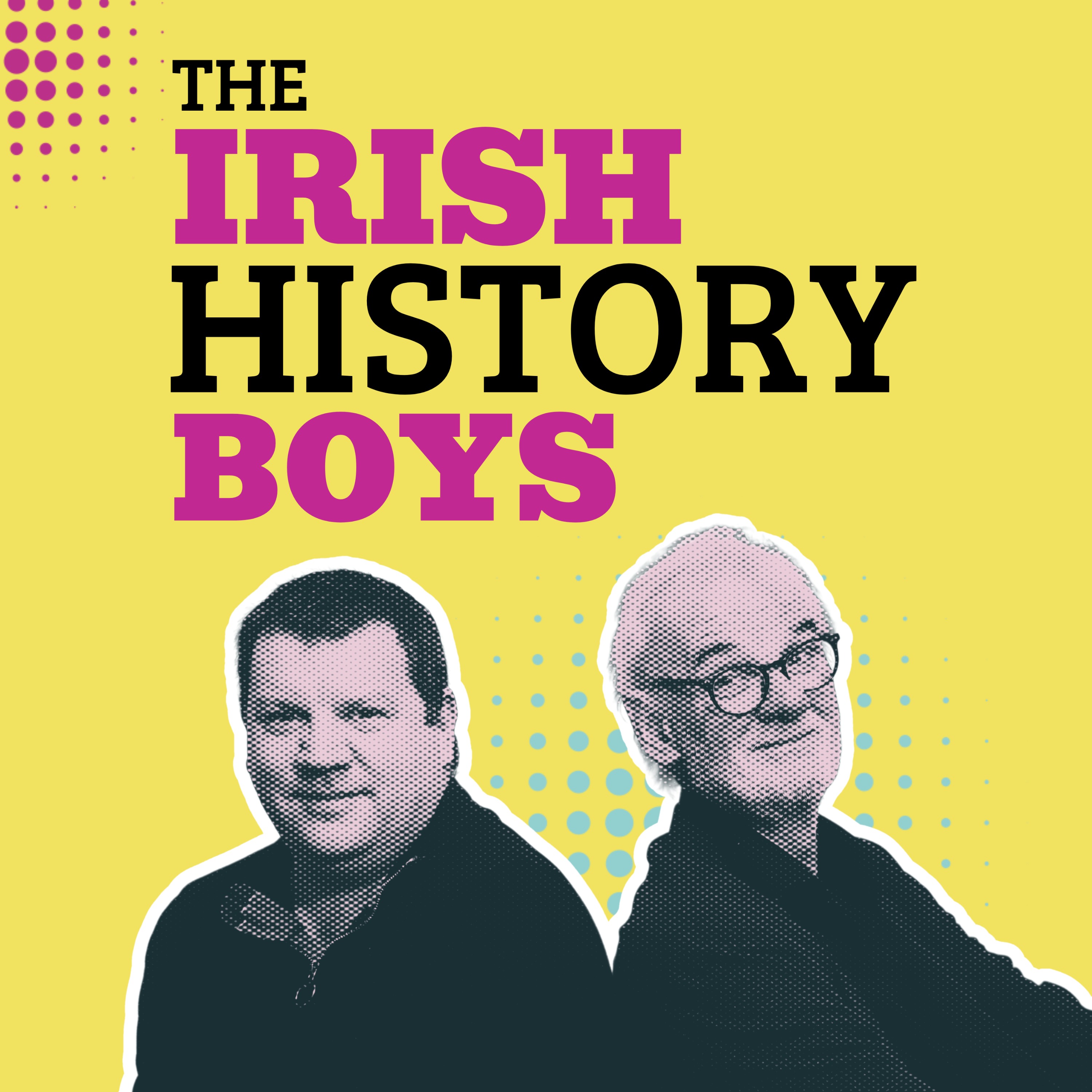
The Irish History Boys
- Format:
- Podcast
- New episodes:
- Weekly
- Typical length:
- about 40 minutes
- Latest episode:
About this show
Comedian Tim McGarry and Historian Cormac Moore select the stories from the archives of The Irish News that bring Irish history to life in enlightening and amusing ways. Hosted on Acast. See acast.com/privacy (https://acast.com/privacy) for more information.
Covers: Irish history, northern ireland, Irish republicanism, the troubles, Irish politics, world war era politics, 1926 ireland, 1798 rebellion, cromwell in ireland, US politics
Show details and episodes come from the publisher's public feed at feeds.acast.com. Last updated . Names, artwork and text belong to their publishers.
Recently on this show
Summary of recent episodes, drawn from the publisher's feed.
The Irish History Boys is a podcast using archive stories from The Irish News to explain Irish history in amusing ways, hosted by comedian Tim McGarry and historian Cormac Moore. Recent episodes cover the 1926 IRA raids on Garda stations, the 1976 Irish presidential crisis, and the 1798 Rebellion.
Cosmos
Similar in subject
- The Troubles Podcast
Both cover: irish republicanism, the troubles - Drummer Seeks Musicians: The Making of U2
Both cover: irish politics, irish history - Léargas: A Podcast by Gerry Adams
Both cover: northern ireland, irish politics
Similar shows




Explore more
Episodes
Hunger Strikes and Splenetic Denunciations
· 48 min
In this episode of the Irish History Boys, we commemorate the 50th anniversary of Frank Stagg’s 1976 hunger strike—a 60-day ordeal that ended in a "cloud of controversy" and left his family deeply divided. We examine the harrowing physiological toll of the strike and the Irish government's extraordinary tactical decision to intercept Stagg's remains via helicopter to prevent the IRA from achieving a "propaganda coup". Additionally, we travel back 100 years to 1926 to analyze the "splenetic denunciation" of the Irish Free State by the Unionist press. We discuss how the Irish News exposed this as a "political trick" used by leaders to distract their own public from domestic grievances by focusing on the "business worries" of their neighbours. To conclude, we address the international stage of the mid-1920s, specifically Benito Mussolini’s aggressive "Italianization" of South Tyrol. We examine his defiant stance against the "toothless" League of Nations, a bold assertion of power that signaled the darkening political climate of early 20th-century Europe. Hosted on Acast. See acast.com/privacy (https://acast.com/privacy) for more information.
Not rated yetAsserting Irish Independence with Coins and Customs
· 47 min
In this episode of the Irish History Boys, we examine the poignant death and funeral of Anthony Reavy in 1976—the third brother in one family to perish following a loyalist shooting. We place this tragedy within the broader context of the era's relentless sectarian violence and the prevailing "political vacuum" of the time. Additionally, we highlight the growth of indigenous Irish commercial entities, such as IPB Insurance, as symbols of burgeoning statehood and the drive to move away from British-run systems. To conclude, we address a listener's strategic question regarding the partition of Ireland: specifically, whether the unionists' decision to secure six counties instead of four ultimately created the demographic conditions for a future reunification. Hosted on Acast. See acast.com/privacy (https://acast.com/privacy) for more information.
Not rated yetPacts and Prisoners: The 1926 Release and the death of Frank Stagg
· 48 min
his week we explore the fallout of the tripartite agreement of 1926, which led to the release of 33 political prisoners in Northern Ireland—though three "Derry prisoners" remained behind bars due to their roles in a fatal rescue attempt. We examine how political status served as a recurring bargaining chip, tracing the history of Republican resistance from the 1918 "German Plot" to the daring escapes of the Civil War. Finally, we discuss the harrowing death of hunger striker Frank Stagg in 1976 and the British government's "callous" refusal to grant him a transfer to a Northern Irish prison. We also look at the Irish government's extraordinary measures to prevent a Republican funeral, including the use of helicopters and concrete to secure his final resting place against his family's wishes Hosted on Acast. See acast.com/privacy (https://acast.com/privacy) for more information.
Not rated yetBans and Bandits: The GAA’s "Foreign" Struggle and the Stigma of "Bandit Country"
· 43 min
This week we explore the pivotal year of 1926 for the Gaelic Athletic Association, as delegates from Louth and Tipperary pushed for the removal of the compulsory ban on "foreign games" such as soccer, rugby, cricket, and hockey. We look at the systemic issues regarding the enforcement of these rules, including the 1938 removal of Ireland's first president, Douglas Hyde, as GAA patron and the deployment of vigilante committees to ensure members did not attend rival sporting events. We also discuss why Northern members were the strongest advocates for maintaining these bans, as they felt abandoned by the Free State and faced continued obstruction and British rule within the six counties. Finally, we chat about the controversial "bandit country" label applied to South Armagh in the 1970s, while examining a local citizen’s poignant letter protesting the "blackening" of their peace-loving community’s name. Hosted on Acast. See acast.com/privacy (https://acast.com/privacy) for more information.
Not rated yet1926 & 1976: Red Routes and the Darkest Days
· 45 min
Tim McGarry and Dr Cormac look back at the significant news stories of 1926 and 1976. Regarding 1926, they explore the complexities of the cross-channel postal service and the unionist desire for a "red route" to bypass the Irish Free State, highlighting Northern Ireland's unique status as a "polity". They also examine the legacy of the Belfast boycott—a counterproductive campaign that may have accelerated the start of the Civil War—and a prophetic letter to the Irish News bemoaning the "lost art of conversation" in the face of new technologies like radio and cinema. Moving to 1976, they reflect on a "bleak and miserable" period defined by "pure evil" and a "total political vacuum" following the collapse of the Sunningdale agreement. They delve into the horrific sectarian atrocities in South Armagh, specifically the Reevy and O'Dowd family murders and the retaliatory Kingsmill massacre. The hosts discuss the long-term impact on survivors like Alan Black, the lack of formal inquests, and the unsettling questions regarding potential British collusion and the mysterious role of Robert Nairac. Hosted on Acast. See acast.com/privacy (https://acast.com/privacy) for more information.
Not rated yet1925 & 1975: A Unionist Triumph and the Miserable Year
· 44 min
Tim McGarry and Dr Cormac look back at the significant news stories of 1925 and 1975. Regarding 1925, they delve into the Boundary Commission, which established the permanent border of Northern Ireland and was seen as a "triumph for unionism" under James Craig, alongside social issues like the emancipation of women smoking in public and a largely "forgotten" famine in the West of Ireland. Moving to 1975, they reflect on a "miserable year" defined by a political vacuum, horrific sectarian violence such as the Miami Showband murders, and the unexpected political conversion of hardliner William Craig to the idea of power-sharing. Hosted on Acast. See acast.com/privacy (https://acast.com/privacy) for more information.
Not rated yetAt the Crossroads: The London Agreement and the "Factory of Grievances"
· 51 min
This week we explore the pivotal moment for Northern Catholics following the 1925 London Agreement, which firmly established the six-county border and left many feeling "stuck" and abandoned by the Free State. We look at the systemic issues that followed, including the "factory of grievances" born from gerrymandering, the removal of Proportional Representation, and the stark lack of Catholic representation in the judiciary and civil service. We also chat about the staggering unemployment figures of 1975 in border areas like Strabane and Newry, while answering a listener’s question regarding the Troubles' impact on Scotland Hosted on Acast. See acast.com/privacy (https://acast.com/privacy) for more information.
Not rated yetThe Specials' Legacy: The 1925 Disbandment and the Survival of the B Specials
· 58 min
This week we explore the controversial legacy of the Ulster Special Constabulary, tracing its 1920 origins as a multi-tiered force. We look at the the group's involvement in sectarian violence and the subsequent disbandment of the A and C Specials following the 1925 London Agreement, despite vocal protests from members over their severance terms. We also chat about the B Specials long-term survival until 1970, while contrasting the era’s news with the political despair felt in Northern Ireland fifty years later. Hosted on Acast. See acast.com/privacy (https://acast.com/privacy) for more information.
Not rated yetIreland's Customs Barriers & Chaos: The 11-Plus Exam Scandal and 70 Years of Irish Partition
· 42 min
This week we dive into President WT Cosgrave’s reliance on neighbourly feeling rather than written guarantees for the safety of Northern Catholics and the establishment of customs barriers in 1923 and their controversial persistence for over 70 years. Illicit pig smuggling in the mid-1970s makes an appearance and Tim relives the 11-plus exam. Hosted on Acast. See acast.com/privacy (https://acast.com/privacy) for more information.
Not rated yetThe Tripartite Agreement and the Final Irish Border Settlement
· 49 min
Following the leak of the Boundary Commission's report, the high-stakes Tripartite Agreement of 1925 established that the border would remain unchanged, ensuring Northern Ireland conceded no territory. In exchange for accepting the existing boundary, the Irish Free State was relieved of its crippling obligation to pay a share of the UK's imperial debt, estimated at roughly £150 million. However, W.T. Cosgrave’s government faced severe backlash and a major political crisis for prioritising this financial reprieve over the interests of Northern nationalists, who were effectively abandoned by the deal. Hosted on Acast. See acast.com/privacy (https://acast.com/privacy) for more information.
Not rated yet