

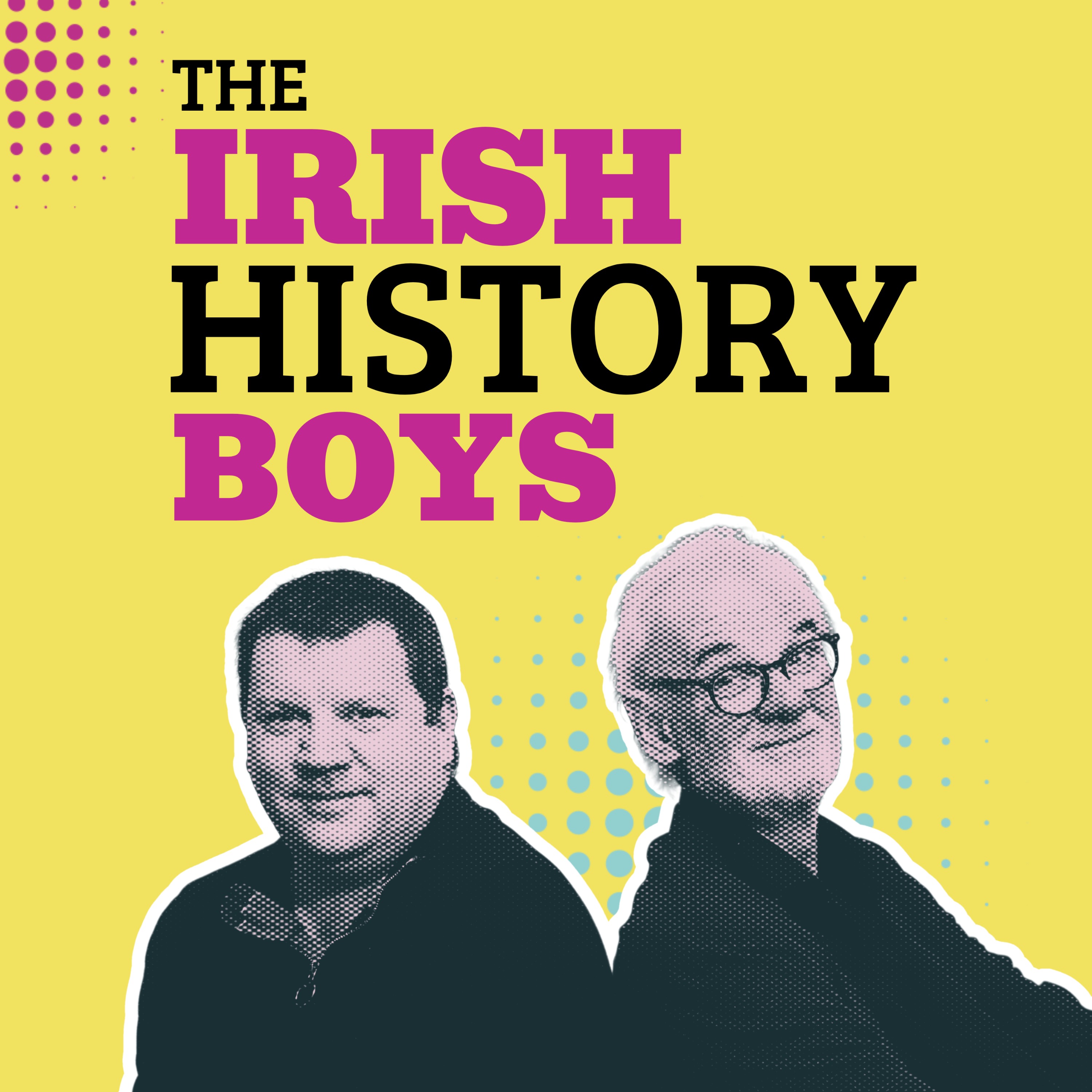
The Irish History Boys
- Format:
- Podcast
- New episodes:
- Weekly
- Typical length:
- about 40 minutes
- Latest episode:
About this show
Comedian Tim McGarry and Historian Cormac Moore select the stories from the archives of The Irish News that bring Irish history to life in enlightening and amusing ways. Hosted on Acast. See acast.com/privacy (https://acast.com/privacy) for more information.
Covers: Irish history, northern ireland, Irish republicanism, the troubles, Irish politics, world war era politics, 1926 ireland, 1798 rebellion, cromwell in ireland, US politics
Show details and episodes come from the publisher's public feed at feeds.acast.com. Last updated . Names, artwork and text belong to their publishers.
Recently on this show
Summary of recent episodes, drawn from the publisher's feed.
The Irish History Boys is a podcast using archive stories from The Irish News to explain Irish history in amusing ways, hosted by comedian Tim McGarry and historian Cormac Moore. Recent episodes cover the 1926 IRA raids on Garda stations, the 1976 Irish presidential crisis, and the 1798 Rebellion.
Cosmos
Similar in subject
- The Troubles Podcast
Both cover: irish republicanism, the troubles - Drummer Seeks Musicians: The Making of U2
Both cover: irish politics, irish history - Léargas: A Podcast by Gerry Adams
Both cover: northern ireland, irish politics
Similar shows


Explore more
Episodes
Why the Pope Supported William of Orange: The Surprising International History of 1690
· 42 min
In this special July episode of the Irish History Boys, hosts Tim McGarry and Cormac Moore set aside their usual news archives to explore "orange" history with Dr. Jonathan Mattison from the Museum of Orange Heritage. The discussion uncovers the complex international politics of the Glorious Revolution, including the surprising tactical support William of Orange initially received from Pope Innocent XI to counter the influence of the French King Louis XIV. The episode highlights why the Siege of Derry was the most critical strategic engagement of the war and provides unique insights into the Battle of the Boyne, such as the international makeup of the armies and the story of William III being wounded the night before the fight. Beyond the battlefield, the hosts explore how the Williamite victory marked a massive shift in power from the monarch to Parliament, laying the constitutional groundwork for the Bill of Rights and even the American Constitution. The conversation also touches on the bloodier Battle of Aughrim and how the religious toleration of the initial settlement was eventually unpicked by penal legislation. The episode concludes with a recommendation to visit Schomberg House and a preview of part 2 on the 1795 founding of the Orange Order. Hosted on Acast. See acast.com/privacy (https://acast.com/privacy) for more information.
Not rated yetWhy De Valera’s future looked “Hopeless” in 1926
· 42 min
This week’s episode of The Irish History Boys explores pivotal moments from 1926 and 1976, focusing on Ireland’s evolving sovereignty and security. We discuss how the Irish Free State and other dominions like Canada began loosening the ties of the British Empire, eventually leading to full independence through agreements like the Statute of Westminster. The episode revisits a biting 1926 critique that deemed Éamon de Valera’s political future "hopeless" just as he was founding Fianna Fáil. Shifting to 1976, we examine the Ulsterization of security and the British strategy to criminalise the IRA by treating the conflict as a policing issue rather than a war. Balancing high-stakes politics with local lore, we also share humorous accounts of egg smuggling across the border and highlight Sinn Féin’s 1976 efforts to internationalise their struggle through links with global movements like the PLO and the ANC. Hosted on Acast. See acast.com/privacy (https://acast.com/privacy) for more information.
Not rated yetRent-Free in the Irish Free State: Why the British Government funded homes for WWI Veterans in 1926
· 45 min
Join Tim McGarry and Dr. Cormac Moore for another episode of The Irish History Boys, where they dig into the archives of the Irish News to explore the stories that shaped Ireland 50 and 100 years ago. In this episode, we dive into the year 1926, a time of historical quirks and radical social shifts. They discuss the surprising reality of the British government funding homes for heroes for WWI veterans within the newly independent Irish Free State, a policy move that sparked political tension and eventually led to a landmark court case where veterans won the right to live rent-free. We look into the 1926 report from the Association of Head Mistresses regarding barriers women faced in the workforce eight years after the end of the war. The dramatic story of a cross-border ambulance dash through a hailstorm after a workhouse master tried to block a life-saving operation based on the new border sparks an interesting discussion followed by a 1920s farmers debate on the Irish Language. Lastly, Tim and Cormac jump to the year 1976 and examine the fracturing of unionist unity as the UUUC began to split, and discuss the little-known talks between the Official Unionist Party and the SDLP aimed at ending direct rule. Hosted on Acast. See acast.com/privacy (https://acast.com/privacy) for more information.
Not rated yetThe Man Who Predicted Brexit: Seán Lemass on Britain, Ireland, and Northern Ireland
· 46 min
In this episode of the Irish History Boys, we delve into the "lost memoir" of Seán Lemass, drawing on newly discovered tapes that provide a blunt and candid look at the man who transformed a failing state. We reflect on Lemass’s rise as the "power behind the throne" during Éamon de Valera’s final years, a period where he transitioned the country away from an "existential threat" and the despair of mass emigration. We examine Lemass’s radical shift in economic policy, moving Ireland from the "sterile arguments" of protectionism toward a modern, open economy. This includes a look at the First Programme for Economic Expansion and his partnership with TK Whitaker, which replaced "fantasy land" policies with a pragmatic plan for growth that doubled the size of the Irish economy. Additionally, we explore Lemass’s groundbreaking approach to Northern Ireland. We discuss the historic 1965 meeting with Terence O’Neill—the first time the leaders of the North and South had met in 40 years—and his realistic assessment that partition could only end through reconciliation, not military force or British coercion. We also highlight his remarkably "prescient" views on Britain's relationship with Europe, including his 1960s warning that the British might only join the EEC to "slow down its development". To conclude, we tackle the domestic legacy of the Lemass era, specifically the revolutionary introduction of free secondary education, which sought to remove what was called the "darkest stain" on the country. We also address his complex relationship with his son-in-law, Charles Haughey, and his final, unsentimental reflections on a career that, unlike most in politics, did not end in failure. Hosted on Acast. See acast.com/privacy (https://acast.com/privacy) for more information.
Not rated yetRewriting Ireland's History - The Lost Memoirs of Sean Lemass
· 53 min
In this episode of the Irish History Boys, we delve into the "lost memoirs" of Seán Lemass, a man widely regarded as the architect of modern Ireland. Joined by author and editor Ronan McGrevy, we explore the significance of the rediscovered 1960s tapes that provide an unprecedented, first-hand account of Lemass’s 50-year public life. We confront the hidden personal tragedies that were long "elided" from his official life story, most notably the accidental childhood shooting of his brother Herbert, an event that remained unknown to the public and even his own daughter for decades. We also reflect on the brutal state-sanctioned execution of his brother Noel in 1923, a vengeful killing by Free State agents that eventually propelled Seán into his own political career. Additionally, we examine Lemass’s transition from revolutionary "poacher" to state "gamekeeper". We discuss his involvement in the 1916 Easter Rising and the controversial revelations found in his pension application regarding his role in the Bloody Sunday assassinations. We explore the tension between his militant Republican past and his later role as a pragmatic leader who helped found Fianna Fáil to move beyond "absolute abstentionism". To conclude, we analyze the modernization of the Irish economy under Lemass’s vision, shifting the nation away from protectionism and toward free trade and the EEC. We tackle his legacy in creating essential semi-state bodies like Aer Lingus and Bord na Móna, while providing a glimpse into his private character—a hardworking, incorruptible, and deeply compartmentalised man who remains, to this day, Ireland's most respected Taoiseach. Hosted on Acast. See acast.com/privacy (https://acast.com/privacy) for more information.
Not rated yetLifting the Rock: Journalist Chris Moore Reveals Northern Ireland’s Most Dangerous Cover-Up
· 46 min
In this episode of the Irish History Boys, we continue our harrowing exploration of the Kincora Boys' Home scandal with award-winning journalist Chris Moore, uncovering the "rotten" truth beneath one of Northern Ireland’s most disturbing institutional cover-ups. We delve into the tragic testimony of survivor Arthur Smith, who recounts his journey from a broken home to Kincora at just 11 years old—a place where his initial hope for safety was met with "horrendous" abuse at the hands of housewarden William McGrath. We further examine the "astonishing allegation" involving the Queen’s cousin, Lord "Dicky" Mountbatten, whom multiple survivors identify as a key abuser within the home. Through Moore’s investigative lens, we trace a disturbing pattern of predatory behaviour that allegedly extended from Kincora to Lambeth and various hotels across Ireland, highlighting the paradox of shame felt by the victims while their high-profile abusers remained protected. Additionally, we tackle the institutional wall of silence erected by the British state. We discuss the role of MI5 in allegedly covering up these crimes to "protect the sovereign," including the shocking revelation that intelligence officers discussed providing "false files" to official investigations to stymie the truth. This episode highlights the systemic obstruction faced by the RUC and journalists alike when attempting to hold powerful figures accountable. To conclude, we reflect on the personal stakes of Moore's decades-long investigation, from being "warned off" and threatened with prison by MI5 to the ongoing struggle to bring the "Lost Boys" of Kincora into the light. We address the enduring silence from the British media and the disturbing possibility that the networks of abuse described 45 years ago may still cast a shadow over the present day. Hosted on Acast. See acast.com/privacy (https://acast.com/privacy) for more information.
Not rated yetBritain’s Darkest Secret: The Northern Ireland Scandal MI5 Tried to Bury
· 47 min
**WARNING - This episode contains references to child sex abuse** In this episode of the Irish History Boys, we delve into the harrowing and long-suppressed history of the Kincora Boys' Home in East Belfast—a scandal described as "Britain’s Shame" and a profound betrayal of the most vulnerable children in society. We examine the systematic sexual abuse that began in the late 1950s under unqualified wardens and discuss how early reports of these "unpleasant" crimes were chillingly "sidestepped" by authorities. We explore the rise of William McGrath, the notorious "Beast of Kincora," an evangelical preacher who maintained a sinister double life as a paramilitary leader and alleged intelligence asset. We discuss how the grim violence of the Troubles provided a convenient backdrop for the state to ignore horrific complaints, as the relentless cycle of "bodies in the streets, bombs and bullets" often meant the cries of abused boys were tragically overlooked. Additionally, we dissect the British establishment’s enduring struggle to keep the truth of Kincora buried. Joined by award-winning investigative journalist Chris Moore, we examine the role of MI5 and the secret services in "blocking" a full judicial inquiry and the shocking decision to seal official files until 2065 and 2085. We discuss the tension between the public's right to the truth and the state's efforts to "knock the story on the head" to protect its own interests. To conclude, we reflect on the courage of the survivors who stood up against a system that threatened them with "death if they spoke". We highlight how, 45 years after the first exposé in the Irish Independent, the fight for accountability continues against a legacy of state-sponsored cover-ups and a judicial system that failed to grasp the "true damage" inflicted upon the souls of the children in its care Hosted on Acast. See acast.com/privacy (https://acast.com/privacy) for more information.
Not rated yetWhy Ireland’s Massive Railway Network Suddenly Vanished
· 40 min
In this episode of the Irish History Boys, we examine a pivotal moment in the Troubles: the 1976 shift in American diplomacy that forever altered the conflict's trajectory. We discuss how John Hume bypassed the "internal UK issue" blockade to engage the "Four Horsemen"—including Ted Kennedy and Tip O’Neill—effectively bringing the weight of Washington D.C. to bear on the search for peace. We reflect on these diplomatic maneuvers within the context of 1976’s grim violence, the second worst year of the Troubles in terms of deaths. We explore the "muscular Christianity" of the era through Cardinal William Conway’s staunch 1976 defense of denominational schools, where he argued that only a religious "supportive framework" could prevent the youth from being "rudderless" in a sectarian society. Additionally, we travel back to 1926 to witness the "rapid and alarming" collapse of the Irish railway network following partition. We explore how the "big tentacles" of a system that once reached every corner of the island were severed by a "hard border," customs barriers, and the failure of the Council of Ireland to maintain an all-island service. To conclude, we tackle a bizarre instance of "human idiocy" from May 1926: the appearance of the Ku Klux Klan in London. We examine the scathing editorial response of the time, which prophetically warned against "naves or fanatics" who lead the directionless—a sentiment that continues to resonate a century later Hosted on Acast. See acast.com/privacy (https://acast.com/privacy) for more information.
Not rated yetThe Machine That Ruled Ireland: How Fianna Fáil Conquered a Nation for 67 Years
· 45 min
In this episode of the Irish History Boys, we mark the centenary of a political movement that would dominate the landscape of the southern state for nearly a century: Fianna Fáil. We revisit May 16, 1926, when Éamon de Valera addressed a crowded theater in Dublin to launch a party that promised to move away from animalistic formalism and toward the realities of power. We explore the massive risk this split from Sinn Féin represented and how the party transitioned from Civil War rebels to the most successful political organization in the history of the state. Our discussion highlights the heavy lifting of Seán Lemass, the great organizer who drove battered old Fords across the country to establish a cumann in every parish. We examine how this grassroots machine allowed the party to master the art of electioneering and eventually hold power for 67 of the last 95 years. We also delve into the dramatic events of 1927, including the assassination of Kevin O'Higgins and the pragmatic shift that saw de Valera dismiss the mandatory oath of allegiance as a mere empty formula to gain entry to the Dáil. To conclude, we tackle the party's complex legacy, ranging from its radical housing programs in the 1930s to the scandals of brown envelopes and corruption that later tarnished its reputation. We also reflect on the ineffective approach toward Northern Ireland and the slow evolution from hollow rhetoric to the pragmatic peace-making efforts of the modern era. Hosted on Acast. See acast.com/privacy (https://acast.com/privacy) for more information.
Not rated yetDefending the Republic: The Siege and Execution of Rory O'Connor
· 44 min
In this episode of the Irish History Boys, we reflect on the momentous and tragic final year of Rory O’Connor, culminating in the "completely illegal" reprisal executions of O’Connor, Liam Mellows, Joe McKelvey, and Dick Barrett in December 1922. We examine these state-sanctioned killings—described as an act of "literal revenge" for the assassination of TD Seán Hales—as a pivotal and controversial moment in the birth of the Irish state. We examine O'Connor's role within the context of the Irish Civil War's escalating bitterness, tracing his journey from the IRA's head of engineering to the "most public face" of anti-Treaty opposition. We discuss the "split within a split" that saw former comrades turn their guns on one another and the ways in which the 1916 tradition of martyrdom influenced the fateful decision to occupy the Four Courts. Additionally, we explore the Irish Free State's struggle to legitimise its authority through the controversial "Army Special Powers Resolution". We discuss the tactical decision to avoid formal legislation—which would have required the British monarch's signature—in favour of a resolution that empowered military courts to hand down death sentences to Republican prisoners. This highlights the stark tension between the burgeoning state’s democratic aspirations and its descent into what some critics viewed as a "military dictatorship". To conclude, we tackle the deeply personal tragedy of the conflict, specifically the haunting story of Kevin O’Higgins sanctioning the execution of his own best man, Rory O’Connor. We reflect on the "moral" cost of the 81 state executions, debating whether the Free State's pursuit of stability through "vengeance" allowed it to win the war while ultimately "losing the peace". Hosted on Acast. See acast.com/privacy (https://acast.com/privacy) for more information.
Not rated yetThe Secret Bomb-Maker of Ireland: How Rory O'Connor Fueled the Revolution
· 46 min
In this episode of the Irish History Boys, we reflect on the life and radicalization of Republican figure Rory O’Connor, drawing on Jerry Shannon’s new biography, To Defend the Republic. We examine O’Connor’s transition from a "wandering spirit" working on Canadian railroads to a central, albeit enigmatic, figure in the Irish Volunteers and the IRB. We explore O’Connor’s surprising personal background, born into a "castle Catholic" family with a father who supported the British regime. We discuss his elite education and early radicalization at UCD, where he first met key figures like Joseph Plunkett. We also delve into his clandestine work at the Larkfield Chemical Company, ostensibly making aspirin but actually "creating bombs for the volunteers" ahead of the 1916 Rising. Additionally, we trace O’Connor’s "Damascus conversion" from wanting to join the British army in 1915 to becoming a tireless worker in the shadows of the revolutionary movement. We highlight his role as the Director of Engineering for the IRA and his activities as OC of the IRA in Britain, including spectacular jailbreaks and operations in Liverpool. To conclude, we explore the deep, complex friendship between O’Connor and Kevin O’Higgins, his former colleague in the Department of Local Government. We reflect on the irony of O'Connor serving as O’Higgins's best man in 1921, set against the backdrop of the looming Civil War and the political fractures that would eventually lead to their tragic estrangement and O'Connor's execution Hosted on Acast. See acast.com/privacy (https://acast.com/privacy) for more information.
Not rated yetIreland’s 100-Year Secret: What the 1926 Census Finally Reveals
· 42 min
In this episode of the Irish History Boys, we anticipate the historic release of the 1926 Census, a "huge treasure trove of information" becoming available for the first time under the hundred-year rule. We reflect on its immense value for social historians and those tracing family trees, offering a unique "color to that story" of Irish life following a decade of unprecedented upheaval between 1911 and 1926. We examine the 1926 Census as the first taken in a post-partition Ireland and discuss the "awful shame" of the lost Northern records, which were destroyed in the Second World War during the Belfast Blitz. We also explore the dramatic decline of the Protestant population in the South during this period, debating whether this shift was due to "ethnic cleansing," the natural withdrawal of British forces, or the general "upheaval of the War of Independence and the Civil War". Additionally, we delve into the complex legacy of Seán Lemass, the "pragmatic" Taoiseach often considered the architect of modern Ireland. We trace his extraordinary path from a teenage rebel in the GPO to the founding of Fianna Fáil and his role in dragging the state out of isolationism toward EEC membership. This journey is framed by the profound personal tragedies that shaped him, including the accidental shooting of one brother and the brutal 1923 abduction and murder of another, Noel, by a Free State "murder gang". To conclude, we reflect on the 1976 commemorations of the Easter Rising at Milltown Cemetery, examining the "long war" rhetoric of the Provisional IRA and the "hollow" promises of being on the "threshold of victory". Finally, we attempt to settle the lighthearted "Snowballgate" debate: was it Seán Lemass or his successor, Jack Lynch, who was targeted by Ian Paisley’s snowballs during the high-stakes cross-border meetings of the 1960s? Hosted on Acast. See acast.com/privacy (https://acast.com/privacy) for more information.
Not rated yetThe Irish Woman Who Shot Mussolini
· 45 min
In this episode of the Irish History Boys, we delve into the heated 1976 debate surrounding integrated education in Northern Ireland. We examine a scathing letter from a "very concerned" parent to the Irish News, which denounced the burgeoning movement for integrated schools as a threat to Catholic culture and traditions. This correspondence highlights the deep-seated fears and sectarian tensions of the era, where even the classroom became a battlefield for religious identity, marked by allegations of intolerance and the perceived surrender of "treasured customs". We also travel back to April 1926 to recount the extraordinary story of Violet Gibson, the Dublin-born daughter of a prominent unionist peer, who attempted to assassinate Benito Mussolini in Rome. We discuss how Mussolini exploited this "lone wolf" attack to consolidate his fascist grip on power and project an image of "coolness" and bravery. The discussion explores Gibson’s complex background—from her conversion to Catholicism to her history of mental health struggles—and her eventual fate of being declared insane and confined to an English asylum for the remainder of her life. To conclude, we explore the fractures within the Irish trade union movement following partition, specifically the split between the Irish National Teachers' Organisation (INTO) and the Ulster Teachers’ Union (UTU). We analyse how the constitutional question often trumped "bread and butter" labour issues, leading to a "chasm" between workers of different backgrounds. Finally, we address the removal of Proportional Representation in Northern Ireland, a move that marginalized the labour movement and further cemented the "siege mentality" of the partitionist state. Hosted on Acast. See acast.com/privacy (https://acast.com/privacy) for more information.
Not rated yetThe Mandela Connection: How a Global Icon Almost Changed Northern Ireland Forever
· 41 min
In this episode of the Irish History Boys, we reflect on the 1976 assassination of Sinn Féin Vice President Máire Drumm, who was shot dead by loyalist gunmen while recovering from an eye operation in Belfast’s Mater Hospital. We examine the chilling allegations that Secretary of State Merlin Rees "set her up" as a target through a series of unprecedented personal public attacks just months before her murder. We place this high-profile killing within the context of the "collective madness" of 1976—historically the second bloodiest year of the Troubles—characterised by devastating 400-pound landmine attacks in South Armagh and a relentless cycle of sectarian violence that seemed to offer no escape. We also contrast this grim reality with the global hope surrounding Nelson Mandela, discussing the 1976 reports of his potential release from Robin Island and the eventual inspirational "rainbow nation" template he offered for reconciliation. Additionally, we explore the deep-seated grievances of nationalists "west of the Bann" in 1926, who felt systematically ignored and "neglected" by a Belfast-centric Unionist government in matters of trade, infrastructure, and education. We discuss the pivotal political dilemma of the era: whether to maintain a policy of abstentionism or enter the Northern Parliament to fight for a "fair crack" for regions like Derry and Newry. To conclude, we address the "heartless order" of 1926, which saw political exiles barred from returning home for family funerals under the threat of arrest, a striking historical precursor to the modern "On The Run" (OTR) letters controversy. Finally, we examine the Irish Free State's early experiments with economic protectionism, specifically the struggle to cultivate an indigenous tobacco industry through heavy tariffs and the blending of "fairly good" homegrown leaves with American imports. Hosted on Acast. See acast.com/privacy (https://acast.com/privacy) for more information.
Not rated yetWhy Ireland Banned These Workers: The 1926 Donegal Scandal Revealed
· 40 min
In this episode of the Irish History Boys, we delve into the 1926 Donegal County Council controversy, where a resolution was passed requiring all council officials to reside within the county or face dismissal. We analyze this move—described as a "further slight" to Northern Nationalists—against the backdrop of the Boundary Commission debacle, which left many feeling abandoned by the Free State government and subjected to a "partitionist" policy. We also explore the complex naming debate that has plagued the island for a century, examining why terms like "Ireland," "Ulster," and "The Six Counties" remain such a significant "bugbear" for different political identities. This leads to a fascinating look at the technicality of December 1922, questioning whether there was a "brief moment" of a legally United Ireland during the month Northern Ireland was given to opt out of the Free State. Shifting to the 1970s, we reflect on the stunning political conversion of Bill Craig. Once a hardline leader of the Vanguard movement who "flirted with paramilitarism," Craig’s 1976 meeting with Dublin government leaders signaled a shocking shift toward power-sharing that was "formerly unthinkable" and ultimately led to his political obscurity. To conclude, we address the "economic blizzard" of 1976, a year when Northern Ireland hit a grim milestone of 50,000 unemployed workers amidst the IRA's deliberate policy to make the state "economically unviable". We also examine the border security tensions of the era, specifically the Irish government's refusal to allow joint patrols with the British Army, highlighting the "politically unacceptable" nature of cross-border military cooperation. Hosted on Acast. See acast.com/privacy (https://acast.com/privacy) for more information.
Not rated yetThe Real-Life "Psycho": Why 3 Sisters Kept a Skeleton in Their Kitchen in Ireland
· 48 min
In this episode of the Irish History Boys, we delve into the shock resignation of British Prime Minister Harold Wilson on St. Patrick’s Day 1976, a move that left the political world reeling and remains shrouded in mystery. We explore the real reasons behind his departure—from economic exhaustion to private fears for his health—and examine the secret "Doomsday scenario" files that contemplated Britain pulling out of the North to create an independent Ulster. We analyze the volatile relationship between Wilson and Northern Ireland, reflecting on his infamous 1974 televised address where he branded unionists as "spongers" off the British state. We also discuss the "dirty tricks" and rumored coup attempts involving Lord Mountbatten, before looking at how his successor, Jim Callaghan, ushered in a new era of "criminalisation" and "Ulsterisation" that would fundamentally alter the course of the Troubles. Additionally, we revisit the macabre international sensation of 1926: the story of the three Nixon sisters who kept their mother’s skeleton on a kitchen couch for four years, claiming to be guided by the "singing of birds". We use this "real-life Psycho" mystery to frame the social and "moral panic" of the 1920s, examining the rigid Sabbatarian debates in Portadown and Coleraine where even the Sunday trading of newspapers was seen as a threat to the Lord’s Day. We also tackle the contentious intersection of sport and identity, using the 1926 Ireland vs. Wales rugby match as a lens. We debate the "intrinsically linked" nature of politics and athletics, discussing the controversies surrounding national anthems and flags, the "foreign games ban," and how sports like rugby and football became pillars of differing national expressions. To conclude, we reflect on Liam Cosgrave’s 1976 address to the US Congress, a pivotal moment where he warned that American "pennies, dimes, or dollars" were directly funding the IRA’s campaign of violence. We examine how this speech reinforced the "principle of consent", a policy that insisted the North’s constitutional position would only change through the will of its majority, a concept that would not be fully accepted by all sides until the 1998 Good Friday Agreement. Hosted on Acast. See acast.com/privacy (https://acast.com/privacy) for more information.
Not rated yetThe 5-Vote Defeat That Changed Ireland
· 44 min
In this episode of the Irish History Boys, we reflect on the harrowing 1976 UVF attack on the Golden Pheasant restaurant—a "mass murder attempt" that claimed the lives of brothers Tony and Miles O’Reilly. We examine these senseless killings within the context of 1976’s grim violence, a year that saw the second-highest death toll of the Troubles and was defined by a "political vacuum" following the collapse of the Sunningdale Agreement. We also discuss Seamus Mallon’s famously inaccurate 1976 forecast of power-sharing within two years—a vision that would ultimately take 22 years to become "Sunningdale for slow learners". Additionally, we explore Éamon de Valera’s 1926 struggle to "unshackle" his movement from the "politically limp" policy of abstentionism. We discuss his narrow five-vote defeat within Sinn Féin over the oath of allegiance—a pivotal moment that led to the founding of Fianna Fáil and a new era of political pragmatism that sought to attract a broader base of supporters. To conclude, we tackle the "moral panic" of the 1920s, examining the social crusade against "American-style" beauty shows, which an Irish News editorial condemned as symbols of "decadence" and "materialism" that lacked spiritual value. We also address the early accusations of BBC bias in 1926 and 1976, highlighting the "pitiable" lack of Irish cultural programming and the contentious refusal to use the name "Derry," which listeners felt ignored the identity of the nationalist community. Hosted on Acast. See acast.com/privacy (https://acast.com/privacy) for more information.
Not rated yetThe Irish "Football Team" That Was Actually an IRA Hit Squad
· 42 min
In this episode of the Irish History Boys, we delve into the seismic political shift of 1926—the split within Sinn Féin that birthed the Fianna Fáil party. We examine Éamon de Valera’s pragmatic yet controversial move to abandon abstentionism, provided the oath of allegiance was removed, and the pivotal role of his protege Seán Lemass in driving this new movement. We also draw parallels between this 1926 rupture and the Republican movement's similar debate over entering the Dáil sixty years later in 1986. Additionally, we revisit the 1922 arrest of the Monaghan football team in Tyrone, an event still sparking heated debate in 1926 over whether it was a "wild act" or a legitimate revolutionary mission. We trace the dark consequences of this incident, including retaliatory kidnappings and the escalation of sectarian violence in Belfast, specifically reflecting on the forgotten horror of the Weaver Street massacre, where a grenade attack claimed the lives of children playing in the street. To conclude, we transition to the cultural tensions of 1976, examining the "mini-referendum" in Craigavon regarding the opening of recreational facilities on Sundays—a direct challenge to the rigid Sabbatarianism of the time. Finally, we reflect on the 1976 Trócaire Lenten campaign, the iconic "Trócaire box," and the enduring, if complicated, legacy of Bishop Eamonn Casey in Irish charitable life. Hosted on Acast. See acast.com/privacy (https://acast.com/privacy) for more information.
Not rated yetNorthern Ireland in 1976: The Collapse of the Convention and the Move to Direct Rule
· 49 min
In this episode of the Irish History Boys, Tim McGarry and Dr. Cormac Moore reflect on the "obituary" of the 1975–1976 Constitutional Convention, a failed British attempt to find a political solution that instead left Northern Ireland in a "complete political vacuum". We examine how the refusal of unionists to share power led to a period of "violence and stagnation," with 1976 becoming one of the bloodiest years of the Troubles. We also dive into the financial "insolvency" of Northern Ireland, tracing it back to 1926 when the statelet first required a "free gift" from the British Treasury to avoid bankruptcy and pay unemployment benefits. We discuss the myth of the North as a self-sustaining industrial powerhouse and reveal how it has evolved into the highest per-head drain on UK resources, now costing an estimated £14 billion a year. Additionally, we explore the social and legislative landscape of the mid-70s, from the introduction of sex discrimination laws to the "watered down" Fair Employment Act of 1975. We also discuss the historical "security lapse" of 1981, where the IRA came remarkably close to assassinating the Queen during a visit to the Shetland Islands. To conclude, we tackle the modern-day debate over a United Ireland, questioning whether the British truly want to leave and if the Republic of Ireland is prepared to inherit a "partition statelet" that has never truly paid its own way. Hosted on Acast. See acast.com/privacy (https://acast.com/privacy) for more information.
Not rated yetJudicial Robes and Jazz Panics
· 45 min
In this episode of the Irish History Boys, we reflect on the barbaric 1976 murders of Mary Sloan, May Sloan, and Doris McGrath—a tragedy described at the time as a "new low in barbarity". We examine these senseless killings within the context of 1976's grim violence and the ways in which such horrific events were often "hazed over" by the relentless cycle of conflict during the Troubles. Additionally, we explore the Irish Free State's struggle to "unshackle" itself from the British judicial yoke in 1926. We discuss the debate over judges’ wigs and gowns as a symbol of burgeoning statehood and the tension between adopting the inherited British system versus the more egalitarian, indigenous Dáil court system. To conclude, we tackle the "moral panic" of the 1920s, examining how both Catholic and Protestant leaders waged a social crusade against the perceived evils of jazz, modern dancing, and "evil literature". We also address 1926 proposals for border tolls on heavy lorries, highlighting how economic disputes further cemented the reality of partition. Hosted on Acast. See acast.com/privacy (https://acast.com/privacy) for more information.
Not rated yet