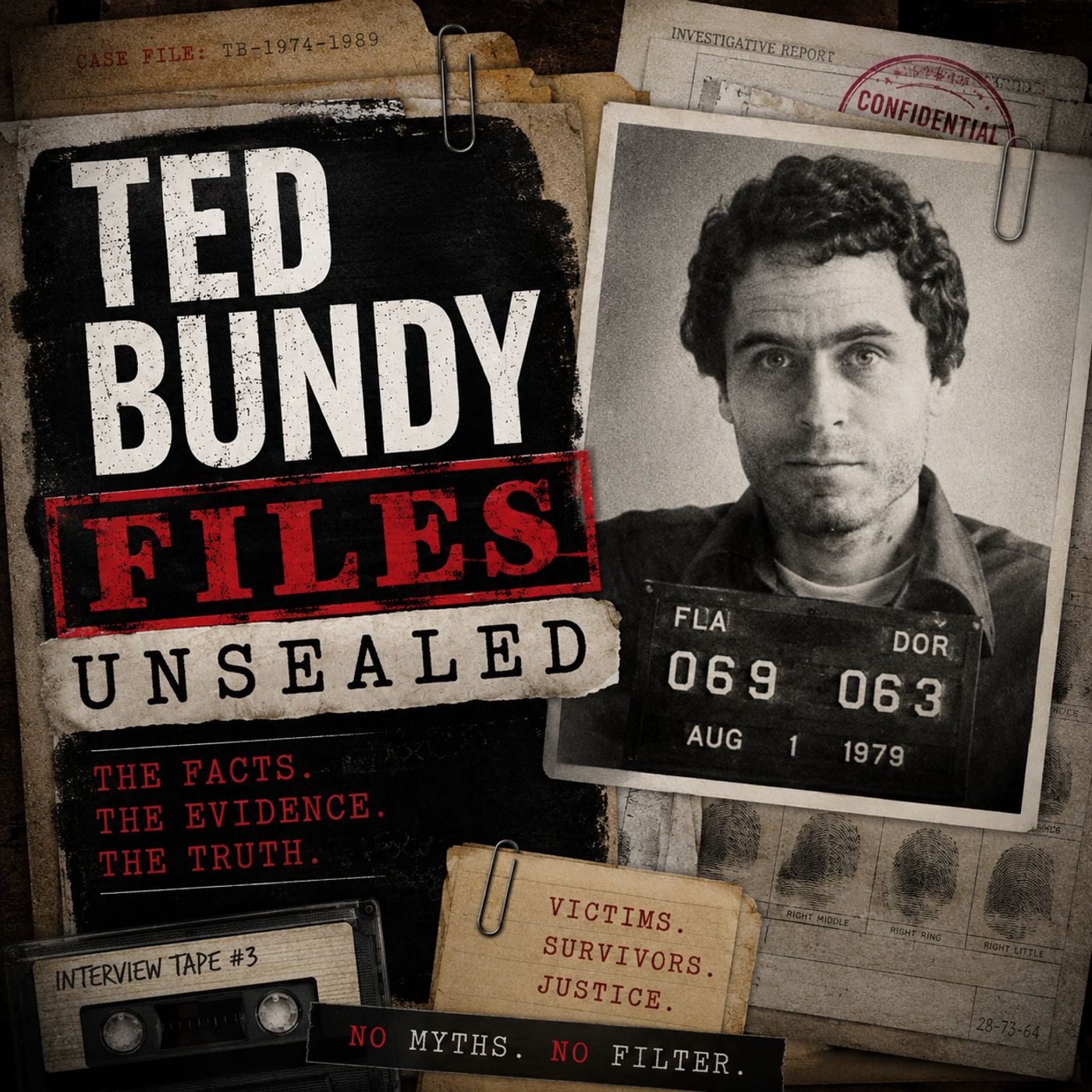
Ted Bundy Files Unsealed
AC WilsonAudio
- Format:
- Podcast
- New episodes:
- Irregular
- Typical length:
- about 35 minutes
- Latest episode:
About this show
Ted Bundy Files Unsealed dives deep into one of the most infamous criminal cases in American history. Through carefully researched episodes, this true crime podcast examines the life, crimes, investigations, courtroom battles, and lasting impact of serial killer Ted Bundy. From newly revisited evidence and survivor accounts to investigative timelines and historical context, each episode explores the facts behind the headlines. Our goal is to separate myth from reality by presenting documented information, expert insights, and the stories of those whose lives were forever changed. Rather than glorifying violence, Ted Bundy Files Unsealed seeks to understand how these crimes occurred, how investigators pursued justice, and what lessons can be learned from one of the darkest chapters in true crime history.
Podcast Disclaimer Ted Bundy Files Unsealed is intended for informational, educational, and commentary purposes only. This podcast discusses real-life crimes involving violence, murder, and disturbing subject matter that some listeners may find upsetting. Listener discretion is strongly advised. The hosts and producers do not condone, celebrate, or glorify criminal behavior. Our intent is to examine historical events, investigative processes, legal proceedings, and the broader societal impact of these crimes while honoring the experiences of victims and survivors.
Covers: true crime, serial killers, ted bundy, criminal investigations, forensic science, cold cases, courtroom trials, criminal psychology
Show details and episodes come from the publisher's public feed at spreaker.com. Last updated . Names, artwork and text belong to their publishers.
Recently on this show
Summary of recent episodes, drawn from the publisher's feed.
Ted Bundy Files Unsealed is a true crime podcast about serial killer Ted Bundy, covering his crimes, investigations, and court battles. Recent episodes look at the 1974 Melissa Ann Smith case and Carol DaRonch's escape from an attempted abduction.
Cosmos
Similar in subject
- Partners in Crime
Both cover: criminal psychology, forensic science, serial killers - True Crime
Both cover: courtroom trials, forensic science, serial killers - True Crime Files - Unsolved Mysteries, Serial Killers & Real Crime Stories
Both cover: criminal psychology, forensic science, serial killers
Similar shows






Explore more
Episodes
Ted Bundy’s Death Row Letters and Final Words
· 34 min
The episode provide a chilling look into the final communications of the infamous American serial killer Ted Bundy. While on death row, Bundy maintained a haughty and dismissive tone in letters to his family, consistently denying his involvement in any murders despite the overwhelming evidence against him. His cousin, Edna Martin, described his writing as condescending and manipulative, noting that he refused to drop his deceptive facade even when directly questioned about his crimes. Interestingly, his final words before his 1989 execution were surprisingly simple, as he merely requested that his love be passed on to his friends and family members. This calm farewell stood in stark contrast to his brutal history of violence and the defiant, unrepentant attitudes of other notorious criminals. Ultimately, the episode illustrate how Bundy used his articulate persona to mask his lack of remorse until the very end. Content Warning: This podcast contains discussions of homicide, violence, abuse, and other graphic themes related to real-life criminal events. It is intended for mature audiences and listener discretion is advised. This episode includes AI-generated content.
Not rated yetTed Bundy - A Suspect in the Sonoma County Cold Cases
· 45 min
The episode details the Santa Rosa Hitchhiker Murders, a series of unsolved killings in Sonoma County during the early 1970s involving at least seven young female victims. Investigators have frequently considered Ted Bundy as a primary suspect due to his presence in California and the similarity between these crimes and his established methods. Despite his execution in 1989, the 2011 recovery of his DNA profile allowed authorities to pursue modern forensic links to these cold cases. Experts like Robert Keppel support the theory that Bundy began his violent spree earlier than records suggest, though some believe a local offender with intimate knowledge of the terrain is more likely. While other suspects like the Zodiac Killer were explored, the lack of definitive physical evidence or confessions leaves the mystery unresolved. Ultimately, the source highlights the enduring trauma of the victims' families and the persistent effort to find forensic closure decades later. Content Warning: This podcast contains discussions of homicide, violence, abuse, and other graphic themes related to real-life criminal events. It is intended for mature audiences and listener discretion is advised. This episode includes AI-generated content.
Not rated yetWhy does Ted Bundy’s name keep coming up in the Burlington cold case?
· 42 min
For over fifty years, the 1971 murder of Rita Curran in Burlington, Vermont, was frequently linked to the infamous serial killer Ted Bundy due to his local birth and similar criminal patterns. Despite decades of speculative theories fueled by true-crime literature and Bundy's own cryptic remarks, modern DNA technology eventually redirected the investigation. In 2023, authorities used genetic genealogy to identify the true culprit as William DeRoos, a neighbor who lived in Curran's apartment building at the time of the attack. This discovery highlights the limitations of circumstantial evidence and the power of forensic science to dismantle myths surrounding high-profile criminals. The case ultimately reveals how notoriety can overshadow the truth, proving that the most famous suspect is not always the guilty party. Content Warning: This podcast contains discussions of homicide, violence, abuse, and other graphic themes related to real-life criminal events. It is intended for mature audiences and listener discretion is advised. This episode includes AI-generated content.
Not rated yetDid Ted Bundy Kill His First Victim When He Was 14?
· 54 min
This episode explores the enduring mystery of whether the infamous serial killer Ted Bundy committed his first murder at age 14. It focuses on the 1961 disappearance of Ann Marie Burr, an eight-year-old girl who vanished from her Tacoma home just miles from where a young Bundy lived. The source examines circumstantial evidence linking him to the crime, such as his local paper route and cryptic statements he made before his execution. While DNA testing in 2011 proved inconclusive, the article highlights how forensic limitations and Bundy’s own habit of manipulation have left the case officially unsolved. Ultimately, the narrative weighs the psychological theories regarding Bundy's early development against the lack of definitive physical proof. This overview captures the tragic impact on the Burr family and the persistent suspicion that Bundy’s violent trajectory began much earlier than documented. Content Warning: This podcast contains discussions of homicide, violence, abuse, and other graphic themes related to real-life criminal events. It is intended for mature audiences and listener discretion is advised. This episode includes AI-generated content.
Not rated yetA New DNA Profile of Ted Bundy Could Help Solve These Utah Cold Cases
· 41 min
Using advanced genotyping technology acquired in 2023, Utah authorities successfully extracted a full DNA profile of serial killer Ted Bundy from evidence preserved since 1974. This forensic breakthrough officially closed the decades-old murder case of Laura Ann Aime, providing her family with long-awaited scientific certainty. Because this modern profile is now uploaded to national databases, law enforcement agencies across the country can compare it against biological material from other unsolved cold cases. While this provides a path to justice for victims with recovered remains, cases involving missing bodies still face significant investigative hurdles. Ultimately, the discovery highlights how meticulous evidence preservation and evolving science can eventually overcome the passage of time. This development offers a renewed sense of hope for resolving various 1970s disappearances linked to Bundy’s violent tenure in the Mountain West. Content Warning: This podcast contains discussions of homicide, violence, abuse, and other graphic themes related to real-life criminal events. It is intended for mature audiences and listener discretion is advised. This episode includes AI-generated content.
Not rated yetHow the Grand Junction Police Department Solved a Ted Bundy Victim Cold Case
· 33 min
The episode details the decades-long investigation into the disappearance of Denise Lynn Oliverson, who vanished in Grand Junction, Colorado, in April 1975. Although her body was never recovered, the case was officially reclassified as a homicide and closed in 2019 after a methodical review by local authorities. Investigators successfully linked the crime to serial killer Ted Bundy by combining historical gas receipts that placed him in the city with a long-overlooked audio confession. This recording, which specifyied that he discarded her remains in the Colorado River, provided the necessary resolution for a case that had remained a missing-persons file for over forty years. The sources emphasize that while modern DNA played a limited role, persistent police work and inter-agency communication were vital in naming the perpetrator. Ultimately, the narrative highlights the somber reality of achieving justice for families when a killer is long dead and physical evidence is scarce. Content Warning: This podcast contains discussions of homicide, violence, abuse, and other graphic themes related to real-life criminal events. It is intended for mature audiences and listener discretion is advised. This episode includes AI-generated content.
Not rated yetExtremely Wicked Director on How Ted Bundy ‘Seduced’ His Victims
· 34 min
Filmmaker Joe Berlinger released two distinct projects in 2019 to provide a comprehensive look at the life and crimes of Ted Bundy. The first, a Netflix documentary series, utilizes over 100 hours of death row recordings to provide a clinical analysis of the killer’s internal psyche. In contrast, the narrative feature film starring Zac Efron explores the perspective of Bundy’s longtime girlfriend to illustrate how manipulation and charm can mask profound evil. Berlinger intentionally avoided graphic violence in the dramatization to mirror the deception experienced by those who trusted the murderer. By presenting these works as two sides of the same coin, the director examines both the evidentiary reality of the crimes and the social camouflage that allowed them to occur. Ultimately, the sources highlight how the most dangerous threats often emerge from individuals who appear ordinary and trustworthy. Content Warning: This podcast contains discussions of homicide, violence, abuse, and other graphic themes related to real-life criminal events. It is intended for mature audiences and listener discretion is advised. This episode includes AI-generated content.
Not rated yetTed Bundy’s First Known Victim Believes A Random Coincidence Saved Her Life
· 44 min
This episode details the life and survival of Karen Sparks, who is recognized as the first known victim of the serial killer Ted Bundy. Although she suffered permanent, life-altering injuries during the 1974 assault, she attributes her survival to the random coincidence of her roommate talking in his sleep, which she believes frightened the attacker away. The narrative explores her arduous recovery process, her professional success as an accountant, and her decades-long commitment to maintaining personal privacy. It highlights her eventual decision to speak publicly in 2020 to reclaim her story and contribute to the historical record. Ultimately, the source emphasizes Sparks' resilient philosophy, as she refuses to let the identity of a victim define her life despite the lasting physical consequences of the attack. Content Warning: This podcast contains discussions of homicide, violence, abuse, and other graphic themes related to real-life criminal events. It is intended for mature audiences and listener discretion is advised. This episode includes AI-generated content.
Not rated yetKimberly Leach, The 12-Year-Old Girl Who Became Serial Killer Ted Bundy’s Final Victim
· 32 min
The episode recounts the tragic life and death of twelve-year-old Kimberly Diane Leach, who was the final victim of the notorious serial killer Ted Bundy. It details her 1978 disappearance from her Lake City junior high school, the subsequent massive search effort, and the eventual discovery of her remains. Beyond the criminal investigation, the source highlights Kimberly’s personal history as a kind, bright student whose loss profoundly impacted her small Florida community. The narrative also tracks Bundy’s criminal path to Florida, his high-profile legal trials, and his 1989 execution. Ultimately, the episode seeks to shift the focus away from the perpetrator’s notoriety to honor the memory and human cost of a life cut short. Content Warning: This podcast contains discussions of homicide, violence, abuse, and other graphic themes related to real-life criminal events. It is intended for mature audiences and listener discretion is advised. This episode includes AI-generated content.
Not rated yetThe Untold Truth Of Ted Bundy
· 53 min
The episode critiques the persistent myth of Ted Bundy as a brilliant, "Lecter-like" mastermind, instead presenting him as a sadistic predator who relied on ordinary social camouflage and institutional failures. It explores his troubled upbringing, his history of voyeurism, and the strategic deception he used to maintain a persona as a promising young conservative. By detailing his brutal crimes and opportunistic escapes, the source highlights the stark contrast between his violent reality and the suave public image he projected. Ultimately, the narrative warns that romanticizing his intelligence minimizes the savagery of his actions and ignores the psychopathic entitlement that fueled his spree. The episode serves as a sobering correction to pop-culture portrayals, stripping away the fabricated charisma to reveal a man driven by a desire for absolute control. Content Warning: This podcast contains discussions of homicide, violence, abuse, and other graphic themes related to real-life criminal events. It is intended for mature audiences and listener discretion is advised. This episode includes AI-generated content.
Not rated yet“The Very Definition of Heartless Evil”: Ted Bundy in Colorado
· 43 min
This episode examines the criminal activity and incarceration of Ted Bundy within the state of Colorado during the mid-1970s. It details the disappearances and murders of Caryn Campbell, Julie Cunningham, and Denise Oliverson, highlighting how Bundy used his charming persona to mask his predatory nature. The narrative specifically focuses on his two daring escapes from custody, first by jumping from a courthouse window in Aspen and later by tunneling through a jail ceiling in Glenwood Springs. These lapses in security allowed him to flee to Florida, where he committed further atrocities before his eventual execution in 1989. Ultimately, the source reflects on the lasting trauma inflicted on these mountain communities and the systemic changes in legal and forensic protocols that followed his capture. This overview portrays Bundy as a calculated manipulator whose actions represent the totality of heartless evil. Content Warning: This podcast contains discussions of homicide, violence, abuse, and other graphic themes related to real-life criminal events. It is intended for mature audiences and listener discretion is advised. This episode includes AI-generated content.
Not rated yetTimeline of Many of Ted Bundy's Brutal Crimes
· 37 min
This source provides a comprehensive chronological record of the violent activities committed by Ted Bundy between 1974 and 1978. It details his early life and academic background in the Pacific Northwest before tracing his path across multiple states, where he targeted dozens of young women. The episode highlights his two successful escapes from custody and the eventual Florida crimes that led to his final arrest. Beyond the specific criminal acts, the document examines the significant failures in law enforcement communication that allowed him to remain at large for so long. It also honors the identities of the victims and discusses the lasting psychological impact these events had on American society and the justice system. Ultimately, the narrative serves as a historical ledger of the lives lost and the evolution of modern criminal profiling. Content Warning: This podcast contains discussions of homicide, violence, abuse, and other graphic themes related to real-life criminal events. It is intended for mature audiences and listener discretion is advised. This episode includes AI-generated content.
Not rated yetThe Disturbing Stories Of The Women Ted Bundy Killed — And The Few Who Survived
· 36 min
This episode documents the violent history of Ted Bundy, a serial killer who targeted dozens of young women across multiple states during the 1970s. It details his calculated methods of deception, such as feigning injuries or impersonating authority figures to exploit the kindness of his victims. While the narrative recounts the tragic murders of several students, it also highlights the resilience of survivors whose bravery and testimony ultimately led to his conviction. The source emphasizes the profound human cost of his crimes, shifting the focus from the killer’s notoriety to the lives and legacies of the women he harmed. Ultimately, the overview serves as a somber record of a predatory spree that fundamentally changed forensic investigations and campus safety awareness. Content Warning: This podcast contains discussions of homicide, violence, abuse, and other graphic themes related to real-life criminal events. It is intended for mature audiences and listener discretion is advised. This episode includes AI-generated content.
Not rated yet7 Ted Bundy Documentaries Every Real True-Crime Fan Needs to Watch
· 34 min
This episode provides a comprehensive overview of essential documentaries and docuseries centered on the notorious serial killer Ted Bundy. The selected media explores the stark contrast between Bundy's outward appearance as a charismatic professional and the brutal reality of his violent crimes. Key sources emphasize diverse perspectives, ranging from archival death row audio of the killer himself to the intimate testimonies of his longtime girlfriend and surviving victims. These films analyze the psychological pathology behind his actions while critiquing the societal failures and media sensationalism of the era. By shifting the focus from the killer’s supposed brilliance to the humanity of his victims, the collection offers a balanced look at Bundy's enduring impact on criminal profiling and popular culture. Ultimately, the sources serve as a grim reminder of how manipulative predators exploit trust and the importance of honoring those who suffered through their crimes. Content Warning: This podcast contains discussions of homicide, violence, abuse, and other graphic themes related to real-life criminal events. It is intended for mature audiences and listener discretion is advised. This episode includes AI-generated content.
Not rated yetHow Ted Bundy’s Education Helped Him Lure Victims and Evade Arrest
· 41 min
The episode examines how Ted Bundy’s academic background in psychology and law served as a sophisticated tool for manipulation rather than a path toward a legitimate career. While his education did not cause his violent impulses, it equipped him with the psychological insights necessary to exploit social vulnerabilities and the legal knowledge to navigate the criminal justice system. The source details how Bundy utilized campus environments to find victims and employed various intellectual ruses, such as faking injuries or impersonating authority figures, to lower his targets' defenses. Ultimately, the article portrays Bundy as a predator who weaponized his perceived normalcy and credentials to maintain a lethal double life. By analyzing his history at various universities, the episode highlights the dangerous intersection of academic achievement and psychopathic behavior. Content Warning: This podcast contains discussions of homicide, violence, abuse, and other graphic themes related to real-life criminal events. It is intended for mature audiences and listener discretion is advised. This episode includes AI-generated content.
Not rated yetThe Story of Ted Bundy, Who Studied Psychology and Law Before Murder
· 53 min
The episode details the life and criminal history of Ted Bundy, one of the most infamous serial killers in American history. It explores his unremarkable upbringing and his academic background in psychology and law, which he weaponized to manipulate his victims and evade capture. The source documents his violent multi-state crime spree during the 1970s, his daring escapes from custody, and the eventual forensic evidence that led to his execution. Beyond the specific murders, the episode examines Bundy’s psychopathic traits and his ability to maintain a deceptive veneer of normalcy within society. Ultimately, the material serves as a case study on the failures of early law enforcement and the enduring chilling legacy of a man who hid extreme depravity behind a charming facade. Content Warning: This podcast contains discussions of homicide, violence, abuse, and other graphic themes related to real-life criminal events. It is intended for mature audiences and listener discretion is advised. This episode includes AI-generated content.
Not rated yetTed Bundy Confessed to Killing 30 Women—Here’s How He Gained Their Trust
· 40 min
The episode details how Ted Bundy exploited human psychology and social norms to facilitate his violent crimes against at least 30 women. By utilizing a calculated public persona that appeared charming, intelligent, and non-threatening, Bundy successfully bypassed the natural defenses of his victims. He frequently employed specific ruses, such as feigning physical injuries to elicit help or impersonating authority figures to demand compliance. These tactics leveraged the "halo effect," a cognitive bias where attractive and articulate individuals are perceived as inherently trustworthy. The source analyzes these methods through investigative records and psychological profiles to explain how he operated undetected in public spaces. Ultimately, the overview highlights the dangerous contrast between Bundy’s outward normalcy and his true nature as a predatory serial killer. Content Warning: This podcast contains discussions of homicide, violence, abuse, and other graphic themes related to real-life criminal events. It is intended for mature audiences and listener discretion is advised. This episode includes AI-generated content.
Not rated yet5 Things to Know About Serial Killer Ted Bundy
· 50 min
This source chronicles the life, criminal career, and lasting impact of Ted Bundy, a notorious American serial killer who exploited his outward charm to murder dozens of young women. The text details how Bundy utilized deceptive social personas and calculated ruses, such as faking injuries, to lure victims across multiple states throughout the 1970s. It describes his two daring escapes from custody and the subsequent Florida trial that became a national media spectacle before his 1989 execution. Beyond the historical timeline, the passage highlights how his case spurred advancements in forensic science and criminal profiling that continue to solve cold cases today. Ultimately, the overview presents Bundy as a chilling example of psychopathy, warning that extreme violence can hide behind an ordinary, helpful facade. Content Warning: This podcast contains discussions of homicide, violence, abuse, and other graphic themes related to real-life criminal events. It is intended for mature audiences and listener discretion is advised. This episode includes AI-generated content.
Not rated yetHandwritten Note Mentioning Serial Killer Ted Bundy and Zip Ties Found at Olney Property
· 53 min
A multi-agency investigation in Philadelphia has uncovered a "house of horrors" following the arrest of Eugene Horsch on drug and weapons charges. Inside the Olney property, authorities discovered a disturbing handwritten note referencing serial killer Ted Bundy, alongside a 55-gallon drum, zip ties, and hazardous chemicals. The search also yielded bank cards and identification belonging to missing women, specifically Amy McHale and Blair Tonzelli, who both had prior ties to the household. While Horsch remains in custody, his late father’s history as a sociopathic filmmaker and writer of dark serial killer fiction has complicated the inquiry into whether the evidence represents actual crimes or macabre fantasy. Investigators are currently utilizing forensic testing and DNA analysis to determine if the site contains evidence of foul play or remains. Ultimately, the case highlights the intersection of drug addiction, missing persons, and the unsettling legacy of a family steeped in criminal activity and violence. Content Warning: This podcast contains discussions of homicide, violence, abuse, and other graphic themes related to real-life criminal events. It is intended for mature audiences and listener discretion is advised. This episode includes AI-generated content.
Not rated yet"The Trail of Blood: Bundy’s Cross-Country Killing Spree (1974–1978)"
· 37 min
The episode documents the violent trajectory of Ted Bundy during his four-year cross-country murder spree. It details how he utilized manipulative charm and high mobility to target young women across Washington, Utah, Colorado, and Florida while evading fragmented law enforcement agencies. The narrative highlights critical investigative turning points, such as key survivor testimonies and forensic breakthroughs involving bite-mark evidence. Beyond the crimes, the source examines the systemic failures in communication between jurisdictions and the resulting evolution of modern criminal profiling. Ultimately, the episode emphasizes the profound human cost of his actions, urging a historical focus on the victims rather than the perpetrator’s notoriety. Through this lens, it explores how the case reshaped American culture and public perceptions of serial violence. Content Warning: This podcast contains discussions of homicide, violence, abuse, and other graphic themes related to real-life criminal events. It is intended for mature audiences and listener discretion is advised. This episode includes AI-generated content.
Not rated yet