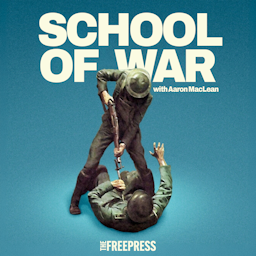
School of War
The Free PressAudio
- Format:
- Podcast
- New episodes:
- Several times a week
- Typical length:
- about 55 minutes
- Latest episode:
About this show
In School of War, CBS News National Security Analyst and Free Press columnist Aaron MacLean sits down with secretaries of state, top military historians, war planners, and key political decision-makers to help understand the lessons of war.
Tune in as School of War takes you to the front lines.
Aaron MacLean is a former senior fellow at Hudson Institute. He has worked as a foreign policy advisor and legislative director to Sen. Tom Cotton of Arkansas and spent seven years in the U.S. Marine Corps.
Visit our Substack for episode transcripts
Follow along on Instagram
Covers: military history, national security, foreign policy, middle east politics, US politics, israel politics, nato defense, military aviation
Show details and episodes come from the publisher's public feed at feeds.megaphone.fm. Last updated . Names, artwork and text belong to their publishers.
Recently on this show
Summary of recent episodes, drawn from the publisher's feed.
School of War is a podcast where Aaron MacLean talks with political leaders, military historians, and war planners about the lessons of war. Recent episodes cover Israel's election and northern frontier, Napoleon's marshals, Sweden's secret cooperation with NATO, and the MV-22 Osprey.
Cosmos
Rated alike
- Daniel Greene
Often rated the same way. - This American Life
Often rated the same way. - Biscuits & Jam
Often rated the same way.
Similar in subject
- The Jimmy Dore Show
Both cover: israel politics, foreign policy, us politics - Uncommon Knowledge
Both cover: foreign policy, national security, us politics - Redacted News
Both cover: israel politics, foreign policy, us politics
Similar shows






Explore more
Episodes
Lindsey Graham: The Last of the ‘Three Amigos’ with Vance Serchuk
· 58 min
Vance Serchuk, executive director and Partner at the KKR Global Institute, and former senior national security adviser to Senator Joe Lieberman, was uniquely positioned to witness one of the most influential partnerships in modern American foreign policy: the “Three Amigos” of John McCain, Joe Lieberman, and Lindsey Graham. What made their partnership so effective? What vision did they share for America’s role in the world? And what does the end of the “Three Amigos” mean for the future of American foreign policy? 02:21 - Lindsey Graham and the Three Amigos 10:42 - First Impressions of Lindsey Graham 13:20 - Lindsey Graham’s Sense of Humor 15:47 - Graham’s Spontaneity 21:44 - The Three Amigos’ Bond Through Travel 23:31 - Oversight on the Front Lines 24:56 - The Russian Threat 27:00 - The Three Amigos’ Shared Convictions 28:28 - Russia’s Invasion of Georgia 32:56 - Senator Graham’s Political Courage 33:27 - What Made the Three Amigos Different 37:24 - Graham’s Political Instincts 37:56 - Why the Three Amigos Worked 39:33 - The Power of Political Friendship 42:28 - Graham’s Work in the Trump Era Follow along (https://bit.ly/41EloxN) on Instagram, X@schoolofwarpod (https://x.com/schoolofwarpod), and YouTube@SchoolofWarPodcast (https://www.youtube.com/@SchoolofWarPodcast) Find more at The Free Press (https://www.thefp.com/s/school-of-war). Learn more about your ad choices. Visit megaphone.fm/adchoices (https://megaphone.fm/adchoices)
Not rated yetHow Choke Points Became Weapons of War, with Edward Fishman
· 45 min
Edward Fishman, senior fellow and director of the Greenberg Center for Geoeconomics at the Council on Foreign Relations, joins School of War to discuss his New York Times best-selling book, Chokepoints: American Power in the Age of Economic Warfare (https://bookshop.org/a/93116/9780593712979). How has the United States turned the global economy into a strategic weapon? What are the strengths and limits of sanctions? And how are China, Russia, and Iran adapting to a new era of economic warfare? 02:46 - Edward Fishman's background 04:26 - Understanding economic chokepoints 05:35 - The dollar as a strategic chokepoint 07:02 - Semiconductors as a strategic chokepoint 09:24 - The Iraq embargo and modern sanctions 11:05 - Airpower vs. economic warfare 12:14 - Are sanctions a "nuclear weapon"? 13:23 - America's sanctions strategy toward Iran 14:25 - Trump pulling out of the JCPOA 16:20 - The limits of economic warfare 18:00 - Iran, the Strait of Hormuz, and the MoU 20:44 - Shadow fleets and Iranian oil 22:54 - The evolution of Russia sanctions 27:59 - China and the economic arms race 29:53 - How nations mitigate economic chokepoints 34:20 - What makes a strategic chokepoint? 39:40 - Chokepoints beyond economics 41:05 - Can Iran institutionalize control over the Strait of Hormuz? Follow along (https://bit.ly/41EloxN) on Instagram, X@schoolofwarpod (https://x.com/schoolofwarpod), and YouTube@SchoolofWarPodcast (https://www.youtube.com/@SchoolofWarPodcast), or at The Free Press (https://www.thefp.com/s/school-of-war) Learn more about your ad choices. Visit megaphone.fm/adchoices (https://megaphone.fm/adchoices)
Not rated yetFour Years Fighting Russia: An American Soldier’s Testimony
· 1 hr 21 min
David, a U.S. military veteran who has been fighting voluntarily alongside Ukrainian forces, joins School of War to discuss how four years on the front lines have transformed modern warfare. How has combat in Ukraine changed since Russia’s 2022 invasion? Why have first-person view drones become the defining weapon of the war? What misconceptions does the West still have about the Russian military? And what lessons must the United States absorb before its next major conflict? 02:49 - David’s military history 05:56 - What brought David to Ukraine 07:37 - Russia's failed invasion of Kyiv 10:24 - How Ukraine turned the tide in 2022 17:04 - How Ukraine adapted to Russia's invasion 19:06 - America's role in Ukraine's early success 23:59 - How the battlefield has evolved since 2022 28:15 - Experiencing Russian artillery 37:22 - From artillery warfare to drone warfare 40:41 - Why FPV drones are terrifying 44:20 - The modern "gray zone" 49:26 - Why Russia is still a military threat 01:00:49 - What Ukraine must do to survive 01:11:41 - Is the U.S. military learning the right lessons? 01:15:55 - The future of warfare and America's defense industry Follow along (https://bit.ly/41EloxN) on Instagram, X@schoolofwarpod (https://x.com/schoolofwarpod), and YouTube@SchoolofWarPodcast (https://www.youtube.com/@SchoolofWarPodcast) Find more at The Free Press (https://www.thefp.com/s/school-of-war). Learn more about your ad choices. Visit megaphone.fm/adchoices (https://megaphone.fm/adchoices)
Not rated yetThe American Revolution Was a World War, with Richard Bell
· 48 min
Richard Bell, historian, professor at the University of Maryland, and author of The American Revolution and the Fate of the World (https://bookshop.org/a/93116/9780593719510), joins School of War to discuss how the American Revolution became a global conflict that stretched from Boston to the Caribbean, Europe, India, and beyond. How did George Washington's strategy force Britain to fight a world war? Why was France's intervention decisive to American victory? And what does the revolution reveal about the nature of coalition warfare? 00:53 - Rick Bell's background 02:05 - The American Revolution was a global war 06:09 - What led to the Boston Tea Party 12:45 - Patriot motivations 14:38 - Who was Edmund Burke? 16:50 - Britain divided over the Revolution 20:47 - Why France backed the Patriots 23:45 - France and Spain vs. Britain 27:01 - The Caribbean: Britain's crown jewel 30:08 - The forgotten theater of the Revolution 35:49 - Washington's global coalition strategy 38:55 - Germany and the Hessian soldiers 41:50 - The Patriots' European officers 43:10 - The myth of guerrilla warfare 44:50 - Final thoughts Follow along (https://bit.ly/41EloxN) on Instagram, X@schoolofwarpod (https://x.com/schoolofwarpod), and YouTube@SchoolofWarPodcast (https://www.youtube.com/@SchoolofWarPodcast) Find more at The Free Press (https://www.thefp.com/s/school-of-war). Learn more about your ad choices. Visit megaphone.fm/adchoices (https://megaphone.fm/adchoices)
Not rated yetOne Battle of Hormuz After Another, with Sal Mercogliano
· 42 min
Sal Mercogliano, professor of history at Campbell University and host of the What’s Going on with Shipping (https://www.youtube.com/@wgowshipping) YouTube channel, joins the show once again to discuss Iran's renewed attacks on commercial shipping in the Strait of Hormuz. Why is the ceasefire already beginning to unravel? What is Iran trying to accomplish by asserting control over the strait? And what could the long-term consequences be for global trade, energy markets, and freedom of navigation? 02:11 - New arrangement in the Strait of Hormuz 05:19 - Humanitarian situation for sailors 06:53 - Jobs at sea and AI 08:05 - New rounds of violence 11:02 - Route options for ships 13:30 - Why did the ceasefire break down? 15:05 - Iran asserts control over the strait 16:10 - Why were these ships targeted? 19:08 - Strait of Hormuz as a strategic choke point 21:49 - What Iran learned from the Houthis 23:21 - Why energy prices haven't spiked 28:20 - Impact on developing nations 29:13 - The endgame in the Strait of Hormuz 33:22 - U.S. naval presence in the Gulf 36:26 - Iran's maritime protection racket Follow along (https://bit.ly/41EloxN) on Instagram, X@schoolofwarpod (https://x.com/schoolofwarpod), and YouTube@SchoolofWarPodcast (https://www.youtube.com/@SchoolofWarPodcast), or at The Free Press (https://www.thefp.com/s/school-of-war) Learn more about your ad choices. Visit megaphone.fm/adchoices (https://megaphone.fm/adchoices)
Not rated yetWhy Chimpanzees Go to War, with John Mitani
· 49 min
Dr. John Mitani, professor emeritus in the Department of Anthropology at the University of Michigan and recipient of the Charles R. Darwin Lifetime Achievement Award, joins School of War to discuss the violent chimpanzee civil war he documented among the Ngogo chimpanzees in Uganda. What caused one of the world's largest chimpanzee communities to turn on itself? What does chimpanzee warfare reveal about the origins of human conflict? And what separates humans from our closest living relatives? 02:39 - How Dr. Mitani became an ape researcher 04:02 - Why chimpanzees? 05:13 - Humans' closest living relatives 08:38 - The Ngogo chimpanzees 09:31 - The chimpanzee civil war begins 13:35 - Living among wild chimpanzees 17:09 - Territorial patrols and warfare 22:34 - Why the chimpanzee community split 26:26 - How chimpanzees fight 29:14 - The strategy behind chimp warfare 31:24 - Why full stomachs lead to war 33:10 - Land, food, and reproduction 37:27 - Infanticide and the mystery of female survival 39:26 - When civil war becomes permanent 41:13 - What chimpanzees teach us about human nature Follow along (https://bit.ly/41EloxN) on Instagram, X@schoolofwarpod (https://x.com/schoolofwarpod), and YouTube@SchoolofWarPodcast (https://www.youtube.com/@SchoolofWarPodcast) Find more at The Free Press (https://www.thefp.com/s/school-of-war). Learn more about your ad choices. Visit megaphone.fm/adchoices (https://megaphone.fm/adchoices)
Not rated yetFrom Teenage Soldier to Commander in Ukraine, with Mamuka Mamulashvili
· 56 min
Earlier this year, Aaron MacLean visited Ukraine, where he met with Georgian Legion commander Mamuka Mamulashvili. What happens when a boy goes to war at 14 years old? What does a lifetime of fighting Russians teach you about how they operate? And what lessons should the West be learning from war in Ukraine? 02:18 - Growing up in Soviet Georgia 03:53 - Russia's invasion of Abkhazia 07:59 - Capture and torture by Russian forces 10:24 - The First and Second Chechen Wars 13:49 - Killing a Russian soldier for the first time 17:32 - Force vs. diplomacy 18:14 - Georgia's wars with Russia 20:19 - The 2008 Russo-Georgian War 23:47 - Georgian support for Ukraine 24:39 - Mixed martial arts 29:53 - Founding the Georgian Legion 33:33 - The defense of Hostomel Airport 43:32 - How drones have transformed warfare 50:45 - Russian disinformation 52:27 - Why Ukraine will ultimately win Follow along (https://bit.ly/41EloxN) on Instagram, X@schoolofwarpod (https://x.com/schoolofwarpod), and YouTube@SchoolofWarPodcast (https://www.youtube.com/@SchoolofWarPodcast) Find more at The Free Press (https://www.thefp.com/s/school-of-war). Learn more about your ad choices. Visit megaphone.fm/adchoices (https://megaphone.fm/adchoices)
Not rated yetCan Courage Save America? With Rye Barcott
· 48 min
Rye Barcott, co-founder and CEO of With Honor, veteran of the U.S. Marine Corps, and author of Courage Can Save Us (https://bookshop.org/a/93116/9798260200575), joins School of War to discuss the meaning of courage, the enduring value of service, and the challenge of bridging America’s growing political divides. What separates courage from bravery? Can military service help heal a polarized America? And what does principled leadership look like in an age of distrust? 01:28 - Murph challenge 03:08 - Rye's father and Vietnam 05:08 - Defining courage 07:57 - First to Fight 13:49 - Joining the Marines 14:22 - September 11th 17:42 - Bosnia, Africa, and Fallujah 19:16 - Marine commanders 23:52 - Life in Fallujah 26:05 - The With Honor mission 28:29 - America's polarization problem 30:05 - Veterans in politics 33:12 - The civil-military divide 37:23 - Courage in politics 41:57 - Congressman Jared Golden 44:19 - Senator Todd Young Follow along (https://bit.ly/41EloxN) on Instagram, X@schoolofwarpod (https://x.com/schoolofwarpod), and YouTube@SchoolofWarPodcast (https://www.youtube.com/@SchoolofWarPodcast) Find more at The Free Press (https://www.thefp.com/s/school-of-war). Learn more about your ad choices. Visit megaphone.fm/adchoices (https://megaphone.fm/adchoices)
Not rated yetReading Trump’s Iran Deal So You Don’t Have To, with Mark Dubowitz
· 55 min
Mark Dubowitz, CEO of the Foundation for Defense of Democracies, returns to School of War to discuss the newly released memorandum of understanding between the United States and Iran. What does the deal actually say? What are its biggest strategic implications? And is it comparable to the JCPOA—or something worse? 01:19 - Paragraph 1: Lebanon and Hezbollah 09:45 - Paragraphs 2–3: Sovereignty and the 60-day clock 11:24 - Paragraph 4: Lifting the blockade 16:37 - Paragraph 5: The Strait of Hormuz 23:48 - Paragraph 6: A $300 billion reconstruction fund 33:49 - Paragraph 7: Ending all sanctions 35:43 - Paragraph 8: Nuclear weapons and enrichment 39:12 - Paragraph 9: Maintaining the status quo 40:44 - Paragraph 10: Oil waivers and sanctions relief 43:48 - Paragraph 11: Releasing frozen funds 46:56 - Paragraph 12: Monitoring compliance 47:52 - Paragraph 13: Negotiating the final deal 50:59 - Paragraph 14: A UN Security Council resolution 51:13 - Squandering battlefield leverage Follow along (https://bit.ly/41EloxN) on Instagram, X@schoolofwarpod (https://x.com/schoolofwarpod), and YouTube@SchoolofWarPodcast (https://www.youtube.com/@SchoolofWarPodcast) Find more at The Free Press (https://www.thefp.com/s/school-of-war). Learn more about your ad choices. Visit megaphone.fm/adchoices (https://megaphone.fm/adchoices)
Not rated yetAuditing the Iran War, with Eliot Cohen
· 45 min
Eliot Cohen, Arleigh A. Burke Chair in Strategy at the Center for Strategic and International Studies; professor emeritus at Johns Hopkins School of Advanced International Studies, author of The Strategist: How to Think About War and Politics (https://bookshop.org/a/93116/9780691269443); and co-host of the Shield of the Republic (https://podcasts.apple.com/us/podcast/shield-of-the-republic/id1589548143) podcast, joins School of War to discuss the recent agreement between the United States and Iran. Did the United States and Israel accomplish their objectives against Iran? What does the conflict reveal about the U.S. military's readiness for future wars? And did Trump negotiate from a position of strength, or squander one? 01:22 - Eliot Cohen on the war with Iran 03:34 - Judging Trump by outcomes 05:08 - A war 47 years in the making 06:45 - What we don't know about the air campaign 08:08 - Negotiating from strength? 09:10 - Trump's negotiating style 12:05 - Questions about America's conduct of the war 14:31 - The Strait of Hormuz becomes the objective 15:41 - Why the war ended when it did 17:25 - Trump and the nature of war 19:01 - Has Iran succeeded? 23:21 - The decline of the Iranian empire 28:09 - Why Trump got a bad deal 31:36 - Auditing the U.S. military 39:39 - Has warfare been transformed? 42:10 - What should America do next? Learn more about your ad choices. Visit megaphone.fm/adchoices (https://megaphone.fm/adchoices)
Not rated yet