

About this show
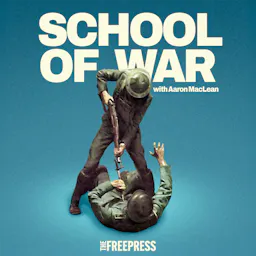
In School of War, CBS News National Security Analyst and Free Press columnist Aaron MacLean sits down with secretaries of state, top military historians, war planners, and key political decision-makers to help understand the lessons of war.
Tune in as School of War takes you to the front lines.
Aaron MacLean is a former senior fellow at Hudson Institute. He has worked as a foreign policy advisor and legislative director to Sen. Tom Cotton of Arkansas and spent seven years in the U.S. Marine Corps.
Visit our Substack for episode transcripts
Follow along on Instagram
Show details and episodes come from the publisher's public feed at feeds.megaphone.fm. Last updated . Names, artwork and text belong to their publishers.
Cosmos
Similar by topic and creator
- Conversations with Coleman
Shares the creator The Free Press. - Business of Home Podcast
Shares the topics Arts and Culture and Business. - Radio Cherry Bombe
Shares the topics Arts and Culture and Business.
Episodes
Netenyahu’s Grand Strategy, with Ron Dermer
· 1 hr 57 min
With the Israeli government in limbo after last month’s elections, very little about the country’s military and political future is certain. But Ron Dermer, one of Prime Minister Benjamin Netanyahu’s closest advisers and a key architect of the Abraham Accords, is optimistic—even if Aaron MacLean doesn’t entirely share his confidence. Today, the former Israeli ambassador to the United States—who has described himself as “Robin to Netanyahu’s Batman”—joins School of War to discuss Israel’s strategy, the changing Iranian threat, and the prospects for a more stable Middle East. 03:03 – Ron Dermer's Political Origins 10:40 – Growing Up in Miami Beach 17:14 – America's Political Polarization 20:14 – Netanyahu's Grand Strategy 22:17 – Netanyahu's Economic Revolution 35:37 – Israel's Strategy After October 7 52:57 – The Case for Preemptive War 56:34 – Israel's Military Presence in Gaza and Lebanon 59:15 – Could Iran's Collapse Bring Peace? 1:02:31 – Israel's Strategy Against Hezbollah 1:09:41 – The Failure of Palestinian Diplomacy 1:23:18 – The Future of Gaza and Hamas 1:30:42 – Arab States and Palestinian Reform 1:37:03 – Iran's Military Capabilities 1:47:44 – Can America Unite Against Iran? Learn more about your ad choices. Visit megaphone.fm/adchoices (https://megaphone.fm/adchoices)
Not rated yetNapoleon: The Great Micromanager, with Lord Andrew Roberts
· 40 min
Napoleon Bonaparte’s troops adored him. His generals, meanwhile, were another story. In his new book, Napoleon and His Marshals (https://bookshop.org/a/93116/9781668085080), Lord Andrew Roberts details the lives of the 26 marshals who conquered Europe—and the micromanaging boss who couldn’t stop undermining them. Roberts joins Aaron MacLean to explore the military genius, rivalries, and leadership failures that shaped Napoleon’s empire, before turning to the recent unrest in France, rising political extremism, and the country’s uncertain political future. 02:29 – The French Army Before Napoleon 04:17 – The French Revolution and Napoleon's Rise 02:29 – The French Army Before Napoleon 04:17 – The French Revolution and Napoleon's Rise 05:51 – The Wars Against Napoleon 07:30 – How Napoleon Revolutionized Warfare 11:03 – Meet Napoleon's Marshals 12:29 – Napoleon's Military Meritocracy 16:24 – Napoleon's Micromanagement Problem 19:24 – Berthier: Napoleon's Brilliant Chief of Staff 23:13 – Rivalries Among Napoleon's Generals 27:25 – The Marshal Who Turned Against Napoleon 31:01 – Napoleon's Greatest Leadership Lessons 32:06 – Riots in Modern France Learn more about your ad choices. Visit megaphone.fm/adchoices (https://megaphone.fm/adchoices)
Not rated yetIs AI Destroying the Next Generation of Leaders?
· 54 min
Yuval Levin ranks AI among the most important political questions facing the country, one with “no left and right.” Just last week, the midterms saw voters push back against artificial intelligence in a series of referenda—but the question of its place in American life is far from settled. Today, Levin joins School of War to discuss what he learned during a recent visit to Anthropic, how the debate over AI defies traditional left-right political divisions, and how the technology threatens the development of the next generation of American leaders, including within the military. 02:05 AI and the Professions 03:47 What Is AGI? 07:50 Inside Anthropic 12:27 Can AI Improve Itself? 20:27 AI’s Limitations 24:34 AI and Creativity 28:11 The Threat to Excellence 31:32 AI and Military Leadership 35:23 The Crisis of Expertise 39:44 The Military’s Advantage 48:18 AI, Politics, and China 51:52 Take the Long Way Learn more about your ad choices. Visit megaphone.fm/adchoices (https://megaphone.fm/adchoices)
Not rated yetFlying America’s Most Controversial Aircraft
· 57 min
Is it a plane or a helicopter? The MV-22 Osprey has features from both, but that’s not what makes it one of the most controversial aircraft in the American military. Its history of deadly crashes has earned it a reputation as a dangerous machine, but former Marine Corps pilot Bubba Scott takes a different view Today, Scott joins School of War to explain why he believes the Osprey is “unfairly maligned,” what makes it so revolutionary, why the Marine Corps depends on it, and what it takes to fly one of the most demanding aircraft in military aviation. From a terrifying near-collision to harrowing nighttime landings, Scott offers a rare look inside the cockpit—and the extraordinary skill, training, and leadership required to operate at the limits of modern military aviation. 04:11 – Becoming a Marine Osprey Pilot 09:05 – A Lesson in Marine Corps Toughness 12:54 – Why the Military Needed the Osprey 18:54 – Operation Eagle Claw and the Osprey's Mission 24:07 – Is the Osprey Really Dangerous? 27:07 – The Osprey's Safety Record 30:46 – What Is It Like to Fly an Osprey? 34:34 – The Challenges of Flying the Osprey 38:56 – A Near-Fatal Midair Collision 46:35 – America's Night-Flying Capabilities 50:18 – American Military Excellence 52:20 – Leadership Lessons From the Cockpit Learn more about your ad choices. Visit megaphone.fm/adchoices (https://megaphone.fm/adchoices)
Not rated yetIsrael’s Fight in the North
· 1 hr 6 min
Reporting from northern Israel, Aaron sits down with two unidentified Israeli army officers and Druze community leader Tamir Murad to explore the threats facing the country’s northern frontier. From drones changing the battlefield to the plight of Syria’s Druze, their conversations reveal how closely war touches everyday life. As one Israeli army officer puts it, “There’s no distance between the front line and home. Home is the front line.” 01:10 — Tamir Morad on Israel’s Druze 02:50 — Four generations of service 07:28 — October 7 11:02 — Hezbollah rockets and tunnels 13:55 — Majdal Shams and Druze identity 17:29 — Violence in Suwayda 25:06 — A Druze state? 36:28 — Israeli officers on the 1973 war 39:57 — Lessons from Ukraine 42:07 — Hezbollah’s drones 50:02 — AI on the battlefield 54:15 — Israel’s Syrian buffer zone Learn more about your ad choices. Visit megaphone.fm/adchoices (https://megaphone.fm/adchoices)
Not rated yetWhy Another Iran Strike Looks Inevitable
· 1 hr 18 min
Will Iran cost Republicans the midterms? What happens when half of the GOP turns against Israel? Middle East expert Mike Doran returns to School of War for a wide-ranging discussion of these questions as the midterms threaten to widen divisions on the American right over foreign policy. Taking aim at Tucker Carlson’s influence, Doran argues that the consequences of this divide reach far beyond Israel: “It sets us against ourselves, Americans against Americans, conservatives against conservatives.” He and Aaron MacLean explore the stakes of another escalation with Iran and when it might unfold, the future of America’s alliances, and what it all means for 2028. 03:59 (https://www.youtube.com/watch?v=_LN2RTtxynw&t=239s) Trump’s Next Move on Iran 11:29 (https://www.youtube.com/watch?v=_LN2RTtxynw&t=689s) Can Trump Force a Deal? 17:24 (https://www.youtube.com/watch?v=_LN2RTtxynw&t=1044s) What Iran Really Wants 20:26 (https://www.youtube.com/watch?v=_LN2RTtxynw&t=1226s) Is Renewed War Inevitable? 26:58 (https://www.youtube.com/watch?v=_LN2RTtxynw&t=1618s) Targeting Iran’s Refineries 30:36 (https://www.youtube.com/watch?v=_LN2RTtxynw&t=1836s) Trump, Putin, and Russian Oil 37:55 (https://www.youtube.com/watch?v=_LN2RTtxynw&t=2275s) Israel and Turkey’s Rivalry 45:05 (https://www.youtube.com/watch?v=_LN2RTtxynw&t=2705s) The Fight Over Syria 51:35 (https://www.youtube.com/watch?v=_LN2RTtxynw&t=3095s&pp=0gcJCWMAwfN6Pr3D) The Right Turns on Israel 53:19 (https://www.youtube.com/watch?v=_LN2RTtxynw&t=3199s) The Debate With the NatCons 1:00:09 (https://www.youtube.com/watch?v=_LN2RTtxynw&t=3609s) What Should Conservatives Defend? 1:10:56 (https://www.youtube.com/watch?v=_LN2RTtxynw&t=4256s) Can America Find the Center? This episode of School of War is brought to you by Maven Smart System, the builder platform for the American warfighter, fielded across the force and live on the frontline today. Learn more at palantir.com (https://urldefense.com/v3/__https://www.palantir.com__;!!CxwJSw!Jdc74gnHiUyVh_s2nRh2V0PczrDyMyLouY_4e21nP7wB5iSDqCizDUO-FznilhuXfWiaIASEI0d_w4W6ji7Vqih6-TdFaXaqwQ$). This episode of School of War is also brought to you by Stratolaunch, a leading pure-play hypersonics company. Stratolaunch helps the U.S. and its allies move new hypersonic technologies from concept to capability, faster and cheaper. Learn more about how Stratolaunch is accelerating the future of hypersonics at Stratolaunch.com. Learn more about your ad choices. Visit megaphone.fm/adchoices (https://megaphone.fm/adchoices)
Not rated yetWhat Israel’s Election Is Really About, with Haviv Rettig Gur
· 1 hr 26 min
“It feels like an election where the nature of the country, the future of this foundational ethos of solidarity, is at stake,” says Haviv Rettig Gur. The Free Press Middle East analyst and host of Ask Haviv Anything joins Aaron MacLean in Jerusalem to explore the history behind the election’s deepest divisions. From Zionism’s origins as a rescue project to the military service that shapes its leaders, Gur explains the shared responsibility that built Israel—and why Israelis fear it is unraveling. What does Benjamin Netanyahu offer voters that his opponents don’t? And can a country united against its enemies agree on what it owes its own citizens? 02:05 What Is Zionism? 09:53 Herzl’s Warning 15:13 A Jewish Rescue Project 26:38 Visions of the Jewish State 30:24 Netanyahu’s Security Message 35:21 American Jews and Israel 43:32 Military Service and Political Power 47:41 The Foundations of Israeli Democracy 52:40 The Ultra-Orthodox Draft Fight 1:01:42 The Army and Israeli Identity 1:12:35 What’s at Stake in the Election? 1:21:23 Antisemitism in America This episode of School of War is brought to you by Maven Smart System, the builder platform for the American warfighter, fielded across the force and live on the frontline today. Learn more at palantir.com (https://urldefense.com/v3/__https://www.palantir.com__;!!CxwJSw!Jdc74gnHiUyVh_s2nRh2V0PczrDyMyLouY_4e21nP7wB5iSDqCizDUO-FznilhuXfWiaIASEI0d_w4W6ji7Vqih6-TdFaXaqwQ$). This episode of School of War is also brought to you by Stratolaunch, a leading pure-play hypersonics company. Stratolaunch helps the U.S. and its allies move new hypersonic technologies from concept to capability, faster and cheaper. Learn more about how Stratolaunch is accelerating the future of hypersonics at Stratolaunch.com. Learn more about your ad choices. Visit megaphone.fm/adchoices (https://megaphone.fm/adchoices)
Not rated yetSweden’s Secret Army
· 49 min
Sweden joined NATO in 2024. What took them so long? Historian Johan Wennström, author of The Stay Behinds: Sweden’s Cold War Guardians (https://bookshop.org/a/93116/9781472877543), joins Aaron MacLean to uncover how Sweden secretly collaborated with NATO for decades while remaining publicly neutral for fear the Soviet Union would invade Finland if they did. With Russia threatening Europe again, Wennström discusses the history of Sweden’s balancing act, how it built an army of sleeper cells, and whether NATO membership risks giving countries a false sense of security. 03:13 The Soviet Threat 08:00 Was Sweden Neutral? 15:52 Sweden in World War II 20:10 Sweden’s Military Might 20:50 Building the Resistance 25:11 Legalizing a Secret Army 28:35 Soviet Invasion Plans 33:05 The Resistance Leaders 37:09 Is Europe Prepared? 41:09 Was NATO a Mistake? 42:41 The Case for Deterrence 44:29 Preparing for Defeat This episode of School of War is brought to you by Maven Smart System, the builder platform for the American warfighter, fielded across the force and live on the frontline today. Learn more at palantir.com (https://urldefense.com/v3/__https://www.palantir.com__;!!CxwJSw!Jdc74gnHiUyVh_s2nRh2V0PczrDyMyLouY_4e21nP7wB5iSDqCizDUO-FznilhuXfWiaIASEI0d_w4W6ji7Vqih6-TdFaXaqwQ$). This episode of School of War is also brought to you by Stratolaunch, a leading pure-play hypersonics company. Stratolaunch helps the U.S. and its allies move new hypersonic technologies from concept to capability, faster and cheaper. Learn more about how Stratolaunch is accelerating the future of hypersonics at Stratolaunch.com. Learn more about your ad choices. Visit megaphone.fm/adchoices (https://megaphone.fm/adchoices)
Not rated yetCan Ukraine Win Without America?
· 43 min
Russia is losing ground in eastern Ukraine and suffering mounting casualties. So why is the White House handing Vladimir Putin a lifeline? Retired Australian Army major general Mick Ryan, author of the newsletter Futura Doctrina (https://mickryan.substack.com/), joins Aaron MacLean to examine the links between the Iran war and Ukraine, and explains why Ukraine’s battlefield successes aren’t translating into political advantage. Putin’s best hope, Ryan argues, is getting Donald Trump on his side: “He’s tried everything else and it hasn’t worked.” Could Washington give Putin what his army can’t? 03:07 Ukraine and Iran 05:58 Putin’s American Lifeline 08:04 Rising Diesel Prices 11:22 Ukraine’s Starlink Dependence 13:30 Satellite Speed Limits 18:00 Russia’s Jet-Powered Drones 19:40 Ukraine Without America 22:34 Stalled Peace Talks 25:39 Economic Warfare Against Iran 31:08 Ukraine’s Counteroffensive 36:40 Adapting on the Battlefield 39:14 China’s Lessons From War This episode of School of War is brought to you by Maven Smart System, the builder platform for the American warfighter, fielded across the force and live on the frontline today. Learn more at palantir.com (https://urldefense.com/v3/__https://www.palantir.com__;!!CxwJSw!Jdc74gnHiUyVh_s2nRh2V0PczrDyMyLouY_4e21nP7wB5iSDqCizDUO-FznilhuXfWiaIASEI0d_w4W6ji7Vqih6-TdFaXaqwQ$). This episode of School of War is also brought to you by Stratolaunch, a leading pure-play hypersonics company. Stratolaunch helps the U.S. and its allies move new hypersonic technologies from concept to capability, faster and cheaper. Learn more about how Stratolaunch is accelerating the future of hypersonics at Stratolaunch.com. Learn more about your ad choices. Visit megaphone.fm/adchoices (https://megaphone.fm/adchoices)
Not rated yetThe Making of Xi Jinping
· 1 hr 7 min
During the Cultural Revolution, the Chinese Communist Party purged Xi Jinping’s father and subjected him to 16 years of persecution and imprisonment—so how did the current president of China emerge more devoted to the party than ever? “It’s like a comic book villain origin story,” says Aaron MacLean. Today, Joseph Torigian, senior fellow at the Council on Foreign Relations and author of The Party’s Interests Come First: The Life of Xi Zhongxun, Father of Xi Jinping (https://bookshop.org/a/93116/9781503649057), joins School of War to explore the strange and dark story of China’s current president, the brutality of Mao’s China, and how it all shaped the power dynamics in Beijing today. 03:24 – The Xi Family and Communist Loyalty 08:14 – Why Xi Jinping Never Abandoned the Party 10:05 – China's Revolutionary Origins 13:23 – The Books That Shaped Xi Jinping 18:34 – Why China Embraced Communism 22:13 – Xi Zhongxun's Rise and Near-Execution 29:21 – Mao's Loyalty Test 35:30 – The Great Leap Forward and Famine 45:14 – Xi Jinping's Brutal Childhood 47:38 – His Father's 16 Years of Persecution 52:11 – Mao and the Cultural Revolution 59:17 – The Xi Family's Tragedy This episode of School of War is brought to you by Maven Smart System, the builder platform for the American warfighter, fielded across the force and live on the frontline today. Learn more at palantir.com (https://urldefense.com/v3/__https://www.palantir.com__;!!CxwJSw!Jdc74gnHiUyVh_s2nRh2V0PczrDyMyLouY_4e21nP7wB5iSDqCizDUO-FznilhuXfWiaIASEI0d_w4W6ji7Vqih6-TdFaXaqwQ$). This episode of School of War is also brought to you by Stratolaunch, a leading pure-play hypersonics company. Stratolaunch helps the U.S. and its allies move new hypersonic technologies from concept to capability, faster and cheaper. Learn more about how Stratolaunch is accelerating the future of hypersonics at Stratolaunch.com. Learn more about your ad choices. Visit megaphone.fm/adchoices (https://megaphone.fm/adchoices)
Not rated yetWhen, Not If: The Baltics Prepare for War
· 1 hr 3 min
In the Baltics, war with Russia is no abstraction. Putin could take Lithuania’s capital if he achieved surprise, the nation’s army commander told Aaron MacLean. This week, Aaron travels through Lithuania and Latvia to speak with Brigadier General Nerijus Stankevičius, Lithuanian defense Minister Robertas Kaunas, and Latvian foreign minister Baiba Braže about why Lithuania is amending its constitution to allow weapons of mass destruction on its soil, what schoolchildren are learning in their war-preparedness exercises, and what each country is doing now to make sure they’re ready if war comes. 02:58 — Brig. Gen. Nerijus Stankevičius 04:25 — Russia Could Take Vilnius 06:03 — How Lithuania Would Fight 09:58 — “Never Again” 14:14 — Robertas Kaunas, Lithuania’s Defense Strategy 17:28 — Drones, AI & the Eastern Flank 22:31 — Nuclear Deterrence 23:58 — Preparing the Whole Country 29:16 — A Message to Putin 31:29 — Baiba Braže, Latvia on the Front Line 36:12 — Drones Over Latvia 37:28 — Joining Latvia’s National Guard 40:30 — Russia’s “Sub-Conventional” War 48:46 — What If Russia Wins in Ukraine? 55:54 — Can Russia Be Pressured Into Peace? This episode of School of War is brought to you by Maven Smart System, the builder platform for the American warfighter, fielded across the force and live on the frontline today. Learn more at palantir.com (https://urldefense.com/v3/__https://www.palantir.com__;!!CxwJSw!Jdc74gnHiUyVh_s2nRh2V0PczrDyMyLouY_4e21nP7wB5iSDqCizDUO-FznilhuXfWiaIASEI0d_w4W6ji7Vqih6-TdFaXaqwQ$). This episode of School of War is also brought to you by Stratolaunch, a leading pure-play hypersonics company. Stratolaunch helps the U.S. and its allies move new hypersonic technologies from concept to capability, faster and cheaper. Learn more about how Stratolaunch is accelerating the future of hypersonics at Stratolaunch.com. Learn more about your ad choices. Visit megaphone.fm/adchoices (https://megaphone.fm/adchoices)
Not rated yetRebuilding America’s War Machine
· 49 min
America is running low on munitions, its shipyards can’t keep pace, and the materials its weapons depend on too often run through China. Michael Cadenazzi is the Pentagon official charged with turning that around, putting billions of dollars behind the factories, materials, and supply chains that make America’s military power possible. He joins School of War to explain how the Pentagon plans to ramp up weapons production, attract private investment, and break decades of bad habits in how the Pentagon does business. Cadenazzi is confident America can still mobilize its industrial might for a major war, but he warns that waiting until the shooting starts would be “way more expensive in blood and treasure.” The race to rearm is on, and the question is whether America can win it before the next great-power war begins. 03:40 – America's Industrial Decline 06:15 – Dependence on China 09:12 – Pentagon Spending 12:40 – Rare Earth Production 16:59 – Defense Supply Chains 20:41 – Weapons Manufacturing 23:26 – High-End Weapons vs. Mass 28:01 – Blood and Treasure 31:56 – Private Investment 34:58 – Outproducing China 41:29 – Pentagon Equity Stakes 45:00 – Managing Investments This episode of School of War is brought to you by Maven Smart System, the builder platform for the American warfighter, fielded across the force and live on the frontline today. Learn more at palantir.com (https://urldefense.com/v3/__https://www.palantir.com__;!!CxwJSw!Jdc74gnHiUyVh_s2nRh2V0PczrDyMyLouY_4e21nP7wB5iSDqCizDUO-FznilhuXfWiaIASEI0d_w4W6ji7Vqih6-TdFaXaqwQ$). This episode of School of War is also brought to you by Stratolaunch, a leading pure-play hypersonics company. Stratolaunch helps the U.S. and its allies move new hypersonic technologies from concept to capability, faster and cheaper. Learn more about how Stratolaunch is accelerating the future of hypersonics at Stratolaunch.com. Learn more about your ad choices. Visit megaphone.fm/adchoices (https://megaphone.fm/adchoices)
Not rated yetWhat Happened Inside Russia’s Plague Lab?
· 35 min
A young researcher in Siberia has died under mysterious circumstances, raising questions about a potential lab leak. Russia won’t say how it happened. Marshall Billingslea, former Special Presidential Envoy for Arms Control, says Moscow has scrubbed news reports, had officials walk back talk of an outbreak, and kept the World Health Organization in the dark. He joins School of War to fill in what the Kremlin won’t, taking us inside Russia’s expanding bioweapons program and the institute at the heart of the mystery, which defectors say ran a covert effort to weaponize the disease and make it resistant to antibiotics. He also explains how Moscow thinks about using these weapons, how China is building a program of its own, and why the most frightening of them pose a risk even nuclear weapons don’t. 2:32 — Mystery at a Russian Plague Lab 5:29 — Russia’s Bioweapons Program 7:14 — Weaponizing Plague 10:39 — How Russia Would Use Bioweapons 13:01 — Smallpox and Ebola 15:07 — Controlling the Spread 16:40 — “Your Vaccines Wouldn’t Have Worked” 18:20 — A Soviet Bioweapons Defector 20:30 — Why Bioweapons Bans Are Hard to Verify 24:58 — Irkutsk and Wuhan 29:48 — Another Pandemic? 32:45 — China and North Korea This episode of School of War is brought to you by Maven Smart System, the builder platform for the American warfighter, fielded across the force and live on the frontline today. Learn more at palantir.com (https://urldefense.com/v3/__https://www.palantir.com__;!!CxwJSw!Jdc74gnHiUyVh_s2nRh2V0PczrDyMyLouY_4e21nP7wB5iSDqCizDUO-FznilhuXfWiaIASEI0d_w4W6ji7Vqih6-TdFaXaqwQ$). This episode of School of War is also brought to you by Stratolaunch, a leading pure-play hypersonics company. Stratolaunch helps the U.S. and its allies move new hypersonic technologies from concept to capability, faster and cheaper. Learn more about how Stratolaunch is accelerating the future of hypersonics at Stratolaunch.com. Learn more about your ad choices. Visit megaphone.fm/adchoices (https://megaphone.fm/adchoices)
Not rated yetMichael Oren: October 7 and the Cost of Defending Israel
· 45 min
Three years after October 7, the deadliest terror attack in Israeli history looms large over the Jewish state’s upcoming election. Former Israeli ambassador to the U.S. Michael Oren says whomever takes the helm next is unlikely to “remove a single soldier from Lebanon, from Gaza, from Syria.” Today, Oren joins School of War to discuss Israel’s “80 percent” consensus on national security, why he thinks Hezbollah “cannot be destroyed militarily,” and the deepening political divide between religious Zionists and ultra-Orthodox Jews over the Jewish state’s future. 3:33 How October 7 Changed Israel 8:54 The Ultra-Orthodox Draft Fight 13:52 Israel’s Election and the Draft 17:17 Why the Ultra-Orthodox Don’t Serve 19:17 Oren's Path to the IDF 24:45 How Israel Defeated Hezbollah 26:50 Israel’s New Security Consensus 29:58 Can Iran Survive the Blockade? 32:40 What Comes Next in Gaza? 34:52 Hunting the October 7 Terrorists 37:02 Why Michael Oren Chose Israel 41:11 What Happens if Iran’s Regime Falls? This episode of School of War is brought to you by Maven Smart System, the builder platform for the American warfighter, fielded across the force and live on the frontline today. Learn more at palantir.com (https://urldefense.com/v3/__https://www.palantir.com__;!!CxwJSw!Jdc74gnHiUyVh_s2nRh2V0PczrDyMyLouY_4e21nP7wB5iSDqCizDUO-FznilhuXfWiaIASEI0d_w4W6ji7Vqih6-TdFaXaqwQ$). This episode of School of War is also brought to you by Stratolaunch, a leading pure-play hypersonics company. Stratolaunch helps the U.S. and its allies move new hypersonic technologies from concept to capability, faster and cheaper. Learn more about how Stratolaunch is accelerating the future of hypersonics at Stratolaunch.com. Learn more about your ad choices. Visit megaphone.fm/adchoices (https://megaphone.fm/adchoices)
Not rated yetWhat the Dutch Empire Reveals About America Today
· 1 hr 2 min
How do you fight a superpower you can’t afford to stop trading with? The Dutch faced that problem at the start of the 17th century in their war against Spain, and their answer was the Dutch West India Company, a business built to wage war. Alexander Bick, a historian who served on the National Security Council under Barack Obama and Joe Biden, joins School of War to discuss his new book, Minutes of Empire (https://bookshop.org/a/93116/9780197582831). He explains how the company helped secure Dutch independence and why the Dutch kept trading with Spain while fighting it, taxing certain exports to “plow that money back into the military,” and what that reveals about America’s tangled relationship with China. All of which raises a question about Donald Trump’s foreign policy: Is America reviving an older style of empire? 02:52 — The Rise of the Dutch Republic 06:25 — How Dutch Trading Companies Began 09:47 — Shareholder Profits vs. National Strategy 11:59 — Who Invested in the Company? 14:33 — Challenging Spain in the New World 19:19 — The Costs of Conquering Brazil 22:49 — Who Ran the West India Company? 31:58 — Business Failure, Strategic Success 39:36 — The Dutch Legacy in Britain 43:16 — America and Trading with the Enemy 49:13 — Biden and Trump: What Changed? 55:30 — Trump, Venezuelan Oil, and Empire This episode of School of War is brought to you by Maven Smart System, the builder platform for the American warfighter, fielded across the force and live on the frontline today. Learn more at palantir.com (https://urldefense.com/v3/__https://www.palantir.com__;!!CxwJSw!Jdc74gnHiUyVh_s2nRh2V0PczrDyMyLouY_4e21nP7wB5iSDqCizDUO-FznilhuXfWiaIASEI0d_w4W6ji7Vqih6-TdFaXaqwQ$). This episode of School of War is also brought to you by Stratolaunch, a leading pure-play hypersonics company. Stratolaunch helps the U.S. and its allies move new hypersonic technologies from concept to capability, faster and cheaper. Learn more about how Stratolaunch is accelerating the future of hypersonics at Stratolaunch.com. Learn more about your ad choices. Visit megaphone.fm/adchoices (https://megaphone.fm/adchoices)
Not rated yetHow the Middle East Got So Screwed Up, with Simon Sebag Montefiore
· 1 hr 14 min
“Let’s whisper it,” said historian Simon Sebag Montefiore. “The Trump blockade is working.” It can be hard to parse the state of play in the Middle East amid escalating rhetoric, but history gives us the necessary perspective to call balls and strikes in the present day. Today, the author of The Cauldron: The Making of the Modern Middle East (https://bookshop.org/a/93116/9780593805053) joins School of War to discuss the forces that created the modern Middle East, why he thinks Trump’s strategy in Iran is working, and the growing rivalry between Israel and Turkey. “There is a real danger that Erdoğan will talk himself into a war with Israel,” he warns. 05:22 — The Middle East Is Not Monochrome 09:49 — Four Eras of the Modern Middle East 11:45 — The Problem With Nation-States 18:30 — Why 1979 Changed the Middle East 25:22 — Can Iran’s Revolution Survive Regime Change? 34:28 — Iran, Hormuz, and the Nuclear Question 39:57 — Could Iran’s Regime Reach a Breaking Point? 44:42 — Why Iran’s Regime Is Built for War 50:46 — Trump, Soleimani, and the 12-Day War 52:28 — Can the Iran Blockade Work? 54:23 — Israel’s Post–October 7 Grand Strategy 1:04:56 — Israel, Turkey, and Erdoğan’s Neo-Ottoman Ambitions This episode of School of War is brought to you by Maven Smart System, the builder platform for the American warfighter, fielded across the force and live on the frontline today. Learn more at palantir.com (https://urldefense.com/v3/__https://www.palantir.com__;!!CxwJSw!Jdc74gnHiUyVh_s2nRh2V0PczrDyMyLouY_4e21nP7wB5iSDqCizDUO-FznilhuXfWiaIASEI0d_w4W6ji7Vqih6-TdFaXaqwQ$). This episode of School of War is also brought to you by Stratolaunch, a leading pure-play hypersonics company. Stratolaunch helps the U.S. and its allies move new hypersonic technologies from concept to capability, faster and cheaper. Learn more about how Stratolaunch is accelerating the future of hypersonics at Stratolaunch.com. Learn more about your ad choices. Visit megaphone.fm/adchoices (https://megaphone.fm/adchoices)
Not rated yetAmerica’s Aging Shipyards Are a Crisis Waiting to Happen
· 47 min
If America wants to defend Taiwan’s sovereignty, it needs to build more warships. China currently dominates global shipbuilding—producing vessels at a scale the United States can no longer match. Alex Wong, an executive at South Korean shipbuilding giant Hanwha Group and a former Trump administration national security adviser, thinks he has the solution. Today, Wong joins Aaron MacLean to discuss how the United States lost its shipbuilding capacity, how South Korean technology and investment could help revive American shipyards, and what it will take to rebuild the country’s naval industrial base. “America doesn’t have 20 years” to regain its maritime dominance, he warns. 02:23 — America’s Shipbuilding Crisis 05:44 — How America Lost Its Shipbuilding Industry 09:43 — Why Commercial Shipbuilding Matters to the Navy 12:28 — America vs. China’s Shipbuilding Capacity 13:54 — Rebuilding America’s Shipyards 16:16 — Robots and the Future of Shipbuilding 23:52 — Rebuilding America’s Shipbuilding Workforce 29:11 — Building Ships for Golden Dome 30:11 — Can America Build Enough Ships? 32:46 — Replacing Ships in Wartime 34:54 — Trump, Kim Jong Un, and North Korea 43:06 — Taiwan, Korea, and a Two-Front Crisis This episode of School of War is brought to you by Maven Smart System, the builder platform for the American warfighter, fielded across the force and live on the frontline today. Learn more at palantir.com (https://urldefense.com/v3/__https://www.palantir.com__;!!CxwJSw!Jdc74gnHiUyVh_s2nRh2V0PczrDyMyLouY_4e21nP7wB5iSDqCizDUO-FznilhuXfWiaIASEI0d_w4W6ji7Vqih6-TdFaXaqwQ$). This episode of School of War is also brought to you by Stratolaunch, a leading pure-play hypersonics company. Stratolaunch helps the U.S. and its allies move new hypersonic technologies from concept to capability, faster and cheaper. Learn more about how Stratolaunch is accelerating the future of hypersonics at Stratolaunch.com. Learn more about your ad choices. Visit megaphone.fm/adchoices (https://megaphone.fm/adchoices)
Not rated yetThe Middle East After America?
· 48 min
Could Pakistan, Saudi Arabia, and Turkey form a “Muslim NATO?” Pakistan has the nuclear arsenal, Saudi Arabia has the wealth, and Turkey has the NATO-trained military—“you put these three together and it becomes a pretty formidable force,” says CBS News senior foreign correspondent Imtiaz Tyab. Today, he joins School of War to discuss whether the pact could really become an effective alliance, what the effort reveals about America’s changing role in the Middle East, and what five years of Taliban rule have meant for Afghanistan: “I’ve never seen the Taliban more confident,” he said. 02:14 — Reporting From Afghanistan 05:42 — The War in Afghanistan 11:29 — A More Confident Taliban 13:09 — Life Under Taliban Rule 16:13 — Afghanistan’s Secret Girls’ Schools 20:26 — Letters From Afghan Girls 25:30 — Afghanistan Under the Taliban 28:47 — A Girl’s Plea to the World 30:07 — The Pakistan-Saudi-Turkey Alliance 31:47 — A “Muslim NATO”? 40:33 — The Abraham Accords 44:27 — Testing the New Defense Pact This episode of School of War is brought to you by Maven Smart System, the builder platform for the American warfighter, fielded across the force and live on the frontline today. Learn more at palantir.com (https://urldefense.com/v3/__https://www.palantir.com__;!!CxwJSw!Jdc74gnHiUyVh_s2nRh2V0PczrDyMyLouY_4e21nP7wB5iSDqCizDUO-FznilhuXfWiaIASEI0d_w4W6ji7Vqih6-TdFaXaqwQ$). This episode of School of War is also brought to you by Stratolaunch, a leading pure-play hypersonics company. Stratolaunch helps the U.S. and its allies move new hypersonic technologies from concept to capability, faster and cheaper. Learn more about how Stratolaunch is accelerating the future of hypersonics at Stratolaunch.com. Learn more about your ad choices. Visit megaphone.fm/adchoices (https://megaphone.fm/adchoices)
Not rated yetWhy John Boyd Still Matters
· 59 min
John Boyd was one of the most influential military thinkers of the 20th century, and the intellectual godfather of the U.S. Marines’ military strategy. Today, as artificial intelligence continues to transform battlefields in Ukraine and the Middle East, author and retired Marine officer Ian Brown argues that Boyd’s ideas are more relevant than ever. Today, Brown joins Aaron MacLean to discuss how Ukraine is harnessing Boyd’s concept of narrative warfare, what Boyd can teach us about conflict in the age of AI, drones, and precision strikes, and his new book co-authored with Frans P. B. Osinga, Snowmobiles and Grand Ideals (https://www.usmcu.edu/Outreach/Marine-Corps-University-Press/Books-by-topic/MCUP-Titles-A-Z/Snowmobiles-and-Grand-Ideals/). 2:20 Who Was John Boyd? 7:25 What Boyd Learned From Dogfighting 15:37 From Air Combat to the OODA Loop 23:49 Is the OODA Loop Really About Speed? 29:33 What Do Blitzkrieg and Insurgency Have in Common? 36:44 Surfaces and Gaps 41:25 Why Did the Marine Corps Embrace Boyd? 48:25 The Marine Corps’ Warfighting Doctrine 50:25 Does Modern Warfare Challenge Boyd? 53:18 Information as a Weapon 53:53 Boyd’s Ideas Meet Drone Warfare 54:55 From Nagorno-Karabakh to Ukraine This episode of School of War is brought to you by Maven Smart System, the builder platform for the American warfighter, fielded across the force and live on the frontline today. Learn more at palantir.com (https://urldefense.com/v3/__https://www.palantir.com__;!!CxwJSw!Jdc74gnHiUyVh_s2nRh2V0PczrDyMyLouY_4e21nP7wB5iSDqCizDUO-FznilhuXfWiaIASEI0d_w4W6ji7Vqih6-TdFaXaqwQ$). This episode of School of War is also brought to you by Stratolaunch, a leading pure-play hypersonics company. Stratolaunch helps the U.S. and its allies move new hypersonic technologies from concept to capability, faster and cheaper. Learn more about how Stratolaunch is accelerating the future of hypersonics at Stratolaunch.com. Learn more about your ad choices. Visit megaphone.fm/adchoices (https://megaphone.fm/adchoices)
Not rated yetWhat War Teaches Us—If We Survive It
· 1 hr 2 min
People think retired Army Major John Spencer lost part of his ear in combat. He didn’t; he lost it in a fight behind a bar that cost him his spot in the Army Rangers. Spencer went on to serve repeatedly in combat and become one of the country’s leading experts on urban warfare. He joins Aaron MacLean to discuss his origin story and other anecdotes from his new book, Twenty Times I Almost Died (https://bookshop.org/a/93116/9798895655566), as well as why he thinks the U.S. “is clearly winning” the war in Iran. 3:30 War With Iran 9:43 Battle of Hormuz 10:42 Wartime Stockpiles 12:32 The Stakes of Failure 15:34 Losing His Ear 23:34 Losing the Rangers 25:51 Resilience 28:58 Invading Iraq 33:59 Common Sense in Combat 39:08 The IED Trap 44:25 Battle of Marjah 51:01 Gangs of Baghdad This episode of School of War is brought to you by Maven Smart System, the builder platform for the American warfighter, fielded across the force and live on the frontline today. Learn more at palantir.com (https://urldefense.com/v3/__https://www.palantir.com__;!!CxwJSw!Jdc74gnHiUyVh_s2nRh2V0PczrDyMyLouY_4e21nP7wB5iSDqCizDUO-FznilhuXfWiaIASEI0d_w4W6ji7Vqih6-TdFaXaqwQ$). This episode of School of War is also brought to you by Stratolaunch, a leading pure-play hypersonics company. Stratolaunch helps the U.S. and its allies move new hypersonic technologies from concept to capability, faster and cheaper. Learn more about how Stratolaunch is accelerating the future of hypersonics at Stratolaunch.com. Learn more about your ad choices. Visit megaphone.fm/adchoices (https://megaphone.fm/adchoices)
Not rated yet