

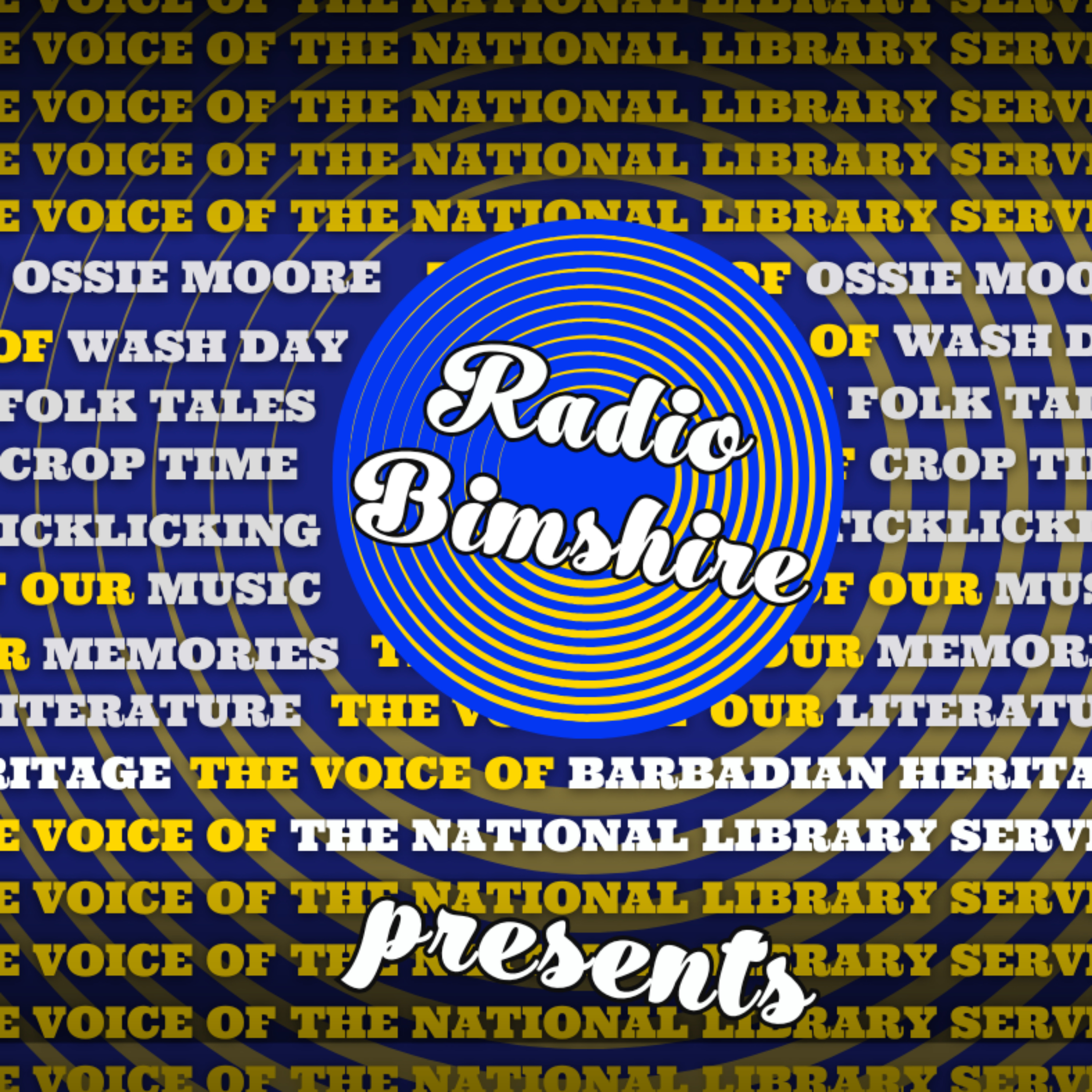
Radio Bimshire Presents
Radio BimshireAudio
- Format:
- Podcast
- New episodes:
- Weekly
- Typical length:
- about 15 minutes
- Latest episode:
About this show
Catch up or listen on-demand with the best of Radio Bimshire - the Voice of the Barbados National Library Service (https://bit.ly/radiobimshire). Radio Bimshire Presents is a selection of short stories, poetry, history, rare audio clips and humour - the sound of Barbadian heritage. Featuring: This Barbadian Life: real voices, true stories, only in Barbados; Off The Shelf: Readings of Barbadian writing; Reparations Revealed; Standpipe: Memories of Wash Day; Sounds of Freedom: Stories of Emancipation... and much more.
Covers: barbadian history, caribbean culture, short fiction, barbados heritage, kaiso music, emancipation, family history, folklore, barbadian literature
Show details and episodes come from the publisher's public feed at anchor.fm. Last updated . Names, artwork and text belong to their publishers.
Recently on this show
Summary of recent episodes, drawn from the publisher's feed.
Radio Bimshire Presents is an audio collection from the Barbados National Library Service, offering short stories, poetry, history and rare recordings about Barbadian heritage. Recent episodes cover yellow fever's history in Bridgetown, the lives behind a memorial's names, and what makes a short story work on radio.
Cosmos
Similar in subject
- Caribbean Mystics
Both cover: caribbean culture, folklore
Similar shows

Explore more
Episodes
Sounds of Freedom III - Esther Phillips - 3 - “Monkey Noko”
· 6 min
Sounds of Freedom III: Esther Phillips and the legend of Monkey Noko digs into the haunting legacy of Drax Hall Plantation and the unfinished business of emancipation in Barbados. Against the backdrop of one of the hemisphere’s oldest sugar estates, Phillips reflects on growing up in the shadow of Drax Hall without ever being told its brutal history of sugar and slavery. Through her poem “Monkey Noko”, she interrogates loyalty, survival, silence and complicity on the plantation, and asks what it cost to gain a white master’s favour in a world built on Black dispossession.
Not rated yetHouse on James Street: Episode two - Building a slave society
· 15 min
In Episode Two - "Building A Slave Society" - House on James Street explores the roots of the world that would one day define Sarah Ann Gill. Joining us is historian Professor Pedro Welch, who walks us through the 17th-century transformation of Barbados into a laboratory of plantation slavery. We trace how an overwhelmingly African population, brought from the Gold Coast, was systematically dehumanized by a "plantocracy"—and how they maintained their humanity within a brutal system that categorized them as property. From the specific names recorded in 1654 plantation lists to the complex bureaucratic labels used for the growing free coloured population—FM, FN, and FC—this episode uncovers the rigid social structures that dictated life in early Barbados. We begin to see how this history of violence, intimacy, and resistance created the very environment that Sarah Ann Gill would one day navigate and challenge. Produced and presented by Julius Gittens from a National Library Service lecture by late historian Professor Pedro Welch.
Not rated yetSounds of Freedom III - Esther Phillips - 2 - “Hard Love - Odifo's Story"”
· 7 min
This episode of Sounds of Freedom III traces the journey of a boy named Odifo and the enslaved mothers who loved – and lost – their children on Barbados’s sugar estates, through the words of poet and former Poet Laureate of Barbados, Esther Phillips. In this episode, Phillips reads her searing poem “Hard Love” and reflects on the emotional terror, brutality and impossible “adjustments” enslaved women were forced to make, knowing their babies could be sold away at any moment. Host Shayla Murrell guides listeners through the soundscape of Drax Hall plantation in St George – once owned by James and Henry Drax – evoking the heat, cane dust and the small, weary bodies of children who laboured there, where nearly 30,000 enslaved Africans perished over two centuries. This episode offers a powerful meditation on emancipation, memory and the long shadow of wealth built on the suffering of enslaved families in Barbados.
Not rated yetNew episodes: House on James Street
· 1 min
Before Sarah Ann Gill became a National Hero, she was a free woman in Bridgetown — navigating a society built on the brutal logic of slavery. In this episode, we step into her world to explore the precarious, complex lives of free coloured women in early 19th-century Barbados. The late historian Professor Pedro Welch unpacked the strategies these women — tavern owners, property holders, and political actors—used to carve out autonomy in a discriminatory society. From the political courage of Alexander Gill’s 1811 petition to the extraordinary, behind-the-scenes influence of Betty Goodwin in the Governor’s residence, we examine how wealth, negotiation, and survival paved the way for Sarah Ann Gill’s future defiance. House on James Street - a radio documentary series only on Radio Bimshire - explores the contradictions of love, power, and property — and set the stage for the moment one house on James Street would change history. Produced and presented by Julius Gittens
Not rated yetThis Barbadian Life - 09 - "The Birth Women"
· 10 min
In this special International Midwifery Day edition of This Barbadian Life, we honour the Barbadian “birth women” – the lay midwives who walked cane tracks and village roads at all hours to catch babies long before there were labour wards and diplomas. Registered midwife Michelle Marshall guides us from the apprenticeship days of granny and auntie, through the 1937 riots and the Moyne Commission, into today’s accredited midwifery programmes at the Barbados Community College. Along the way, she recalls home births by kerosene lamp, folk practices like sealing house cracks against “lining cold”, and the quiet, transcultural wisdom passed from one generation of Caribbean women to the next. This episode sits at the crossroads of African-Caribbean tradition and a formal health system that slowly expanded in the 20th century. It celebrates the midwives – women and men – who continue to hold families’ hopes in their hands, blending ancestral knowledge with modern medicine in delivery rooms across Barbados. This Barbadian Life – real voices, true stories, only in Barbados - is presented by Shayla Murrell for Radio Bimshire - the voice of the National Library Service of Barbados
Not rated yetSounds of Freedom III - Esther Phillips - 1 - “Choice Young Negro”
· 6 min
Sounds of Freedom is a journey through the soundscape of emancipation, memory, and hope. In episode one from a new season, host Shayla Murrell sits with Barbadian poet, teacher, and editor Esther Phillips, Barbados’ first Poet Laureate, to explore the making and meaning of her poem “Choice Young Negro”. Drawing on a chilling 1979 instruction manual written by plantation owner Henry Drax for the running of Drax Hall Estate, the conversation unpacks how enslaved Africans were reduced to “units” of labour and profit — and how poetry can turn that language back on itself. Esther’s poem responds to Drax’s demand for “choice young Negroes” by restoring the enslaved as sons, daughters, and freedom fighters from the Coromantee people, whose strength and resistance haunted the sugar empire that tried to break them. Through archive, verse, and voice, this episode situates Drax Hall within the wider history of Caribbean slavery, where historians estimate that close to 30,000 enslaved Africans died on Drax plantations in Barbados and Jamaica. Hear how those lives still echo in Barbados today — not as a mere footnote to empire, but as a living call to remember, reckon, and imagine freedom anew.
Not rated yetThe Opel Effect: The Soul of Spouge - part nine (final): "Spouge Forevermore"
· 11 min
Legacy only lives if it is nurtured. In the final episode, we visit the Jackie Opel Residency Lab, where a new generation of musicians, visual artists and choreographers reimagine his work for today’s Barbados, proving that spouge is not a relic but a living, evolving movement. Written, produced and narrated by Shayla Murrell Produced with John Downes, Amour Chandler, Lamar Nicholls and Adrian Archer Mixed and edited by Julius Gittens
Not rated yetThe Opel Effect: The Soul of Spouge - part eight: "A Musical Revolution"
· 12 min
What began as a local rhythm became a chapter in Caribbean music history. This episode looks at how Jamaicans like Dean Fraser and regional scholars place Jackie Opel alongside reggae’s greats, and how spouge helped reshape ideas of what Barbadian music could be. Narrated by Shayla Murrell
Not rated yetThe Opel Effect: The Soul of Spouge - part seven: "The Rhythm Goes On"
· 15 min
Jackie Opel’s voice fell silent, but spouge did not. From Wendy Alleyne to the late Richard Stoute and a generation of performers, part seven follows the artists who carried his legacy forward, keeping Barbadian voices on stage and spouge alive in dance halls and on radio. Narrated by Shayla Murrell
Not rated yetThe Opel Effect: The Soul of Spouge - part six: "The Loss of a Legend"
· 10 min
On March 9 1970, at just 32, Jackie Opel’s story ended abruptly on Bay Street. Friends and collaborators remember the night of the accident, the outpouring of grief, and what it meant for a young nation to lose one of its brightest artistic lights just as his career was reaching new heights. Narrated by Shayla Murrell
Not rated yetThe Opel Effect: The Soul of Spouge: part five: "Spouge Beyond Borders"
· 15 min
Spouge was not only culture, it was commerce. This episode explores how bands like Blue Rhythm Combo, De Opels, The Escorts, The Troubadours, Draytons Two and Wendy Alleyne and the Dynamics took a Barbadian beat into hotels, dance halls, regional tours and record sales, turning rhythm into livelihoods.
Not rated yetPREMIERE: House on James Street: Episode one - Intrepid Fighter for Religious Freedom
· 20 min
Before Barbados had universal adult suffrage, before slavery was abolished in the British Empire, and before religious freedom was protected by law, a free coloured woman in Bridgetown did something dangerously simple: she opened her front door. In Episode One – “An Intrepid Fighter for Religious Freedom” – House on James Street introduces the life and times of the Right Excellent Sarah Ann Gill. We meet Ann Gill as a free coloured woman of property in early 19th‑century Bridgetown, whose home on James Street becomes a sanctuary for persecuted Methodists after white mobs destroy the island’s Methodist chapel and drive out the minister. Drawing on the research of the late historian Professor Pedro Welch, this opening episode peels back the myths to reveal a more complex figure: a devoted Methodist and National Hero who was also part of a free coloured world shaped by slavery, race and property. We set the scene for the series by tracing how Gill’s year under siege – facing threats, gunfire, and legal harassment under the old Conventicle Act – would eventually echo all the way to the Colonial Office in London and the floor of the British Parliament. This episode lays the groundwork for the journey ahead: from the making of a slave society to the rise of a free coloured community, and from a front room on James Street to the heart of imperial power.
Not rated yetNATIONAL HEROES DAY PREMIERE: House on James Street: The Life and Times of Sarah Ann Gill
· 2 min
Before slavery was abolished in the British Empire. Before religious freedom was protected by law. A free coloured woman in Bridgetown did something dangerously simple: she opened her front door. House on James Street is a new Radio Bimshire original series that follows the life and times of the Right Excellent Sarah Ann Gill – from the making of a slave society and the rise of a free coloured community, to the mobs that tore down a Methodist chapel and the front room that became a sanctuary for persecuted worshippers. Drawing on the work of the late historian Professor Pedro Welch, the series peels back the myths to reveal a more complex figure: a woman of faith and property, a defender of religious freedom, and, like many of her class and time, an enslaver. It is a story of courage and compromise, resistance and complicity, stretching from James Street in Bridgetown to debates in the British Parliament. Follow this show and tap the bell to be notified when House on James Street drops on Radio Bimshire Presents. Subscribe now so you don’t miss an episode - and listen live online at http://bit.ly/RadioBimshire.
Not rated yetThe Opel Effect: The Soul of Spouge - part four: "Decade of a superstar"
· 9 min
As independence swept the Caribbean in the 1960s, Jackie Opel became a symbol of a region finding its voice. Scholars and cultural critics set spouge in the context of nationalism, decolonisation and a maturing Barbadian recording industry that was finally ready for its own sound. Narrated by Shayla Murrell
Not rated yetThe Opel Effect: The Soul of Spouge - part three: "When Jackie Met Bob"
· 12 min
His voice cut through bands, rocked Jamaican stages and stunned schoolboys who thought only Kingston stars could command a crowd. In part three, historians and eyewitnesses recall Jackie Opel’s time in Jamaica, his brushes with ska and rocksteady royalty, and how a Bajan singer earned respect in reggae’s heartland.
Not rated yetThe Opel Effect: The Soul of Spouge - part two: "The Birth of a Beat"
· 16 min
Jackie Opel was not just a star, he was a mentor who saw greatness in City youths long before the country did. This episode traces how De Opels, Richard Stoute and other young talents helped forge a new Barbadian sound that would become known as spouge.
Not rated yetThe Opel Effect: The Soul of Spouge - part one: "Wharf Boy"
· 17 min
Part one of the serial documentary, The Opel Effect: The Soul of Spouge, takes us back to the Bridgetown waterfront, where a skinny “wharf boy” with a fearless dive and a grown-up voice is about to change Barbadian music. We follow Dalton Sinclair Bishop from Chapman Lane to the bright lights of Showtime ’65, through the memories of those who saw Jackie Opel rise from the harbour to become a headliner the Caribbean could not ignore. (https://ppl-ai-file-upload.s3.amazonaws.com/web/direct-files/attachments/17033284/4b201f13-363f-42b3-a43e-2a3a0da0e2fb/The-Opel-Effect-rewrite.docx) Blending rare archival audio, first-hand testimony and original sound design, this opening episode traces how environment, poverty, ambition and sheer vocal power shaped a young boy into the artist who would help give Barbados its own popular music, spouge. It is the beginning of a story about risk, reinvention and what it means to come from a small place and still take up space on the regional stage. Written, produced and narrated by Shayla Murrell Produced with John Downes, Amour Chandler, Lamar Nicholls and Adrian Archer Mixed and edited by Julius Gittens
Not rated yetThis Barbadian Life - episode 8 - On Tour with the Troubadours: The Geoffrey Jones Journey
· 23 min
We go on the road with one of Barbados’ most beloved bands: The Troubadours. In “On Tour with the Troubadours – The Geoffrey Jones Journey”, presenter Shayla Murrell sits down with guitarist Geoffrey Jones to trace his path from a little boy playing under a mahogany tree in Christ Church, to lead guitarist with The Troubadours, and finally to veteran musician looking back from a life in Britain. Along the way, he remembers Hurricane Janet, funeral home garage rehearsals in the early years, recording with Jackie Opel and helping to shape the Spouge beat, and the band’s later years playing tight, seamless sets in a cold London club. Blending intimate interview, rich sound design and narrative storytelling, this episode explores how one band helped define a Barbadian sound, carried it to the wider world, and built a legacy they only truly understood decades later.
Not rated yetREPARATIONS REVEALED - Episode 6 : Justice in Action: Esther Phillips at the United Nations (Bonus episode)
· 15 min
In this special episode, from in the General Assembly Hall at United Nations Headquarters, Barbados’ Poet Laureate Esther Phillips lends her voice to the 2026 International Day of Remembrance of the Victims of Slavery and the Transatlantic Slave Trade. Against the backdrop of this year’s theme, “Justice in Action: Confronting History, Advancing Dignity, Empowering Futures”, Phillips delivers two powerful poems that honour the millions of Africans uprooted, enslaved and exploited, and speak to the unfinished work of memory, repair and justice. Woven around her performance is an historic moment at the UN: a landmark resolution introduced by Ghana, in which the General Assembly formally recognises the transatlantic slave trade as one of the gravest crimes against humanity and calls for reparative measures and concrete action.
Not rated yetCOMING SOON: The (Jackie) Opel Effect - The Soul of Spouge
· 1 min
Based on the epic documentary that premiered on 9 March – the 56th anniversary of Jackie Opel’s tragic death at the age of 32 – The Opel Effect: The Soul of Spouge is a nine-part documentary podcast series that traces the life, music and legacy of Dalton “Jackie Opel” Bishop. Born in Chapman Lane in Bridgetown and inspired by American soul star Jackie Wilson, Opel rose from “wharf boy” diving for cruise ship coins to become the powerhouse singer who helped give Barbados its own indigenous popular music genre: spouge. Drawing on archive recordings and new interviews, the series hears from promoters, musicians and scholars, including Anthony “Al” Gilkes, the late Mark Williams, the late Richard Stoute, Wendy Alleyne, Desmond Weekes, the late Trevor Marshall, Sach Moore, Norman Barrow, Cleve Scott and Ambassador David Commissiong. Listeners travel from the electric atmosphere of Showtime ’65 in Bridgetown to Kingston’s Silver Slipper club, where Jamaican audiences embraced Jackie’s voice and wove it into the story of ska, rocksteady and reggae. The Opel Effect also follows spouge beyond Jackie’s death, through bands like Blue Rhythm Combo, De Opels, The Escorts, The Troubadours, Draytons Two and Wendy Alleyne and the Dynamics, and into today’s experiments with the Jackie Opel Residency Lab, where young Barbadian creatives remix his work for a digital age. Across its episodes, the series asks urgent questions for a new generation: what happened to spouge, what does this music mean for Barbados now, and who will claim the next chapter of Jackie Opel’s legacy? Watch for new episodes each week, coming soon. Written, produced and narrated by Shayla Murrell Mixed and edited by Julius Gittens Produced with John Downes, Amour Chandler, Lamar Nicholls and Adrian Archer
Not rated yet