

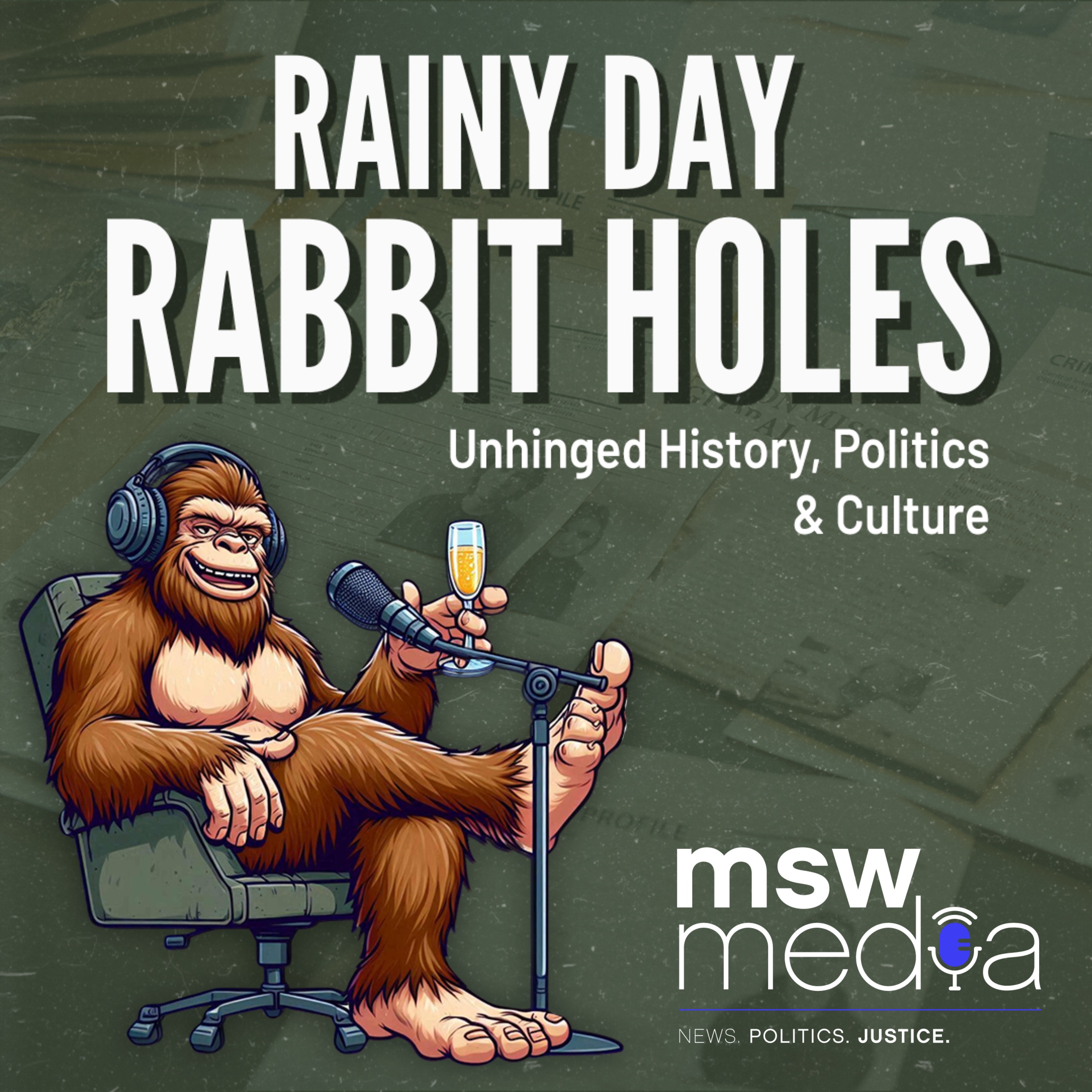
Rainy Day Rabbit Holes: History Unhinged
- Format:
- Podcast
- New episodes:
- Weekly
- Typical length:
- about 50 minutes
- Latest episode:
About this show
Rainy Day Rabbit Holes is a history podcast exploring wild, weird, and unhinged stories—from crazy disasters and juicy scandals to heartwarming moments and people behaving badly. History is messy, and we love it that way.
Show details and episodes come from the publisher's public feed at feeds.redcircle.com. Last updated . Names, artwork and text belong to their publishers.
Cosmos
Similar by topic and creator
- Who What When
Shares the topics Comedy, History and Society. - What's Your Issue?
Shares the topics Comedy, History and Society. - America's Strangest History
Shares the topics Comedy, History and Society.
Similar shows






Explore more
Episodes
Weird Whales and Walruses
· 1 hr 4 min
A young orca swims all the way to Portland. A legendary whale lurks on the mountainsides of Colorado. And somehow, the remains of a walrus wind up in a London burial ground. Well, that’s weird. This week on Rainy Day Rabbit Holes, Shea is joined by marine biologist Sheanna “Shea” Steingass, AKA The Other Shea, for three stories sitting at the wonderfully messy intersection of natural history, folklore, and mystery. And yes, putting two Sheas behind microphones caused exactly as much confusion as you’d expect. Ethelbert: The Orca Who Came to Portland In 1931, a young orca appeared in Portland, Oregon, roughly 100 miles upriver from the Pacific Ocean. Crowds gathered to see her, but Ethelbert’s story soon took a grim turn. After she was killed, her body was preserved with formaldehyde and put on display. Then, somehow, an entire preserved whale disappeared. Decades later, Ethelbert was rediscovered in a tank on a property north of the Portland area. Eventually her remains were buried, but the location of that burial has itself been lost The Other Shea also digs into another part of the mystery: what kind of orca was Ethelbert? A surviving tooth might offer clues through genetics, aging, and stable-isotope analysis. But Shea explains that Ethelbert’s historical photographs may already preserve important evidence about her identity. Beware the Mountain Whale Next we head to famously landlocked Colorado for the Slide-Rock Bolter, a massive whale-like creature from lumberjack folklore said to hook itself onto mountaintops, hurtle down the slope, devour an unfortunate logger or tourist, and use its momentum to swing back up another mountain. Because obviously. We also meet some of its fellow creatures from the lumberwoods, including the jointless Hoogag, branch-hurling Agropelter, elusive Hidebehind, and spectacularly impractical Splintercat. The stories are ridiculous, but the landscape around them wasn’t. The conversation explores how tales like the Slide-Rock Bolter existed alongside dramatic environmental changes caused by mining and logging. Why Was a Walrus Buried in London? Finally, we cross the Atlantic. During work at St. Pancras in London, archaeologists encountered something unexpected in a 19th-century burial ground: the remains of an adult walrus mixed into a burial containing human remains. Where did the walrus come from? Was it Atlantic or Pacific? How did it get to London? And why did it end up underground? Even better, this may be a mystery modern science can help unravel. The Other Shea explains how techniques such as isotope analysis and genetics could potentially reveal more about the animal’s origins. Follow The Other Shea Follow Sheanna “Shea” Steingass, AKA The Other Shea, and her marine-science adventures on Instagram: 📸 Marine Cowgirl: https://www.instagram.com/marinecowgirl/?hl=en She also talks in the episode about Strange Waters, her planned podcast project, and Shea Explorers, where she shares more of her adventures investigating weird stuff. Support Rainy Day Rabbit Holes 🐇 Visit Rainy Day Rabbit Holes: https://www.rainydayrabbitholes.com ❤️ Want to help us keep making deeply researched, delightfully weird episodes? Become a supporter and help keep us tumbling down strange historical rabbit holes: Support the show: https://www.rainydayrabbitholes.com/support If you enjoyed this episode, follow Rainy Day Rabbit Holes, leave us a review, and send this episode to someone who would immediately need to know why there was a walrus buried in London. Stay curious, and we’ll see you down the next rabbit hole. Support this podcast at — https://redcircle.com/history-unhinged-rainy-day-rabbit-holes/exclusive-content Advertising Inquiries: https://redcircle.com/brands Privacy & Opt-Out: https://redcircle.com/privacy
Not rated yetBirdwatching with the Dead
· 1 hr 19 min
What if some of the best places to find wildlife in the city are also full of dead people? Pour yourself a glass of wine and join Shea and her friend Raine Rath for a wander through the wonderfully strange world of historic Victorian garden cemeteries. Raine is a writer, illustrator, longtime bird nerd, nature geek, and cemetery enthusiast who is working on a forthcoming book with Heyday Books about the historic garden cemeteries of the West Coast. The project began while she was birdwatching in Tacoma's Old Tacoma Cemetery and realized that these beautiful old burial grounds aren't just repositories of human history. They can also be fascinating pockets of urban nature. We talk about why Victorians designed cemeteries to feel more like parks and gardens, why old trees and relatively undisturbed spaces can be so valuable for wildlife, and how the Victorian obsession with nature collided with an equally impressive obsession with death. And then things get weird. Mourning jewelry. Grave symbolism. Spiritualism. Cemetery legends. And plenty of birds. We also explore some of the historic cemeteries Raine is researching around Tacoma, Seattle, Portland, Bellingham, and Victoria. So grab your binoculars, pour a glass of wine, and come take a walk among the dead. Turns out, they're surrounded by an awful lot of life. Want an ad-free version of this episode? Join our Patreon! You get ad-free episodes, early episodes, bonus content, and more! Head on over to www.rainydayrabbitholes.com/support for more. Thank you so much! Support this podcast at — https://redcircle.com/history-unhinged-rainy-day-rabbit-holes/exclusive-content Advertising Inquiries: https://redcircle.com/brands Privacy & Opt-Out: https://redcircle.com/privacy
Not rated yetGrit City After Dark: Beyond Ted Bundy
· 43 min
What happens when the Ted Bundy story is told by someone who actually knew him? Shea and Ellicia are fresh from Grit City After Dark, a night of Pacific Northwest true crime at Tacoma's Spanish Ballroom featuring retired Tacoma detective Lindsey Wade, Pulitzer Prize-winning author Caroline Fraser, and Ted Bundy's cousin Edna Cowell Martin. Edna Cowell Martin, co-author of Dark Tide: Growing Up With Ted Bundy, offers a perspective dramatically different from the infamous mythology surrounding Bundy: what it was like discovering that someone she had known and loved within her family was capable of terrible crimes. Lindsey Wade, author of In My DNA, brings the investigator's perspective through her career with the Tacoma Police Department, including her work on cold cases. And Caroline Fraser, author of Murderland: Crime and Bloodlust in the Time of Serial Killers, zooms out to look at serial murder and the Pacific Northwest through a broader historical and cultural lens. Then the rabbit hole gets personal. Ellicia talks about her work as an assistant producer on Killing Theodore, a documentary project that has sought to move the conversation away from the mythology surrounding Ted Bundy and toward the people affected by his crimes. We're talking about cold cases, DNA, family secrets, true-crime storytelling, Tacoma history, and the uncomfortable question underneath all of it: How do we tell these stories without making the killer the most important person in the room? In this episode - Ted Bundy and the mythology built around him - Edna Cowell Martin and Dark Tide: Growing Up With Ted Bundy - Lindsey Wade and Tacoma cold cases - Caroline Fraser and Murderland - Grit City After Dark in Tacoma - Ellicia's work as an assistant producer on Killing Theodore - Victims, families, investigators, and the ethics of true-crime storytelling Support this podcast at — https://redcircle.com/history-unhinged-rainy-day-rabbit-holes/exclusive-content Advertising Inquiries: https://redcircle.com/brands Privacy & Opt-Out: https://redcircle.com/privacy
Not rated yetOregon's Serial Killer Case: What's Changed?
· 7 min
Oregon's Serial Killer Update When Jody and I first talked about this story back in 2023, it felt like something out of a true crime documentary that was still being written. At the time, several women had been found dead across the Portland area, rumors of a serial killer were spreading everywhere, and investigators were publicly saying they had no reason to believe the cases were connected. A lot has changed since then. In this bonus episode, I take a step back and walk through the entire story from the beginning, from the disappearances that first raised concerns to the growing list of indictments prosecutors have now filed against Jesse Lee Calhoun. What started as a handful of seemingly unrelated cases has evolved into one of the most significant homicide investigations Oregon has seen in years. As always, it's important to remember that these are allegations. Calhoun has pleaded not guilty, and the case has not yet been decided in court. A Story We Couldn’t Stop Thinking About This case has been in the background of the podcast almost from the beginning. When we first mentioned it, nobody knew whether the deaths were connected. Some people thought the serial killer theories were overblown. Others were convinced something bigger was happening. Looking back now is fascinating because we get to see how the investigation unfolded in real time and how dramatically the public understanding of the case changed over the past few years. From Wildfires to Murder Charges One of the most surprising parts of the story has nothing to do with the investigation itself. Years before his name became tied to these allegations, Jesse Lee Calhoun was one of the inmates who helped fight Oregon's devastating 2020 wildfires. His service earned him clemency and an early release from prison. Today, prosecutors allege he is connected to the deaths of six women across the Portland metropolitan area, transforming what was once a local mystery into a case being followed throughout the Pacific Northwest. What We Cover in This Episode - How the story first landed on our radar - The disappearances that started the investigation - Why rumors of a serial killer spread so quickly - The evidence timeline prosecutors have laid out so far - The indictments announced between 2024 and 2026 - Why one alleged victim's body has never been recovered - What happens next as the case moves toward trial A Final Reminder This is still an active criminal case. The charges discussed in this episode are allegations made by prosecutors and have not been proven in court. Jesse Lee Calhoun has pleaded not guilty, and the outcome will ultimately be decided through the legal process. If you've been following this case since we first covered it years ago, this episode brings everything together in one place and catches you up on where the investigation stands today. Stay curious, and we'll see you down the next rabbit hole. Want an ad-free version of this episode? Join our Patreon. Visit www.rainydayrabbitholes.com Support this podcast at — https://redcircle.com/history-unhinged-rainy-day-rabbit-holes/exclusive-content Advertising Inquiries: https://redcircle.com/brands Privacy & Opt-Out: https://redcircle.com/privacy
Not rated yetThe Smuggler's Inn: America's Strangest Border Story
· 49 min
A backyard. Two countries. One unbelievable story. Most people think of the U.S.-Canada border as quiet, friendly, and uneventful. But behind a quirky bed-and-breakfast in Blaine, Washington, one of the strangest border stories in modern North American history was unfolding. This week, Shea sits down with author Reece Jones to discuss his new book Smuggler: Drugs, Gangs, and Refugees at America's Northern Border. What begins as the story of a roadside inn quickly turns into a tale involving smugglers, asylum seekers, Border Patrol agents, underground networks, and a Supreme Court case that continues to shape debates about federal law enforcement today. At the center of it all is Bob Boulay, the owner of the Smuggler's Inn, whose backyard quite literally sat on the international border. In This Episode The Strangest Property in America The Smuggler's Inn wasn't just near the border. It was on it. Reece explains how Bob Boulay accidentally became a border innkeeper and found himself witnessing everything from drug trafficking operations to refugee crossings. What started as a simple real estate investment became one of the most important crossroads on the U.S.-Canada border. Why Refugees Chose Canada A major theme of the conversation is the little-known history of asylum seekers traveling through the United States to reach Canada. Reece breaks down how changes to Canadian immigration policy unintentionally transformed the Smuggler's Inn into a destination for people fleeing persecution from places including Afghanistan and Turkey. The Supreme Court Case That Changed Everything The story eventually landed before the U.S. Supreme Court in the landmark case Egbert v. Boule. The discussion explores how one confrontation between a Border Patrol agent and Bob Boulay evolved into a legal battle with major implications for constitutional rights, federal accountability, and border enforcement. About Our Guest Reece Jones is a professor of geography and environment at the University of Hawaii and the author of multiple award-winning books on borders, migration, and immigration policy. His latest book, Smuggler: Drugs, Gangs, and Refugees at America's Northern Border, was co-written with attorney Greg Boos. Learn more about Reece and his work: 🔗 https://www.reecejonesauthor.com/ More Rainy Day Rabbit Holes Explore more strange true stories and hidden history: 🔗 https://www.rainydayrabbitholes.com/ Related episodes: 🔗 https://www.rainydayrabbitholes.com/podcast/convergence-true-crime-and-corruption-in-the-windy-city 🔗 https://www.rainydayrabbitholes.com/podcast/when-tylenol-turned-deadly Support this podcast at — https://redcircle.com/history-unhinged-rainy-day-rabbit-holes/exclusive-content Advertising Inquiries: https://redcircle.com/brands Privacy & Opt-Out: https://redcircle.com/privacy
Not rated yetJody Returns and Big Changes Ahead
· 43 min
Jody's Back, Baby! Good news, rabbit holers: Jody is officially back. After taking time away to focus on family, travel, and life outside the studio, she's rejoining Shea behind the microphones. But this isn't just a welcome-back episode. It's a look at where Rainy Day Rabbit Holes is headed next and why the show is evolving. After three years of producing episodes, meeting incredible listeners, and building a community neither host expected, Shea and Jody are making some changes designed to keep the podcast fun, sustainable, and full of the stories they love telling. Why We're Changing Things Weekly episodes have been rewarding, but they've also been demanding. Rather than rushing to produce content every week, Rainy Day Rabbit Holes is moving to a seasonal format. Starting in 2027, listeners can expect: - Three themed seasons per year - Six episodes per season - More research and deeper storytelling - Guest interviews between seasons - Special rabbit holes that don't fit into a larger theme The goal is simple: better stories, less burnout, and more room for curiosity. A Sneak Peek at 2027 The upcoming seasons are shaping up to be some of the most ambitious yet: Season One: Villains Con artists. Grifters. Outlaws. Criminal masterminds. Strange and forgotten villains you probably haven't heard much about. Season Two: Heroes Inventors, scientists, explorers, doctors, civil rights pioneers, and everyday people who accomplished extraordinary things. Season Three: Folklore & Mysteries Cryptids, hauntings, strange legends, unexplained events, local lore, and the kind of weird stories that make perfect rabbit holes. Building a Bigger Community One unexpected part of creating the podcast has been meeting listeners who became genuine friends. In this episode, Shea and Jody reflect on: - Live events in Tacoma - Meeting listeners in person - Growing the Patreon community - Why fan connections have become one of the most rewarding parts of podcasting They also share ideas for future live events, listener involvement, and expanded Patreon perks. UFO Festivals, Men in Black, and Other Future Shenanigans The hosts also discuss their growing involvement with the annual Men in Black Birthday Bash and plans being explored for the 80th anniversary of the Maury Island Incident in 2027. Expect: - UFO-themed events - Community gatherings - Independent films - Local history - Plenty of tongue-in-cheek mystery and folklore No alien conversion required. Just curiosity. Visit www.rainydayrabbitholes.com for more or to learn how you can join the Patreon! Support this podcast at — https://redcircle.com/history-unhinged-rainy-day-rabbit-holes/exclusive-content Advertising Inquiries: https://redcircle.com/brands Privacy & Opt-Out: https://redcircle.com/privacy
Not rated yetKlondike Kate: Queen of the Yukon Gold Rush
· 1 hr 19 min
Klondike Kate, The Woman History Forgot Recorded live before a packed audience at McMenamins Elks Temple's Spanish Ballroom in Tacoma, Washington, this episode follows the remarkable life of Kathleen Eloisa Rockwell, better known as Klondike Kate, one of the most colorful and influential figures of the Klondike Gold Rush. While history remembers theater magnate Alexander Pantages, few remember the woman whose talent, charisma, and financial support helped launch the beginnings of his empire. Tonight, we're fixing that. From Spokane to New York, from Chilean convents to Yukon dance halls, Kate's life was a whirlwind of adventure, scandal, romance, reinvention, and larger-than-life storytelling. Gold, Gambling, and the Queen of Dawson When news of gold discoveries in the Yukon ignited one of history's greatest stampedes, thousands of prospectors poured north through Seattle in search of fortune. Most failed. Klondike Kate, however, discovered there was often more money to be made entertaining miners than digging beside them. In Dawson City, she became a sensation. Known as the Rose of the North, the Darling of Dawson, and the Queen of the Yukon, Kate earned extraordinary sums as a performer while capturing the affection of an entire city. Unlike many of the boomtown celebrities of her era, Kate built a reputation for generosity, remembering names, helping struggling miners, and sharing her success with those around her. But fame and fortune would also bring her face to face with the ambitious young entrepreneur who would change the course of her life: Alexander Pantages. The Woman Behind the Pantages Empire Long before the Pantages name became synonymous with legendary theaters across the West Coast, Alexander Pantages was a struggling newcomer chasing opportunity in the Yukon. Kate believed they were building a future together. She financed ventures, supported his ambitions, and helped fund the theater business that would eventually make him one of the wealthiest entertainment figures in America. While Kate toured and earned money, she continued investing in what she believed was their shared dream. Then she discovered he had secretly married another woman. The fallout led to a highly publicized breach-of-promise lawsuit, heartbreak, and one of the most dramatic chapters in Gold Rush history. Reinvention, Resilience, and Aunt Kate Many stories would end there. Kate's didn't. After the spotlight faded, she reinvented herself repeatedly. She tried ranching in Oregon, survived financial setbacks, weathered failed relationships, cared for friends and strangers in need, and eventually became a beloved local figure known simply as "Aunt Kate." Far removed from the glamorous stages of Dawson City, she spent her later years feeding the hungry, helping neighbors, supporting firefighters, and turning kindness into her final act. By the time she passed away in 1957, Klondike Kate had lived more lives than most people could imagine. Showgirl. Homesteader. Philanthropist. Celebrity. Scandal. Legend. And somehow, after all of that, she also became the inspiration for Glittering Goldie from DuckTales. Not bad for a woman history almost forgot. In This Episode - The Klondike Gold Rush and the rise of Dawson City - How Klondike Kate became the Queen of the Yukon - The surprising origins of the Pantages theater empire - Alexander Pantages and his complicated relationship with Kate - Gold Rush entertainment and boomtown culture - Kate's famous lawsuit against Pantages - Homesteading in Central Oregon - Aunt Kate's philanthropy and community work - The Hollywood adaptation that never quite happened - The DuckTales connection to Klondike Kate Special Thanks Recorded live September 16, 2026, at McMenamins Elks Temple Spanish Ballroom in Tacoma, Washington. Special thanks to: - McMenamins Elks Temple - PACK (People for Animal Care and Kindness) - Radio Tacoma - Pretty Gritty Tours If you enjoyed this…
Not rated yetConvergence: True Crime and Corruption in the Windy City
· 57 min
A Murder Case Everyone Wanted to Abandon What do you do when witnesses vanish, evidence disappears, and corruption reaches into the courtroom itself? Former Cook County homicide prosecutor Gregg Owen faced exactly that challenge. In this episode of Rainy Day Rabbit Holes, Gregg joins Shea to discuss his upcoming true crime book, Convergence, which chronicles an extraordinary double murder prosecution that unfolded during one of the most corrupt periods in Chicago's history. But Gregg's story is anything but ordinary. Before becoming a prosecutor, he spent years as a professional musician, sharing stages with legendary performers and living the life of a touring rock artist. Then one unexpected decision changed everything, launching him into a legal career that would place him at the center of murder trials, gang prosecutions, and one of the largest judicial corruption scandals ever uncovered in America. From Rock Stages to Courtrooms Gregg recounts his unlikely transition from musician to prosecutor, including: - Opening for legendary acts including The Doors - Touring during the late 1960s and early 1970s - Attending law school while performing professionally - The chance encounter that changed the course of his life - Why courtroom advocacy felt unexpectedly similar to being on stage You'll also hear incredible firsthand stories from Chicago's music scene and Gregg's unforgettable encounter with Jim Morrison. Inside Chicago's Corruption Era The conversation takes a darker turn as Gregg describes the realities of practicing law during one of Chicago's most infamous periods. Topics include: - Operation Greylord - Judicial corruption in Cook County courts - How bribery influenced criminal proceedings - The undercover FBI operation that changed everything - The challenges prosecutors faced when pursuing justice - Why some cases seemed impossible to win Gregg explains how prosecutors learned to expect missing evidence, compromised witnesses, and unexpected obstacles before every major trial. The Story Behind Convergence At its heart, Convergence is more than true crime. It's a story about perseverance, character, and refusing to abandon victims when the system fails. Gregg discusses: - The double murder case that inspired the book - Why victims remained central to the story - How unlikely connections helped break the case - The role integrity plays when doing the right thing comes at a personal cost - The life lessons he hopes readers will take away Gregg Owen Links 🌐 Website https://www.greggowen26th.com/ 📚 Books https://www.greggowen26th.com/books/ 📸 Instagram https://www.instagram.com/greggowen26th/ 🎧 Convergence is available through major booksellers, Audible, Apple Books, Amazon, and Barnes & Noble. Related Episodes If you enjoyed this episode, check out: 📌 When Tylenol Turned Deadly https://www.rainydayrabbitholes.com/podcast/when-tylenol-turned-deadly 📌 Mayhem and the Mob: Grit City's Dark Past https://www.rainydayrabbitholes.com/podcast/29-mayhem-and-the-mob-grit-citys-dark-past 📌 Smooth Criminal: Roy Olmstead, Seattle's Good Bootlegger https://www.rainydayrabbitholes.com/podcast/36-smooth-criminal-roy-olmstead-seattles-good-bootlegger Key Takeaways - Gregg Owen transitioned from professional musician to homicide prosecutor through an unexpected twist of fate. - Convergence centers on a double murder case many believed was impossible to prosecute. - Chicago's judicial corruption crisis inspired the events chronicled in the book. - Operation Greylord became the largest judicial corruption investigation in American history. - Missing evidence and reluctant witnesses nearly derailed a major murder prosecution. - Gregg's music background unexpectedly helped him earn the trust of key witnesses. - Courtroom advocacy shares surprising similarities with live performance. - The book emphasizes perseverance when justice seems unattainable. - Victims remain the…
Not rated yetHow the Atomic Age Changed Metal Forever
· 31 min
Did Nuclear Testing Change Every Piece of Steel on Earth? What if one of humanity's biggest technological achievements accidentally altered the materials we use every day? In this Rabbit Hole short, Shea welcomes back her brother Jason to uncover a bizarre scientific mystery involving nuclear bombs, radioactive contamination, sunken warships, and some of the most sensitive scientific instruments ever built. The story begins with the first atomic bomb test in New Mexico in 1945. While the world focused on the dawn of the nuclear age, very few people were thinking about steel. Yet the radioactive particles released by atmospheric nuclear testing would eventually become a problem for physicists attempting to detect incredibly rare events deep within the universe. Why Scientists Needed Old Warships Modern radiation detectors are designed to identify signals so faint they can be overwhelmed by even the smallest amount of background radiation. As scientists improved these instruments, they discovered that steel produced after atmospheric nuclear testing contained tiny traces of radioactive contamination. The solution seemed almost unbelievable. Researchers began seeking out pre-1945 steel, material produced before the atomic age. Some of the largest supplies of this steel could be found in battleships, cruisers, and other vessels that had sunk during wartime. Shea and Jason explore how old shipwrecks became valuable resources for scientific research and why these forgotten relics of history took on an unexpected second life helping researchers study the fundamental nature of the universe. The Amazing Quest for Ultra-Clean Materials The conversation goes even deeper into the world of low-background physics. From underground laboratories to copper grown atom by atom in mines, scientists have developed remarkable methods to create materials with incredibly low levels of radiation. The lengths researchers go to eliminate contamination can sound like science fiction, but they're essential for experiments searching for dark matter, rare particle interactions, and phenomena that could redefine our understanding of physics. Along the way, Shea and Jason discuss: - The Trinity nuclear test and the beginning of the atomic age - How atmospheric nuclear testing spread radioactive particles worldwide - What "low-background steel" is and why it mattered - The surprising value of pre-war shipwrecks - The ethics of salvaging wartime gravesites - Underground copper production for ultra-sensitive experiments - How scientists eventually learned to manufacture cleaner materials - Why the atomic age permanently changed precision measurement Fact vs. Folklore Fact: Atmospheric nuclear testing introduced measurable radioactive contamination into the environment. Fact: Scientists used pre-1945 steel in certain low-background physics applications. Fact: Modern techniques allow researchers to manufacture extremely low-radiation materials without relying on historic shipwrecks. Folklore/Oversimplification: Every modern scientific instrument depends on steel recovered from sunken warships. While ship steel was used in some applications, modern science is not dependent on salvaging wrecks. Key Takeaways - Atmospheric nuclear testing left a detectable signature in many post-1945 industrial materials. - Ultra-sensitive detectors must account for even minuscule sources of radiation. - Pre-1945 steel became valuable because it predated atmospheric nuclear testing. - Sunken warships provided large supplies of low-background steel. - Some scientific experiments search for events so rare they may occur only a handful of times. - Researchers have grown ultra-pure copper underground to reduce contamination. - Modern manufacturing can now create materials comparable to historic low-background steel. - Advances in physics often require solving unexpected engineering challenges. - The atomic age altered how scientists think about…
Not rated yetSnake Oil and Opium Eaters
· 1 hr 23 min
Snake Oil, Opium Eaters, and the Original Wellness Grifters What do nineteenth-century snake oil salesmen, opium-laced medicines, and today's wellness trends have in common? More than you might think. In this special crossover episode, Shea from Rainy Day Rabbit Holes joins forces with historian Kenyon Payne, host of the Outcasts of the Earth Podcast, to explore the fascinating and often bizarre world of patent medicines, miracle cures, and the people who made fortunes selling hope in a bottle. Shea uncovers the story of Clark Stanley, the legendary "Rattlesnake King" whose famous snake oil liniment helped turn the phrase snake oil salesman into a permanent part of the English language. Along the way, she reveals the surprising truth about real snake oil, why it actually worked, and how clever marketing transformed a legitimate remedy into one of history's most famous scams. Then Kenyon zooms out to examine the rise of opium eating in the Victorian era. From laudanum and patent medicines to Civil War-era morphine addiction, she traces how nineteenth-century society wrestled with dependency, regulation, and the growing realization that not every miracle cure was as miraculous as advertised. Together, they discuss: - The real origins of snake oil medicine - Why Chinese water snake oil actually had medicinal value - Clark Stanley's rise from cowboy showman to national celebrity - The role of advertising in selling miracle cures - Opium eating and laudanum use in Victorian society - How addiction was understood in the nineteenth century - The Civil War's role in America's first opioid crisis - The birth of drug regulation and the FDA - Why human beings keep falling for miracle cures Fact vs. Folklore Fact: Traditional Chinese snake oil was rich in omega-3 fatty acids and may have provided legitimate pain relief. Fact: Clark Stanley's famous snake oil preparation was eventually found to contain no snake oil at all. Fact: Many nineteenth-century patent medicines contained opium, morphine, cocaine, or alcohol. Folklore & Marketing: Cure-all tonics routinely claimed to treat everything from arthritis and sciatica to nervous disorders and general weakness. Still Relevant Today: Many of the marketing tactics used by nineteenth-century patent medicine companies remain recognizable in modern supplement and wellness advertising. About Our Special Guest Kenyon Payne is the creator and host of the Outcasts of the Earth Podcast, a history podcast that explores people living on society's margins, forgotten stories, and overlooked corners of the past. From witches and moonshiners to the history of alcohol and intoxicants, Kenyon brings deep historical research and engaging storytelling to every episode. 🎙️ Listen to Outcasts of the Earth Podcast: https://www.ootepod.com/ Explore More from Rainy Day Rabbit Holes If you love strange history, forgotten stories, weird science, folklore, mysteries, and the occasional ridiculous detour into humanity's stranger decisions, be sure to visit: 🌧️ https://rainydayrabbitholes.com You'll find full episodes, show notes, source material, and plenty of additional rabbit holes to explore. Support Both Shows If you enjoyed this crossover episode: ✅ Subscribe to Rainy Day Rabbit Holes ✅ Subscribe to Outcasts of the Earth Podcast ✅ Leave a review wherever you listen ✅ Share the episode with a fellow history nerd Because whether you're chasing snake oil salesmen, Victorian opium eaters, witches, moonshiners, or forgotten oddities from the past, there is always another rabbit hole waiting. Rainy Day Rabbit Holes: https://rainydayrabbitholes.com Outcasts of the Earth Podcast: https://www.ootepod.com/ See you down the next rabbit hole. 🐇🌧️ Related Episodes You Might Enjoy If this episode has you fascinated by miracle cures, questionable health trends, and the long history of people selling hope in a bottle, check out these related episodes from Rainy Day Rabbit Holes: ☢️…
Not rated yetThe Red Ghost of Arizona (Rewind)
· 47 min
🐪 RERUN ALERT: One of Our Most-Downloaded Listener Favorites Returns! Some episodes are simply too weird, too wonderful, and too delightfully Western to stay buried in the archives. This week we're bringing back one of our favorite listener-favorite episodes: The Red Ghost of Arizona. What happens when a terrifying monster stalks the Arizona desert for nearly a decade, leaves giant hoofprints, carries a decaying corpse on its back, and inspires stories of demons, ghosts, and curses? The answer turns out to be even stranger than the legend. In this unforgettable episode, we dive into one of the weirdest tales in Wild West history: the mystery of the Red Ghost of Arizona. Witnesses described a massive red-haired beast appearing out of the desert twilight, terrifying settlers, attacking camps, and vanishing without a trace. Some swore it was supernatural. Others believed it was a punishment sent from beyond. The truth? It involves one of the most bizarre military experiments ever attempted in the United States. The Legend of the Red Ghost Beginning in the 1880s, reports spread across Arizona Territory of a towering red creature roaming the desert. Witnesses claimed it was enormous, impossibly fast, and unlike anything they had ever seen. Even stranger, many said there appeared to be a human figure strapped to its back. As sightings multiplied, so did the stories. Folklore - The creature was said to be 30 feet tall. - Some claimed it killed a grizzly bear. - Others believed it was a ghost, demon, or desert curse. - Reports described a mysterious rider that appeared fused to the beast itself. Fact Settlers, miners, ranchers, and travelers genuinely reported encounters with a strange red-haired animal leaving oversized hoofprints across Arizona Territory. The mystery persisted for years. The U.S. Army's Camel Experiment The answer to the Red Ghost legend leads directly to one of the strangest chapters in American history: the U.S. Army Camel Corps. Fact In the 1850s, the U.S. Army imported camels from the Middle East and North Africa to help transport supplies across the deserts of the American Southwest. The experiment was surprisingly successful. Camels could: - Carry far heavier loads than mules. - Travel days without water. - Navigate rough desert terrain with ease. - Survive conditions that challenged horses and pack animals. Military leaders believed camels might revolutionize transportation across the frontier. Then history intervened. The onset of the Civil War halted the program, and many camels were sold, abandoned, or released into the wild. For decades afterward, feral camels wandered the deserts of Arizona, California, New Mexico, and Texas. The Mystery That Remains When the legendary Red Ghost was finally killed, witnesses discovered the truth: Fact The monster was a camel. Fact A human corpse was still attached to its back. And that's where the mystery deepens. Speculation No one knows with certainty who the rider was or how he became permanently strapped to the animal. Theories include: - A prospector attempting to survive in the desert. - A camel handler who died during transport. - A victim of frontier violence or punishment. - Someone who intentionally tied themselves to the animal hoping it would lead them to water. More than a century later, no definitive answer has emerged. The ghost may be explained. The corpse never was. In This Episode - The terrifying sightings that created the Red Ghost legend - How a camel became one of the Wild West's most feared creatures - The bizarre history of the U.S. Army Camel Corps - Jefferson Davis and America's camel experiment - The real-life camel driver known as Hi Jolly - Why camels nearly transformed transportation in the Southwest - The unsolved mystery of the mummified rider If you love strange history, forgotten military experiments, Western folklore, and mysteries that remain unsolved, this episode delivers all…
Not rated yetHow the Vietnam War Changed the Pacific Northwest
· 1 hr 19 min
The Vietnam War is usually remembered as a conflict fought half a world away. But for the Pacific Northwest, especially the communities surrounding Fort Lewis, the war wasn't something happening "over there." It was happening right at home. In this episode, Shea is joined by historian, retired Army Reserve Lieutenant Colonel, former Lewis Army Museum Director, and current battlefield historian Erik Flint to explore how the Vietnam War transformed Washington State, the U.S. military, and the South Sound. From counterinsurgency training exercises in Washington forests to anti-war movements inside the military itself, Erik reveals how Fort Lewis became one of the Army's most important Vietnam-era installations and how the conflict left a lasting mark on Tacoma, Seattle, and the surrounding communities. Please check out tours with historian Erik Flint! (Psst, he's also now a fellow guide with Pretty Gritty Tours!) https://stephenambrosetours.com/historian/erik-flint/ Fort Lewis Becomes a Gateway to Vietnam Long before Joint Base Lewis-McChord became one of America's largest military installations, Fort Lewis was already a critical part of the nation's defense infrastructure. During Vietnam, its role expanded dramatically. As the war escalated, Fort Lewis became a major training center and personnel processing hub for soldiers heading to and returning from Southeast Asia. Hundreds of thousands of service members passed through the South Sound during the conflict, making the region one of the most important military gateways on the West Coast. Erik explains how Washington's geography, transportation networks, and established military presence made the area uniquely suited to support the war effort. He also discusses the Army's early counterinsurgency training programs, some of which took place on the Olympic Peninsula years before large-scale American involvement in Vietnam. In this section: - Why Fort Lewis became a major Vietnam-era training center - Early Army counterinsurgency exercises in Washington State - The difference between draftees and volunteers - How soldiers moved through Fort Lewis on their way to and from Vietnam - The South Sound's growing connection to the war effort Protest, Resistance, and the GI Movement One of the most surprising stories from the Vietnam era is that some of the strongest anti-war activism came from inside the military itself. Erik explores the rise of the GI Movement at Fort Lewis, including underground newspapers, anti-war coffeehouses, legal aid organizations, and soldiers who openly challenged military policies and America's involvement in Vietnam. The conversation dives into publications like Fed Up and the Lewis-McChord Free Press, as well as the broader cultural shifts of the late 1960s that fueled dissent both inside and outside military communities. Shea and Erik also discuss: - The Fort Lewis Six - National Guard resistance efforts - Anti-war organizing near military bases - Jane Fonda's involvement in local activism - The growing divide between military leadership and younger soldiers These stories highlight a rarely discussed side of Vietnam-era history: the conflict between military discipline and a generation increasingly willing to question authority. How Vietnam Changed the Military Forever The Vietnam War exposed challenges the military could no longer ignore. Drug abuse, racial tensions, morale issues, recruiting difficulties, and widespread dissatisfaction forced Army leaders to rethink how service members lived and worked. Many of the reforms that followed shaped the modern military Americans know today. Erik explains how military leaders implemented new equal opportunity programs, improved quality of life initiatives, expanded educational opportunities, and ultimately helped guide the transition from the draft to an all-volunteer force. Fort Lewis once again found itself at the center of that transformation. Topics include: - Military…
Not rated yetScientists Invented Smart Underwear to Track Farts
· 13 min
What If We've Been Counting Farts Wrong Our Entire Lives? For years, scientists believed the average person passes gas about 14 times per day. It turns out that number may have been dramatically underestimated. In this bonus episode, Shea dives into a wonderfully bizarre study where researchers developed wearable "smart underwear" capable of detecting intestinal gas. The device allowed scientists to measure real-world gas production more accurately than ever before, and the findings were both surprising and hilarious. But that's only half the story. Once we're done discussing wearable fart technology, we head to the ocean where a whale's gas reportedly created sounds that were mistaken for a possible underwater security threat. Because apparently even military intelligence isn't immune to the power of a well-timed toot. In This Episode - The surprising reason the "14 farts per day" estimate may be wrong - How researchers built wearable gas-detecting underwear - Why self-reporting isn't always reliable science - The Human Flatus Atlas project and what researchers hope to learn - The medical importance of understanding normal gas production - The whale fart that allegedly sounded suspiciously like a military threat - Why some of the funniest scientific studies can still produce valuable discoveries Fact, Folklore, or Speculation? Fact: Researchers developed wearable technology to measure intestinal gas production in real-world settings and found people may pass gas far more often than previously estimated. Fact: Scientists are using this data to better understand digestion, microbiomes, and gastrointestinal health. Reported Incident: Unusual underwater sounds investigated as a potential security concern were later attributed to a whale. Universal Truth: Farts have apparently been funny for thousands of years. Coming Soon: Klondike Kate Live! 🎙️ Join us for our upcoming Klondike Kate live show! Rainy Day Rabbit Holes is heading to the stage to explore the fascinating history, colorful characters, and larger-than-life legends surrounding the iconic Klondike Kate. Expect laughs, fascinating stories, audience interaction, and plenty of unexpected rabbit holes along the way. For show details, updates, tickets, and upcoming events, visit: https://www.rainydayrabbitholes.com Related Episodes If bizarre science, strange human behavior, and wonderfully weird discoveries are your thing, check out: - Hold My Sake: Japan Made Alcohol Out of Moth Poop - https://www.rainydayrabbitholes.com/podcast/hold-my-sake-japan-made-alcohol-out-of-moth-poop-5-minute-friday - Why Are People Putting Coffee There? - https://www.rainydayrabbitholes.com/podcast/why-are-people-putting-coffee-there - Rectum? Damn Near Evacuated 'Em - https://www.rainydayrabbitholes.com/podcast/5-minute-friday-rectum-damn-near-evacuated-em Explore the full archive at: https://www.rainydayrabbitholes.com Listen, Laugh, and Keep Digging Got a strange article we should cover in a future bonus episode? We'd love to hear it. Visit us at: https://www.rainydayrabbitholes.com Support this podcast at — https://redcircle.com/history-unhinged-rainy-day-rabbit-holes/exclusive-content Advertising Inquiries: https://redcircle.com/brands Privacy & Opt-Out: https://redcircle.com/privacy
Not rated yetRadithor: The Toxic Wellness Trend That Fooled America
· 1 hr 20 min
🎙️ LIVE SHOW – SEPTEMBER 16TH IN TACOMA! Join Shea Drury and Jody Shaw of Rainy Day Rabbit Holes for a special live podcast recording at the historic McMenamins Spanish Ballroom inside the Elks Temple in Tacoma, Washington. Long before Tacoma's Pantages Theater lit up Broadway Avenue, a woman known as Klondike Kate ruled the dance halls of the Yukon. She was the "Queen of the Gold Rush," a vaudeville performer, businesswoman, and according to some accounts, a key figure behind the early rise of theater mogul Alexander Pantages. Follow Kate's story from the chaos of the Klondike Gold Rush to the bright lights of Tacoma as we trace a tale of ambition, money, love, betrayal, and the origins of one of Tacoma's most iconic theaters. 🎟️ Tickets: McMenamins Live Show Event Page In the 1920s, Americans were told radioactivity was healthy. Radium appeared in beauty products, toothpaste, drinking water systems, and even medical treatments. But one product stood apart from all the rest. Unlike many "radioactive" products of the era, Radithor actually contained measurable amounts of radium—and people were encouraged to drink it. This week, Shea welcomes back Radiant Radium to uncover the unbelievable story of Radithor, the radioactive patent medicine that became one of history's most infamous health disasters. ☢️ The Rise of Radithor Created by self-styled medical entrepreneur William J.A. Bailey, Radithor was marketed as a cure-all capable of restoring energy, improving vitality, stimulating the endocrine system, and even enhancing sexual performance. Doctors prescribed it. Patients trusted it. And many consumers reported feeling better—at least initially. But beneath the promises of "perpetual sunshine" and scientific progress lurked a far darker reality. In this episode: - The radium craze that swept America in the 1910s and 1920s - How William J.A. Bailey built a radioactive wellness empire - The bizarre history of irradiated medical devices and "radiation therapy" products - Why consumers believed radioactive products improved health - How actual radium differs from many other so-called radioactive products of the era 💀 The Tragic Story of Eben Byers One of Radithor's most devoted customers was wealthy socialite and champion golfer Eben Byers. After suffering an injury, he began taking Radithor on his physician's recommendation. At first, he felt fantastic. Over time he consumed an estimated 1,400 bottles. Then the symptoms began. What happened next became one of the most famous medical tragedies of the twentieth century and helped expose the dangers of radioactive patent medicines to the public. Fact: Byers' highly publicized death became a turning point in public attitudes toward radium health products. 🔬 Did Radium Really Make People Feel Better? The answer is more complicated than you might think. Shea and Radiant Radium discuss why some users believed Radithor worked, how radium interacts with the body, the placebo effect, and why dangerous health trends can persist long after evidence shows they're harmful. They also explore surprising modern parallels with today's wellness industry and examine why extraordinary health claims continue to attract believers. 📺 Follow Radiant Radium Want to see original Radithor bottles, radioactive antiques, Geiger counter demonstrations, and the strange artifacts of the Radium Age? 📺 YouTube: Radiant Radium 🎧 Related Episodes ☢️ The Deadly Glow: America's Radium Craze https://www.rainydayrabbitholes.com/podcast/the-deadly-glow-americas-radium-craze 💄 Glowing From the Inside: Radium Beauty | 5 Minute Friday https://www.rainydayrabbitholes.com/podcast/glowing-from-the-inside-radium-beauty-5-minute-friday 🐍 Snake Oil Never Died, It Just Went Online (Featuring Dark History) https://www.rainydayrabbitholes.com/podcast/snake-oil-never-died-it-just-went-online-featuring-dark-history Support this podcast at —…
Not rated yetQuick Update from Shea!
· 7 min
Hey, it's Shea, popping in for a quick update about what's coming up on the show, and some exciting events! Come see us LIVE! Wednesday September 16th at the McMenamins Elks Temple in Tacoma Washington. https://www.mcmenamins.com/events/274791-klondike-kate-and-the-pantages-theater Check out the Bootleggers Ball! Friday, October 16th in Seattle, Washington. https://www.strangertickets.com/events/185904773/bootleggers-ball Want to get in touch? Email me at shea@rainydayrabbitholes.com or reach out on Instagram @rainydayrabbitholespod Thank you to all of the listeners and historians who have been supporting us! Support this podcast at — https://redcircle.com/history-unhinged-rainy-day-rabbit-holes/exclusive-content Advertising Inquiries: https://redcircle.com/brands Privacy & Opt-Out: https://redcircle.com/privacy
Not rated yet1,000 Swingers, One Town, Zero Earplugs
· 16 min
🎤 LIVE SHOW ALERT: KLONDIKE KATE IN TACOMA Before we get into this week's episode... Join us on September 16 for a special presentation of Klondike Kate and the Pantages Theater at McMenamins Elks Temple in Tacoma. Klondike Kate was one of the most colorful figures of the Yukon Gold Rush era, and this live event explores her remarkable story and connection to Pacific Northwest history. 🎟️ Tickets and event details: Klondike Kate and the Pantages Theater 🚨 NSFW Warning: This episode contains discussion of an adults-only event and mature themes. Listener discretion is advised. This week on Rainy Day Rabbit Holes, Jody takes us down a rabbit hole that starts with a local noise complaint and quickly spirals into one of the strangest headlines you'll read all year. A large swingers convention called Swingathon became the subject of widespread attention after neighbors reportedly complained about the sounds coming from the event. The story quickly spread across social media and news outlets, creating one of those rare moments where everyone collectively stops and says, "There's no way that's a real headline." Rather than focus on the lifestyle itself, we're interested in how unusual stories become cultural phenomena, how media outlets frame bizarre events, and why some headlines are simply impossible to ignore. Along the way, Jody delivers plenty of laughs, observations, and commentary on a story that somehow gets weirder the deeper you go. Featured Article - Swingathon Draws Noise Complaints Over Loud Moaning From 1,000 Swingers - Read the article on Vice: - View Article In This Episode - The Swingathon story - The noise complaint that made international news - How weird headlines spread online - Public reaction to unusual events - Media coverage and sensationalism - Jody's hilarious commentary - The strange intersection of privacy and publicity Support Rainy Day Rabbit Holes If you enjoy the show, visit our website for episodes, show archives, updates, merchandise, and more. 🌧️ Rainy Day Rabbit Holes www.rainydayrabbitholes.com Want to help support the podcast? You can become a patron through Patreon, which is linked directly from our website. Your support helps us continue researching strange stories, weird history, forgotten legends, and fascinating rabbit holes from the Pacific Northwest and beyond. Sponsor Spotlight BrzySend Need to send large files without fighting email attachment limits? BrzySend is a fast and reliable file transfer service designed for creators, businesses, podcasters, videographers, photographers, and anyone who regularly shares large files. Whether you're delivering a video project, podcast episode, photo gallery, or important documents, BrzySend makes file sharing simple, secure, and stress-free. Learn more about BrzySend through the links available on our website and support the businesses that help make Rainy Day Rabbit Holes possible. https://brzysend.com/ Thanks for listening to Rainy Day Rabbit Holes. The world is full of strange stories. We're just here to dig them up. 🌧️🐇🕳️ Support this podcast at — https://redcircle.com/history-unhinged-rainy-day-rabbit-holes/exclusive-content Advertising Inquiries: https://redcircle.com/brands Privacy & Opt-Out: https://redcircle.com/privacy
Not rated yetBlade Runner with Midday Movies
· 1 hr 9 min
Blade Runner: Humanity, Memory, and Replicants in the Rain This week on Rainy Day Rabbit Holes, we're turning the tables a bit. Instead of our usual deep dive, we're featuring a special crossover appearance from the Midday Movies podcast, where Shea and her brother Jason joined hosts Laura and Stephen to discuss Ridley Scott's groundbreaking 1982 sci-fi masterpiece, Blade Runner. Set in a rain-soaked, neon-lit Los Angeles of the future, Blade Runner is far more than a detective story. It's a philosophical exploration of what it means to be human, how memories shape identity, and whether artificial life deserves the same rights and dignity as its creators. Nearly 45 years after its release, the film remains one of the most influential works in science fiction history. In this conversation, Laura, Stephen, Shea, and Jason share their personal experiences with the film and unpack the themes that have made Blade Runner a lasting cultural touchstone. From the tragic journey of Roy Batty to the mystery surrounding Rick Deckard, the discussion explores why audiences continue to wrestle with the film's biggest questions decades later. The group also examines the movie's stunning visual style, its impact on the cyberpunk genre, and the ways its vision of the future feels surprisingly relevant today. Along the way, they dive into themes of memory, empathy, mortality, consumerism, and the ethical implications of creating artificial life. Whether you're a longtime fan who can quote the "tears in rain" monologue by heart or someone experiencing Blade Runner for the first time, this episode offers an engaging and thought-provoking look at one of cinema's most enduring achievements. In This Episode - First impressions and evolving perspectives on Blade Runner - The replicants' search for identity and purpose - Memory, empathy, and what defines humanity - The visual design that helped define cyberpunk - Roy Batty as one of science fiction's greatest characters - The film's influence on modern movies, television, and gaming - The enduring mystery of Deckard's true nature - Why Blade Runner remains relevant more than four decades later Chapters 00:00 — Introduction to Blade Runner 02:45 — Personal experiences with the film 10:30 — Themes of identity and humanity 18:00 — The film's visual style and influence 25:15 — Memory and the replicants' struggle for meaning 35:00 — Character dynamics and moral complexity 45:20 — The ambiguous ending and its implications 50:00 — Final thoughts on the film's legacy For more Laura and Stephen, follow them at @middaymoviespod, @umbrellapodcastcollective, and @facehuggersandfriendspod 🎭 Live Show Announcement! Join us for Klondike Kate: Queen of the Yukon, a special live edition of Rainy Day Rabbit Holes at McMenamins on September 16th. We'll explore the fascinating life, legends, and larger-than-life legacy of one of the most famous figures from the Klondike Gold Rush. 🎟️ Tickets are available now at RainyDayRabbitHoles.com. Connect with Rainy Day Rabbit Holes 🌧️ Website: RainyDayRabbitHoles.com 🎟️ Live Show Tickets: RainyDayRabbitHoles.com 🎙️ Listen wherever you get your podcasts 📱 Follow us on social media for upcoming episodes, live events, and behind-the-scenes content If you enjoyed this episode, please leave a rating and review—it helps more curious minds find the rabbit hole. Support this podcast at — https://redcircle.com/history-unhinged-rainy-day-rabbit-holes/exclusive-content Advertising Inquiries: https://redcircle.com/brands Privacy & Opt-Out: https://redcircle.com/privacy
Not rated yetThat Time Lenny Kravitz Lost a Fight With His Pants
· 16 min
🚨 NSFW WARNING 🚨 This episode contains discussion of a legendary rock-and-roll wardrobe malfunction, adult language, and way more giggling than is medically recommended. If you're listening at work, around children, or while giving a serious presentation, maybe save this one for later. Consider yourself warned. Sometimes the world is a lot. Sometimes you need a break from the news, your responsibilities, and the relentless march of reality. This is one of those times. On this week's 5-Minute Friday, Shea reads Jody an absolutely ridiculous article from Vice celebrating the anniversary of one of the most infamous wardrobe malfunctions in rock history: the moment Lenny Kravitz's leather pants gave up the fight during a concert and revealed far more than anyone expected. What starts as a simple reading of a bizarre article quickly spirals into complete chaos. To be fair, Jody and Shea were working their way through their second bottle of wine, so maintaining professionalism was never really an option. The result? A short episode packed with laughter, derailed conversations, questionable observations, and a healthy appreciation for the strange moments that unite humanity. Is it educational? Not particularly. Is it important? Probably not. Is it a welcome distraction from reality? Absolutely. So thank you, Lenny Kravitz. Your sacrifice has brought joy to generations. 🍷 In This Episode - The infamous Lenny Kravitz pants incident - A Vice article that somehow gets funnier with age - What happens when podcast hosts reach bottle number two - Uncontrolled laughter and total derailment - The healing power of absurd internet history 📖 Source Article Read the Vice article that inspired this episode: 👉 "Happy Anniversary to Lenny Kravitz's Dick Flopping Out of His Pants (NSFW)" https://www.vice.com/en/article/happy-anniversary-to-lenny-kravitzs-dick-flopping-out-of-his-pants-nsfw/ 🐇 Explore More Rabbit Holes Visit our website for more weird, hilarious, and fascinating stories: 🌧️🐇 Rainy Day Rabbit Holes www.rainydayrabbitholes.com 🎉 Join Our Patreon Want even more rabbit holes? Support the show on Patreon and get: - Ad-free episodes - Early access to new releases - Exclusive bonus episodes - Behind-the-scenes content - Extra ridiculousness (and occasionally something serious) If you enjoy the chaos, Patreon is where we keep even more of it. 🎧 Related Episodes 🌲 Did the FBI Actually Investigate Bigfoot? https://www.rainydayrabbitholes.com/podcast/did-the-fbi-actually-investigate-bigfoot ☕ Why Are People Putting Coffee There? https://www.rainydayrabbitholes.com/podcast/why-are-people-putting-coffee-there 🍶 Hold My Sake: Japan Made Alcohol Out of Moth Poop | 5-Minute Friday https://www.rainydayrabbitholes.com/podcast/hold-my-sake-japan-made-alcohol-out-of-moth-poop-5-minute-friday 5-Minute Friday is where we embrace the weird, celebrate the absurd, and occasionally discover that the internet never forgets. This week: leather pants lose, comedy wins. 🎸🍷😂 Support this podcast at — https://redcircle.com/history-unhinged-rainy-day-rabbit-holes/exclusive-content Advertising Inquiries: https://redcircle.com/brands Privacy & Opt-Out: https://redcircle.com/privacy
Not rated yetThe Psychic Who Scammed a Nation
· 54 min
🔥 Join us LIVE for a Rainy Day Rabbit Holes experience! 🔥 Step into the shadows of Pacific Northwest history with us for a special live show featuring unforgettable stories, strange characters, and wild twists you won’t hear anywhere else. 🎭 Klondike Kate at the Pantages Theater 📍 Tacoma, WA 👉 Get tickets & event details https://www.mcmenamins.com/events/274791-klondike-kate-and-the-pantages-theater Don’t miss your chance to experience the rabbit hole in real life… What if someone on stage knew your deepest secret before you even asked the question? That was the promise of Alexander the Man Who Knows—a mysterious figure in jeweled turbans who claimed he could read minds, speak to the dead, and reveal truths hidden even from yourself. But behind the curtain lies a far more fascinating story… 🎙️ Special Guest: Tim Greyhavens This episode features special guest Tim Greyhavens, a Seattle-based writer, researcher, and independent historian specializing in early Pacific Northwest photography and cultural history. Tim brings a rare depth of research and storytelling to this episode, drawing on archival work, historical records, and his own published research on Claude Alexander Conlin. His insights help separate fact from myth—and reveal just how carefully constructed Alexander’s persona really was. 👉 Explore Tim’s work: TimGreyhavens.com Tim’s perspective is what transforms this episode from a wild story… into a deeply revealing look at performance, belief, and manipulation in early 20th-century America. 🎭 From Gold Rush Chaos to Stage Stardom Alexander’s story begins in the chaos of the Klondike Gold Rush—where fortunes weren’t just mined… they were taken. FACT: He spent time in Skagway during its most notorious era of con artists and opportunists. FACT: He crossed paths with figures like Soapy Smith and theatrical entrepreneur Alexander Pantages. SPECULATION: Some accounts suggest his early exposure to fraud and deception directly shaped his later career. Rather than chasing gold, Alexander realized something far more valuable: people’s willingness to believe. 🧠 The Illusion of Mind Reading By the 1910s and 1920s, Alexander reinvented himself as a psychic phenomenon. FACT: He performed as “Alexander the Man Who Knows,” presenting himself as a mystical mind reader. FACT: He used hidden radio receivers inside his turban to receive real-time audience intelligence. FACT: Assistants gathered personal information from audience members before shows. With stagecraft, psychology, and carefully curated mysticism, he created an experience so convincing that audiences believed they were witnessing something supernatural. KEY INSIGHT (via Tim Greyhavens): This wasn’t just magic—it was an early form of information-driven manipulation, combining surveillance, performance, and psychology decades ahead of its time. 💰 Wealth, Power & the Rialto Beach Estate At the height of his fame, Alexander built an isolated retreat on Washington’s coast near what we now know as Rialto Beach. FACT: The property included hidden microphones and listening systems inside guest spaces. FACT: Conversations were used to enhance private readings and deepen the illusion of psychic ability. SPECULATION: Wealthy guests—including rumored Hollywood figures—may have unknowingly been part of ongoing information-gathering efforts. This wasn’t just a vacation home—it was an extension of his act. Meanwhile, Prohibition opened yet another opportunity… FACT: He reportedly ran liquor from Canada to fund his lifestyle and entertain guests. 🎬 The Fall of the Illusion By the 1930s, everything changed. FACT: The rise of film and special effects reduced public belief in live magic acts. FACT: Vaudeville theaters declined, taking performers like Alexander with them. FACT: He transitioned into writing and publishing—eventually revealing parts of his methods. The man who once guarded his secrets above all else… began to expose them. 🧩…
Not rated yetWhy Are People Putting Coffee… There?
· 30 min
NSFW / Listener Discretion This episode contains explicit language, frank discussion of anatomy, bathroom humor, and references to medical complications involving enemas and rectal injury. It is intended for mature audiences. Also: we are not medical professionals. This episode is not medical advice. It is a humorous commentary episode in which we react, recoil, and repeatedly ask how humanity got here. We love coffee. We love podcasts. We love asking weird questions. What we do not love is discovering that somewhere, somehow, people looked at a perfectly good beverage and thought: “What if this went in the opposite end?” In this Five Minute Friday, we laugh our way through one of the most cursed corners of wellness culture: the coffee enema. Yes, it’s exactly what it sounds like, and no, we do not recommend it. Not even a little. Not even if someone expensive in beige linen tells you it’s “detoxifying.” What this episode covers Facts A coffee enema is exactly the upsetting thing it sounds like: coffee introduced into the rectum/colon as an enema. The reporting discussed in this episode presents coffee enemas as a bad idea, not a wellness necessity. The articles referenced in the episode describe medical concerns associated with enemas in general, including dehydration, electrolyte imbalance, infection, and injury. The coverage also references more serious complications reported in medical literature, including burns, rectal damage, and other severe outcomes. Folklore / Wellness Claims Some people claim coffee enemas can “detox” the body or flush out “toxins.” These claims are discussed in the cited articles as lacking solid scientific support. Like many bad ideas, this one tends to show up wearing the costume of “natural wellness.” Speculation / Commentary Why does every weird wellness trend sound like it was invented during a dare? Why are people so willing to suffer in the name of “cleansing”? And why is there always a luxury version of the worst possible decision? Why this matters Sure, this episode is funny. Very funny, in fact. We laughed a lot. But underneath the jokes is a real point: wellness culture can make dangerous nonsense sound premium, enlightened, or aspirational. Sometimes bad ideas don’t arrive looking dangerous. Sometimes they arrive with minimalist packaging, a suspiciously expensive kit, and the word “detox.” This episode is our loving reminder to maybe, just maybe, let coffee continue doing what it already does best: going in a mug smelling delightful helping you survive a Monday not becoming a DIY science experiment for your colon If you want the extended version… If this rabbit hole made you laugh, recoil, and question the entire wellness industry, there’s more. 💡 The extended version of this episode is available for supporters, along with: bonus content ad-free episodes early access 👉 Support the show here: https://www.rainydayrabbitholes.com/support Links 🌧 Website: https://www.rainydayrabbitholes.com/ 🎧 Related episode: 5 Minute Friday: Rectum? Damn Near Evacuated ’Em https://www.rainydayrabbitholes.com/podcast/5-minute-friday-rectum-damn-near-evacuated-em CTA If you enjoy weird history, fringe beliefs, internet nonsense, and lovingly roasting terrible ideas, subscribe, leave a review, and send this episode to the friend who would absolutely text you, “You are not going to believe what Gwyneth is selling now.” And if you want the extended cut, plus bonus episodes, ad-free listening, and early access, support the show here: 👉 https://www.rainydayrabbitholes.com/support Key Takeaways Coffee enemas are one of those wellness trends that sound fake until you realize someone is absolutely trying to sell them to you. This episode explores how coffee enema “detox” claims keep circulating even though the concept is treated skeptically in the reporting discussed. The cited articles describe coffee enemas as risky, unnecessary, and not supported by strong…
Not rated yet