

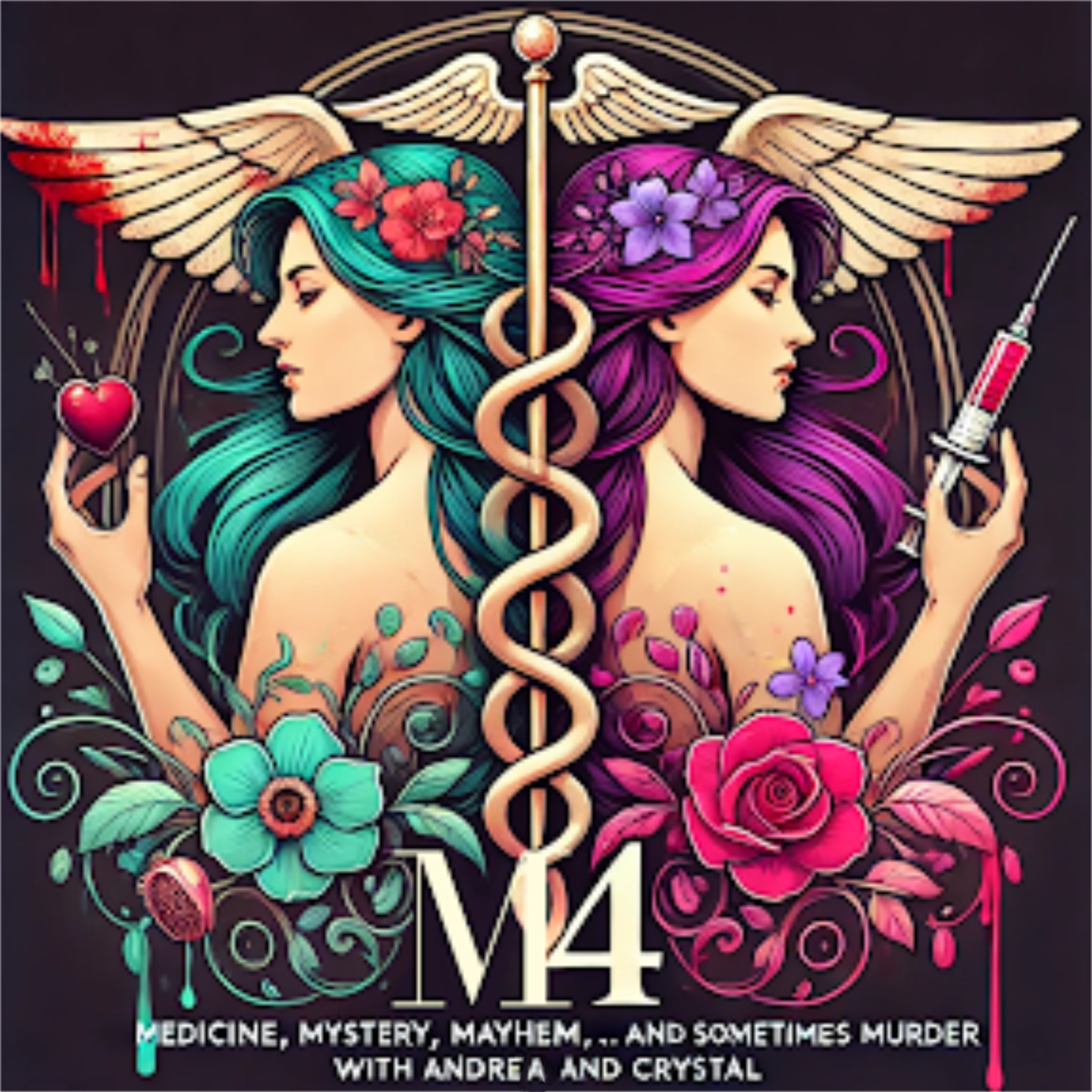
M⁴: Medicine, Mystery, Mayhem... and Sometimes Murder
M4 PodcastAudio
- Format:
- Podcast
- New episodes:
- Weekly
- Typical length:
- about 1 hour
- Latest episode:
About this show
Hosted by two seasoned RNs with over 45 years of combined experience and a friendship nearly as long, the M⁴ Podcast dives into the strange, shocking, and sometimes spine-chilling side of medicine. Each episode explores real cases, bizarre conditions, historical medical mysteries, and the occasional true crime, with expert insight, unfiltered commentary, and a touch of gallows humor. If you love twisted tales with a clinical twist, M⁴ delivers. Subscribe now—because healthcare isn’t always by the book.
Covers: medical history, true crime, neuroscience, medical mysteries, nursing, paranormal claims, forensic medicine, social history
Show details and episodes come from the publisher's public feed at anchor.fm. Last updated . Names, artwork and text belong to their publishers.
Recently on this show
Summary of recent episodes, drawn from the publisher's feed.
M⁴ is a podcast from two registered nurses that covers strange, shocking and sometimes spooky medical stories, including real cases, unusual conditions, historical medical mysteries and some true crime. Recent episodes have covered split-brain syndrome, a case of babies raised under false identities, the "Radioactive Boy Scout," and the 1848 railroad accident of Phineas Gage.
Cosmos
Similar in subject
- 3SchemeQueens
Both cover: medical mysteries, medical history, true crime - Crime Corner With Jessie Wiseman
Both cover: medical mysteries, true crime - Patient Zero
Both cover: medical mysteries, medical history
Similar shows





Explore more
Episodes
Ep. 41: Who Can it Be Now?
· 1 hr 3 min
Imagine your hand picking up a glass, unbuttoning your shirt, or reaching for someone else's plate, and you had nothing to do with it. You didn't decide. You didn't even feel it coming. You just watched your own hand act like it belongs to someone else. This week, Crystal and Andrea dig into Alien Hand Syndrome, the rare neurological condition where one hand moves with purpose but without permission. We cover where it comes from, including stroke, traumatic brain injury, brain tumors, and certain neurodegenerative diseases, and why a condition this strange so often gets mistaken for something else entirely. We get into the split-brain surgeries that first revealed it, the cases where patients gave their hand its own name just to cope, and the unsettling question at the center of it all: what happens when part of your body stops listening to you. It's rare. It's real. And it might be happening right now to someone who has no idea why their own hand won't behave.
Not rated yetEp. 40: Bad Blood
· 1 hr 0 min
For forty years, the U.S. government promised free healthcare to a group of men who needed it most. What they delivered instead was decades of deliberate, documented deception. This week, Andrea and Crystal break down the U.S. Public Health Service Syphilis Study at Tuskegee: how it started, why it kept going long after a cure existed, and the nurse caught in the middle of it all. We trace the men behind the headlines, the whistleblower who finally ended it, and the bioethics rules that exist today because of what happened to them. It's a hard one. It's also one of the most important episodes we've made.** Please note, we are aware that Crystal mispronounces "Tuskegee" throughout this episode - our sincerest apologies **
Not rated yetEP. 39: Pour Some Sugar on Me
· 54 min
On January 15, 1919, a massive steel tank in Boston's North End ruptured without warning, releasing 2.3 million gallons of molasses in a wave that reached 25 feet high and moved at 35 miles per hour. It crushed buildings, snapped elevated train tracks, and killed 21 people. The cleanup took weeks. The myths have lasted a century. In this episode, Andrea takes us through one of the strangest industrial disasters in American history. Why was that much molasses sitting in a residential neighborhood? What did rescuers face when the wave finally stopped? And how did a flood of sugar end up changing corporate accountability in America forever? Join Andrea and Crystal as they wade through the science of why this wave was anything but slow, and the medical realities of drowning in syrup.
Not rated yetEp. 38: It's Your Poison Running Through My Veins
· 1 hr 11 min
In the 1910s and 1920s, thousands of young women sat at factory benches painting radium onto watch dials, pressing their brushes to their lips to form a fine point with every single stroke. They were told it was safe. Some were told it would put roses in their cheeks. The scientists who handled the same material wore lead-lined gloves. This week, Crystal walks through the full story of the Radium Girls — the dial painters of New Jersey and Ottawa, Illinois, who were poisoned by their employers, gaslit by company-hired doctors, and whose deaths were falsely attributed to syphilis. And then fought back anyway, from courtrooms, from bedsides, from their own living room couches. We cover the science of what radium does inside the human body, how modern radiation medicine traces its foundations directly to these women, and the extraordinary legal legacy that helped build OSHA and protect every American worker who came after them. SOURCES:Moore, Kate. The Radium Girls: The Dark Story of America'sShining Women. Naperville, IL: Sourcebooks, Inc., 2017. NIH/PMC. 'Radium Dial Workers: Back to the Future.' pmc.ncbi.nlm.nih.gov/articles/PMC10563809/ NIH/PMC. 'Facts and Ideas from Anywhere' — Ottawa dialpainters overview. pmc.ncbi.nlm.nih.gov/articles/PMC5595405/ NIST Journal of Research. 'The National Bureau of Standardsand the Radium Dial Painters.' Vol. 126 (2021). nvlpubs.nist.gov/nistpubs/jres/126/jres.126.051.pdf MIT News. 'Professor Robley D. Evans, nuclear medicinepioneer, dies.' January 1996. news.mit.edu ORAU. 'Tales from the Atomic Age: Robley Evans in the WildWest.' orau.org ORAU. 'Radium Girls: The Health Scandal of Radium DialPainters.' orau.org Library of Congress. United States Radium Corporation sitedocumentation. loc.gov/item/nj1644/ REAC/TS Radiation Countermeasures (ORISE). Ca-DTPA/Zn-DTPAguidance. orise.orau.gov/reacts Radiation Emergency Medical Management (REMM/HHS).'Ca-DTPA/Zn-DTPA.' remm.hhs.gov/dtpa.htm NORD. 'Radiation Sickness.' rarediseases.org TED Ideas. 'This Pill May Be a Cure for Radiation Poisoning.'Abergel research, Lawrence Berkeley National Laboratory. ideas.ted.com NPR Illinois. 'The Radium Girls — An Illinois Tragedy.' TaraMcClellan McAndrew, January 25, 2018. will.illinois.edu Library of Congress / Headlines & Heroes. 'Radium Girls:Living Dead Women.' March 2019. blogs.loc.gov National Archives Blog. 'The Radium Girls at the NationalArchives.' June 2021. text-message.blogs.archives.gov NIST Blog. 'New Jersey's Radium Girls and the NIST-TrainedScientist Who Came to Their Aid.' January 2026. nist.gov History.com. 'How the Radium Girls Forced Workplace SafetyReforms.' History.com. 'Radium: The Deadly Health Fad of the Early1900s.' HowStuffWorks. 'The Radium Girls' Dark Story Still Glows WithDeath and Deceit.' Kate Morgan, 2022. Duquesne Law / Juris Magazine. 'The Radium Girls: A Tale ofWorkplace Safety.' December 2019. HistoryNet. 'Radium Girls vs. U.S. Radium.' VOA News. 'Radium Girls Remembered for Role in Shaping USLabor Law.' September 2011. Illinois Women's History Trail — Radium Girls. sites.google.com/ismsociety.org/womens-history-trail/radium-girls Historical Marker Database. 'Remembering the Radium Girls.'Ottawa, IL. Wikipedia. 'Radium Girls'; 'Grace Fryer'; 'Radium.' AccessedApril 2026. theradiumgirls.com — individual women's biographical profiles. ExploreTheArchive.com. 'The Tragic Case of the Radium Girls.'2022. Popular Science. 'The Radioactive Miracle Water That KilledIts Believers.' CBS News / Kang & Pedersen. Excerpt from Quackery: ABrief History of the Worst Ways to Cure Everything. Workman Publishing,2017.
Not rated yetEp. 37: Twist and Shout
· 1 hr 4 min
Some people are born with a blueprint that's slightly off. The structure looks right at first glance, but the details are wrong in ways that matter: joints that stretch too far, a heart that works too hard, a frame that grows faster than it should. Marfan Syndrome is a genetic connective tissue disorder that hides in plain sight, and for decades, it hid in some of the most recognizable bodies in history. This week, we're breaking down the science behind the mutation that affects fibrillin-1, what it actually does to the body over time, and why Marfan often doesn't get caught until something catastrophic makes it impossible to ignore. We'll look at what modern screening can and can't do for the people living with it today. It looks like tall. It looks like flexible. It looks like gifted. Until it doesn't.
Not rated yetEp. 36: The Roof, The Roof, The Roof is On Fire
· 58 min
The Clinic That Burned: The Cleveland Clinic Fire of 1929 One hundred and twenty-three people went to the doctor. They didn't come home. On May 15, 1929, a fire broke out in the basement of the Cleveland Clinic, one of the most respected medical facilities in the country. But it wasn't the flames that killed most of the victims. It was the gas, a toxic cloud released when nitrocellulose X-ray film ignited, that moved through the building faster than anyone could run. In minutes, a place built to heal people became one of the deadliest disasters in American medical history. In this episode, Andrea walks Crystal through the fire that shocked a nation, the science behind why it was so lethal, and the lasting changes it forced on hospital safety, film manufacturing, and how we think about the hidden dangers inside the buildings we trust most.
Not rated yetEp. 35: Wake Up
· 49 min
Sleeping Sickness: The Epidemic That Vanished and the Patients Left Behind It put millions to sleep. Some of them never woke up. Others woke up wrong. Between 1917 and 1928, a mysterious illness swept the globe, leaving its victims in states of suspended animation, rigid and unreachable, trapped somewhere between sleep and death. Doctors called it encephalitis lethargica. The world called it the sleeping sickness. And then, almost as quickly as it appeared, it was gone, leaving behind no clear cause, no confirmed treatment, and thousands of survivors warehoused in institutions for decades, largely forgotten. In this episode, Crystal walks Andrea through one of medicine's most enduring unsolved puzzles: what encephalitis lethargica is, what it did to the people it touched, why it vanished, and what its long shadow tells us about the limits of what medicine thinks it understands.
Not rated yetEp. 34: I Will Survive
· 1 hr 14 min
Not every case ends in darkness. This week, Crystal and Andrea bring you something a little different: stories of ordinary people thrust into extraordinary circumstances, and the sheer, stubborn will it took to make it out alive. We're covering Juliane Koepcke, the 17-year-old who fell two miles from a lightning-struck plane on Christmas Eve and walked out of the Peruvian Amazon eleven days later. Then there's Harrison Okene, a cook on a Nigerian tugboat who survived sixty hours at the bottom of the ocean in nothing but his underwear, breathing from a single pocket of air while rescue divers came expecting only bodies. And finally, Mauro Prosperi, an Italian ultramarathon runner who got swallowed by a Saharan sandstorm mid-race and turned up nine days later in Algeria, nearly 200 miles off course. Three different disasters. Three impossible odds. Three people who refused to stop moving. These are the ones who made it, and the science, the grit, and the grace behind how.
Not rated yetEp. 33: Get Out, Right Now
· 1 hr 5 min
In 1955, the United States had 558,000 people living in state psychiatric hospitals. By 2000, that number had dropped to under 55,000. Not because mental illness got better. Not because we found a cure. Because we closed the doors. What came next was supposed to be a revolution: community mental health centers, wraparound care, dignity over warehousing. What actually came next was the Los Angeles County Jail becoming the largest psychiatric facility in its county. Rikers Island. Cook County. Streets. In this episode, we follow the full arc of psychiatric deinstitutionalization in America, from the genuine horrors of the old state hospital system and the reform movement that dismantled it, to the Medicaid funding loophole that gave states a financial incentive to empty beds, to the civil commitment laws that narrowed the path to treatment, to the correctional system that absorbed what the mental health system stopped holding. We talk about the families navigating a support structure that was promised but never built, the evidence-based models we've had for fifty years and consistently refused to fund, and the question nobody in power wants to answer: if we know what works, why don't we do it? Content note: This episode covers institutionalization, incarceration, homelessness, solitary confinement, and systemic neglect of people with serious mental illness. SOURCES: PrimaryHistories of Deinstitutionalization Fuller Torrey, E.(2014). American Psychosis: How the Federal Government Destroyed the MentalIllness Treatment System. Oxford University Press. Grob, G.N.(1994). The Mad Among Us: A History of the Care of America's Mentally Ill. FreePress. Deutsch, A.(1948). The Shame of the States. Harcourt Brace. Sociology andTheory Goffman, E.(1961). Asylums: Essays on the Social Situation of Mental Patients and OtherInmates. Anchor Books. Szasz, T. (1961).The Myth of Mental Illness. Harper & Row. Criminalizationand Incarceration James, D.J. &Glaze, L.E. (2006). Mental Health Problems of Prison and Jail Inmates. Bureauof Justice Statistics. TreatmentAdvocacy Center. (2016). The Treatment of Persons with Mental Illness inPrisons and Jails: A State Survey. Gilligan, J.(1996). Violence: Our Deadly Epidemic and Its Causes. Putnam. Homelessness Tsemberis, S.(2010). Housing First: The Pathways Model to End Homelessness for People withMental Illness and Addiction. Hazelden. Padgett, D.K.,Gulcur, L., & Tsemberis, S. (2006). Housing First Services for People WhoAre Homeless with Co-Occurring Serious Mental Illness and Substance Abuse.Research on Social Work Practice. TreatmentModels Stein, L.I. &Test, M.A. (1980). Alternative to Mental Hospital Treatment. Archives ofGeneral Psychiatry. Swartz, M.S. etal. (2001). Can Involuntary Outpatient Commitment Reduce Hospital Recidivism?American Journal of Psychiatry.
Not rated yetEp. 32: You Are Not Alone
· 1 hr 2 min
You're alone. The odds are against you. And then, somehow, you're not alone anymore. Third Man Syndrome is one of the most haunting and hotly debated phenomena in survival psychology — the experience of an unseen presence appearing at the moment of greatest crisis, offering calm, guidance, and sometimes a voice that keeps you moving when every instinct says to stop. Explorers stranded in Antarctica. Climbers fighting for oxygen near Everest's summit. Shipwreck survivors adrift in open water. Across decades and continents, the accounts are strikingly similar: a presence that shouldn't be there, but feels more real than anything else. This week, Crystal and Andrea dig into what science, psychology, and spirituality each have to say about this phenomenon. Is it a hallucination? A survival mechanism the brain has been quietly running all along? Or something stranger and harder to explain away? The answer might depend on whether you've ever needed one.
Not rated yetEp. 31: She's So High
· 59 min
They called it non-addictive. They were lying. In this episode, Crystal takes Andrea through the opioid epidemic, one of the deadliest public health crises in American history. From the origins of opioid use in medicine to the moment Purdue Pharma unleashed OxyContin on an unsuspecting public, we trace how a single drug company's greed, backed by manipulated research and a relentless sales machine, helped hook a nation. We dig into the doctors who prescribed, the regulators who looked the other way, and the communities left to pick up the pieces. Then there's fentanyl, the policy failures, and the people still fighting to survive an epidemic that was never an accident. This one was built on a lie. And a lot of people died for it.
Not rated yetEp. 30: I Need a Hero?
· 1 hr 0 min
He was a nurse. He was trusted with the most vulnerable patients in intensive care. And somewhere along the way, the line between saving lives and ending them disappeared entirely. Niels Högel worked the cardiac wards of two hospitals in northern Germany, where deaths under his watch climbed to alarming rates -- rates that colleagues noticed, whispered about, and ultimately failed to stop. For years, he induced cardiac arrests in his patients just to step in and play the hero. Some survived. Many didn't. By the time investigators finished exhuming bodies from 67 cemeteries across three countries, the confirmed death toll had reached 85 -- with suspicions stretching to 300 or more. This week, Andrea and Crystal are digging into one of the most chilling cases in modern medical history: a killer hidden in plain sight, the colleagues who saw the warning signs, and a system that handed him glowing reference letters instead of accountability.
Not rated yetEp. 29: Breathe In, Breathe Out
· 55 min
In late 2019, a mysterious respiratory illness began spreading through Wuhan, China. Within months, it had a name — COVID-19 — and within months after that, it had the entire world in its grip. In this episode of Medicine, Mystery, Mayhem & Murder, Crystal walks Andrea through the full story of COVID-19, from the long history of coronaviruses and how scientists had been watching this viral family for decades, to the emergence of a novel pathogen that no one was prepared for. They explore what the virus does to the body, why it hit some people harder than others, and what we now know about long COVID, the lingering and often debilitating condition that millions of survivors are still living with today. Along the way, they touch on how the pandemic unfolded on a global scale and the complicated, often fractured response that followed. Join Andrea and Crystal as they unpack one of the most defining medical events of our lifetime and what it revealed about science, systems, and the human body under pressure.
Not rated yetEp. 28: Paralyzer
· 1 hr 27 min
You've heard of paralysis. But what if it came and went, triggered by rest, a meal, or exercise, and left no trace by morning? This week, Andrea walks Crystal through Periodic Paralysis, a rare and frequently misdiagnosed group of channelopathies that can leave patients unable to move for hours at a time. We break down how ion channels gone wrong can bring an otherwise healthy person to a complete standstill, why it often takes years to get a correct diagnosis, and what living with this condition actually looks like. Medicine doesn't always look the way we expect. Sometimes the most dramatic symptoms vanish before anyone can see them.
Not rated yetEp. 27: Mama, Just Killed A Man
· 44 min
A wealthy Utah industrialist is found shot dead in his own warehouse. The scene looks like a robbery. It isn't. What follows is a years-long unraveling of a family held together by money, manipulation, and secrets — stretching from Salt Lake City to Manhattan's Upper East Side. This week, Crystal and Andrea dig into the 1978 murder of Franklin Bradshaw, a case so twisted it inspired two books and two TV movies — and somehow, the most unbelievable parts are all true.
Not rated yetEp. 26: Can't Sleep, Won't Sleep
· 58 min
Sleep is something we all take for granted until it’s gone. In this episode of Medicine, Mystery, Mayhem & Murder, Andrea and Crystal explore one of the rarest and most terrifying conditions known to medicine: Fatal Familial Insomnia. Imagine a disease where your body simply forgets how to sleep, and no amount of medication, exhaustion, or intervention can bring it back. This is a story about more than just sleep. It is about what happens when one of the most basic human functions is stripped away, and how medicine continues to chase answers in the face of something it still does not fully understand. So get comfortable… and maybe do not listen right before bed.
Not rated yetEp. 25: Down in a Hole
· 49 min
In October 1987, the world held its breath when 18-month-old toddler Jessica McClure, known to millions as Baby Jessica, fell 22 feet down a narrow well in a backyard in Midland, Texas. What followed was a tense 58-hour rescue that captured the attention of the entire country. Television crews gathered outside the site while engineers, oil field workers, and rescuers worked around the clock. Across the nation, people watched and waited, hoping the small voice coming from deep underground would be heard safely above ground again. In this episode of Medicine, Mystery, Mayhem & Murder, Andrea and Crystal walk through the extraordinary rescue operation step by step. They explore how responders worked through dangerous conditions, the medical concerns surrounding a trapped toddler, and the emotional toll on everyone involved. It became one of the first live breaking news events that truly united viewers across the country in real time. The story also opens the door to a broader discussion about dramatic rescues that captured global attention. From Baby Jessica’s ordeal to the incredible survival and rescue of the trapped miners during the 2010 Copiapó mining accident in Chile, these moments remind us how determination, engineering, and human compassion can converge when every second matters. Join Andrea and Crystal as they revisit the rescue that kept the world watching and proved that sometimes hope can reach even the deepest places.
Not rated yetEp. 24: I am Iron Man
· 1 hr 28 min
Before ventilators, before modern ICUs, and before vaccines nearly erased one of the most feared diseases in history, there was the iron lung. In this episode of Medicine, Mystery, Mayhem & Murder, Andrea and Crystal explore the strange, fascinating, and sometimes heartbreaking story of the machine that helped people breathe when their own bodies couldn’t. During the height of the polio epidemics, hospital wards filled with massive metal cylinders that kept patients alive. Sometimes for weeks, sometimes for decades. We talk about how the iron lung actually worked, why it became such an iconic symbol of the polio era, and the human stories behind the machine. From the desperate race to save patients during outbreaks to the small number of survivors who lived inside these machines for most of their lives, this is a chapter of medical history that feels both unbelievable and deeply personal. It’s a story about ingenuity, survival, and a time when medicine was forced to invent solutions in real time. Join us as we step back into the age of the iron lung, when breathing itself depended on a machine.
Not rated yetEp. 23: Doctor, Doctor
· 46 min
In 1999, Dr. Jerri Nielsen was the only physician stationed at the South Pole when she discovered a lump in her breast — after the last plane had already left. With evacuation impossible, she diagnosed, biopsied, and began treating her own cancer while trapped in one of the most isolated places on Earth. This episode explores her story alongside other moments when medicine had to happen without rescue: self-surgery in Antarctica, healthcare in disaster zones, and the realities of telemedicine when infrastructure disappears. Andrea and Crystal examine what happens when the provider becomes the patient, how isolation changes decision-making, and what these stories reveal about resilience, preparedness, and the human side of care. Because sometimes survival begins long before help arrives.
Not rated yetEp. 22: No One Knows What it's Like - Michael Swango Pt 2
· 1 hr 11 min
In Part Two of our deep dive into Michael Swango, we follow the trail all the way to the end — the arrests, the lies, the international flight, and the staggering body count that may never be fully known. How did he continue practicing medicine after convictions? How did hospitals miss — or ignore — the warnings? And how many patients paid the price for institutional silence and fragmented reporting systems? We walk through the criminal charges, the federal case, and the ultimate sentence that finally stopped him. We also talk about what changed in healthcare because of him, and where the gaps still remain. This isn’t just the story of one man. It’s a story about systems that failed. About oversight that came too late. And about the uncomfortable truth that sometimes the white coat hides more than it heals. If you thought Part One was disturbing… this is where it all comes into focus.
Not rated yet