

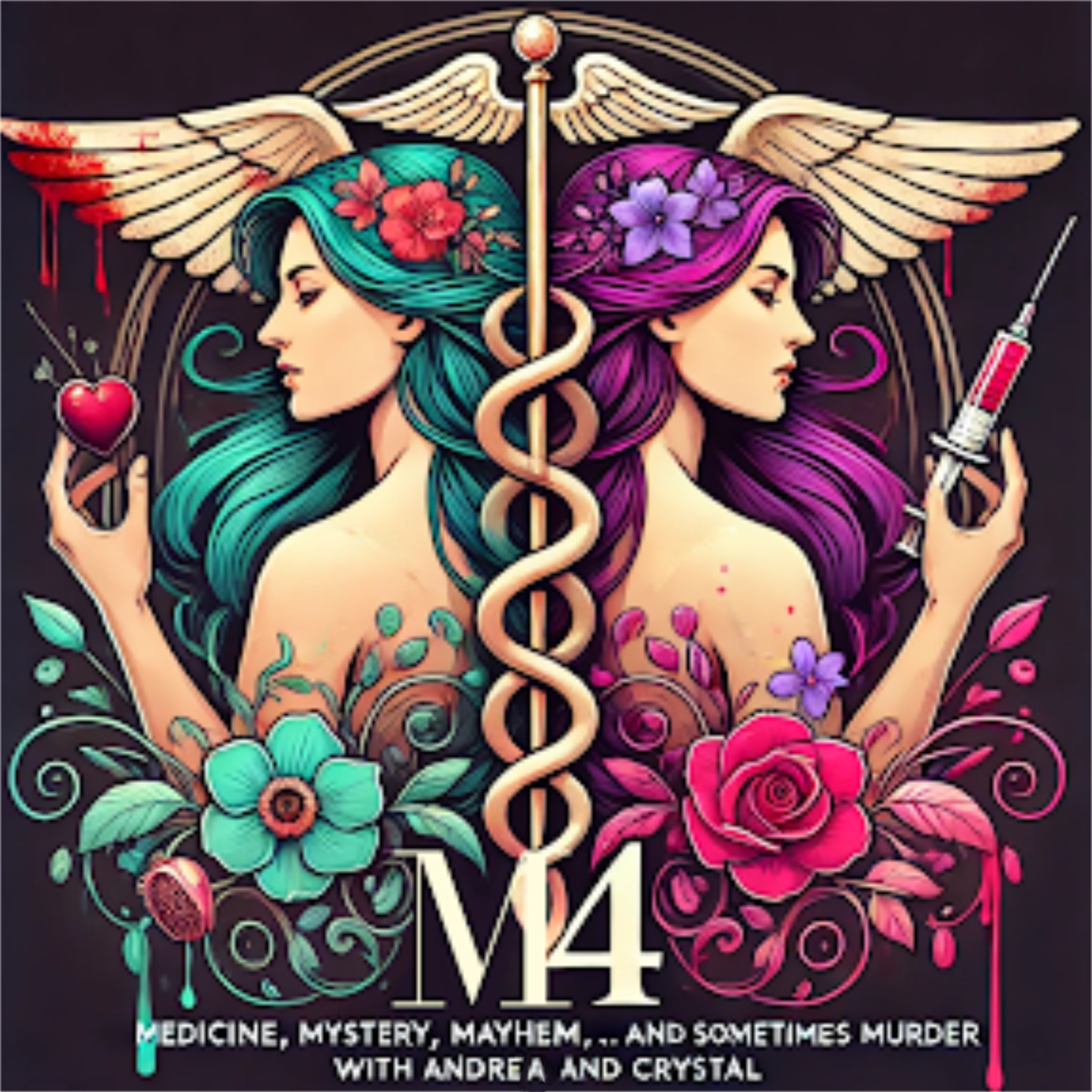
M⁴: Medicine, Mystery, Mayhem... and Sometimes Murder
M4 PodcastAudio
- Format:
- Podcast
- New episodes:
- Weekly
- Typical length:
- about 1 hour
- Latest episode:
About this show
Hosted by two seasoned RNs with over 45 years of combined experience and a friendship nearly as long, the M⁴ Podcast dives into the strange, shocking, and sometimes spine-chilling side of medicine. Each episode explores real cases, bizarre conditions, historical medical mysteries, and the occasional true crime, with expert insight, unfiltered commentary, and a touch of gallows humor. If you love twisted tales with a clinical twist, M⁴ delivers. Subscribe now—because healthcare isn’t always by the book.
Covers: medical history, true crime, neuroscience, medical mysteries, nursing, paranormal claims, forensic medicine, social history
Show details and episodes come from the publisher's public feed at anchor.fm. Last updated . Names, artwork and text belong to their publishers.
Recently on this show
Summary of recent episodes, drawn from the publisher's feed.
M⁴ is a podcast from two registered nurses that covers strange, shocking and sometimes spooky medical stories, including real cases, unusual conditions, historical medical mysteries and some true crime. Recent episodes have covered split-brain syndrome, a case of babies raised under false identities, the "Radioactive Boy Scout," and the 1848 railroad accident of Phineas Gage.
Cosmos
Similar in subject
- 3SchemeQueens
Both cover: medical mysteries, medical history, true crime - Crime Corner With Jessie Wiseman
Both cover: medical mysteries, true crime - Patient Zero
Both cover: medical mysteries, medical history
Similar shows





Explore more
Episodes
Ep. 61: Mind Games
· 59 min
What if cutting one bundle of nerves could leave you with two minds sharing one skull? This week, Andrea walks Crystal through split-brain syndrome. In the mid-1900s, surgeons treating severe, uncontrollable epilepsy began severing the corpus callosum, the bridge that lets the brain’s two hemispheres talk to each other. The seizures improved, and the patients seemed perfectly normal. Then researchers Roger Sperry and Michael Gazzaniga started running clever experiments in the lab and found something much stranger: each half of the brain could see, know, and want things the other half knew nothing about. We get into the Nobel Prize-winning research that came out of these patients, the brain’s habit of inventing confident explanations for things it never actually saw, and the question that still keeps neuroscientists arguing: when the two halves disagree, which one is you? If you’ve ever argued with yourself, this one’s going to hit a little differently.
Not rated yetEp. 60: Who Are You?
· 1 hr 5 min
What if the name on your birth certificate was never yours? This week, Andrea and Crystal dig into one of the rarest crimes in America: babies taken by strangers and raised as someone else’s child, kids who grew up with no idea anyone was searching for them. From a Harlem pediatric unit in 1987 to a Cape Town maternity ward, a Fort Worth babysitting ad, and a Chicago hospital in 1964, we follow the paper trails, schoolyard coincidences, and DNA matches that finally handed these children back their names. Along the way, two nurses ask the hard questions. How did women posing as staff walk out of hospitals with newborns? What changed in infant security because of it? And when the truth finally comes out, who do you love: the family you were born to, or the one who raised you? Featuring the cases of Carlina White, Kamiyah Mobley, Zephany Nurse, Melissa Highsmith, Paul Fronczak, Baby Holly Clouse, and Lisa Jensen.
Not rated yetEp. 59: Radioactive
· 1 hr 7 min
In 1994, a teenager in suburban Michigan set out to earn a merit badge and ended up building something in his mother’s backyard potting shed that brought the EPA to his door in hazmat suits. This week, Andrea takes Crystal through the story of David Hahn, the “Radioactive Boy Scout,” who collected smoke detectors, camping lantern mantles, and old glow-in-the-dark clocks in his attempt to build a nuclear reactor. How did a high schooler with no formal training get this far? Where were the adults? And what does that kind of exposure do to the human body? As two RNs, we dig into the science, the radiation risks, and the family dynamics that let a dangerous obsession grow unchecked, plus the question of what happened to David after the cleanup crews left.
Not rated yetEp. 58: The Mind is a Terrible Thing to Taste
· 55 min
In 1848, a railroad foreman in Vermont leaned over a blasting hole, turned his head for one second, and sent a 13-pound iron rod straight through his skull. Minutes later, he was sitting up and cracking jokes with the doctor. Phineas Gage is the most famous patient in neuroscience, the man who was “no longer Gage.” He’s in nearly every psychology textbook ever printed. And much of what those textbooks say about him is wrong. This week, Crystal walks Andrea through the accident, the country doctor who kept Phineas alive with no antibiotics and a coffin already measured, and the paragraph that made him a legend twenty years later. Then come the parts the textbooks leave out: a photograph found on Flickr, a skull at Harvard, and a life that didn’t go the way you were taught.
Not rated yetEp. 57: Breeder
· 1 hr 1 min
In 1927, the United States Supreme Court ruled that a young Virginia woman could be sterilized against her will, and the justice who wrote the opinion summed it up in one infamous line: “Three generations of imbeciles are enough.” Her name was Carrie Buck. She was 17, poor, pregnant, and suddenly labeled “feebleminded” by the people who wanted her out of sight. What followed was a test case built to fail her, with a defense attorney who barely defended, expert witnesses who never met her, and doctors ready to perform the procedure the moment the gavel came down. This week, Andrea walks Crystal through the story of Carrie Buck and the American eugenics movement: how “better breeding” became law in dozens of states, how medicine lent it credibility, and how tens of thousands of people lost the ability to have children because someone decided they were unfit. As nurses, we can’t ignore the uncomfortable truth that this was carried out in hospitals, by clinicians, in the name of public health. And here’s the part that may surprise you: Buck v. Bell has never been overturned.
Not rated yetEp. 56: The Day the Music Died
· 46 min
A private jet crosses the Midwest at 46,000 feet, perfectly on autopilot, while fighter pilots pull alongside and see frosted windows and no movement inside. Nobody aboard will ever answer the radio. This week, Andrea and Crystal look at some of the most famous plane crashes in history: Buddy Holly, Ritchie Valens and the Big Bopper, Patsy Cline, Jim Croce, Lynyrd Skynyrd, John Denver, Payne Stewart, Aaliyah, and JFK Jr. But we’re not telling these stories in order. We’re sorting them by what actually happened to the human body and brain in the cockpit, because most of these crashes weren’t about the airplane at all. We get into why your inner ear will confidently lie to you in a cloud, what it means when the pilot is the patient, how running out of fuel is really a dosing error, and why hypoxia looks a lot like that patient satting 82 who swears they feel fine. Along the way, because they too deserve to be remembered, we say the names of everyone on board, including the pilots, bandmates, and crew that history usually leaves out.
Not rated yetEp. 55: Fade to Black
· 1 hr 0 min
On the night of August 21, 1986, the villages around Lake Nyos in northwestern Cameroon went quiet. There was no fire, no flood, and no sign of a struggle. By morning, more than 1,700 people and thousands of animals were dead, some of them miles from the water. The few who woke up found that their neighbors, their families, and even the insects were gone. This week, Andrea takes us to a remote crater lake that had been keeping a deadly secret for centuries. What rolled through those valleys in the dark? Why did some people survive while the person lying next to them did not? And how did scientists piece together a kind of disaster that almost no one believed was possible? We dig into the science of what happened at Lake Nyos, what it does to the human body, the strange injuries survivors woke up with, and the unsettling question of whether it could happen again.
Not rated yetEp. 54: If You Could Read My Mind, Love
· 46 min
A podcast climbed to the top of Spotify's charts with a claim that stopped us cold: that some non-speaking autistic children can read minds — and that dozens of them gather on a shared, non-physical plane they call "the Hill." As two RNs, we wanted to believe it. So we pulled the research. What we found traces straight back to a technique with a body count of false accusations, broken families, and at least one criminal conviction — and a well-documented psychological effect that explains why loving, honest parents can be completely convinced their child is typing when they aren't. This one's about grief, hope, a horse named Clever Hans, and what actually works for kids who can't speak for themselves. Extraordinary claims. Ordinary evidence.
Not rated yetEp. 53: Knocking On Heaven's Door
· 57 min
People who've survived a near-death experience often describe the same things: a tunnel, a bright light, a sense of peace, even a "life review." But what if some of these experiences aren't happening at the edge of death at all, and instead are happening in the brain during a seizure? This week Andrea dives into the eerie overlap between post-ictal states and near-death experiences, tracing the neuroscience of what happens in the brain right after a seizure and asking a genuinely unsettling question: are NDEs a glimpse of something beyond, or a very human misfire of an overtaxed brain? Grab your headphones and get ready to question everything you thought you knew about the line between life and death.
Not rated yetEp. 52: Fart Song
· 55 min
He turned a childhood beach accident into the most bizarre stage career in French history — and became the highest-paid entertainer in Paris doing it. In this episode, Crystal takes Andrea through the strange, true story of Joseph Pujol, the 19th-century performer who discovered he had absolute voluntary control over a part of his anatomy most people never think about twice. From his early days as a baker in Marseille to his sold-out shows at the Moulin Rouge — where he reportedly out-earned Sarah Bernhardt herself — we cover his rise to fame, the imitators who tried to steal his act, the business dispute that pushed him to open his own theater, and his return to a quiet, ordinary life after the applause stopped. We also dig into the actual physiology behind what he could do, and how it compares to what modern medicine understands about pelvic floor control today. It's mayhem, it's medicine, and it's one of the strangest success stories you'll ever hear.
Not rated yetEp. 51: Cream
· 46 min
Dr. Thomas Neill Cream trained as a doctor, and he used every bit of that training to hurt the people who trusted him most. As nurses, we've seen what it means to hold someone's life in your hands. Cream held that same trust and used it as a weapon, poisoning patients across two continents while the medical establishment looked the other way. In this episode, Andrea walks us through how he got away with it for so long, the string of victims most people have never heard of, and the twisted claim he made on the gallows that still gets repeated as fact today. This one will make you look twice at anyone who's ever handed you a pill.
Not rated yetEp. 50: I See a Bad Moon Rising
· 53 min
A blue diamond mailed through the regular postal service. A pharaoh's tomb blamed for deaths that had nothing to do with him. A Porsche that vanished from a locked trailer. A Raggedy Ann doll two student nurses swore was moving on its own. This week Crystal and Andrea go owner by owner, deathbed by deathbed, through history's most famous "cursed" objects, and dig into what's actually killing people versus what's just an excellent sales pitch. Spoiler: one jeweler wrote a curse clause into an actual legal contract to close a deal.
Not rated yetEp. 49: Then I Saw Her Face
· 1 hr 7 min
Most people can barely recall a stranger's face after a few minutes. Then there are the outliers, the small slice of the population who can pick a face out of a crowd years later, from a single glimpse, even through disguises. We dig into the research on super recognizers: how scientists identify them, what's happening differently in their brains, and how police departments and border agencies have started recruiting them as real investigative tools. It's a rare case where a "superpower" isn't science fiction, it's just measurable human variation. In this episode, Andrea and Crystal break down what the studies actually show, and what it means for the rest of us who can barely remember a name at a party.
Not rated yetEp. 48: Breathe In, Breathe Out
· 55 min
Ever wondered how we went from "just sleep on your side" to strapping a machine to your face every night? In this episode, Crystal and Andrea dig into the surprisingly wild history of the CPAP machine — from a wine bottle and a vacuum cleaner motor in an Australian lab to the sleek, quiet devices millions of people rely on today. We trace the invention back to Dr. Colin Sullivan's 1981 breakthrough, the decades of trial, error, and skepticism that followed, and how CPAP went from a clunky lab experiment to the gold-standard treatment for sleep apnea. Whether you're a longtime CPAP user, a curious insomniac, or just love a good "who knew?" origin story, this one's for you.
Not rated yetEp. 47: I'm Half the Man I Used to Be
· 1 hr 9 min
At 19 years old, Loren Schauers made a choice most of us will never have to face. This week, Andrea and Crystal cover the story of a young man whose ordinary workday on a bridge construction site turned into a fight to survive an accident that should have killed him instantly. We break down the injuries, the split-second decisions that saved his life, and the radical surgery that let him keep living, even after losing half his body. It's a story about the limits of the human body, and what it takes to keep going when everything changes in an instant.
Not rated yetEp. 46: Tell Me Lies
· 1 hr 3 min
Medicine promises the same standard of care to everyone. History tells a different story. In this episode, Andrea and Crystal dig into the disparities baked into modern medicine, who gets diagnosed, who gets believed, and who gets left behind. Two RNs unpack the data, the cases, and the consequences.
Not rated yetEp. 45: War Pigs
· 1 hr 17 min
He was a physician. He held the rank of general. And for over a decade, he ran one of the most horrifying human experimentation programs in modern history — and walked away from it a free man. This week, we head to Manchuria to unpack the story of Unit 731, the covert biological and chemical warfare research unit of the Imperial Japanese Army, and the doctor who built it. We're talking vivisection without anesthesia, deliberate frostbite experiments, and weaponized plague fleas — all conducted under the banner of "scientific research." We'll walk through how a licensed physician convinced his government to fund it, why the victims were stripped of even the dignity of a name, and how a deal with American occupation forces after the war meant almost no one was ever held accountable. As two nurses, this one hit different. We talk about what it means when the Hippocratic Oath gets weaponized, and how the West's Cold War priorities let a war crime of staggering scale disappear from most history books entirely. ** Content note: this episode discusses graphic human experimentation and wartime atrocities.
Not rated yetEp. 44: I Fell In to a Burning Ring of Fire
· 54 min
A machine that was supposed to heal became one of the deadliest medical devices of the twentieth century, and nobody could figure out why. This week, we dig into the Therac-25, a radiation therapy machine whose software errors delivered massive, lethal overdoses to patients across the US and Canada in the mid-1980s. We walk through the race condition bugs that let operators override safety checks in a matter of keystrokes, the manufacturer that dismissed early reports as impossible, and the investigation that turned this into one of the founding case studies in software safety engineering. It's a story about how a few lines of bad code became a body count.
Not rated yetEp. 43: Bad Medicine
· 1 hr 8 min
At a crowded state institution on Staten Island, hepatitis wasn't just common. It was almost guaranteed. Instead of treating it, one doctor decided to use it. This week, Andrea walks through the hepatitis studies conducted at Willowbrook State School, where children with intellectual disabilities were deliberately infected in the name of vaccine research. We cover how the study was framed to parents, why it went on for over a decade, and how it became one of the defining scandals in the history of medical ethics. It's a hard listen, and an important one.
Not rated yetEp. 42: It's a Cult of Personality
· 42 min
"Two Women Sue Church When Christ Fails to Appear" In a small Utah town, a self-proclaimed prophet convinced dozens of followers that the Second Coming had a date on the calendar. When it didn't happen the way he said, he didn't lose his followers. He just adjusted the story. This week, Crystal and Andrea head to Manti, Utah, to unpack the rise of a charismatic leader who claimed direct communication with God, built a following through seances and secret plural marriages, and somehow talked his way out of a failed apocalypse. Along the way: whispered VHS tapes, a memoir from a woman who lived it, and a lawsuit headline you have to read twice to believe. Faith, control, and a prophecy that just wouldn't quit.
Not rated yet