

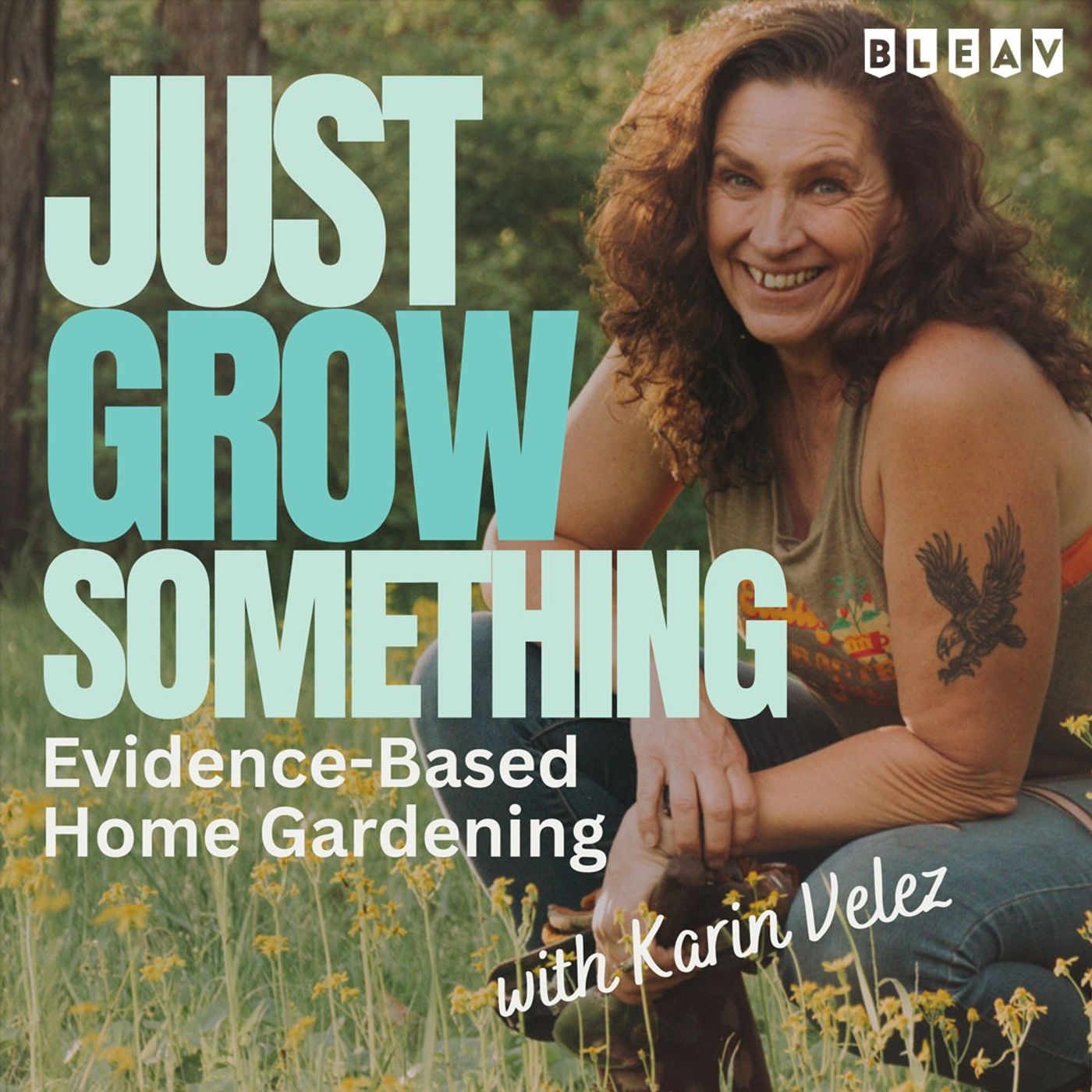
Just Grow Something | Evidence-Based Home Gardening
Karin VelezAudio
- Format:
- Podcast
- New episodes:
- Weekly
- Typical length:
- about 35 minutes
- Latest episode:
About this show
Grow a better vegetable garden, whether you're a seasoned gardener or have never grown a thing in your life. Karin helps home gardeners learn to grow their own food using evidence-based techniques and research. She talks all about specific plants, pests, diseases, soil and plant health, mulch, garden planning, and more. It's not just the "how" but also the "why" that makes us better. The goal? For everyone to know how to grow their own food no matter what sized space they have or their experience level.
Tune in each week to plan, learn, and grow with your friend in the garden, Karin Velez.
Covers: home gardening, vegetable gardening, soil health, garden pests, food preservation, seed saving, cover crops, native plants, weed control, garlic and onions
Show details and episodes come from the publisher's public feed at feeds.simplecast.com. Last updated . Names, artwork and text belong to their publishers.
Recently on this show
Summary of recent episodes, drawn from the publisher's feed.
Just Grow Something is a podcast where Karin Velez helps home gardeners produce their own food with research-backed methods. Recent episodes cover winter and garden pests, fall soil testing, perennial weeds, and preserving food without canning.
Cosmos
Similar in subject
- The Gardenangelists: Flowers, Veggies, and All the Best Dirt
Both cover: seed saving, native plants, vegetable gardening - The Beet: A Podcast For Plant Lovers
Both cover: food preservation, native plants, home gardening - MARGARET ROACH A WAY TO GARDEN
Both cover: seed saving, native plants, vegetable gardening
Similar shows




Episodes
How to Time Your Fall Brassicas - Ep. 307
· 25 min
Fall gardening doesn't start in September. For the crops that take a long time to produce, your broccoli, your cauliflower, your cabbage, your Brussels sprouts, it starts right now in late June and early July. And if you've never had a productive fall brassica bed, it's almost certainly because you started too late and it took me a lot of years to master this. This episode is about fall gardening planning, and specifically about the crops that require you to be thinking ahead right now, in late June and into July, when literally nothing about summer conditions suggest that fall is coming. We’re talking about the timing, why it matters, how to calculate it for your specific first frost date, and exactly what to do if you're sitting here thinking you may have already missed the window — because you might not have, but we need to move quickly. Let’s dig in. Join my FREE fall garden email challenge! https://justgrowsomethingpodcast.com/fall Resources: How to Calculate Your Fall Brassica Dates - Step 1: Find your average first frost date (garden.org/apps/frost-dates or your local extension service) - Step 2: Take days to maturity for your chosen variety - Step 3: Add 10–14 days for the short-day factor - Step 4: Count backward from first frost — that is your transplant-out deadline - Step 5: Count back another 4–6 weeks — that is your seed-starting deadline MU Extension — Vegetable Planting Calendar (G6201): Variety-specific fall planting dates for Missouri's three planting regions. https://extension.missouri.edu/publications/g6201 UMN Extension — Growing Broccoli: Seed-starting timing (early to late July for fall crop), variety selection, and fall head quality. https://extension.umn.edu/vegetables/growing-broccoli UMN Extension — Growing Broccoli: Seed-starting timing (early to late July for fall crop), variety selection, and fall head quality. https://extension.umn.edu/vegetables/growing-broccoli UMN Extension — Growing Brussels Sprouts: Start seeds in June indoors or direct, water deeply once weekly, harvest through fall frosts. https://extension.umn.edu/vegetables/growing-brussels-sprouts UMN Extension — Growing Cauliflower: Start seeds in July for fall crop; cool temperatures essential for quality curd formation. https://extension.umn.edu/vegetables/growing-cauliflower UMN Extension — Growing Cabbage: For fall crop, plant seed directly in garden in early July; cabbage takes 60–100 days. https://extension.umn.edu/vegetables/growing-cabbage UMD Extension — Planting Dates for Vegetable Crops (Transplant Timing): Short-day factor methodology for fall transplant timing. https://extension.umd.edu/sites/extension.umd.edu/files/2021-03/PlantingDatesforVegetableCropsinMaryland.pdf Just Grow Something: https://justgrowsomething.com Gardening Courses: https://justgrowsomething.com/courses Just Grow Something Merch and Downloads: https://justgrowsomething.com/shop Just Grow Something Gardening Friends Facebook Group: https://www.facebook.com/share/g/18YgHveF5P/ Check out how you can become a patron on Patreon: https://www.patreon.com/JustGrowSomething (https://www.patreon.com/JustGrowSomething?fan_landing=true) Feed my coffee habit: https://buymeacoffee.com/justgrowsomething Amazon storefront: https://www.amazon.com/shop/justgrowsomething Get 10% off and FREE shipping on my favorite raised planters at Planter Box Direct using code JUSTGROW10: https://planterboxdirect.com/?ref=593 Hosted by Simplecast, an AdsWizz company. See pcm.adswizz.com (https://pcm.adswizz.com) for information about our collection and use of personal data for advertising.
Not rated yetMid-Season Fertilizing: How to Know What Your Vegetables Actually Need - Ep. 306
· 41 min
It’s June, your tomatoes are climbing, your corn is waist-high, and the internet is full of fertilizing advice—most of it missing the most important variable: timing. In this episode, we dig into what your vegetables need right now at mid-season, why nitrogen timing is the thing most gardeners get wrong, how fruiting crops and leafy crops have completely different needs, and when fertilizing can actually hurt instead of help. We’ll cover how to read your plants for deficiency signs, how to side-dress correctly, and why the most common mid-season mistake isn’t under-fertilizing—it’s fertilizing at the wrong time with the wrong form. Grounded in university extension research and my own experience farming through Missouri summers, this one will give you a clear, crop-by-crop picture of what to do right now. Let’s dig in. Crop-by-Crop Quick Reference: Mid-Season Nitrogen Timing LEAFY CROPS (lettuce, kale, chard, spinach, collards, arugula, basil) - When to side-dress: 3–4 weeks after transplanting or when 2–3 inches tall; repeat every 4–6 weeks for heavy-harvesting crops - Goal: steady nitrogen supply throughout season - Note: don’t exceed recommended rates—excess nitrogen increases pest/disease vulnerability COLE CROPS (broccoli, cabbage, cauliflower) - When to side-dress: approximately 30 days after transplanting, during active vegetative growth - Hold off once head formation begins TOMATOES - When to side-dress: when first fruits are approximately one-third grown (golf ball size) - DO NOT apply nitrogen at transplant or during early fruit set—drives vegetative growth at expense of fruit - Second application: 2 weeks after first ripe fruit; third: 4 weeks later - Rate: 0.5 lb actual nitrogen per 100 feet of row per application PEPPERS - When to side-dress: early vegetative growth before fruit set - Pull back after fruit is setting SWEET CORN - When to side-dress: when plants are approximately one-third grown (knee-high) - Apply alongside rows, not into the whorl of leaves - May benefit from a second application before tasseling CUCUMBERS / SQUASH / MELONS - When to side-dress: after vines are well-established and fruit is setting regularly - Not during early flowering window - For squash with blossom drop only: do not add nitrogen—address pollination instead BEANS / PEAS (inoculated) - Mid-season nitrogen side-dressing generally not needed if seeds were inoculated - Extra nitrogen causes excessive leaf growth and reduced pod set - If not inoculated: apply light nitrogen early in vegetative growth only Side-Dressing How-To - Move mulch aside before applying; replace afterward - Keep granular fertilizer 4–6 inches from plant stems to prevent burn - Work granular into top 1–2 inches of soil - Water in after application—nitrogen moves into the root zone with moisture - Organic options: blood meal or alfalfa pellets (work in lightly; slower to show results); fish emulsion (liquid, faster uptake, more frequent application needed) Signs of Nutrient Deficiency - Nitrogen: yellowing starting on oldest, lowest leaves; stunted or stalled growth - Phosphorus: stunted growth; reddish-purple tint in leaf tissue (often triggered by cold soil, not low soil P) - Potassium: browning at leaf edges, starting with older leaves - Note: many of these symptoms overlap with stress from crowding, insufficient sun, compaction, waterlogged roots, or nematode damage—rule those out first Common Myths Addressed - Myth: More fertilizer = more production. The research is clear: overapplied nitrogen causes excess vegetative growth at the expense of fruit, increases pest and disease vulnerability, and leaches into groundwater without benefiting plants. - Myth: If plants look off, they need fertilizer. Nutrient deficiency symptoms look almost identical to symptoms of watering problems, compaction, pH issues, root damage, and pest pressure. Identify the actual cause before applying anything. - Myth: Tomatoes need nitrogen…
Not rated yetEarly Blight Versus Late Blight in Tomatoes: Don't Get This One Wrong! - Ep. 305
· 41 min
Every June, one of the most common questions that floods gardening groups, emails, and extension offices is some version of: “My tomato leaves are turning brown — do I have blight?” The confusion is completely understandable, because there are two diseases that get lumped under that word — and they are caused by completely different organisms, show up in different ways, and require completely different responses. Treating late blight like early blight — or vice versa — can mean the difference between saving your plants and losing your entire harvest. In this episode, horticulturist and market farmer Karin Velez breaks both diseases down in plain language: what they look like, where they show up on the plant, what conditions favor them, how fast they move, what happens if you ignore them, and exactly what to do when you find either one. Whether you’re seeing spots on your lowest leaves or a whole section of your garden that looks like it got hit by frost overnight, this episode will help you figure out what you’re looking at — and what to do next. Let’s dig in. References and Resources Captain Jack’s Copper Fungicide - https://amzn.to/43DKqAn Penn State Extension — Tomato Diseases and Disorders in the Home Garden: https://extension.psu.edu/tomato-diseases-and-disorders-in-the-home-garden Penn State Extension — Scouting and Identifying Tomato Diseases: https://extension.psu.edu/scouting-and-identifying-tomato-diseases Penn State Extension — Tomato-Potato Late Blight in the Home Garden: https://extension.psu.edu/tomato-potato-late-blight-in-the-home-garden University of Georgia Extension — Common Tomato Diseases in Georgia (Bulletin B1285): https://extension.uga.edu/publications/detail.html?number=B1285&title=common-tomato-diseases-in-georgia (https://extension.uga.edu/publications/detail.html?number=B1285&title=common-tomato-diseases-in-georgia) UGA Extension, Madison County — Tomato Troubles: https://site.extension.uga.edu/madison/2021/08/tomato-troubles/ University of Minnesota Extension — Late Blight of Tomato and Potato: https://extension.umn.edu/disease-management/late-blight Michigan State University Extension — Organic Management of Early Blight on Tomato (Hausbeck Lab): https://www.canr.msu.edu/hausbeck/Uploads/PDF/FS_Organic-Management-of-Early-Blight-on-Tomato.pdf UC ANR / UC IPM — Late Blight of Tomato (Phytophthora infestans): https://ipm.ucanr.edu/agriculture/tomato/late-blight/ Pacific Northwest Pest Management Handbooks — Tomato Late Blight: https://pnwhandbooks.org/plantdisease/host-disease/tomato-solanum-lycopersicum-late-blight Cornell University — Disease-Resistant Vegetable Varieties (late blight resistance): https://www.vegetables.cornell.edu/pest-management/disease-factsheets/disease-resistant-vegetable-varieties/ Midwest Vegetable Production Guide — current fungicide recommendations for late blight (referenced by Penn State and UMN Extension): https://mwveguide.org/ USAblight.org — national real-time late blight tracking and outbreak alerts (when it’s working?): http://usablight.org/ Quick-Reference: Early Blight vs. Late Blight at a Glance Pathogen type | Early Blight: true fungus (Alternaria solani) | Late Blight: water mold / oomycete (Phytophthora infestans) Ideal temperature | Early Blight: 68–77°F (warm) | Late Blight: 60–78°F (cool to mild) Where it starts | Early Blight: oldest/lowest leaves first | Late Blight: anywhere on the plant, no pattern Lesion appearance | Early Blight: dark bullseye with concentric rings, yellow halo | Late Blight: large irregular dark oily blotch, gray-green edge, no rings Underside of leaf | Early Blight: dark spores in lesion center | Late Blight: white downy/powdery growth at lesion margins in humidity Speed | Early Blight: slow and progressive, weeks to months | Late Blight: explosive, can kill plant in ~14 days Fruit symptoms | Early Blight: sunken dark spot at stem attachment | Late Blight: firm dark brown spot starting at fruit…
Not rated yetHow to Manage Squash Vine Borer - Ep. 304
· 45 min
Every year, gardeners across the country watch their squash plants collapse overnight and have absolutely no idea why until it’s too late. The culprit is the squash vine borer, and it is one of the most misunderstood pests in the home garden. In this episode, Karin Velez breaks down the full life cycle of the squash vine borer, including regional timing differences that explain why gardeners in Florida, Missouri, and New Hampshire are fighting very different battles. She covers the remedies that likely don’t work (no matter how many gardening blogs swear by them), the strategies that actually do, and how to build a prevention plan before you ever see a moth. Whether you’ve been battling these for years or just lost your first plant to a mystery wilt, this one’s for you. Let’s dig in. Quick-Reference: Squash Vine Borer Management at a Glance Most susceptible crops: zucchini, yellow summer squash, acorn squash, Hubbard squash, pumpkins (Cucurbita pepo) Less susceptible crops: butternut squash, cucumbers, melons, watermelon Diagnostic sign: frass (greenish-yellow sawdust) at the base of the stem near a small hole South: first flight May, 2 generations possible, adult activity May–October Mid-country (MO, KY, OH, IN, VA): first flight mid-June, peak June–July North (MN, WI, NH, PA, SD): first flight ~June 20, peak July 10–15, mostly finished by August 1 West Coast: rarely affected What works: pheromone traps for monitoring, floating row covers (on clean ground), planting date manipulation, variety selection, timed stem sprays (spinosad, Bt, pyrethroids before larvae enter), fall tillage, post-harvest sanitation, surgical larva removal if caught early What does not work once larvae are inside: all foliar insecticide applications Episode References Insect Netting: https://amzn.to/4vuYp7s University Extension Resources University of Kentucky Entomology — Squash Vine Borer (EF-314), Ric Bessin: https://entomology.ca.uky.edu/ef314 Ohio State University Extension — Squash Vine Borer Damage and Management: What to Look for and When to Act (ENT-0106): https://ohioline.osu.edu/factsheet/ent-0106 Illinois Extension — Squash Vine Borer: https://extension.illinois.edu/insects/squash-vine-borer Illinois Extension — Managing Squash Vine Borer in the Garden (Good Growing blog): https://extension.illinois.edu/blogs/good-growing/2022-07-15-managing-squash-vine-borer-garden Illinois Extension — Squash Vine Borer Has Arrived: https://extension.illinois.edu/blogs/over-garden-fence/2024-08-20-squash-vine-borer-has-arrived UMass Amherst Extension — Squash Vine Borer (CAFE Vegetable Fact Sheet): https://ag.umass.edu/vegetable/fact-sheets/squash-vine-borer Penn State Extension — Squash Vine Borer: https://extension.psu.edu/squash-vine-borer University of New Hampshire Cooperative Extension — Managing Squash Vine Borer Problems in New Hampshire (Dr. Alan T. Eaton & George Hamilton): https://extension.unh.edu/resource/managing-squash-vine-borer-problems-new-hampshire-fact-sheet South Dakota State University Extension — Biology and Management of Squash Vine Borer in the Garden: https://extension.sdstate.edu/biology-and-management-squash-vine-borer-garden University of Minnesota Extension — Squash Vine Borers: https://extension.umn.edu/yard-and-garden-insects/squash-vine-borers University of Wisconsin-Madison Division of Extension — Squash Vine Borer: https://hort.extension.wisc.edu/articles/squash-vine-borer-melittia-curcurbitae/ eOrganic (USDA) — Biology and Management of Squash Vine Borer in Organic Farming Systems: https://eorganic.org/node/5300 ATTRA Sustainable Agriculture — Squash Bug and Squash Vine Borer: Organic Controls: https://attra.ncat.org/publication/Squash-Bug-and-Squash-Vine-Borer-Organic-Controls/ Peer-Reviewed Research Middleton, E. (2018). Biology and Management of Squash Vine Borer (Lepidoptera: Sesiidae). Journal of Integrated Pest Management, 9(1), 22. https://academic.oup.com/jipm/article/9/1/22/5061838…
Not rated yetHow to Identify and Manage Perennial Weeds (Without the Viral Sprays) - Ep. 303
· 52 min
Perennial weeds are in a different category than annuals. They don’t just re-seed, they regrow from the ground up, season after season, from root systems that can run three feet deep or spread fifteen feet sideways underground. In this episode, we’re tackling them systematically. First, a regional tour of the most aggressive perennial weeds in the U.S. - what they look like, how they spread, and why they’re so hard to beat. Then, we work on management using Integrated Pest Management principles, starting with prevention and exclusion, moving through cultural and mechanical controls, and knowing when chemical options are appropriate. Finally, we close with a hard look at the homemade internet sprays that are all over social media - and why some of them could do more damage to your soil than the weeds ever would. Let's dig in. References: - Montana State University Extension – Field Bindweed (Convolvulus arvensis) MontGuide MT201903AG https://apps.msuextension.org/montguide/guide.html?sku=MT201903AG - University of Nevada, Reno Extension – Managing Field Bindweed (Publication 4834) https://extension.unr.edu/publication.aspx?PubID=4834 - University of Minnesota Extension – Perennial Weeds Identification Guide https://extension.umn.edu/weed-identification/perennial-weeds - University of Minnesota Extension – Canada Thistle Identification https://extension.umn.edu/identify-invasive-species/canada-thistle - University of Maryland Extension – Canada Thistle https://extension.umd.edu/resource/canada-thistle - Colorado State University Extension – Canada Thistle https://extension.colostate.edu/resource/canada-thistle/ - SARE (Sustainable Agriculture Research & Education) – Canada Thistle: Manage Weeds on Your Farm https://www.sare.org/publications/manage-weeds-on-your-farm/canada-thistle/ - NC State Extension Plant Toolbox – Sorghum halepense (Johnsongrass) https://plants.ces.ncsu.edu/plants/sorghum-halepense/ - University of Georgia Extension – Johnsongrass Control in Pastures, Roadsides, and Noncropland Areas https://fieldreport.caes.uga.edu/?p=62642 - Schantz, M.C. (2025). Johnsongrass (Sorghum halepense): a review of its invasion, management, and spread in the changing climate of the Southern Great Plains. Weed Science, 73(e31), 1–7. https://doi.org/10.1017/wsc.2025.7 - University of Maryland Extension – Poison Hemlock Identification and Management https://extension.umd.edu/resource/poison-hemlock-identification-and-management - Montana State University Extension – Poison Hemlock MontGuide MT200013AG https://apps.msuextension.org/montguide/guide.html?sku=MT200013AG - Purdue Extension – Poison Hemlock: Invasive Plant Series (FNR-437-W) https://www.extension.purdue.edu/extmedia/fnr/fnr-437-w.pdf - Mississippi State University Extension – Kudzu https://extension.msstate.edu/publications/kudzu - Mississippi State University Extension – Torpedograss (Panicum repens) https://extension.msstate.edu/publications/torpedograss - UC IPM – Nutsedge (Yellow and Purple) https://ipm.ucanr.edu/PMG/WEEDS/nutsedge.html - West Virginia University Extension – Yellow Nutsedge (Cyperus esculentus) https://extension.wvu.edu/lawn-gardening-pests/weeds/yellow-nutsedge - Penn State Extension – Japanese and Giant Knotweed https://extension.psu.edu/japanese-and-giant-knotweed - University of Wisconsin Extension – Perennial Knotweed Identification (Mark Renz, Extension Weed Scientist) https://renzweedscience.cals.wisc.edu/wp-content/uploads/sites/177/2025/05/Perennial-knotweed-identification.pdf - Oregon State University Extension – Solve Pest Problems: Grasses & Grass-Like Pacific Northwest Weeds https://solvepestproblems.oregonstate.edu/weeds/grass-like - Washington State University – Perennial Weed Control in the Pacific Northwest (PNW Pest Management Handbooks) https://pnwhandbooks.org/weed/agronomic/corn/field-silage-seed/perennial-weed-control-quackgrass-field-bindweed-canada-thistle-johnsongrass-etc-0 -…
Not rated yetMulch Matchmaking: Choosing the Right Mulch for Your Vegetable Garden - Ep. 302
· 50 min
Mulch is one of the highest-return investments you can make in your vegetable garden and yet most gardeners are using whatever happens to be available rather than whatever would actually work best for their situation. In this episode, we dig into the full lineup of organic mulches—straw, shredded leaves, wood chips, pine needles, grass clippings, and compost—as well as a shorter look at inorganic options like landscape fabric and black plastic. For each type, you’ll learn how well it suppresses annual, perennial, and invasive weeds, how it handles moisture retention and heavy rainfall, how to apply it correctly, and what drawbacks to watch for in terms of pests, availability, and cost. The bottom line: any mulch is better than bare soil. But the right mulch for your garden depends on your weed pressure, your climate, your crops, and your situation—and by the end of this episode, you’ll know exactly how to make that call. Let’s dig in! Mulch Quick Reference Best for annual weed suppression: Straw, wood chips, black plastic Best for moisture retention: Wood chips, straw, compost Best for slopes and heavy rain areas: Pine needles, wood chips Best for soil building: Compost, shredded leaves Best free options: Shredded leaves, grass clippings (herbicide-free), arborist chips Best for soil warming: Black plastic Avoid in vegetable gardens long-term: Landscape fabric References: - Warnall School of Forestry and Natural Resources - Black Walnut Allelopathy: Tree Chemical Warfare: openscholar.uga.edu/record/22964/files/Walnut Allelopathy 11-10.pdf (https://openscholar.uga.edu/record/22964/files/Walnut%20Allelopathy%2011-10.pdf) - Horticultural Sciences Department, University of Florida, Gainesville - Evaluation of Allelopathic Potential of Wood Chips for Weed Suppression in Horticultural Production Systems: ashs.org/hort/hort/published/rest/pdf-watermark/v1/journals/hortsci/40/3/article-p711.pdf/watermark-pdf/ (https://journals.ashs.org/hort/hort/published/rest/pdf-watermark/v1/journals/hortsci/40/3/article-p711.pdf/watermark-pdf/) - University of Minnesota Extension — Mulching in the Home Garden: extension.umn.edu (http://extension.umn.edu) - Penn State Extension — Mulches for the Home Landscape: extension.psu.edu (http://extension.psu.edu) - NC State Extension Gardener Handbook — Mulching chapter: content.ces.ncsu.edu (http://content.ces.ncsu.edu) - University of Illinois Extension — Wood Chip Mulch: Landscape Boon or Bane: extension.illinois.edu (http://extension.illinois.edu) - Cornell Cooperative Extension — Grass Clippings as Mulch: gardening.cornell.edu (http://gardening.cornell.edu) - University of Tennessee Extension — Using Leaves as Mulch and Compost: extension.tennessee.edu (http://extension.tennessee.edu) - Iowa State University Extension — Plastic Mulch in the Vegetable Garden: yardandgarden.extension.iastate.edu (http://yardandgarden.extension.iastate.edu) - Michigan State University Extension — Landscape Fabric: Is It Really Worth It: canr.msu.edu (http://canr.msu.edu) - ChipDrop (free arborist chips): getchipdrop.com (http://getchipdrop.com) Resources: Just Grow Something: https://justgrowsomething.com Gardening Courses: https://justgrowsomething.com/courses Just Grow Something Merch and Downloads: https://justgrowsomething.com/shop Just Grow Something Gardening Friends Facebook Group: https://www.facebook.com/share/g/18YgHveF5P/ Check out how you can become a patron on Patreon: https://www.patreon.com/JustGrowSomething (https://www.patreon.com/JustGrowSomething?fan_landing=true) Feed my coffee habit: https://buymeacoffee.com/justgrowsomething Amazon storefront: https://www.amazon.com/shop/justgrowsomething Get 10% off and FREE shipping on my favorite raised planters at Planter Box Direct using code JUSTGROW10: https://planterboxdirect.com/?ref=593 Hosted by Simplecast, an AdsWizz company. See pcm.adswizz.com (https://pcm.adswizz.com) for information about our collection and use of…
Not rated yetSpring-Planted Bulbs and Summer Blooms: A Guide to Growing and Storing Dahlias, Gladiolus, and More - Ep. 301
· 51 min
A listener asked for a deep dive on dahlias and I’m delivering, from the ground up (pun intended). But we’re not stopping there. In this episode, I’m covering the full world of spring-planted bulbs: dahlias, gladiolus, cannas, calla lilies, and tuberous begonias. You’ll learn when and how to plant them, how to grow them for maximum blooms, how to cut them for the vase (because that’s half the fun), and, critically, how to handle end-of-season care based on where you live. If you’re in a warmer zone, some of these can stay in the ground. If you’re in a colder zone like me, we’re digging them up, curing them, storing them, and doing it all again in the spring. Let’s dig in! Quick-Reference: Zone-Based Overwintering Guide Zone 9-10+: Leave everything in the ground. Mulch lightly after frost. Let plants rest and re-emerge in spring. Zone 8: Cannas and callas can stay with heavy mulch. Dahlias and glads: consider digging, especially in colder parts of the zone. Zone 7: Mulching is a gamble. Reliable: dig dahlias and glads. Cannas may survive with very heavy mulch in milder Zone 7. Zone 6 and colder: Dig everything. Cure properly. Store in cool, dry, dark, frost-free conditions. Replant after soil warms to 60°F in spring. Bloom Timing and Vase Life at a Glance - Dahlias — Bloom: midsummer to first hard frost | Vase life: 5–8 days | Zone to leave in ground: 9+ - Gladiolus — Bloom: ~70–90 days after planting | Vase life: 7–10 days | Zone to leave in ground: 8+ (with mulch) - Cannas — Bloom: midsummer to frost | Vase life: 4–7 days | Zone to leave in ground: 8+ (with mulch) - Calla Lilies — Bloom: summer | Vase life: 10–14 days | Zone to leave in ground: 8–9+ depending on type - Tuberous Begonias — Bloom: summer all season | Vase life: 3–5 days | Zone to leave in ground: 9+ References - University of Minnesota Extension — Dahlias: From Garden to Vase. extension.umn.edu (http://extension.umn.edu) - University of Missouri Extension — Growing Dahlias (G6600). extension.missouri.edu (http://extension.missouri.edu) - NC State Extension Gardener Toolbox — Dahlia pinnata. plants.ces.ncsu.edu (http://plants.ces.ncsu.edu) - Colorado State University Extension — Dahlias, Fact Sheet 7.418. extension.colostate.edu (http://extension.colostate.edu) - Iowa State University Extension — Gladiolus for the Home Garden (PM 874). extension.iastate.edu (http://extension.iastate.edu) - University of Florida IFAS Extension — Gladiolus Production. edis.ifas.ufl.edu (http://edis.ifas.ufl.edu) - University of Illinois Extension — Canna Lily in the Garden. web.extension.illinois.edu (http://web.extension.illinois.edu) - Michigan State University Extension — Digging and Storing Tender Bulbs. canr.msu.edu (http://canr.msu.edu) - University of Vermont Extension — Storing Tender Bulbs Over Winter. uvm.edu (http://uvm.edu) - USDA Plant Hardiness Zone Map (2023). planthardiness.ars.usda.gov (http://planthardiness.ars.usda.gov) Just Grow Something: https://justgrowsomething.com Gardening Courses: https://justgrowsomething.com/courses Just Grow Something Merch and Downloads: https://justgrowsomething.com/shop Just Grow Something Gardening Friends Facebook Group: https://www.facebook.com/share/g/18YgHveF5P/ Check out how you can become a patron on Patreon: https://www.patreon.com/JustGrowSomething (https://www.patreon.com/JustGrowSomething?fan_landing=true) Feed my coffee habit: https://buymeacoffee.com/justgrowsomething Amazon storefront: https://www.amazon.com/shop/justgrowsomething Get 10% off and FREE shipping on my favorite raised planters at Planter Box Direct using code JUSTGROW10: https://planterboxdirect.com/?ref=593 Hosted by Simplecast, an AdsWizz company. See pcm.adswizz.com (https://pcm.adswizz.com) for information about our collection and use of personal data for advertising.
Not rated yetEpisode 300: The Questions You Keep Asking (and What the Research Actually Says)
· 1 hr 6 min
We made it to 300 episodes! And to celebrate, I’m doing something a little different. I went looking for the questions home gardeners are asking most, the ones showing up in Reddit threads, Facebook groups, university extension Q&A lines, master gardener helplines, and my own DMs and emails, over and over and over again. Then I went to the research: university extensions, peer-reviewed horticulture studies, and land-grant university publications, to find the best science-backed answers available. The result is this episode, ten of the most common gardening questions, answered with evidence, nuance, and a little bit of real-world gardener perspective from someone who’s been doing it for over 20 years and with a degree in horticulture. Whether you’ve been listening since episode 1 or you just found me today, this one is for you. Let’s dig in. References Watering - University of Maine Cooperative Extension — How Often Should I Water My Vegetable Garden?: https://extension.umaine.edu/gardening/2020/07/14/watering-a-vegetable-garden/ - Utah State University Extension — Water Recommendations for Vegetables: https://extension.usu.edu/yardandgarden/research/water-recommendations-for-vegetables.pdf Tomato Leaf Problems - Texas A&M AgriLife Extension — Common Tomato Plant Problems and How to Fix Them (May 2026) https://hpj.com/2026/05/06/common-tomato-plant-problems-and-how-to-fix-them/ - Texas A&M AgriLife Extension — Why Are My Tomato Leaves Curling? https://agrilifetoday.tamu.edu/2022/05/05/why-are-my-tomato-leaves-curling/ - University of Maryland Extension — Key to Common Problems of Tomatoes https://extension.umd.edu/resource/key-common-problems-tomatoes Blossom End Rot - University of Maryland Extension — Blossom End Rot on Vegetables https://extension.umd.edu/resource/blossom-end-rot-vegetables/ - NC State Extension (Pender County) — Why Are My Squash Rotting? (2024) https://pender.ces.ncsu.edu/news/why-are-my-squash-rotting/ Soil Improvement - Oregon State University Extension — Improving Garden Soils With Organic Matter (EC 1561) https://extension.oregonstate.edu/catalog/ec-1561-improving-garden-soils-organic-matter - Oregon State University Extension — How to Use Compost in Gardens and Landscapes (EM 9308) https://extension.oregonstate.edu/catalog/em-9308-how-use-compost-gardens-landscapes - University of Maryland Extension — Soil to Fill Raised Beds https://extension.umd.edu/resource/soil-fill-raised-beds/ Fertilizing - Virginia Tech Cooperative Extension — Fertilizing the Vegetable Garden (revised March 2026) https://www.pubs.ext.vt.edu/426/426-323/426-323.html - Texas A&M AgriLife Extension — Fertilizing a Garden https://agrilifeextension.tamu.edu/library/gardening/fertilizing/ Pest Management - Utah State University Extension — Creating Sustainable Home Gardens: Organic Pest Management https://extension.usu.edu/utah4h/research/organic-pest-management - South Dakota State University Extension — Organic Pest Control Methods (2025) https://extension.sdstate.edu/organic-pest-control-methods Crop Rotation - Illinois Extension — Sow, Grow, Rotate: How Crop Rotation Promotes Gardening Success (Jan 2024) https://extension.illinois.edu/blogs/good-growing/2024-01-05-sow-grow-rotate-how-crop-rotation-promotes-gardening-success Harvest Timing - Illinois Extension Good Growing — Harvesting Vegetables: When and How to Pick Your Vegetables for Best Quality (June 2024) https://extension.illinois.edu/blogs/good-growing/2024-06-28-harvesting-vegetables-when-and-how-pick-your-vegetables-best-quality - Iowa State University Extension — Vegetable Harvest Guide https://yardandgarden.extension.iastate.edu/how-to/vegetable-planting-and-harvesting-times Resources Just Grow Something: https://justgrowsomething.com Gardening Courses: https://justgrowsomething.com/courses Just Grow Something Merch and Downloads: https://justgrowsomething.com/shop Just Grow Something Gardening Friends Facebook Group:…
Not rated yetTopping Peppers: What does the science say, yay or nay? - Ep. 299
· 28 min
The subject of whether you should top your pepper plants can bring on a pretty strong debate among gardeners. That’s because this is one of those topics where the answer genuinely is: it depends. And I mean that in a very specific, evidence-based way that comes down to two things: your climate and your pepper type. I’ll be straight with you, I do not top my peppers. We are in a zone 6b in west central Missouri and our season is just short enough that for our large sweet peppers, by the time a topped plant recovered and loaded up with new fruit, I’d be in a race with the first frost, so I don’t love my odds of winning. And for our smaller peppers, both hot and sweet, they branch naturally. They’ve never needed my help getting bushy and they generally end up so loaded with fruit there’s no need for me to create new growing points. But that does NOT mean topping is wrong. In fact, if your growing season is long enough and you are growing the right type of pepper, there is a solid, research-grounded argument for it and I want to make that argument fairly today. Let's dig in! References: Illinois Extension (University of Illinois) — Frillman, N. (2021). “Pruning tomatoes and peppers for healthier plants and a stronger harvest.” Flowers, Fruits, and Frass Blog. https://extension.illinois.edu/blogs/flowers-fruits-and-frass/2021-05-17-pruning-tomatoes-and-peppers-healthier-plants-and Nebraska Extension — “Garden Peppers.” University of Nebraska–Lincoln Extension Publications. https://extensionpubs.unl.edu/publication/967/html/view University of Minnesota Extension — Ask Extension response on topping pepper plants (2021). https://ask.extension.org/kb/faq.php?id=740168 University of Minnesota Extension — Weisenhorn, J. Ask Extension response on topping for yield (2016). https://ask.extension.org/kb/faq.php?id=333053 University of Maryland Extension — Home and Garden Information Center. Ask Extension response on topping chile plants (2024). https://ask.extension.org/kb/faq.php?id=869966 University of Minnesota Extension — “Growing Peppers in Home Gardens.” https://extension.umn.edu/vegetables/growing-peppers-home-gardens Peer-Reviewed Research: Humadi, F. (1980). “Effects of plant growth retardants and mechanical topping on growth and yield of pimiento pepper (Capsicum annuum L.).” Dissertation, University of Tennessee. Tennessee Research and Creative Exchange. https://trace.tennessee.edu/utk_graddiss/7869/ Buczkowska, H., & Najda, A. (2001). “Impact of plant topping on chemical composition of sweet pepper fruit.” Zeszyty Naukowe Akademii Techniczno-Rolniczej w Bydgoszczy. Rolnictwo, 46, 33–37. Cao, D., Chabikwa, T., Barbier, F., Dun, E. A., Fichtner, F., Dong, L., Kerr, S. C., & Beveridge, C. A. (2023). “Auxin-independent effects of apical dominance induce changes in phytohormones correlated with bud outgrowth.” Plant Physiology, 192(2), 1420–1434. https://doi.org/10.1093/plphys/kiad034 Avent, A. R., & Armitage, A. M. (2015). “Effects of Paclobutrazol and Pinching on Ornamental Pepper.” HortScience / Journal of the American Society for Horticultural Science. ResearchGate: DOI 10.21273/HORTSCI. Hu, Q., Wei, Y., Gan, X., Zhang, O., Huangpu, J., Hu, B., & Wu, L. (2016). “Effects of pruning methods and harvest time on yield and benefit of pepper in greenhouse.” Jiangsu Agricultural Sciences, 44, 182–185. Resources: Just Grow Something: https://justgrowsomething.com Gardening Courses: https://justgrowsomething.com/courses Just Grow Something Merch and Downloads: https://justgrowsomething.com/shop Just Grow Something Gardening Friends Facebook Group: https://www.facebook.com/share/g/18YgHveF5P/ Check out how you can become a patron on Patreon: https://www.patreon.com/JustGrowSomething (https://www.patreon.com/JustGrowSomething?fan_landing=true) Feed my coffee habit: https://buymeacoffee.com/justgrowsomething Amazon storefront: https://www.amazon.com/shop/justgrowsomething Get 10% off and FREE shipping on my favorite…
Not rated yetGrowing Tomatoes, Peppers, and Lettuce in Pots - Ep. 298
· 26 min
Last week on the show we talked about the basic considerations for growing in containers, and that included how to evaluate whether a crop is a good candidate for growing in a pot. This week we’re digging into the three crops I get asked about the most often when it comes to growing in containers: tomatoes, peppers, and lettuce. And while, technically, you can grow most anything in the right sized pot, these three are the ones folks tend to try first, so we’re going to get specific on them. And yes, each one of them can be very productive in a container. Welcome back to Just Grow Something, I’m Karin Velez, a horticulturist and market farmer who has grown in containers in some way, shape, or form for probably 18 of the 20-plus years I’ve been gardening. I have grown in 6-inch pots all the way up to 100-gallon grow bags – yes, I said 100-gallon and, in all fairness, that’s more like a raised planter bed than a pot – but I’ve been really successful in most instances with just a few failures along the way and I want to teach you how to avoid those mistakes with these popular crops. Let’s dig in. University Extension References Penn State Extension — Container Vegetable Gardening: Four Keys to Success: https://extension.psu.edu/container-vegetable-gardening-four-keys-to-success Penn State Extension — Growing Vegetables and Flowers in Containers: https://extension.psu.edu/growing-vegetables-and-flowers-in-containers Oregon State University Extension — Grow Your Own Peppers (EC 1227): https://extension.oregonstate.edu/catalog/ec-1227-grow-your-own-peppers University of Missouri Extension — Container Gardens to Supply Your Salads: https://extension.missouri.edu/news/container-gardens-to-supply-your-salads North Carolina A&T State University Cooperative Extension — Growing Fruiting Vegetables in Containers: Tomato, Pepper and Eggplant: https://www.ncat.edu/caes/cooperative-extension/covid-19/fruiting-vegetables.php Resources: Just Grow Something: https://justgrowsomething.com Gardening Courses: https://justgrowsomething.com/courses Just Grow Something Merch and Downloads: https://justgrowsomething.com/shop Just Grow Something Gardening Friends Facebook Group: https://www.facebook.com/share/g/18YgHveF5P/ Check out how you can become a patron on Patreon: https://www.patreon.com/JustGrowSomething (https://www.patreon.com/JustGrowSomething?fan_landing=true) Feed my coffee habit: https://buymeacoffee.com/justgrowsomething Amazon storefront: https://www.amazon.com/shop/justgrowsomething Get 10% off and FREE shipping on my favorite raised planters at Planter Box Direct using code JUSTGROW10: https://planterboxdirect.com/?ref=593 Hosted by Simplecast, an AdsWizz company. See pcm.adswizz.com (https://pcm.adswizz.com) for information about our collection and use of personal data for advertising.
Not rated yetContainer Gardening 101 - Ep. 297
· 40 min
No yard? No tiller? No problem. If you've got a patio, a porch, a balcony, or even a sunny driveway, you can grow a real, productive vegetable garden in containers. Today on Just Grow Something, we walk through the essentials of container gardening from the ground up: how to evaluate whether a crop is a good candidate for a pot, how to pick the right container size based on root system and mature plant size, what kind of soil to use (and what NOT to use), how to feed your plants organically, and the special considerations that make container growing a little different than growing in the ground — things like light, drainage, airflow, watering, and trellising. Whether you're a total beginner or someone adding containers to an existing garden, you'll walk away knowing how to get your best start. Let’s dig in! SHOW NOTES & RESOURCES Resources • Just Grow Something Garden Planning Workbook — https://justgrowsomething.com/shop • Plan Like a Pro Course — https://justgrowsomething.thinkific.com • Days to Maturity reference chart — https://justgrowsomethingpodcast.com/maturity • The Cantry, Belton MO: https://thecantrypantry.com/?page_id=357 • Fabric Grow Bags: https://amzn.to/4vHDHSO • Fish Emulsion: https://amzn.to/4sM7nvg • Kelp Concentrate: https://amzn.to/4u0dcq7 Quick-Reference: Container Size by Crop Small containers (2 gallons, 4–6 in. deep): • Lettuce, spinach, arugula, salad greens, radishes, scallions, basil, cilantro, thyme, mint Medium containers (3–5 gallons, 10–12 in. deep): • Bush beans, Swiss chard, beets, short carrots, dwarf tomatoes, dwarf peppers, compact eggplant, kale, cabbage, larger herbs Large containers (8–15+ gallons, 12–16+ in. deep): • Standard tomatoes (determinate), peppers, eggplant, cucumbers, summer squash, broccoli, large herbs like rosemary Extra-large containers (15–25+ gallons, 18–24 in. deep): • Indeterminate tomatoes, winter squash, large sweet peppers, long-season superhot peppers, bush melons Quick-Reference: Light Requirements • Fruiting vegetables (tomatoes, peppers, eggplant, cucumbers, squash): 6–8+ hours direct sun • Root vegetables (carrots, beets, radishes): at least 6 hours • Leafy greens (lettuce, spinach, chard, kale) and most herbs: at least 4 hours Simple Organic Feeding Schedule • At planting: Mix a balanced granular organic fertilizer (e.g., 4-6-4) into potting mix per label rate. • Every 2 weeks during the growing season: Water with diluted fish emulsion or fish-and-kelp blend (follow label; skip the first 2–3 weeks after transplanting). • When fruiting plants start to flower: Switch to a lower-nitrogen, higher-phosphorous and potassium feed (e.g., 3-4-6 tomato & vegetable formula). University Extension References https://extension.umd.edu/resource/types-containers-growing-vegetables University of Maryland Extension — Types of Containers for Growing Vegetables https://extension.umd.edu/resource/maintaining-container-grown-vegetables University of Maryland Extension — Maintaining Container Grown Vegetables https://hort.extension.wisc.edu/articles/growing-vegetables-containers/ University of Wisconsin–Madison Division of Extension — Growing Vegetables in Containers (XHT1278) https://extension.psu.edu/container-vegetable-gardening-four-keys-to-success Penn State Extension — Container Vegetable Gardening: Four Keys to Success https://extension.psu.edu/growing-vegetables-and-flowers-in-containers Penn State Extension — Growing Vegetables and Flowers in Containers https://extension.oregonstate.edu/news/container-gardening-grow-vegetables-even-without-yard-space Oregon State University Extension — Container Gardening: Grow Vegetables Even Without Yard Space Just Grow Something: https://justgrowsomething.com Gardening Courses: https://justgrowsomething.com/courses Just Grow Something Merch and Downloads: https://justgrowsomething.com/shop Just Grow Something Gardening Friends Facebook Group: https://www.facebook.com/share/g/18YgHveF5P/…
Not rated yetSuccession Planting 101: How to Keep Your Garden Producing from Spring Through Frost - Ep. 296
· 36 min
Empty beds mean missed harvests. But with the right plan, they're completely avoidable. Today on Just Grow Something I'm walking you through succession planting and relay planting, the strategies that keep your garden productive not just across space, but across time. Whether you're dealing with a four-month growing season or gardening in year-round heat, there's a succession approach that works for your climate. I break down the three types of succession crops, explain how to build a planting calendar that eliminates gaps, and get into relay planting, where you plant your next crop into your current one before it's even finished so there's never a moment of wasted ground. I've also included a full dos and don'ts list, because a few key mistakes can turn a great succession plan into a depleted bed and a missed season. In this episode: - The four types of succession planting and when to use each one - Rapid, mid-range, and long-season crops and how to succession plant each category - Why cucumbers, zucchini, and squash practically require succession planting (and exactly how I do it) - Relay planting: how it works, why it's different from interplanting, and some of my favorite pairs - Succession strategies by climate: short season, mid-range, and long hot season - A full dos and don'ts list, including the disease rotation mistake most gardeners don't see coming This episode pairs with last week's episode on interplanting — together, they give you a complete system for filling every bed, every season. Episode References - Episode 43 (https://justgrowsomethingpodcast.com/episode/ep-43-succession-planting-relay-planting-and-interplanting-increase-your-garden-yield-without-increasing-your-space): Succession Planting, Relay Planting, and Interplanting - Episode 204 (https://justgrowsomethingpodcast.com/episode/summer-succession-planting-for-a-greater-harvest-ep-204): Top Crops to Plant in Succession Throughout the Summer - Episode 295 (https://justgrowsomethingpodcast.com/episode/interplanting-done-right-the-high-low-fast-slow-method-for-bigger-harvests-ep-295) (previous): Interplanting Done Right — High, Low, Fast, Slow Resources - Days to Maturity reference chart — justgrowsomethingpodcast.com/maturity (https://justgrowsomethingpodcast.com/maturity) - Just Grow Something Garden Planning Workbook — justgrowsomething.com/shop (https://justgrowsomething.com/shop) - Plan Like a Pro Course — justgrowsomething.thinkific.com (https://justgrowsomething.thinkific.com) Succession Crop Quick Reference Rapid Succession (plant every 2–3 weeks): - Lettuce, spinach, arugula, radishes, cilantro, green onions, baby bok choy Mid-Range Succession (plant every 3–4 weeks): - Bush beans, cucumbers, summer squash/zucchini, determinate tomatoes, sweet corn Split Succession (spring + fall, something else in between): - Carrots, beets, broccoli, snap beans (in hot climates), cucumbers & squash (in hot climates) Great Relay Planting Pairs: - Spring lettuce → tomatoes → fall lettuce - Garlic/onions → peppers - Bok choy → summer squash - Carrots → sweet corn → carrots - Peas → beans or cucumbers Just Grow Something: https://justgrowsomething.com Gardening Courses: https://justgrowsomething.com/courses Just Grow Something Merch and Downloads: https://justgrowsomething.com/shop Just Grow Something Gardening Friends Facebook Group: https://www.facebook.com/share/g/18YgHveF5P/ Check out how you can become a patron on Patreon: https://www.patreon.com/JustGrowSomething (https://www.patreon.com/JustGrowSomething?fan_landing=true) Feed my coffee habit: https://buymeacoffee.com/justgrowsomething Amazon storefront: https://www.amazon.com/shop/justgrowsomething Get 10% off and FREE shipping on my favorite raised planters at Planter Box Direct using code JUSTGROW10: https://planterboxdirect.com/?ref=593 Hosted by Simplecast, an AdsWizz company. See pcm.adswizz.com (https://pcm.adswizz.com) for information about our collection and…
Not rated yetInterplanting Done Right: The High, Low, Fast, Slow Method for Bigger Harvests - Ep. 295
· 41 min
What if you could get more food from the exact same garden space, without expanding a single bed? That's the promise of interplanting, and today on Just Grow Something I break down exactly how to do it right. Building on the "high, low, fast, slow" mantra I use in my own garden and teach in my Plan Like a Pro course, I walk you through the framework that makes interplanting work and the common mistakes that turn it into overcrowding. I cover what to consider before you ever put two plants together (mature size, water needs, nutrient timing, and allelopathy), then get practical with six beginner-friendly pairings that are low-risk and high-reward, plus advanced combinations and experiments for experienced gardeners ready to push further. I've also put together a clear list of dos and don'ts to keep on hand when you're planning your beds. In this episode: - What interplanting, intercropping, and companion planting actually mean - The "high, low, fast, slow" framework and how to apply it to any bed - What to know about your plants before pairing them (and what can go wrong if you don't) - Six beginner pairings: tomatoes + basil, lettuce + tomatoes, radishes + carrots, peas + spinach, garlic + peppers, cucumbers + lettuce - Advanced ideas: trap cropping, stacked seasonal beds, the Three Sisters and beyond - A full dos and don'ts list for interplanting success Let's dig in! Episode References - Episode 180: Interplanting to Maximize Your Harvest: https://justgrowsomethingpodcast.com/episode/interplanting-to-maximize-your-harvest-ep-180 - Episode 247: Smarter Planting for Bigger Harvests – Interplanting Strategies: https://justgrowsomethingpodcast.com/episode/smarter-planting-for-bigger-harvests-interplanting-strategies-ep-247 - 254 – Spring Interplanting Strategies: What Worked, What Flopped, and Why: https://justgrowsomethingpodcast.com/episode/spring-interplanting-strategies-what-worked-what-flopped-and-why-ep-254 Resources - "Gardening with the Moon Around the World" by Vergers du Monde: https://amzn.to/4cuSmcj - Companion Planting Chart download: https://justgrowsomethingpodcast.com/companion - Days to Maturity reference chart: https://justgrowsomethingpodcast.com/maturity - Just Grow Something Garden Planning Workbook: https://justgrowsomething.com/shop/p/just-grow-something-garden-planning-workbook - Plan Like a Pro Course: https://justgrowsomething.thinkific.com Quick-Reference: Beginner Pairings - Tomatoes + Basil — HIGH/SLOW + LOW/MED - Lettuce + Tomatoes — LOW/FAST + HIGH/SLOW - Radishes + Carrots — FAST + SLOW - Peas + Spinach — HIGH/FAST + LOW/SLOW - Garlic/Onions + Peppers — timing/space efficiency - Cucumbers on trellis + Lettuce beneath — HIGH/SLOW + LOW/FAST Next week: succession planting — the strategy that keeps your beds productive across time, not just space. Get 10% off and FREE shipping on my favorite raised planters at Planter Box Direct using code JUSTGROW10: https://planterboxdirect.com/?ref=593 Just Grow Something: https://justgrowsomething.com Gardening Courses: https://justgrowsomething.com/courses Just Grow Something Merch and Downloads: https://justgrowsomething.com/shop Just Grow Something Gardening Friends Facebook Group: https://www.facebook.com/share/g/18YgHveF5P/ Check out how you can become a patron on Patreon: https://www.patreon.com/JustGrowSomething (https://www.patreon.com/JustGrowSomething?fan_landing=true) Feed my coffee habit: https://buymeacoffee.com/justgrowsomething Amazon storefront: https://www.amazon.com/shop/justgrowsomething Hosted by Simplecast, an AdsWizz company. See pcm.adswizz.com (https://pcm.adswizz.com) for information about our collection and use of personal data for advertising.
Not rated yetYour Greenhouse Operating Manual - Ep. 294
· 40 min
Get my greenhouse selection guide to help you choose which protected growing structure is right for you: https://justgrowsomethingpodcast.com/greenhouse A protected growing structure isn’t “set it and forget it” but a microclimate you manage. In this final episode of our greenhouse mini-series, you’ll get a practical operating manual for cold frames, low tunnels, caterpillar tunnels, high tunnels, and home greenhouses. We’ll cover ventilation, heating and cooling strategies, watering and irrigation basics, container vs raised-bed vs in-ground considerations, pollination management, and an evidence-based approach to pest and disease control. We’ll also tackle a topic many gardeners miss until something goes wrong: soil health under cover, including salt buildup, nutrient imbalances, and why protected soils often need a different fertility strategy than open-field beds. Let’s dig in! Resources: The thermometer/hygrometer I use to monitor my greenhouse and other garden structures: https://amzn.to/4th56Ja NRCS (USDA) — Controlling the High Tunnel Environment: https://www.nrcs.usda.gov/sites/default/files/2022-10/Controlling-High-Tunnel-Environment.pdf Oklahoma State University Extension — The Hobby Greenhouse: https://extension.okstate.edu/fact-sheets/the-hobby-greenhouse-2 Just Grow Something: https://justgrowsomething.com Gardening Courses: https://justgrowsomething.com/courses Just Grow Something Merch and Downloads: https://justgrowsomething.com/shop Just Grow Something Gardening Friends Facebook Group: https://www.facebook.com/share/g/18YgHveF5P/ (https://www.facebook.com/share/g/18YgHveF5P/ ) Check out how you can become a patron on Patreon: https://www.patreon.com/JustGrowSomething Feed my coffee habit: https://buymeacoffee.com/justgrowsomething Amazon storefront: https://www.amazon.com/shop/justgrowsomething Hosted by Simplecast, an AdsWizz company. See pcm.adswizz.com (https://pcm.adswizz.com) for information about our collection and use of personal data for advertising.
Not rated yetGreenhouse Tradeoffs: Heat, Humidity, Pests, and Practicality - Ep. 293
· 27 min
Get my free guide to choosing which protected gardening structure you should choose - https://justgrowsomethingpodcast.com/greenhouse Protected growing structures like greenhouses can be game-changers - earlier harvests, fewer rain-splashed diseases, better crop quality, and more reliable timing. But they also create a new microclimate with new rules: overheating, humidity spikes, irrigation demands, shifting pest pressure, and sometimes pollination problems. Today on Just Grow Something, we break down what problems protected culture solves, what it tends to make harder, and how to predict those tradeoffs before you invest. You’ll learn the core principals of tunnels and greenhouses, like temperature, humidity, airflow, and water, plus what changes when you grow in containers, raised beds, or in-ground under cover. Let’s dig in! Resources: High Tunnels and Other Season Extension Techniques - SARE: https://www.sare.org/resources/high-tunnels-and-other-season-extension-techniques/ NRCS (USDA) — Controlling the High Tunnel Environment: https://www.nrcs.usda.gov/sites/default/files/2022-10/Controlling-High-Tunnel-Environment.pdf Just Grow Something: https://justgrowsomething.com Gardening Courses: https://justgrowsomething.com/courses Just Grow Something Merch and Downloads: https://justgrowsomething.com/shop Just Grow Something Gardening Friends Facebook Group: https://www.facebook.com/share/g/18YgHveF5P/ (https://www.facebook.com/share/g/18YgHveF5P/ ) Check out how you can become a patron on Patreon: https://www.patreon.com/JustGrowSomething Feed my coffee habit: https://buymeacoffee.com/justgrowsomething Amazon storefront: https://www.amazon.com/shop/justgrowsomething Hosted by Simplecast, an AdsWizz company. See pcm.adswizz.com (https://pcm.adswizz.com) for information about our collection and use of personal data for advertising.
Not rated yetHow to Pick the Right Greenhouse, Tunnel, or Cold Frame - Ep. 292
· 42 min
Download my Protected Growing Quick Guide to help you make the decision on what type of structure would work best in your garden: https://justgrowsomethingpodcast.com/greenhouse Thinking about a greenhouse but not sure if you really need one? There are some beautiful and expensive options out there, but greenhouses aren’t the only option for extending the season your garden. Today on Just Grow Something, we map out the full spectrum of protected growing structures for home gardeners: from cold frames and covered shelving to low tunnels, caterpillar tunnels, hoop houses/high tunnels, and home greenhouses. You’ll learn what each option is best for, how to match a structure to your goals, space, budget, and maintenance tolerance, and which “hidden factors” make or break success, like site selection, orientation, wind exposure, and snow load. By the end, you’ll have a clear decision framework so you can choose a protected structure that fits your garden and your life, not just your Pinterest board. Resources: Cornell High Tunnels: Structures - https://blogs.cornell.edu/hightunnels/structures/ Penn State Extension: Season Extenders - https://extension.psu.edu/season-extenders-and-growing-fall-vegetables Oklahoma State University Extension: The Hobby Greenhouse: https://extension.okstate.edu/fact-sheets/the-hobby-greenhouse-2.html Just Grow Something: https://justgrowsomething.com Gardening Courses: https://justgrowsomething.com/courses Just Grow Something Merch and Downloads: https://justgrowsomething.com/shop Just Grow Something Gardening Friends Facebook Group: https://www.facebook.com/share/g/18YgHveF5P/ (https://www.facebook.com/share/g/18YgHveF5P/ ) Check out how you can become a patron on Patreon: https://www.patreon.com/JustGrowSomething Feed my coffee habit: https://buymeacoffee.com/justgrowsomething Amazon storefront: https://www.amazon.com/shop/justgrowsomething Hosted by Simplecast, an AdsWizz company. See pcm.adswizz.com (https://pcm.adswizz.com) for information about our collection and use of personal data for advertising.
Not rated yetHardening Off Homegrown AND Storebought Seedlings - Ep. 291
· 29 min
Hardening off is the difference between sturdy transplants that take off fast and seedlings that stall, scorch, or collapse after planting. Today on Just Grow Something, you’ll learn what to do indoors before hardening off, a simple step-by-step hardening-off schedule (including temperature guidelines, shade vs. sun, wind protection, and watering adjustments), and what to watch for when you transplant. We’ll also cover the “mystery variable” of purchased seedlings and how to treat garden-center starts if you’re not sure they’ve been acclimated. Then, in the second half, we’ll talk about how the process changes when you’re using a greenhouse, cold frame, or high tunnel and why protected structures can help without eliminating the need to transition plants carefully. Let’s dig in! Resources: University of Maryland Extension — Hardening Off Vegetable Seedlings for the Home Garden: https://extension.umd.edu/resource/hardening-vegetable-seedlings-home-garden/ NC State Extension Gardener Handbook — Season Extenders and Greenhouses: https://content.ces.ncsu.edu/extension-gardener-handbook/appendix-e-season-extenders-and-greenhouses Iowa State University Extension — All about Cold Frames: https://www.extension.iastate.edu/news/yard-and-garden-all-about-cold-frames Just Grow Something: https://justgrowsomething.com Gardening Courses: https://justgrowsomething.com/courses Just Grow Something Merch and Downloads: https://justgrowsomething.com/shop Just Grow Something Gardening Friends Facebook Group: https://www.facebook.com/share/g/18YgHveF5P/ Check out how you can become a patron on Patreon: https://www.patreon.com/JustGrowSomething Bonus content for supporters of the Podcast: https://buymeacoffee.com/justgrowsomething Amazon storefront: https://www.amazon.com/shop/justgrowsomething Hosted by Simplecast, an AdsWizz company. See pcm.adswizz.com (https://pcm.adswizz.com) for information about our collection and use of personal data for advertising.
Not rated yetHow to Time Seed Starting for Your Garden: Start Dates That Make Sense - Ep. 290
· 28 min
Timing your seed starting shouldn't be hard. There are plenty of calendars to follow, right? Until following a calendar means you start too early, run out of space, and end up babysitting leggy, root-bound seedlings for weeks. Or you start too late and miss the planting window you planned for. So, today on Just Grow Something, we're connecting the dots between frost dates, planting calendars, and harvest windows to build a seed-starting schedule that fits your garden and your climate. You’ll learn which crops are best started indoors vs direct sown, which plant families need a long “grow-on” period, how to avoid common timing traps, and a step-by-step way to pick seed-starting dates based on your planned transplant date or your desired harvest window. Let's dig in! If you need some additional help with starting your seeds indoors, it’s not too late in the season to take my Seed to Sprout course. In about 90 minutes you’ll know everything you need to know about getting your seeds started in the proper containers, with the right balance of lighting, water, and air flow, and how to get them transitioned to the garden with very little shock or damage. https://www.justgrowsomething.com/indoor-seed-starting University of Missouri Extension — Starting Plants Indoors From Seeds: https://extension.missouri.edu/publications/g6570 Illinois Extension (Good Growing) — When should I start my seeds?: https://extension.illinois.edu/blogs/good-growing/2023-02-10-when-should-i-start-my-seeds Just Grow Something: https://justgrowsomething.com Gardening Courses: https://justgrowsomething.com/courses Just Grow Something Merch and Downloads: https://justgrowsomething.com/shop Just Grow Something Gardening Friends Facebook Group: https://www.facebook.com/share/g/18YgHveF5P/ Check out how you can become a patron on Patreon: https://www.patreon.com/JustGrowSomething Bonus content for supporters of the Podcast: https://buymeacoffee.com/justgrowsomething Amazon storefront: https://www.amazon.com/shop/justgrowsomething Hosted by Simplecast, an AdsWizz company. See pcm.adswizz.com (https://pcm.adswizz.com) for information about our collection and use of personal data for advertising.
Not rated yetSpring Garden Bed Preparation - Ep. 289
· 19 min
If you want an easier garden season, February is the time to set the foundation. Two steps do most of the heavy lifting: getting a soil test and prepping beds without damaging soil structure. Done well, these tasks reduce fertilizer guesswork and improve root growth. You can do a lot right now that sets you up for success without rushing into two classic mistakes: 1. throwing amendments at the garden without knowing what the soil actually needs, and 2. working soil while it’s still too wet, which can damage structure for the long haul. So, today on Just Grow Something, I’m walking you through what a soil test can (and can’t) tell you, exactly how to collect a sample that’s representative of your whole garden, the key parts of a soil report that matter most for vegetables, and bed prep steps you can do now that improve soil instead of compacting it. Let’s dig in! Resources: My Seed to Sprout course is waiting for you here: https://justgrowsomething.com/indoor-seed-starting My free Seed Starting eBook is here: https://justgrowsomethingpodcast.com/seedbook Soil amendment episodes and articles: https://justgrowsomethingpodcast.com/search/amendments How to calculate how much fertilizer to add to the garden: https://justgrowsomethingpodcast.com/blog/how-much-fertilizer-to-add-to-your-garden References: How temperature affects the rate of nitrification: https://livetoplant.com/how-temperature-influences-the-rate-of-nitrification/ Guide to Collecting Soil Samples - Oregon State University: https://extension.oregonstate.edu/catalog/ec-628-guide-collecting-soil-samples-farms-gardens Soil Compaction from Wet Soils - Purdue University Extension: https://www.purdue.edu/hla/sites/yardandgarden/resist-the-urge-to-work-wet-soil/ Add Organic Matter to Improve Most Garden Soils - Oregon State University: https://extension.oregonstate.edu/news/add-organic-matter-improve-most-garden-soils Just Grow Something: https://justgrowsomething.com Just Grow Something Merch and Downloads: https://justgrowsomething.com/shop Just Grow Something Gardening Friends Facebook Group: https://www.facebook.com/share/g/18YgHveF5P/ Check out how you can become a patron on Patreon: https://www.patreon.com/JustGrowSomething Bonus content for supporters of the Podcast: https://buymeacoffee.com/justgrowsomething Amazon storefront: https://www.amazon.com/shop/justgrowsomething Hosted by Simplecast, an AdsWizz company. See pcm.adswizz.com (https://pcm.adswizz.com) for information about our collection and use of personal data for advertising.
Not rated yetIndoor Seedling Troubleshooting - Ep. 288
· 21 min
Today is a clinic episode, a Seedling Troubleshooting Clinic to be exact, because if you’re starting seeds indoors, something is eventually going to look weird. A tray that was perfect yesterday is suddenly leaning. Something looks fuzzy on the soil surface. Or a seedling that seemed fine just flops over. The good news is most seedling problems come from a small handful of causes, causes that we can actually control - light, temperature, water, airflow, or sanitation. And once you know what you’re looking at, you can usually fix it quickly or at least stop it from spreading to the rest of your tray. So, I’m going to give you a simple diagnostic checklist and then we’ll walk through the most common seedling symptoms and what to do about each one. Let's dig in! Get my FREE seed starting ebook: https://justgrowsomethingpodcast.com/seedbook Take my comprehensive course for indoor seed starting, Seed to Sprout: https://justgrowsomething.com/indoor-seed-starting Just Grow Something episodes, videos and blog posts on seed starting: https://justgrowsomethingpodcast.com/search/seed%20starting References and resources: University of Illinois Extension: Troubleshooting seed starting problems: https://extension.illinois.edu/blogs/good-growing/2022-02-25-whats-wrong-my-seedlings-troubleshooting-seed-starting-problems University of Minnesota Extension: How to prevent seedling damping off: https://extension.umn.edu/solve-problem/how-prevent-seedling-damping Utah State University Extension: Seedling culture, airflow, temps: https://extension.usu.edu/yardandgarden/research/starting-vegetable-seeds-indoors-seeding-culture-and-transplanting.pdf Just Grow Something: https://justgrowsomething.com Just Grow Something Merch and Downloads: https://justgrowsomething.com/shop Just Grow Something Gardening Friends Facebook Group: https://www.facebook.com/share/g/18YgHveF5P/ Check out how you can become a patron on Patreon: https://www.patreon.com/JustGrowSomething Bonus content for supporters of the Podcast: https://buymeacoffee.com/justgrowsomething Amazon storefront: https://www.amazon.com/shop/justgrowsomething Hosted by Simplecast, an AdsWizz company. See pcm.adswizz.com (https://pcm.adswizz.com) for information about our collection and use of personal data for advertising.
Not rated yet