

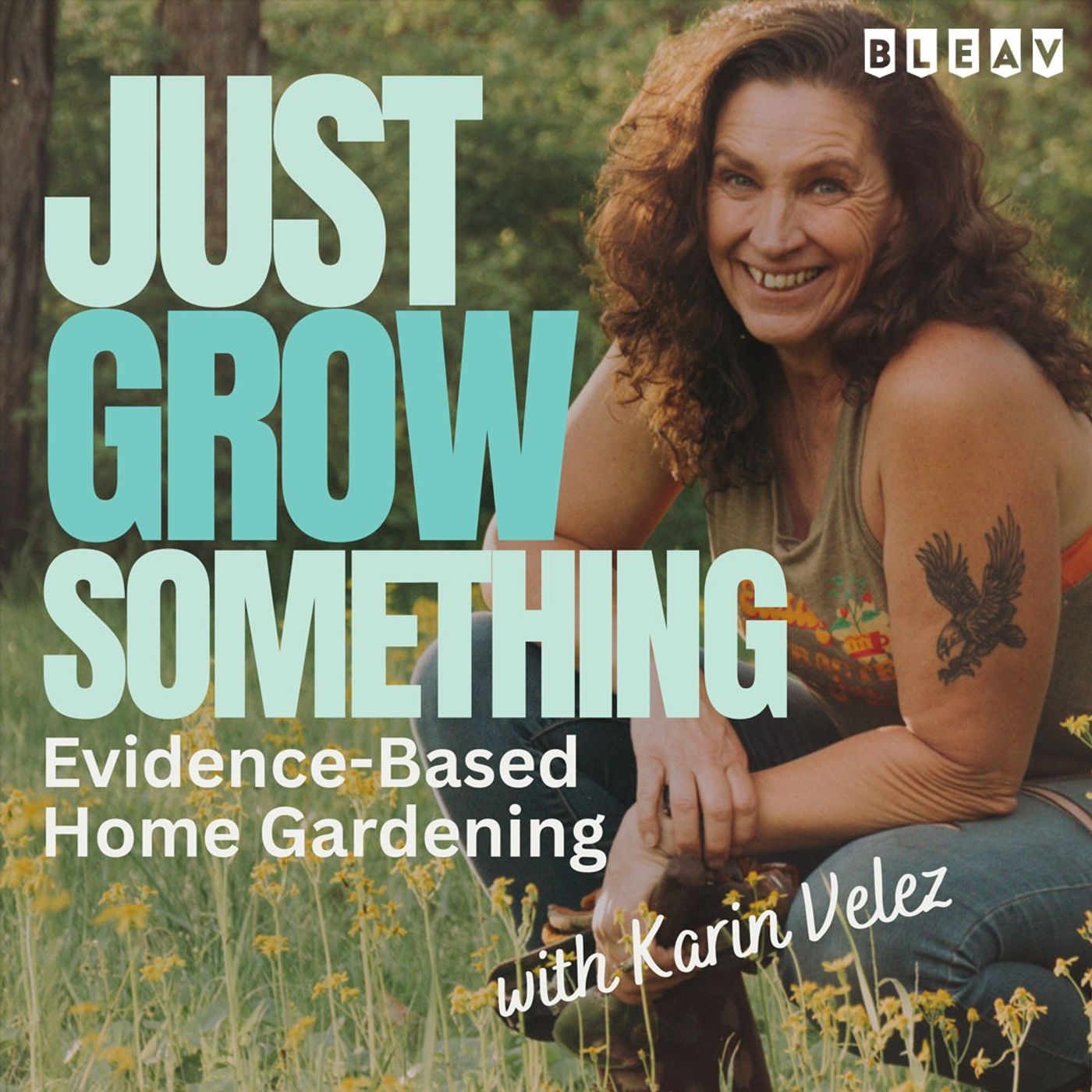
Just Grow Something | Evidence-Based Home Gardening
Karin VelezAudio
- Format:
- Podcast
- New episodes:
- Weekly
- Typical length:
- about 35 minutes
- Latest episode:
About this show
Grow a better vegetable garden, whether you're a seasoned gardener or have never grown a thing in your life. Karin helps home gardeners learn to grow their own food using evidence-based techniques and research. She talks all about specific plants, pests, diseases, soil and plant health, mulch, garden planning, and more. It's not just the "how" but also the "why" that makes us better. The goal? For everyone to know how to grow their own food no matter what sized space they have or their experience level.
Tune in each week to plan, learn, and grow with your friend in the garden, Karin Velez.
Covers: home gardening, vegetable gardening, soil health, garden pests, food preservation, seed saving, cover crops, native plants, weed control, garlic and onions
Show details and episodes come from the publisher's public feed at feeds.simplecast.com. Last updated . Names, artwork and text belong to their publishers.
Recently on this show
Summary of recent episodes, drawn from the publisher's feed.
Just Grow Something is a podcast where Karin Velez helps home gardeners produce their own food with research-backed methods. Recent episodes cover winter and garden pests, fall soil testing, perennial weeds, and preserving food without canning.
Cosmos
Similar in subject
- The Gardenangelists: Flowers, Veggies, and All the Best Dirt
Both cover: seed saving, native plants, vegetable gardening - The Beet: A Podcast For Plant Lovers
Both cover: food preservation, native plants, home gardening - MARGARET ROACH A WAY TO GARDEN
Both cover: seed saving, native plants, vegetable gardening
Similar shows




Episodes
Does a Cold Winter Kill Garden Pests? - Ep. 327
· 30 min
Every winter someone says it. We need a good hard freeze to kill off the bugs. And every mild winter, someone warns that we're in for a terrible bug year. In this episode I dig into what the research says about winter and garden pests. Most of the insects that bother our gardens are built for the winters where they live, and they spend those months tucked into soil, leaf litter, and plant debris where the air temperature barely reaches them. Snow keeps them even warmer. We'll talk about how insects survive the cold, why a snowless cold snap can do more damage than a snowy one, and what studies on ticks and Japanese beetle grubs found when researchers measured winter survival. Then we'll look at what a warm winter does change, from invasive pests creeping north to insects that wake up too early and starve. And we'll finish with what you can do this fall and next spring, zone by zone, that matters more than the weather forecast. Let's dig in! Get a quote for your personalized garden consultation: https://justgrowsomething.com/gardenconsulting Get your fair-trade, organic coffee and support the show at https://LarrysCoffee.com/JustGrow Reference and Resources - Bale, J. S., & Hayward, S. A. L. (2010). Insect overwintering in a changing climate. Journal of Experimental Biology 213(6): 980–994: https://doi.org/10.1242/jeb.037911 - University of Illinois Extension (Pankau) — Winter Impacts to Insects: https://extension.illinois.edu/blogs/garden-scoop/2018-01-24-winter-impacts-insects - University of Minnesota Extension (Schuh) — What does a wimpy winter mean for insects?: https://blog-fruit-vegetable-ipm.extension.umn.edu/2024/03/what-does-wimpy-winter-mean-for-insects.html - Lawton, D., Huseth, A. S., Kennedy, G. G., Morey, A. C., Hutchison, W. D., et al. (2022). Pest population dynamics are related to a continental overwintering gradient. Proceedings of the National Academy of Sciences 119(37): e2203230119: https://doi.org/10.1073/pnas.2203230119 - Iowa State University Extension and Outreach (Iles) — Will Mild Winter Mean More Insects Next Summer?: https://yardandgarden.extension.iastate.edu/article/2012/2-8/insectsurvival.html - University of Maryland Extension (Anderson, Xerces Society) — Leave the Leaves for Natural Pest Control: https://extension.umd.edu/resource/leave-leaves-natural-pest-control Just Grow Something: https://justgrowsomething.com Gardening Courses: https://justgrowsomething.com/courses Just Grow Something Merch and Downloads: https://justgrowsomething.com/shop Just Grow Something Gardening Friends Facebook Group: https://www.facebook.com/share/g/18YgHveF5P/ Check out how you can become a patron on Patreon: https://www.patreon.com/JustGrowSomething Feed my coffee habit: https://buymeacoffee.com/justgrowsomething Amazon storefront: https://www.amazon.com/shop/justgrowsomething Hosted by Simplecast, an AdsWizz company. See pcm.adswizz.com (https://pcm.adswizz.com) for information about our collection and use of personal data for advertising.
Not rated yetTest Before You Amend: Fall Soil Testing and What to Add Now - Ep. 326
· 38 min
Fall is the best time of year to test your garden soil, and the main reason is time. The amendments that fix pH work slowly, so a test this fall gives lime the months it needs to do its job before you plant next spring. But there's a twist most gardeners don't expect. When soil labs look at home garden samples, a huge share of them come back with too much phosphorus and potassium already, often from years of adding fertilizer, manure, and yes, compost. In this episode I walk you through why fall testing works so well, how to take a sample that tells you the truth, and whether a home test kit is good enough. Then we'll go line by line through a soil test report so you know what pH, buffer pH, phosphorus, potassium, and organic matter are telling you. And then we'll talk about what to add this fall, and what to skip, including lime, sulfur, wood ash, manure, gypsum, and coffee grounds, with adjustments for cold, moderate, and mild-winter climates. Let's dig in! Get a quote for your personalized garden consultation: https://justgrowsomething.com/gardenconsulting Get your fair-trade, organic coffee and support the show at https://LarrysCoffee.com/JustGrow My recommended at-home soil test kit: https://link.amazon/B0eUEdKgd - Penn State Extension (White) — Fall Is the Perfect Time for Soil Sampling: https://extension.psu.edu/fall-is-the-perfect-time-for-soil-sampling - University of Missouri IPM, Missouri Environment & Garden (Nathan) — Don't Guess — Test Your Soil: https://ipm.missouri.edu/MEG/2014/4/Do-Not-Guess-Test-Your-Soil/ - Faber, B. A., Downer, A. J., Holstege, D., & Mochizuki, M. J. (2007). Accuracy varies for commercially available soil test kits analyzing nitrate–nitrogen, phosphorus, potassium, and pH. HortTechnology 17(3): 358–362: https://oc4h.ucanr.edu/sites/default/files/2010-07/35923.pdf - University of Kentucky Cooperative Extension (Lee) — No P on my Lawn!: https://kers.ca.uky.edu/core/reports/Story/s/3900/2026 - University of Missouri Extension (Geist, quoting Trinklein) — Ashes to ashes: https://extension.missouri.edu/news/ashes-to-ashes - Iowa State University Extension and Outreach (Fillius, Rindels, & Steil) — Using Manure in the Home Garden: https://yardandgarden.extension.iastate.edu/how-to/using-manure-home-garden - Oregon State University Extension (Pokorny, with Brewer) — Coffee grounds boost soil health — and help control slugs: https://extension.oregonstate.edu/news/coffee-grounds-boost-soil-health-help-control-slugs Just Grow Something: https://justgrowsomething.com Gardening Courses: https://justgrowsomething.com/courses Just Grow Something Merch and Downloads: https://justgrowsomething.com/shop Just Grow Something Gardening Friends Facebook Group: https://www.facebook.com/share/g/18YgHveF5P/ Check out how you can become a patron on Patreon: https://www.patreon.com/JustGrowSomething (https://www.patreon.com/JustGrowSomething?fan_landing=true) Feed my coffee habit: https://buymeacoffee.com/justgrowsomething Amazon storefront: https://www.amazon.com/shop/justgrowsomething Newsletter link: https://dashboard.mailerlite.com/forms/757286/109572786559649154/share Hosted by Simplecast, an AdsWizz company. See pcm.adswizz.com (https://pcm.adswizz.com) for information about our collection and use of personal data for advertising.
Not rated yetAttacking Perennial Weeds in Fall: Find Them, Dig Them, Starve Them - Ep 325
· 33 min
Perennial weeds live in their roots, and fall is when those roots are filling up for winter. That's why you hear so much about fall being weed-killing season. But if you garden without herbicides, the real value of fall is a little different. It's the season to find these weeds while they're easy to see, dig the ones you can dig while the soil is soft, block the light on the ones you can't, and set yourself up to hit them next spring when their roots are at their weakest. In this episode I'm walking you through why perennial weeds keep coming back, and what the research says about the popular fixes, including vinegar sprays, cardboard and mulch, tilling, and counting on a hard freeze. Then I'll give you a fall and winter game plan that changes depending on whether your winters are frozen, moderate, or mild. And then we'll go weed by weed through bindweed, Canada thistle, Johnson grass and Bermuda grass, nutsedge, dandelions, and poison hemlock. Let's dig in! Get a quote for your personalized garden consultation: https://justgrowsomething.com/gardenconsulting Get your fair-trade, organic coffee and support the show at https://LarrysCoffee.com/JustGrow References and Resources - Nebraska Extension in Lancaster County (Browning) — Fall Weed Control (perennials move carbohydrates to roots in fall; fall control of annual weeds is unnecessary): https://lancaster.unl.edu/fall-weed-control - SARE (Mohler, Teasdale, & DiTommaso) — Manage Weeds On Your Farm: Canada Thistle (lowest root reserves at ~1-foot shoots and flower bud; 21-day weeding schedule; exhaust roots within two years; loose mulch ineffective, tough tarp effective; surface root fragments killed at 14–21°F; fall cover grains favor thistle): https://www.sare.org/publications/manage-weeds-on-your-farm/canada-thistle/ - SARE (Mohler, Teasdale, & DiTommaso) — Manage Weeds On Your Farm: Bindweeds (lowest reserves at 12–28-inch stems with 4–6 leaves; roots withstand 21°F; hedge bindweed through 18 inches of bark mulch; 2-inch root piece produced 25 shoots in four months and spread 9.4 feet in 15 months; forage soybean shade; fall-planted cover crops): https://www.sare.org/publications/manage-weeds-on-your-farm/bindweeds/ - SARE (Mohler, Teasdale, & DiTommaso) — Manage Weeds On Your Farm: Johnsongrass (lowest reserves 10–30 days after emergence at 6–12 inches; late-fall tillage won't prompt sprouting; rhizomes die below ~16°F daily minimum soil temperature; freeze-kill varies year to year; shattercane lacks rhizomes): https://www.sare.org/publications/manage-weeds-on-your-farm/johnson-grass/ - Oregon State University Extension, Ask Extension (Bubl) — Does vinegar help with controlling weeds? (contact action, perennials hardest to control; homemade vinegar–Epsom salt–soap test on Canada thistle): https://extension.oregonstate.edu/ask-extension/featured/does-vinegar-help-controlling-weeds - University of Maine Cooperative Extension (Lounsbury, Birthisel, Lilley, & Maher) — Bulletin #1075, Tarping in the Northeast: Types of Tarps and How They Work (annual weeds killed in under a week in summer, up to three weeks in cool seasons; perennials knocked back but not eliminated by under six weeks; nutsedge resistant; ~10% of farmers saw some weeds worsen; no regional research on long tarping and perennial bud banks): https://extension.umaine.edu/publications/1075e/types-of-tarps-and-how-they-work/ - Oregon State University Extension (Filley) — EM 9652, Tracking weeds is first step in controlling them (weed mapping, weed calendaring, identification through Extension): https://extension.oregonstate.edu/catalog/em-9652-tracking-weeds-first-step-controlling-them - Colorado State University Extension (Beck) — Canada Thistle (roots 15+ feet horizontal, 6–15 feet vertical; 0.25-inch root pieces regrow; shoots emerge ~15 days after tillage; pieces survive 100 days; fall flush; seedlings perennial at 7–8 weeks): https://extension.colostate.edu/resource/canada-thistle/ - Purdue…
Not rated yetHow to Attract Pollinators and Natural Pest Predators with Native Plants - Ep. 324
· 33 min
Fall is the best time of year to plant native perennials, and it's also the easiest. The seeds of most native wildflowers need a winter outside before they'll sprout, and plugs planted while the soil is still warm get a head start on roots before they go dormant. In this episode I'm walking you through why it's worth making room for natives at all, including what researchers are finding about the decline of butterflies, bumble bees, and the insects that birds depend on. Then we'll get into how fall and winter planting works, from dormant seeding after a few hard frosts to the six-week window for plugs, and how that changes if your winters are snowy, rainy, or barely there. After that we'll go plant by plant through milkweeds, coneflowers, black-eyed Susans, bergamot, asters, goldenrod, golden alexanders, and mountain mint, with whether each one is best started from seed, a plug, or either. We'll also talk about the plants that feed the lady beetles, lacewings, and tiny wasps that eat your garden pests. Let's dig in. Support the show at https://larryscoffee.com/justgrow and get a free gift! Work with me! Get a quote for your garden consultation at https://justgrowsomething.com/gardenconsulting References and Resources: - Edwards, C.B., Zipkin, E.F., Henry, E.H., et al. (2025). Rapid butterfly declines across the United States during the 21st century. Science 387(6738): 1090 (22% decline in butterfly abundance, 2000–2020, 554 species): https://doi.org/10.1126/science.adp4671 - USDA National Agroforestry Center (Vaughan & Black) — Agroforestry Note 34: Enhancing Nest Sites for Native Bee Crop Pollinators (4,000 native bee species, ~70% ground nesting, ~30% tunnel nesting, ~45 bumble bee species, overwintering and mowing timing): https://www.fs.usda.gov/nac/assets/documents/agroforestrynotes/an34g08.pdf - University of Delaware, UDaily — Biodiversity for the birds (summary of the chickadee study; oaks support 557 caterpillar species, ginkgo zero): https://www.udel.edu/udaily/2018/october/non-native-plants-birds-insects-washington-chickadee-desiree-narango-doug-tallamy/ - University of Illinois Extension — Plant native perennials in the fall for healthy spring growth (plugs six weeks before first frost, seed after first hard frost, watering, no fall fertilizer, mulch timing): https://extension.illinois.edu/news-releases/plant-native-perennials-fall-healthy-spring-growth - Utah Department of Agriculture and Food, Utah Pollinator Habitat Program — Native Seed Planting Guide (sow after several hard frosts, soil below 55°F, seeding before snow, 1:8 seed-to-sand mix, pressing seed, 3–4 years to establish): https://ag.utah.gov/wp-content/uploads/2023/09/Seed-Planting-Guide.pdf - Michigan State University Extension — Attracting Beneficial Insects with Native Flowering Plants, Bulletin E-2973 (seed flowers in 3–5 years vs. plugs in 1–2 years; nectar and pollen extend natural enemies' life span and egg laying): https://sanweb.lib.msu.edu/DMC/extension_publications/e2973/E2973-2007.PDF - Oklahoma State University Extension — Native Milkweed Germination Guide, HLA-6503 (30-day cold stratification for most milkweeds, 60–90 for some; 90% vs. under 1% germination for green antelopehorn): https://extension.okstate.edu/fact-sheets/native-milkweed-germination-guide - University of Wisconsin–Madison Extension — Butterfly Weed, Asclepias tuberosa (zones 3a–9b, deep taproot, fall sowing, 2–3 years to bloom from seed): https://hort.extension.wisc.edu/articles/butterflyweed-asclepias-tuberosa/ - University of Georgia, Odum School of Ecology — Tropical Milkweed and Parasite Infections in Resident Monarchs in the Southern U.S. (cut tropical milkweed to 6 inches monthly, October–February; replace with natives): https://ecology.uga.edu/wp-content/uploads/2018/08/monarch-factsheet-2018-1.pdf - USDA NRCS — Plant Guide: Eastern Purple Coneflower, Echinacea purpurea (germinates without cold; overwintered seed germinates rapidly; goldfinches and…
Not rated yetOverwintering Tender Garden Plants - Ep. 323
· 36 min
Every fall I look at my pepper plants loaded with fruit and my rosemary at its biggest, and I hate the idea of handing them over to the first hard freeze. The good news is you don't have to. Peppers, rosemary, and geraniums are all perennials somewhere in the world, and basil will keep going for a while on a windowsill if you start it right. But whether a plant makes it to spring gets decided mostly before it ever comes through the door. In this episode we're talking about which plants are worth the space, when to bring them in, and whether to keep them growing, put them to sleep, or just take cuttings. Then we'll get into my step-by-step for leaving aphids, spider mites, whiteflies, and fungus gnats outside, including why dish soap isn't the same as insecticidal soap and how long to keep new arrivals away from your houseplants. We'll finish with plant-by-plant care for peppers, rosemary, basil, and geraniums, plus a place where the experts don't agree. Let’s dig in. Get your fair-trade, organic coffee and support the show at https://LarrysCoffee.com/JustGrow Root Boost Rooting Hormone: https://amzn.to/4BeOCWX Pure Castile Soap for insecticidal soap: https://amzn.to/3U0HnBb References and Resources: Pests and Insecticidal Soap - Iowa State University Extension and Outreach, Yard and Garden — Can I Use Dish Soap Instead of Insecticidal Soap to Treat for Insect Pests? (detergent vs. true soap, phytotoxicity, contact-only action, reapplying): https://yardandgarden.extension.iastate.edu/faq/can-i-use-dish-soap-instead-insecticidal-soap-treat-insect-pests - University of Florida IFAS Gardening Solutions — Soaps, Detergents and Pest Management (don't treat drought-stressed plants or above 90°F): https://gardeningsolutions.ifas.ufl.edu/care/pests-and-diseases/pests/soaps-detergents-and-pest-management/ - Nebraska Extension in Lancaster County — Washing Pests Away, Sarah Browning (2–3 applications at 4–7 day intervals, testing a small area first): https://lancaster.unl.edu/washing-pests-away/ - University of Minnesota Extension — Houseplant Pests (spider mite white paper tap test, mealybugs, fungus gnat management): https://extension.umn.edu/news/houseplant-pests - Iowa State University Extension and Outreach, Yard and Garden — Spider Mites on Houseplants (dry winter air, stippling, webbing, rinsing in the shower): https://yardandgarden.extension.iastate.edu/article/2007/12-5/SpiderMites.html - Iowa State University Extension and Outreach, Yard and Garden — Fungus Gnats in Houseplants (overwatering, letting soil dry): https://yardandgarden.extension.iastate.edu/article/2023/02/fungus-gnats-houseplants Peppers - New Mexico State University, Southwest Yard & Garden — Chiles Can Be Grown Year-Round if They Are Brought Indoors (south window with about 4 hours of sun, nights around 50°F, underwatering losses, monthly fertilizer): https://swyg.nmsu.edu/2014/101814.html - New Mexico State University, Southwest Yard & Garden — Chiles for New Mexico Holiday Houseplants (chiles as frost-tender perennials): https://swyg.nmsu.edu/2007/110307.html - Ask Extension — Overwintering Peppers (nights above 50°F, days around 70°F, artificial light for fruiting; hot peppers more resilient; dormancy option): https://ask.extension.org/kb/faq.php?id=855650 Rosemary - University of Illinois Extension, The Garden Scoop — Rosemary, Ryan Pankau (50–60°F indoors, very bright light, hardiness zone 7, 'Arp' and 'Hill Hardy' to zone 6, outdoor protection): https://extension.illinois.edu/blogs/garden-scoop/2018-10-18-rosemary - Nebraska Extension in Lancaster County — Rosemary, An Herb for All Seasons, Sarah Browning (zones 7–10, 50–55°F indoors, watering): https://lancaster.unl.edu/rosemary-herb-all-seasons - University of Arkansas Cooperative Extension — Rosemary, Janet B. Carson (overwatering as the biggest indoor risk, coolest sunny room, holiday topiaries): https://www.uaex.uada.edu/yard-garden/home-landscape/adgrosemaryjan2018.pdf -…
Not rated yetSeed Saving: Harvesting, Drying and Storing for Next Season - Ep. 322
· 43 min
Every fall somebody asks me if they can save the seeds from that amazing tomato or melon they just ate, and the answer is "maybe." Whether a saved seed grows into the plant you loved gets decided twice. The first time is months earlier, when the flower was pollinated, and the second is after harvest, when the seed either stays in the right conditions or doesn't. In this episode we're covering both. We'll talk about hybrids versus open-pollinated and heirloom varieties, which crops are easiest for beginners, why your zucchini and your pumpkin can cross but your cucumber and your cantaloupe can't, and why peppers cross more often than most people think. Then we'll get into harvesting and cleaning seeds, including what tomato seed fermentation does and doesn't do for seedborne disease, how to dry seeds without cooking them, the simple temperature-plus-humidity rule for storage, and why seed longevity charts don't agree with each other. Let’s dig in. Get your free gift, great coffee, and support the show at https://larryscoffee.com/justgrow Tell me about your garden goals and challenges, get a quote, and get on my calendar: https://JustGrowSomething.com/gardenconsulting Six Steps for Saving Seeds From Your Garden: https://justgrowsomethingpodcast.com/blog/six-steps-for-saving-seeds-from-your-garden References and Resources Choosing Crops, Pollination, and Isolation - University of Minnesota Extension — Saving Vegetable Seeds (open-pollinated vs. hybrid, cross-pollination, harvesting, storage, bacterial canker and seed treatments): https://extension.umn.edu/planting-and-growing-guides/saving-vegetable-seeds - University of Illinois Extension — How to Save Seeds (terms, isolation methods, isolation distance table, wet and dry harvesting): https://extension.illinois.edu/sites/default/files/how_to_save_seeds_062021.pdf - University of Maryland Extension — Seed Saving 101: Vegetables (three levels of seed saving, tomato and potato-leaf isolation, pepper species crossing, squash after-ripening, storage rule of thumb): https://extension.umd.edu/sites/extension.umd.edu/files/2021-02/Seed%20Saving%20Veggies%20Resources.pdf - UC Agriculture and Natural Resources, Orange County 4-H — Saving Seed from the Three Sisters and Tomatoes (population sizes for home gardens): https://oc4h.ucanr.edu/sites/default/files/2016-09/248080.pdf - NC State Extension, Onslow County — Saving Your Own Seed (hot and sweet pepper crossing): https://onslow.ces.ncsu.edu/2023/01/saving-your-own-seed/ - Barchenger, D.W., et al. (2025). Producing High Quality Pepper Seed. World Vegetable Center, Publication No. 25-1099 (pepper outcrossing rates, bee visitation, seed moisture): https://worldveg.tind.io/record/76153/files/25-1099_Producing%20high%20quality%20pepper%20seed.pdf Harvesting, Cleaning, and Seedborne Disease - Oregon State University Extension — Collecting and Storing Seeds From Your Garden (crop-by-crop harvesting, hand-pollinating squash, bean weevils, longevity groups, germination testing): https://extension.oregonstate.edu/gardening/techniques/collecting-storing-seeds-your-garden - Pradhanang, P.M., & Collier, G. (2009). How effective is hydrochloric acid treatment to control Clavibacter michiganensis michiganensis contamination in tomato seed? Acta Horticulturae 808: 81–86 (overnight fermentation vs. washing): https://doi.org/10.17660/ActaHortic.2009.808.10 Drying, Storage, and Longevity - Colorado State University Extension — Storing Vegetable and Flower Seeds, Fact Sheet 7.221 (drying temperatures, seed moisture, humidity, hard seed, federal minimum germination and longevity table): https://extension.colostate.edu/resource/storing-vegetable-and-flower-seeds/ - University of Delaware Cooperative Extension, Weekly Crop Update — Storing Vegetable Seed (temperature-plus-humidity rule, storage life halving rules, freezing seed): https://sites.udel.edu/weeklycropupdate/?p=2967 Hosted by Simplecast, an AdsWizz company. See pcm.adswizz.com…
Not rated yetPreserving Without Canning - Ep. 321
· 42 min
Canning gets most of the attention, but for a lot of what comes out of the garden, it isn't the best way to put food up. In this episode, we're opening up the rest of the preserving toolbox: freezing, drying, fermenting, refrigerator pickles, and good old-fashioned cold storage. We'll talk about why skipping the blanch (or cutting it short) costs you flavor and color in the freezer, which vegetables you can freeze raw, and why a full freezer rides out a power outage twice as long as a half-empty one. Then we'll get into drying in a humid climate, why vegetables need a blanch before the dehydrator, and what the research does and doesn't say about home freeze dryers. We'll make a simple, safe batch of sauerkraut, cover the one rule for fridge pickles, and wrap up with the temperature and humidity each storage crop wants, from potatoes and onions to carrots, sweet potatoes, and apples. There's a crop-by-crop quick-reference chart to download, and a fantastic fermenting book to check out. Let’s dig in! References and Resources: Larry's Coffee (affiliate): https://LarrysCoffee.com/JustGrow Download the preserving guide: https://justgrowsomethingpodcast.com/preserve Fermented Vegetables by Kristen and Christopher Shockey: https://amzn.to/4zjI2g4 Freezing - National Center for Home Food Preservation — Blanching Vegetables: https://nchfp.uga.edu/how/freeze/freeze-general-information/blanching-vegetables/ - National Center for Home Food Preservation — Freezing Tomatoes: https://nchfp.uga.edu/how/freeze/vegetable/freezing-tomatoes/ - National Center for Home Food Preservation — Freezing Onions: https://nchfp.uga.edu/how/freeze/vegetable/freezing-onions/ - National Center for Home Food Preservation — Freezing Bell or Sweet Peppers: https://nchfp.uga.edu/how/freeze/vegetable/freezing-bell-or-sweet-peppers/ - National Center for Home Food Preservation — Freezing Hot Peppers: https://nchfp.uga.edu/how/freeze/vegetable/freezing-hot-peppers/ - National Center for Home Food Preservation — Foods That Do Not Freeze Well: https://nchfp.uga.edu/how/freeze/freeze-general-information/foods-that-do-not-freeze-well/ - North Dakota State University Extension — Freezing Vegetables (blanching times, freezer loading, storage time): https://www.ndsu.edu/agriculture/extension/publications/freezing-vegetables - University of Minnesota Extension — How to Freeze Fruit Safely: https://extension.umn.edu/food/preparing/cooking-at-home/food-preservation/freezing/freezing-fruit - NC State Extension, Guilford County — Put a Freeze on Foodborne Illness: https://guilford.ces.ncsu.edu/2020/10/put-a-freeze-on-foodborne-illness - University of Illinois Extension — Power Outages: https://extension.illinois.edu/food-safety/power-outages - Li, L., Pegg, R. B., Eitenmiller, R. R., Chun, J. Y., & Kerrihard, A. (2017). Selected nutrient analyses of fresh, fresh-stored, and frozen fruits and vegetables. Journal of Food Composition and Analysis: https://doi.org/10.1016/j.jfca.2017.02.002 Drying and Freeze-Drying - National Center for Home Food Preservation — Food Dehydrators: https://nchfp.uga.edu/how/dry/drying-general/food-dehydrators/ - National Center for Home Food Preservation — Sun Drying: https://nchfp.uga.edu/how/dry/drying-general/sun-drying/ - National Center for Home Food Preservation — Packaging and Storing Dried Foods: https://nchfp.uga.edu/how/dry/drying-general/packaging-and-storing-dried-foods/ - Penn State Extension — Let's Preserve: Drying Fruits and Vegetables (Dehydration): https://extension.psu.edu/lets-preserve-drying-fruits-and-vegetables-dehydration - Colorado State University Extension — Drying Vegetables, Fact Sheet 9.308: https://extension.colostate.edu/resource/drying-vegetables/ - University of Minnesota Extension — Preserving Herbs by Freezing or Drying: https://extension.umn.edu/preserving-and-preparing/preserving-herbs-freezing-or-drying - South Dakota State University Extension — Preserving Herbs:…
Not rated yetHome Canning Myths Debunked - Ep. 320
· 34 min
A jar that seals is a jar that seals, and that's about all it tells you. In this episode, we're taking on four home canning myths that keep circulating in gardening groups, on food blogs, and in family recipe boxes: oven canning, open-kettle canning (and its cousin, flipping jars upside down), packing tomatoes and garlic in oil, and the idea that a salsa recipe can be tweaked however you like as long as it tastes right. For each one, we'll look at what the research from the National Center for Home Food Preservation and university extension services shows, why these methods fail, and what to do instead so your harvest stays on the pantry shelf and out of the danger zone. We'll also look at a study that checked 56 salsa canning recipes from food blogs, and what it found might make you rethink where your recipes come from. Let's dig in! Support the show and get your free gift at https://LarrysCoffee.com/JustGrow References and Resources: - National Center for Home Food Preservation — Ensuring Safe Canned Foods: https://nchfp.uga.edu/how/can/general-information/ensuring-safe-canned-foods/ - National Center for Home Food Preservation — Equipment and Methods Not Recommended: https://nchfp.uga.edu/how/can/general-information/equipment-and-methods-not-recommended/ - National Center for Home Food Preservation — General Information (includes the 1943 history on oven and open-kettle canning): https://nchfp.uga.edu/how/can/general-information/ - National Center for Home Food Preservation — Identifying and Handling Spoiled Canned Food: https://nchfp.uga.edu/how/can/general-information/identifying-and-handling-spoiled-canned-food/ - National Center for Home Food Preservation — Tomato Acidification Directions: https://nchfp.uga.edu/how/can/how-do-i-can-tomatoes/tomato-acidification-directions/ - National Center for Home Food Preservation — Freezing Garlic-in-Oil: https://nchfp.uga.edu/how/freeze/vegetable/freezing-garlic-in-oil/ - National Center for Home Food Preservation — Burning Issue: Can I Can My Own Salsa Recipe? (PDF): https://boone.mgcafe.uky.edu/files/nchfp_burning_issue_can_i_can_my_own_salsa_recipe.pdf - D'Sa et al. (2007), Survey of Home Canning Practices and Safety Issues in the U.S.: https://nchfp.uga.edu/papers/2007/canning_survey.html - Nummer et al. (2004), Studies on Safe Acidification of Salsa for Home Boiling Water Canning: https://nchfp.uga.edu/papers/2004/04ift-tomatosalsaPoster_combined.html - Nummer et al. (2011), Current Food Safety Issues of Home-Prepared Vegetables and Herbs Stored in Oil, Food Protection Trends (PDF): https://www.foodprotection.org/files/food-protection-trends/Jun-11-Nummer.pdf - Savoie & Perry (2019), Adherence of Food Blog Salsa Recipes to Home Canning Guidelines, Food Protection Trends: https://www.foodprotection.org/publications/food-protection-trends/archive/2019-09-adherence-of-food-blog-salsa-recipes-to-home-canning-guidelines/ - University of Maine Cooperative Extension — The Missing Ingredient: Food Blog Salsa Recipes: https://extension.umaine.edu/food-health/2023/07/20/the-missing-ingredient-adherence-of-food-blog-salsa-recipes-to-home-canning-guidelines/ - Penn State Extension — Say No to Oven Canning: https://extension.psu.edu/say-no-to-oven-canning - Penn State Extension — Avoid Open Kettle Canning: Always Process Canned Goods: https://extension.psu.edu/avoid-open-kettle-canning-always-process-canned-goods - Penn State Extension — Caution: Canning with Fats and Oils: https://extension.psu.edu/caution-canning-with-fats-and-oils - Oregon State University Extension Service — Herbs and Vegetables in Oil, SP 50-701: https://extension.oregonstate.edu/catalog/pub/sp-50-701-herbs-vegetables-oil - Oregon State University Extension Service — Preserving Garlic: https://extension.oregonstate.edu/food/preservation/preserving-garlic - UC Agriculture and Natural Resources — Garlic: Safe Methods to Store, Preserve, and Enjoy, Pub. 8568 (PDF):…
Not rated yetEnd-of-Season Tomato Rescue: Ripening, Freezing, and Preserving - Ep. 319
· 30 min
Frost is on the way, and the vines are still loaded with green tomatoes. In this episode, we sort out which green tomatoes will finish ripening on your counter (the mature greens and the blushers) and which ones belong in the skillet, the freezer, or a tested relish recipe. You'll learn what cold does to a tomato, why a stretch of chilly weather can cost you ripening ability before frost ever shows up, and four ways to ripen fruit indoors, including how to stage a harvest for a steady supply into November. Then we dig into the canning rule that catches a lot of gardeners off guard. National home-canning guidance says not to can tomatoes from dead or frost-killed vines, and we look at why, what the research does and doesn't show, and what to do with those tomatoes instead. Grab a notebook and let’s dig in! Resources and References: Grab your bag of Larry's Coffee, support the show, and get a free gift! https://larryscoffee.com/justgrow - Colorado State University Extension — Ripening Tomatoes Indoors: https://extension.colostate.edu/resource/ripening-tomatoes-indoors/ - University of California, Davis, Postharvest Research and Extension Center (Suslow and Cantwell) — Tomato: Recommendations for Maintaining Postharvest Quality: https://postharvest.ucdavis.edu/produce-facts-sheets/tomato - Iowa State University Extension and Outreach — Can I ripen green tomatoes indoors before frost?: https://yardandgarden.extension.iastate.edu/faq/can-i-ripen-green-tomatoes-indoors-frost - National Center for Home Food Preservation (University of Georgia) — Canning Tomatoes: Introduction: https://nchfp.uga.edu/how/can/how-do-i-can-tomatoes/canning-tomatoes-introduction/ - National Center for Home Food Preservation — Resources for Home Preserving Tomatoes: https://nchfp.uga.edu/resources/entry/resources-for-home-preserving-tomatoes - USDA Complete Guide to Home Canning, Guide 3 (electronic version by Utah State University Extension, 1995) — Selecting, Preparing, and Canning Tomatoes and Tomato Products: https://digitalcommons.usu.edu/cgi/viewcontent.cgi?article=1600&context=extension_histall - National Center for Home Food Preservation — Freezing Tomatoes: https://nchfp.uga.edu/how/freeze/vegetable/freezing-tomatoes/ - National Center for Home Food Preservation — Freezing Green Tomatoes: https://nchfp.uga.edu/how/freeze/vegetable/freezing-green-tomatoes/ Just Grow Something: https://justgrowsomething.com Gardening Courses: https://justgrowsomething.com/courses Just Grow Something Merch and Downloads: https://justgrowsomething.com/shop Just Grow Something Gardening Friends Facebook Group: https://www.facebook.com/share/g/18YgHveF5P/ Check out how you can become a patron on Patreon: https://www.patreon.com/JustGrowSomething (https://www.patreon.com/JustGrowSomething?fan_landing=true) Feed my coffee habit: https://buymeacoffee.com/justgrowsomething Amazon storefront: https://www.amazon.com/shop/justgrowsomething Hosted by Simplecast, an AdsWizz company. See pcm.adswizz.com (https://pcm.adswizz.com) for information about our collection and use of personal data for advertising.
Not rated yetCover Crops in the Home Garden - Ep. 318
· 36 min
Every empty bed in your garden is either growing something for you or growing weeds and losing topsoil. Cover crops are how you make sure it's the first one. In this episode, we get into why cover crops work in both in-ground beds and raised planters, which ones perform best when you sow them in fall, and which ones are worth a spot in your rotation come spring. We'll look at nitrogen-fixing legumes like crimson clover and hairy vetch, soil-building grasses like winter rye and oats, and fast-growing summer options like buckwheat that can turn a bare bed around in a matter of weeks. Then we'll cover how to actually terminate a cover crop, whether that's mowing, crimping, tarping, or letting winter do the work for you, so it feeds your soil instead of becoming a weed problem of its own. Let's dig in! References and Resources: Get your sustainably grown coffee and support the show at LarrysCoffee.com/JustGrow (https://larryscoffee.com/justgrow)! - University of Maryland Extension — Cover Crops For Gardens: umd.edu/resource/cover-crops-gardens (https://extension.umd.edu/resource/cover-crops-gardens) - University of Maryland Extension — Offing Cover Crops for Weed Suppression: Featuring the Roller Crimper and Other Mechanical Contraptions: umd.edu/resource/offing-cover-crops-weed-suppression (https://extension.umd.edu/resource/offing-cover-crops-weed-suppression-featuring-roller-crimper-and-other-mechanical-contraptions) - University of New Hampshire Extension — Cover Cropping for the Home Garden [fact sheet]: unh.edu/resource/cover-cropping-home-garden-fact-sheet (https://extension.unh.edu/resource/cover-cropping-home-garden-fact-sheet) - University of Missouri Integrated Pest Management, Missouri Environment & Garden — Cover Crops Improve Garden Soil: missouri.edu/meg/2014/9/Cover-Crops-Improve-Garden-Soil (https://ipm.missouri.edu/meg/2014/9/Cover-Crops-Improve-Garden-Soil/) - Oregon State University Extension — Buckwheat Makes a Good Summer Cover Crop for Gardens: oregonstate.edu/news/buckwheat-makes-good-summer-cover-crop-gardens (https://extension.oregonstate.edu/news/buckwheat-makes-good-summer-cover-crop-gardens) - Cornell Cooperative Extension Vegetable Program, Cover Crop Guide for NY Growers — Buckwheat as a Summer Cover Crop for Weed Suppression: org/blog/buckwheat-as-a-summer-cover-crop-for-weed-suppression (https://covercrop.org/blog/buckwheat-as-a-summer-cover-crop-for-weed-suppression/) - UF/IFAS Extension Duval County — Cover Crop Termination: What Do I Do When It's Over?: ifas.ufl.edu/duvalco/2025/09/15/cover-crop-termination-what-do-i-do-when-its-over (https://blogs.ifas.ufl.edu/duvalco/2025/09/15/cover-crop-termination-what-do-i-do-when-its-over/) - Purdue University Center for New Crops and Plants Products — Hairy Vetch: purdue.edu/newcrop/afcm/vetch.html (https://hort.purdue.edu/newcrop/afcm/vetch.html) - USDA Agricultural Research Service — Crimson Clover Cover Crop Fact Sheet (PDF): usda.gov/ARSUserFiles/60100500/FactSheets/FS04e.pdf (https://www.ars.usda.gov/ARSUserFiles/60100500/FactSheets/FS04e.pdf) Just Grow Something: https://justgrowsomething.com Gardening Courses: https://justgrowsomething.com/courses Just Grow Something Merch and Downloads: https://justgrowsomething.com/shop Just Grow Something Gardening Friends Facebook Group: https://www.facebook.com/share/g/18YgHveF5P/ Check out how you can become a patron on Patreon: https://www.patreon.com/JustGrowSomething (https://www.patreon.com/JustGrowSomething?fan_landing=true) Feed my coffee habit: https://buymeacoffee.com/justgrowsomething Amazon storefront: https://www.amazon.com/shop/justgrowsomething Hosted by Simplecast, an AdsWizz company. See pcm.adswizz.com (https://pcm.adswizz.com) for information about our collection and use of personal data for advertising.
Not rated yetFall-Planted vs. Spring-Planted Onions: Choosing the Right System for Your Garden - Ep. 317
· 34 min
Onions are having a moment in the seed catalogs right now, and a lot of that buzz is about overwintering them, tucking small transplants into the bed in September, letting them sit through the cold, and pulling bigger, earlier bulbs the following June. It sounds like a clear win. But the biology underneath it is more particular than the marketing lets on, and the trade-offs are real. In this episode, I'm breaking down the day-length science that controls when an onion decides to bulb, the separate cold-exposure trigger that can send it to flower instead, and why those two mechanisms together explain both the promise and the risk of overwintering. I'll walk through the specific varieties that university research has found reliable for this system versus the ones that bolted their way out of a harvest, and I'll lay out the honest cost side of the ledger: a bed occupied for the better part of a year, a real chance of premature flowering if timing or variety selection is off, and whether any of that beats simply direct-seeding or transplanting in spring. Whether you've got seed garlic already planned for a bed and you're eyeing the space next to it for onions, or you're just trying to figure out which system fits your garden, this episode will give you the research to make that call yourself. Let’s dig in. References and Resources: Short Day Onions • Latitude: ~25°–35° N • Daylength trigger: 10–12 hours • Climate: Mild winters (USDA Zone 7+), These are generally planted in fall, mature in late spring. Intermediate Day Onions • Latitude: ~32°–42° N • Daylength trigger: 12–14 hours • Climate: Central U.S. conditions; planted in spring (or early spring in cooler areas) Long Day Onions • Latitude: ~37°–47° N • Daylength trigger: 14–16 hours • Climate: Northern latitudes; often sweet, specialty, or long storage types. Planted in fall or spring depending on climate Get your free fair-trade gift and support the show at https://LarrysCoffee.com/JustGrow Episode 296 — Successions: Never an Empty Bed: https://justgrowsomethingpodcast.com/episode/succession-planting-101-how-to-keep-your-garden-producing-from-spring-through-frost-ep-296 - Oregon State University Extension — Winter Vegetable Production on Small Farms and Gardens West of the Cascades (PNW 548): oregonstate.edu/catalog/pnw-548-winter-vegetable-production-small-farms-gardens-west-cascades (https://extension.oregonstate.edu/catalog/pnw-548-winter-vegetable-production-small-farms-gardens-west-cascades) - University of New Hampshire Extension / NH Agricultural Experiment Station — Research Report: Overwintering Onions, 2014–15 (Becky Sideman et al.): unh.edu/resources/files/Resource005477_Rep7652.pdf (https://extension.unh.edu/resources/files/Resource005477_Rep7652.pdf) - Iowa State University Extension and Outreach — What Is a Long-Day Type Onion Variety?: extension.iastate.edu/faq/what-long-day-type-onion-variety (https://yardandgarden.extension.iastate.edu/faq/what-long-day-type-onion-variety) - University of Minnesota Extension — Growing Onions in Home Gardens: umn.edu/vegetables/growing-onions (https://extension.umn.edu/vegetables/growing-onions) - NC State Extension Publications — Bulb Onions: ces.ncsu.edu/bulb-onions (https://content.ces.ncsu.edu/bulb-onions) - University of Missouri Extension — Planting, Growing and Harvesting Onions: missouri.edu/news/planting-growing-and-harvesting-onions (https://extension.missouri.edu/news/planting-growing-and-harvesting-onions) - Clemson Cooperative Extension, Home & Garden Information Center — Onion, Leek, Shallot & Garlic: clemson.edu/factsheet/onion-leek-shallot-garlic (https://hgic.clemson.edu/factsheet/onion-leek-shallot-garlic) - Oregon State University Extension — Plant Onions Early for Bigger Summer Bulbs: oregonstate.edu/news/plant-onions-early-bigger-summer-bulbs (https://extension.oregonstate.edu/news/plant-onions-early-bigger-summer-bulbs) Just Grow Something: https://justgrowsomething.com…
Not rated yetChoosing a Garlic Variety Based on the Science - Ep. 316
· 38 min
It's the middle of summer, and I want you thinking about garlic. Not because it's time to plant, but because if you wait until it's time to plant, the good seed garlic may already be gone! In this episode, I'm breaking down the real difference between hardneck and softneck garlic: the cold-exposure requirement called vernalization that decides which type will bulb properly in your garden, how clove structure and storage life differ between the two, and how to match your choice to your specific climate. I'll also cover why garlic bought at the grocery store is a gamble, what certified disease-free seed garlic protects you from, how much seed to order for the bed you're planting, and exactly what to do in your garden bed this month to set yourself up for a strong harvest next summer. Whether you've grown garlic for years or you're planting your first clove this fall, this episode will get your ordering and your bed prep sorted before the window closes. Let’s dig in! Episode References: - Episode 302 — Mulch Matchmaking (winter mulch materials and application for newly planted garlic beds): https://justgrowsomethingpodcast.com/episode/mulch-matchmaking-choosing-the-right-mulch-for-your-vegetable-garden-ep-302 - All the garlic episodes: https://justgrowsomethingpodcast.com/search/garlic Resources: - University of Georgia Cooperative Extension — Garlic Production for the Gardener (Circular 854): caes.uga.edu/publications/C854/garlic-production-for-the-gardener (https://fieldreport.caes.uga.edu/publications/C854/garlic-production-for-the-gardener) - University of Minnesota Extension — Growing Garlic in Home Gardens: umn.edu/vegetables/growing-garlic (https://extension.umn.edu/vegetables/growing-garlic) - University of Missouri Extension — Fall Is a Good Time to Plant Garlic: missouri.edu/news/fall-is-a-good-time-to-plant-garlic (https://extension.missouri.edu/news/fall-is-a-good-time-to-plant-garlic) - Lincoln University of Missouri Cooperative Extension — Garlic Production in Missouri: edu/publications/garlic-production-in-missouri.html (https://lincolnu.edu/publications/garlic-production-in-missouri.html) - Utah State University Extension — How to Grow Garlic in Your Garden: usu.edu/yardandgarden/research/garlic-in-the-garden (https://extension.usu.edu/yardandgarden/research/garlic-in-the-garden) - Oregon State University Extension — Get Your Garlic On: A Primer on Planting, Growing and Harvesting: oregonstate.edu/news/get-your-garlic-primer-planting-growing-harvesting (https://extension.oregonstate.edu/news/get-your-garlic-primer-planting-growing-harvesting) - Cornell Cooperative Extension, Warren County — Garlic: cce.cornell.edu/gardening-landscape/warren-county-master-gardener-articles/garlic (https://warren.cce.cornell.edu/gardening-landscape/warren-county-master-gardener-articles/garlic) - Penn State Extension — Garlic Production: psu.edu/garlic-production (https://extension.psu.edu/garlic-production) - University of California Agriculture and Natural Resources (Contra Costa Master Gardeners) — Garlic, Love It or Leave It: edu/blog/hort-coco-uc-master-gardener-program-contra-costa/article/garlic-love-it-or-leave-it (https://ucanr.edu/blog/hort-coco-uc-master-gardener-program-contra-costa/article/garlic-love-it-or-leave-it) Just Grow Something:https://justgrowsomething.com Gardening Courses: https://justgrowsomething.com/courses Just Grow Something Merch and Downloads: https://justgrowsomething.com/shop Just Grow Something Gardening Friends Facebook Group: https://www.facebook.com/share/g/18YgHveF5P/ Check out how you can become a patron on Patreon: https://www.patreon.com/JustGrowSomething Feed my coffee habit: https://buymeacoffee.com/justgrowsomething Amazon storefront: https://www.amazon.com/shop/justgrowsomething Hosted by Simplecast, an AdsWizz company. See pcm.adswizz.com (https://pcm.adswizz.com) for information about our collection and use of personal data for advertising.
Not rated yetHow to Know When Winter Squash is Ready to Harvest (and How to Store Them) - Ep. 315
· 26 min
Winter squash gives you almost no obvious warning before it's ready, and pulling it too early is one of the most common mistakes gardeners make. And that mistake costs you flavor, sugar content, and months of storage life. In this episode, we're breaking down exactly how to read maturity on butternut, acorn, spaghetti, delicata, and storage pumpkins: the rind test, the ground spot, and the specific cues for each type. Then we'll cover what to do with a squash patch when frost is bearing down on you, why curing helps some squash and actively ruins others, and how to set up a storage space that gets you squash on your table well into the new year instead of watching half your harvest go soft by Thanksgiving. Get your fair-trade, organic, sustainably harvested coffees and support the show at https://larryscoffee.com/justgrow Got my newsletter: JustGrowSomething.com (https://dashboard.mailerlite.com/forms/757286/109572786559649154/share) References: University of Missouri IPM — Pumpkin Picking Time: ipm.missouri.edu/meg/2022/10/pumpkins-DT/ South Dakota State University Extension — Time to Harvest Those Winter Squash: extension.sdstate.edu/time-harvest-those-winter-squash South Dakota State University Extension — Harvesting and Storing Pumpkins and Winter Squash: extension.sdstate.edu/harvesting-and-storing-pumpkins-and-winter-squash South Dakota State University Extension — Fall Frost Tolerance of Common Vegetables: extension.sdstate.edu/fall-frost-tolerance-common-vegetables Iowa State University Extension — Yard and Garden: Winter Squash: extension.iastate.edu/news/yard-and-garden-winter-squash Purdue University Vegetable Crops Hotline — Harvest and Postharvest Storage of Pumpkins and Winter Squash: vegcropshotline.org/article/harvest-and-postharvest-storage-of-pumpkins-and-winter-squash-2/ Purdue Extension FoodLink — Winter Squash: extension.purdue.edu/foodlink/includes/pubs/Print4perpaper/4VegetablesPrint/4WINTER_SQUASH2print.pdf Oregon State University Extension Service — Preserving Pumpkins and Winter Squash: extension.oregonstate.edu/catalog/sp-50-767-preserving-pumpkins-winter-squash Michigan State University Extension — Pumpkins, Squash, Gourds: canr.msu.edu/resources/pumpkins_squash_gourds_commercial_vegetable_recommendations_e1953 University of Illinois Extension — Winter Squash (Home Vegetable Gardening): extension.illinois.edu/gardening/winter-squash University of Minnesota Extension — Harvesting and Storing Melons, Squash and Pumpkins: extension.umn.edu/agriculture/specialty-crops/commercial-fruit-production/harvesting-and-storing-melons-squash-and-pumpkins Cornell Cooperative Extension Regional Vegetable Program — Winter Squash and Pumpkin Maturity, Harvesting and Storage Tips: rvpadmin.cce.cornell.edu/uploads/doc_1144.pdf UC Master Gardener Program of Contra Costa (UC ANR) — Harvesting and Storing Winter Squash and Pumpkins: ucanr.edu/blog/hort-coco-uc-master-gardener-program-contra-costa/article/harvesting-and-storing-winter-squash Maine Organic Farmers and Gardeners Association — Harvesting Winter Squash for Peak Flavor and Optimal Storage Life: mofga.org/resources/crops/harvesting-winter-squash-for-flavor-and-storage/ Resources: Just Grow Something: https://justgrowsomething.com Gardening Courses: https://justgrowsomething.com/courses Just Grow Something Merch and Downloads: https://justgrowsomething.com/shop Just Grow Something Gardening Friends Facebook Group: https://www.facebook.com/share/g/18YgHveF5P/ Check out how you can become a patron on Patreon: https://www.patreon.com/JustGrowSomething (https://www.patreon.com/JustGrowSomething?fan_landing=true) Feed my coffee habit: https://buymeacoffee.com/justgrowsomething Amazon storefront: https://www.amazon.com/shop/justgrowsomething Hosted by Simplecast, an AdsWizz company. See pcm.adswizz.com (https://pcm.adswizz.com) for information about our collection and use of personal data for advertising.
Not rated yetWho's Eating My Garden? Identifying and Deterring Common Backyard Wildlife - Ep. 314
· 30 min
Something has been eating your tomatoes, mowing your green beans down to nubs overnight, or turning your flower bed into a construction site, and you want to know who's responsible and what will make them stop. In this episode, we're working through the full lineup of backyard garden critters, starting with the animals most home gardeners deal with every season: squirrels, chipmunks, rabbits, deer, and raccoons. Then we're digging into two animals that caused real trouble this year: groundhogs, which mowed down entire rows in my own garden, and armadillos, a first-time visitor here on the farm. For each one, we'll cover how to identify their particular style of damage, what university research shows works to deter them, and where fencing, repellents, and scare tactics fall short. Whether you're dealing with a woodchuck built like a small, determined bulldozer, or an armadillo rototilling your flower bed at two in the morning, you'll walk away with a real plan instead of another myth to try. Let's dig in! Get your organic, fair-trade coffee with free gift at LarrysCoffee.com/JustGrow (https://larryscoffee.com/JustGrow). No code needed! Save 10% and get free shipping on my favorite raised planters at PlanterBoxDirect.com (https://planterboxdirect.com) with code JUSTGROW. References and Resources Squirrels - University of Missouri Extension — Tree Squirrels: Managing Habitat and Controlling Damage (G9455): extension.missouri.edu/publications/g9455 Chipmunks - Penn State Extension — Chipmunks: extension.psu.edu/chipmunks - University of Georgia Extension — Chipmunks Publication: extension.uga.edu/publications/detail.html?pk_id=7652 Rabbits - University of Missouri Extension — Preventing and Controlling Damage Caused by Cottontail Rabbits (G9441): extension.missouri.edu/publications/g9441 - Iowa State University Extension, Yard and Garden — How to Protect Gardens From Rabbits: yardandgarden.extension.iastate.edu/how-to/how-protect-gardens-rabbits Deer - University of Missouri Extension — Controlling Deer Damage in Missouri (MP685): extension.missouri.edu/publications/mp685 - Colorado State University Extension — Preventing Deer Damage: extension.colostate.edu/resource/preventing-deer-damage - University of Minnesota Extension — Winterizing Plants: Animal Damage: extension.umn.edu/yard-and-garden-news/winterizing-plants-animal-damage Raccoons - University of Missouri Extension — Managing Raccoon Problems in Missouri (G9453): extension.missouri.edu/publications/g9453 - Kansas State University Extension — Protecting Sweet Corn From Raccoons: extension.k-state.edu/news-and-publications/news/stories/2025/07/horticulture-raccoons-sweet-corn.html - Iowa State University Extension, Yard and Garden — How Can I Keep Raccoons Out of My Sweet Corn?: yardandgarden.extension.iastate.edu/faq/how-can-i-keep-raccoons-out-my-sweet-corn - Iowa State University Extension, Natural Resources — Raccoons: Damage Management: naturalresources.extension.iastate.edu/encyclopedia/raccoons-damage-management Groundhogs - University of Missouri Extension — Managing Woodchuck Problems in Missouri (G9452): extension.missouri.edu/media/wysiwyg/Extensiondata/Pub/pdf/agguides/wildlife/g09452.pdf - UNH Extension — Dealing with Woodchuck Damage (fact sheet, includes capsaicin repellent trial results): extension.unh.edu/sites/default/files/migrated_unmanaged_files/resource000562_rep584.pdf - Missouri Department of Conservation — Groundhog Control: mdc.mo.gov/wildlife/nuisance-problem-species/groundhog-control Armadillos - University of Missouri Extension — Armadillos in Missouri: Techniques to Prevent and Control Damage (G9456): extension.missouri.edu/publications/g9456 - Oklahoma State University Extension — Managing Nuisance Armadillo Damage: extension.okstate.edu/fact-sheets/managing-nuisance-armadillo-damage - Oklahoma State University Extension — Tips for Managing Nuisance Armadillo:…
Not rated yetOrganic, Conventional, or Homegrown: What the Research Really Shows About Nutrition - Ep. 313
· 31 min
You've probably heard both sides of this argument: that organic and conventional produce are nutritionally identical, and that homegrown vegetables blow store-bought out of the water. Which one is true? In this episode, I dig through the peer-reviewed research on three separate questions: whether organic farming produces more nutritious food, whether soil health itself changes the nutrient content of what we eat, and what happens to those nutrients in the days between harvest and the moment food lands on your plate. I'm treating this as a real meta-analysis, pulling together findings from major systematic reviews, long-term field trials, and postharvest storage studies, and following the data wherever it leads. The answer is more interesting, and more useful for your own garden, than either side of the argument usually admits. By the end, you'll know exactly which parts of the nutrient-density conversation hold up under scrutiny and which parts are oversimplified, plus what it means for the food coming out of your own backyard. Let's dig in! Get your bag of Larry's Coffee and a free gift from their fair-trade partners at https://LarrysCoffee.com/JustGrow Peer-Reviewed Sources - Smith-Spangler et al. (2012), Annals of Internal Medicine — Are Organic Foods Safer or Healthier Than Conventional Alternatives?: https://www.acpjournals.org/doi/10.7326/0003-4819-157-5-201209040-00007 - Baranski et al. (2014), British Journal of Nutrition — Higher Antioxidant and Lower Cadmium Concentrations in Organically Grown Crops (343-study meta-analysis): https://www.ncbi.nlm.nih.gov/pmc/articles/PMC4141693/ - Worthington (2001), Journal of Alternative and Complementary Medicine — Nutritional Quality of Organic Versus Conventional Fruits, Vegetables, and Grains: https://pubmed.ncbi.nlm.nih.gov/11327522/ - Hunter et al. (2011), Critical Reviews in Food Science and Nutrition — Evaluation of the Micronutrient Composition of Plant Foods Produced by Organic and Conventional Methods: https://pubmed.ncbi.nlm.nih.gov/21929333/ - Montgomery & Biklé (2021), Frontiers in Sustainable Food Systems — Soil Health and Nutrient Density: Beyond Organic vs. Conventional Farming: https://www.frontiersin.org/journals/sustainable-food-systems/articles/10.3389/fsufs.2021.699147/full - Lehmann et al. (2014), Soil Biology and Biochemistry — Arbuscular Mycorrhizal Influence on Zinc Nutrition in Crop Plants: A Meta-Analysis: https://www.sciencedirect.com/science/article/abs/pii/S0038071713004045 - Reganold et al. (2010), PLOS ONE — Fruit and Soil Quality of Organic and Conventional Strawberry Agroecosystems: https://journals.plos.org/plosone/article?id=10.1371/journal.pone.0012346 - Helfenstein et al. (2016), PLOS ONE — Organic Wheat Farming Improves Grain Zinc Concentration: https://journals.plos.org/plosone/article?id=10.1371/journal.pone.0160729 - Hepperly, Omondi & Seidel (2018), MOJ Food Processing & Technology — Soil Regeneration Increases Crop Nutrients, Antioxidants and Adaptive Responses (Rodale Institute Farming Systems Trial): https://medcraveonline.com/MOJFPT/soil-regeneration-increases-crop-nutrients-antioxidants-and-adaptive-responses.html - Davis, Epp & Riordan (2004), Journal of the American College of Nutrition — Changes in USDA Food Composition Data for 43 Garden Crops, 1950 to 1999: https://pubmed.ncbi.nlm.nih.gov/15637215/ - Marles (2017), Journal of Food Composition and Analysis — Mineral Nutrient Composition of Vegetables, Fruits and Grains: The Context of Reports of Apparent Historical Declines: https://www.sciencedirect.com/science/article/pii/S0889157516302113 - Favell (1998), Food Chemistry — A Comparison of the Vitamin C Content of Fresh and Frozen Vegetables: https://www.sciencedirect.com/science/article/abs/pii/S0308814697001659 - Rickman, Barrett & Bruhn (2007), Journal of the Science of Food and Agriculture — Nutritional Comparison of Fresh, Frozen and Canned Fruits and Vegetables, Part 1:…
Not rated yetWhy I Trust University Extension - Ep. 312
· 35 min
If you've listened to this show for any length of time, you've heard me point to University Extension again and again as my go-to source. But I've never actually explained why. In this episode, we're pulling back the curtain on the Cooperative Extension System: where it came from, starting with farmers comparing notes in the early 1800s, through the Morrill Act's creation of land-grant universities in 1862, the Hatch Act's 1887 research mandate, and the 1914 Smith-Lever Act that built the nationwide Extension system we know today. We'll also trace the Master Gardener program from its 1972 origins in Washington State and we'll get honest about reliability: how peer review works (and where it doesn't), how to evaluate a publication for yourself, and why regional, research-based information matters more than ever in an age of viral gardening myths. This one's less about your garden bed and more about why you can trust what I tell you to put in it. Let’s dig in! Episode References - https://LarrysCoffee.com/JustGrow – Free Gift with order from this link only! - Battling Blossom End Rot the Right Way - Ep. 309 (https://justgrowsomethingpodcast.com/episode/battling-blossom-end-rot-the-right-way-ep-309) - Raised Bed Gardening with Gardener Scott - Ep. 268 (https://justgrowsomethingpodcast.com/episode/raised-bed-gardening-with-gardener-scott-ep-268) - Just Grow Something: https://justgrowsomething.com - Gardening Courses: https://justgrowsomething.com/courses - Just Grow Something Merch and Downloads: https://justgrowsomething.com/shop - Just Grow Something Gardening Friends Facebook Group: https://www.facebook.com/share/g/18YgHveF5P/ - Check out how you can become a patron on Patreon: https://www.patreon.com/JustGrowSomething - Feed my coffee habit:https://buymeacoffee.com/justgrowsomething - Amazon storefront: https://www.amazon.com/shop/justgrowsomething Resources - Rutgers Cooperative Extension — The 1914 Smith-Lever Act: https://extension.rutgers.edu/history/smith-lever - OSU Extension — A Brief History of Extension: https://extension.osu.edu/about/mission-vision-values/osu-extension-brief-history - USDA NIFA — History: https://www.nifa.usda.gov/about-nifa/who-we-are/history - USDA NIFA — Cooperative Extension History: https://www.nifa.usda.gov/about-nifa/what-we-do/extension/cooperative-extension-history - USDA NIFA — What We Do: Extension: https://www.nifa.usda.gov/about-nifa/what-we-do/extension - gov CRS — The Agricultural Cooperative Extension System: An Overview: https://www.congress.gov/crs-product/R48071 - gov CRS — The U.S. Land-Grant University System: https://www.congress.gov/crs-product/R45897 - APLU — Land-Grant University FAQ: https://www.aplu.org/about-us/history-of-aplu/what-is-a-land-grant-university/ - Land-Grant Impacts — Extension (current office count): https://landgrantimpacts.org/extension/ - Garden Professors — Not All Extension Publications Are Created Equal: https://gardenprofessors.com/not-all-extension-publications-are-created-equal/ - OSU Extension — Peer Review Guidelines: https://extension.oregonstate.edu/peer-review-guidelines - University of Illinois Extension — Peer Reviewed Publications: https://extension.illinois.edu/global/peer-reviewed-publications - Clemson News — Land-Grant Press Publications: https://news.clemson.edu/land-grant-press-publications-provide-vital-knowledge-from-clemson-cooperative-extension-program-areas/ - Washington State University — History of the Master Gardener Program: https://mastergardener.wsu.edu/who-we-are/history/history-of-the-master-gardener-program/ - WSU CAHNRS News — Seeds of a Movement: 50 Years Ago: https://news.cahnrs.wsu.edu/article/seeds-of-a-movement-50-years-ago-master-gardeners-began-with-wsu-trained-volunteers/ - University of Missouri Extension — History of Extension: https://extension.missouri.edu/about-us/history-of-extension - Master Gardeners of Greene County — History (Missouri program):…
Not rated yetThe Science We Got Wrong: How Plant Research Rewrote the Rules for Gardening - Ep. 311
· 41 min
For most of the last century, gardeners were taught to cultivate their soil after every rain to conserve moisture, to think of plant roots as lone competitors, and to treat "plant communication" as science fiction. All of that was built on the best evidence available at the time, and all of it has been revised, in some cases more than once, as better tools let researchers see what earlier generations simply could not. In this episode, we walk through four real case studies of plant science changing its mind. Along the way, we talk about how the scientific method works, why one of my favorite phrases, "we don't know what we don't know," is not a discouraging idea but an exciting one, and what all of this means for the choices you make in your own garden each season, now and into the future. Let’s dig in! References and Resources: - Chalker-Scott, L., and C.H. Daniels. (2016). "Scientific Literacy for the Citizen Scientist." WSU Extension Manual EM100E. https://wpcdn.web.wsu.edu/extension/uploads/sites/30/2024/07/Scientific-Literacy-for-the-Citizen-Scientist.pdf - Chalker-Scott, L. (2021, revised). "Dust Mulch Efficacy in Gardens and Landscapes." WSU Extension Fact Sheet FS167E. https://wpcdn.web.wsu.edu/wp-ecommerce/uploads/sites/2/product-3540-sku-FS167E.pdf - Chalker-Scott, L. (2017). "A Gardener's Primer to Mycorrhizae: Understanding How They Work and Learning How to Protect Them." WSU Extension Fact Sheet FS269E. https://wpcdn.web.wsu.edu/wp-ecommerce/uploads/sites/2/product-3286-sku-FS269E.pdf - Chalker-Scott, L. (2023). "Gardening with Companion Plants." WSU Extension Publication EM128E. https://pubs.extension.wsu.edu/product/gardening-with-companion-plants-home-garden-series/ - Oklahoma State University Extension. "Mycorrhizal Fungi." Fact Sheet. https://extension.okstate.edu/fact-sheets/mycorrhizal-fungi - Pacific Horticulture Society. "Mycorrhizal Fungi, Nature's Key to Plant Survival and Success." https://pacifichorticulture.org/articles/mycorrhizal-fungi-natures-key-to-plant-survival-and-success/ - Cao, D., Chabikwa, T., Barbier, F., Dun, E.A., Fichtner, F., Dong, L., Kerr, S.C., & Beveridge, C.A. (2023). "Auxin-independent effects of apical dominance induce changes in phytohormones correlated with bud outgrowth." Plant Physiology, 192(2), 1420–1434. https://doi.org/10.1093/plphys/kiad034 - Mason, M.G., Ross, J.J., Babst, B.A., Wienclaw, B.N., & Beveridge, C.A. (2014). "Sugar demand, not auxin, is the initial regulator of apical dominance." Proceedings of the National Academy of Sciences, 111(16), 6092–6097. https://www.pnas.org/doi/10.1073/pnas.1322045111 - Barbier, F.F., Dun, E.A., & Beveridge, C.A. (2017). "A Growing Stem Inhibits Bud Outgrowth — The Overlooked Theory of Apical Dominance." Frontiers in Plant Science, 8:1874. https://www.ncbi.nlm.nih.gov/pmc/articles/PMC5671643/ - "Lessons from a century of apical dominance research." (2023). Journal of Experimental Botany. https://pmc.ncbi.nlm.nih.gov/articles/PMC10400159/ - Simard, S.W., Perry, D.A., Jones, M.D., Myrold, D.D., Durall, D.M., & Molina, R. (1997). "Net transfer of carbon between ectomycorrhizal tree species in the field." Nature, 388, 579–582. https://www.nature.com/articles/41557 - "Belowground carbon transfer across mycorrhizal networks among trees: Facts, not fantasy." (2023). Review discussing the scope and limits of current evidence for mycorrhizal carbon transfer. https://pmc.ncbi.nlm.nih.gov/articles/PMC10751480/ - Baldwin, I.T., & Schultz, J.C. (1983). "Rapid Changes in Tree Leaf Chemistry Induced by Damage: Evidence for Communication Between Plants." Science, 221(4607), 277–279. https://www.science.org/doi/10.1126/science.221.4607.277 - Heil, M. (2014). "Herbivore-induced plant volatiles: targets, perception and unanswered questions." New Phytologist, 204(2), 297–306. https://nph.onlinelibrary.wiley.com/doi/10.1111/nph.12977 Just Grow Something: https://justgrowsomething.com Gardening Courses:…
Not rated yetThe Mid-Season Soil Check - Ep. 310
· 39 min
Your garden is at its busiest in July, and so is the wear and tear on your soil. In this episode we get past the fertilizer conversation and into whether your soil is still functioning at all — how traffic, pounding rain, heat, and heavy-feeding crops degrade soil mid-season, the physical, chemical, and biological warning signs to look for right now, and tests you can run this week to sort the problems. Plus, how to use a mid-season open bed as a soil-building opportunity. Let's dig in! REFERENCES & RESOURCES - University of Delaware Cooperative Extension — "Combating Soil Compaction" — https://www.udel.edu/academics/colleges/canr/cooperative-extension/fact-sheets/combating-soil-compaction/ - University of Minnesota Extension — "Backyard science: Is your soil healthy?" (slake test, infiltration test, earthworm counts) — https://extension.umn.edu/yard-and-garden-news/backyard-science-your-soil-healthy - Cornell Soil Health Laboratory — Individual soil analyses, including wet aggregate stability — https://soilhealthlab.cals.cornell.edu/testing-services/individual-soil-analyses/ - Purdue University Vegetable Crops Hotline — "Nitrogen Loss from Wet Soils" — https://vegcropshotline.org/article/nitrogen-loss-from-wet-soils/ - UF/IFAS Extension — CIR 1092/SS117, "Soil and Container Media Electrical Conductivity Interpretations" — https://ask.ifas.ufl.edu/publication/SS117 - Texas A&M AgriLife, Aggie Horticulture — "Salt Injury" (Cucurbit Problem Solver) — https://aggie-horticulture.tamu.edu/vegetable/problem-solvers/cucurbit-problem-solver/leaf-disorders/salt-injury/ - Purdue University Vegetable Crops Hotline — "Summer Cover Crops for Improved Soil Health and Weed Management" — https://vegcropshotline.org/article/summer-cover-crops-for-improved-soil-health-and-weed-management/ Just Grow Something: https://justgrowsomething.com Gardening Courses: https://justgrowsomething.com/courses Just Grow Something Merch and Downloads: https://justgrowsomething.com/shop Just Grow Something Gardening Friends Facebook Group: https://www.facebook.com/share/g/18YgHveF5P/ Check out how you can become a patron on Patreon: https://www.patreon.com/JustGrowSomething (https://www.patreon.com/JustGrowSomething?fan_landing=true) Feed my coffee habit: https://buymeacoffee.com/justgrowsomething Amazon storefront: https://www.amazon.com/shop/justgrowsomething Get 10% off and FREE shipping on my favorite raised planters at Planter Box Direct using code JUSTGROW10: https://planterboxdirect.com/?ref=593 Hosted by Simplecast, an AdsWizz company. See pcm.adswizz.com (https://pcm.adswizz.com) for information about our collection and use of personal data for advertising.
Not rated yetBattling Blossom End Rot the Right Way - Ep. 309
· 24 min
If you've grown tomatoes or peppers for more than one season, you more than likely know the feeling been waiting that first tomato to ripen, finally see it’s blushing red, and you flip it over to find a sunken, leathery patch covering half the bottom of the fruit. And if you went looking for answers, you probably found three of them repeated everywhere you turned: sprinkle in some crushed eggshells, spray on some calcium, add a scoop of Epsom salt. All three of those are extremely common advice. Two of them do close to nothing. And one of them can genuinely make the problem worse. That problem? Blossom end rot. Today on Just Grow Something we're covering what blossom end rot really is at the cellular level, the conditions that trigger it in your garden, why the most popular home remedies for it are built on a total misunderstanding of the problem, and what the research consistently recommends instead. Let's dig in. University Extension and Research-Based Resources - Utah State University Extension — Blossom End Rot (IPM Fact Sheet) https://extension.usu.edu/planthealth/ipm/notes_ag/veg-blossom-end-rot - Purdue Extension — Blossom End Rot of Tomato Fruit (BP-13-W) https://www.extension.purdue.edu/extmedia/bp/bp-13-w.html - University of Maryland Extension — Blossom End Rot on Vegetables https://extension.umd.edu/resource/blossom-end-rot-vegetables - Alabama Cooperative Extension System — Blossom-End Rot in Tomatoes: Causes and Prevention (ANR-1059) https://www.aces.edu/blog/topics/lawn-garden/blossom-end-rot-in-tomatoes-causes-and-prevention/ - University of Massachusetts Amherst, Center for Agriculture, Food, and the Environment — Solanaceous: Blossom End Rot https://ag.umass.edu/vegetable/fact-sheets/solanaceous-blossom-end-rot - Oregon State University Extension — Blossom-End Rot of Tomatoes (FS-139) https://extension.oregonstate.edu/catalog/fs-139-blossom-end-rot-tomatoes - University of Wisconsin Horticulture Extension — Blossom End Rot https://hort.extension.wisc.edu/articles/blossom-end-rot/ - University of California Cooperative Extension, UC ANR "The Real Dirt" — Fighting Blossom End Rot https://ucanr.edu/blog/real-dirt/article/fighting-blossom-end-rot - University of Connecticut Extension — Put an End to Blossom-End Rot: Water and Nutrient Management is Key https://homegarden.cahnr.uconn.edu/2025/06/15/blossom-end-rot/ - Clemson Cooperative Extension HGIC — Gardening Myths: Fix Blossom End Rot with Calcium Sprays https://hgic.clemson.edu/gardening-myths-fix-blossom-end-rot-with-calcium-sprays/ - North Dakota State University Extension — The Epsom Salt Myth https://www.ndsu.edu/agriculture/extension/extension-topics/gardening-and-horticulture/vegetables/epsom-salt-myth - University of Minnesota Extension — Do Common Soil Health "Home Remedies" Work? (Coffee Grounds, Eggshells, Epsom Salts) https://extension.umn.edu/manage-soil-nutrients/coffee-grounds-eggshells-epsom-salts Peer-Reviewed Research - Topcu, Y., Nambeesan, S. U., & van der Knaap, E. (2022). Blossom-end rot: a century-old problem in tomato (Solanum lycopersicum L.) and other vegetables. Molecular Horticulture, 2, 1. https://doi.org/10.1186/s43897-021-00022-9 Just Grow Something: https://justgrowsomething.com Gardening Courses: https://justgrowsomething.com/courses Just Grow Something Merch and Downloads: https://justgrowsomething.com/shop Just Grow Something Gardening Friends Facebook Group: https://www.facebook.com/share/g/18YgHveF5P/ Check out how you can become a patron on Patreon: https://www.patreon.com/JustGrowSomething (https://www.patreon.com/JustGrowSomething?fan_landing=true) Feed my coffee habit: https://buymeacoffee.com/justgrowsomething Amazon storefront: https://www.amazon.com/shop/justgrowsomething Get 10% off and FREE shipping on my favorite raised planters at Planter Box Direct using code JUSTGROW10: https://planterboxdirect.com/?ref=593 Hosted by Simplecast, an AdsWizz company. See pcm.adswizz.com…
Not rated yetHeat Stress vs Drought Stress in the Vegetable Garden - Ep. 308
· 31 min
It's two o'clock on a July afternoon. You walk out to check the garden, and your squash leaves are drooping so low they're nearly touching the mulch. Your tomato plants look like they've given up on the whole season. If your first thought, every single time, is “I need to water right now,” hold on a second before you grab that hose. Because that dramatic afternoon collapse you're looking at likely has absolutely nothing to do with how much water is in your soil. So today on Just Grow Something we're covering three things: what's actually happening inside a plant's cells when the temperature spikes, the specific ways to tell heat stress wilting apart from drought stress wilting, and what heat stress does beyond the leaves, because your tomatoes and peppers and squash can look perfectly fine and still be failing to set fruit, and that's a heat problem too. Let's dig in. Join the Fall Garden Challenge: https://justgrowsomethingpodcast.com/fall References and Resources: Graci, S., & Barone, A. (2024). Tomato plant response to heat stress: a focus on candidate genes for yield-related traits. Frontiers in Plant Science, 14, 1245661. https://doi.org/10.3389/fpls.2023.1245661 Sellami, D., & Kooli, S. (2025). Physiological and growth responses of tomato plants to heat stress. Discover Plants. https://doi.org/10.1007/s44372-025-00462-3 University of Maryland Extension — Drought and Excessive Heat Stress https://extension.umd.edu/resource/drought-and-excessive-heat-stress University of Maryland Extension — Pollination of Vegetable Crops in a Changing Climate https://extension.umd.edu/resource/pollination-vegetable-crops-changing-climate NC State Cooperative Extension, Beaufort County — What "Wilting" Really Means: Heat Stress vs. Water Needs https://beaufort.ces.ncsu.edu/news/what-wilting-really-means-heat-stress-vs-water-needs/ Oregon State University Extension — Heat Wave in the Garden: How to Identify and Prevent Heat Stress in Plants https://extension.oregonstate.edu/catalog/em-9556-heat-wave-garden-how-identify-prevent-heat-stress-plants Oregon State University Extension — Why Vegetables Drop Blossoms https://extension.oregonstate.edu/news/why-vegetables-drop-blossoms Oregon State University Extension — Mother Nature May Need Help to Pollinate Squash and Cucumbers https://extension.oregonstate.edu/news/mother-nature-may-need-help-pollinate-squash-cucumbers Just Grow Something: https://justgrowsomething.com Gardening Courses: https://justgrowsomething.com/courses Just Grow Something Merch and Downloads: https://justgrowsomething.com/shop Just Grow Something Gardening Friends Facebook Group: https://www.facebook.com/share/g/18YgHveF5P/ Check out how you can become a patron on Patreon: https://www.patreon.com/JustGrowSomething (https://www.patreon.com/JustGrowSomething?fan_landing=true) Feed my coffee habit: https://buymeacoffee.com/justgrowsomething Amazon storefront: https://www.amazon.com/shop/justgrowsomething Get 10% off and FREE shipping on my favorite raised planters at Planter Box Direct using code JUSTGROW10: https://planterboxdirect.com/?ref=593 Hosted by Simplecast, an AdsWizz company. See pcm.adswizz.com (https://pcm.adswizz.com) for information about our collection and use of personal data for advertising.
Not rated yet