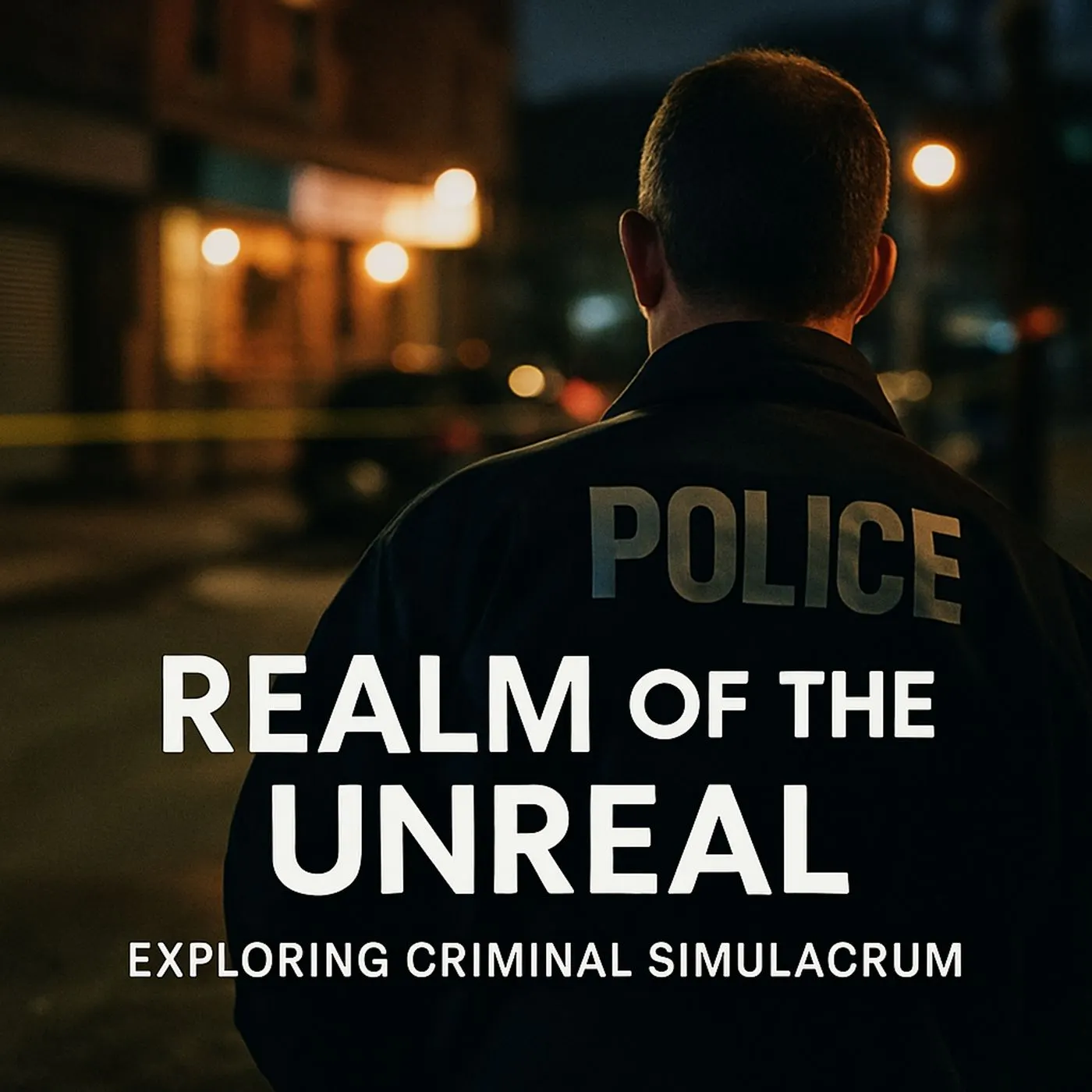
Immutable Echoes Decoding Criminal Whisper Trails
Neon Nights StudioAudio
- Format:
- Podcast
- New episodes:
- Weekly
- Typical length:
- about 10 minutes
- Latest episode:
About this show
Immutable Echoes examines the psychological architecture underlying urban crime through rigorous analysis, expert interviews, and historical case examination. Each narrative traces the cognitive patterns, social conditions, and behavioral markers that define criminal behavior in metropolitan environments. This series reconstructs how perpetrators think, how communities respond, and what forensic and psychological science reveals about the human capacity for transgression.
Show details and episodes come from the publisher's public feed at feeds.megaphone.fm. Last updated . Names, artwork and text belong to their publishers.
Cosmos
Similar by topic and creator
- Jungle Shadows Sifting Through Urban Felonies
Shares the topics History and True Crime and the creator Neon Nights Studio. - Urban Underneath Forensics of Hidden Delinquency
Shares the topics History and True Crime and the creator Neon Nights Studio. - Graffiti of Guilt Decoding Urban Crime Syndicates
Shares the topics History and True Crime and the creator Neon Nights Studio.
Similar shows







Explore more
Episodes
Recidivism Prediction and the Limits of Risk Assessment Accuracy
· 10 min
Criminal justice systems increasingly rely on actuarial risk assessment tools to predict which offenders will reoffend, yet these instruments possess significant limitations and potential for bias. This episode examines how risk assessment algorithms combine static factors including criminal history with dynamic factors including employment and substance abuse to estimate reoffense probability. We analyze the accuracy of these instruments, demonstrating that while they predict better than clinical judgment, they still misclassify substantial proportions of offenders. The discussion includes how risk assessment tools can embed historical discrimination, perpetuating racial disparities if trained on historically biased data. We examine the COMPAS algorithm, widely used in criminal justice, which has faced criticism for racial bias in predicting recidivism. The episode addresses the ethical implications of using imperfect predictions to determine parole decisions, sentencing length, and housing restrictions. We discuss how overestimation of risk leads to unnecessary incarceration while underestimation fails to protect public safety. Learn more about your ad choices. Visit megaphone.fm/adchoices (https://megaphone.fm/adchoices)
Not rated yetWhite Collar Crime and the Psychology of Respectable Criminality
· 10 min
White collar offenders occupy positions of trust and respectability while perpetrating fraud, embezzlement, and corruption that cause massive financial harm. This episode examines how white collar criminals often maintain self-images as fundamentally honest individuals despite systematic deception, employing neutralization techniques that reframe misconduct as victimless or justified. We analyze the psychological mechanisms including moral disengagement that allow educated, intelligent individuals to rationalize serious crimes. The discussion includes how white collar offenders often face dramatically lighter sentences than street criminals despite greater financial impact, reflecting class bias in criminal justice. We examine major cases including Enron, where executives' fraud destroyed retirement savings for thousands of employees while executives received relatively modest sentences. The episode addresses how white collar crime prevention requires understanding occupational opportunity, organizational culture that normalizes misconduct, and regulatory capture where industries influence their own oversight. We discuss why white collar crime receives less public attention despite its greater financial impact. Learn more about your ad choices. Visit megaphone.fm/adchoices (https://megaphone.fm/adchoices)
Not rated yetEnvironmental Criminology and How Physical Spaces Enable or Prevent Crime
· 11 min
The physical environment exerts profound influence on crime occurrence through visibility, access points, natural surveillance opportunities, and perceived risk of detection. This episode examines environmental criminology theories including Crime Prevention Through Environmental Design, which proposes that architectural choices directly affect criminal opportunity. We analyze how street lighting, visibility from windows, maintained landscaping, and clear territorial markers reduce crime by increasing perceived risk of detection. The discussion includes how urban design choices create defensible space where residents feel ownership and responsibility, versus anonymous spaces where criminal activity proceeds without witness intervention. We examine how broken windows theory proposed that visible disorder signals weak social control and invites further crime, though subsequent research has complicated this relationship. The episode includes analysis of how specific architectural features including entrapways, poor visibility, and isolation enable sexual assault and robbery. We discuss how environmental interventions represent crime prevention approaches requiring no individual behavior change. Learn more about your ad choices. Visit megaphone.fm/adchoices (https://megaphone.fm/adchoices)
Not rated yetVictimology and the Sociology of Crime Target Selection
· 11 min
Victims are not randomly distributed but systematically selected based on perpetrator accessibility, perceived vulnerability, and opportunity structures. This episode examines how victimology emerged as a distinct field recognizing that understanding crime requires analyzing victim characteristics and behaviors alongside perpetrator motivation. We analyze how certain populations face dramatically elevated victimization risk, including homeless individuals, sex workers, and those with limited social protection. The discussion includes how perpetrators assess victim vulnerability through subtle cues including body language, awareness of surroundings, and social isolation. We examine victim precipitation theory, the controversial argument that some victims contribute to their victimization through behavior, and the limitations of this framework in addressing systemic vulnerability. The episode includes analysis of how repeat victimization occurs, with some individuals experiencing multiple crimes while others remain untouched, reflecting underlying vulnerability patterns. We discuss how victim-blaming rhetoric obscures perpetrator responsibility while victim-centered approaches acknowledge agency within constrained circumstances. Learn more about your ad choices. Visit megaphone.fm/adchoices (https://megaphone.fm/adchoices)
Not rated yetRacial Disparities in Criminal Justice and the Systemic Roots of Inequality
· 12 min
Racial disparities permeate the criminal justice system from arrest through sentencing, reflecting both explicit discrimination and structural inequalities that operate independent of individual prejudice. This episode examines empirical data demonstrating that African Americans face higher arrest rates, receive longer sentences, and experience greater police use of force compared to white individuals accused of similar crimes. We analyze how historical policies including redlining, employment discrimination, and educational inequality created concentrated poverty in specific neighborhoods, which then receive intensive police surveillance. The discussion includes how implicit bias research demonstrates that individuals unconsciously associate Black individuals with criminality and threat, influencing police decisions to stop, search, and use force. We examine how the war on drugs disproportionately targeted communities of color despite similar drug use rates across racial groups. The episode addresses the controversial question of whether racial disparities reflect discrimination or differences in offending behavior, examining the evidence carefully. Learn more about your ad choices. Visit megaphone.fm/adchoices (https://megaphone.fm/adchoices)
Not rated yetThe Neurobiology of Addiction and Criminal Behavior Interconnection
· 10 min
Addiction fundamentally alters brain reward systems, executive function, and decision-making capacity in ways that directly increase criminal behavior probability. This episode examines how repeated drug use creates neuroadaptation where normal dopamine signaling becomes insufficient, requiring escalating doses to achieve the same effect. We analyze how addiction-driven changes in the prefrontal cortex reduce impulse control precisely when the individual faces increasing legal and social consequences. The discussion includes how withdrawal states create acute distress that motivates crime for relief, and how the criminal justice system's response to addiction often intensifies rather than addresses underlying neurobiology. We examine treatment approaches including medication-assisted therapy that address brain changes directly versus purely behavioral interventions. The episode establishes that understanding addiction as a neurobiological condition rather than moral failing does not eliminate criminal responsibility but contextualizes it within altered brain function. Learn more about your ad choices. Visit megaphone.fm/adchoices (https://megaphone.fm/adchoices)
Not rated yetCorruption Within Law Enforcement and the Betrayal of Public Trust
· 10 min
Police corruption represents a profound institutional failure where those sworn to enforce law instead exploit their authority for personal gain or to protect criminal associates. This episode examines the psychological pathways through which law enforcement officers transition from legitimate authority to corrupt practice, including gradual normalization of misconduct and peer pressure within corrupt units. We analyze major corruption scandals including the Los Angeles Police Department's Rampart Division, where officers engaged in evidence planting, perjury, and assault, and the Baltimore Police Department's Gun Trace Task Force, where officers operated as armed robbers. The discussion includes how corruption undermines investigations, leads to wrongful convictions, and destroys community trust essential for effective policing. We examine the institutional factors that enable corruption, including inadequate supervision, protection of officers through union contracts, and prosecution reluctance to pursue fellow law enforcement. The episode addresses how corruption investigations often reveal that officers engaged in misconduct for extended periods before discovery. Learn more about your ad choices. Visit megaphone.fm/adchoices (https://megaphone.fm/adchoices)
Not rated yetOrganized Crime Structures and the Persistence of Criminal Enterprise
· 10 min
Organized crime syndicates operate as resilient institutional structures that survive leadership changes, law enforcement pressure, and internal conflict through bureaucratic organization and cultural transmission. This episode examines how major criminal organizations including Italian mafia families, Russian organized crime groups, and Mexican drug cartels maintain operational continuity across generations. We analyze the initiation rituals, codes of conduct, and internal discipline mechanisms that bind members to organizational loyalty. The discussion includes how organized crime provides services—dispute resolution, contract enforcement, protection—that legitimate institutions fail to provide in certain communities, explaining why membership persists despite lethal risks. We examine how law enforcement strategies targeting individual leaders often prove ineffective because organizational structures survive leadership transitions. The episode addresses the controversial question of whether organized crime represents rational economic enterprise or fundamentally pathological organization. Learn more about your ad choices. Visit megaphone.fm/adchoices (https://megaphone.fm/adchoices)
Not rated yetInterrogation Techniques and the Production of False Confessions
· 10 min
Innocent individuals confess to crimes they did not commit with surprising regularity, driven by psychological pressure, coercive interrogation techniques, and the cognitive exhaustion of prolonged questioning. This episode examines the Reid Technique, the dominant American interrogation method, which uses deception, confrontation, and psychological manipulation to elicit confessions. We analyze the specific mechanisms through which false confessions are produced, including how innocent individuals can come to believe they committed crimes they have no memory of, a phenomenon termed internalized false confession. Case studies include the Central Park Five, who confessed to a rape they did not commit after hours of intensive interrogation, and numerous DNA exoneration cases where confessions preceded exculpatory evidence. The discussion includes how false confessions contaminate subsequent investigations by directing police attention away from actual perpetrators. We examine jurisdictional differences in interrogation regulation and how video recording of entire interrogations reduces false confessions. Learn more about your ad choices. Visit megaphone.fm/adchoices (https://megaphone.fm/adchoices)
Not rated yetForensic Evidence and the Cognitive Biases That Distort Interpretation
· 11 min
Forensic evidence possesses an aura of scientific objectivity that can mask the subjective human interpretation underlying its analysis. This episode examines how cognitive biases systematically distort forensic evidence evaluation, including confirmation bias where analysts unconsciously favor interpretations supporting the prosecution's theory. We analyze specific cases where forensic experts provided testimony later discredited—including bite mark analysis, hair microscopy, and arson investigation—revealing how these disciplines operated with insufficient scientific validation. The discussion includes how tunnel vision in investigations leads analysts to ignore exculpatory evidence and how the adversarial legal system incentivizes prosecution-favorable interpretations. We examine blind testing protocols that reduce bias and discuss how forensic science has begun implementing quality control measures. The episode establishes that forensic evidence requires critical evaluation rather than uncritical acceptance, and that the appearance of scientific certainty often masks profound uncertainty. Learn more about your ad choices. Visit megaphone.fm/adchoices (https://megaphone.fm/adchoices)
Not rated yetPsychopathy in Criminal Populations and the Absence of Remorse
· 10 min
Psychopathy represents a constellation of personality traits including superficial charm, lack of genuine empathy, manipulativeness, and absence of remorse that appears with elevated frequency in criminal populations. This episode examines how psychopathic individuals navigate criminal systems with particular success, using intelligence and interpersonal skill to manipulate authorities, witnesses, and victims. We analyze the Hare Psychopathy Checklist, the most widely used assessment instrument, and discuss both its utility and its limitations in predicting violent behavior. The discussion includes how psychopathic offenders often present as ideal prisoners—compliant, articulate, and apparently reformed—while maintaining complete absence of genuine behavioral change motivation. We examine whether psychopathy is primarily heritable, environmentally determined, or results from complex gene-environment interactions. The episode addresses the controversial question of whether individuals with psychopathic traits should face different criminal consequences given their reduced capacity for rehabilitation. Learn more about your ad choices. Visit megaphone.fm/adchoices (https://megaphone.fm/adchoices)
Not rated yetSexual Predation and the Typology of Offender Motivation
· 10 min
Sexual offenders constitute a heterogeneous population with distinct motivational profiles, offense patterns, and recidivism risks that require differentiated understanding. This episode examines the major typologies developed by forensic psychologists, distinguishing between offenders motivated primarily by sexual arousal to non-consent, those seeking power and domination, those driven by anger and revenge, and those with developmental intellectual disabilities. We analyze how offense patterns reveal underlying motivation—the meticulous planning of some offenders versus the impulsive opportunism of others, the victim selection preferences that indicate fantasy-driven versus situational offenders. The discussion includes controversial research on whether certain sexual offenders can be reliably identified through physiological responses or psychological testing, and the limitations of these assessment methods. We examine recidivism research demonstrating that static risk factors predict reoffense more reliably than clinical judgment, and how this challenges assumptions about sexual offender dangerousness. Learn more about your ad choices. Visit megaphone.fm/adchoices (https://megaphone.fm/adchoices)
Not rated yetIntimate Partner Violence and the Escalation Toward Lethal Outcome
· 11 min
Domestic homicide follows predictable escalation patterns that forensic researchers have learned to identify, though intervention remains tragically inconsistent. This episode examines the psychological dynamics of intimate partner violence, including how control, jealousy, and perceived abandonment create escalating cycles of abuse. We analyze the specific risk factors that predict progression from assault to lethal violence, including weapon access, substance abuse, prior threats, and separation attempts. The discussion includes analysis of cases where warning signs were documented by police, hospitals, and social services but failed to trigger protective intervention. We also examine how perpetrators often escalate violence immediately after separation, making that period statistically the most dangerous for victims. The episode addresses the controversial intersection of mental illness and intimate partner homicide, distinguishing between mental health conditions that correlate with violence versus those that do not. Learn more about your ad choices. Visit megaphone.fm/adchoices (https://megaphone.fm/adchoices)
Not rated yetSerial Homicide Patterns and the Geographic Profiling of Urban Predators
· 12 min
Serial killers operate within geographic and temporal patterns that reflect their residential or work locations, mobility patterns, and victim selection preferences. This episode explores geographic profiling methodology, which uses mathematical algorithms to predict offender location based on crime site distributions. We examine how serial offenders typically kill within their 'comfort zone'—areas where they feel secure and knowledgeable—and how this geographic consistency has enabled law enforcement to narrow suspect pools. The discussion includes analysis of famous cases including the Yorkshire Ripper, Son of Sam, and regional serial killers whose patterns were eventually decoded through systematic geographic analysis. We also address the limitations and occasional failures of geographic profiling, including cases where offenders operated across vast territories or deliberately created misleading geographic patterns. The episode establishes how understanding spatial behavior reveals perpetrator psychology and operational constraints. Learn more about your ad choices. Visit megaphone.fm/adchoices (https://megaphone.fm/adchoices)
Not rated yetThe Psychology of Robbery and Confrontational Theft
· 11 min
Robbery represents a unique criminal act combining property acquisition with direct human confrontation, requiring perpetrators to manage both instrumental goals and interpersonal threat. This episode examines the psychological profiles of robbers, distinguishing between desperate individuals seeking immediate cash for survival versus experienced criminals executing calculated takings. We analyze the decision-making moments that lead someone to confront a stranger with violence or threat, including how perpetrators assess victim vulnerability, police response probability, and personal risk tolerance. Interviews with incarcerated robbers reveal the cognitive distortions that minimize perceived harm to victims and the adrenaline-seeking aspects that motivate some offenders beyond financial necessity. The episode includes analysis of how robbery patterns vary across urban neighborhoods based on target density, police presence, and perpetrator familiarity with locations. Learn more about your ad choices. Visit megaphone.fm/adchoices (https://megaphone.fm/adchoices)
Not rated yetSubstance Abuse as Catalyst and Consequence in Criminal Trajectories
· 11 min
The relationship between drug use and criminal behavior forms a complex bidirectional pathway rather than simple causation. This episode distinguishes between pharmacological effects that directly impair judgment, withdrawal-induced desperation that motivates crime, and the criminalization of addiction itself that forces users into illegal markets. We examine how stimulant use correlates with violent crime through mechanisms of paranoia and impulse dysregulation, while opioid addiction drives property crime through physical dependence and economic necessity. The discussion includes how criminal justice responses to drug use have created feedback loops that intensify criminal identity and reduce rehabilitation prospects. Historical analysis traces how changing drug epidemics in urban centers have shaped specific crime patterns, from crack cocaine's association with violent turf wars to methamphetamine's connection with property crime. Learn more about your ad choices. Visit megaphone.fm/adchoices (https://megaphone.fm/adchoices)
Not rated yetGang Hierarchies and the Economics of Street-Level Distribution Networks
· 11 min
Urban gangs function as sophisticated economic enterprises with clearly defined organizational structures, profit incentives, and market competition. Rather than viewing gang membership as purely driven by ideology or protection, this episode applies economic analysis to understand how street-level drug distribution networks operate with remarkable efficiency despite constant law enforcement pressure. We examine the hierarchical structures that parallel legitimate corporate organizations, including recruitment processes, internal discipline mechanisms, and financial accounting systems. Interview segments with former gang members and law enforcement specialists reveal how economic desperation, limited legitimate opportunity, and rational cost-benefit calculations drive participation in these networks. The episode establishes that understanding criminal enterprise requires economic literacy alongside psychological insight. Learn more about your ad choices. Visit megaphone.fm/adchoices (https://megaphone.fm/adchoices)
Not rated yetWitness Testimony Under Stress and the Fragility of Criminal Evidence
· 10 min
The human memory operates as a reconstruction machine rather than a recording device, a reality that undermines the apparent certainty of eyewitness accounts in criminal cases. This episode examines landmark psychological research demonstrating how stress, trauma, and the weapon focus effect systematically distort witness recollection, leading to false identifications and wrongful convictions. We analyze specific cases where confident eyewitness testimony sent innocent individuals to prison for decades, only to be exonerated through DNA evidence. The discussion includes how law enforcement interrogation techniques can inadvertently implant false memories, and why the confidence expressed by a witness bears no correlation to the accuracy of their account. This foundational understanding is essential for evaluating the reliability of criminal investigations throughout the series. Learn more about your ad choices. Visit megaphone.fm/adchoices (https://megaphone.fm/adchoices)
Not rated yetChildhood Abandonment and the Formation of Predatory Pathways
· 10 min
Developmental trauma creates invisible blueprints that guide criminal behavior across decades. This episode traces longitudinal research following children who experienced early parental abandonment, neglect, and institutional care, documenting how disrupted attachment patterns correlate with later violent and antisocial conduct. We examine the work of attachment theorists who have mapped how the absence of secure bonding in infancy cascades into deficient empathy, poor emotional regulation, and increased likelihood of perpetrating harm. Case studies from urban crime files illustrate how perpetrators frequently experienced profound early loss, and how understanding this trajectory challenges simplistic notions of moral culpability while maintaining accountability for adult actions. Learn more about your ad choices. Visit megaphone.fm/adchoices (https://megaphone.fm/adchoices)
Not rated yetMapping the Neurological Basis of Violent Impulse
· 10 min
Criminal violence begins not in the moment of action but in the architecture of the brain itself. This opening examination explores how neuroscientists have identified specific structural and functional abnormalities in individuals prone to violent behavior, including reduced activity in the prefrontal cortex and heightened amygdala reactivity. Through analysis of brain imaging studies conducted on incarcerated offenders, we establish the biological foundation that distinguishes impulsive aggression from premeditated harm. The episode considers whether these neural signatures constitute causes, correlates, or merely markers of violent tendency, and what implications this holds for criminal accountability and rehabilitation. Learn more about your ad choices. Visit megaphone.fm/adchoices (https://megaphone.fm/adchoices)
Not rated yet