

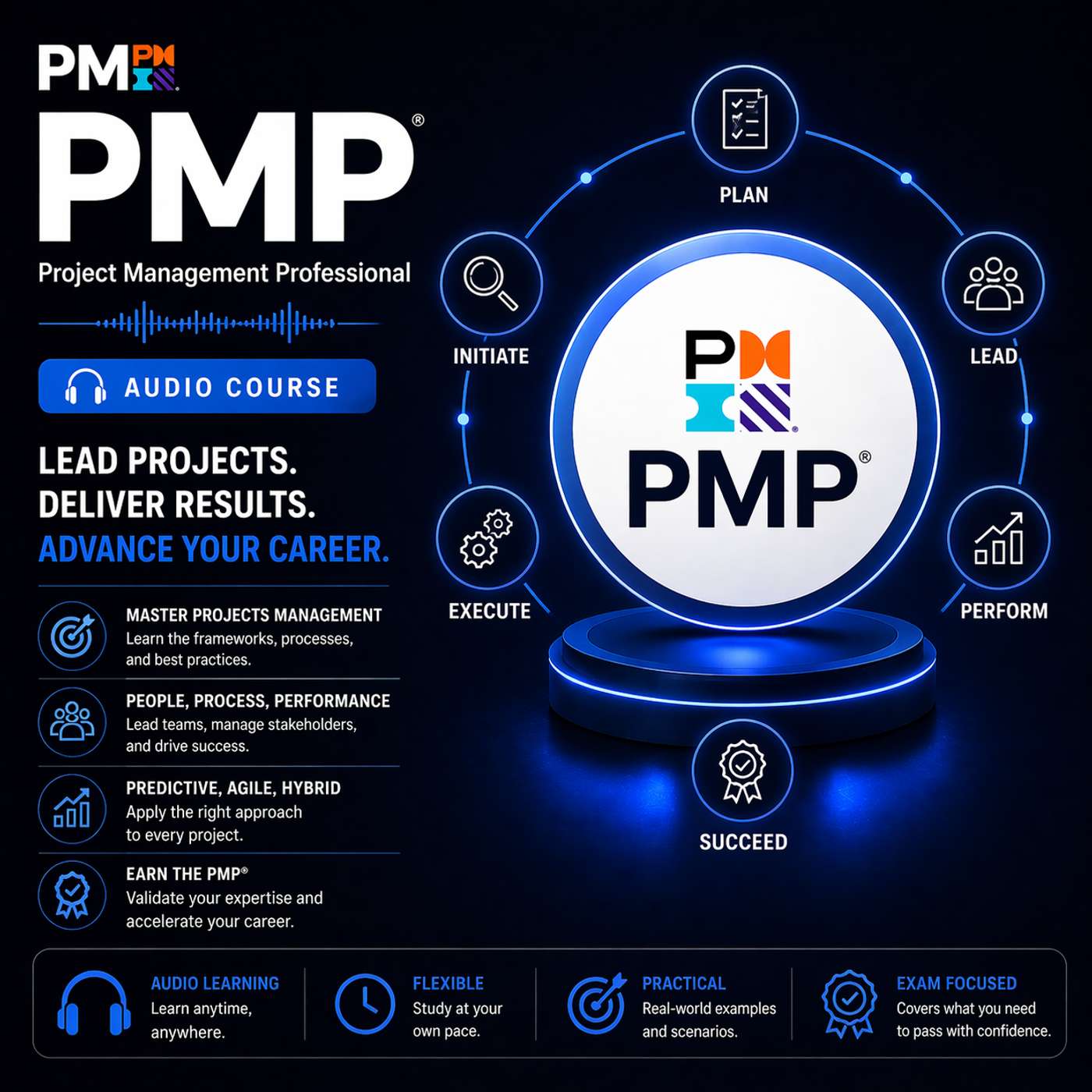
Certified - Project Management Professional (PMP) Audio Course
Jason EdwardsAudio
- Format:
- Podcast
- New episodes:
- Daily
- Typical length:
- about 30 minutes
- Latest episode:
About this show
CURRENT EDITION: PMP 2026. Start with Season 2 for the updated certification preparation course. Previous seasons are archived and may not reflect current exam requirements.
The Certified PMP® Audio Course is your complete, on-the-go study companion for mastering the Project Management Professional (PMP®) certification exam. Designed for busy professionals, this Audio Course transforms every aspect of the Project Management Institute’s (PMI) exam content into structured, easy-to-follow lessons that blend clarity with real-world application. Each episode guides you through the principles of project leadership, process integration, stakeholder management, risk, quality, and agile methodologies—ensuring you understand not only the “what” but also the “why” behind each concept. Whether you’re commuting, exercising, or reviewing between meetings, this series helps you study smarter, stay motivated, and move steadily toward exam success.
The PMP® certification is the global gold standard for project managers, validating your ability to lead teams, deliver results, and manage complex projects under real-world constraints. It measures your proficiency across predictive, agile, and hybrid approaches—emphasizing leadership, strategic thinking, and adaptability. Earning the PMP® demonstrates mastery of the three key domains: People, Process, and Business Environment, and signals to employers that you can manage risk, align projects with organizational goals, and deliver value from start to finish.
Developed by BareMetalCyber.com, the Certified PMP® Audio Course provides structured instruction, practical insights, and exam-focused guidance to help you build the confidence, mindset, and discipline needed to pass the PMP® exam and excel as a certified project management professional.
Covers: project management, professional certification, project leadership, exam preparation, stakeholder management, risk management, agile methodology, procurement, ethics in business, organizational change
Show details and episodes come from the publisher's public feed at feeds.transistor.fm. Last updated . Names, artwork and text belong to their publishers.
Recently on this show
Summary of recent episodes, drawn from the publisher's feed.
This podcast is an audio study course for the Project Management Professional (PMP) certification exam, covering leadership, process, and stakeholder topics. Recent episodes cover knowledge transfer when team members leave, corrective action after setbacks, AI in status reporting, sustainability decisions, change readiness, continuous improvement, public-sector procurement, and construction projects.
Cosmos
Similar in subject
- Project Management Happy Hour
Both cover: stakeholder management, project leadership, risk management - Business Analysis Live!
Both cover: stakeholder management, professional certification, project management - Projectified
Both cover: stakeholder management, project leadership, project management
Similar shows






Explore more
Episodes
Planning and Managing Project Scope
· 28 min
CURRENT EDITION: PMP 2026. This episode is part of Season 2, the recommended course for the current certification exam. A request to add one field to a form can reach three interfaces, reporting rules, and a new round of testing. This episode uses that deceptively small change to explore the boundaries of project scope. Distinguish the work required to deliver a project from the features of its product, then connect requirements, exclusions, ownership, and acceptance criteria to a clear understanding of what the team has committed to deliver. Predictive work breakdown structures and agile backlogs provide different ways to decompose and organize scope. Learn how those views connect in hybrid delivery, why security and performance requirements belong alongside functionality, and how traceability can expose unapproved additions. The discussion separates validating completed deliverables from controlling scope changes and explains why a Sprint Review does not automatically provide contractual acceptance. Useful evidence, appropriate decision authority, and visible impact analysis help address disputed completion or proposed additions without confusing stakeholder enthusiasm with an approved commitment. Visit https://BareMetalCyber.com for more certification study resources and podcasts.
Not rated yetRemoving Impediments and Addressing Issues
· 26 min
CURRENT EDITION: PMP 2026. This episode is part of Season 2, the recommended course for the current certification exam. Work can stop because of a missing decision, an access restriction, or a supplier handoff, even when the team is ready to proceed. This episode explains how to turn an impediment into an actionable issue: identify the blocked work, its consequence, the responsible owner, and the next response needed. It separates immediate relief from investigation of a recurring cause and shows when an escalation trigger should be followed promptly. A scenario involving approval to use production data illustrates the limits of a workaround. Synthetic or de-identified data may help only when the responsible roles confirm that the alternative is permitted and suitable for the tests. The lesson also covers external dependencies, supplier remedies, temporary resequencing, and visible follow-up. Cause-analysis tools organize possible explanations, but evidence must test them. Resolution is checked by whether acceptable work can proceed, with remaining risks and any lasting process improvement still owned. Visit https://BareMetalCyber.com for more certification study resources and podcasts.
Not rated yetBuilding a Capable Project Team
· 28 min
CURRENT EDITION: PMP 2026. This episode is part of Season 2, the recommended course for the current certification exam. A list of available people is not yet a capable project team. This episode connects the skills the work requires with actual availability, clear responsibilities, and the conditions people need to contribute. Skills matrices and resource calendars reveal different gaps, while sourcing and onboarding decisions determine whether expertise can become usable capacity. A “hire now, clarify later” scenario brings those tradeoffs into focus. The discussion covers first-week access and orientation, working agreements, inclusive communication, supplier interfaces, and team development as membership or priorities change. It also examines dependence on a single specialist: pairing and documentation can build resilience, but they do not automatically qualify a replacement or satisfy an independent-review requirement. Scrum, matrix, predictive, and hybrid arrangements are considered through their actual responsibilities. The goal is a team design that supports both today’s delivery and the ability to adapt without relying on constant individual heroics. Visit https://BareMetalCyber.com for more certification study resources and podcasts.
Not rated yetProject Records and Visual Evidence Lab
· 32 min
CURRENT EDITION: PMP 2026. This episode is part of Season 2, the recommended course for the current certification exam. Project records become useful when their dates, units, assumptions, and decision rights remain visible. This lab works through an identity-access release, a construction recovery, and a service-center funding problem, explaining the evidence aloud as each decision develops. Compare required scope with optional enhancements, network logic with actual inspector availability, and a performance forecast with the cash needed to meet upcoming payments. The calculations connect earned value, reserves, risk responses, and scope-change authority while showing why different forecasts should retain their distinct assumptions. A control-chart example then separates process behavior from specification limits, followed by guidance on throughput, cycle time, work-item age, and cumulative flow. You will practice identifying what a record establishes, what a chart cannot prove, and how to present the approved baseline, observed state, conditional forecast, and pending proposal without blending them into one misleading status claim. Visit https://BareMetalCyber.com for more certification study resources and podcasts.
Not rated yetExternal Change and Project Value Lab
· 28 min
CURRENT EDITION: PMP 2026. This episode is part of Season 2, the recommended course for the current certification exam. Value decisions can change when the denominator, the capacity constraint, or the operating environment changes. This lab follows an equipment-rental portal whose Product Owner must preserve a required repair while selecting optional work within a limited Sprint forecast. The worked comparison shows why the best value-per-effort ratio may not produce the strongest feasible combination when items are indivisible and a mandatory condition must be met. Pilot results then reveal why total support contacts can rise while the proportion of sessions needing help falls. Explore percentage points, relative change, estimated benefits, and the evidence still needed to judge progress toward the Product Goal. A separate carrier-disruption scenario challenges the original assumptions and connects prompt operating action with product reprioritization and commercial authority, helping you explain what remains binding, what must be reassessed, and which commitments require another owner's decision. Visit https://BareMetalCyber.com for more certification study resources and podcasts.
Not rated yetAdvanced Lab: Global Remote Teams and Follow the Sun Delivery
· 26 min
CURRENT EDITION: PMP 2026. This episode is part of Season 2, the recommended course for the current certification exam. Passing work between regions can extend coverage, but reliable follow-the-sun delivery requires more than people being online at different times. This lab examines repeated work caused by unclear acceptance criteria, an urgent access request, an incident crossing a regional handoff, and conflicting versions of a feature. Each situation reveals how ownership, current information, access, and communication must work together for the receiving team to continue effectively. Learn to choose useful handoff content, confirm incident ownership, and distinguish authoritative records from a requirement to use one tool for everything. The discussion also addresses comparable flow measures, cross-border information conditions, accessible communication, and workable meeting arrangements. You will practice evaluating whether a template, live conversation, access decision, or ownership change addresses the actual problem, then use subsequent handoffs and operating evidence to check whether the arrangement has improved. Visit https://BareMetalCyber.com for more certification study resources and podcasts.
Not rated yetAdvanced Lab: Financial Services and Supplier Risk
· 27 min
CURRENT EDITION: PMP 2026. This episode is part of Season 2, the recommended course for the current certification exam. Financial-services projects depend on accurate controls, protected information, and suppliers whose performance can be evaluated against clear requirements. This lab examines payment-data logging, a release that bypassed an independent review, a supplier assurance finding at renewal, and a confirmed change to an onboarding requirement. Each situation highlights how the current exposure, applicable conditions, and available authority shape the next project decision. Explore the different implications of masking, truncation, and tokenization without treating any label as proof that the data is adequately controlled. Further examples address honest incident communication, permitted renewal conditions, and the difference between a missing approval link and an approval that never happened. The episode helps you coordinate security, compliance, financial-control, and procurement owners while evaluating evidence, communicating uncertainty, and handing continuing monitoring responsibilities to the people accountable for operations. Visit https://BareMetalCyber.com for more certification study resources and podcasts.
Not rated yetAdvanced Lab: Healthcare and Pharmaceutical Projects
· 27 min
CURRENT EDITION: PMP 2026. This episode is part of Season 2, the recommended course for the current certification exam. Healthcare and pharmaceutical projects require careful attention to the obligations that apply to a particular system, activity, and organization. This advanced lab uses fictional cases involving an electronic-signature control, a proposed export of protected information, and a validation run interrupted by an outage. The examples connect privacy, quality, testing, and operating readiness with the qualified owners who interpret requirements and authorize the response. Practice distinguishing a control that was never implemented from a broken reference to valid evidence, and a missing test from a result whose reliability needs broader assessment. The discussion also considers approved analytical alternatives, the scope of revalidation, and when correction or corrective action is appropriate. You will learn to explain the actual readiness gap, maintain an honest forecast, and preserve accurate records while technical and quality owners determine what must happen before the affected work can proceed. Visit https://BareMetalCyber.com for more certification study resources and podcasts.
Not rated yetEthics: Culture, Sustainability, and Social Impact
· 26 min
CURRENT EDITION: PMP 2026. This episode is part of Season 2, the recommended course for the current certification exam. A project's impact continues through the people who use its results, the communities affected by its work, and the resources required to operate what it delivers. This episode connects ethical leadership with accessibility, inclusive communication, reasonable workloads, environmental considerations, and lifecycle thinking. It examines how daily choices about meetings, requirements, procurement, and stakeholder involvement influence the culture that develops around a project. Two practical situations focus on pressure to remove mandatory accessibility conditions and a subcontractor's proposal to work outside permitted hours. Explore how to compare feasible recovery options, involve affected users and communities, and separate adjustable preferences from requirements that constrain the decision. The lesson also addresses evidence behind sustainability claims and ownership after closure, helping you make longer-term effects visible without assuming that a policy statement or contract clause proves a positive outcome. Visit https://BareMetalCyber.com for more certification study resources and podcasts.
Not rated yetEthics: Responsibility and Respect
· 26 min
CURRENT EDITION: PMP 2026. This episode is part of Season 2, the recommended course for the current certification exam. Responsibility and respect become visible in the choices a project leader makes when deadlines tighten and difficult information surfaces. This episode connects the PMI ethical values with everyday conduct, including disclosing risks, acknowledging mistakes, listening to stakeholders, and setting realistic expectations for workloads. It also considers how power differences, accessibility needs, and communication across cultures affect people's ability to participate and raise concerns. Worked situations explore pressure for unsupported weekend work, sensitive information shared too broadly, potential conflicts of interest, and conduct that requires a designated reporting process. Learn to distinguish routine coaching from concerns that need specialist handling, protect confidentiality while reporting relevant facts, and recognize when another owner must act promptly. The lesson emphasizes accountable behavior within your role, respectful treatment of affected people, and follow-through that makes ethical commitments visible in the work. Visit https://BareMetalCyber.com for more certification study resources and podcasts.
Not rated yetScenario Lab: Healthcare, Finance, and Construction
· 26 min
CURRENT EDITION: PMP 2026. This episode is part of Season 2, the recommended course for the current certification exam. Healthcare, financial services, and construction expose project managers to different obligations, specialists, and operating conditions. This scenario lab follows a health-record rollout with incomplete readiness, a payment supplier changing an interface field, and a construction activity affected by an immediate unsafe condition. The cases show how a familiar project concern can require a different first response when the evidence, authority, and urgency change. Learn to distinguish training attendance from demonstrated operating capability, a supplier assurance from verified interface impact, and routine schedule pressure from an explicit protective duty. The discussion also examines the roles of privacy, control, contract, and safety owners in determining an acceptable path forward. You will practice carrying project-management reasoning into unfamiliar settings while respecting the limits of your role, keeping forecasts honest, and identifying which requirements need qualified interpretation. Visit https://BareMetalCyber.com for more certification study resources and podcasts.
Not rated yetScenario Lab: Rapid Triage and First Actions
· 26 min
CURRENT EDITION: PMP 2026. This episode is part of Season 2, the recommended course for the current certification exam. Project triage is the skill of recognizing what needs attention now while keeping the larger solution in view. This lab considers severe defects, acceptance disagreements, supplier requests, changed obligations, an unavailable decision owner, growing work queues, and benefits that have drifted after release. Each case asks whether the immediate need is protection, notification, verification, a decision, or a clearer understanding of the constraint. Explore how existing response authority, escalation thresholds, current forecasts, and accountable owners shape a useful opening move. A release hold differs from an emergency deployment, stakeholder silence does not supply approval, and a crowded Kanban board still needs investigation before an intervention is chosen. The practice helps you give a concise explanation of what is known, what remains unresolved, and who can act, so an initial response creates a sound basis for the work that follows. Visit https://BareMetalCyber.com for more certification study resources and podcasts.
Not rated yetScenario Lab: Choosing the Best Next Action
· 26 min
CURRENT EDITION: PMP 2026. This episode is part of Season 2, the recommended course for the current certification exam. Choosing the best next action begins with understanding what has already happened and what the project still needs. Six fictional micro-scenarios explore an unclear scope commitment, required issue coordination, a possible interface constraint, disputed acceptance evidence, a severe defect, and missing benefits ownership after handover. The episode uses these situations to make the words first, next, and best more concrete without assigning them a fixed sequence of responses. Examine why two coordination actions can both be valid in a multiple-response question, when a requested hotfix qualifies for an emergency route, and who should address an unowned business outcome. The accompanying debrief connects errors with targeted study and a flexible map of useful evidence. You will practice stating the decisive condition, identifying the appropriate owner, and explaining why an attractive alternative fails to answer the question actually being asked. Visit https://BareMetalCyber.com for more certification study resources and podcasts.
Not rated yetScenario Lab: Increasingly Difficult Decisions
· 26 min
CURRENT EDITION: PMP 2026. This episode is part of Season 2, the recommended course for the current certification exam. Small changes in a scenario can make a previously reasonable answer inappropriate. This lab builds from an acceptance dispute to a mid-Sprint compliance request and then to a supplier interface change under an incentive contract. As the situations become more demanding, the discussion examines how missing evidence, binding obligations, financial terms, and delegated authority affect the decision that needs to be made. Practice distinguishing an optional reporting preference from a mandatory release condition and an authorized component choice from a change to an agreed interface. The cases also show how the next action changes when impact analysis or approval has already been completed. By varying one fact at a time, you can test whether your reasoning responds to the circumstances and identify when clarification, verification, escalation, or implementation is actually needed. Visit https://BareMetalCyber.com for more certification study resources and podcasts.
Not rated yetDebrief Lab: Bias and Decision Traps
· 25 min
CURRENT EDITION: PMP 2026. This episode is part of Season 2, the recommended course for the current certification exam. A memorable failure, an influential executive, or the first proposed solution can pull attention away from the evidence a project decision actually needs. This lab explores anchoring, confirmation bias, availability, sunk-cost reasoning, loss aversion, authority bias, and overconfidence through practical examples. The emphasis is on recognizing a specific assumption and testing it, while keeping knowledge gaps and calculation errors visible as other possible explanations for a missed question. Compare the remaining costs and benefits of continuing a troubled project, evaluate a familiar tool against changed requirements, and consider whether one supplier outage justifies a broader sourcing decision. Further variations show how release authority and immediate protective duties can change the appropriate response. These exercises help you compare alternatives fairly, look for disconfirming evidence, and distinguish a person's status from the authority they hold for the decision at hand. Visit https://BareMetalCyber.com for more certification study resources and podcasts.
Not rated yetDebrief Lab: Causes of Missed Questions
· 25 min
CURRENT EDITION: PMP 2026. This episode is part of Season 2, the recommended course for the current certification exam. A missed practice question becomes more useful when you can explain why you missed it. This debrief lab develops an error log that distinguishes knowledge gaps, process mistakes, rushing, and misreading, then connects each pattern with a specific review action. Worked examples show how an unsupported scope commitment, a misunderstood authority boundary, or an approval-evidence gap can reveal different weaknesses even when the wrong answers appear similar. Build short reminders that include the conditions under which they apply, and test them against a changed version of the original case. The episode also addresses multiple-response items, release decisions, artifact selection, and the limits of familiar study shortcuts. By explaining your reasoning aloud, using counterexamples, and returning to difficult concepts after a gap, you can make review more diagnostic and determine whether a correction transfers to a different situation. Visit https://BareMetalCyber.com for more certification study resources and podcasts.
Not rated yetScenario Lab: Timed Situations, Set Two
· 26 min
CURRENT EDITION: PMP 2026. This episode is part of Season 2, the recommended course for the current certification exam. The second timed situational set adds six more opportunities to practice decisions under competing demands. An urgent Sprint request, weak adoption after delivery, and a disputed supplier interface challenge your ability to separate stakeholder pressure from the conditions that actually control the next step. Each situation asks you to identify the relevant evidence, the accountable owner, and what remains unresolved before selecting a response. The later cases address a severe defect before go-live, a newly announced retention obligation, and rising costs under an incentive-fee contract. Explore when an emergency procedure applies, why applicability and effective dates matter, and how contract terms shape financial decisions. The review encourages you to compare confidence with the strength of your reasoning, revisit uncertain concepts, and avoid treating a backlog swap, training session, or action log as sufficient merely because it sounds practical. Visit https://BareMetalCyber.com for more certification study resources and podcasts.
Not rated yetScenario Lab: Timed Situations, Set One
· 26 min
CURRENT EDITION: PMP 2026. This episode is part of Season 2, the recommended course for the current certification exam. Put your project judgment to work in six fictional situations covering late scope requests, interface performance risk, approval records, supplier substitutions, benefits, and schedule compression. This first timed practice set invites you to pause, choose an action, and explain the fact that makes it appropriate. The cases are short enough for focused review while still requiring attention to authority, acceptance conditions, and the limits of available evidence. Work through a cheaper component with unresolved support concerns, a service portal whose users cannot complete a critical step, and two parallel schedule paths that respond differently to acceleration. You will also distinguish a missing approval record from an approval that never occurred. The debrief helps identify imported assumptions and familiar phrases that can distract from the actual decision, turning each response into a targeted opportunity for further study. Visit https://BareMetalCyber.com for more certification study resources and podcasts.
Not rated yetScenario Lab: Predictive Project Decisions
· 26 min
CURRENT EDITION: PMP 2026. This episode is part of Season 2, the recommended course for the current certification exam. Predictive projects can adapt to changing demands, but a credible response must account for dependencies, approved commitments, and decision authority. Three worked situations explore an executive's request to accelerate a launch, a supplier's proposed change under an incentive contract, and a disagreement about acceptance immediately before sign-off. The episode connects each problem with the evidence needed to understand its consequences before making a new commitment. Learn how critical and near-critical paths, resource constraints, crashing, and fast-tracking affect the feasibility of an earlier finish. The procurement and acceptance cases then examine actual contract terms, requirements traceability, and the distinction between missing evidence and changed requirements. Throughout the lab, current forecasts remain separate from approved baselines, helping you explain emerging delays honestly while the appropriate owners consider changes to scope, cost, schedule, or contractual obligations. Visit https://BareMetalCyber.com for more certification study resources and podcasts.
Not rated yetScenario Lab: Agile and Hybrid Decisions
· 27 min
CURRENT EDITION: PMP 2026. This episode is part of Season 2, the recommended course for the current certification exam. Urgent requests, growing queues, and approaching approval gates can put adaptive teams under pressure from several directions. This scenario lab examines a mid-Sprint demand from an executive, a Kanban workflow struggling with too much work in progress, and a hybrid project preparing evidence for a regulatory gate. Each case shows how product priorities, team capacity, required quality, and external commitments shape the options available to the project manager. Explore the different purposes of the Sprint Goal, Definition of Done, backlog policies, and release criteria while considering who can authorize each decision. The discussion also connects cumulative flow and cycle-time evidence with practical responses to blocked work. You will practice assessing whether an adjustment is feasible, recognizing when a request must wait, and explaining why a completed Increment may still need additional evidence before an external gate can be passed. Visit https://BareMetalCyber.com for more certification study resources and podcasts.
Not rated yet