

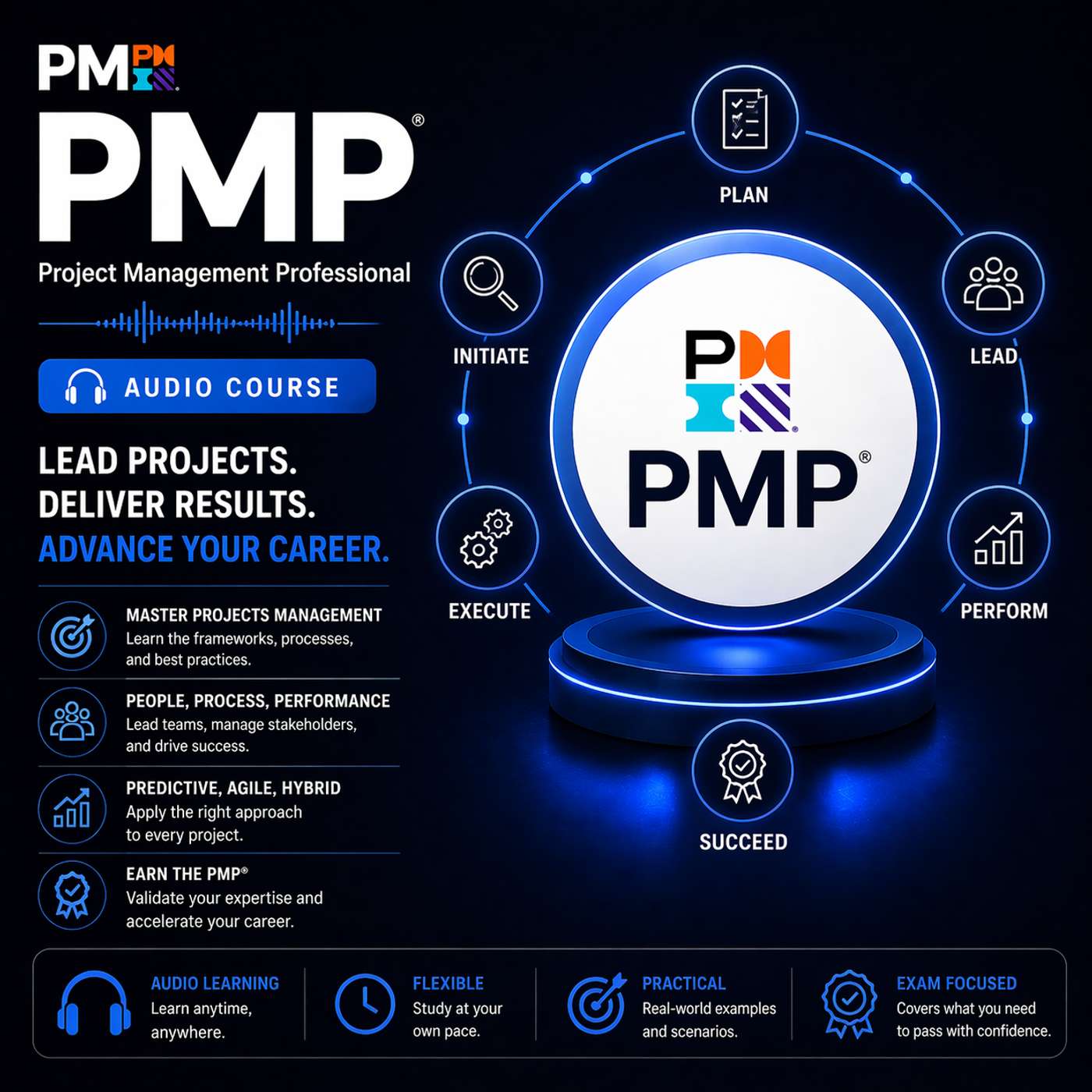
Certified - Project Management Professional (PMP) Audio Course
Jason EdwardsAudio
- Format:
- Podcast
- New episodes:
- Daily
- Typical length:
- about 30 minutes
- Latest episode:
About this show
CURRENT EDITION: PMP 2026. Start with Season 2 for the updated certification preparation course. Previous seasons are archived and may not reflect current exam requirements.
The Certified PMP® Audio Course is your complete, on-the-go study companion for mastering the Project Management Professional (PMP®) certification exam. Designed for busy professionals, this Audio Course transforms every aspect of the Project Management Institute’s (PMI) exam content into structured, easy-to-follow lessons that blend clarity with real-world application. Each episode guides you through the principles of project leadership, process integration, stakeholder management, risk, quality, and agile methodologies—ensuring you understand not only the “what” but also the “why” behind each concept. Whether you’re commuting, exercising, or reviewing between meetings, this series helps you study smarter, stay motivated, and move steadily toward exam success.
The PMP® certification is the global gold standard for project managers, validating your ability to lead teams, deliver results, and manage complex projects under real-world constraints. It measures your proficiency across predictive, agile, and hybrid approaches—emphasizing leadership, strategic thinking, and adaptability. Earning the PMP® demonstrates mastery of the three key domains: People, Process, and Business Environment, and signals to employers that you can manage risk, align projects with organizational goals, and deliver value from start to finish.
Developed by BareMetalCyber.com, the Certified PMP® Audio Course provides structured instruction, practical insights, and exam-focused guidance to help you build the confidence, mindset, and discipline needed to pass the PMP® exam and excel as a certified project management professional.
Covers: project management, professional certification, project leadership, exam preparation, stakeholder management, risk management, agile methodology, procurement, ethics in business, organizational change
Show details and episodes come from the publisher's public feed at feeds.transistor.fm. Last updated . Names, artwork and text belong to their publishers.
Recently on this show
Summary of recent episodes, drawn from the publisher's feed.
This podcast is an audio study course for the Project Management Professional (PMP) certification exam, covering leadership, process, and stakeholder topics. Recent episodes cover knowledge transfer when team members leave, corrective action after setbacks, AI in status reporting, sustainability decisions, change readiness, continuous improvement, public-sector procurement, and construction projects.
Cosmos
Similar in subject
- Project Management Happy Hour
Both cover: stakeholder management, project leadership, risk management - Business Analysis Live!
Both cover: stakeholder management, professional certification, project management - The Project Management Podcast
Both cover: project leadership, risk management, project management
Similar shows






Explore more
Episodes
Knowledge Transfer for Project Continuity
· 29 min
CURRENT EDITION: PMP 2026. This episode is part of Season 2, the recommended course for the current certification exam. When a key developer leaves, the project needs more than a folder of hurried notes. Knowledge transfer connects written records with the judgment and experience people use to make the work succeed. Examine the difference between explicit and tacit knowledge, the warning signs of dependence on one expert, and the value of capturing decisions and lessons throughout delivery. Pairing, shadowing, walkthroughs, and accessible records each contribute something different. A departing integration specialist provides a practical test of how to preserve continuity. The discussion then extends to operational handover, where recipients need to demonstrate useful capability through practice and readiness checks. Training, access, escalation contacts, and support responsibilities matter alongside documentation. Supplier transitions introduce a further boundary: contracts determine the knowledge, licenses, and access the customer is entitled to receive. Explore how tailored transfer methods, current repositories, and appropriate security help the next owner use the knowledge while respecting intellectual property and continuing obligations. Visit https://BareMetalCyber.com for more certification study resources and podcasts.
Not rated yetAdvanced Lab: Recovery and Corrective Action
· 26 min
CURRENT EDITION: PMP 2026. This episode is part of Season 2, the recommended course for the current certification exam. Recovering from failure requires both a response to the current impact and a clear understanding of what needs to change. This lab distinguishes correction, corrective action, and preventive action through a production outage, recurring defects, an emergency-change failure, and excessive after-hours alerts. It connects containment, accurate communication, and reliable evidence with an investigation that can identify the causes relevant to the event. Explore why a Pareto chart can guide investigation without proving a cause, why a procedure update does not establish effectiveness, and why fewer alerts are useful only if essential detection remains reliable. The episode also considers accurate late records, fair accountability, operational ownership, and sharing lessons in a form others can use. You will practice defining a meaningful effectiveness check and deciding what remains open when implementation is complete but the evidence of improvement is still developing. Visit https://BareMetalCyber.com for more certification study resources and podcasts.
Not rated yetAI Across Project Work Lab
· 28 min
CURRENT EDITION: PMP 2026. This episode is part of Season 2, the recommended course for the current certification exam. A fluent AI summary can still use outdated evidence, omit an unmet release condition, or confuse a forecast with an approved commitment. This lab examines a generated status report for a public-service booking product and traces its claims back to current acceptance, defect, and readiness records. The case shows what meaningful human review requires and how permitted inputs, reporting cutoffs, and source context affect the reliability of the result. The second case turns to procurement of an AI reporting service, comparing mandatory eligibility gates, technical scores, first-year prices, and a proposed commercial pilot. A later family relationship disclosure introduces a separate conflict-of-interest decision. Explore why source-linked output still needs checking, why attractive scores cannot replace required evidence, and why disclosure does not complete the mitigation process. The lesson connects useful AI assistance with accountable reporting, fair evaluation, and explicit decision authority. Visit https://BareMetalCyber.com for more certification study resources and podcasts.
Not rated yetSustainability Across Delivery Lab
· 28 min
CURRENT EDITION: PMP 2026. This episode is part of Season 2, the recommended course for the current certification exam. Sustainability becomes a practical project decision when requirements, costs, and claims can be evaluated on a consistent basis. A footbridge-lighting procurement provides the first worked case, combining illumination, accessible passage, energy use, fixture recovery, and five-year ownership cost. Compare the evidence behind three offers and follow how a later negotiated price changes the financial picture without changing the mandatory conditions or the limits of signing authority. A library refurbishment then introduces a delivery threat and a material-reuse opportunity, each with a defined response cost and uncertain outcome. Work through expected-value comparisons, acceptance of recovered materials, contingency, and delegated authority before a carrier notice changes the available options. The cases connect environmental goals with execution and handover, showing how to distinguish promised recovery from measured results, estimated gains from realized benefits, and available funds from permission to commit them. Visit https://BareMetalCyber.com for more certification study resources and podcasts.
Not rated yetOrganizational Change and Transition Readiness Lab
· 28 min
CURRENT EDITION: PMP 2026. This episode is part of Season 2, the recommended course for the current certification exam. Everyone attended training, but that does not establish that everyone can perform the changed workflow independently. This lab begins with a permit-processing team whose reorganization changes authority, reduces instructor capacity, and exposes a gap between shift coverage and full handover readiness. The case uses demonstration evidence, current procedures, and remaining instructor effort to develop a concrete resource request and a credible transition decision. A second case follows an energy-monitoring project after a regional reorganization introduces a replacement platform and changes its remaining value. Compare continued delivery with orderly early closure while keeping sunk expenditure, future costs, benefits, technical acceptance, and operating ownership distinct. Together, the cases show how adoption depends on usable support and current decision routes, and how a project can preserve valid completed work while resolving the responsibilities and readiness conditions that remain. Visit https://BareMetalCyber.com for more certification study resources and podcasts.
Not rated yetContinuous Improvement Lab
· 27 min
CURRENT EDITION: PMP 2026. This episode is part of Season 2, the recommended course for the current certification exam. A digital-service team is starting plenty of work, but accepted output is falling while the review queue grows. This lab follows six weeks of evidence to investigate the constraint, distinguish incomplete handoffs from unavailable qualified capacity, and design a two-week improvement experiment. The case keeps acceptance checks and independent review intact while the team tests protected review time and clearer evidence packages. Work through throughput, waiting time, queue size, and escaped-defect observations using consistent definitions and comparison periods. The discussion connects those measures with cost-of-quality concepts, correction, corrective action, and the limits of a short before-and-after comparison. You will consider how simpler work can affect the apparent result, what the process owner needs before retaining a change, and how improved guidance, review capacity, and continuing ownership must transfer into normal operations. Visit https://BareMetalCyber.com for more certification study resources and podcasts.
Not rated yetAdvanced Lab: Public Sector and Federal Procurement
· 26 min
CURRENT EDITION: PMP 2026. This episode is part of Season 2, the recommended course for the current certification exam. Public procurement requires project teams to pursue value while respecting competition, information protections, and defined contracting authority. This advanced lab uses federal-style scenarios to examine a supplier's question about an ambiguous requirement, pressure to favor a bidder, and a request for additional work after award. The episode distinguishes the project team's role in developing evidence from the authority to issue acquisition decisions or bind the organization. Explore the difference between legitimate corrections and manipulated evaluations, shared clarifications and protected proposal information, and authorized changes and unsupported commitments. Additional situations address conflicts of interest, supplier performance, debriefings, and genuine urgency. The lesson emphasizes the applicable process and the actual sequence of events, helping you support contracting and legal owners with accurate facts while recognizing why a formal-looking document alone cannot establish that a procurement action was proper. Visit https://BareMetalCyber.com for more certification study resources and podcasts.
Not rated yetAdvanced Lab: Construction and Capital Projects
· 26 min
CURRENT EDITION: PMP 2026. This episode is part of Season 2, the recommended course for the current certification exam. Construction and capital projects bring physical work, technical instructions, and commercial commitments into the same decision space. This advanced lab follows an unsafe scaffold affecting the critical path, conflicting drawings that require an authorized design response, and a late request for additional contracted scope. The cases show why safety authority, technical responsibility, and contract authority must be identified separately when pressure builds around a milestone. The discussion extends to subcontractor interfaces, payment conditions, weather and logistics, commissioning, and staged turnover. Learn to keep current forecasts distinct from approved baselines, evaluate recovery options against actual dependencies, and verify whether an operating stage meets its acceptance conditions. Requests for information, inspections, daily reports, and turnover records each support a different decision, helping you coordinate qualified owners and maintain a clear connection between the authorized instruction, the work performed, and the evidence retained. Visit https://BareMetalCyber.com for more certification study resources and podcasts.
Not rated yetEthics: Contracts, Suppliers, and Data
· 27 min
CURRENT EDITION: PMP 2026. This episode is part of Season 2, the recommended course for the current certification exam. Contracts, supplier relationships, and shared data create ethical decisions that cross organizational boundaries. This episode examines how clear commitments, reliable acceptance evidence, appropriate incentives, and authorized information use support integrity throughout delivery. It also considers the limits of supplier assurances and AI-generated summaries, showing why important claims still need verification against the requirements and records that govern the work. Follow practical cases involving a proposed supplier change, restricted production data requested for testing, and an audit that exposes gaps in the evidence. Learn how to involve the proper contract and data owners, assess approved alternatives, and preserve an accurate account of what occurred. The discussion addresses proprietary supplier material, access and retention conditions, and transparent corrections, helping you align the action taken, the explanation given, and the record available to authorized reviewers. Visit https://BareMetalCyber.com for more certification study resources and podcasts.
Not rated yetEthics: Fairness and Honesty
· 26 min
CURRENT EDITION: PMP 2026. This episode is part of Season 2, the recommended course for the current certification exam. Fairness and honesty shape how project decisions are made and how their consequences are reported. This episode examines impartial supplier evaluation, truthful status updates, conflicts of interest, gifts, and the integrity of project records. It explains why reporting should distinguish evidence from assumptions and why a dashboard's color must reflect agreed criteria and material facts, even when sponsors would prefer a more reassuring picture. Scenarios involving a friend's bidding firm, pressure to soften a funding risk, and changing team performance put those principles into practice. Explore how to correct a misleading report, preserve the history of an approval, and separate a legitimate late entry from fabricated authorization. The discussion also connects honest forecasting with appropriate confidentiality, helping you provide accurate information to the people who need it while using a fair process for evaluation and participation. Visit https://BareMetalCyber.com for more certification study resources and podcasts.
Not rated yetScenario Lab: Virtual Teams and Cultural Differences
· 26 min
CURRENT EDITION: PMP 2026. This episode is part of Season 2, the recommended course for the current certification exam. A handoff that seems complete in one time zone can become duplicated work in the next. This scenario lab explores how unclear acceptance criteria, drifting versions, and inaccessible information disrupt virtual teams. Learn to combine useful asynchronous records with selective overlap time, explicit response expectations, and fair participation. The discussion also considers language, tone, and accessibility, encouraging teams to ask about individual needs instead of making assumptions from nationality or cultural labels. The later scenarios examine blocked partner access and conflicting copies of project records. You will consider authorized access routes, the limits of temporary test data, and why sharing credentials is not a solution to delay. Record reconciliation requires understanding scope and decision history before merging files or retiring versions. Across the cases, the episode treats a new tool or working agreement as something to verify in practice: the important question is whether it improves coordination while preserving the controls the work requires. Visit https://BareMetalCyber.com for more certification study resources and podcasts.
Not rated yetScenario Lab: Stakeholder Negotiation and Influence
· 27 min
CURRENT EDITION: PMP 2026. This episode is part of Season 2, the recommended course for the current certification exam. Marketing wants a campaign feature, operations wants fewer defects, and the launch date is fixed. This scenario lab examines how to uncover the interests behind competing requests and compare options against real capacity and release conditions. A compromise that sounds balanced still needs to be feasible. The episode shows how benefits, constraints, evidence, and decision rights shape the space for negotiation, including when a sponsor or other accountable owner must participate. The remaining cases involve an influential stakeholder who calls a change free and a supplier seeking schedule relief. You will examine hidden interface and testing impacts, the boundary between routine adjustments and protected commitments, and the role of alternatives when negotiating with a vendor. BATNA and ZOPA provide language for fallback options and possible agreement. The emphasis stays on fair, documented decisions that both parties understand, with contractual remedies and required approvals available when the situation calls for them. Visit https://BareMetalCyber.com for more certification study resources and podcasts.
Not rated yetAdaptive Risk and Governance
· 26 min
CURRENT EDITION: PMP 2026. This episode is part of Season 2, the recommended course for the current certification exam. Adaptive delivery needs a clear way to recognize risk, make decisions, and act before uncertainty becomes a crisis. This episode shows how owners, triggers, response work, and review points can fit into the team’s normal rhythm. It explores proportionate controls, visible decision rights, and useful records that support action without unnecessary delay. Risk charts and external scanning provide signals to interpret, while backlog work makes the effort of responding visible. A newly disclosed critical vulnerability puts the approach under pressure. The team must establish actual exposure, involve qualified owners, and follow any immediate protection or reporting requirements before assuming a patch is sufficient. You will examine emergency authority, temporary controls, expedite policies, and the evidence needed to verify a response. The episode also explains why an approved template is not approval of a future decision, and why frequent alerts call for investigation rather than silently weakening the control. Visit https://BareMetalCyber.com for more certification study resources and podcasts.
Not rated yetServant Leadership and Team Maturity
· 27 min
CURRENT EDITION: PMP 2026. This episode is part of Season 2, the recommended course for the current certification exam. Servant leadership asks what people need to do good work, then follows through on the answer. This episode explores practical ways to clarify purpose, remove barriers, invite dissent, and give useful feedback without taking over the team’s decisions. Observable behaviors help distinguish a team that needs clearer roles from one ready for more autonomy. Coaching, working agreements, and visible priorities support that development, while sensitive concerns still follow the appropriate reporting route. A scenario involving a program manager who has centralized routine approvals shows why empowerment needs actual authority behind it. The discussion examines bounded delegation, the information people need to use it, and the decisions that still require another owner. You will learn to adjust support as capability grows, evaluate coaching through behavior and outcomes, and recognize the problems created by hidden vetoes or unsupported delegation. The aim is a team that can act responsibly and knows when to seek help. Visit https://BareMetalCyber.com for more certification study resources and podcasts.
Not rated yetBacklog Management and Prioritization
· 27 min
CURRENT EDITION: PMP 2026. This episode is part of Season 2, the recommended course for the current certification exam. A backlog is a record of choices about value, risk, and timing. This episode explains how to keep those choices visible through clear items, testable acceptance criteria, useful refinement, and work small enough to deliver and learn from. It separates size from value and explores MoSCoW, cost of delay, and weighted scoring as ways to structure a priority discussion. Dependencies and mandatory obligations remain part of that discussion, even when a score looks persuasive. A simple weighted shortest job first example shows how a relative delay score and job-size estimate produce a comparison, and why the ratio cannot decide everything. The episode then considers a large, strategically important feature with substantial uncertainty. Splitting it into usable slices can bring feedback forward without abandoning the larger goal. You will also examine how completion criteria, required evidence, and transparent reasons for reordering keep a backlog grounded in delivery rather than stakeholder rank or wishful thinking. Visit https://BareMetalCyber.com for more certification study resources and podcasts.
Not rated yetKanban and Flow Metrics
· 26 min
CURRENT EDITION: PMP 2026. This episode is part of Season 2, the recommended course for the current certification exam. A busy board can hide a delivery system that is slowing down. This episode introduces Kanban through the work itself: what has started, what is waiting, what is blocked, and what has actually finished. Learn how explicit workflow policies and work-in-progress limits support pull, and how cycle time, throughput, lead time, and item age answer different questions. Blocked work stays visible in the count because waiting is still part of delivery. The episode uses Little’s Law to explain the relationship between average work in progress, throughput, and elapsed time under suitable conditions. It also examines classes of service, expedite policies, and forecasts that communicate uncertainty honestly. A scenario with aging integration work and a growing test queue challenges the impulse to start more tasks or promise exact dates. You will explore how to investigate the constraint, limit new starts, and test a focused improvement while keeping stakeholders informed. Visit https://BareMetalCyber.com for more certification study resources and podcasts.
Not rated yetRisk Toolkit: Identify, Analyze, Respond, and Learn
· 28 min
CURRENT EDITION: PMP 2026. This episode is part of Season 2, the recommended course for the current certification exam. A useful risk register does more than list things that might go wrong. This episode follows risk management from identifying uncertainty to choosing responses, watching early warning signals, and learning from the results. It distinguishes future risks from current issues, explains how causes, owners, and triggers make a risk actionable, and considers opportunities alongside threats. The focus stays on decisions that connect risk work with the schedule, budget, and delivery approach. Worked examples introduce decision trees and expected monetary value, including how response costs and remaining exposure change a comparison. You will learn why an expected loss is neither a guaranteed outcome nor an automatic reserve recommendation. A supplier-delay scenario then tests what information is still needed before selecting a cheaper mitigation, a stronger intervention, or a staged response. Throughout, the episode keeps timing, feasibility, authority, and nonfinancial constraints in view so a persuasive calculation does not replace sound judgment. Visit https://BareMetalCyber.com for more certification study resources and podcasts.
Not rated yetCommunication Toolkit: Clarity and Cadence
· 27 min
CURRENT EDITION: PMP 2026. This episode is part of Season 2, the recommended course for the current certification exam. Conflicting schedule versions, unanswered requests, and crowded message threads can slow a project as surely as a technical problem. This episode explains how to design communication around the decisions people need to make. Learn to match audiences with useful information, choose channels that fit urgency and accessibility, and establish a rhythm for updates, approvals, and escalation. A clear request and an authoritative project record give each message a practical purpose. The discussion also examines how communication complexity grows, using the possible connections among five and ten people without confusing those connections with required meetings. You will explore ways to confirm understanding, retain valid approvals, and protect sensitive information. A scenario involving contradictory schedules shows why verifying the authorized decision comes before publishing a correction. Incident updates and predictive, agile, and hybrid communication patterns round out a toolkit for reducing confusion and helping people act. Visit https://BareMetalCyber.com for more certification study resources and podcasts.
Not rated yetProject and Phase Closure
· 29 min
CURRENT EDITION: PMP 2026. This episode is part of Season 2, the recommended course for the current certification exam. Project closure establishes what has ended, what was accepted, and who now owns the work that continues. That matters after successful delivery and after cancellation. This episode brings acceptance evidence, operational readiness, administrative records, procurement, and financial reconciliation into one view. It also considers the people leaving the project, the stakeholders receiving its results, and the communication needed to make the transition clear. Benefits may emerge after the delivery team has disbanded, so their measures and accountable owners need a deliberate handover. Warranties, support arrangements, retention duties, and approved residual actions may continue as well. Scenarios involving missing acceptance evidence and an unresolved vendor dispute show why closure requires accurate records and the actual contractual route. Completing a genuine acceptance activity now is different from backdating a signature, just as an open claim does not automatically justify withholding payment. The focus is a clear, authorized disposition of each responsibility rather than simply stopping project activity. Visit https://BareMetalCyber.com for more certification study resources and podcasts.
Not rated yetIntegrating Project Planning
· 28 min
CURRENT EDITION: PMP 2026. This episode is part of Season 2, the recommended course for the current certification exam. A quality plan can be sound while the schedule leaves no time to carry it out. A staffing plan can promise people the budget cannot fund. Integrating project planning means finding these contradictions and making the consequences visible before isolated decisions become delivery problems. Explore how scope, schedule, cost, resources, procurement, communication, and risk fit together, with shared assumptions and decision rights connecting the pieces. Rolling wave planning offers a way to develop near-term detail while keeping later work at a realistic level of certainty. The episode pairs that approach with live assumption reviews, cross-plan consistency checks, and configuration practices that identify authoritative records across one or several systems. A required-testing scenario puts integration into practice: the team must compare feasible changes to time, cost, or scope while preserving the required assurance. The emphasis is on a coherent delivery plan that can evolve through informed decisions, rather than a collection of individually polished documents. Visit https://BareMetalCyber.com for more certification study resources and podcasts.
Not rated yet