
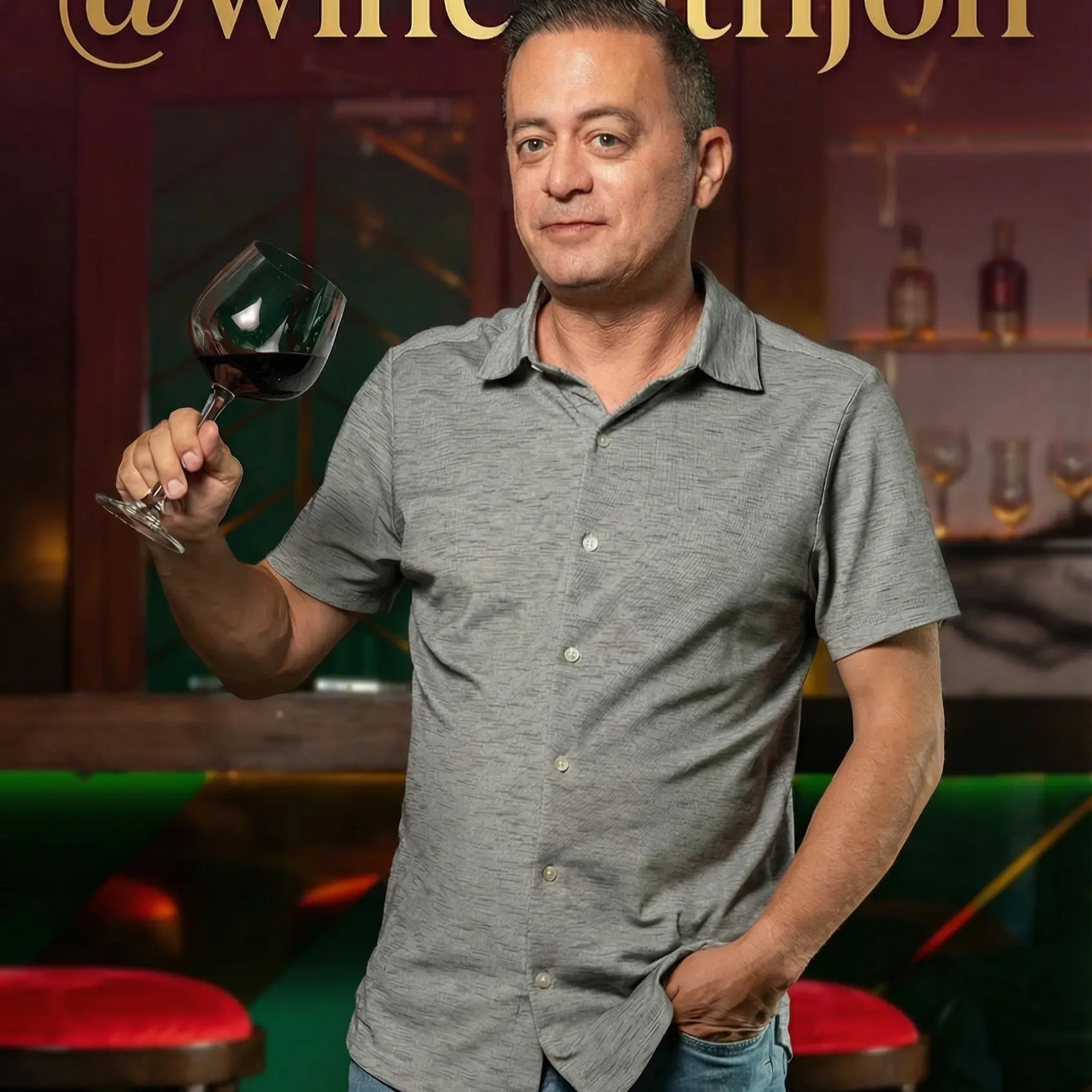
@WineWithJon
Jonathan FrutkinAudio
- Format:
- Podcast
- New episodes:
- Weekly
- Typical length:
- about 30 minutes
- Latest episode:
About this show
Young professionals want to love wine—but the industry keeps getting in its own way. @winewithjon gathers voices from across the business to figure out what needs to change. Winemakers, merchants, sommeliers, influencers, and educators share what’s working, what’s failing, and where we go from here. An industry conversation about wine’s future and how tech is changing everything. CEO of Preface Wine in Delray Beach, Florida.
Show details and episodes come from the publisher's public feed at anchor.fm. Last updated . Names, artwork and text belong to their publishers.
Cosmos
Similar by topic and creator
- The Noble Dram
Shares the topics Arts and Culture and Food. - Hello and Welcome
Shares the topics Arts and Culture and Food. - Speakin Birds
Shares the topics Arts and Culture and Food.
Similar shows




Explore more
Episodes
Caroline Fazeli, @winedinecaroline
· 38 min
Caroline Fazeli — @winedinecaroline — went from California to London at sixteen, to Oxford, where she was top taster at the 2009 Cambridge match, to Le Cordon Bleu and the WSETDiploma, and finally to Lyon, where for eight years she ran Lyon Wine Tastings for travelers. This week, the week of the Beaujolais Nouveau release: why French wine is easier to learn than Italian, why wine alone is a hard niche on Instagram, what France's strict alcohol advertising law means for creators, andthe honest story of Beaujolais Nouveau — the marketing boom, the bust, and the natural-wine revival that followed. Plus Fishwives of Paris, the podcast she co-hosts with Emily Monaco, and why she thinks the future of wine influence is people around a table. New episodes Tuesday mornings.
Not rated yetDaniel Valverde, Making Wine in the Peruvian Desert
· 34 min
Peru made wine before Chile and before Argentina — vines went in during the 1540s — and then history took it away: Spanish export restrictions, earthquakes, and a war with Chile that destroyed the southern vineyards. Peru turned to pisco and sweet wine. Daniel Valverde, the youngest of five kids raised by a single mother, left Peru at eighteen, worked his way from busboy to beverage director at The Palm in NewYork, and spent years promising a fellow waiter turned sommelier that they'd make Peruvian wine together one day. Now they are: Negra Criolla — the grape Americans call Mission — grown in the desert of Tacna near the Chilean border.This week: Peru's lost wine history, one grape with a dozen names, why he wants to do for Negra Criolla what Malbec did for Argentina, and why Peru's restaurants, from Central to Maido, are his way in. New episodes Tuesday mornings.
Not rated yetHas Fine Wine Hit its Price Floor?
· 10 min
Burgundy — the region everyone said was bulletproof — is down about a third from its 2022 peak. This week is aletter from London, where the fine wine secondary market actually lives: bonded warehouses, barcoded cases, and a screen called Liv-ex where the price of the world's most collected wine gets set. After three years of steady decline, thepeople who make markets in this stuff are saying the floor is in — not a boom, a floor. The most bids relative to offers since 2022. Bordeaux at a record-low share of the market, Italy at a record high, Piedmont posting double-digitgains in a single month. American buyers back after the 2025 tariff shock. And at Christie's sale of the Henry Tang cellar in Hong Kong, almost half the buyers were Millennials and Gen Z. Plus what I'm doing with my own cellar right now, and what I'm not. Not financial advice — a collector reporting from thecity where the price gets set. New episodes Tuesday mornings.
Not rated yetAnya Myalyuk, @winewithanya
· 30 min
Anya Myalyuk was born above the Arctic Circle, in a familywhere her father drank vodka and her mother drank Soviet champagne. She arrived in New York at twenty-two without real English, got waiting jobs by lying on her résumé, and started reading the wine lists. A manager pointed her at Gary Vaynerchuk; then she watched SOMM and decided that same night to find out howyou become one. What makes her different from every other accessibility creatoris what came next — she sold a premium California portfolio for one of the largest distributors in America, which means she can explain the part consumers never see: how a bottle actually lands on a restaurant list, and how much of that is relationships, placement and margin rather than what's in the glass. This week: why she defends certifications, what burned her out of the business, the year she stopped thinking about wine, why the Santa Cruz Mountains is the most underrated region in California, and the honest thing nobody says about European wine. New episodes Tuesday mornings.
Not rated yetUnbridled Enthusiasm
· 24 min
I was on a hillside in Napa, twenty minutes into geeking out about a vineyard, when my friend Chandler — whocould not care less about the Harlan family tree — started beaming. I asked her why. "I’m just excited to see YOU so excited." That’s this whole episode. She caught the feeling, not the facts. Matt Horkey’s mentor said it better than I can: wine needs less educators and more seducers. This week I make the casethat the industry has the sequence backwards — we hand people the textbook before we’ve played them the song. There’s the woman who quit wine after one question in a tasting room, the difference between performing expertise andsharing discovery, the winemaker with eighty perfect scores who describes his wine like a car crash into a chocolate shop, and why I hire for enthusiasm over credentials. Teaching creates students. Sharing creates friends. New episodes Tuesday mornings.
Not rated yetDoug Frost, Master of Wine and Master Somm
· 31 min
Doug Frost's uncle poured him a 1968 Louis Martini SpecialSelect Pinot Noir when he was fifteen — his first glass of wine ever. He told that story so often that Mike Martini eventually sent him a bottle of the same wine, which he used to ambush his aunt and uncle at dinner decades later. He has a degree in acting and directing, won his first wine contest by doing animpression of the restaurant's wine steward, and then sat the Master Sommelier and Master of Wine exams at the same time, which he says is not a good idea. He passed the theory first go and flunked the tasting. Today he's one of a handful of people alive holding both titles, buys wine for United Airlines, won an Emmy for a PBS wine show, and owns Echolands in Walla Walla. This week: what happens to aroma at altitude, why he chose Walla Walla over Napa, chillable reds nine years before they were cool, goats and sheep between the rows — and his flatrefusal to blame consumers for not buying the wine. When something doesn't sell, the trade says people need to be better educated. His answer: no, that's our fault. New episodes Tuesday mornings.
Not rated yetRay Isle, Food & Wine Magazine
· 40 min
Ray Isle's first real memory of wine is lying on a floor incollege while someone squeezed it into his mouth from a bag. The bottle that actually changed things was a Diamond Creek Volcanic Hill Cabernet at a dinner in the late eighties — first sip whatever, third sip what the hell is this. He was writing fiction at the time. What pulled him across was the stories: working harvest, he met a Santa Cruz Mountains vineyard manager who shot a deer, skinned it, wore the skin through the vineyard, and lost his whole crew when they decided he was a warlock. Now he's the executive wine editor at Food & Wine, the wine guy on TODAY, and the author of The World in a Wine Glass — 275 producer profiles built on the belief that knowing who made a wine changes how it tastes. We get into the Taco Bell test for what's actually artisanal, why he'd rather write about a $25 Rhône than a $700 Burgundy, the pricing gap driving young drinkers away, and which half of biodynamics he thinks is bonkers. New episodes Tuesday mornings.
Not rated yetThe $200 Million Mondavi Bet
· 18 min
How much would you spend on an idea that every analyst says is dying? This spring, Constellation Brands answered: two hundred million dollars. The Robert Mondavi Winery reopened in Oakville in April after a three-year renovation — at the exact moment Silicon Valley Bank was telling the wine industry the bottom was insight and nine million Americans had walked away from wine. This week’s essay is about why that bet makes sense. The bottom quartile of wineries is drowning; the top quartile is growing, and almost all of them are places you have tovisit. Jon traces that back to 1966, when Robert Mondavi looked at an American wine industry that was a national punchline and decided it wasn’t a quality problem — it was a pricing error — then opened his doors to the public and invented the pilgrimage economy. Sixty years later, somebody paid $200 million for the idea. New episodes Tuesday mornings.
Not rated yetJacqueline Coleman, @historyandwine
· 27 min
Jacqueline Coleman is a fourth-generation Miamian who hasbeen covering South Florida wine since 2013 — but the whole thing started in Virginia, where a DC day job and a weekend discovery that there was wine country forty-five minutes away turned into a blog called History & Wine. One of her early subjects was an ex-CIA officer who'd been part of the Bay of Pigs and decided in retirement to make wine. When she came home to Miami in 2013 she was the only young woman she came across in the business, and her mentordied before he could introduce her to the women he wanted her to meet. This week: what actually changed in Miami and when, why heat makes South Florida a leading indicator rather than a laggard on lighter and fresher wine, the line from a room of hospitality students that stuck with her — wine needs to tell adifferent story — and why guests at her bar have started asking for guidance instead of ordering what they always order. New episodes Tuesday mornings.
Not rated yetAmanda McCrossin - @SommVivant
· 36 min
This week: Amanda McCrossin —SommVivant — on why the wine industry doesn’t have a simplification problem, ithas a translation problem. Amanda is a certified sommelier who ran the wine program at PRESS in Napa and has since built an audience of roughly half a million people by making wine feel approachable without dumbing it down. She and Jon talk about her path from a non-drinking household outside Philadelphia to one of America’s great wine lists, why she started filming a winery a day in 2015, how she handles brand partnerships without losing trust,and what she notices standing quietly in an ordinary wine shop — the label doing all the marketing, 91 versus 92 deciding the sale, and shoppers who are moving faster than we think. Plus her fix: a wine store organized around how you actually live. New episodes Tuesday mornings.
Not rated yetThe Bourbon Reflex: Why American Men Won't Order the Wine They Actually Want
· 16 min
Four guys at a steakhouse order bourbon, an old fashioned, and a beer — and the guy who actually wants the Barolo orders bourbon anyway. This week's essay is about that hesitation. Wine is five thousand years old and was never gendered anywhere — until, in about forty years, American culture quietly stamped it pink. Jon walks through the numbers (only ~16% of American men who drink prefer wine; in France and Italy men out-drink women on it), the three forces that did it — marketing, media, and the culture of expertise — and what it's costing everyone, including the women it supposedly belongs to. The fix isn't camo labels and rugged fonts. It's de-gendering wine entirely, and giving everyone permission to not know yet. New episodes Tuesday mornings.
Not rated yetRajat Parr - Superstar Somm Turned Farmer
· 35 min
This week: Raj Parr — one of the most influential sommeliers America has produced — on why he left the dining room for the dirt. Raj ran the wine program for the Michael Mina Restaurant Group, co-founded Sandhi and Domaine de la Côte, helpedlead the push toward balance in California wine, and co-wrote the James Beard Award–winning Sommelier’s Atlas of Taste. Now he farms by hand at Phelan Farms in Cambria. He and Jon trace the improbable path — Calcutta to culinary school,65 rejection-adjacent job offers, a borrowed one-way ticket, and Larry Stone’s blind tastings — then the harder second act: regenerative farming, the one-shot-a-year math of winegrowing, and why the industry’s conversation has shifted from the cellar to the soil. New episodes Tuesday mornings.
Not rated yetA Thing of Beauty: Remembering Sam Neill
· 18 min
In 1993, a working actor planted five acres of pinot noir at the bottom of the world, in a region most people said was too cold to grow anything serious. His neighbors thought it was ahobby. Sam Neill died last month, and two completely different sets of obituaries ran for the same man — one for the movie star, one in the wine trade press. This week’s essay is about the secondone, and about the strange arithmetic of a grapevine: plant it today, get nothing for years, and the best fruit arrives long after you might. Which means nobody plants a vine for themselves. Then a story out of southern Ukraine — a winegrower tending vines with a rocket buried in a row of chardonnay — makesthe point unavoidable. Wheat feeds you this winter. A vine is a bet that there will be winters worth surviving for. New episodes Tuesday mornings.
Not rated yetYour Parents' Wine
· 23 min
What did your parents actually drink — not what they taught you about wine, but what was in the fridge? This week is a solo essay about that question, and the pattern it reveals: every generation rejects the wine its parents loved. Jug wine became Robert Parker's scores. The boomers' big Napa Cabs gave way to Gen X skepticism and then the millennial natural-wine rebellion. And now Gen Z, who aren't rejecting a style of wine so much as opting out of wine altogether. Jon walks through why that's happening, why chasing them with cans and edgy labels backfires, and what actually works instead — making space, and getting out of the way. The bottle changes. The table doesn't. New episodes Tuesday mornings.
Not rated yetKaren MacNeil, The Wine Bible
· 38 min
This week: Karen MacNeil —author of The Wine Bible, creator of WineSpeed, and founder of Come Over October — on the improbable road from a runaway teenager drinking 89-cent Bulgarian reds to the most decorated wine writer in America. Karen grew up poor in the Nevada desert, ran away at fourteen, and taught herself wine over the cheapest bottles in the shop. She landed in 1970s New York with six dollars, collected 325rejection slips before her first sale, and — to earn a seat tasting with the men who ran wine then — agreed not to speak for six years. She and Jon talk about the book she wished she’d had, why wine education got too standardized, Come Over October, and why wine belongs to well-being and connection, not theabstinence-vs-abuse binary. New episodes Tuesday mornings.
Not rated yetMichael Amorosia, @TheAmorosiaCellar
· 26 min
This week: Michael Amorosia — founder of The Amorosia Cellar and former frontman of the faceless hardcore band REACTIONS — on why “wine is failing the room,” and how to make it the move for the next generation. Michael went from covering his face on stage (so fans reacted to the music, not the image) to putting a face on a wine industry that’s been faceless forever. A whiskey guy who fell for wineon a delayed-honeymoon Napa trip, he now argues that wine has been turned into a test — credentials, vocabulary, performance — when it should be a bottle at the table that opens your night. He and Jon talk aspiration vs. accessibility, what the U.S. can learn from Europe, and how to build a room newcomers actually want to walk into. New episodes Tuesday mornings.
Not rated yetThe Arc of Life
· 27 min
The most personal essay Jon has shared on this show. It starts at a graduation — a giant fairground hall, his son crossing a stage on a monitor from thirty rows back, eighteen years condensed into a four-second walk. After the ceremony, Jon drove back to a Hilton Garden Inn next to a freeway because he'd sold the house. His ex-wife turned to him and said, "I don't know what to do." Neither did he. Out of that quiet came this essay — about the three stages of a life. The first: dreaming, pure desire for a life you haven't lived yet. The second: building — career, kids, marriage, the years you stop asking "what do I want?" and start asking "what do I need to do?" And the third — the one English calls "empty nest" and Spanish calls tercera edad — the stage without a real name, where the obligations lift and the dreams come back. Jon walks through all three using wine as the through-line: grape, barrel, bottle. He talks about law school, a freezing Maryland harvest, COVID-era Burgundy obsessions, his mother's three stages (Chicago, Cleveland, and an Arizona realtor's license with a biker boyfriend), Colombia and two-and-a-half-hour meals, a lake house he's building mostly as a trick to see his grandkids more — and a wine bar he didn't need, but wanted. This is the origin episode. The one that explains the person behind all the others. "The grape doesn't know it's going to be wine. The barrel doesn't know what it's building. But the bottle is where it all makes sense." Host: Jon Frutkin (@winewithjon) — lawyer turned collector turned wine bar owner, Preface Wine in Delray Beach, FL.
Not rated yetHillary Cole, Vineyards of War
· 38 min
This week: Hillary Cole — former Air Force intelligence officer and author of Vineyards of War — on what wine and warfare have always had in common.Hilary spent ten years in intelligence (a Russian linguist reassigned to counterterrorism on 9/11) before a glass of Barolo rerouted her life into wine. Now a French wine scholar living in Albania, she joins Jon to talk about reading a wine the way she once read a battlespace: why Champagne became the drink of celebration in a region leveled by war every century, theKosovo full-circle moment that bookended her two careers, and why she teaches beginners structure and history instead of tasting notes — because “tasting notes can’t give youhumanity.” New episodes Tuesday mornings.
Not rated yetKelli White, Napa Valley
· 38 min
This week: Kelli White — wine writer, decade-long sommelier, and director of education at Meadowood — on Napa as a conversion engine and why the way we talk about wine keepsturning newcomers away. Kelli went from a Howard Hughes Fellowship in neurogenetics to writing two of the most talkedabout wine books of the last decade: Napa Valley Then & Now, the encyclopedic history, andWine Confident, which argues there’s no wrong way to enjoy wine. She and Jon talk about what living among the growers taught her (wine is agriculture, full stop), why tasting-note “winespeak” makes people feel like they’re failing a test, and why a first trip to wine country might be the best thing that ever happens to a curious drinker. New episodes Tuesday mornings.
Not rated yetThe "Josh" Problem
· 21 min
Jon walked into a BMW dealership and put a deposit down on a car that hadn't arrived yet. He didn't need the salesperson to explain anything — the brand had spent decades showing him the ladder. Then he walked into his local Publix wine aisle and watched the whole system fall apart. Five hundred bottles. Five hundred unrelated labels. What no consumer can see is that many of those bottles are owned by the same companies — and that a ladder exists. Constellation owns Josh, Robert Mondavi, The Prisoner, and Schrader. Gallo owns Barefoot, Apothic, William Hill, and Orin Swift. Thearchitecture is already built. The industry just refuses to make it visible. Jon calls it the Josh Problem. In this essay, he walks through howMercedes, Rolex, and Tudor get this right; how LVMH actually does it in wine with Veuve Clicquot and Dom Pérignon; how Coca-Cola makes its portfolio legible under the exact same distribution constraints wine claims it can't overcome;who pays the price when the ladder stays hidden; and why the work of building it now falls to wine bars, retailers, sommeliers, and the people building places like Preface Wine. "Wine hides the ladders. And then we wonder why people feel lost. The ladders exist. Someone just needs to turn on the lights." Host: Jon Frutkin (@winewithjon) — lawyer turned collector turned wine bar owner, opening Preface Wine in Delray Beach, FL.
Not rated yet