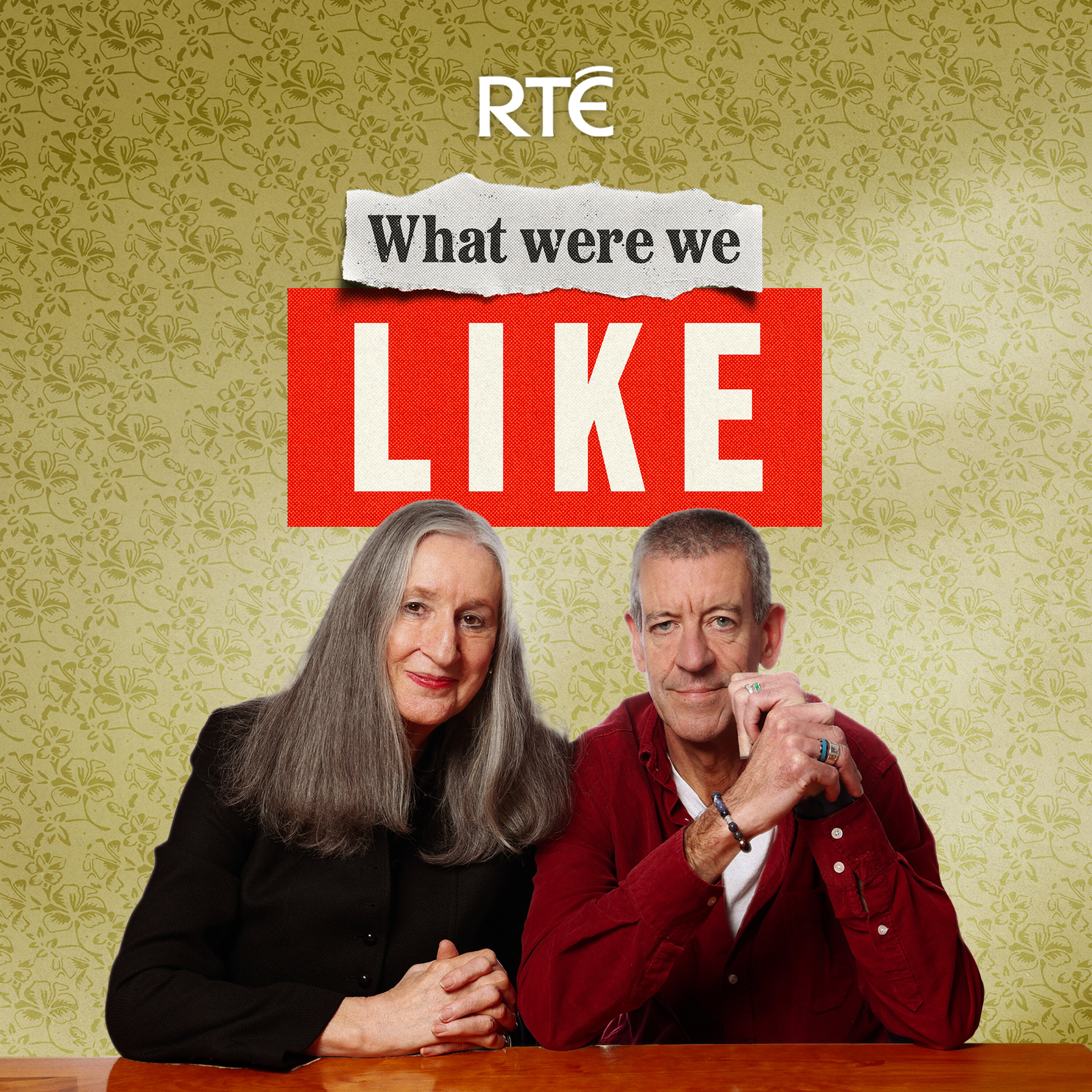
What Were We Like
RTÉAudio
- Format:
- Podcast
- New episodes:
- Weekly
- Typical length:
- about 45 minutes
- Latest episode:
About this show
Diarmaid Ferriter and Catriona Crowe bring us on a journey through the hidden histories, humanity and humour of our past.
Covers: Irish history, Irish civil war, Irish politics, 1913 lock out, michael collins, brendan behan, Irish social history, catholic church in ireland
Show details and episodes come from the publisher's public feed at omnycontent.com. Last updated . Names, artwork and text belong to their publishers.
Recently on this show
Summary of recent episodes, drawn from the publisher's feed.
This RTÉ podcast, presented by Diarmaid Ferriter and Catriona Crowe, looks at the lesser-known stories, people and humour of Ireland's past. Recent episodes cover the 1986 divorce referendum, the 1913 Lock Out, Brendan Behan, Michael Collins and the 1981 Stardust fire.
Cosmos
Similar in subject
- Drummer Seeks Musicians: The Making of U2
Both cover: irish politics, irish history
Similar shows



Explore more
Episodes
The 1986 Divorce Referendum
· 38 min
On the 26th June 1986, Ireland went to the polls to vote in the first ever referendum on Divorce. The referendum was a stark illustration of the moral civil wars that were going on at the time in Ireland. Early opinion polls suggested that Ireland would vote yes to divorce. However, the campaign was marked by bitter division with claims that divorced women would be left on the scrap heap. This week on What Were We Like, we explore the history of divorce in Ireland and the 1986 Divorce referendum. See omnystudio.com/listener (https://omnystudio.com/listener) for privacy information.
Not rated yetThe 1913 Lock Out - Part 2
· 50 min
Description: The 1913 Lock Out is in full effect and workers are faced with an urgent question: how will they feed their families? With the emergence of the 'Save The Kiddies' scheme - which saw children temporarily relocated to homes in the UK - and the establishment of large soup kitchens helmed by activists like Constance Markievicz and Rosie Hackett, the Catholic Church takes steps to ensure the religious piety of its members, at all costs. On this week’s 'What Were We Like', we tell the story of the 1913 Lock Out and the legacy of this mass trade union effort. See omnystudio.com/listener (https://omnystudio.com/listener) for privacy information.
Not rated yetThe 1913 Lock Out - Part 1
· 46 min
The 1913 Lock Out dispute was the biggest clash between capital and labour, between employers and trades unions, between rich and poor, ever seen in Dublin city. It lasted for 5 months, saw pitched battles in the streets of the city between newly unionised workers and police resulting in deaths and many injuries. The Lock Out saw the emergence of figures like businessman and press baron William Martin Murphy who bitterly opposed the charismatic trade union leader James Larkin. In 1913, Dublin was regarded as one of the worst slums in Europe, with 20,000 families living in single-room dwellings. Unskilled workers, led by Larkin, went on strike to demand higher wages. William Martin Murphy, the owner of the Irish Independent, was determined to stop Larkin and gathered other employers to join him in sacking workers who joined Larkin’s union and lock them out. The Lock Out lasted from August 26th 1913 to January 18th 1914 and brought workers to the brink of starvation. On this week’s What Were We Like, we tell the story of the 1913 Lock Out. See omnystudio.com/listener (https://omnystudio.com/listener) for privacy information.
Not rated yetBrendan Behan – Dublin's Wild Literary Genius
· 56 min
During his short life from 1923 to 1964, Dubliner Brendan Behan achieved both fame and infamy, both at home and abroad, on the back of his writing talents and his very public battle with alcoholism. Today we want to talk about one of Ireland’s greatest writers Brendan Behan who continues to have a massive influence on Irish culture today. In November 1946, Behan, aged just 16, arrived in Liverpool with a suitcase of explosives, declaring: ‘My name is Brendan Behan. I came over here to fight for the Irish Workers’ and Small Farmers’ Republic, for a full and free life, for my countrymen, North and South, and for the removal of the baneful influence of British Imperialism from Irish affairs. God save Ireland.’ This set off an extraordinary chain of events that would lead Behan to becoming a global celebrity because of his wit and writings, from The Quare Fellow to the Hostage to The Borstal Boy. Behan was a heavy drinker and prone to self destructive heavy drinking. A lifelong battle with alcoholism came to an end when Brendan Behan died on the 20 March 1964. However, he left behind an incredible legacy and one was of Dublin’s last great characters. See omnystudio.com/listener (https://omnystudio.com/listener) for privacy information.
Not rated yetMichael Collins - Part 3
· 46 min
On the 22nd of August 1922, Michael Collins was shot dead in Béal Na Bláth, County Cork. His death at just 31 ensured he would become one of Ireland’s most iconic figures, forever frozen in time. This week on What Were We Like, we explore the complicated legacy of Michael Collins. We also look at the significance of the revival of interest of Collins in recent years and the impact Neil Jordan’s film had on his legacy, despite taking some poetic licence. See omnystudio.com/listener (https://omnystudio.com/listener) for privacy information.
Not rated yetMichael Collins - Part 2
· 53 min
Michael Collins is now one of the most powerful men in Ireland. But events that will tear Ireland apart and lead to his brutal assassination in Cork are already set in train. In 1921 he is sent by De Valera to London to negotiate with the British on what will become the Anglo-Irish Treaty. With his striking good looks and his fierce reputation, London is gripped by "Collins mania". But on December 6th 1921, when Collins signs the Treaty, he is said to have remarked: “I'm signing my actual death warrant.” Within months, a brutal civil war breaks out across the country, and just over nine months after signing the Treaty, Collins is killed in an ambush at Béal Na Bláth on 22nd August 1922. His death remains one of the most shocking moments in Irish history resulting in endless speculation and conspiracy theories on what happened on the fateful day. See omnystudio.com/listener (https://omnystudio.com/listener) for privacy information.
Not rated yetMichael Collins - Part 1
· 41 min
On the 22nd of August 1922, Michael Collins, the Commander in Chief of the National Army was shot dead. He was just 31. Almost immediately the myth making around Michael Collins began, starting with the last words he’s alleged to have uttered. But what is the real legacy of Michael Collins? He was a man who operated as a politician but was capable of ruthless violence. On this week’s What Were We Like, we talk about Michael Collins, a man that has captured the imagination of the Irish public, film makers, artists and politicians like no other figure in modern Irish history. See omnystudio.com/listener (https://omnystudio.com/listener) for privacy information.
Not rated yetStardust – From national tragedy to national scandal
· 49 min
In the early hours of February 14th 1981, a fire ripped through the Stardust Nightclub in Artane in Dublin. 48 people, aged between 16 and 27, die in the tragedy. It is one of the worst fires, in terms of loss of life and significant injury, in the State’s history. In 1982 a Tribunal controversially found that the fire was "probably caused deliberately" despite no evidence. For 43 years, the families fought for justice for the 48 people who died and to get answers how their love ones died. This is the story of Stardust. See omnystudio.com/listener (https://omnystudio.com/listener) for privacy information.
Not rated yetSean O’Casey – The Irish Rebel playwright
· 42 min
He was one of Ireland’s greatest and most controversial playwrights. Sean O’Casey’s remarkable life began in the slums of Dublin and took him to the biggest stages in the world, including the Abbey Theatre. His work caused riots in Dublin and caused protests around the world, from Texas to Berlin to London. O’Casey made enemies of the Church and the Censors, forcing him to choose self-imposed exile in England. Through his plays, O’Casey asked fundamental questions about violence and challenged the founding myths of the new Irish state. They were questions a new Ireland wasn’t ready for. See omnystudio.com/listener (https://omnystudio.com/listener) for privacy information.
Not rated yetThe Ballyseedy Massacre (Part 2)
· 32 min
After committing one of the worst atrocities in the Irish Civil War, the State attempts to cover up its role in the massacre. As “Terror Month” in Kerry continues, further atrocities are carried out with more prisoners blown up by landmines. However, the man who gave the order at Ballyseedy, Paddy O'Daly, remains unrepentant, stating: “No one asked me to take my kid gloves to Kerry and I didn’t take them.” Diarmaid and Catriona discuss the fall out from Ballyseedy, how the truth finally emerges, and why the Dáil record still contains the cover-up. See omnystudio.com/listener (https://omnystudio.com/listener) for privacy information.
Not rated yetThe Ballyseedy Massacre (Part 1)
· 30 min
On the 7th of March 1923, nine anti-Treaty prisoners were taken to a field in Kerry, tied to a landmine and blown up. It was one of the most shocking events of the Irish Civil War and became known as the Ballyseedy Massacre. The State immediately tried to cover it up but incredibly, one man survived and his witness account revealed just how brutal the civil war had become. Diarmaid and Catriona recount the whole affair, and also the wider conflict in Kerry at the time, which is often referred to as "Terror Month". See omnystudio.com/listener (https://omnystudio.com/listener) for privacy information.
Not rated yetThe Pope's Visit of 1979
· 39 min
John Paul II, the "rock star" Pope took Ireland by storm in 1979, and millions came out to see him. (Everyone except Catriona, who went to Donegal in a sulk but kept an eye on proceedings through the television). This was an iconic moment, and everyone was swept away by his good looks, his "deep baritone" voice, and his ability to connect with young people. Yet his abilities as a showman belied a deep conservatism, particularly on women's issues, and his visit turned out to be a last hurrah for the Catholic Church before it was rocked by child sexual abuse scandals, the rise of feminism and plummeting mass attendances in later years. See omnystudio.com/listener (https://omnystudio.com/listener) for privacy information.
Not rated yetBest of What Were We Like (Part 2)
· 49 min
RTÉ's podcast intern Arran returns with the second instalment of his favourite parts of What Were We Like. This time around, grumpy Patrick Kavanagh, "airhead" Ronald Reagan, and the insertion of the Eighth Amendment into the Constitution all feature. This is Arran's last selection - he's off to Electric Picnic on Thursday where he'll be boring his pals with his newfound knowledge of history. Diarmaid and Catriona are back next Monday, 31 August. See omnystudio.com/listener (https://omnystudio.com/listener) for privacy information.
Not rated yetBest of What Were We Like (Part 1)
· 39 min
Diarmaid and Catriona are on holidays, so RTE's podcast intern, Arran has selected some of his favourite parts of What Were We Like so far. Bobby Sands, The Contraceptive Train, and John Charles McQuaid all feature in the first part of this "Best of" series. Part 2 of Arran's selections will be out next week, and Diarmaid and Catriona return on Monday 31 August. See omnystudio.com/listener (https://omnystudio.com/listener) for privacy information.
Not rated yetWhat Were We Like: Back in Two Weeks
· 30 sec
What Were We Like is on holidays for the next two weeks. We'll be back with a podcast about the visit of Pope John Paul II to Ireland in 1979, and that will come out on Monday the 24th of August. See omnystudio.com/listener (https://omnystudio.com/listener) for privacy information.
Not rated yet1980s Ireland: Moving Statues
· 31 min
Ireland was gripped by a bizarre phenomenon in the summer of 1985: sightings of moving statues of the Virgin Mary. Tens of thousands of people flocked to villages in Kerry - and elsewhere - to catch a glimpse of these monuments, which eyewitnesses claimed would move, beckon and even undergo strange facial transformations. Diarmaid and Catriona chart this crazy story, look at how it challenged the Catholic Church, and also trace the history of holy apparitions in Ireland. See omnystudio.com/listener (https://omnystudio.com/listener) for privacy information.
Not rated yet1980s Ireland: The Kerry Babies Case
· 44 min
In 1985, the body of a newborn baby washed up on a beach in Cahersiveen, Co Kerry, stabbed to death. What followed was one of the most infamous incidents in the history of An Garda Síochána. Diarmaid and Catriona trace the botched Garda investigation into the baby's death, carried out by the notorious Heavy Gang, the shocking Tribunal of Inquiry which followed, and how it became a watershed moment in the treatment of women in Ireland. See omnystudio.com/listener (https://omnystudio.com/listener) for privacy information.
Not rated yet1980s Ireland: The Eighth Amendment
· 36 min
Today, Diarmaid and Catriona kick off a new series focusing on Ireland in the 1980s. This was a decade of great political instability, with three general elections alone happening between 1981 and 1982. Unemployment and emigration were high. Heroin took hold in Dublin and spread around the country. But one of the most polarising issues of all was abortion. In the first of this series, What Were We Like looks at how the extremely controversial Eighth Amendment came to be inserted into the Constitution in 1983 - and remained there until its repeal in 2018. See omnystudio.com/listener (https://omnystudio.com/listener) for privacy information.
Not rated yetThe brilliant poetry and turbulent life of Patrick Kavanagh
· 45 min
Monaghan born Patrick Kavanagh was a notorious presence in Dublin for much of his life. Broke, drunk and often bitter, he boozed in the bars around Grafton Street, clashing with the likes of Brendan Behan and railing against the literary establishment. Always an outsider, he nonetheless transformed Irish poetry by focusing on the ordinary aspects of rural Ireland, paving the way for the likes of Seamus Heaney, and writing perhaps the greatest love song of all time, Raglan Road. See omnystudio.com/listener (https://omnystudio.com/listener) for privacy information.
Not rated yetBobby Sands, Margaret Thatcher, and the 1981 hunger strikes
· 46 min
On 5 May 1981, 26-year-old Bobby Sands became the first of ten IRA hunger strikers to die at the Maze Prison, changing the course of history in Northern Ireland. In this episode, Diarmaid and Catriona assess his life, his status as a Republican icon, and how he impacted the career of his chief antagonist, British Prime Minister Margaret Thatcher among others. See omnystudio.com/listener (https://omnystudio.com/listener) for privacy information.
Not rated yet