

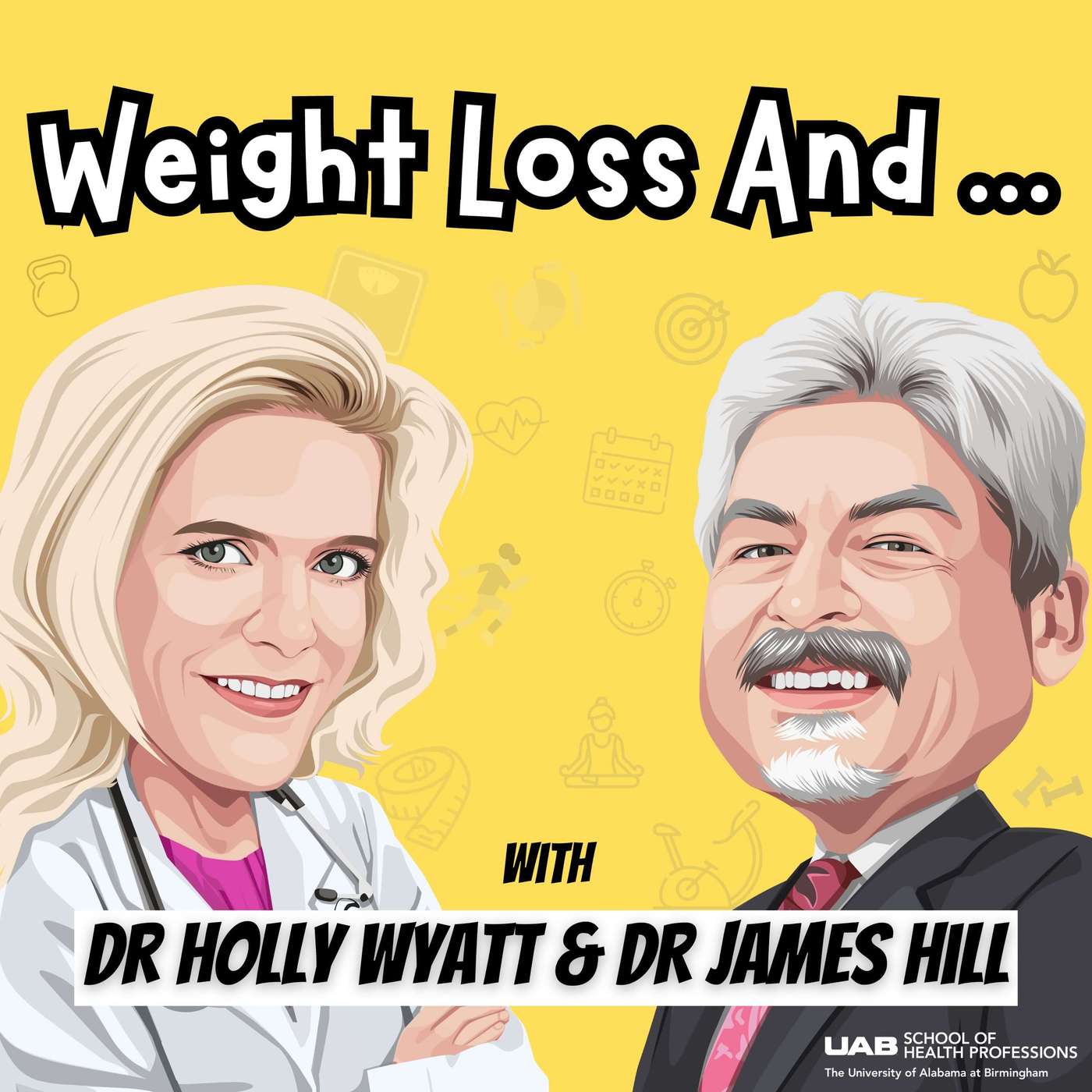
Weight Loss And ...
- Format:
- Podcast
- New episodes:
- Weekly
- Typical length:
- about 45 minutes
- Latest episode:
About this show
Your go-to hangout for everything weight loss… and beyond! “Weight Loss and…” is brought to you by the University of Alabama at Birmingham (UAB) and hosted by seasoned experts in weight management, Dr. James Hill and Dr. Holly Wyatt.
We’re your friendly guides through the maze of weight loss, but with a fun twist. We’re not here to preach the latest fad diet or promise a miracle workout. Instead, we’re all about embracing the journey, acknowledging there’s more than one way to hit your health goals, and having a good laugh while we’re at it.
We get it: weight loss can be tough, and sometimes pretty serious business. But why can’t it also be enjoyable? With a side of humor, we’ll bring you science-backed insights, real-life stories, and some hard truths. (Spoiler alert: there’s no magic answer - but that doesn’t mean we can’t find what works best for you.)
“Weight Loss and…” is your inclusive space to explore, question, and learn — and to feel part of a community along the way. This isn’t just about shedding pounds. It’s about gaining perspective, building better habits, and enjoying the ride.
So if you’re up for honest conversations about weight loss - spiced with a little science and a whole lot of fun - pull up a chair, plug in those earbuds, and let’s see where this journey takes us.
Covers: weight loss, obesity medicine, glp-1 medications, nutrition science, exercise science, behavioral psychology, pharmacy safety, diet and evolution, resistance training, health and wellness
Show details and episodes come from the publisher's public feed at feeds.transistor.fm. Last updated . Names, artwork and text belong to their publishers.
Recently on this show
Summary of recent episodes, drawn from the publisher's feed.
A podcast from two weight management experts offering a light-hearted, science-based look at losing weight and building habits. Recent episodes explore muscle loss and resistance training, what happens after reaching a goal weight, and how GLP-1 medications are changing treatment, including questions about movement and diet quality.
Cosmos
Similar in subject
- Fat Science
Both cover: obesity medicine, glp-1 medications, nutrition science - Ben Bikman
Both cover: glp-1 medications, nutrition science, weight loss - The Dr. Joey Munoz Show
Both cover: resistance training, health and wellness, weight loss
Similar shows





Explore more
Episodes
How Hype and Common Sense Shape Our Eating Choices with Tamar Haspel
· 52 min
For 40 years, every time nutrition has found a new villain, the food industry has handed us a new label to go with it: non-fat, no GMOs, gluten-free, no seed oils, and now, non-ultra-processed. We have more experts, more studies, and more food rules than ever before, so why does standing in the grocery aisle still feel like such a guessing game? Join Holly and Jim as they sit down with Tamar Haspel, the James Beard Award-winning Washington Post columnist behind Unearthed and author of To Boldly Grow, to pull apart the ultra-processed food debate and ask whether today's labels are actually helping us eat better or just making us easier to market to. Tamar doesn't just write about food from behind a desk: she gardens, fishes, raises chickens, and runs an oyster farm on Cape Cod, and she brings three decades of reporting, real skepticism, and zero patience for diet cranks to the conversation. You'll hear why the food world keeps repeating the same mistake, what a cage full of B.F. Skinner's pigeons can teach us about our relationship with food, and what's really driving overeating once you strip away the marketing. Discussed on the episode: - The decades-old pattern that explains why every new food "villain" feels eerily familiar - The bizarre pigeon experiment that reveals why we're so convinced certain foods are "good" or "bad" for us - Why a bowl of crushed cereal proved more about overeating than years of processed-food headlines - The blunt case for why "everything in moderation" might be the most useless diet advice out there - The one-sentence grocery store rule that could replace almost every food label you've ever side-eyed - How GLP-1 medications could end up reshaping the entire food industry, not just individual waistlines - The "healthy" nutrient claim, Tamar says, is wildly overrated and the snack everyone blames for something it's not even guilty of
Not rated yetThe Science and Realities of Long-Term GLP-1 Use
· 50 min
Losing weight on a GLP-1 medication can feel like magic until the scale stops moving. For almost everyone on these drugs, there comes a moment when the rapid progress slows, then stalls completely. Is the medication failing? Has your metabolism adapted? Did you do something wrong? For most people, that moment feels like a problem. It isn't. Join Holly and Jim as they unpack one of the most misunderstood parts of the GLP-1 journey: the shift from losing weight to keeping it off. You'll discover why a stalled scale is actually a sign the medication is doing exactly what it's supposed to do, and why "maintenance" is a completely different physiological state than "weight loss." One that comes with its own rules. Along the way, you'll pick up science-backed (and some still-unanswered) guidance on nutrition, muscle, bone health, and motivation for the long haul, plus a clear answer to a question Holly says she gets all the time: Are they against staying on these medications long-term? Discussed on the episode: - Why hitting a plateau on a GLP-1 is good news, not a sign the drug has stopped working. - The blood pressure pill comparison that reframes what people call "drug resistance" - Why nutrition may matter even more, not less, once weight loss stops - Whether you actually need to exercise to keep weight off on a GLP-1 (the honest answer might surprise you) - The bone health risk in younger women that's getting far less attention than muscle loss - Why are dose-tapering and switching strategies being called the "Wild West" of GLP-1 care - A New York Times claim about these medications "rewiring the brain" and what that could mean long after you stop. - How to find motivation once the scale refuses to budge Have a question or a success story? Send it in. Holly and Jim read every one, and they're especially looking for listener stories about navigating weight loss maintenance.
Not rated yetThe Hidden Influence of Community and Environment with Christina Economos
· 49 min
What if the biggest obstacle to your health isn't your willpower, it's your zip code? Most of us have been raised to believe that weight and health come down to personal choices: what you eat, how much you move, how disciplined you are. But what if the deck has been stacked against millions of Americans before they ever make a single decision? This week, Holly and Jim sit down with Dr. Christina Economos, Dean of the Friedman School of Nutrition Sciences and Policy at Tufts University, to explore one of the most important and most overlooked dimensions of the obesity epidemic: the environments we live in. With decades of groundbreaking research behind her, including the landmark Shape Up Somerville study, Dr. Economos makes a compelling case that lasting health change can't happen one person at a time. And with GLP-1 medications reshaping what's possible for individual weight loss, the conversation has never been more urgent. Does community still matter when we have powerful new treatments? Dr. Economos has a clear answer, and it just might change how you see your own role in the bigger picture. Discussed on the episode: - The landmark study that proved community-wide obesity prevention actually works in the real world, and the surprising ripple effect it had beyond the children involved. - Why your zip code may predict your health outcomes nearly as powerfully as your genetics - The hidden forces in your neighborhood that are quietly shaping what you eat and how much you move, often without you realizing it - What a food environment assessment in the Mississippi Delta revealed perfectly captures the challenge millions of Americans face daily - Why fixing schools alone won't fix childhood obesity, and what actually needs to happen instead - The honest answer to how much of the obesity epidemic is biology versus environment (hint: it's not a clean split) - The key ingredients, Dr. Economos says, every successful community health intervention must have, and the #1 mistake researchers keep making - How GLP-1 medications and community health are more connected than you might think - What "spark plugs" are, why every successful health movement has had them, and whether you could be one - Real U.S. communities that are getting this right and what they're actually doing differently - Practical steps anyone can take right now, even if your environment is working against you
Not rated yetThe Rise and Fall of Popular Diets Over 100 Years
· 46 min
If you've spent years hopping from one diet to the next: low fat, then low carb, then keto, then intermittent fasting, you're not alone, and you're not failing. The truth is, the diet world has been cycling through the same promises, the same villains, and the same disappointments for nearly a hundred years. And most of us never stop to ask why. Join Holly and Jim as they do something they've never done before on the show: step back and take a decade-by-decade look at almost 100 years of dieting history. From the 1930s to the GLP-1 era of today, they trace how we went from counting calories to carnivore diets and what it all actually taught us (or didn't). This one is equal parts fascinating, a little humbling, and surprisingly fun. Whether you're a diet history nerd or just someone who's tired of starting over, this episode will change the way you think about every diet you've ever tried. Discussed on the episode: - The three-category system Holly and Jim use to classify every diet, and why one category might describe your current eating plan - The diet from the 1930s that your favorite wellness influencer is basically still selling today - Why the decade that got everyone obsessed with fat-free foods may have actually made obesity worse - The weight loss medication that came before GLP-1s, and the dramatic reason it was pulled from the market - Which diets from the last 100 years actually have the science to back them up - The rapid-fire verdict: best diet, biggest mistake, and most underrated program of the century - What GLP-1 medications are changing about the way we think about diets, and why Holly has one big worry about where this is all heading - Jim's closing thought that reframes everything you think you know about why diets succeed or fail
Not rated yetWhy Dietitians Matter More Than Ever with Maha Tahiri
· 45 min
Millions of people are now taking GLP-1 medications and losing weight, but is eating less the same as eating better? The answer, according to today's guest, is a resounding no. And almost nobody in medicine, food, or public health is talking seriously about what happens when appetite disappears, but nutritional needs don't. Join Holly and Jim as they sit down with Dr. Maha Tahiri, a nutrition scientist, food industry strategist, and founder of Nutrition Sustainability Strategies, for one of the most eye-opening conversations in the GLP-1 era. Maha has spent decades at the crossroads of nutrition science, public health, and food innovation, and she's now helping companies around the world rethink what it means to nourish a consumer who's eating dramatically less. Her new company, S2B, is building a strategy for the GLP-1 era and beyond, and she's asking the questions that urgently need answers. This episode will change how you think about GLP-1 medications, food, and what it truly means to be well-nourished. Discussed on the episode: - Why eating less on GLP-1s does NOT mean you're eating better and the nutritional crisis hiding in plain sight - The alarming statistic about how many GLP-1 users are falling short on fiber, protein, and key micronutrients - Why Maha calls what's happening to GLP-1 users "medically induced malnutrition" and why that phrase should get your attention - The one behavior Holly says is now more important on GLP-1s than ever before (not what most people expect) - Why fiber deserves its own strategy and why lumping it in with protein is a mistake. - The three phases of GLP-1 use that should shape everything you eat - What a strange debate in Botswana had to do with Maha's entire career pivot - The unexpected food category that's actually thriving because of GLP-1 users - Why the food industry may owe pharma a thank-you and what it needs to do with its second chance - The role AI is now playing in nutrition advice, and why Maha thinks that's actually good news - Maha's rapid-fire picks: the most underrated nutrient, the most overrated trend, and the one food she'd put in every kitchen.
Not rated yetWhat Comes After GLP-1 Success with Ken Fujioka
· 43 min
What if the medications changing everything about obesity treatment are also creating problems nobody saw coming? We’re living through a genuine before-and-after moment in obesity medicine. Drugs that once seemed like science fiction are now producing 20, even 25% weight loss in real patients. But the questions piling up are just as staggering as the results: What happens to your muscle? Your bone? Your sense of self? And what happens when the medication stops? Holly and Jim sit down with Dr. Ken Fujioka, an endocrinologist, director of the Nutrition and Metabolic Research Center at Scripps Clinic, and one of the very first physicians to build an entire career around treating obesity, long before it was popular or even respected. He’s run over 100 clinical trials, treated thousands of patients a month, and watched this field go from Fen-phen clinics to GLP-1 breakthroughs. If anyone has the perspective to separate the genuine revolution from the hype, it’s Ken. This episode is a masterclass in what actually happens in the exam room, not in a clinical trial, not in a headline, but with real patients facing real tradeoffs. Ken is refreshingly practical, deeply experienced, and not trying to win any argument. He’s just trying to help people build healthier lives in the middle of one of the fastest-moving moments medicine has ever seen. Discussed on the episode: - Why a shortage revealed a danger nobody was talking about, and why emergency rooms are still seeing the consequences - The patients who are actually reaching their goal weight for the first time ever (and what that creates as the new problem to solve) - What Ken tells patients who want to reduce or stop their medication, and the pattern he keeps seeing a few months later. - The one group of patients he’s seen keeps the weight off without staying on the drugs, and what might explain it. - Why losing weight faster is one of the biggest mistakes being made right now, and what the bariatric surgery literature has been telling us for years - How Ken decides which medication to prescribe and why insurance coverage is always the first question - The muscle loss conversation: why it’s like pulling teeth, and the one thing he’s considering making non-negotiable - What the next generation of obesity drugs looks like, and the hormone that once seemed like a crazy idea that now has Ken most excited - His rapid-fire answers: the most underrated obesity treatment tool, the biggest mistake clinicians make, and the one thing patients should protect above everything else - The single thing Ken hopes every listener walks away remembering
Not rated yetWhat the Nutrition Guidelines Still Haven't Caught Up To with Arne Astrup
· 44 min
Everyone has been burned by nutrition advice that completely reversed itself a few years later. Eggs were dangerous, then essential. Butter was poison, then practically a health food. Fat was the enemy until we realized what replaced it might have been even worse. If you've ever thrown up your hands and wondered whether nutrition scientists agree on anything, you're not alone. What if the confusion isn't just about changing science but about how nutrition guidelines are made, who influences them, and why the U.S. and Europe keep landing in different places? In this episode, Holly and Jim sit down with one of the world’s most influential nutrition scientists, Dr. Arne Astrup, to pull back the curtain on decades of dietary dogma, trace how some of our biggest nutritional mistakes happened, and explore where the science is actually heading. Dr. Astrup has chaired the Nordic Nutrition Recommendations, led one of Europe's top nutrition research departments, and published over 700 scientific papers. He's also someone who has never been afraid to challenge the consensus, long before it was popular to do so. If you want to understand why nutrition science feels so chaotic, and what you should actually be eating, this conversation is your roadmap. Discussed on the episode: - The surprising historical event that set off decades of misguided dietary advice, and the real culprit that was overlooked - Why the margarine push that replaced butter may have done far more damage than the food it was meant to replace - The simple shift in thinking that makes navigating nutrition less complicated, not more - Why Dr. Astrup says we should stop talking about saturated fat entirely - The counterintuitive truth about full-fat cheese, yogurt, and eggs, and what the latest U.S. dietary guidelines finally got right - A famous olive oil "fact" that will make you question everything you thought you knew about saturated fat - Why the popular ultra-processed food classification may be doing more harm than good, and what a Harvard professor says is the real problem ingredient. - The hidden nutritional crisis quietly unfolding among people on GLP-1 medications - What industry-funded nutrition research actually looks like, compared to publicly funded studies (the answer may surprise you) - Rapid fire: the most misunderstood food in America, the one thing Americans obsess over that barely matters, and the health food Dr. Astrup is most skeptical about
Not rated yetIt Worked for Them. Will It Work for You? How to Actually Use Anecdotes
· 37 min
You've heard it before. A friend, a coworker, or your own mother swears by something, and the proof is standing right in front of you. She lost 30 pounds. You've seen it. You know it's real. So why aren't you doing it too? Here's the thing: personal success stories are powerful precisely because they're real. But real doesn't mean the whole picture. And in the world of weight loss, acting on the wrong part of a true story can quietly pull you off track, not because you were fooled, but because no one told you what was missing. In this episode, Holly and Jim break down the science of why anecdotes feel so convincing, and give you a practical framework for turning "my friend lost 30 pounds doing this" into something you can actually use without falling into the traps that catch almost everyone. Discussed on the episode: - The six ways a real, true story can still mislead you, and the scientific terms that explain exactly why - Why the people who didn't get results are almost never the ones you hear from - The surprising reason your friend may have lost weight on keto that had nothing to do with keto - What apple cider vinegar actually does (and doesn't do) for weight loss - The questions Holly always asks when a patient walks in, swearing by something new - How to respond when someone you trust is completely convinced that something worked without damaging the relationship - When you should sit up and pay attention to an anecdote, and when to be suspicious - The one red flag that should always make you pause before trying something new
Not rated yetHow Regular Exercise Positively Influences Depression
· 39 min
Exercise is good for you. But good for your mood? Your brain? Science has now weighed in, and the answer might surprise you more than you'd expect. Join Holly and Jim as they dig into the most comprehensive review ever conducted on exercise and depression, a sweeping 2026 Cochrane analysis of 73 randomized controlled trials and nearly 5,000 people. This isn't feel-good advice; it's hard data. Discover why taking action through movement can benefit your mental health, no matter your role or experience, and why it's time to prioritize exercise for your mind. Along the way, Holly and Jim go beyond the science to tackle the real challenge: knowing exercise helps is one thing, but actually doing it when you're at your lowest is another. They share practical, compassionate strategies for getting off the couch even when depression is telling you not to. Discussed on the episode: - How exercise stacks up against antidepressants (the results will raise your eyebrows) - Why "moderate" is actually a powerful word when it comes to science - The reason you can't just tell a depressed person to "go for a walk" and what to say instead - Why you should need a doctor's note not to exercise - The surprising truth about whether more intense exercise is actually better for your mood - Holly's "10-minute rule" - a simple trick for when you truly cannot get off the couch - What does it mean if you feel like you "need" exercise to feel okay - The one thing Jim wishes every doctor would bring up when treating depression Resources & Links Mentioned: - Cochrane Review (2026) on exercise and depression (https://www.cochrane.org/evidence/CD004366_exercise-effective-treating-depression)
Not rated yetTen Things Lean People Assume About Weight Loss
· 47 min
Have you ever wondered why the same advice that worked perfectly for your friend did absolutely nothing for you? What if the problem isn't your effort, your commitment, or even the advice itself, but rather the body you're living in? Holly and Jim tackle one of the most misunderstood topics in weight management: the gap between what feels obviously true and what's actually universal. If you've never struggled with your weight, some things just seem like common sense. However, for millions of people, this "common sense" doesn't align with their lived experience, and there's a biological reason why. This episode represents a significant shift in perspective that could alter the way you perceive yourself, your struggles, and the people around you. Whether you've battled your weight your whole life or you've never given it much thought, this conversation will challenge what you think you know and open the door to something far more useful than judgment. Discussed on the episode: - The one word that explains why weight loss advice works for some people and completely fails others - Why "just eat less and move more" is technically correct and almost entirely unhelpful. - What a yogurt and an old medication taught Holly about how different bodies really are - The concept of "food noise" and why some people can't even imagine what it feels like - Why the number on the scale might be the worst goal you can set - What the new generation of GLP-1 medications is revealing about biology that we couldn't see before - How your metabolism is like a thumbprint and what that means for your weight loss strategy - The uncomfortable truth about why well-meaning advice from lean people often misses the mark
Not rated yetExercise Isn't What You Think It Is Anymore with Renee Rogers
· 47 min
For decades, the message has been simple: if you want to lose weight, you need to exercise more. But what happens when a medication can do the heavy lifting for you? GLP-1 drugs are reshaping everything we thought we knew about weight loss, and that means the role of exercise is changing, too. Not disappearing. Changing. Join Holly and Jim as they sit down with Dr. Renee Rogers, senior scientist at the University of Kansas Medical Center and expert in biobehavioral lifestyle interventions, to explore this new frontier. If you've ever struggled to stick with exercise, felt guilty for not doing enough, or wondered whether movement even matters now that medications like Ozempic and Wegovy exist, this conversation was made for you. The answer isn't what you'd expect. Exercise isn't less important in the age of GLP-1s. It's more important just for entirely different reasons. Discussed on the episode: - The one word that could completely transform your relationship with exercise - Why losing muscle during weight loss isn't always the crisis people think it is (but also why you shouldn't ignore it) - The surprising link between fatigue on GLP-1 medications and physical activity levels - Why cardio vs. strength training is the wrong question to ask (and what to ask instead) - The exercise myth Dr. Rogers would delete from the internet forever - How the timing of your GLP-1 dose might affect when you should work out - What to focus on after you've hit your goal weight
Not rated yetWhy Your Body Fights After Weight Loss with Rudy Leibel
· 49 min
You hit your goal weight. Then, hunger crept back in, your energy dropped, and the scale rose. Sound familiar? You're not broken, your body is built for this. In this episode, Holly and Jim sit down with Dr. Rudy Leibel, one of the most influential obesity researchers in history, a Columbia University scientist whose team cloned the leptin gene and fundamentally changed the world's understanding of obesity. What was once dismissed as a willpower problem, Dr. Leibel helped prove is a deeply biological one. And his groundbreaking work laid the foundation for the very GLP-1 medications making headlines today. If you've ever felt like your body is working against you, this episode will explain how your body’s biology impacts weight, share practical strategies for managing it, and offer real reasons for optimism about what's coming next. Discussed on the episode: - The evolutionary reason your body panics the moment you start losing weight - Why the biological drive to regain never truly lets up, and what successful "maintainers" are actually doing differently - The surprising reason metabolic adaptation may not predict who regains weight - What "threshold" vs. "set point" means for your biology and why the distinction matters - Why GLP-1 medications are more like aspirin for a fever than a true fix for the underlying biology - The next frontier in obesity treatment that the pharmaceutical industry hasn't fully tackled yet - What yo-yo dieting on a GLP-1 could mean for your body, and when it becomes a real concern. - The honest answer to: "Do I have to be on semaglutide forever?" - At what age does obesity risk "lock in" for kids, and what should parents actually do about it - Whether there will ever be a single solution to obesity (Dr. Leibel doesn't hold back) - What Dr. Leibel is doing with the next decade of his career, and why it involves growing brain cells in a dish
Not rated yetThe Evolutionary Truth Behind Why Exercise Feels So Hard with Daniel Lieberman
· 49 min
You've probably told yourself the story before: "I'm just lazy. I should want to exercise. Something must be wrong with me." But what if science says you're not lazy at all? What if avoiding the treadmill is one of the most deeply human things you can do? This week, Holly and Jim are joined by Dr. Daniel Lieberman, professor of human evolutionary biology at Harvard University and author of The Story of the Human Body and Exercised. Dan has spent his career studying why humans move the way we do — and more importantly, why we so often don't. His research with hunter-gatherers around the world has turned some of our most cherished fitness beliefs completely upside down. If you've ever felt guilty for skipping the gym, this episode will change how you see yourself. From the real reason modern exercise feels so unnatural, to what GLP-1 medications are quietly doing to your muscles, to why "no pain, no gain" might be the worst advice in fitness history, this conversation goes deep into the evolutionary science of movement and what it actually takes to build a life where physical activity sticks. Discussed on the episode: - The surprising reason no animal on earth exercises except humans (and why that matters for your motivation) - Why hunter-gatherers sit just as much as we do, but avoid the health consequences we don't - The real difference between losing weight with exercise and keeping it off, and why the dosage is not the same - What a study of people running a marathon every day across the United States revealed about behavioral compensation - The GLP-1 muscle problem no one is talking about, and why exercise may be the only real fix - Why the treadmill was literally invented as a punishment device (and what that tells us about modern fitness culture) - The running form insight that could protect your knees and why your cushioned shoes may not be helping the way you think - What evolution says about the "best" type of exercise for weight management
Not rated yetThe Making of the 2025 Dietary Guidelines and What They Mean for You with Christopher Gardner
· 59 min
Every five years, the U.S. government releases dietary guidelines that shape what gets served in school cafeterias, what doctors recommend to patients, and what ends up on your plate. But what actually happens behind the scenes, and who really gets the final say? If you've ever felt confused about protein, carbs, red meat, or dairy, you're not alone. The latest 2025–2030 Dietary Guidelines for Americans arrived with controversy baked in, with final recommendations that diverged from what the scientific advisory committee actually concluded after two years of rigorous, volunteer-driven research. The result? A lot of frustrated scientists and the public left sorting through mixed messages. Join Holly and Jim as they sit down with Dr. Christopher Gardner, Professor of Medicine at Stanford University and Director of Nutrition Studies at the Stanford Prevention Research Center. Dr. Gardner served on the 2025 Dietary Guidelines Advisory Committee, giving him a front-row seat to both the science and the politics of how America's nutrition advice gets made. His research has shaped how we think about plant-based eating, diet quality, and what actually works for weight management in the real world. This one gets spicy. Discussed on the episode: - The surprising reason why it's nearly impossible to pick Dietary Guidelines Committee members who have zero conflicts of interest - What 1,000 hours of unpaid volunteer work look like, and what happened when the new administration received the finished report - The specific recommendation that left nutrition professionals across the board scratching their heads - Why the protein aisle at your grocery store may be misleading you and what the data actually shows about how much protein Americans eat - The little-known food group that Dr. Gardner says wins on protein, fiber, AND antioxidants simultaneously. - Why the "upside-down pyramid" may be more sensationalist than scientific - The real reason dietary guidelines have "failed" and why it's not the reason most people think - What Google's free employee cafeteria has to do with fixing America's food system - Dr. Gardner's unconventional answer to what comfort food means to him
Not rated yetTrue, False, or It's Complicated: The Weight Loss Myth-Busting Game
· 44 min
Everything you think you know about weight loss might be wrong, and that's actually great news. From "my metabolism is broken" to "I just need more willpower," the weight loss world is full of statements that sound completely reasonable, get repeated constantly, and quietly keep people stuck. The problem isn't that people aren't trying hard enough. It's that they're working from a playbook full of myths, half-truths, and oversimplifications. Join Holly and Jim as they turn the podcast into a game, throwing out the statements they hear most often in the clinic, on social media, and out in the real world, and putting each one to the test: true, false, or it's complicated? Play along at home and see how your answers stack up against two scientists with decades of combined research experience. You might be surprised where you agree and where the science has a very different story to tell. Discussed on the episode: - The metabolism myth that makes people feel helpless and the simple fix that actually works - Why feeling hungry doesn't always mean what you think it means (and when a little hunger might actually be a good sign) - The truth about GLP-1 medications: what they genuinely fix, what they don't, and the question researchers still can't answer - How your environment is quietly controlling how much you eat, even when you think you're in charge - The one thing decades of research agree willpower cannot do on its own - Why Holly and Jim actually disagree on whether you can out-exercise a bad diet - The scale question that trips up almost everyone, and the time frame that actually matters - Why keeping weight off isn't easier after you lose it, but it doesn't have to be as hard as you think. - The persistent myth that there's one perfect plan out there waiting for you, and what to look for instead
Not rated yetWhy Your Spice Rack Is Your Best Health Tool with Penny Kris-Etherton and Kristina Petersen
· 39 min
You already know that what you eat matters. But what about how you season it? Most of us reach for the salt shaker without a second thought, but hiding in your spice rack right now could be some of the most powerful, most overlooked tools in nutrition science. Join Holly and Jim as they sit down with two leading researchers from Penn State University, Dr. Penny Kris-Etherton, one of the most decorated nutrition scientists in the field of diet and cardiovascular health, and Dr. Kristina Petersen, a rising star whose cutting-edge research is changing how we think about flavor, behavior, and healthy eating. Together, they make a compelling case that herbs and spices are far more than a finishing touch. They may be a key to unlocking lasting health. From inflammation and blood pressure to gut bacteria and appetite, the science behind your spice cabinet is deeper than you ever imagined. And the best part? You don’t need to overhaul your entire diet to start benefiting. Discussed on the episode: - The two “big buckets” of how herbs and spices impact your health and why both matter - Why researchers are moving away from supplements and back to your kitchen cupboard (and the safety concern that’s driving that shift) - The one spice pairing that makes each ingredient dramatically more effective - What chili pepper does to your eating speed and why it’s probably not what you think - The surprising connection between your spice rack and your gut microbiome - Why sodium reduction doesn’t have to mean flavor reduction and where to start - The most underrated spices both researchers swear by (you may not have heard of one of them) - What nutritional belief has each researcher completely changed their mind about over their career
Not rated yetThe New GLP-1 Questions Nobody Saw Coming
· 50 min
The questions people asked about GLP-1 medications a year ago: Do they work? Are they safe? has been answered. However, a new wave of questions is now emerging, and they're more complex, personal, and in some cases, more surprising than anyone had expected. Something has shifted in the conversation, and Holly and Jim are paying close attention. When the questions change, that's where the real tension lives. People on these medications are reporting feeling emotionally flat. Others are quietly whispering that they're on drugs at all. Some are obsessing over microdosing, while still others are wondering if eliminating food noise entirely is actually a good thing. These aren't the questions of skeptics; they're the questions of people living with these medications every day. And the science hasn't fully caught up yet. Join Holly and Jim as they walk through the new frontier of GLP-1 conversations. The ones happening in waiting rooms, on social media, and at dinner parties. This episode doesn't have all the answers, because honestly, no one does. But it will help you ask better questions. Discussed on the episode: - The surprising effect of emotional flatness that keeps coming up, why it's not the same as depression, and what people actually mean by it. - What your brain's reward system has to do with gambling, alcohol, and your afternoon snack - The oral pill that's generating enormous buzz and the morning routine dealbreaker that comes with it - Why one of the world's leading researchers would personally choose the shot over the pill - The microdosing trend that’s taking over social media, and whether there's any real science behind it. - A thought-provoking question: Is there such a thing as too little food noise? - "Ozempic face," "Ozempic teeth," and the body changes that are really just weight loss in disguise. - Why some people are super responders and others barely respond at all, and what to do if you're in the second group - The reason people still whisper about being on these medications, and why Holly and Jim want that to stop - A big-picture concern about whether the medical model is crowding out the social one
Not rated yetWhy Your Weight Loss Maintenance Plan Doesn’t Fit
· 50 min
Most people spend years chasing the “right” weight loss plan, the one diet, the one program, the one secret that finally makes everything fall into place. But what if the reason nothing has stuck isn’t a lack of willpower or effort? What if it’s because you’ve been following someone else’s plan? Holly and Jim are pulling back the curtain on one of the most liberating truths in weight loss science: maintenance isn’t one-size-fits-all, and the sooner you stop looking for a universal formula, the sooner you can build something that actually works for you. This episode is your permission slip to stop copying and start personalizing. From three distinct weight loss profiles to three different plan structures, Holly and Jim break down a framework for figuring out where to start and why that starting point matters more than anything else. Whether you’re on a GLP-1 medication, thinking about coming off one, or navigating maintenance without meds, this episode will change the way you think about what “success” actually looks like. Discussed on the episode: - The three weight loss profiles and the surprisingly specific clues that reveal which one fits you best - Why some people lose weight easily but can never seem to keep it off (and the science behind why) - What “food noise” is, who experiences it most intensely, and why a certain medication makes it disappear - The truth about precision nutrition and microbiome testing: Are they actually ready to personalize your plan? - How AI is quietly changing what’s possible in weight loss research (and what Holly and Jim are working on with NIH right now) - Why the future of GLP-1 medications might look a lot more like “mix and match” than anyone expected - The one type of person who may be best positioned to transition off weight loss medications successfully - Three different plan structures to choose from, including one for the overwhelmed and one for the overachiever - Why a “super friend” might see your biggest weight loss obstacle before you ever do Resources & Links: - Losing the Weight Loss Meds book by Holly Wyatt and James Hill (weightwisdom.com (http://weightwisdom.com))
Not rated yet12 Things GLP-1 Users Don’t Understand (Yet)
· 46 min
If you're on a GLP-1 medication or thinking about starting one, there's a good chance you're only seeing half the picture. The media is full of before-and-after stories, but what happens after the after? Most people don't find out until it's too late. The truth is, GLP-1 medications are genuinely remarkable tools. But tools only work when you know how to use them. And right now, millions of people are stopping their medications, regaining the weight, and walking away convinced the drugs "didn't work" when the real issue was never the medication at all. Join Holly and Jim as they lay out the 12 things every GLP-1 user needs to understand to make their success last. Whether you're just starting out, thinking about stopping, or already dealing with regain, this episode could change everything about how you approach the game. Discussed on the episode: - Why weight management is a forever game and why knowing that isn't enough - The phase of weight loss that experts have been leaving out for years (until now) - What happens in your brain and body when you stop GLP-1 medication cold turkey - Why Oprah's experience with willpower is more instructive than you might think - The one thing Holly says everyone wants, and why chasing it is setting you up to fail - What "a desirable body state" actually means (hint: it's not the number on the scale) - The Four E's: the framework for making healthy habits actually stick long-term. - Why your environment is just as powerful as your physiology and what you can actually do about it - What Jim tells people who come off medication without a plan (this one is hard to hear) - The question every listener should ask themselves before they ever step on a scale again
Not rated yetFrom Food Noise to Clarity: Bill's GLP-1 Journey
· 43 min
Weight loss isn’t just about the number on the scale. It’s about reclaiming your life. When you’ve been carrying excess weight for years, it’s easy to start accepting limitations as your new normal. Skipping events because of walking. Staying in the car while others explore. Wondering if you’ll see your future grandchildren grow up. But what if the right support could help your body work with you instead of against you? What if losing weight didn’t have to mean constant hunger and willpower battles? Join Holly and Jim as they sit down with Bill Tollett, a former school principal and coach who lost over 120 pounds and rediscovered what living fully actually means. This conversation goes beyond the mechanics of weight loss. Bill shares the mental shifts that surprised him most, the challenges of navigating insurance hurdles, and why he now describes himself as feeling “capable” for the first time in decades. Whether you’re considering medication, struggling with where to start, or simply curious about what sustainable change actually looks like, Bill’s story offers honest insights into a journey that’s transformed not just his body, but his entire approach to life. Discussed on the episode: - Why one doctor’s blunt comment became the catalyst for change - The unexpected mental clarity that came with medication (and why it felt like being a superhero) - How Bill built exercise into his day without joining a gym or running marathons - The three different reactions people have when they see his transformation - What “food noise” really feels like and what life is like when it quiets down - Why Bill says this isn’t cheating, it’s “leveling the playing field.”
Not rated yet