

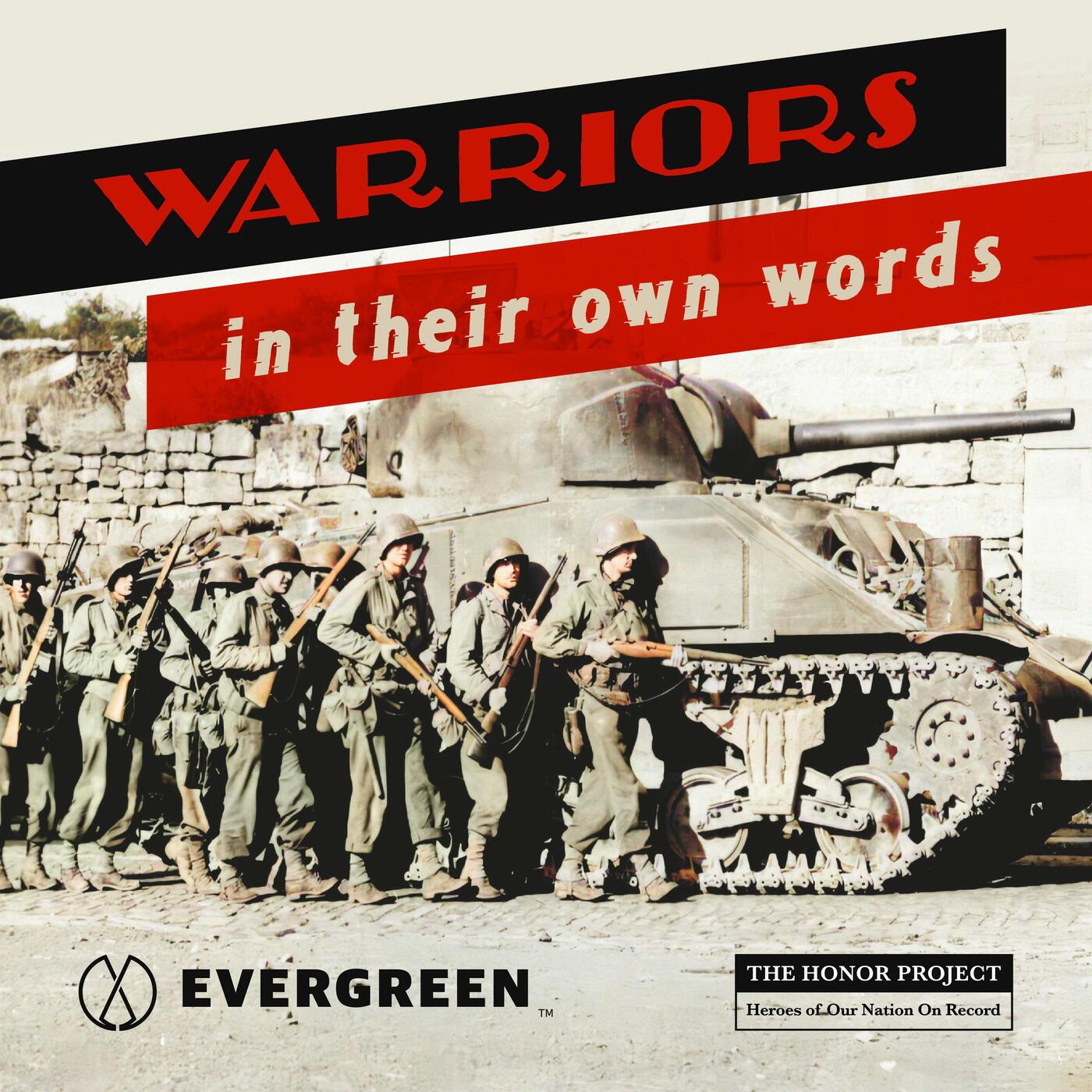
Warriors In Their Own Words | First Person War Stories
Evergreen Podcasts | The Honor ProjectAudio
- Format:
- Podcast
- New episodes:
- Every two weeks
- Typical length:
- about 55 minutes
- Latest episode:
About this show
The unsanitized truth of what we have asked of those who defend this nation. From archived tapes of WWI veterans, to conversations with modern-day warriors, these are their stories, in their own words.
Covers: military history, world war ii, veterans oral history, military aviation, test pilots, pacific war, korean war, vietnam war
Show details and episodes come from the publisher's public feed at rss.pdrl.fm. Last updated . Names, artwork and text belong to their publishers.
Recently on this show
Summary of recent episodes, drawn from the publisher's feed.
This podcast presents first-person accounts from people who have served in the military, drawing on archived recordings and conversations with modern warriors. Recent episodes cover test pilot Bob Hoover, a Marine's Pacific island campaign in World War II, and a Tuskegee Airmen fighter pilot.
Cosmos
Similar in subject
- Ask A Vet Podcast
Both cover: korean war, vietnam war, military history - A Daily Dose of History: Events on this Day in History
Both cover: vietnam war, world war ii, military history - New Books in Military History
Both cover: korean war, world war ii, military history
Similar shows





Explore more
Episodes
Bat 21Rescue in Vietnam: From the Archive
· 36 min
On Easter Sunday, April 2, 1972, two EB-66 aircraft, call signs Bat 21 and Bat 22 were flying pathfinder escort for three B-52s, which were assigned to bomb the two primary access routes to the Ho Chi Minh Trail through Laos. Gene Hambleton, a navigator aboard Bat 21, was shot down behind North Vietnamese lines. His rescue became known as the largest, longest, and most complex search-and-rescue operation during the Vietnam War. In this episode, Gene Hambleton recounts his dramatic story. Learn more about your ad choices. Visit megaphone.fm/adchoices (https://megaphone.fm/adchoices) See Privacy Policy at https://art19.com/privacy and California Privacy Notice at https://art19.com/privacy#do-not-sell-my-info.
Not rated yetForward Air Controllers in Vietnam: From the Archive
· 43 min
Forward Air Controllers or FACs choreographed this skies over the battlefield in Vietnam. They courageously flew low, slow and unarmed over enemy territory in small, propeller driven aircraft like the Cessna 0-1 Bird Dog and 0-2 Skymaster. The FACs were experts at spotting an evasive, well camouflaged enemy and they often braved a battery of enemy ground fire to target the opposing force. In this episode, FACs William Platt and Bill Townsley tell their dramatic stories, In Their Own Words. Learn more about your ad choices. Visit megaphone.fm/adchoices (https://megaphone.fm/adchoices) See Privacy Policy at https://art19.com/privacy and California Privacy Notice at https://art19.com/privacy#do-not-sell-my-info.
Not rated yetVietnam Forward Observers: From the Archive
· 1 hr 3 min
During the Vietnam War, all too often the chaos of battle found Allied forces trapped and facing annihilation. The situation called for courageous men to carry out some of the deadliest missions in the history of warfare. Forward Observers, often alone, moved behind enemy lines to serve as the eyes of the artillery gunner in delivering rounds on vital targets. In this episode, Medal of Honor recipients Barney Barnum and Brian Thacker tell their dramatic stories, In Their Own Words. Learn more about your ad choices. Visit megaphone.fm/adchoices (https://megaphone.fm/adchoices) See Privacy Policy at https://art19.com/privacy and California Privacy Notice at https://art19.com/privacy#do-not-sell-my-info.
Not rated yetIwo Jima: From the Archive
· 1 hr 7 min
The battle for Iwo Jima in World War II became the bloodiest in U. S. Marine Corps history. But for survivors like Chuck Tatum, it also represents the best, the Marines and the United States has to give. For despite the 23,000 U.S. casualties, including 5,400 dead, the flag atop Mount Suribachi, is a symbol of this nation's willingness to fight for freedom and liberty, no matter what the cost. This episode is an in-depth interview with Chuck Tatum. These are his experiences in his own words. Learn more about your ad choices. Visit megaphone.fm/adchoices (https://megaphone.fm/adchoices) See Privacy Policy at https://art19.com/privacy and California Privacy Notice at https://art19.com/privacy#do-not-sell-my-info.
Not rated yetMarine Raiders in the Pacific: From the Archive
· 1 hr 1 min
The Marine Raiders were elite units established by the United States Marine Corp during World War II to conduct special amphibious assault missions, operating behind the lines. The Raiders were created by an order from President Franklin D. Roosevelt in February 1942. They are said to be the first U.S. special forces operations see combat in World War II. William Lansford was a member of the 2nd Raider Battalion during the Pacific campaigns. These are his dramatic stories told in his own words. Learn more about your ad choices. Visit megaphone.fm/adchoices (https://megaphone.fm/adchoices) See Privacy Policy at https://art19.com/privacy and California Privacy Notice at https://art19.com/privacy#do-not-sell-my-info.
Not rated yetAmphibious Assault in the Pacific: From the Archive
· 1 hr 1 min
By 1943, the war in the Pacific burned in its full fury. On November 20th, the Allies launched the first amphibious assault against heavily defended beaches in US history. The 2nd division of the US Marine Corps, used amphibious tractors and assault boats to reach the beaches of the Tarawa atoll, an enemy stronghold protected by 5,000 hardened Imperial Japanese marines. Ed Moore and Tommy Reed were decorated veterans of the 2nd Marine Division during the island campaigns in the Pacific War. Learn more about your ad choices. Visit megaphone.fm/adchoices (https://megaphone.fm/adchoices) See Privacy Policy at https://art19.com/privacy and California Privacy Notice at https://art19.com/privacy#do-not-sell-my-info.
Not rated yetGuadalcanal: From the Archive
· 1 hr 4 min
The unrelenting ferocity of the Pacific War was without a doubt the bloodiest and most savage of the two theaters of World War II. The memories of brutal battles like Guadalcanal, Tarawa, Midway and Iwo Jima are forever seared into minds of the courageous men who fought there. The island of Guadalcanal represented one of the last chances for the Allies to turn back the Japanese advance in the Pacific. Marine veteran Victor Croizat experienced the "hell of earth" of the battle for Guadalcanal. Learn more about your ad choices. Visit megaphone.fm/adchoices (https://megaphone.fm/adchoices) See Privacy Policy at https://art19.com/privacy and California Privacy Notice at https://art19.com/privacy#do-not-sell-my-info.
Not rated yetGlider Attack On D-Day
· 59 min
They are known as America's first military stealth aircraft. Under cover of darkness, the Waco CG-4A combat glider carried U.S. troops and materiel into battle during World War II. William Horn and Leo Cordier, pilots who flew these unarmed and un-powered planes, landed behind enemy lines before the invasion troops arrived in Europe on D-Day. Their courageous stories are a little known chapter in the Allied march to victory during WWII. Learn more about your ad choices. Visit megaphone.fm/adchoices (https://megaphone.fm/adchoices) See Privacy Policy at https://art19.com/privacy and California Privacy Notice at https://art19.com/privacy#do-not-sell-my-info.
Not rated yetU.S. Rangers On D-Day: From the Archive
· 1 hr 0 min
This episode features the dramatic role of the U.S Rangers on D-Day during World War II. Leonard Lomell and Sidney Salomon, from the 2nd Ranger Battalion, were among those who comprised America's first Special Forces group. They were part of the first wave landing on Omaha Beach on June 6th, 1944. Learn more about your ad choices. Visit megaphone.fm/adchoices (https://megaphone.fm/adchoices) See Privacy Policy at https://art19.com/privacy and California Privacy Notice at https://art19.com/privacy#do-not-sell-my-info.
Not rated yetHitting the Beach On D-Day: From the Archive
· 1 hr 7 min
On June 6, 1944, the Allies launched the largest amphibious military assault in history known as D-Day. More than 150,000 American, British and Canadian forces landed on five beaches along the heavily fortified coast of France’s Normandy region. Some of the first men to hit the beach on D-Day were the U.S. Navy Combat Demolition Unit. Jerry Markham and John Talton were members of this elite group. In this episode, these courageous veterans tell their dramatic stories, In Their Own Words. Learn more about your ad choices. Visit megaphone.fm/adchoices (https://megaphone.fm/adchoices) See Privacy Policy at https://art19.com/privacy and California Privacy Notice at https://art19.com/privacy#do-not-sell-my-info.
Not rated yetAirborne Assault On D-Day: From the Archive
· 1 hr 2 min
June 6th, 1944...D-Day. It was the greatest military assault ever staged. Code named Operation Overlord, the massive invasion of Normandy by the Allies involved more than a quarter of a million soldiers, sailors and airmen as well as 5000 ships and 3000 aircraft. Tom McCarthy and Francis Lamoureux were Parachute Infantrymen during the epic conflict. They tell their riveting first-hand accounts in this dramatic presentation, Airborne Assault on D-Day. Learn more about your ad choices. Visit megaphone.fm/adchoices (https://megaphone.fm/adchoices) See Privacy Policy at https://art19.com/privacy and California Privacy Notice at https://art19.com/privacy#do-not-sell-my-info.
Not rated yetVietnam Forward Observers: From the Archive
· 1 hr 3 min
During the Vietnam War, all too often the chaos of battle found Allied forces trapped and facing annihilation. The situation called for courageous men to carry out some of the deadliest missions in the history of warfare. Forward Observers, often alone, moved behind enemy lines to serve as the eyes of the artillery gunner in delivering rounds on vital targets. In this episode, Medal of Honor recipients Barney Barnum and Brian Thacker tell their dramatic stories, In Their Own Words. Learn more about your ad choices. Visit megaphone.fm/adchoices (https://megaphone.fm/adchoices) See Privacy Policy at https://art19.com/privacy and California Privacy Notice at https://art19.com/privacy#do-not-sell-my-info.
Not rated yetAssault on Germany in World War Two: From the Archive
· 56 min
In 1944, the Allies fought their way from the beaches of Normandy towards German soil. Their sites were firmly set on pushing all the way to Hitler's capital Berlin and putting an end to WWII. Robert Weiss was a US Army forward observer. His mission was to move ahead of the troops and find targets for the artillery, but being out in front placed him closer to the enemy and a greater risk of being cut off from his comrades. These are his experiences In His Own Words. Learn more about your ad choices. Visit megaphone.fm/adchoices (https://megaphone.fm/adchoices) See Privacy Policy at https://art19.com/privacy and California Privacy Notice at https://art19.com/privacy#do-not-sell-my-info.
Not rated yetBattle of the Bulge: From the Archive
· 1 hr 5 min
Toward the end of 1944, it was clear that Germany was losing WWII. Low on fuel, munitions and morale, the ability of the Nazis was slipping away. Still Hitler burned with a passion for one more mad assault. In December, 1944, 600,000 Germans surged into the western front. The stage was set for total Allied defeat. Hitler could count the thousands of guns, the tons of munitions and the hundreds of tanks, but he failed to grasp the most important element, the unfailing courage and valor of the Allied troops Learn more about your ad choices. Visit megaphone.fm/adchoices (https://megaphone.fm/adchoices) See Privacy Policy at https://art19.com/privacy and California Privacy Notice at https://art19.com/privacy#do-not-sell-my-info.
Not rated yetAir War Over Europe in World War Two: From the Archive
· 1 hr 14 min
By 1942, the skies over Germany were aflame with German fighters battling Allied bombers for the survival of Europe and the free world. Central to victory were the fighter planes of the Allies. At first they were obsolete and woefully inadequate. But with the advent of aircraft like the P-47 Thunderbolt and the P-51 Mustang, the tide of war was about to change. In this episode we hear the words of fighter aces Clarence "Bud" Anderson in his revolutionary P-51 and Francis "Gabby" Gabreski, flying the P-47 Learn more about your ad choices. Visit megaphone.fm/adchoices (https://megaphone.fm/adchoices) See Privacy Policy at https://art19.com/privacy and California Privacy Notice at https://art19.com/privacy#do-not-sell-my-info.
Not rated yetArmored Warfare in World War Two: From the Archive
· 1 hr 6 min
In this episode of Warriors In Their Own Words, veterans of the 3rd Armored Division, Belton Cooper and Bertrand Close, transport us to the Race Across Europe in World War Two. Learn more about your ad choices. Visit megaphone.fm/adchoices (https://megaphone.fm/adchoices) See Privacy Policy at https://art19.com/privacy and California Privacy Notice at https://art19.com/privacy#do-not-sell-my-info.
Not rated yetThe Surrender of Wake Island: From the Archive
· 36 min
On December 8th, 1941, Japanese forces attacked Wake Island. The Americans were outmanned and out gunned, but fought hard for 15 days before surrendering. Sgt. Pearsall and his fellow Marines were taken as prisoners of war, and spent 3 ½ years at a prison camp in China during WWII. Sergeant John Edward ‘Swede’ Pearsall served in the Marines as a part of the 1st Defense Battalion, D Battery on Wake Island in 1941. Wake Island is located 2,458 miles west of Hawaii in the Pacific Ocean. The U.S. knew a Japanese attack was coming, so men were stationed on the island to protect it. On December 8th, 1941, the day after the attack on Pearl Harbor, the Japanese attacked Wake Island. The Battle of Wake Island lasted for a little over two weeks until American forces surrendered in order to protect civilian lives. After the surrender, Sgt. Pearsall and his fellow Marines were almost executed before the Japanese decided to take them as prisoners. They would eventually be taken on a prison ship to Yokohama Harbor, and then transported to Wusong China, where they would spend three and a half years in a prison camp. At the camp, conditions were brutal. They had little water to drink or bathe with, were beaten often, were not adequately fed, and were forced to do physical labor. During the interview, Pearsall had this to say about the camps: “Starvation, I found, was the toughest thing. The beatings you took. Almost daily, you took beatings from the Japanese, but you kind of became punch-drunk, so to speak. You expected them and you lived with them. But starvation you don't live with. When you're hungry, you're hungry 24 hours a day. You go to sleep hungry. You wake up during the night hungry, and you're hungry all day. Starvation is one of the toughest things we found to face. The work and labor that they made us do was tough, but the food was totally inadequate for the work and to sustain life. Myself, I went from a 200 pound Marine. When the war ended, I weighed somewhere around 85 pounds, so that when the war finally came to end, there wasn't much left of us. We couldn't have sustained life, under the food we were getting, much longer.” Finally on Easter Sunday, 1945, American forces arrived and liberated the camp, saving Sgt. Pearsall and his fellow prisoners. Upon arriving home, Pearsall was awarded the Purple Heart. To learn more about J. Edward Pearsall and the Battle of Wake Island, check out Son of Wake Island (https://sonofwakeisland.com/ols/products/hardcover-book-son-of-wake-island). It's written by J. Edward Pearsall's son, David Pearsall, with the help of his father and the other surviving defenders of Wake island. Learn more about your ad choices. Visit megaphone.fm/adchoices (https://megaphone.fm/adchoices) See Privacy Policy at https://art19.com/privacy and California Privacy Notice at https://art19.com/privacy#do-not-sell-my-info.
Not rated yetThe Horrific Documentation of Death: From the Archive
· 41 min
Warning: This episode contains depictions of corpses, substance abuse, a suicide attempt, and some foul language. Viewer discretion is advised. Kris Goldsmith is an Army combat Veteran who served in Iraq. As a 19 year-old, he was assigned the task of photographing corpses and documenting mass graves. He developed severe PTSD, and in 2007, as the result of a suicide attempt that caused him to miss redeployment, he was given a less-than-honorable discharge. After years of legal battles, that discharge was upgraded. Kris went on to become an advocate for veterans with “bad paper” discharges, and helped pass crucial legislation that helps them receive the benefits they deserve. Learn more about your ad choices. Visit megaphone.fm/adchoices (https://megaphone.fm/adchoices) See Privacy Policy at https://art19.com/privacy and California Privacy Notice at https://art19.com/privacy#do-not-sell-my-info.
Not rated yetCaptured By the NVA: From the Archive
· 46 min
Colonel Leo Thorsness served as a fighter pilot in Vietnam. He was a Wild Weasel, whose missions required them to draw surface-to-air (SAM) missiles away from bombers, and then destroy the SAM sites. This meant that Weasels spent sometimes more than 20 minutes over the target, as opposed to the one or two minutes bomber pilots spent. On one mission, COL Thorsness’ wingman was shot down, forcing him to eject. As he parachuted to the ground, rescue helicopters were called in to rescue him, but they were threatened by encroaching enemy fighters. Despite being incredibly low on fuel, Thorsness fought off the enemy, saving his wingman and the rescue helicopters. Eleven days later, Thorsness was shot down and captured by the North Vietnamese Army. He was captured, and became a prisoner of war. During his first three years in captivity, torture was common. After six years, he was released and sent home. Shortly after returning to the United States, COL Thorsness was awarded the Medal of Honor for saving his wingman. Learn more about your ad choices. Visit megaphone.fm/adchoices (https://megaphone.fm/adchoices) See Privacy Policy at https://art19.com/privacy and California Privacy Notice at https://art19.com/privacy#do-not-sell-my-info.
Not rated yetThe Candy Bomber: From the Archive
· 56 min
Every other week, we'll be re-releasing an episode we think deserves more attention. Today, we'll hear about The Candy Bomber. After World War Two, Germany was split up and occupied by the United States, France, Britain and the Soviet Union. In June of 1948, the U.S., France, and Britain announced they were creating a unified West German currency. Joseph Stalin opposed this unification, and cut off land routes from Berlin to West Germany. In order to bypass the land routes, bombers transported supplies (primarily food) and delivered them to West Berlin in what was called Operation Vittles. Colonel Gail S. Halvorsen was one of several pilots recruited to fly these missions. One day, after sneaking out and flying to Berlin for some R&R, COL Halvorsen met some local children who were survivors of the war. Talking with them changed his life, and he decided he wanted to do something to help them. He returned to base, gathered as much candy and gum as he could, fashioned parachutes with handkerchiefs, and put all the goodies inside. The next day, he flew over West Berlin and dropped the parachutes full of candy out of his bomb bay. The children were delighted. COL Halvorsen did this several more times, and gained international acclaim for his actions. To learn more about COL Halvorsen, check out his book, The Berlin Candy Bomber (https://www.abebooks.com/9780882906164/Berlin-Candy-Bomber-Gail-Halvorsen-088290616X/plp). Learn more about your ad choices. Visit megaphone.fm/adchoices (https://megaphone.fm/adchoices) See Privacy Policy at https://art19.com/privacy and California Privacy Notice at https://art19.com/privacy#do-not-sell-my-info.
Not rated yet