

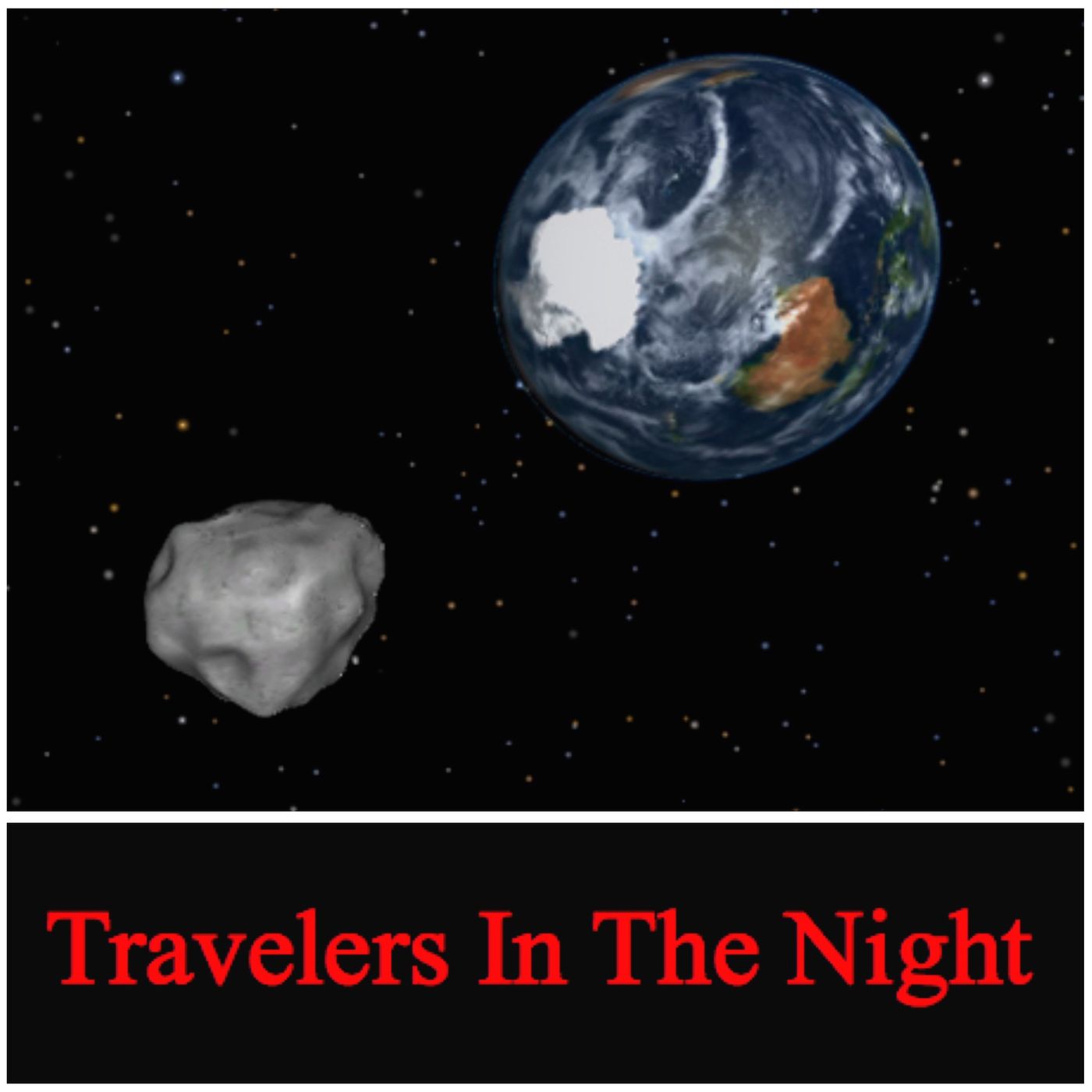
Travelers In The Night
Albert D. GrauerAudio
- Format:
- Podcast
- New episodes:
- Several times a week
- Typical length:
- about 2 minutes
- Latest episode:
About this show
A real "Science Snack" for anyone who is interested in the extraterrestrial. Dr. Al Grauer is a member of the Catalina Sky Survey which has led the world in near Earth asteroid discoveries for 17 of the past 19 years. The music is "Eternity" by John Lyell. Astronomy Asteroids Space NASA Comets Earth Impact Aliens
Covers: astronomy, asteroids, comets, space exploration, planetary science, meteors, near earth objects, mars colonization
Show details and episodes come from the publisher's public feed at spreaker.com. Last updated . Names, artwork and text belong to their publishers.
Recently on this show
Summary of recent episodes, drawn from the publisher's feed.
Travelers In The Night is a podcast by Dr. Al Grauer of the Catalina Sky Survey, covering asteroids, comets, and meteors. Recent episodes discuss fireballs, farming soil on Mars, and three potentially hazardous asteroids found in four days.
Cosmos
Similar in subject
- Astrum Space
Both cover: comets, planetary science, space exploration - Spacepod
Both cover: asteroids, planetary science, space exploration - Planetary Radio: Space Exploration, Astronomy and Science
Both cover: asteroids, planetary science, space exploration
Similar shows





Explore more
Episodes
906-Pierazzo Lunar Crater
· 2 min
The visually stunning Lunar Crater Pierazzo, named for the late Planetary Scientist Elizabeth “Betty” Pierazzo was observed by the Artemis II Crew as they passed over the Moon’s far side. It is a 5.9 mile diameter crater with white streaks or rays which extend more than 50 miles in all directions.
Not rated yet395E-436-Lonely Asteroids
· 2 min
Most asteroids are located in the lonely space between Mars and Jupiter where the average distance between two asteroids is about 600,000 miles. Even though there is a tremendous space between asteroids they occasionally collide and pieces of them become Earth approaching objects. Most of them remain close to the plane of the solar system, however, a few are sent on paths which take them into the extremely lonely space high above and far below the orbits of the planets about the Sun. In 2017, my team, the Catalina Sky Survey, discovered 13 of these loneliest asteroids whose paths are tilted more than 45 degrees to the plane of the solar system. They have an average diameter about 4 times larger than that of the 987 asteroids we discovered in 2017. Even though 13 is a small sample it is interesting to speculate what this size difference could mean. In 2013, astronomers used the Subaru Telescope on Mauna Kea in Hawaii to discover that main belt asteroids with orbits which are highly inclined to the plane of the solar system tend to be larger and made of stronger materials than those asteroids which reside in the plane of the solar system. They attribute these differences to the collisions which must have occurred to send asteroids into highly inclined orbits about the Sun. If this result applies to the lonely near Earth asteroids we discovered then perhaps they are made of very strong materials and could be of particular interest to asteroid miners.
Not rated yet905-Hogan’s Interesting PHA
· 2 min
My Catalina Sky Survey teammate Josh Hogan has discovered a 2 football field diameter asteroid that was placed on NASA’s Sentry list because it has a tiny minuscule but non-zero chance of impacting our home planet. With this motivation my team the Catalina Sky Survey, the Pan STARRS group in Hawaii, the ATLAS group with telescopes Hawaii, Chile, and South Africa , the Vera C. Rubin telescope in Chile, will be soon joined NASA’s NEO Surveyor and groups world wide in a planet wide defense network.
Not rated yet394E-435-Number 31
· 2 min
Asteroids appear as moving points of light in an asteroid hunter's images so that when my Catalina Sky Survey teammate Alex Gibbs spotted a fuzzy moving object he immediately suspected it to be a comet. The data obtained by astronomers over the next 8 days enabled scientists at the Minor Planet Center to verify Alex's 31st comet discovery and give it the name C/2018 A6 (Gibbs). In January of 2018 it was in the constellation of Leo traveling from the vast empty space above the Sun's north pole toward the plane of the solar system which contains all of the planets and most of the asteroids. In March of 2018 Comet C/2018 A6 (Gibbs) will cross the plane of the solar system a bit farther from the Sun than the giant planet Jupiter's orbit. After that it will continue on a wide arcing parabolic path, pass under the Sun's south pole in the summer of 2019, and once again cross the plane of the solar system in February of 2021. After that it will continue into the vast empty space above the Sun's north pole from whence it came. How a comet brightens as it approaches the Sun is difficult to predict. With luck humans will be able to spot Comet C/2018 A6 (Gibbs) with their naked eye, binoculars, or a small telescope as it pays a rare visit to our planet's neighborhood.
Not rated yet904-Ohio Fireball
· 2 min
On St. Patrick’s day 2026 a fireball meteor brighter than the full moon streaked across the daytime sky. The American Meteor Society received 223 eyewitness reports from observers in 15 states, the District of Columbia, and Ontario Canada as well as 5 videos and 6 photos. NASA reported that the incoming object was approximately 6 feet in diameter, weighed about 7 tons, released the energy of 250 tons of TNT, created a sonic boom heard over a wide area , and rained bits of itself onto the ground in Medina county Ohio.
Not rated yet393E-431-Tough Space Rocks
· 2 min
Most small asteroids are likely to be rubble piles of small rocks and dust loosely held together by their weak force of gravity while others may be made of ices of various substances. A few are solid objects which may contain metals like iron and nickel as well as gold, silver, and platinum. As they whiz by us it is hard to tell much about them from their overall brightness and distance from us. In 2017 my team the Catalina Sky Survey found 21 asteroids having an average diameter of 750 feet which pass closer to the Sun than the planet Mercury. They must be made of very tough rocky material since they regularly receive more solar energy than heats the surface of Mercury to 800F. Over the centuries this repeated baking has likely removed all of their water and other volatile materials leaving only rocky metallic minerals. The largest of this group of tough guys is the half mile in diameter asteroid 2017 VV14 which orbits the Sun once every 3.4 years and can come to about 20 times the Moon's distance from us. The smallest is the 30 foot diameter tiny asteroid 2017 RQ17 which orbits the Sun once every 214 days on a path that brings it close to Mercury, Venus, Earth, and Our Moon. Based on known terrestrial deposits many of the key elements required for modern industry and food production such as phosphorus, antimony, silver, gold, and copper could be exhausted on Earth in the next 50 to 60 years. Perhaps in the future humans will mine tough asteroids for the materials they need.
Not rated yet903-Eclipse of the Moon Observing
· 2 min
My team the Catalina Sky Survey has pioneered searching for asteroids coming from the direction of the dark side of the moon.
Not rated yet392E-430-Deportee
· 2 min
The beautiful star cluster the Pleiades in the constellation of Tauris is about 100 million years old making it one of the youngest objects that you can see in the natural night sky. Data obtained by observing Oumuamua (“Oh-moo-ah-moo-ah”), the first object humans have identified which is definitely from outside of our solar system suggests that it is an icy body with a red, rock appearing shell, of carbon rich organic material. By tracing Omuamua's path for millions of years into the past, Dr. Fabo Feng of the University of Hertfordshire , found that it's slow speed in the vicinity of 5 stars in the Pleiades suggests that it was ejected from one of them. Check out the Pleiades with your unaided eye, binoculars or a small telescope and contemplate the messengers it might be sending our way.
Not rated yet902-Lighting Up The Night
· 2 min
A start up company Reflect Orbital is proposing to launch 50,000 satellite mirrors by 2035 to illuminate solar panels on Earth all night long. This would be devastating for human sleep cycles, birds, insects, plants and many of the biological systems of organisms on which we all depend.
Not rated yet391E-428-Phaethon
· 2 min
The mysterious Earth approaching object Phaethon (FAY-eh-thon) does not fit neatly into our definition of either an asteroid or a comet. Further it appears to be like the Peanuts character Pigpen in that it leaves a trail of dust and other fine debris in it's wake which in the case of Phaethon produces the Geminid Meteor Shower to delight us every year around Christmas time. Phaethon is amazing in that every 524 days it makes a death defying flight to a point less than one of half of the planet Mercury's distance from the Sun, where it's surface temperature reaches a mind boggling 1,200 Fahrenheit. During one of these events the NASA Stereo Spacecraft A discovered that Phaethon had rock dust tail.
Not rated yet