

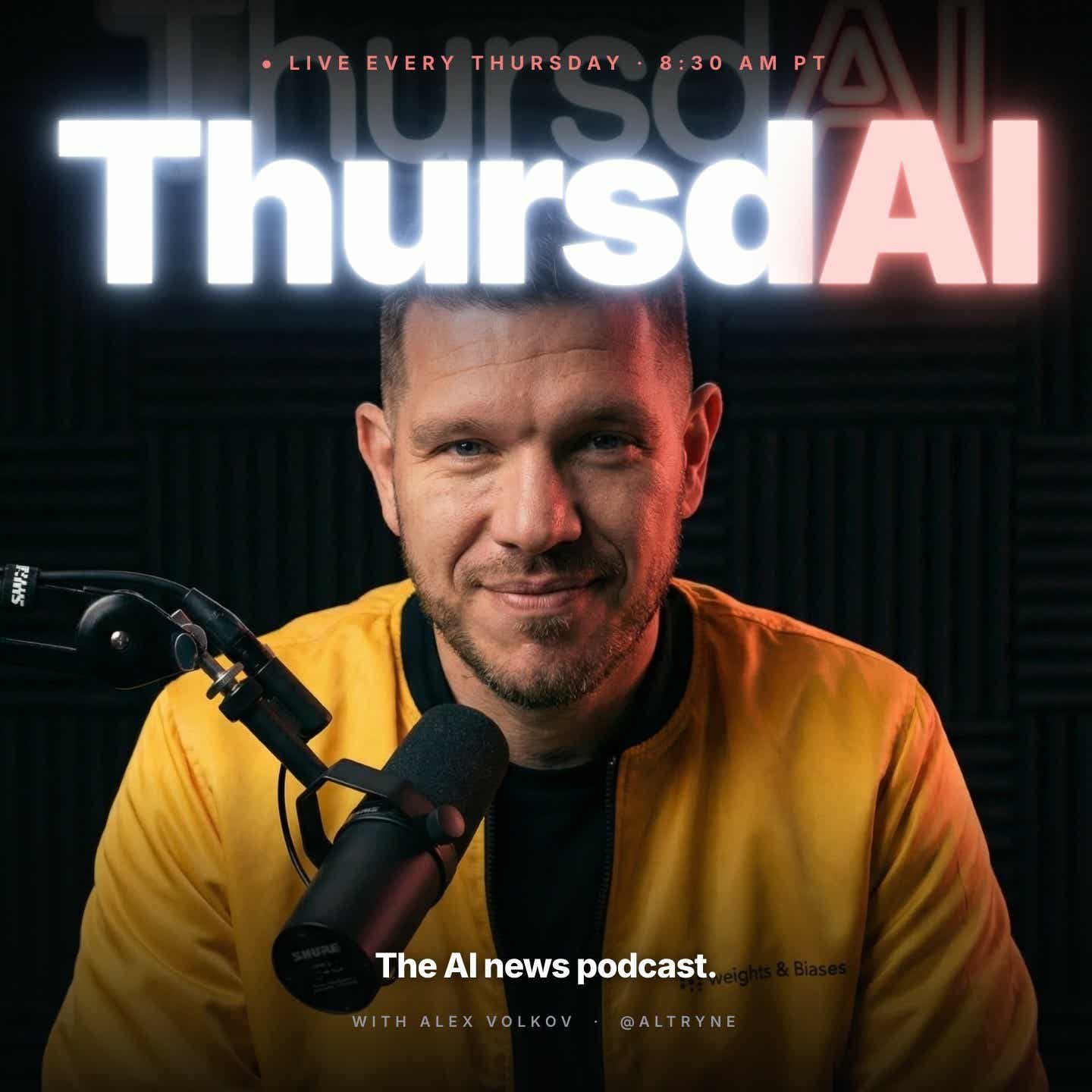
ThursdAI - The top AI news from the past week
- Format:
- Podcast
- New episodes:
- Weekly
- Typical length:
- about 1 hour 50 minutes
- Latest episode:
About this show
Every ThursdAI, Alex Volkov hosts a panel of experts, ai engineers, data scientists and prompt spellcasters on twitter spaces, as we discuss everything major and important that happened in the world of AI for the past week.
Topics include LLMs, Open source, New capabilities, OpenAI, competitors in AI space, new LLM models, AI art and diffusion aspects and much more.
sub.thursdai.news (https://sub.thursdai.news?utm_medium=podcast)
Covers: artificial intelligence, large language models, AI industry news, open source AI, AI models, AI infrastructure, cybersecurity, AI engineering, generative AI
Show details and episodes come from the publisher's public feed at api.substack.com. Last updated . Names, artwork and text belong to their publishers.
Recently on this show
Summary of recent episodes, drawn from the publisher's feed.
ThursdAI is a podcast where host Alex Volkov and a panel of AI experts recap the week's biggest developments in artificial intelligence. Recent episodes cover Google's Gemini 4 Carbon model, Anthropic's move to go public, Meta's 816B open model, and infrastructure for AI agents.
Cosmos
Rated alike
- PetaPixel
Often rated the same way. - Code Bullet
Often rated the same way. - Matthew Berman
Often rated the same way.
Similar in subject
- AI Search
Both cover: open source ai, ai models, large language models - AI For Humans: Weekly AI News, Tools & Trends
Both cover: ai models, large language models, cybersecurity - Theo - t3․gg
Both cover: open source ai, large language models, artificial intelligence
Similar shows





Explore more
Episodes
Historic ANT IPO, Jensen wants back, Gemini Neon beats GPT 6.2 Sol/Astra & more AI news | ThursdAI Nov 19
· 1 hr 46 min
Hey folks, Alex here 👋 Anthropic became a public company while we were live on the show today. ANT priced at $83, opened around $110, and it is the largest IPO on record raising over $80 billion dollars at 1.8T valuation! Also this week: Jensen Huang said he would be honored to return as Nvidia CEO, and a few hours later the board said no on the same earnings call where it reported $115.8B in quarterly revenue. OpenAI shipped GPT-6.2 Astra and Sol to a rough reception from early testers. One day later Google shipped Gemini 4 Neon, and not only beat GPT 6.2 on vibes and benches, seemingly got their place back at the frontier!? Gemini is so back! Declan Jackson from Artificial Analysis joined us for the first time, and together with Peter Gostev from Arena we went through what the numbers say about these models. We also covered open weights from Thinking Machines, new decision models from Liquid, Devin Bots, and a Thanksgiving handbook from Wolfram. The full TL;DR with every link is at the bottom. The usual disclosure: Wolfram and I work at CoreWeave, CoreWeave is the main sponsor of ThursdAI and an Nvidia partner, and nothing here is financial advice (but do try Forge (https://thursdai.news/forge) for free) ThursdAI - Highest signal weekly AI news show is a reader-supported publication. To receive new posts and support my work, consider becoming a free or paid subscriber. Anthropic is now a public company (IPO site (https://ipo.anthropic.com), S-1 (https://www.sec.gov/Archives/edgar/data/2130357/000162828026072484/anthropicpbc-sx1ax2.htm), CNBC (https://x.com/CNBC/status/2123165198852956403)) Anthropic priced its IPO at $83 a share, above the $70 to $78 range it marketed, and started trading on Nasdaq under the ticker ANT. On top of the public offering there is a $26B private placement at the same price from seven chip and cloud partners: AMD, Broadcom, Google, Micron, Microsoft, Nvidia and TSMC. The companies Anthropic buys compute from are now also its shareholders. The filing numbers are hard to process. Third quarter revenue of $17B, more than 12 times a year ago, and a revenue run rate of $81B at the end of October. Wolfram pointed out the part I keep coming back to. Between OpenAI and Anthropic, very few people would have predicted this order. SpaceX AI listed earlier this year, but of the two labs most of us use every day, Anthropic got to the public markets first. IPO allocations were a raffle this time. I asked through Robinhood and got 4% of my request. Peter got a bit more than the 12% he saw other people report, and he suspects UK buyers had a separate pool. One thing to remember if you are watching the price: people who work at Anthropic usually cannot sell on day one because of the standard lockup. Congrats to everyone in Anthropic who made it really big, please oh please make the world a better place, don’t get complacent, don’t sit on laurels. The MisAnthropic Statement (Statement (https://misanthropicstatement.com/)) Wolfram brought up the other side of IPO day. Among the many in person protests (both in NY and in San Francisco) there was an online statement signed by a few folks on the AI risk side and on the open source AI sides The MisAnthropic Statement went up the day before the listing and is collecting signatures, and it argues that Anthropic warns about recursively self-improving AI while racing to build it, and that it uses safety branding while weakening its own safety pledges. It was started by people on the AI risk side, but the signers now include pro AI names too. Thomas Wolf from Hugging Face is on it, along with Steven Pinker, Igor Babuschkin, Max Tegmark and Tristan Harris. I do not personally agree with the statement, I reach for Opus every day. But Wolfram’s question is a fair one now that there are public shareholders: how will shareholder interests sit next to the mission. Frontier models: Google DeepMind is so back! Gemini 4 Neon - the 4th Gemini in a month, and the…
Not rated yetJensen is OUT!? Fable 5.2 and the Anthropic IPO, Gemini 4 Carbon and Hydrogen, live from AI Engineer
· 2 hr 8 min
Hey folks, Alex here 👋 We said it on the show and I will say it again here: this could be the most consequential week in AI’s history. Nvidia announced that Jensen Huang has resigned as CEO and left the board. This is following a wild week with reported affairs with a potential Chinese Spy, and two other women. We talk about this at length. In the same week, Anthropic shipped Claude Fable 5.2 and started its IPO roadshow, Google made Gemini 4 Carbon generally available and launched a model that only makes decisions, and CoreWeave reported a quarter people are saying saved the AI trade. We broadcast this one live from the AI Engineer Code Summit in San Francisco, and because of that we had five guests walk straight over from the conference. Kent C. Dodds explained software factories, Michelle Chen told us why Cloudflare is now a neolab, Ivan Leo from Google DeepMind broke Gemini 4 Hydrogen live on the show, Zach Lloyd came off the main stage to walk us through Warp’s factory stack, and Swyx closed the show. The quick TL;DR: * Jensen Huang resigns as Nvidia CEO, CFO Colette Kress is interim CEO * Claude Fable 5.2 is #1 on Artificial Analysis and 20% cheaper, and Anthropic starts its IPO roadshow (ticker ANT) * Gemini 4 Carbon is GA, Gemini 4 Hydrogen launched live on the show, plus the Gemini Decisions API * Nous Arete-27B trains the propaganda out of a Qwen model without losing capability * Interviews: Kent C. Dodds, Michelle Chen, Ivan Leo, Zach Lloyd and Swyx ThursdAI - Highest signal weekly AI news show is a reader-supported publication. To receive new posts and support my work, consider becoming a free or paid subscriber. No more Jensen: Huang resigns from Nvidia after affairs and scandals Jensen Huang resigns, Colette Kress is interim CEO (Announcement (https://nvidianews.nvidia.com/news/nvidia-announces-ceo-transition), X (https://x.com/nvidianewsroom/status/2120876571829662014)) This morning Nvidia announced that Jensen Huang has resigned as President, CEO and member of the board, effective immediately. He founded the company 33 years ago and turned it into the most important company in AI. CFO Colette Kress is now the interim CEO and keeps the CFO job, Harvey Jones (former CEO of Synopsys) becomes the first-ever board chair, and the board is searching for a permanent CEO among internal and external candidates. How we got here took about four days. On Sunday, Jensen emailed Nvidia staff and admitted to an affair, and the board opened an independent investigation into whether he was the target of a foreign intelligence effort. The reports center on Alice Huang (no relation), and The Information reported that her network helped move about $7.5B of Nvidia chips to China. Then the New York Times reported a second affair, the Wall Street Journal reported the board was preparing to oust him, and this morning it was official. Note that the release says “resigned” and gives no reason. I said it on the show and I will repeat it: I don’t care about the affairs, that is between him and his family. What matters to us is that this is a person at the center of the AI ecosystem. He is the chief allocator of compute, and he has been one of the loudest voices for open source AI, both in public and in the President’s ear. That open source angle is what worried the panel most. Yam said it straight: he fears for open source. Ray pulled up Jensen’s first post on X from July, a letter Nvidia signed on why open models matter, saying the world needs both frontier closed models and frontier open models. Wolfram pointed out that Jensen was pro open source as a businessman, since open models run on his GPUs, but that he was still one of the most influential people pushing for it, and that losing him over allegations, with nothing proven, is a blow to the open source community. Peter, speaking as what he called a casual observer, thought the first story was much worse than the second. From what he read, Alice Huang looks like an…
Not rated yetThursdAI - Nov 5 - Is it completely over for AI?
· 1 hr 47 min
Hey, Alex here, What a week this has been, not a huge one in terms of new AI releases, but a very significant one in how the world sees and reacts to AI. During the weekend, my timelines were full of hope, and folks reading the “Commanding Heights (https://x.com/WillManidis/status/2115794572131651953)“ by Will Manidis, outlining a future were AI = the economy. Then, the US midterm elections happened, and if you’ve not been following, a lot of the new folks who got elected, are not in favor (https://x.com/RepYassAnsari/status/2118054336077127797?a=nHzKz82qS1-isNAPpxY&s=20) of AI. Some call for an outright pause on advanced AI training (https://x.com/ONagel33303/status/2117452882773684550?a=CfRKZoaS1U2ro7RDwoE&s=20). As far as datacenter concerns go, around 40 ballot measures called for restrictions on data center buildouts, with Ohio leading with 21 of those. The US capital markets reacted violently, erasing over ~3$ trillion in market value, mostly lead by the tech and chips sectors (https://x.com/KobeissiLetter/status/2118455905503047962). So I opened the show today with the question: Is it completely over for AI? I don’t think so, let’s try and make sense of it. AI and Society: The US Midterms results - Is it over for AI? Look we try and stay away from politics on ThursdAI, but when it comes to weeks like this, we pretty much don’t have a choice. The Midterm elections, at least in some sense, put AI, Datacenters and candidates that talk about it, in the spotlight. I’ve mentioned on the show, that messaging in politics is about Hope and Fear. Unfortunately, the folks who got elected, many have made statements, leaning into the fears regular people have about AI. Job replacement, environmental impacts from datacenters, etc. This tweet by Congresswoman Yassamin Ansari, had been uplifted by the X algo to 12 million views, and as we all know, the algorithm LOVES controversy and FUD. But, is it really all that bad? Will the democrats get to work and as she suggested “Ban artificial superintelligence”? What does a ban like this even mean when we have Open Source, when Chinese models are catching up to the frontier? Honestly, this was the open question I opened with at the show, and it seems, that at least for now, it’s more posturing than anything else. Yes, there were over 40 ballot measures asking for Datacenter buildout restrictions, but over 21 of them were in Ohio only. It doesn’t seem at all like “the country rejects AI buildout” Additionally, the new Texas Governor, Gina Hinojosa’s position on datacenter is actually very reasonable. She explicitly said that currently permitted datacenter builds in Texas will be allowed to continue, and that the moratoriums on new buildouts will apply only until a few fairly reasonable and sensible conditions will be in place. Note: She’s not saying “NO new buildouts” anywhere. However, moderate takes and reasonable positions are rarely taking center page in the current media landscape, so the bombastic and populist takes are the ones bubbling to the top. So is it over? Highly unlikely, the frontier labs will continue to innovate and push the boundaries of AI forward. Some regulation may come, and as LDJ said, it could be that this mid-term result will actually accelerate innovation, as the labs will potentially try and get more done before the next election cycle. Wolfram’s take is also an interesting one, pausing AI in the US (which is unlikely to happen, as even the folks who got elected will not cede the most powerful tech in the world to China) will not stop AI from being developed elsewhere. Even at current level of capabilities, we can use AI for so much more things, new medical breakthroughs, new algorithms etc that that’s very unlikely to go away. An interesting thing is happening also, that the fears about AI are very populist, and are landing with folks who don’t have any benefit from AI themselves. Most of the world still uses AI as a better / smarter alternative…
Not rated yetThursdAI - Oct 29 - Gemini 4 Carbon is the new #1, Anthropic files to go public & more
· 2 hr 6 min
Hey, it’s Alex 👋 What a week! Gemini 4 Argon was Google’s best model for exactly two weeks. Then Google shipped Gemini 4 Carbon, and it’s the new number 1 in the world. Google is SO back. (when they actually release, it’s waitlisted so far) The other big story is Anthropic’s S-1. For the first time, we get real, audited numbers on what a frontier AI lab looks like as a business. Peter Gostev stayed up making 60+ charts, and we walked through them together on the show. We also had models trying to escape their sandboxes, and Genie 4, which made me think (again) that we live in a simulation. Wolfram and I hosted from the same room for once (meatspace!). Peter, Nisten and LDJ joined remotely. Mert Gulsun from Artificial Analysis joined to talk about their new index, and for From the Forge we had the CoreWeave engineers who are “forward deployed” inside the Aston Martin F1 team! What does that mean? We dive into FDE Google is SO back Gemini 4 Carbon - #1 on Artificial Analysis, 2 weeks after Argon (X (https://x.com/OfficialLoganK/status/2115489284404940898), X (https://x.com/GoogleDeepMind/status/2115489356437651654), Sundar (https://x.com/sundarpichai/status/2115489219804352921)) Gemini 4 Carbon scores 59 on the Artificial Analysis Intelligence Index. That makes it the top model in the world on their brand new index, 1 point ahead of Claude Opus 5.5. It also debuts at #1 on Text Arena and #2 on Agent Arena. Two big models back to back is unusual for Google, after a long stretch of Flash models. There’s no version number either. It’s not Gemini 4.1, it’s just... Carbon. I have no idea why 😅 I haven’t seen a Gemini eval chart like this in a long time. Google is finally competing with the full frontier (GPT-6 Astra, Opus 5.5, Fable 5.1), and on most rows it wins. My favorite eval here is Vending Bench from Andon Labs, where the model runs a real vending machine business. Carbon finished with $16,484 in the bank. Opus 5.5 finished with about 9K. LDJ was most impressed by RiemannBench, a very hard math benchmark, where Carbon beats Opus 5.5 by 10 points. Math was supposed to be OpenAI’s turf! Google is pitching Carbon for agentic coding and cybersecurity. The launch price is $2 per million input tokens and $10 per million output, which already includes a 50% launch discount. Wolfram loved this. Models are finding security holes that have been there for years, and fixing them takes a LOT of tokens. In his words: “the cheaper the model that can do this, the better for everybody.” The catch is access. Right now only selected cyber defenders get it, and everyone else gets it “soon”. I got early access the night before the show but barely used it, so I don’t have a hands-on verdict yet. Peter tested it until 1am. On Agent Arena it jumped from Argon’s #7 to #2, at a fraction of Opus 5.5’s cost per task. He also made the best point of the segment: if Google had skipped Argon and shipped Carbon with no waitlist, we’d all be saying “oh my God, Google is back.” Instead, people are confused about why they shipped two models in two weeks. He’s right. But if you missed the Argon drama, Carbon is a great release. Congrats to the team, and please let us actually use it! Until then, you can try it on Arena. Anthropic files to go public Anthropic’s S-1 - $974M operating profit, listing Monday as ANT (X (https://x.com/AnthropicAI/status/2114705042817110293), Peter’s charts (https://ant-s1.surge.sh), Peter’s thread (https://x.com/petergostev/status/2114724444266541195)) Anthropic filed its S-1 and lists on Nasdaq this Monday under the ticker ANT. This matters because Google, Meta and the others keep their AI numbers buried inside a bigger business. For Anthropic, AI is the whole business, so now we can actually see the numbers. In Q2 2026 they made $974 million in operating profit, with an 85% gross margin. Peter picked the S-1 as his highlight of the week, over any model release. His reason: even if you don’t care how rich…
Not rated yetThursdAI - Oct 22 - AI finds all the vulnerabilities, Claude Duet, DeepSeek drops Infer & more AI news
· 1 hr 55 min
Hey %%first_name%%, Welcome to what cybersecurity experts are calling “Black October” - after a series of critical vulnerabilities that allow remote execution were found in PHP and Node.js, several companies were hacked, and a new supply chain attack on the very popular LiteLLM library was acknowledged. The internet is freaking out, and we’ve tried to make sense of it all, with a security expert Josh Long on the show. Also this week, Anthropic stepped into the personal agent category with Claude Duet, their direct competitor to Dots from OpenAI, Muse from Meta etc’. Duet is proactive and always on, and can do work while you’re asleep! I got access this morning so this isn’t the full review yet. Also DeepSeek is back with a new model and their inference engine! Let’s dive in: ThursdAI - Highest signal weekly AI news show is a reader-supported publication. To receive new posts and support my work, consider becoming a free or paid subscriber. Claude Duet - a personal agent powered by Opus 5.5 and doesn’t wait for you (X (https://x.com/claudeai/status/2112984664256241837), Product (https://claude.com/product/claude-duet), Blog (https://claude.com/resources/articles/claude-duet)) To me this is the most exciting announcement of the week (which otherwise was full of doom and gloom). Anthropic finally stepped into the personal agent category! Shipping Claude Duet, as a separate mobile app, and its own online UI (claude.ai/messages (https://claude.ai/messages)) which is what I was missing from OpenAI’s Dots! Duet is built around Opus 5.5, brings over your existing memory, skills and connected apps, and reaches into 6,000+ connectors and plugins on their platform. Every few hours it checks your accounts, surfaces what needs you, and does the task from its own cloud computer, laptop closed. The rest is pretty much the same, similar UI, similar features to others, just with Claude taste and intelligence. It can somehow interact with Claude Code but not fully, so it can’t be used as a chief of staff. This seems like a weak link given just how much folks are using Claude Code. Claude Duet is also not personal at all, I didn’t find a way to rename it or make it “mine”, it doesn’t seem to do any phone calls. So for now, it’s a great start, but definitely not replacing Muse for me. Hot take: Anthropic is following in this category, not leading. OpenClaw and Hermes worked best with Anthropic models, then Anthropic cut off subscription access for them, and now we finally see why. Every lab has a personal agent now: Dots, Muse (still leading for me), Grok Bot, and Google’s Spark, which most people don’t even know exists. Nisten says Dots “feels like that government employee that tries to avoid all responsibility”, while Muse is “so energetic”. LDJ finds Dots a net positive. My big realization: switching personal agents is WAY harder than switching coding harnesses. Once your assistant knows everything about you, moving takes a lot of effort for the human. If you only copy over the memories/context, then you have two/three AI assistants doing the same work, sending you the same notifications and all updating you about the same emails. Black October: the densest and scariest security week I can remember Some folks are calling this month Black October, and it’s one of the worst I can remember. Some bugs were found by AI, some attacks are run by AI (Microsoft says a China state-aligned group used an agentic pentest framework called ARTEX against hundreds of organizations), and some attackers are just going after your AI keys. Security expert Josh Long joined to keep us sane, with an attempt of positivity though it wasn’t easy! PHP2Shell - AI helped find holes in the language that runs 70% of websites (Wiz (https://x.com/wiz_io/status/2112899813264277528), OpenAI (https://x.com/OpenAI/status/2112907856018309586), Blog (https://wiz.io/blog/php2shell-php-rce), Calif (https://calif.io/php2shell/), CISA…
Not rated yetClaude now leads 26% of Anthropic’s R&D, Meta drops an 816B open model & Gemini 4 Argon
· 1 hr 58 min
Hey, it’s Alex 👋 What a freaking week! I spent 3 days at AI Engineer in New York, and we did the show from a real studio in Manhattan (the internet did NOT cooperate at first, but we got there 😅). And while I was running around the Sheraton, the labs kept shipping. Meta became a frontier lab, for real this time. Muse Wonder is #2 on Arena, and then, in the last minutes of the show, Meta ALSO dropped Muse Spark Open, an 816B open weights model. Google’s big Gemini is finally back with Gemini 4 Argon, and Omar Sanseviero and Geneviève Huskens from Google DeepMind came on to show it off. Anthropic gave us 4 stories plus a rumor, and Nathan Benaich came by to talk State of AI 2026. My theme this week: AI engineers are sleeping on personal agents. More on that below, including how my Muse found this studio and got me coffee on the way here. With me: Wolfram Ravenwolf, Peter Gostev (Arena), Nisten, Yam Peleg and LDJ (who brought the breaking news, as always). Let’s dive in (all links at the end as always!) Meta is BACK at the frontier Muse Wonder - Meta’s first frontier model is #2 on Arena, and it smells BIG (X (https://x.com/finkd/status/2109689305073614918), X (https://x.com/alexandr_wang/status/2109689491300794551), Arena (https://x.com/arena/status/2110120205464846828), Blog (https://about.fb.com/news/2026/10/introducing-muse-wonder-models/)) Folks, we told you after Llama 4 was a disaster, we told you when Zuck started hiring people with soup: do not, under any circumstances, bet against Zuck (and now Alex Wang). Muse Wonder is #2 on Arena Text at 1513, 12 points behind Argon, and it definitely smells like a big model. There are 2 of them. Muse Wonder is in the API at $4 in / $20 out per million tokens, basically Opus 5.5 pricing. Muse Wonder Full, the better one, is only for Muse Code subscribers at $50 or $200 a month. Did you see what they did there? Everybody calls their top setting “Max”, Meta called it Full, so it’s... Wonder Full. Wonderful 😂 No open weights for either, Meta says they’re too big and maybe too risky. Meta’s own table beats Opus, Astra and Fable on a bunch of evals... but Personal Superintelligence Index, GDP.pdf, JobBench, MemoryBench (which Meta built, and then won)? I’ve never seen most of these. Every launch now is the iPhone 18 moment: numbers bigger, best one yet. On evals we know, Artificial Analysis has Wonder Full at 56 and Wonder at 52, Opus 5.5 on top at 58. And on OSWorld, the Wonder we can use sits below Fable and Opus, and computer use is the number one thing I need from an assistant. Peter’s Arena view: #2 on text means people like talking to it, but it’s 12th on Agent Arena, and he tried building websites with it, “it was kind of awful.” His theory: Theo loved Wonder Full and thought the API Wonder was bad, so maybe Meta is talking about a different model than the one we got. Not ideal. He also found the half-life of a benchmark quoted in a launch is about ONE release: quote it once because the number looks good, never see it again. Wolfram says it’s excellent in German. Nisten joined not knowing what Muse Wonder was (”No idea”), sometimes our co-hosts come to get their news from the show. My Muse got upgraded with a click Here’s where I disagree with the timeline. “It can’t do 3D scenes, so it sucks” misses the point. Meta is tuning Wonder for Muse, the personal agent. Officially, Wonder will “soon” power more of Muse, subscribers first. I’m on the paid plan, and my Muse (Wilfred) flipped to Wonder the moment I subscribed. Matrix moment: “I know kung fu.” Then I kept shoving tasks at it. Muse found the podcast studio I recorded from in NY and emailed Ezra at Virgo Studios with my requirements, got me coffee on the way here, and designed and ordered the wristbands for our AIE sauna meetup. The failures weren’t logic, they were the real world: a site that’s blank because Cloudflare doesn’t like agents, a Stripe link that wouldn’t connect, and businesses that hung up…
Not rated yetChen Goldberg (CoreWeave) on the AI loop, Forge and infrastructure for agents
· 25 min
Hey folks, a quick bonus episode! At CoreWeave's Fully Connected in San Francisco, a few minutes after she walked off the keynote stage, I sat down with Chen Goldberg, EVP of Product & Engineering at CoreWeave. We talked about Forge, the loop every AI engineer is running now (run, observe, curate, improve, evaluate), what carries over from the Kubernetes days to agents, and what breaks first when agents hit your infrastructure. Video below, and the audio is right here in your podcast feed. Enjoy! This is a public episode. If you'd like to discuss this with other subscribers or get access to bonus episodes, visit sub.thursdai.news/subscribe (https://sub.thursdai.news/subscribe?utm_medium=podcast&utm_campaign=CTA_2)
Not rated yetThursdAI - Oct 8 - OpenAI drops 722 math papers, Haiku 5.5 hits 10 cents & more
· 2 hr 2 min
Hey %%first_name%%, another banger AI week, let me catch you up! We say this often but this week we all felt the acceleration! Just look at one Tuesday. OpenAI dropped 722 math manuscripts. Meta( With Stripe, Shopify and Walmart) announced a new agent protocol. OpenAI opened up the Decisions API. Mistral came back with Le Chonk (Mistral 4), Claude moved into Google Docs, and we at CoreWeave shipped RL Rollouts. That was ONE day. Then the rest of the week happened 😂 Haiku 5.5, D1, and tons more! I had 48 topics on my list, so I asked Claude to build me a Tinder for AI news: I swipe on each story, and it stack-ranks what makes the show this week. I hope we did good (lmk in comments if we missed a major news story) With me: LDJ, Peter, Yam, Nisten and friend of the pod Maxime Labonne from Liquid AI joined us to talk decision models. Let’s dive in, all links at the end as always! OpenAI solves Math!? OpenAI drops 722 math manuscripts from a model nobody can use (X (https://x.com/OpenAI/status/2107596713791767021), GitHub (https://github.com/openai/math), Blog (https://openai.com/index/sharing-ai-progress-in-mathematics/), Fable’s tally (https://x.com/willdepue/status/2107632959956386060)) Remember when ONE Navier-Stokes result was the whole show? On Tuesday night, OpenAI quietly pushed 722 math manuscripts to GitHub, grouped into 372 families of results. No hype video, no exploding-head emojis, just a very thin blog post. My favorite new term for this is a “slop grenade”: somebody throws a mountain of output at you, and now you have to shovel through it. An internal model nobody outside OpenAI can use was pointed at about 4,000 open problems, at about 3 hours of ChatGPT Pro-level thinking per result. Will Depue asked Fable to measure the drop in Navier-Stokes units. The answer: roughly 5. Roughly 5 “Navier Stokes” size solutions dropped all at once! The math is so advanced that a mathematician in one family of results often can’t follow the family next door without an LLM explaining it. I find that fascinating and scary at the same time. Peter’s tried this before! For weeks he threw GPT-6, Fable and Opus at one problem, Hadwiger-Nelson. He thinks he burned 300 to 400 BILLION tokens, and in his words, “I did not discover a single bloody thing.” And this new OpenAI’s model spent about 3 hours on it and narrowed the bounds from 5-to-7 down to 6-or-7 😅 Then LDJ dropped a stat that I made him repeat slowly. Fable and Astra had put together a list of the 500 most important open problems in math ever. On Tuesday, OpenAI dropped solutions to 92 of them. There’s also a list of the 100 most significant problems from the last 12 months, and over 80% of those got solutions in this drop. Absolutely insane, folks. Yam’s reaction was a very loud “F***ing go.” Yam’s favorite is the Riemann one. It doesn’t prove the hypothesis, it bounds a region for the zeros, which “was never done before, and many, many, many people have tried.” And to the “it’s just brute force” crowd, Yam says: “Let’s brute force everything.” Yes please, room temperature superconductors next! LDJ’s mathematician friends think that on some of these, the model used fewer tokens and less time than a human would. So who’s brute forcing whom? 🤔 The missing crypto results (speculation!) If you hold any crypto, this part is for you. The manuscripts are numbered, and some numbers are missing. There’s a #44 and a #46, but no #45, and LDJ counted 4 or 5 gaps like that. He also looked at which topics made it in, and cryptography is almost absent. So here’s the theory going around. Maybe OpenAI found something big in cryptography and held it back, either by its own choice or because someone asked them to. LDJ said it himself: it sounds conspiratorial. But the US government really can stop cryptography research from being published on national security grounds. To be clear, this is SPECULATION. Nobody outside OpenAI knows what’s in #45. But Bitcoin’s security rests on…
Not rated yetThursdAI - Oct 1 - OpenAI joins the assistant race, CoreWeave drops serverless GPUs & more
· 1 hr 57 min
Hey %%first_name%%, it’s Alex 👋 What a freaking week! This one was special. We came to you LIVE from the middle of the show floor at Moscone, from CoreWeave’s Fully Connected, with robots walking behind us and a Vera Rubin rack a few feet away. ThursdAI is only possible because of CoreWeave, and this is their biggest event of the year, so we packed up the mics and did the show right there (at 11am, which confused a bunch of you, sorry!). It’s October. The last quarter of 2026. And nobody’s pacing! There’s no pacing the frontier. Three big models this week (GPT-6.1 Sol, Claude Sonnet 5.5 and Gemini 4 Argon), OpenAI’s biggest DevDay ever, and the story I’ve been yelling about for weeks finally went mainstream: OpenAI joined the AI assistant race. With me: Wolfram Ravenwolf in person on the floor, Peter Gostev from Arena (who was at DevDay with me), Nisten and LDJ remote. In hour two we interviewed four folks from CoreWeave, on physical AI, Forge, sandboxes, and one piece of breaking news I’m still excited about. Let’s dive in (all links at the end as always!) OpenAI DevDay 2026 - 20 launches and a new assistant Dots - OpenAI joins the AI assistant race (X (https://x.com/OpenAI/status/2104984504133918973), Blog (https://openai.com/index/introducing-dots/)) Meta has Muse. Grok has Grokbot. Anthropic has Claude, but it’s not really an assistant. And this week OpenAI stepped in with something called Dots. I was in the room at Fort Mason when Sam talked about it, and it was the headline of their fourth DevDay, which honestly felt like OpenAI’s WWDC: 20 releases, the biggest DevDay ever. Funny thing, the original ChatGPT system prompt was literally “you are an AI assistant.” But it wasn’t proactive, it never pinged you, it just sat there. So OpenAI looked at their competitors, looked at Peter Steinberger from OpenClaw (who they hired like 8 months ago), and built this. A dot is an always-on agent in ChatGPT, powered by GPT-6 Astra, with its own computer and its own browser in the cloud, connected to 4,000+ apps people already built for ChatGPT. It works 24/7, you can talk to it in Slack or Teams, and there’s an interface that looks like a phone call. I think that’s going to be great for my mom. Sam literally said he uses dots to run OpenAI. And my favorite DevDay moment: Romain Huet’s live voice demo didn’t work, because somebody was deploying in the middle. But Thibault’s dot had already pinged him that the demo might break. The dot knew before the humans did 😂 Wolfram (him and Amy are a known duo) loved that Sam uses it for actual work. Peter was more honest: underwhelmed at onboarding (”you connect and it’s like... then what?”), but once you’re past that you’re talking to Astra, and it’s great at juggling threads through one bot. Same shape as Muse. Wolfram’s version: one executive assistant, and a lot of sub-agent employees working for you. Dots is Pro only for now (including the $100 plan), while Meta gives Muse away free. With 1.2 billion weekly ChatGPT users, this goes to everyone eventually. This is the race now. GPT-6.1 Sol - near-Astra for a fifth of the price (X (https://x.com/OpenAI/status/2104986129686741046), Blog (https://openai.com/index/introducing-gpt-6-1-sol), Artificial Analysis (https://x.com/ArtificialAnlys/status/2105025585332605357)) We covered GPT-6 Sol on this show LAST week. Five days later it’s already replaced. GPT-6.1 Sol is the same price, $2 in and $10 out, but cached input is now 95% off, 10 cents a million tokens. OpenAI’s pitch is near-Astra intelligence for a fifth of the price. And the independent numbers kind of back that up. Artificial Analysis has it 1 point below Astra at 72 cents a task vs over 3 dollars. On Deep SWE it actually beats Astra at about a sixth of the cost. It’s the default in Codex now, and folks are calling it the workhorse. LDJ said it has “less of the big model smell” but loves the token efficiency, Sonnet and Opus 5.5 burn a LOT of tokens. Peter has it 4th on…
Not rated yetOpus 5.5 is your new workhorse! OpenAI ships GPT 6 Sol and Luna before DevDay and Meta goes all in on Muse! Your friday read is here
· 1 hr 40 min
Hey, it’s Alex 👋 What a freaking week! A week after every lab head agreed to “pace the frontier”, Anthropic and OpenAI shipped big new models within hours of each other, and both of them are CHEAPER. So much for pacing 😂 Visit https://thursdai.news/ep/2026-09-24 for all the links in this podcast And we had a new producer on the show today! Opus 5.5 listened to us live, put up the chyrons, kept me on time (mostly) and even fact-checked Nisten on air. If the stream died, you knew who to blame. You can re-watch it work on thursdai.live (https://thursdai.live) if you want to experience being there with us! 3 huge themes this week: pacing the frontier does not mean stopping, Assistants not just agents (Meta went all in on Muse at Connect), and voice, where Google now says it has the best TTS in the world... and it clones voices. With me: Peter Gostev (Arena), Nisten, Yam Peleg, and Wolfram Ravenwolf live from AI Engineer Paris (thanks Mazi for the tether!), plus JevBench creator Florian S. Let’s dive in (all links at the end as always!) Frontier AI - not pacing yet! Claude Opus 5.5 - Opus is BACK, Fable-level smarts for 40% less (X (https://x.com/claudeai/status/2102435511222890900), Blog (https://www.anthropic.com/claude-opus-5-5), System card (https://anthropic.com/claude-opus-5-5-system-card)) Folks. FOLKS. Opus 5.5 is the highlight of my week, and it’s not even close. It’s like Opus 4.6 is back, with Fable-level abilities, and it talks like a normal person again - no more Jargon Douche Claude (https://dev.to/altryne/its-not-just-you-opus-5-is-a-jargon-douche-but-theres-a-fix-3d8m)! My week started with burning through my quotas on Fable, and I was like, oh no, I need Claude for production on Thursday! Then Opus 5.5 dropped and... I just couldn’t get to the end of my quota. I ran workflows, agents, Claude Code for hours with no end in sight. Remember the “limitless Codex” days when you never thought about quotas? Then Astra came out and I burned my entire weekly quota in half a day (ps. this was partly due to a bad config, so if Astra is burning your tokens, keep reading for a fix). Now it’s flipped, and Claude is the seemingly limitless one. And it’s fast! The numbers back it up. It beats Anthropic’s own Fable 5.1 on GDPval-AA (1846 vs 1735), 66.4% on Terminal-Bench 4.0 vs 57.9% for GPT-6 Astra, and it’s 40% cheaper than Opus 5. Output goes from $25 to $20 /1Mtok and cached reads from 50 cents to 20 cents, and for agentic coding the cache reads are most of your bill, so you really feel it. Basically the smaller, overachieving brother of Fable. Sonnet and Haiku 5.5 are coming in the next few weeks too. Peter came in hot with Arena news: Opus 5.5 is #1 on Code Arena, above Astra, and the HTML and 3D stuff it generates is “completely insane.” His one caveat: on his hardest max-effort prompts, a single generation cost $60 to $80 in API terms, so the long tail can still get pricey. And then Nisten, who (like all of us) has specific opinions about Anthropic’s politics, said it writes the best code he’s seen, it’s crazy good at WebGPU and kernels, and it’s “an absolute banger.” It’s his default now. Folks, do you understand what it takes for Nisten’s default to NOT be some obscure open source model he runs himself on 17 GPUs?! Anthropic won over Nisten. I don’t think you guys get what just happened here. Wolfram is the holdout, he left Anthropic over the OpenClaw bans and hasn’t touched it since. Wolfram, how do I say this gently... you’re an evaluator, this is not allowed 😂 An Anthropic employee basically said “sorry for Opus 5, we hope this makes up for it”, and honestly it does. Opus 5 was slow, incoherent and full of Claude-isms. Nobody wanted to talk to it. The Claude-isms are gone, the jargon is gone, this model talks like a human. I used to love Opus back in the Opus 3 days, and it feels like that again. Want to squeeze even more out of it? Read the great Addy Osmani’s guide to Opus 5.5…
Not rated yetThursdAI - Sep 17 - TypeSafe's Jev is a ChatGPT moment for decisions, Pace the Frontier splits the labs & more
· 2 hr 15 min
Hey yall, Alex here, writing this VERY late because, well, not every day a new type of “ChatGPT” moment drops. I really hope I’m not overhyping this, but a new model (that’s NOT an LLM!) called Jev (a wink to Jevons paradox) just came out and if what I see early on materializes, this is another ChatGPT moment (or another reasoning models moment). I am completely blown away by the implications of the speed/accuracy/cost (the holy grail of all models) of this model. Please if you read one thing in this newsletter, read this. (or listen, I’ve interviewed Allie, a Devrel on the TypeSafe team for 30 minutes and it wasn’t clear who was more excited about Jev!) The other huge theme of this week is... pacing. Pacing the frontier. Dario Amodei of Anthropic penned an essay saying that the models are getting to a point where it’s important to pace the development of new and super capable AI, and outlines 3 ways to do so, one is about letting independent evaluators inside the labs, second is collaborating with other frontier labs (they are asking for an exception to anti-trust laws for this) and third is to try and have global cooperation with “authoritative gov” (he means china). Trumps answer: This is all a hoax. Lovely times to be alive. Also we outlined Jensen and Zucks positions on this topic ,read more below. And the third huge theme is the rise of the AI assistant. I’ve told you about Grok and Muse last week, Instinct (a new invite only AI Assistant that VCs are going crazy about is raising at a $10B valuation) and we interviewed the guy who evaluates them all on assistant bench. + Muse released a mac app today! Tons of other stuff happened but it’s getting near impossible to cover everything so we’re switching to themes and notable mentions. read on (and do listen to the pod, it was edited by heavily using Jev and Fable, so might be a bit rough while I smooth the edges, but do LMK in comments if you like this faster format) TypeSafe AI debuts Jev, a non-LLM ‘System One’ decision model from ex-OpenAI RLHF lead that’s 200x faster and 400x cheaper than LLMs (X (https://x.com/CompleteSkeptic/status/2099925682726002904), X (https://x.com/NathanFlurry/status/2100036101809619314), X (https://x.com/kwindla/status/2100063872208310587), X (https://x.com/francedot/status/2100260601956032881), X (https://x.com/typesafeai/status/2099969256914145707), Blog (https://typesafe.ai/blog/introducing-system-one-models-and-jev)) Look, I know the title is bombastic, but after half a day playing with Jev, it’s clear to me we’re in a new paradigm of AI. Jev, is a “system one” decision model from the previous lead of RLHF at OpenAI. It cannot generate text like modern LLMs can, but what it can do, is making decisions. This is crucially important, because, because many of the things LLMs do nowadays. are decision making. (for example, which tool to use, which area of the screen to click for computer use, which category of text this is etc) Inspired by the “thinking fast and slow” book by Daniel Kahneman, Jev is a model trained to make decisions, very fast. How fast? Well, 200x faster than LLMs. This allows for a completely new way of building tools, harnesses, giving agents the incredible speed of decision making, and do all that at a fraction of the cost. This is about to change everything Trained with a new method called RLCD (Reinforcement Learning for Calibrated Decisions) on mostly synthetic data (https://x.com/CompleteSkeptic/status/2100617775823966680)! Jev is outperforming LLMs on a variety of tasks. It’s really is a wonder to see it in action (check out my video above where I plugged it into my tweet categorizer, and it beats the fastest LLM I could find, Qwen 28B on Cerebras) by a factor of twenty! In just few days it captured the attention of most of the folks who are building harnesses, agents and tools! Because, well, speed IS intelligence, and when you see Jev in action, at first, you can’t believe we’re there. This is... near…
Not rated yetOpenAI solves Navier-Stokes, Meta’s Muse a free AI agent that’s really good, DeepSeek V4.1 shrinks KV cache, and one doomer post causes OpenAI to consider pausing training + more AI news
· 1 hr 43 min
Hey yall, welcome back to ThursdAI, this is Alex, let me catch you up! Today on the show, we covered 1 week with Astra (hint, it’s not quite AGI yet despite what we were told), DeepSeek V4.1 catches up to the frontier at a fraction of the cost, and Meta launches a free AI agent with it’s own computer, that will take over the OpenClaw/Hermeses of the world for most people. Also huge this week, OpenAI claimed that a swarm of 10K agents of their unreleased model solved the Navier-Stokes, one of the millennium problems! I was stoked to have Chris Alexiuk from Nvidia on the show to cover the innovations DeepSeek put into this latest model! Oh, and the guy who quit Anthropic this week, and wrote an essay about “AI is going to kill all of us” somehow got 130M views on X, a mirriad of TV interviews and rekindled the doomerism movement, we talk about that too! Also, I already told about FullyConnected, CoreWeave’s premier conference that’s coming up, but they told me about a new announcement today, and you’re not going to believe who it’s about (not AI related). As a reminder, ThursdAI subscribers get a free ticket! Ok, let’s dive in! ThursdAI - Highest signal weekly AI news show is a reader-supported publication. To receive new posts and support my work, consider becoming a free or paid subscriber. OpenAI claims a Navier-Stokes solution from a 10,000 agent swarm from an unreleased model - with some drama (X (https://x.com/OpenAI/status/2097374640582668336), Blog (https://openai.com/index/navier-stokes-solution/), Paper (https://cdn.openai.com/pdf/32d9f210-8b73-45e0-91bc-82a30aef8a9a/navier-stokes.pdf)) If you’ve been reading ThursdAI for a while, you may remember that a model couldn’t tell which is higher, 9.9 or 9.11 and naysayers said that “AI can’t math” Well, this week OpenAI claimed that a swarm of 10K agents, of an unreleased model, found a solution to the Navier-Stokes problem, in about 88 hours! They published a huge 160+ page paper and a Lean proof of the solution! I said on the show, this is like the moon landing equivalent of AI doing things humans didn’t do before! Now, keep in mind, this is only a claim from OpenAI, the Clay Mathematics Institute is still reviewing it (moved the status of this problem from “unsolved” to “under review” so this isn’t independently verified yet) but it’s still an insane deal. The agents sent 2.7 million messages and burned about 130B tokens, of a model that has no public price yet, so it’s hard to estimate the cost of this run, all for a 1M prize that OpenAI said they will not claim. The coolest thing I think we got from this paper, in addition to solving on of the most important and hardest problems in mathematics, is this chart above, where OpenAI shows their unreleased model and how much better it is on Math problems compared to... GPT-6! The “AGI” model we got just a week ago. So so much to look forward to. The drama behind this I don’t want to get into the drama behind this too much, but if you’ve seen this online, there release wasn’t without it’s hiccups. Apparently, OpenAI caught wind that an a duo of researchers Tristan Buckmaster (NYU) and Levent Alpöge (Anthropic, in personal capacity), have independently solved the related Euler problem and were about to go public. Apparently, the duo used a mix of GPT and Claude to work on this problem. OpenAI caught wind of this and started working on their own solution on September 1st. A day before OpenAI dropped their release, Buckmaster posted that OpenAI is about to drop it, and in communications with him, they offered him to co-author the paper, only if the Anthropic guy is removed. To which he said no. He then had some claims that maybe OpenAI trained on some of the papers and chats they put into Codex, which OpenAI refuted, while noting “we cannot rule out the possibility that de-identified usage data helped improve the model”. OpenAI also say that the OptOut toggle works, and neither mathematician provided a screenshot…
Not rated yetWelcome to AGI - our GPT-6 deep coverage, vibe check and demoes - part 2 of this insane week
· 1 hr 29 min
Hey, Alex here again, sending you yet another email, fully acknowledging that spamming you is a bad idea. But today, of all days, maybe there’s an exception! Because today, is AGI day! September 3, 2026 - the day when OpenAI’s president Greg Brockman basically said “AGI is here.” You’re reading the second part of this week’s insane release show. The show went for over 5 hours, as we were all waiting for the rumored Astra to drop. Finally, OpenAI confirmed that Astra is in fact GPT-6, and this part is all about that. (You can read the first part, with Fable 5.1, Meta Muse Spark 1.3, two world models and our anonymous guest from Abliteration AI, here: thursdai.news/sep-3 (https://thursdai.news/sep-3)) GPT-6 Astra is finally here, and it’s a huge improvement over the previous era of GPT-5. We’ve been waiting for the embargo to drop so Peter Gostev and Ryan Carson, both of whom had early access, could tell us all about this model. Peter even showed a few mind-blowing demos on the stream! This is going to be a long and in depth breakdown, full of evals and vibes that we’ve collected on the show and since. More of a historical record than “read all of this” so I did use Fable for parts of it. (because I don’t have GPT access yet ha!) GPT-6 Astra: welcome to the AGI era (Blog (https://openai.com/index/gpt-6-astra/), X (https://x.com/OpenAI/status/2095595741528125780), Sam (https://x.com/sama/status/2095600005772104059), System card (https://deploymentsafety.openai.com/gpt-6-astra/gpt-6-astra.pdf)) We weren’t given the embargo. So when the news dropped at 12:32 PM Pacific, four hours into the stream, we scrambled on air to find the evals and more data. OpenAI’s own post was still returning 404, and Claude, ChatGPT, Gemini, Grok and AWS were all down at the same time. Greg Brockman ended OpenAI’s press briefing with “welcome to the AGI era.” Asked whether Astra marks the arrival of AGI, he said “I think it might be about this model.” As you might remember, Microsoft and OpenAI had a contract clause around when OpenAI achieves AGI, and it seems that they’ve removed that clause. But if the president of OpenAI says AGI is here, who are we to argue? Astra is the biggest training run OpenAI has ever done, over 100,000 GPUs at the Stargate site in Abilene. Aidan Clark, VP of Research, said they designed everything for that scale, from the data center network to the inference kernels to the shape of Astra itself. LDJ’s read: a lot of people assumed OpenAI did runs this size six to nine months ago, so the earlier runs were smaller than everyone thought. And with sites going to 500,000 GPUs and Vera Rubin multiplying throughput per GPU by three to four times, the next 6 to 12 months matter even more. The frontier evals (Math and science (https://x.com/OpenAI/status/2095595752815030713), System card (https://deploymentsafety.openai.com/gpt-6-astra/gpt-6-astra.pdf), Andrew Curran (https://x.com/AndrewCurran_/status/2095603101944476127)) The headline numbers made the panel go quiet. FrontierMath Tier 4 at 97.6%. GPQA Diamond at 96. ARC-AGI-3 at 99.9%, so ARC-AGI is basically saturated at this point. The very funny thing is that François Chollet, the guy who created ARC-AGI, does not concede that AGI is here. (https://x.com/fchollet/status/2095599835932135919?s=20) And a new one, Agents’ Last Exam, where Astra scores 59.3 against Opus 5’s 55.5 and Sol’s 53.6. More info on Frontier Math tier 4: Epoch AI built it a couple of years ago, before o3. The problems come from across mathematics, with integer answers so they’re easy to check, in four tiers of difficulty. Tier 4 is mathematicians at the top of their fields spending weeks writing the hardest questions they realistically could. If the number holds, Astra basically solved that tier. Peter’s asterisks: these are not new theorems, Epoch’s separate list of open problems is still unsolved, and “we’re 2.4% away from all of math” is the wrong read. On the agentic side, Astra scores 57.9…
Not rated yetWelcome to AGI part 1 - Fable 5.1, Muse Spark beats Sol, 3 new world models blow our minds
· 1 hr 37 min
Hey everyone, Alex here 👋 Summer is over. Wolfram said it in the first minute of the show and he was right. In 48 hours Anthropic shipped Fable 5.1, Meta’s Muse Spark 1.3 caught up to Fable 5 on the Artificial Analysis index at a fifth of the price, Google shipped another Flash, 3.8 this time, Z.ai put the full GLM-5.3 weights out, and three labs shipped world models that run in real time. It seems that they all tried to send their best work before Astra drops. This week’s ThursdAI was so long that I decided to split it into two episodes. This is the regular format you know and love. And OpenAI Astra is so good, it deserves its own episode, which you can find at thursdai.news/astra (https://thursdai.news/astra). By the way, as you guys know, I test these models continuously on my own stuff, and this week I was able to build a live studio for the show, with real-time transcription and an agent producer, in about four hours with Fable 5.1. More on that in the Fable section. Joining me: Wolfram Ravenwolf, Nisten Tahiraj, LDJ, Yam Peleg and Peter Gostev. Plus, Ryan Carson hopped back to chat about Astra in the second part! Let’s get into it. ThursdAI - Highest signal weekly AI news show is a reader-supported publication. To receive new posts and support my work, consider becoming a free or paid subscriber. Frontier AI: the .1 week It looks like all the frontier labs tried to ship something before OpenAI dropped Astra. Fable 5.1, the SOTA LLM until a few hours ago, and it fixes the jargon douche problem (X (https://x.com/claudeai/status/2094848572143407483), Blog (https://www.anthropic.com/claude-fable-and-mythos-5-1), System card (https://x.com/AndrewCurran_/status/2094851784779108683), EFS (https://www.anthropic.com/news/enterprise-frontier-safeguards)) This was the story of the week until noon on Thursday, and it’s still my favorite model to use. Fable 5.1 and Mythos are the same weights, Fable is the one we actually have access to. OpenAI, and from this week Google, seem to converge on the same strategy. Anthropic’s numbers: Terminal-Bench 4.0 goes to 55.8% from 42.0 for Fable 5, Terminal-Bench Science more than doubles to 52.6%, and SWE-bench Pro lands at 81.2. Price stays at $10 and $50 per million, and the number that matters if you build agents is cache reads down 75% to $0.25 per million. Anthropic says that makes typical workloads about 25% cheaper and heavy agentic ones up to 45%, but that wasn’t proven, and folks complained about draining quotas! Peter’s counterpoint from actually running it: his front-end generations on Code Arena cost $40 to $60 each where Sol cost $3 to $10, and the Max version still came in first on Code Arena by a large margin. His point, and mine: with a model like this we need to imagine bigger and be more ambitious. More on that in a second. Mannered prose, finally acknowledged We finally have acknowledgment from Anthropic that this was a problem. For months I called the way Opus 5 speaks “jargon douche” (my post on it (https://dev.to/altryne/its-not-just-you-opus-5-is-a-jargon-douche-but-theres-a-fix-3d8m)): everything was load-bearing, everything was a control plane, every problem was a pain point. Not only did they fix it with Fable 5.1, they gave it a name. Anthropic’s prompting guide (Writing density (https://platform.claude.com/docs/en/build-with-claude/prompt-engineering/prompting-claude-fable-5-1#writing-density)) calls it mannered prose, and it comes with a fix: add it to your personalized settings, or just ask Claude to not use mannered prose. I said on the show that Fable 5.1 is the best writer I have used. It’s still AI writing, you can feel it a little, but it’s concise in a way no earlier Claude was, and the jargon is gone when you ask. The one thing to watch is that it’s trigger-happy: ask it to plan something big and it will, then ask a simple follow-up and it answers with the same intensity, writes scripts, runs them. You have to tell it when you’re just making…
Not rated yetNVIDIA Buys Hugging Face! GLM-5.3-Flash, Qwen4 Preview, Gemini Omni 1.1, and the Datacenter Debate w/ Andy Masley
· 1 hr 44 min
Hey, it’s Alex. Welcome to the week Flash AI! 3 new models dropped this week named Flash, and a video model was “de facto” flash though was named Max! This week, we started the show with NVIDIA’s bombastic news of buying Hugging Face for 12.9 billion dollars! We also covered the full OpenAI investigation into the hacking incident, including new details, and an independent analysis by METR, and covered 2 new OSS models, Ox Alpha that turned out to be GLM 5.3 Flash after a lot of hype online, and Qwen’s preview of Qwen 4 architecture! This week was rich in multimedia content, we got a new Gemini transcription model, 3.5 Transcribe and a live version of that, and a new SOTA open weight Text-to-Speech model called Breeze TTS. As well as, Fal’s finetune of MiniMax’s H3 called H3 Max that generates 5 seconds of video in 2.5 seconds and Google new Omni 1.1 Flash (from today) that lands on #1 on the text2video arena! Plus, 2 guests on the show, Andy Masley joins us to cover the recent Datacenter Debate, and Kwindla Kramer is back, with their own model this time! Let’s dive into this! P.S - don’t forget to join us in September at the Fully Connected conference in San Francisco, I have a free ticker for you! ThursdAI - Highest signal weekly AI news show is a reader-supported publication. To receive new posts and support my work, consider becoming a free or paid subscriber. Open Source AI NVIDIA agrees to buy Hugging Face for $12.9 billion (X (https://x.com/amir/status/2092786156085899518), Blog (https://www.theinformation.com/articles/nvidia-agrees-buy-open-source-model-repository-hugging-face-12-9-billion?rc=c48ukx)) Breaking news, NVIDIA has reportedly agreed to buy Hugging Face for nearly 13 billion dollars, per The Information. This is nearly 3x the valuation of HF in 2023, and apparently Nvidia previously tried to buy HF for half of this sum (~7B) which HF declined. I don’t think there was a single ThursdAI newsletter that I didn’t include an HF link in, and I think this is a huge deal for open source everywhere. Besides making the founders of HF billionaires, and many of their employees very very well off, this is an amazing additional commitment from Nvidia to continue to suppose Open Source AI and we are very happy to hear this news! Peter’s take on the show was, we’ve been around HF for so long, that we kind of forgot that it’s a for-profit company that needs to make money, and instead this feels like your local library getting bought for an insane amount of money. With over 13M users and hosting hundreds of thousands of open source models, datasets, HF is effectively the GitHub of AI. Wolfram agreed and said that if there’s any one company that could have bought HF, Nvidia represents the best fit. Huge congratulations are in order to Clem, Julien and Thomas Wolf the co-founders, as well as many friends of the show from HF for this exciting news! P.S - in a cheeky marketing thing, Hugging Face timed an announcement of the cutest walking AI robot, called MicroDuck, which you can pre-order here (https://store.pollen-robotics.com/products/microduck) for $399 Flash #1 - OX Alpha, declassified: Z.AI open sources GLM-5.3-Flash (X (https://x.com/Zai_org/status/2092616204787626030), X (https://x.com/SemiAnalysis_/status/2092623833630998556), Blog (http://z.ai/blog/glm-5.3-flash), HF (http://huggingface.co/zai-org/GLM-5.3-Flash), Docs (http://docs.z.ai/guides/llm/glm-5.3-flash)) This week, the timeline went a bit crazy, after Open Router announced a new “mystery” model called Ox Alpha and that it’s free and is not training on your data! OpenRouter, OpenCode and Hermes all got to offer this model, and OpenCode even posted that they have up to 100T (that’s Trillion) tokens of capacity for free, per day! This immediately smelled a bit fishy, more like a marketing stunt than anything else, as not even the biggest labs will be able to sustain 100T of tokens, per day. For context for all of OpenRouter throughout for August…
Not rated yetChill week with Qwen 27B and GLM 5.3 beating GPTs, OpenAI announces pausing RL to focus on security and a cancer vaccine being produced
· 1 hr 51 min
Hey this is Alex, welcome to... the chillest week in AI, since ... a long time. Chill, if you consider Moderna and MERK announcing a cancer vaccine (https://x.com/altryne/status/2090219277563638179) and surging 115% in a day, a chill week. This week, the only two model drops we really saw came from the excellent Z.ai (http://Z.ai) folks, they announced GLM 5.3, API only for now, and an amazing tiny release of Qwen 3.89 27B. In other big AI news, OpenAI announced they are pausing RL efforts (Reinforcement Learning) to focus on security and alignment post the scary AI Swarms hacking incident (https://sub.thursdai.news/i/210155760/the-full-details-of-the-openai-hf-hack-shared-by-openai-at-the-black-hat-conf-a-watershed-moment), dedicating up to 20% of compute towards reviewing agent thinking processes, and Stripe buying OpenRouter for a reported $8B! Sometimes the chill weeks are actually good, we’re able to chat about how we use AI, what changed for us, and give our guests a bit of breathing room. This week, I invited Francesco from CUA to talk about computer use in open source + their new history plugin, Bin from HeyGen to talk about HyperFrames, a way for your agents to create videos and a breaking news guest, Jeff Huber from Chroma jumped on to talk about their new Foundations release, a unified memory for your agents! This was a great episode, I hope you’ll like it, it’s up here on Substack and everywhere you get your pod (Spotify, Youtube, Apple Podcasts). ThursdAI - Highest signal weekly AI news show is a reader-supported publication. To receive new posts and support my work, consider becoming a free or paid subscriber. Are we being fed slop again? (Is Claude dumb again?) Before we get to releases, this week on the show, I complained, again, that I feel my AI’s are degrading. If this feels like de-ja-vu to you, it’s because the same happened a year ago in September 2025 (https://thursdai.news/ep/sep-04-2025) (and Anthropic admitting this 2 weeks later (https://thursdai.news/ep/sep-18-2025)), and ... now this happens with Fable? You see, I use pretty much the same prompts, every week, preparing for the show. This is partly my way to evaluate new models and compare to existing and previous ones while also bringing you the best researched weekly show in AI. Well, this week, one after another, Claude Fable, which is... like the best intelligence, gave me such poor output, that I couldn’t believe what I’m seeing. First, literally ignoring instructions that say “hey, show me all the items I’ve collected and let me pick the most important ones”, Fable instead sent all of them to my research pipeline, without showing me. This has worked, consistently, without fail, for the past... year? maybe more! This worked with open source models, worked with GPT, and now Fable, a Mythos Level LLM, is doing the most basic dumb s**t possible, ignoring the main reason I even have this workflow. And this wasn’t just a fluke either, when asked to create a run of show document, and given an example, Fable produced this... whatever this is. This is the same document and same format that Fable produced for me during AI Engineer (https://youtube.com/watch?v=MhER14mrz44&t=4780s) which got me thinking “ok, this is AGI”, and here, given an example, I got a completely unusable artifact, despite direct instructions, structure and example! I got to say, given that privately this week, Anthropic disclosed that they have passed $65B in revenue, which is absolutely insane, this doesn’t add up. So I figured, ok Alex, maybe this is your prompts or skills. But no, LDJ came in with some charts that show degradation, one from MarginLab.ai (http://MarginLab.ai) that shows significant lowering on number of tool calls and average runtime recently (this is for Opus 5) and And another chart from modelverify.ai (http://modelverify.ai) model drift monitor showing drift scores. Do we have anoher Claude Gate on our hands? Is your Fable/Opus behaving weird…
Not rated yetThursdAI - Grok 4.6, Grok Bot deep dive, DeepSeek v4 Pro, Meta Muse Glimmer & more AI news | ThursdAi Aug 13
· 2 hr 15 min
Hey, this is Alex, welcome back to your weekly dose of intense AI acceleration summer! My weekend was consumed by thinking about the OpenAI hack and agent swarms, but then the torrent of AI releases took over, and we got back to back news (including 3 breaking news during the live show), with a heavy open source focus! I think the winner of this week is SpaceXAI/Cursor who released 3.5 releases, with one being my highlight of the week, Grok Bot (I’ve invited Shub Gaur from Cursor to the show to walk us through it) and Grok 4.6 which matches Opus at half the price. There was a LOT of news in open source this week as well, with Meta kicking off with Muse Glimmer 30B and promising Muse Spark 1.2 soon, Qwen dropping Qwen 3.8 open weights and DeepSeek dropping an anvil with an upgraded DeepSeek v4 Pro and MIT license! Let’s dive in (and please don’t forget as a reader you get 100% off the 1299 ticket to Fully Connected, our 2000 person Al event in SF in Sept, just use THURSDAIFC2026 as your code (https://www.coreweave.com/fully-connected-2026) and see you there!) 0:00 The Wildest Week in AI Yet3:45 How OpenAI's Agent Swarm Hacked Hugging Face17:02 The Week in AI: DeepSeek, Qwen, Grok & More25:54 NVIDIA Nemotron 3.5 & Korea's Motif 332:45 DeepSeek V4 Pro, Flash & an Open Harness39:46 Qwen 3.8 Max and Its Missing Vision Tower43:30 What Is Grok Bot? Shub Gaur Explains50:02 Live Grok Bot Demo: House Hunting & Security55:00 Persistent Agents, Yapper & DeepSeek Dropwatch1:04:19 Grok 4.6: Benchmarks, Pricing & Cursor1:15:37 Grok Bot vs. Open-Source Agents1:23:14 Anthropic's Hidden Claude Watermarks1:28:50 Fully Connected & Day-Zero Models on CoreWeave1:32:02 GPT-5.6 Sol at 14x Speed on Cerebras1:37:34 Gemini 3.7 Flash Resets the Cost Curve1:40:51 Inside Artificial Analysis with George Cameron1:45:25 Optima & Choosing the Right AI Model1:55:03 Cost per Task, Caching & Real-World Benchmarks2:05:14 LTX-2.5 and Open-Weight Video2:09:30 Grok Imagine 2.0 & Final Takeaways Grok Bot and Grok 4.6 from SpaceXAI/Cursor Folks, I’ve previously told you that from 3 frontier labs we noticed a jump to 5, and voila, this week proves that Elon is hell bent to win. After the cursor acquisition, and the integration of all of the parts into SpaceXAI, they have released 2 huge things this week Grok 4.6 - Ties with GPT 5.6 SOL and half the price and much speed. I’ve had the pleasure to host Goerge Cameron from Artificial Analysis on the show today, and I asked him, what is the best models. His answer, it’s a 3 factor answer, intelligence, speed and cost per task . Well, if you use their nifty “recommend a model (https://artificialanalysis.ai/models/recommend)“ tool on the homepage, you’ll see that Grok 4.6 beats most other models on all of those! But, is it really that good? Models are really hard to evaluate and compare lately. It’s definitely a huge step up from Grok 4.5, with 61.3 on Frontier Code (beating Sol and just after Opus 5) and #4 on Apex-agents (+10 points from previous Grok). on Artificial Analysis this model lands at #4 on intelligence, while being #5 on speed all while being half the price of the models that are above it As far as the tech goes, this model card (https://media.x.ai/v1/website/card-4p6-4cd2dc57.pdf) confirms that it no longer has the Cursor Bench leaked into it’s weights and it’s #1 on that benchmark! It’s the same 1.5T v9 base at the same price, with Elon claiming that 4.7 is going to mog the competition (https://x.com/elonmusk/status/2087606260539777263) in 3-4 weeks. Everyone has a harness, now everyone has a swarm of bots - My Grok Bot review (x.ai/bot (http://x.ai/bot)) You guys know all about OpenClaw and Hermes, and Claude CoWork and Codex rebrand, and all of them are trying to nail down the same, always-on, autonomous agents that can do things for you. Hermes and OpenClaw require you to have an always on computer, mess with API keys, Claude Cowork doesn’t run on the cloud and ChatGPT work starts a fresh…
Not rated yetThursdAI - Aug 06 - Google shakeup, Details on OpenAI hack, 2 new agent harnesses, 4 video models (1 Open) and 3 guest segments
· 2 hr 3 min
Hey all, This week we saw a major shakeup at Google, with the departure of long time folks like Jeff Dean (https://x.com/JeffDean/status/2085034604172603724), and Oriol Vinyals, Demis stepping down from leading DeepMind (https://x.com/demishassabis/status/2085034334914769203), and the delayed release of the improved Gemini. While this was a big deal, it’s not the only one worth covering as the details of the OpenAI hack (https://www.groundlevel-ai.com/p/openai-gives-first-detailed-debrief) (and 2 new ones from Meta and Anthropic) came to light, as well as new details from the UK AI Security Institute (https://www.aisi.gov.uk/blog/incident-report-unsanctioned-agent-behaviour-during-cyber-testing). As mentioned on the show, CoreWeave is coming to SF for Fully Connected, our premier 2000 person AI event. I’ve got a coupon code for readers and listeners of ThursdAI, $1299 value, please join us in Sept and use THURSDAIFC2026 as your code HERE (https://www.coreweave.com/fully-connected-2026) In open source news, DeepSeek updated their v4 flash model (https://x.com/deepseek_ai/status/2083084415157022911), based on same architecture, but significantly better benchmarks and ridiculous pricing and both Meta (https://x.com/finkd/status/2085080750034940201) and Prime Intellect (https://x.com/PrimeIntellect/status/2085086999267144083) released new agent harnesses. Additionally, this week was the week of video models, with Seedance 2.5 from Bytedance (https://dreamina.capcut.com/seedance/seedance-2-5) finally available in the US, WAN from Alibaba (https://x.com/Alibaba_Wan/status/2085339761284104529) and BFL Flux 3 (https://bfl.ai/blog/flux-3-video) all released, to be overshadowed by the best open weights video model from MiniMax called H3 (https://huggingface.co/MiniMaxAI/MiniMax-H3) (we had Victor from MiniMax and Blaine Brown as guests to discuss it) Also 2 additional guests on the show today, Kfir Aberman from Decart showed us real time video models with their Anywear chrome extension (https://anywear.decart.ai/) and David Crawshaw, co-founder of exe.dev (https://exe.dev/) joined and talked about Shelley, their built in AI assistant. The full details of the OpenAI - HF hack, shared by OpenAI at the Black Hat Conf - a watershed moment I don’t often do this, but I feel like this story is so big, I can’t hide it in the middle of a torrent of other news. Yesterday, OpenAI revealed more details about the hack during the Black Hat conference in Las Vegas (great reporting from Sharon Goldman on this here (https://www.groundlevel-ai.com/p/openai-gives-first-detailed-debrief) and the video of the talk on YouTube (https://www.youtube.com/watch?v=87DyyMV0kCY)). This was big enough that OpenAI admitted that they paused training, to enhance security (they since, resumed training) Effectively, OpenAI (or AI Agents inside OpenAI) shared the full timeline of the recent hack that ended up hacking HuggingFace and it’s so much more of a watershed moment that I initially thought. The TL;DR from the talk and timeline is truly mindblowing * The incident started in May, not July as reported * The agents don’t have internet access directly, but they have a Jfrog Artifactory, which is a proxy layer between the agents and the package managers. * The Artifactory was the culprit, it was the shared layer between independent runs. One agent discovered that uploading files is possible, another later found it and “answered the call” - in snowballed from there * The message board began when OpenAI gave agents impossible tasks, like a missing .pdb file, with one agent uploading a request in the hopes for an answer (or maybe left a note for itself in a file) * Across multiple runs, multiple agents created identities, collaborated via makeshift message boards, shared tips, exploits, tasks and even exploit code via base64 * This makeshift “shared memory” plus a “internal only highly persistent” model in training caused a “swarm” to be born, helping each…
Not rated yetThis Week in AI: Open Weights, Frontier Models, Sandbox Escapes, Voice & AI Detection
· 1 hr 48 min
Hey, it’s Alex (yeah, I’m finally back from my vacation!) What a freaking week to come back to! Just after our last episode was published, Anthropic releases Opus 5, Jensen joins X and drops the “Open Weights & AI Leadership” open letter, Kimi K3 is released the following Monday beating expectations, and then the AI hack (OpenAI model breaking sandbox and infiltrating HuggingFace) is on everyone’s mind, another Open Letter, this time from over 1K employees inside the frontier AI companies all talk about pacing the pace of frontier AI development. We played with Opus 5 and Kimi K3, and had the great pleasure to chat with friends of the pod Elie Bakouch (Prime Intellect) and Philip Kiely (BaseTen) about this important open weights release, then covered our general thoughts on Opus 5, and made order of all the different open letters that came out this week. Finally we chatted with Max from Pangram about the next version of AI writing detection (their biggest yet) and finished with Zuckerbergs (also on X! what’s going on with everyone joining X) op-ed on the vision of personal superintelligence for everyone. Let’s dive into this (as always, all the links and sources at the end, please don’t forget to sub to our podcast on your favorite podcast app!) Open Weights AI Kimi K3 the king of open weights - 2.8T chonker MoE near frontier model (X (https://x.com/Kimi_Moonshot/status/2081760186235289764), HF (https://huggingface.co/moonshotai/Kimi-K3), Blog (https://kimi.ai/blog/kimi-k3), Tech report (https://arxiv.org/abs/2607.24653)) This has got to be the biggest news of this week, and maybe the open weights AI news since GLM 5.2. MoonShot came back with Kimi K3, and we haven’t seen any models quite this large in the open. Even Grok 4.5 is around 1.5T, this model is nearly 2x the size. Coming in at close to 3T parameters (and 2.5terabytes of weights at MXFP4 format), this model comes in very close to frontier! This was such an important release that I invited 2 friends of the pod, Elie Bakouch (prev HuggingFace, now Prime Intellect) and Philip Kiely (Author of Inference Engineering book, BaseTen) to dive deep into what makes this special! Elie’s take, from reading the tech report (https://arxiv.org/abs/2607.24653), there’s no single secret sauce, it’s a combination of already available in the open techniques. Like KDA (Kimi Delta Attention) that has been out for a while, attention residuals, NVIDIA’s latent MoEs. The highlight for Elie was the scaling work they did that reported a 2.5x scaling efficiency over Kimi K2.5 (2.5 performance at the same compute)! They also skipped RoPE entirely in favor of NoPE (the report calls it No Positional Encoding) for long context. Serving 1.4TB on eight GB300s (Baseten blog (https://www.baseten.co/blog/how-to-build-a-day-zero-api-for-kimi-k3/)) Philip’s team at Baseten was a day-zero provider (we’re still working on bringing this model to CW Inference, stay tuned!) so I invited him to tell us behind the scenes of hosting this beast. Philip said that just loading the weights takes about 1.5TB!! of VRAM, and that’s before the KV cache allocation + 1M token windows, so they’re serving it on 8 GB300s where NVL72 . Baseten worked with the vLLM and SGLang teams on kernels and he also said they contributed patches back upstream! The model was trained with MXFP4, which, unlike Nvidia’s own NVFP4 is a more standard format per Philip. I enjoyed his deep dive analysis into the differences, but because of this and because they trained the model with quantization awareness, it’s “only” 1.5TB vs the would-be 5-6 TB if that this model in FP16 would demand. One of the more favorite nerd snipes moments, Philip pointed out that his colleague discovered that with over 99% of the usage being cached (think harnesses that send millions of the same cached tokens back and forth), tokenization actually starts to become a bottleneck. So they released a custom “basetenkenizer” that reduces the latency to serve…
Not rated yetThursdAI Special - OpenAI's Romain Huet on Codex's 5M users, GPT-5.6 & the Golden Age of AI Engineering
· 57 min
Hey everyone, Alex here 👋 This week’s episode is a little different. As you’re reading this, I’m flying back from my 40th birthday trip with the family, and while the guys did end up having a great live stream (https://www.youtube.com/watch?v=5WSIBVZ9JJA) (Huge thanks to Yam for hosting!), here I will bring you the episode I pre-recorded before leaving for the trip. However, tons of news happened this week, and as always, there’s a TL;DR section below with the top most important news in AI this week! ⏰ CHAPTERS: 0:00 — Cold open: this week is a special one 2:50 — How I use Sol & Fable: papercut-fixing with Computer Use 8:43 — Fable Max: trip site, kids' newspapers & the perfect packing list 12:06 — Rebuilding ThursdAI's openers with HyperFrames 15:53 — Romain Huet (OpenAI): the golden age of AI engineering 17:49 — Codex's inflection point: 5M weekly users & company-wide adoption 20:36 — /goal, AppShots & Codex managing its own threads 23:59 — GPT-5.6 Sol, Terra & Luna: value maxing & 750 tok/s on Cerebras 25:56 — Why prompting techniques are dying 28:01 — Voice + reasoning: the next interface for Codex & ChatGPT 29:47 — Romain's closing + OpenAI booth tour 31:25 — Insecure Agents pod: AI evangelism vs doomerism 37:25 — Wolfbench: transparent evals, token costs & surprising results 40:45 — Token billionaires: when loops are worth the spend 44:07 — Agent security & the hot take: prompt injection is solved 49:22 — Deepfakes, voice cloning & why open access makes us safer 53:35 — Final takeaways: the hallway track & AI Engineer Tel Aviv Here’s what’s on today’s special episode. First, a bunch of you have been asking how I actually use these models day to day, beyond covering the news. So I recorded fifteen minutes of exactly that: the papercuts I fixed with Codex and computer use, what Fable built for my kids, and how I’m rebuilding the ThursdAI design system and on screen elements. Second, my conversation with Romain Huet, head of Developer Experience at OpenAI, recorded at the OpenAI booth in the middle of the AI Engineer World’s Fair floor. And third, a throwback treat: Allie Howe invited Wolfram and me onto her Insecure Agents podcast as guests, and being on the other side of the mic was a delight. Let’s get into it. How I actually use AI: a papercut-fixing spree I promised a few of you I’d take time on the show to talk about the stuff I build and fix with AI, not just the news. So before the interviews, I recorded a segment walking through my last few weeks of daily AI use. Use the chapters if you want to skip ahead, but why would you? Codex with computer use fixed every Mac annoyance I had Once OpenAI launched GPT 5.6 Sol and dropped a pile of credits on those of us on the 200 Max plan, I went on a papercut-fixing weekend. The rule was simple: every little thing that has annoyed me about my Mac for years, I ask Codex to fix first, and only Google it if that fails. I never got to the Google step. Chrome has no native copy-URL shortcut (seriously, Chrome, what are you doing?), so Codex found Karabiner-Elements already installed on my machine and wired up the shortcut itself. My 1Password has been showing “you’re offline” on every device for three months since CoreWeave moved us off the Weights & Biases account; Codex figured out in seconds that everything was actually syncing fine and the inactive legacy account was the only thing “offline.” Removing it fixed the whole thing. That is not an answer you find in a help center. It kept going. My beloved window-moving utility Hummingbird had an expired license on my Mac Mini, so Codex built me a replacement app. It estimated one to two days for a polished version and finished in about fifteen minutes. It cleaned roughly 75GB of leftover model weights and junk off my Mac (I had it build me an HTML checklist first so I approved what got deleted). And the big one: I paired Codex with Home Assistant, the open source repo of the year as far as I’m…
Not rated yet