

Rejection Sensitivity and Social Anxiety w/ADHD Expert Dr. Sharon Saline
From Therapy in a Nutshell · · 26 min
The player loads from YouTube only when you click. It uses YouTube's privacy-enhanced mode.
If the video does not play, the owner may have turned off embedding. Watch it on YouTube instead.
Description
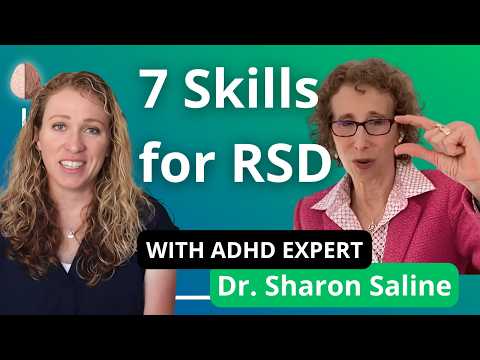
Dr. Sharon Saline explains rejection sensitive dysphoria (RSD), its connection to ADHD and social anxiety, how it impacts mental health, and practical strategies for managing RSD.
Learn the skills to Regulate your Emotions, join the membership: https://courses.therapyinanutshell.com/membership
Does an unanswered text or a small criticism send you into a spiral of “Nobody likes me” or “What’s wrong with me?” Rejection sensitivity can make real—or perceived—rejection feel intensely painful.
In this conversation, I’m joined by psychologist Dr. Sharon Saline to explore rejection sensitive dysphoria (RSD), social anxiety, and ADHD. We share personal experiences with friendship breakups, big emotions, and overthinking—and discuss practical ways to respond when rejection feels overwhelming.
You’ll learn how to: • Separate what actually happened from the story your mind is telling. • Take responsibility for your part without blaming yourself for everything. • Shift from “I’m a terrible person” to “I can learn a new skill.” • Practice compassionate self-acceptance. • Use trusted support and healthy distractions to interrupt a shame spiral.
If rejection sensitivity has you replaying conversations, taking things personally, or withdrawing from relationships, this conversation offers tools to help you work through the hurt and stay connected.
Learn more about Dr. Sharon Saline and her resources: https://drsharonsaline.com/
#RejectionSensitivity #RSD #SocialAnxiety #RejectionSensitiveDysphoria #adhd
00:00 Rejection Sensitive Dysphoria (RSD) and Social Anxiety with ADHD expert Dr. Sharon Saline 00:14 What is Rejection Sensitive Dysphoria (RSD)? 02:17 How does RSD differ from social anxiety? 04:47 The connection between ADHD and RSD 06:27 Emotional regulation with ADHD 07:30 Skill #1: QTIP Quit Taking It Personally 08:12 Skill #2: With neurodivergence, get another perspective 09:18 Skill #3: Own your ADHD gifts 10:04 Emotional regulation and self-compassion with RSD 11:31 RSD and neurodivergence 13:35 ADHD’s rapid thinking and rejection sensitive dysphoria 15:40 Skill #4: Shift into a growth mindset for RSD and ADHD 19:31 Rejection sensitive dysphoria and shame 20:55 Skill #5: Practice compassionate self-acceptance 21:33 Skill #6: Honestly discern who contributed to your RSD pain 22:40 Skill #7: Use a healthy distraction from RSD hyperfocus 25:03 Where to find Dr. Sharon Saline’s work
Looking for affordable online counseling? My sponsor, BetterHelp, connects you to a licensed professional from the comfort of your own home. Try it now for 10% off your first month: https://betterhelp.com/therapyinanutshell
FREE Mental Health Resources: https://courses.therapyinanutshell.com/free-resources Check out my podcast, Therapy in a Nutshell: https://tinpodcast.podbean.com/
Therapy in a Nutshell and the information provided by Emma McAdam are solely intended for informational and entertainment purposes and are not a substitute for advice, diagnosis, or treatment regarding medical or mental health conditions. Although Emma McAdam is a licensed marriage and family therapist, the views expressed on this site or any related content should not be taken for medical or psychiatric advice. Always consult your physician before making any decisions related to your physical or mental health. In therapy I use a combination of Acceptance and Commitment Therapy, Systems Theory, positive psychology, and a bio-psycho-social approach to treating mental illness and other challenges we all face in life. The ideas from my videos are frequently adapted from multiple sources. Many of them come from Acceptance and Commitment Therapy, especially the work of Steven Hayes, Jason Luoma, and Russ Harris. The sections on stress and the mind-body connection derive from the work of Stephen Porges (the Polyvagal theory), Peter Levine (Somatic Experiencing) Francine Shapiro (EMDR), and Bessel Van Der Kolk. I also rely heavily on the work of the Arbinger institute for my…