

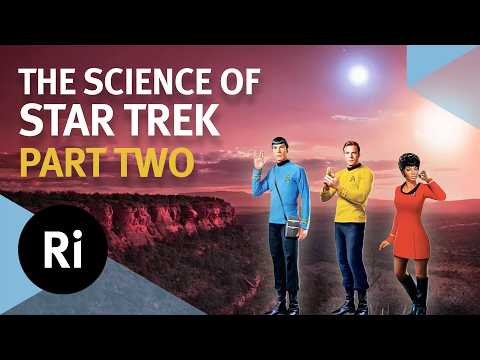
What Star Trek got right about science (and what it got wrong) | Part 2
From The Royal Institution · · 30 min
The player loads from YouTube only when you click. It uses YouTube's privacy-enhanced mode.
If the video does not play, the owner may have turned off embedding. Watch it on YouTube instead.
Description
What would it actually take to become a Starfleet officer? How close are we to replicators, warp drive and futuristic medical technology? And what does real plasma have to do with a phaser?
In Part 2 of The science of Star Trek, reserve astronaut Meganne Christian takes us inside real astronaut training and explores how today's space technology compares with the world of Star Trek. Discover how astronauts prepare for microgravity, how 3D printing could transform medicine in space, and how scientists are already manufacturing materials and pharmaceuticals in orbit.
We then return to the Royal Institution's own history, exploring the surprising connections between scientific discoveries made here and technologies imagined in Star Trek — from wireless communication and robotics to holograms and artificial intelligence. The event concludes with live demonstrations exploring plasma, Tesla coils and the science behind Star Trek's spectacular effects.
This is Part 2 of a two-part event. Watch Part 1 first for the full story of the science behind Star Trek: https://youtu.be/y4szgt79BX8
Filmed at the Royal Institution in London on 12 September 2026.
Viewer note: Actor Martin Quinn has requested that his section of the talk be edited out of the YouTube video. Apologies to everyone keen to hear from his perspective. _________ Chapters: 00:00 ESA vs Starfleet: how astronauts train 01:42 Inside astronaut training 05:22 Spacewalks, microgravity and survival 09:21 3D printing organs in space 11:46 Manufacturing, satellites and warp drive 13:09 The Royal Institution's Star Trek history 16:54 Hacking, holograms and robots 21:04 The real science of plasma and phasers 24:01 Tesla coils and Star Trek technology 27:47 The science behind Star Trek's explosions
_____________ We're a charity and rely on our generous members to keep creating content. Support us by becoming a channel member and you'll unlock exclusive Q&As with our scientists: https://www.youtube.com/channel/UCYeF244yNGuFefuFKqxIAXw/join
Subscribe for regular science videos: http://bit.ly/RiSubscRibe ____________ The Ri is on Facebook: http://www.facebook.com/royalinstitution and TikTok: https://www.tiktok.com/@ri_science Listen to the Ri podcast: https://podcasters.spotify.com/pod/show/ri-science-podcast Donate to the RI and help us bring you more lectures: https://www.rigb.org/support-us/donate-ri Our editorial policy: https://www.rigb.org/editing-ri-talks-and-moderating-comments Subscribe for the latest science videos: http://bit.ly/RiNewsletter
Product links on this page may be affiliate links which means it won't cost you any extra but we may earn a small commission if you decide to purchase through the link.