

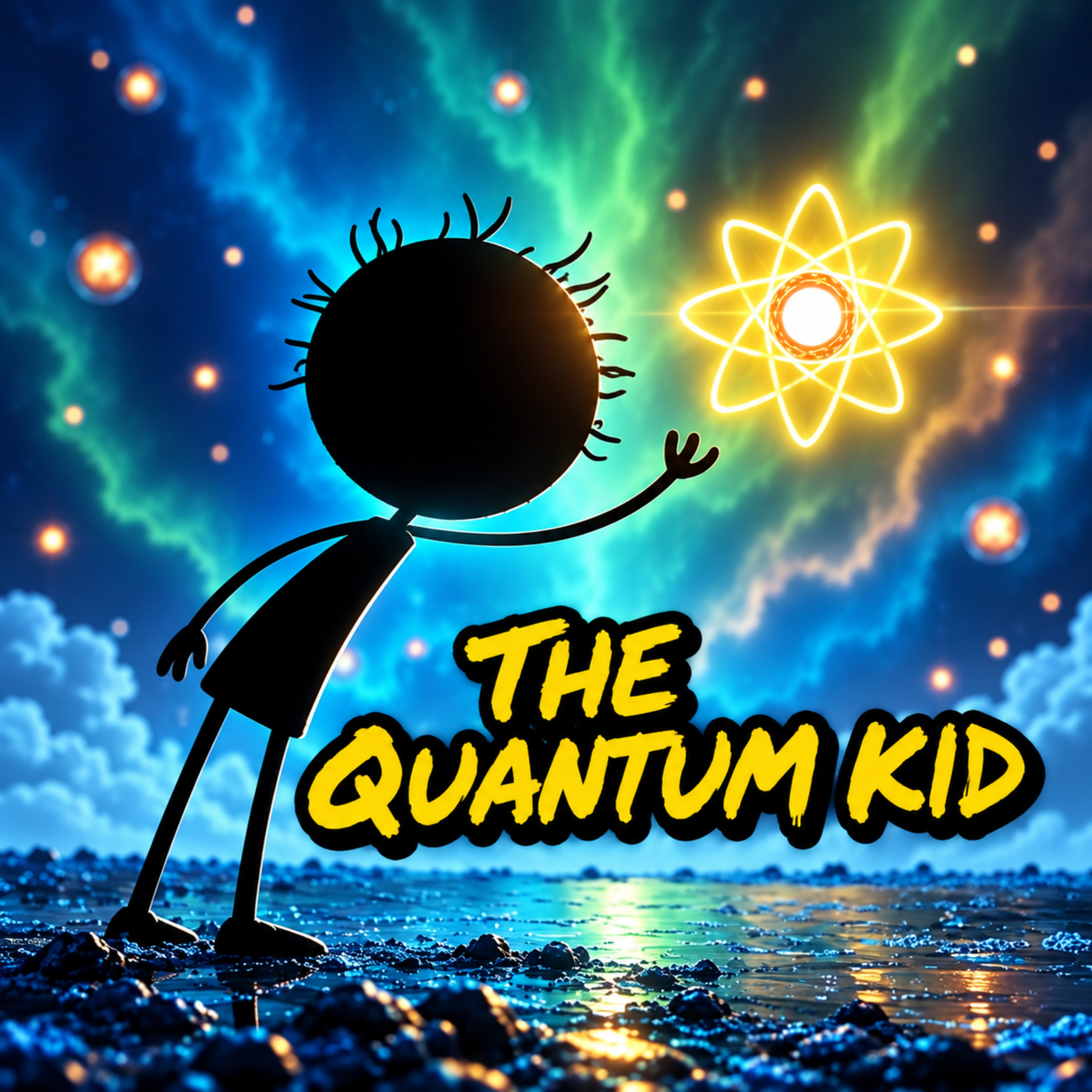
The Quantum Kid
Tesseract QuantumAudio
- Format:
- Podcast
- New episodes:
- Daily
- Typical length:
- about 20 minutes
- Latest episode:
About this show
Big questions about quantum, answered by the people building it. Kai and his mom, physicist and former WIRED editor Katia Moskvitch, talk to Nobel laureates, top scientists and tech leaders, and go inside labs from CERN to ETH Zurich, to find out how quantum computing, fusion, space science and AI are shaping tomorrow's world. If Kai gets it, so will you. Guests include John Martinis, Steven Chu, Peter Shor, John Preskill and Scott Aaronson. Made by Tesseract Quantum.
Covers: quantum physics, quantum computing, science education, fusion energy, particle physics, quantum cryptography, theoretical physics, space science
Show details and episodes come from the publisher's public feed at anchor.fm. Last updated . Names, artwork and text belong to their publishers.
Recently on this show
Summary of recent episodes, drawn from the publisher's feed.
The Quantum Kid is a podcast where a young host and his physicist mother talk with scientists and visit labs to explore quantum computing, fusion, space science and AI. Recent episodes cover Microsoft's topological qubit lab, whether quantum machines can crack encryption, the holographic universe idea, and why children pick up quantum concepts faster than adults.
Cosmos
Similar in subject
- Fermilab
Both cover: fusion energy, particle physics, quantum computing - Why This Universe?
Both cover: particle physics, theoretical physics - Sabine Hossenfelder
Both cover: particle physics, quantum physics
Similar shows




Explore more
Episodes
Microsoft exclusive: what makes this qubit UNIQUE?
· 13 min
How do you build a qubit that protects itself from errors? Kai went inside Microsoft’s quantum lab near Copenhagen to find out.Microsoft is trying to build topological qubits using Majorana zero modes, exotic quantum states that should appear at the ends of special superconducting nanowires. They’re named after Ettore Majorana, the physicist who in 1937 predicted a particle that is its own antiparticle, and who mysteriously vanished a year later. The idea is that a topological qubit stores quantum information spread out across the wire, so a small disturbance can’t easily destroy it.Dr. Lauri Sainiemi, Vice President of Fabrication at Microsoft Quantum, takes Kai through three labs: - Materials lab: Lauri shows Kai the molecular beam epitaxy machines, which grow the chip’s base material atom by atom in an ultra-high vacuum. They spray indium arsenide and a superconductor onto wafers to build the semiconductor–superconductor stack Microsoft calls a topoconductor. - Clean room: next, they see how that material is patterned into the actual qubit devices, the tiny nanowires and circuits on the chip. Since the 2025 expansion, the Lyngby lab can make the full core of the Majorana chips. - Cryostat lab: finally, Kai sees the gold “chandelier” fridges, which cool the finished chips to almost absolute zero, colder than outer space, so the team can test and measure them.Most quantum computers fight a constant battle against noise, correcting errors after they happen. Microsoft wants qubits that resist errors in the first place. It’s one of the boldest and most debated approaches in quantum computing, and this is a rare look at how it’s actually built.The Quantum Kid: quantum physics, explained like you’re 10.Produced in collaboration with Microsoft, filmed and edited by Karl Munck-Westh, Bifrost Productions. The Quantum Kid podcast and this episode remain editorially independent. ▶️ Subscribe on YouTube for more visits to the world’s quantum labs: https://www.youtube.com/@KaiTheQuantumKid🎧 Watch on Apple Podcasts: https://podcasts.apple.com/us/podcast/the-quantum-kid/id1824461468🎧 Watch on Spotify: https://open.spotify.com/show/2miE8BUDAXYvw6uf7Ycu8k🌐 tesseractquantum.com💼 LinkedIn: https://www.linkedin.com/company/the-quantum-kid/?viewAsMember=true#QuantumComputing #Microsoft #Majorana
Not rated yetIs our universe a hologram? Juan Maldacena explains
· 14 min
WHAT IF OUR UNIVERSE IS A HOLOGRAM? And could a quantum computer one day simulate one?In this episode of The Quantum Kid, Kai and Katia explore one of the most fascinating ideas in theoretical physics: the holographic principle, the connection between quantum gravity and information, and what it could tell us about the nature of spacetime.We meet Professor Juan Maldacena, whose groundbreaking work on the AdS/CFT correspondence transformed our understanding of the relationship between gravity and quantum theory.Juan explains:- What the holographic principle actually means.- How a theory describing gravity in one space can be mathematically equivalent to a quantum theory on its boundary.- What black holes have to do with information and holography.- How quantum computers could help us simulate a holographic universe — and why Juan estimates that this would require around 7,000 stable, near-perfect qubits.But what would it take to build a quantum computer capable of such a simulation?We visit Microsoft to explore one of the most ambitious approaches to quantum computing: topological qubits. We speak with Dr Lauri Sainiemi about Majorana fermions, Microsoft's approach and the challenge of building more stable qubits.COMING NEXT: INSIDE MICROSOFT'S QUANTUM LABIn our next video, Kai takes you inside Microsoft's quantum lab to explore the research and technology behind its topological qubits. Don't miss it!CHAPTERS 0:00 Is our universe a hologram? 00:45 What the holographic principle means 01:22 Inside Microsoft's quantum lab 03:01 Quantum mechanics & general relativity: why don't they get along? 05:05 String theory: a candidate for quantum gravity 07:11 Black holes and information 10:56 Simulating a black hole in a holographic universe with 7,000 qubitsThe Quantum Kid makes quantum science and technology accessible through conversations with the scientists, researchers and innovators shaping the field.Subscribe for more conversations exploring quantum computing, physics and the future of technology.#QuantumComputing #HolographicPrinciple #QuantumGravity #JuanMaldacena #Microsoft #TopologicalQubits #MajoranaFermions #TheQuantumKid
Not rated yetThis Roblox game uses quantum computing?! (Gamescom reveal) Kai plays quantum chess too
· 14 min
This game was shown live at Gamescom, where it got serious attention, so we had to find out what it's actually doing with quantum computing. Can a video game really run on quantum mechanics? Kai finds out, then sits down for a real game of quantum chess, where winning means putting his own king into superposition. Chapters: 0:00 What is a quantum game? 0:17 Can a quantum computer make a game? 0:34 Quantum chess: a pawn in superposition 0:52 Meet James Wootton (CSO, MOTH Quantum) and Natasha Skult (CEO, MiTale) 1:52 Kai plays MOTH in real time 2:50 Quantum computers for level generation 3:11 Quantum music 3:56 Should players care about quantum technology? 4:53 MOTH at Gamescom 5:15 Quantum chess with Tamás Varga 6:49 Can I build my own quantum game? 7:23 Quantum backrooms 11:13 Quantum computer as a booster 11:58 The future of quantum gaming 12:09 Clay: The Last Redemption 13:23 Quantum computing and procedural generation 13:58 I lost my MOTH 14:03 Thank you, James and Natasha! In this episode, Kai explores a Roblox-style quantum game (rescuing a moth using quantum mechanics!), then learns to play quantum chess with Tamás Varga, discovering what superposition and entanglement actually mean by using them to win. Along the way, we dive into: - How a video game can be built around real quantum mechanics - What superposition actually means, explained through a chessboard, not a textbook - What entanglement means and how it shows up in the game - Why quantum ideas are showing up in gaming and entertainment, not just labs - Kai's honest reaction to putting a chess piece in two places at once! 💬 Leave a comment here on Spotify. Kai reads them all! 🎧 Follow The Quantum Kid on Spotify for new episodes ▶️ Watch more on YouTube: https://www.youtube.com/@KaiTheQuantumKid 🌐 tesseractquantum.com
Not rated yetCan quantum computers really break the encryption protecting your data?
· 8 min
Can quantum computers really break the encryption protecting your data? Kai sits down with Rebecca Krauthamer, CEO of QuSecure, to find out, recorded live in Geneva at the AI for Good Summit. Plus, great questions from the UN diplomatic corps in the audience! Chapters: 0:00 Rebecca Krauthamer, CEO of QuSecure 0:45 What is encryption? 1:30 Do quantum computers threaten Roblox, banking and email? 2:00 How quantum computers work, really, and what Peter Shor discovered in the 1990s 3:06 Preparing hospitals and banks for the future 3:54 Why quantum computers could break today's encryption 5:25 Steps you can take right now to protect yourself 6:45 Why we need quantum safety 8:18 Kai's take on quantum computing The Quantum Kid is a show where 10-year-old Kai asks the world's top scientists and tech leaders to explain quantum computing to him, and if he gets it, so will everyone else. 💬 Leave a comment here on Spotify. Kai reads them all! 🎧 Follow The Quantum Kid on Spotify for new episodes ▶️ Watch more on YouTube: https://www.youtube.com/@KaiTheQuantumKid 🌐 tesseractquantum.com
Not rated yetParticle Fever director: can art explain quantum physics better than equations?
· 16 min
Can quantum be explained through art instead of equations? Award-winning filmmaker Mark Levinson (Particle Fever, The Universe in a Grain of Sand) joins Roger Highfield from the Science Museum Group to answer Kai's biggest questions! Chapters: 0:00 Meet Mark Levinson and Roger Highfield 1:09 Why quantum physics is so hard to explain 2:28 Can film make invisible physics visible? 3:42 Inside "The Universe in a Grain of Sand" 5:23 How museums make quantum ideas click 7:41 Kai's own take on superposition and entanglement 10:20 Why quantum ideas give even scientists a headache 12:22 Why CERN and museums are teaming up 14:05 What quantum education looks like next For the past year, The Quantum Kid has explored quantum technologies through the eyes of Kai, a curious young co-host who started this journey at age nine. In this special anniversary episode, Kai has officially turned 10! To celebrate, we are joined by two exceptional science storytellers: - Mark Levinson, physicist and director of the acclaimed films Particle Fever and The Universe in a Grain of Sand - Roger Highfield, Director of Science at the Science Museum Group, UK Together, they explore one of the biggest challenges in science: how do you explain quantum ideas to the next generation? The conversation ranges from CERN and Particle Fever to Mark's latest film, The Universe in a Grain of Sand, which uses art, experimental cinema and stunning visuals to make some of the strangest ideas in physics more accessible. Along the way, Kai shares his own interpretations of superposition and entanglement, leading to a fascinating discussion about whether children may sometimes be better prepared for quantum thinking than adults. This episode celebrates one year of The Quantum Kid and Kai's journey from age nine to ten, proving that some of the biggest questions in science can start with a child's curiosity. The Quantum Kid is a show where 10-year-old Kai asks the world's top scientists and tech leaders to explain quantum computing to him, and if he gets it, so will everyone else. 💬 Leave a comment here on Spotify. Kai reads them all! 🎧 Follow The Quantum Kid on Spotify for new episodes ▶️ Watch more on YouTube: https://www.youtube.com/@KaiTheQuantumKid 🌐 tesseractquantum.com
Not rated yetHow do you build a quantum computing startup?
· 20 min
In this episode of The Quantum Kid, Kai visits a real quantum computing startup, ZuriQ, at ETH Zurich to find out what it takes to build a company in one of the world's most advanced technologies. How do quantum startups begin? Who provides the funding? What makes a good founder? And what happens if your company fails? Kai speaks with: - David DiVincenzo, pioneer of quantum computing and creator of the DiVincenzo criteria - Alexandra Beckstein, CEO of QAI Ventures, a venture capital firm investing in quantum technologies Explore a quantum lab with Kai to learn how atoms can become qubits, and why building a startup requires much more than just a great idea! Chapters: 0:00 Introduction to startups 0:28 Inside a quantum laboratory 3:01 Challenges of a quantum CEO 4:37 Expert advice on startups 7:05 Technical and design criteria 9:01 Market applications 11:56 Founding and funding advice 16:14 The reality of failure The Quantum Kid is a show where 10-year-old Kai asks the world's top scientists and tech leaders to explain quantum computing to him, and if he gets it, so will everyone else. 💬 Leave a comment here on Spotify. Kai reads them all! 🎧 Follow The Quantum Kid on Spotify for new episodes ▶️ Watch more on YouTube: https://www.youtube.com/@KaiTheQuantumKid 🌐 tesseractquantum.com
Not rated yetWhy do kids learn quantum faster than adults? John Martinis explains
· 26 min
Why do kids understand quantum concepts faster than adults? Nobel Prize winner John Martinis (2025 Nobel Prize in Physics) and Elisa Torres Durney (founder of Girls in Quantum) join Kai to find out, and to challenge how physics gets taught in the first place. In this episode, we explore why children have a natural advantage with non-intuitive ideas like superposition and entanglement, before anyone's told them physics is supposed to be hard. John shares real advice for parents on how to nurture scientific curiosity through building, playing and asking better questions, not more advanced ones. Chapters: 0:00 Meet John Martinis and Elisa Torres Durney 2:15 John Martinis on curiosity and building things as a kid 6:31 Elisa Torres Durney's path into quantum research 9:10 Why the "adult" way of teaching physics is failing 14:45 What is quantum chess? (and how it's different from the real thing) 18:30 Preview: Kai's quantum chess battle with Tamás Varga 23:33 Advice for raising the next generation of scientists In an upcoming episode: Kai takes on Tamás Varga, the creator of a quantum chess game called Niel's Chess, to see how quantum rules actually govern the board. 💬 Leave a comment here on Spotify. Kai reads them all! 🎧 Follow The Quantum Kid on Spotify for new episodes ▶️ Watch more on YouTube: https://www.youtube.com/@KaiTheQuantumKid 🌐 tesseractquantum.com
Not rated yetCan quantum computing help unlock fusion energy on Earth?
· 22 min
Why can't we simulate the Sun, and could quantum computers help us build a star on Earth? Watch Kai visit a tokamak to find out. First, though, he heads to the Atacama Desert in Chile, where, among cacti and llamas, two remarkable observatories explore the wonders of the universe. Starting at Paranal and the Atacama Large Millimeter/submillimeter Array (ALMA), Kai ponders how stars shine through nuclear fusion. That question takes him all the way to Japan, to the largest operational fusion reactor in the world, the JT-60SA tokamak, to see how scientists are trying to achieve fusion energy right here on Earth. Back in the studio, MIT physicist Peter Fisher explains why fusion is so difficult, especially when it comes to simulating plasma, where vast numbers of particles interact at extreme speeds. Today's classical computers struggle with this complexity, and that's exactly where quantum computing comes in. Quantum systems could simulate plasma in fundamentally new ways, helping scientists better understand and control fusion reactions. Researchers are already exploring this connection, combining quantum simulations with traditional methods. Chapters: 0:00 Why can't we simulate the Sun? 0:49 Seeing the invisible: inside Chile's observatories 2:32 Inside a real fusion reactor in Japan 8:53 How quantum computing could crack fusion 17:24 What comes next for fusion energy 💬 Leave a comment here on Spotify. Kai reads them all! 🎧 Follow The Quantum Kid on Spotify for new episodes ▶️ Watch more on YouTube: https://www.youtube.com/@KaiTheQuantumKid 🌐 tesseractquantum.com
Not rated yetInside CERN: is quantum computing the answer to the next LHC upgrade?
· 15 min
Kai visited CERN just before the Large Hadron Collider shut down for one of the biggest upgrades in its history. The High-Luminosity LHC will dramatically increase collision density: stronger magnets (up to around 12 tesla), far more particle interactions, and an explosion in data that will push computing infrastructure to its limits. So 9-year-old Kai went to CERN to ask a direct question: if nature is quantum, and the data is growing beyond anything we've handled before, could quantum computers help? Inside CMS, 100 metres underground, protons collide every 25 nanoseconds. Millions of detector channels record events at microscopic precision. Physicists simulate quantum field theory on classical machines, and know exactly where approximations start to strain. Chapters: 0:00 Introduction to CERN 0:21 Particle collision process 1:34 Quantum computing role 3:35 Inside the CMS experiment 5:55 Simulation challenges 8:21 Data analysis in control room 10:01 Future computing efforts 12:05 Global data distribution 13:26 Magnet testing and upgrade This episode covers serious scientific questions emerging from the next phase of high-energy physics. Follow the show to catch future episodes, and watch the previous ones! Oh, and leave a comment here on Spotify. Kai is looking forward to each and every one! 🎧 Follow The Quantum Kid on Spotify for new episodes ▶️ Watch on YouTube: https://www.youtube.com/@KaiTheQuantumKid 🌐 tesseractquantum.com
Not rated yetA kid 3D-printed a human ear — then found out how quantum computers discover new drugs
· 27 min
Would you like to print a new ear? How about a new heart? In this episode of The Quantum Kid, 9-year-old Kai goes somewhere very few kids ever get to go: a real bioprinting lab at ETH Zurich. With the help of a researcher, Kai 3D-prints a mini human ear 🦻 made from living cells, and learns how scientists use printed tissue to study the body and test new medicines. Back in the studio, Kai has a fascinating discussion about another big "wow" in science: the use of quantum computing for drug discovery. He chats with two quantum experts: - Pedram Roushan, quantum physicist at Google Quantum AI - Sabrina Maniscalco, Professor of Quantum Information Science and Co-Founder and CEO of Algorithmiq They explain how quantum computers are different from regular computers, and why they could help scientists discover new drugs by understanding molecules in much more detail. To help Kai and viewers understand quantum, we use analogies like LEGO bricks with mini brains 🧱🧠: tiny building blocks that can hold lots of possibilities at once, which is exactly what chemistry and biology need. Chapters: 0:00 Inside a real bioprinting lab 0:20 Why quantum computing matters for medicine 0:47 The problem with studying molecules 2:42 Why molecules are so hard to simulate 6:12 How 3D bioprinting actually works 9:25 The challenge of engineering living tissue 11:05 The problems classical computers can't solve 13:41 Quantum vs. classical computing, explained 15:20 How AI and quantum computing work together 18:52 What's next for drug discovery 20:35 How soon could quantum drug discovery happen? 22:22 Inside the design of a quantum algorithm 25:01 What the future of science could look like Real labs. Real scientists. Big ideas, explained so viewers of any age can follow along. 🎧 Follow The Quantum Kid on Spotify for new episodes ▶️ Watch on YouTube: https://www.youtube.com/@KaiTheQuantumKid 🌐 tesseractquantum.com
Not rated yetJohn Preskill & Ken Goldberg: can quantum computers make robots smarter?
· 29 min
Here's the Spotify version. Spotify has episode comments too, so I kept the "Now your turn" section. You could also turn one of those questions into a Spotify poll (there's a Polls tab on the episode page), which listeners can answer with one tap. Kai, The Quantum Kid, explores what happens when quantum computing meets robotics! We have two amazing guests: • John Preskill, Richard P. Feynman Professor of Theoretical Physics at Caltech, who coined the term "quantum supremacy" • Ken Goldberg, William S. Floyd Jr. Distinguished Chair in Engineering at UC Berkeley We discuss how quantum computers could help robots make smarter decisions and solve problems faster, and what this could mean for the future of intelligent machines. We also talk about uncertainty, both in quantum physics and in robotics. Kai also heads to a super cool robotics lab in Zurich, ANYbotics, to talk to Ayla Watsuji, Robotics Mechanical Engineer. There, he meets ANYmal, a robot dog the size of a Labrador that can walk, climb stairs, and go where it's dangerous for humans. And, as Kai puts it, "it's veeeeeryyyy cute!" Quantum computers don't just calculate faster. They think differently. Could that give robots new abilities? Chapters: 0:00 Exploring a robot lab 3:46 Meeting the experts 5:13 Challenges of uncertainty 6:54 Defining quantum uncertainty 9:59 The role of computation 12:20 AI, data, and synthesis 15:17 Quantum speed for robotics 19:13 Future of quantum hardware 22:22 Robots and human interaction 26:40 Closing thoughts 👇 Now your turn: • How do you think robots might use quantum computers? • What should robots be able to do that they can't do today? • Would you trust a quantum-powered robot? 💬 Leave a comment here on Spotify. Kai reads them and may answer yours in the next episode! 🎧 Follow The Quantum Kid on Spotify for new episodes ▶️ Watch on YouTube: https://www.youtube.com/@KaiTheQuantumKid 🌐 tesseractquantum.com
Not rated yetScott Aaronson's Chat with Kai: Time Travel, Wormholes, Paradoxes, and the Future of Physics
· 23 min
In this episode of The Quantum Kid, 9-year-old Kai explores one of the most fascinating frontiers in modern physics: time travel, and what quantum mechanics and relativity really say about it. Our guest is Scott Aaronson, one of the world's leading experts in quantum computing, the Schlumberger Centennial Chair of Computer Science at the University of Texas at Austin, and director of UT's Quantum Information Center. Together, we dig into the science behind the movies, from Back to the Future to Interstellar, and unpack what physics actually allows. Scott explains: - Why traveling forward in time is real physics, not science fiction - What a closed timelike curve is, and why it matters for time travel - How relativity links wormholes and time travel to the past - Why stable wormholes would require large amounts of negative energy, far beyond anything observed - How time-travel paradoxes like the grandfather paradox and the Shakespeare paradox challenge our understanding of reality - How quantum superposition and David Deutsch's 1991 model introduce the idea of branching timelines - Why quantum computers interacting with their past selves would be unimaginably powerful, far beyond anything we expect real quantum computers to do Along the way, Kai asks what every curious kid wants to know: Can you bring your homework back from the future? Could Marty McFly really fade out of existence? How much of Interstellar is true? And will we ever time-travel for real? To bring the cosmic perspective to life, this episode also features original footage from the ALMA Observatory in the Atacama Desert, one of Earth's most advanced instruments for exploring the structure of space-time. Chapters: 0:00 Introduction to the topic 1:39 Is time travel possible? 3:17 Black holes and telescopes 6:07 Experiencing a black hole 6:59 Wormholes and relativity 9:24 Addressing paradoxes 12:40 The Shakespeare paradox 16:15 Computing and time travel 17:40 Deutsch's model 22:52 Concluding thoughts Whether you're a kid discovering physics for the first time or a researcher wondering how quantum mechanics might resolve time-travel paradoxes, this conversation offers a clear and insightful journey through some of the biggest open questions in science, from wormholes to quantum gravity. 🎧 Follow The Quantum Kid on Spotify for new episodes ▶️ Watch on YouTube: https://www.youtube.com/@KaiTheQuantumKid 🌐 tesseractquantum.com
Not rated yetNobel laureate Steven Chu & Peter Shor on quantum computing vs climate change
· 24 min
In this episode of The Quantum Kid, Kai travels to Easter Island to explore one of the biggest questions of our time: can quantum computing help the environment and make our world just that tiny bit more sustainable? For the chat, Kai is joined by two legendary scientists: - Dr. Steven Chu, Nobel Laureate in Physics and former U.S. Secretary of Energy - Professor Peter Shor, inventor of Shor's algorithm, the discovery that sparked the modern era of quantum computing Together, they discuss how quantum technologies could transform energy systems, climate solutions, and sustainable innovation, and how curiosity and creativity can drive real-world progress. Chapters: 0:00 Introduction to guests 1:33 Lessons from Easter Island 3:27 Deforestation and carbon 6:13 Quantum computing role 7:43 Risks of climate change 9:16 Quantum limits and simulation 11:52 Material science challenges 14:43 Hardware progress 16:47 AI energy consumption 19:01 Future of battery design 20:45 Advice for young scientists It's a rare, intergenerational dialogue that connects qubits and climate, mathematics and meaning, and the future of science and the planet, through the eyes of a child and the minds of two of the world's most visionary scientists. 🎧 Follow The Quantum Kid on Spotify for new episodes ▶️ Watch on YouTube: https://www.youtube.com/@KaiTheQuantumKid 🌐 tesseractquantum.com
Not rated yetThis 9-year-old ran his own program on a real quantum computer
· 19 min
In this episode, 9-year-old Kai codes on a real quantum computer! Join us as we visit an actual quantum computing lab at ETH Zurich, Albert Einstein's alma mater, with Kai, The Quantum Kid. We step inside the cutting-edge world of superconducting qubits and meet Dr. Anatoly Kulikov, one of the ETH researchers pushing the limits of physics. And we even see Kai run his very own quantum algorithm on a live quantum processor! What to expect in this episode: - A behind-the-scenes tour of the quantum hardware lab: cryostats, control electronics and all - An easy-to-follow walkthrough of how qubits work and why they can solve certain problems faster than classical computers - Kai executing a simple Qiskit program and watching the results come back from a real quantum computer Whether you're completely new to quantum or already working in the field, you'll get a close-up look at the technology that's reshaping computing, and the curiosity that drives the next generation of scientists. Chapters: 0:00 Introduction to the lab 1:31 Inside the cryostat 3:46 Quantum chip design 5:29 Operating the qubits 7:14 Scaling quantum hardware 8:11 Classical integration 10:31 Running a quantum experiment 12:57 Challenges and algorithms 16:41 Learning quantum computing Want to go deeper? In this demo, Kai runs what's called a Rabi experiment on a real quantum computer. Think of a qubit as a tiny arrow that can point anywhere on a ball. This ball is called the Bloch sphere. When we send the qubit a carefully timed "pulse," the arrow starts to swing back and forth, just like a playground swing. By slowly changing the length of that pulse and measuring where the arrow ends up, we see a beautiful wave pattern in the results. This is the Rabi oscillation, the qubit's way of showing how it moves between its two possible states. The Bloch sphere is simply the scientist's map for that motion, letting us picture the qubit's dance in 3D space. Seeing the wave appear in the data is proof that the qubit is behaving exactly as quantum physics predicts. Watch the video to see the results! The Quantum Kid is made by Tesseract Quantum. On our YouTube channel you'll also find our Qubits & Coffee webinars, which teach everyone to program a quantum computer. 🎧 Follow The Quantum Kid on Spotify for new episodes ▶️ Watch on YouTube: https://www.youtube.com/@KaiTheQuantumKid 🌐 tesseractquantum.com
Not rated yetCould quantum computers help us find alien life?
· 21 min
In this episode of The Quantum Kid, 9-year-old Kai and his science writer mom, Katia Moskvitch, travel to the Atacama Desert in Chile, the driest place on Earth. They visit the Paranal Observatory, home to the Very Large Telescope, which combines four 8.2-meter telescopes into a single virtual mirror, giving it the highest optical resolution in the world. The Atacama is so free of light pollution that the night sky is stunning, with the Milky Way stretching overhead like a magical blanket. Chapters: 0:00 Exploring the Atacama 2:22 Quantum tools for space 4:58 Seeking intelligent life 7:54 Interstellar anomalies 10:49 Quantum physics principles 14:18 Data processing challenges 17:56 The future of science With guests: - Avi Loeb, astrophysicist at Harvard University - Karen Hallberg, theoretical physicist and Secretary General of the Nobel Peace Prize–winning Pugwash Conferences Kai and Katia look at how quantum technologies and AI could transform space exploration, astronomy, the search for signals of extraterrestrial life, and even our understanding of reality itself. From simulating black holes and the Big Bang to quantum sensing and quantum communication, Kai asks: can quantum and AI help us answer the biggest question of all? Are we alone in the cosmos? In a very down-to-earth way, Avi and Karen explain how quantum computing and AI could help scientists process massive amounts of telescope data, explore galaxies, and probe mysteries like dark matter and dark energy. The episode also tackles another big question: could these technologies one day replace human scientists, or are they tools that amplify human curiosity and discovery? Quantum sensors could detect faint gravitational waves or measure tiny changes in space environments with unprecedented precision. Quantum communication may one day link spacecraft across vast distances with secure signals, while quantum-designed materials may protect astronauts from cosmic radiation on long journeys to Mars and beyond. 🎧 Follow The Quantum Kid on Spotify for new episodes ▶️ Watch on YouTube: https://www.youtube.com/@KaiTheQuantumKid 🌐 tesseractquantum.com
Not rated yetThe 3D-printed panda: can quantum computing reinvent manufacturing?
· 16 min
In this episode of The Quantum Kid, 9-year-old Kai and Katia explore how quantum computing is beginning to reshape how we build, design, and optimize everything, from materials to supply chains. Kai and Katia are joined by two brilliant guests: - Frederik Flöther, Chief Quantum Officer at QuantumBasel, home to Switzerland's first commercial quantum computer - Antonio Linares, global manufacturing executive working on real-world tech integration Whether you're a tech leader, educator, or just quantum-curious, this episode makes deep tech both accessible and inspiring. Chapters: 0:00 Introduction to quantum and manufacturing 1:36 What is a qubit, really? 4:02 How quantum computing is changing manufacturing 7:18 Quantum meets 3D printing: meet the panda 9:31 Discovering stronger, lighter materials with quantum 12:22 What's next for quantum in industry 14:02 Ethics and imagination in emerging tech 🎧 Follow The Quantum Kid on Spotify for new episodes ▶️ Watch on YouTube: https://www.youtube.com/channel/UCJA_FyC7jWsid3hkVQdhvMA 🌐 tesseractquantum.com
Not rated yetCan Quantum Computers Fly a Plane?
· 19 min
Welcome to The Quantum Kid, where 9-year-old Kai and his physicist mom, Katia Moskvitch, talk to scientists, innovators, and entrepreneurs building tomorrow's world. Big questions, real answers, all explained simply. In this first episode, Kai explores big questions with: - His mom, physicist and STEM communicator, former WIRED business editor Katia Moskvitch - A quantum expert: ETH Zurich Quantum Information Professor Renato Renner - A business leader: patent attorney, investor, and Kai's uncle, Andrei Moskvitch We've all heard the buzz around quantum computing, but what are quantum computers, really? They're not just faster. They think differently, which helps them solve complex problems like modeling weather or optimizing flight routes. Could they fly a plane remotely? Not today, but one day they might help make better, faster decisions in unpredictable environments. Why does this matter for business? Quantum could unlock major value in logistics, materials science, and beyond, but only if we ask the right questions now and invest in educating bright, curious minds. Simple questions lead to deep insights, and Kai proves that curiosity might just be the ultimate quantum tool. Chapters:0:00 Introduction to quantum1:06 Understanding the quantum world3:54 Quantum computing basics5:52 Potential applications8:57 Optimization and logistics12:00 Investment and challenges14:47 Algorithms and the future17:04 Quantum networks and conclusion 🎧 Follow The Quantum Kid on Spotify for new episodes▶️ Watch on YouTube: https://www.youtube.com/channel/UCJA_FyC7jWsid3hkVQdhvMA🌐 tesseractquantum.com
Not rated yet