

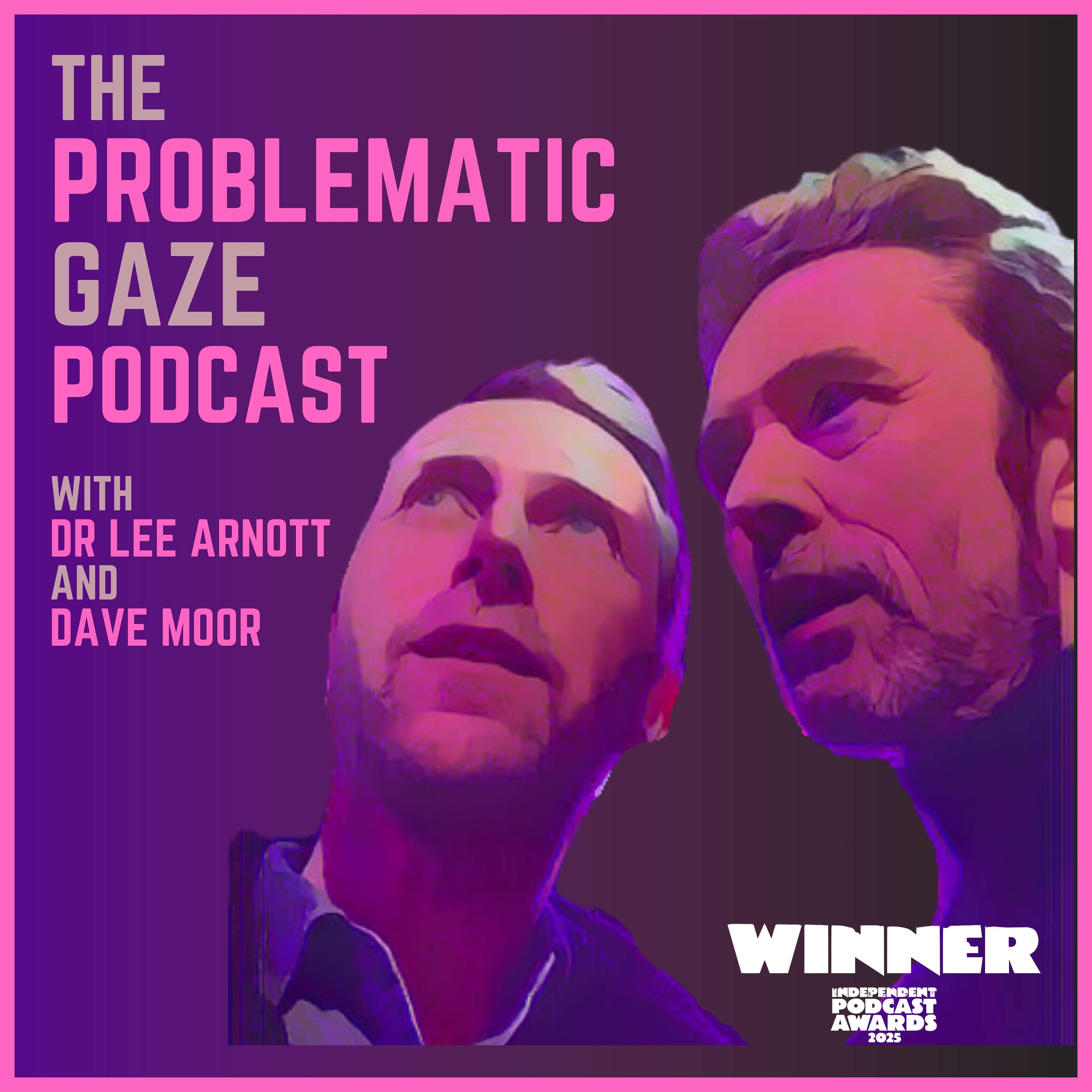
The Problematic Gaze
David Moor and Lee ArnottAudio
- Format:
- Podcast
- New episodes:
- Several times a week
- Typical length:
- about 55 minutes
- Latest episode:
About this show
Winner - ‘Best History Podcast’ - Independent Podcast Awards 2025
‘Top 30 Podcasts To Listen To Right Now’ - The Radio Times 2025
Direct from PG Towers, join social historian Dr Lee Arnott and TV producer Dave Moor for a lighthearted look at the world of TV, Film and Popular Culture of yesteryear that has since been considered problematic. Each week we focus on a different piece of pop culture, and put it into context by looking at the news events and cultural landscape of the year it was released. Out and proud, Dr Lee and Our Dave present a humorous take on life as LGBTQ+ men of a glorious age, and present a digestible mix of academic social commentary, unflinching life lessons, media analysis, and hot takes on feminism, race, politics and cancel culture.
Hosted on Acast. See acast.com/privacy (https://acast.com/privacy) for more information.
Show details and episodes come from the publisher's public feed at feeds.acast.com. Last updated . Names, artwork and text belong to their publishers.
Cosmos
Similar by topic and creator
- Vintage Cinema Rewind
Shares the topics Film and TV, History and Society. - Diggin’ Oak Island
Shares the topics Film and TV, History and Society. - Pop Mystery Pod
Shares the topics Film and TV, History and Society.
Similar shows




Explore more
Episodes
THE GAZETTE: Tim Curry & Dolly Parton, Storm Chaos and Grange Hill
· 24 min
It's been quite a week. We've survived biblical weather, failed to see The Human League and said goodbye to two absolute legends: Tim Curry and Dolly Parton. We begin back at PG Manor with the tale of the concert that never was. Plans to see The Human League, Toyah and Roland Gift were scuppered by a spectacular storm and eventual cancellation, leaving us with no synth-pop whatsoever but at least a reasonably dramatic story to tell. We also catch up on your reactions to our Saturday Night Fever episode. It turns out quite a few of us had remembered John Travolta, the white suit and the Bee Gees while somehow forgetting just how extraordinarily bleak the rest of the film is. Then we remember two much-loved stars we've sadly lost this week. First, Tim Curry, whose extraordinary career gave us Dr Frank-N-Furter in The Rocky Horror Picture Show, Pennywise in It and a wonderfully scene-stealing Long John Silver in Muppet Treasure Island. We celebrate his unique talent, his resilience following his stroke, and why so many of his performances became permanently lodged in popular culture. We also pay tribute to Dolly Parton—singer, songwriter, actress, philanthropist, businesswoman and owner of perhaps the most recognisable hair in showbusiness. Beyond Jolene, 9 to 5 and I Will Always Love You, we look at some of the stories that made us love Dolly quite so much and celebrate the extraordinary generosity that accompanied her extraordinary career. There's plenty of listener mail too, including a recommendation for the gloriously gender-bending Goodbye Charlie, one listener's determination never to watch Crocodile Dundee, and the suggestion that we turn our attention to Priscilla, Queen of the Desert instead. Plus, we're watching Widow's Bay, discovering that apparently crows can hold grudges, discussing The Traitors: Canada, Reacher, Channel 5's Number 1 Fan and some intriguing casting news from Only Murders in the Building. And finally, sharpen your pencils, straighten your tie and try not to get sent to Mr Bronson because we're going back to school. Next time we're taking a nostalgic trip to Grange Hill to discover just how much trouble there really was at that particular comprehensive. Click here to visit our YouTube site, The Gaze Channel, where you can watch video versions of our podcast. (https://www.youtube.com/@PodcastGaze/videos) Our YouTube site also contains playlists for each episode with provides wider context to each episode. (https://www.youtube.com/@PodcastGaze/playlists) Click here to follow us on all our socials (https://linktr.ee/theproblematicgaze) And if our fellow Gazers want to comment on what they've heard in our episodes, or to suggest future topics, please email us at theproblematicgaze@gmail.com. We love hearing from you! Hosted on Acast. See acast.com/privacy (https://acast.com/privacy) for more information.
Not rated yetSaturday Night Fever (1978 UK): The Disco Classic Is Much Darker Than You Remember
· 52 min
Pull on your flares, practise that pointing pose and dust off that Bee Gees soundtrack because this week we're revisiting Saturday Night Fever—although the film we actually watched is a lot less glittery than popular culture would have us believe. Released in America in 1977 and arriving in UK cinemas in March 1978, Saturday Night Fever gave us John Travolta in the white suit, one of the biggest-selling soundtracks of all time and some of the most iconic dancing ever put on film. But strip away the disco lights and this is a surprisingly bleak story about working-class young people who don't see much of a future ahead of them. We follow Tony Manero through the streets of Brooklyn, where his dead-end job, troubled family life and deeply troubled group of friends contrast dramatically with the glamorous world of the 2001 Odyssey nightclub. On Saturday night, Tony can become somebody—and Travolta's extraordinary dancing shows us exactly why. But then there's everything else. We tackle the film's toxic masculinity, misogyny, casual racism and homophobia, as well as its treatment of women, sexual violence, teen pregnancy and tragic deaths. We also discuss the dance competition and the moment Tony himself begins to recognise that the world he inhabits—and some of his own behaviour within it—isn't quite as straightforward as he thought. In Culture Corner, we're heading to Britain in 1978, when disco was everywhere. We revisit the year's chart hits and youth culture while digging beneath the mainstream disco explosion to explore the Black musical traditions and Black, Latino and queer communities that helped create the culture—roots that Saturday Night Fever's overwhelmingly white version of disco largely leaves out. And yet, despite everything that's difficult about the film, there's plenty to celebrate. Travolta gives a remarkable performance, the dance sequences remain electrifying, the soundtrack became a cultural phenomenon, and beneath Tony's swagger is a young man desperately trying to work out whether life might offer him something more. So forget the fancy-dress version of Saturday Night Fever. It's angry, uncomfortable, occasionally shocking and far darker than its glitterball reputation suggests. Click here to visit our YouTube site, The Gaze Channel, where you can watch video versions of our podcast. (https://www.youtube.com/@PodcastGaze/videos) Our YouTube site also contains playlists for each episode with provides wider context to each episode. (https://www.youtube.com/@PodcastGaze/playlists) Click here to follow us on all our socials (https://linktr.ee/theproblematicgaze) And if our fellow Gazers want to comment on what they've heard in our episodes, or to suggest future topics, please email us at theproblematicgaze@gmail.com. We love hearing from you! Hosted on Acast. See acast.com/privacy (https://acast.com/privacy) for more information.
Not rated yetPrime Suspect (1991): Helen Mirren, Sexism & the Drama That Changed TV Crime
· 42 min
To watch the first series of Prime Suspect discussed in this episode,click here to watch on YouTube (https://www.youtube.com/watch?v=Ibzo3Oiw_Ck&t=16s) Grab your notebook, light another cigarette and prepare for some extremely grim early-90s police station décor, because this week we're investigating one of the most acclaimed British crime dramas ever made: Prime Suspect. First broadcast on ITV in 1991, Prime Suspect gave Helen Mirren one of her defining roles as DCI Jane Tennison, an ambitious, formidable detective trying to solve a brutal murder while surrounded by male colleagues who seem almost as determined to undermine her as they are to catch the killer. We revisit the first series, where Tennison finally gets her chance to lead a major murder investigation after the original senior detective suddenly dies. Unfortunately, inheriting the case also means inheriting a squad of deeply unimpressed men, led by DS Ottley, who respond to having a female boss with sexism, obstruction and some good old-fashioned workplace sabotage. At the centre of the investigation is George Marlowe, an apparently respectable family man whose private life brings him into contact with sex workers. As the evidence mounts, we explore how the drama plays with the idea of the seemingly harmless "nice guy" while also examining the appalling attitudes faced by the women involved in the case. But Prime Suspect isn't simply a murder mystery. We look at the sexism surrounding Tennison, the misogyny directed towards sex workers, the pressures her career places on her relationship, and the extraordinary forensic detail that helped make the programme feel so different from the cosy television detective dramas that had come before. In Culture Corner, we're travelling back to 1991 to revisit the year's biggest-selling albums and look at the women who had already been solving crimes on British television—from Juliet Bravo and The Gentle Touch to the wonderfully glossy C.A.T.S. Eyes. So just how revolutionary was Jane Tennison? We also explore Prime Suspect's extraordinary legacy, its awards and reputation for realism, and the influence it had on the crime dramas that followed. More than 30 years later, Helen Mirren's Tennison remains complicated, difficult, brilliant and utterly compelling. The hairstyles may have changed, the offices are considerably less smoky, but some of the workplace politics feel rather less historical than we'd like. Join us as we reopen the case and discover why Prime Suspect still deserves its place among the great British television dramas. Click here to visit our YouTube site, The Gaze Channel, where you can watch video versions of our podcast. (https://www.youtube.com/@PodcastGaze/videos) Our YouTube site also contains playlists for each episode with provides wider context to each episode. (https://www.youtube.com/@PodcastGaze/playlists) Click here to follow us on all our socials (https://linktr.ee/theproblematicgaze) And if our fellow Gazers want to comment on what they've heard in our episodes, or to suggest future topics, please email us at theproblematicgaze@gmail.com. We love hearing from you! Hosted on Acast. See acast.com/privacy (https://acast.com/privacy) for more information.
Not rated yetTHE GAZETTE: Funny-Tasting Water, Ingrid Pitt’s Incredible Escape & Eclipse Disappointment
· 18 min
Something strange is happening to the water, Ingrid Pitt may have had an even more extraordinary life than we realised, and Lee has travelled all the way to Tooting Common to stare at... some clouds. It can only be another Problematic Gazette. We begin with the important question of the week: why does the tap water suddenly taste sweet? With drought conditions, a hosepipe ban, Victorian cast-iron pipes and two very visible bursts on the road, we investigate what might be going on underground. We also discover that people secretly watering their gardens at night aren't just being naughty—they can apparently make it harder for water companies to detect leaks. Who knew hydrology could be so scandalous? Then we return to The Vampire Lovers and the extraordinary life of its star, Ingrid Pitt. Lee has been digging through contemporary interviews and uncovers Pitt's remarkable accounts of escaping with her mother from Nazi persecution as a child and, years later, fleeing East Germany by swimming across the River Spree—an adventure that eventually led to meeting the American serviceman whose surname she would keep throughout her career. Back in considerably less dramatic circumstances, we report on our eclipse expedition to Tooting Common. Expectations were high. Nature had other ideas. We also cast an eye over this year's Strictly lineup and discover that our excitement levels may need professional resuscitation. There's a more serious moment as we mark World Humanitarian Day, looking back at the 2003 bombing of the Canal Hotel in Baghdad that led to its creation and remembering the aid workers who continue to lose their lives while helping others around the world. Plus: we tease our next main episode, when we're heading into considerably darker territory with Prime Suspect. The Gazette is taking next week off while Dave goes on holiday, so enjoy the peace and quiet while it lasts. Click here to visit our YouTube site, The Gaze Channel, where you can watch video versions of our podcast. (https://www.youtube.com/@PodcastGaze/videos) Our YouTube site also contains playlists for each episode with provides wider context to each episode. (https://www.youtube.com/@PodcastGaze/playlists) Click here to follow us on all our socials (https://linktr.ee/theproblematicgaze) And if our fellow Gazers want to comment on what they've heard in our episodes, or to suggest future topics, please email us at theproblematicgaze@gmail.com. We love hearing from you! Hosted on Acast. See acast.com/privacy (https://acast.com/privacy) for more information.
Not rated yetThe Vampire Lovers (1970): Hammer Horror, Ingrid Pitt & The Lesbian Vampire craze
· 43 min
Sharpen your stakes and protect your daughters because this week we're entering the wonderfully gothic, increasingly racy world of Hammer Horror with 1970's The Vampire Lovers. By the dawn of the 1970s, Hammer's familiar formula of castles, cleavage and Christopher Lee was facing competition from a new generation of increasingly explicit cinema. The answer? More blood, more nudity and, in The Vampire Lovers, one of horror cinema's most enduring figures: the lesbian vampire. Directed by Roy Ward Baker and starring Ingrid Pitt, Peter Cushing and Kate O'Mara, the film was adapted from Sheridan Le Fanu's Carmilla, a vampire story that actually predates Bram Stoker's Dracula. We explore how Hammer transformed it into the first instalment of its Karnstein trilogy and helped launch a cycle of lesbian vampire films that became a distinctly provocative corner of 1970s horror. But who exactly was The Vampire Lovers made for? We dig into the film's complicated legacy, asking whether its lesbian relationships offered rare queer visibility at a time when that was almost nonexistent—or whether they were primarily designed for the heterosexual male gaze. And when female desire is ultimately destroyed by men restoring the traditional order, is Hammer reinforcing the status quo or accidentally giving queer audiences someone far more interesting to root for? We also celebrate the extraordinary life of Ingrid Pitt, whose journey to becoming one of Hammer's greatest icons was every bit as remarkable as her screen career. And in Culture Corner, we're travelling back to Britain in 1970: the news stories, television and chart hits—including the inescapable "In the Summertime"—plus major changes to British film censorship that allowed filmmakers like Hammer to push sex, nudity and horror further than they had before. Sexy, camp, gothic and dripping with subtext, The Vampire Lovers captures Hammer at a fascinating crossroads: an old studio trying to survive a new decade by discovering that apparently the answer to everything was more vampires and fewer nightdresses. Join us as we sink our teeth into one of Hammer Horror's most fascinating cult classics. We watched The Vampire Lovers on Amazon Prime Video. Click here (https://www.amazon.co.uk/gp/video/detail/B09KHJ7T99?pageTypeId=B09KHJ9TRJ&qid=1786384466566&pageTypeIdSource=ASIN&sr=1-1&ref_=atv_sr_fle_c_sr08ff8a_1_1_1) Click here to visit our YouTube site, The Gaze Channel, where you can watch video versions of our podcast. (https://www.youtube.com/@PodcastGaze/videos) Our YouTube site also contains playlists for each episode with provides wider context to each episode. (https://www.youtube.com/@PodcastGaze/playlists) Click here to follow us on all our socials (https://linktr.ee/theproblematicgaze) And if our fellow Gazers want to comment on what they've heard in our episodes, or to suggest future topics, please email us at theproblematicgaze@gmail.com. We love hearing from you! Hosted on Acast. See acast.com/privacy (https://acast.com/privacy) for more information.
Not rated yetTHE GAZETTE: Widow's Bay, Ann Droid and Gazer E-Mails
· 25 min
We're back! After a short summer break, our bonus episode, The Problematic Gazette returns with plenty to catch up on, including holidays, television recommendations, listener emails, and a sneak peek at the gloriously gothic world we'll be exploring next week. We start by looking back at our recent recording with special guest Andrew Mercado, where we revisited Crocodile Dundee, before swapping holiday stories. Dave headed to the South of France, where a blocked ear became an unexpected travelling companion, while Lee escaped London's heat with a trip to Northumberland in search of cooler weather—and found it! Naturally, the Great British Weather makes an appearance. We chat about the latest heatwave, hosepipe bans, and the strange moment when you've become so desperate for rain that you find yourself listening to a YouTube thunderstorm just to remember what it sounds like. We've also got plenty of television recommendations. From Apple TV's eerie Widow's Bay and ITV's atmospheric Highlands mystery The Dark to Prime's Ride or Die with Hannah Waddingham, plus the wonderfully bittersweet comedy Ann Droid, starring Diane Morgan and Sue Johnson, we share the shows that have kept us entertained over the summer—and a few that might deserve a place on your watchlist. Elsewhere, we welcome new listeners who discovered us through our posts about the remarkable Rent Boys documentary, give an update on our new website and recent photoshoot, and open the postbag to read your emails, corrections and recommendations. And finally, we look ahead to next week's deep dive into one of Hammer Horror's most influential—and controversial—films: The Vampire Lovers. Expect gothic castles, vampires, and plenty to sink our teeth into. So grab a cold drink, settle in, and join us for another relaxed catch-up packed with pop culture, recommendations, and the usual amount of delightful nonsense. Summer may be ending... but we're just getting warmed up. Click here to visit our YouTube site, The Gaze Channel, where you can watch video versions of our podcast. (https://www.youtube.com/@PodcastGaze/videos) Our YouTube site also contains playlists for each episode with provides wider context to each episode. (https://www.youtube.com/@PodcastGaze/playlists) Click here to follow us on all our socials (https://linktr.ee/theproblematicgaze) And if our fellow Gazers want to comment on what they've heard in our episodes, or to suggest future topics, please email us at theproblematicgaze@gmail.com. We love hearing from you! Hosted on Acast. See acast.com/privacy (https://acast.com/privacy) for more information.
Not rated yetCrocodile Dundee (1986): Paul Hogan & the Movie That Changed Australia (with Andrew Mercado)
· 1 hr 3 min
This week we're heading into the Australian Outback—and the streets of New York—to revisit one of the biggest global movie sensations of the 1980s: Crocodile Dundee. Joining us is Australian author and co-host of the TV Gold Podcast (https://podcasts.apple.com/gb/podcast/tv-gold/id1106441089)Andrew Mercado, who brings first-hand insight into the remarkable phenomenon that turned Paul Hogan from a household name in Australia into one of the world's biggest movie stars almost overnight. Together we explore how Crocodile Dundee became an international box-office sensation, the story behind its production, its different theatrical cuts, its enduring popularity, and why, nearly forty years later, it's still one of Australia's most recognisable cultural exports. We also discuss the 40th anniversary 4K restoration and the film's lasting place in cinema history. Andrew explains Paul Hogan's extraordinary television career before Dundee, Australia's famous tourism campaigns, and how one low-budget comedy helped reshape the world's image of Australia for an entire generation. As always, we also step back into 1986 in our Culture Corner, revisiting the television, music and headlines that surrounded the film's release. From Wham! calling it a day and Madonna's True Blue era to chart hits from EastEnders, Grange Hill, The Young Ones, Spitting Image, and more, it's a nostalgic return to one of pop culture's most memorable years. Finally, we ask how Crocodile Dundee looks through modern eyes. We discuss its ideas about masculinity, its affectionate send-up of New York culture, Linda Kozlowski's role, the film's portrayal of First Nations Australians, and the removal of one scene in later releases that has become increasingly controversial. Funny, charming and packed with behind-the-scenes stories, this episode revisits a film that became far more than a box-office hit—it became part of Australia's national identity and one of the defining movies of the 1980s. So grab your hat, watch out for crocodiles... and remember, that's not a knife... To watch the TV Show Australian Story: Paul Hogan mentioned in this podcast click the YouTube Link Here (https://www.youtube.com/watch?v=QAuLJsKmFNo) To watch the trailer for Love Of An Icon: The Legend of Crocodile Dundee. Click here (https://www.youtube.com/watch?v=vM1JMDFURR0) Click here to visit our YouTube site, The Gaze Channel, where you can watch video versions of our podcast. (https://www.youtube.com/@PodcastGaze/videos) Our YouTube site also contains playlists for each episode with provides wider context to each episode. (https://www.youtube.com/@PodcastGaze/playlists) Click here to follow us on all our socials (https://linktr.ee/theproblematicgaze) And if our fellow Gazers want to comment on what they've heard in our episodes, or to suggest future topics, please email us at theproblematicgaze@gmail.com. We love hearing from you! Hosted on Acast. See acast.com/privacy (https://acast.com/privacy) for more information.
Not rated yetQueer as Folk (1999): The TV Series That Changed Britain
· 52 min
This week we're heading back to Canal Street in 1999 to revisit one of the most influential British television dramas ever made: Queer as Folk. Created by Russell T Davies, the groundbreaking Channel 4 series exploded onto British television with an honesty and confidence rarely seen before. Funny, provocative, explicit and unapologetically gay, it introduced millions of viewers to a world that had seldom been portrayed so openly on mainstream television. We focus on the unforgettable first episode, meeting the confident and charismatic Stuart, his best friend Vince, and fifteen-year-old Nathan, whose arrival on Manchester's Canal Street sets the story in motion. Along the way we revisit the moments that made headlines—from explicit sex scenes and frank discussions of gay relationships to Stuart fathering a child through sperm donation, Vince's endearing Doctor Who obsession, and some wonderfully memorable comic moments that remind us why the series became such a phenomenon. In our Pride Corner, we step back into Britain at the end of the 1990s to explore just how much the country was changing. We discuss shifting public attitudes towards LGBTQ+ people, media representation, advertising, the growing visibility of trans people, and how newspapers such as The Sun gradually changed their approach to outing and reporting on LGBTQ+ lives. We also revisit the television, music and popular culture that formed the backdrop to one of the most talked-about dramas of the decade. Of course, we also examine the controversies that surrounded Queer as Folk. Was the reaction driven by genuine concerns or by lingering prejudice? How does the series look through modern eyes? We discuss its handling of age, sex and consent, while also considering criticisms of its relatively narrow portrayal of gay life, including its overwhelmingly white cast, limited representation of lesbians, and the notable absence of HIV and AIDS from a story set at the end of the twentieth century. More than twenty-five years later, Queer as Folk remains funny, moving, controversial and hugely influential. This episode asks not simply what has aged well, but what the series tells us about Britain in 1999—and how far we've travelled since. Join us as we revisit the drama that changed the conversation about LGBTQ+ lives on British television forever. GAZER HOMEWORK: Next week we turn our focus to the 1986 movie: Crocodile Dundee Click here to visit our YouTube site, The Gaze Channel, where you can watch video versions of our podcast. (https://www.youtube.com/@PodcastGaze/videos) Our YouTube site also contains playlists for each episode with provides wider context to each episode. (https://www.youtube.com/@PodcastGaze/playlists) Click here to follow us on all our socials (https://linktr.ee/theproblematicgaze) And if our fellow Gazers want to comment on what they've heard in our episodes, or to suggest future topics, please email us at theproblematicgaze@gmail.com. We love hearing from you! Hosted on Acast. See acast.com/privacy (https://acast.com/privacy) for more information.
Not rated yetTales of the City (1993): The Queer Classic That Changed Television
· 45 min
To watch the episode of 'Tales Of The City" discussed in this episode on YouTube: Click here (https://www.youtube.com/watch?v=z4BB89u_cLc) Pack your bags because this week we're moving to 28 Barbary Lane as our Pride series takes us to one of television's most beloved LGBTQ+ classics: Tales of the City. First broadcast in the UK on Channel 4 in 1993 and adapted from Armistead Maupin's novels, the series transports us back to San Francisco in 1976—a city of sexual liberation, social change and people arriving from across America hoping to reinvent themselves. At the centre of it all is Mary Ann Singleton, a wonderfully naïve newcomer from Cleveland who visits San Francisco on holiday and promptly decides never to leave. She finds a home at the gloriously bohemian 28 Barbary Lane, presided over by the mysterious and endlessly fabulous Anna Madrigal, and meets a new chosen family including Mona, Mouse and Brian. Meanwhile, across town, the wealthy Halcyon family introduces us to a very different San Francisco, complete with money, marriage, infidelity and enough secrets to keep several soap operas running for years. But this episode is about much more than what happens at Barbary Lane. In our Pride Corner, we explore how San Francisco became one of the world's great LGBTQ+ centres—from the impact of the Second World War and the growth of queer communities to the rise of the Castro and the political breakthrough of Harvey Milk. We also look at the very different world into which the television adaptation arrived in 1993, when LGBTQ+ visibility was growing even as the AIDS crisis continued to cast an enormous shadow. We discuss why the idea of found family sits at the heart of Tales of the City and why that message resonated so powerfully with generations of LGBTQ+ viewers. We also revisit Anna Madrigal's groundbreaking trans identity and ask how remarkably progressive her portrayal was for mainstream television in the early 1990s, while examining elements that feel more complicated through modern eyes—including casting choices, the framing of secrecy and "deception," and the limited racial diversity that Armistead Maupin himself later acknowledged. Plus, we revisit the television and music of 1993, explore the characters and stories that made the series so addictive, and ask the big question: more than 30 years later, how much of Tales of the City still holds up? Warm, funny, sexy, occasionally messy and filled with unforgettable characters, Tales of the City is ultimately about something beautifully simple: finding the people and the place where you can finally be yourself. Welcome to Barbary Lane, Gazers. We may be staying for a while. Click here to visit our YouTube site, The Gaze Channel, where you can watch video versions of our podcast. (https://www.youtube.com/@PodcastGaze/videos) Our YouTube site also contains playlists for each episode with provides wider context to each episode. (https://www.youtube.com/@PodcastGaze/playlists) Click here to follow us on all our socials (https://linktr.ee/theproblematicgaze) And if our fellow Gazers want to comment on what they've heard in our episodes, or to suggest future topics, please email us at theproblematicgaze@gmail.com. We love hearing from you! Hosted on Acast. See acast.com/privacy (https://acast.com/privacy) for more information.
Not rated yetRent Boys (1984): Britain's Forgotten LGBTQ Documentary
· 48 min
Watch the '40 Minutes: Rent Boys' documentary on YouTube here (https://www.youtube.com/watch?v=ZBnQqwRMFpE&t=930s) This week, as our Pride series continues, we're discussing one of the most powerful—and perhaps least remembered—BBC documentaries ever broadcast Rent Boys, first shown as part of BBC2's acclaimed 40 Minutes strand in December 1984. Unlike many of the films we've covered, this isn't entertainment. It's an unflinching documentary that quietly observes the lives of vulnerable young male sex workers without narration, judgement or sensationalism, allowing their own voices to tell a story that remains as shocking today as it was forty years ago. Before exploring the documentary itself, we return to 1984 in our Culture Corner, looking at the music, television and major events shaping Britain during one of the country's most turbulent decades. Against the backdrop of Thatcher's Britain, high unemployment, industrial decline and the emerging AIDS crisis, we consider what life was like for LGBTQ+ people at a time when fear, prejudice and misunderstanding were becoming increasingly widespread. The documentary introduces us to teenagers and young men whose lives have been shaped by abuse, family rejection, poverty, time spent in care, homelessness and the struggle simply to survive. It also explores the complex realities of selling sex, including questions of identity, shame, survival, and the blurred lines between sexuality and circumstance. Alongside the young men themselves, we hear from a conflicted client wrestling with guilt and secrecy, and from one mother whose compassion offers a rare glimpse of hope. Throughout the episode we reflect on why Rent Boys remains such an extraordinary piece of documentary filmmaking. Rather than exploiting its subjects, it asks viewers to confront the human stories behind the headlines and to consider how society failed so many vulnerable young people. It's a difficult watch, but also a deeply compassionate one—an essential document of a forgotten chapter in British LGBTQ+ history and a powerful reminder of why Pride is about far more than celebration. Sometimes it's about remembering the people and stories that history almost left behind. GAZER HOMEWORK: Next week we focus on 'Tales Of The City" Watch the pilot episode on YouTube here (https://www.youtube.com/watch?v=z4BB89u_cLc) Click here to visit our YouTube site, The Gaze Channel, where you can watch video versions of our podcast. (https://www.youtube.com/@PodcastGaze/videos) Our YouTube site also contains playlists for each episode with provides wider context to each episode. (https://www.youtube.com/@PodcastGaze/playlists) Click here to follow us on all our socials (https://linktr.ee/theproblematicgaze) And if our fellow Gazers want to comment on what they've heard in our episodes, or to suggest future topics, please email us at theproblematicgaze@gmail.com. We love hearing from you! Hosted on Acast. See acast.com/privacy (https://acast.com/privacy) for more information.
Not rated yetThe Killing of Sister George (1968): Pride, Censorship & Britain's Forgotten LGBTQ Classic
· 57 min
This week we kick off our Pride Month curation. OK, OK so we thought Pride Month was in July instead of June. Be we are taking ownership of our clanger and calling this 'Milking Pride Month'!!! We start by revisiting one of the most controversial LGBTQ+ films ever released: The Killing of Sister George (1968). Part psychological drama, part soap-industry satire, and part time capsule of queer Britain, it's a film that was groundbreaking, provocative, and deeply problematic all at once. Click here to watch the film on YouTube (https://www.youtube.com/watch?v=jY-j51P9JRY&t=7262s) We explore the remarkable journey from Frank Marcus's hit stage play to Robert Aldrich's uncompromising film adaptation, starring the incomparable Beryl Reid alongside Susannah York. At its heart is June "George" Buckridge, the hard-drinking star of a popular BBC soap whose personal life begins to unravel as rumours spread that her character is about to be written out. As her career collapses, so too does her volatile relationship with her much younger partner, Childie, while television executive Mercy Croft quietly orchestrates events from the sidelines. But this episode is about much more than the film itself. In our Pride Corner, we travel back to Britain in the late 1960s to explore what life was really like for LGBTQ+ people. We discuss the limited and often stereotyped representation of lesbians on screen, the social and legal landscape following the partial decriminalisation of sex between men in 1967, and the extraordinary importance of London's legendary Gateways Club, one of the few places where lesbian women could meet openly. The film's scenes inside the club now serve as a rare and fascinating record of a community that was seldom seen on screen. We also ask whether The Killing of Sister George deserves its reputation. Does it simply recycle harmful stereotypes of predatory, unhappy lesbians, or was it reflecting the harsh realities and prejudices of its time? We unpack the film's voyeuristic additions, controversial seduction scene, complicated power dynamics, and why many LGBTQ+ audiences have had such divided reactions over the decades. Along the way we celebrate the outstanding performances, uncover behind-the-scenes stories, and consider why, despite its flaws, The Killing of Sister George remains an important piece of British queer cinema and an invaluable snapshot of LGBTQ+ history. It's funny, uncomfortable, heartbreaking, occasionally infuriating—and one of the most fascinating films we've covered for Pride. GAZER HOMEWORK: Next week we focus on the 40 Minutes documentary 'Rent Boys" from 1984.Click here to watch. (https://www.youtube.com/watch?v=ZBnQqwRMFpE) Please be aware the programme covers very sensitive topics! Click here to visit our YouTube site, The Gaze Channel, where you can watch video versions of our podcast. (https://www.youtube.com/@PodcastGaze/videos) Our YouTube site also contains playlists for each episode with provides wider context to each episode. (https://www.youtube.com/@PodcastGaze/playlists) Click here to follow us on all our socials (https://linktr.ee/theproblematicgaze) And if our fellow Gazers want to comment on what they've heard in our episodes, or to suggest future topics, please email us at theproblematicgaze@gmail.com. We love hearing from you! Hosted on Acast. See acast.com/privacy (https://acast.com/privacy) for more information.
Not rated yetAbigail's Party (1977): Britain's Most Awkward Dinner Party Ever?
· 1 hr 3 min
Pour yourself a Gin and Tonic, grab the olives, and dust off your Demis Roussos LP', because this week we're stepping inside one of the most gloriously awkward evenings in British television history: Abigail's Party. Originally broadcast as part of the BBC's Play for Today in 1977, Mike Leigh's masterpiece of social discomfort has become one of Britain's defining television dramas. But what makes a play about drinks, small talk and endless passive aggression so endlessly watchable nearly fifty years later? We explore the remarkable improvisational process that created the production, the unforgettable performances—especially Alison Steadman's iconic Beverly—and the fascinating story behind the music, including why some of the original songs had to be replaced from the original stage production. We revisit Beverly and Lawrence's disastrous drinks evening, where every refill of gin, every cigarette, and every painfully polite conversation nudges the guests closer to complete emotional collapse. Along the way we ask whether the play's attitudes to class, gender, race, smoking, drinking and marriage feel dated today—or whether Mike Leigh was cleverly exposing these behaviours rather than celebrating them. As always, we also travel back to the year itself. Our Culture Corner revisits Britain in 1977, from the Silver Jubilee and the rise of punk to disco, Northern Soul, inflation, trade unions, televisions with three channels, and a time when having a telephone at home was still something of a luxury. We also look back at the biggest chart hits, the programmes everyone was watching, and the events shaping everyday British life. It's funny, painfully recognisable, occasionally tragic, and proof that sometimes the most gripping drama comes from simply putting five people in a suburban living room and letting them slowly destroy one another with cheese and pineapple sticks. Just don't mention Abigail... she's having a much better party than this one. GAZER HOMEWORK: Next week we focus on the 1968 cult classic UK film 'The Killing Of Sister George' from 1968. Click here to watch on YouTube (https://www.youtube.com/watch?v=jY-j51P9JRY) Click here to visit our YouTube site, The Gaze Channel, where you can watch video versions of our podcast. (https://www.youtube.com/@PodcastGaze/videos) Our YouTube site also contains playlists for each episode with provides wider context to each episode. (https://www.youtube.com/@PodcastGaze/playlists) Click here to follow us on all our socials (https://linktr.ee/theproblematicgaze) And if our fellow Gazers want to comment on what they've heard in our episodes, or to suggest future topics, please email us at theproblematicgaze@gmail.com. We love hearing from you! Hosted on Acast. See acast.com/privacy (https://acast.com/privacy) for more information.
Not rated yetTHE GAZETTE: Heatwave sweats, Farage and The Fizz
· 28 min
Hello Gazers! We're recording this week's Gazette bright and early this week because the UK has once again transformed into a country completely unprepared for temperatures above "pleasant." If you hear the occasional background noise, blame the open windows—we're choosing fresh air over melting. With everyone reminiscing about the legendary summer of 1976, we decide to put nostalgia under the microscope. Was it really Britain's golden summer, or have we collectively edited out the hosepipe bans, wildfires, crop failures, water shortages and thousands of heat-related deaths? We take a look at the facts, chat about why every generation thinks theirweather was different, and ask whether climate change has made "once-in-a-lifetime" summers far more common than we'd like. There's also plenty of postbag to get through as we read your thoughts on our recent Who's Afraid of Virginia Woolf?episode and reveal what's coming next: the gloriously awkward world of Abigail's Party. Elsewhere, we swap television and film recommendations—including The Boys in the Band, Galaxy Quest, and Silkwood—pay tribute to legendary music executive Clive Davis and the extraordinary artists whose careers he helped shape, and catch up with the latest news from The Fizz. As always, the conversation wanders delightfully off course, taking in politics, skincare, Madonna ticket plans, and the sort of random tangents that seem to happen whenever two middle-aged gay men start with the weather and refuse to stop talking. Grab something cold to drink, find the nearest fan, and join us for another week of nostalgia, news, pop culture and mildly overheated opinions. Click here to visit our YouTube site, The Gaze Channel, where you can watch video versions of our podcast. (https://www.youtube.com/@PodcastGaze/videos) Our YouTube site also contains playlists for each episode with provides wider context to each episode. (https://www.youtube.com/@PodcastGaze/playlists) Click here to follow us on all our socials (https://linktr.ee/theproblematicgaze) And if our fellow Gazers want to comment on what they've heard in our episodes, or to suggest future topics, please email us at theproblematicgaze@gmail.com. We love hearing from you! Hosted on Acast. See acast.com/privacy (https://acast.com/privacy) for more information.
Not rated yet'Who’s Afraid of Virginia Woolf?' (1966): Elizabeth Taylor and Richard Burton at Their Most Explosive!
· 52 min
Click here to watch Who's Afraid Of Virginia Woolf on YouTube (https://www.youtube.com/watch?v=YdfZkqHia48&t=7739s) Hello Gazers! Pour yourself something strong because this week we're spending an evening with cinema's most gloriously dysfunctional couple: George and Martha in 1966's Who's Afraid of Virginia Woolf? Fresh from a faculty party, the pair invite younger couple Nick and Honey back for what should be a quiet nightcap. Instead, everyone embarks on a marathon session of drinking, bickering, psychological warfare, emotional oversharing, and the sort of relationship dynamics that would have a modern therapist quietly reaching for the emergency exit. Before diving into the chaos, we take a trip back to 1966 with a Culture Corner packed with the news stories, television, music, and cultural moments that surrounded the film's release. We also explore the remarkable production itself: Mike Nichols' directorial debut, its astonishing 13 Oscar nominations, five wins, and its lasting place in film history. Naturally, we can't discuss the movie without talking about Elizabeth Taylor and Richard Burton, whose famously turbulent real-life romance was almost as dramatic as anything happening on screen. The result is a pair of performances so convincing you'll occasionally forget they're acting and wonder whether the cameras simply happened to capture a real domestic argument. As the evening unfolds, we unpack George and Martha's increasingly cruel "games," the mystery surrounding their invented child, and the collateral damage inflicted upon poor Nick and Honey, who really should have left after the first drink. We discuss gender roles, ambition, academic snobbery, middle-class anxieties, and whether anyone in this film has ever experienced a healthy conversation. Surprisingly, despite all the emotional carnage, we find the film far less problematic than many of the titles we've covered. Instead, it's a sharp, uncomfortable, often funny examination of marriage, illusion, and the stories people tell themselves to get through life. Plus: Oscar trivia, admiration for Sandy Dennis, a look at how the film helped push Hollywood towards a more adult era, and plenty of appreciation for a movie that proves you don't need explosions when you've got Elizabeth Taylor armed with a martini and a devastating one-liner. It's funny, heartbreaking and exhausting: All words that have been used by critics to describe The Problematic Gaze at one point or another! Click here to visit our YouTube site, The Gaze Channel, where you can watch video versions of our podcast. (https://www.youtube.com/@PodcastGaze/videos) Our YouTube site also contains playlists for each episode with provides wider context to each episode. (https://www.youtube.com/@PodcastGaze/playlists) Click here to follow us on all our socials (https://linktr.ee/theproblematicgaze) And if our fellow Gazers want to comment on what they've heard in our episodes, or to suggest future topics, please email us at theproblematicgaze@gmail.com. We love hearing from you! Hosted on Acast. See acast.com/privacy (https://acast.com/privacy) for more information.
Not rated yetTHE GAZETTE: Heatwaves, Hero Beavers and World Cup Trump Chants
· 30 min
Hello Gazers! This week we're recording remotely because Britain has once again entered its annual tradition of becoming completely incapable of coping with weather. As temperatures soar, we compare heatwave survival strategies, including tinfoil-covered windows, strategic fan placement, and the increasingly tempting idea of simply lying on a cold kitchen floor until September. The conversation quickly drifts from sweaty complaints into climate change, extreme weather, and the surprising possibility that Britain's future may depend on one unlikely hero: the beaver. Yes, beavers. We discover how these industrious little rodents have helped reduce flooding in Scotland and discuss the possibility that they could one day be hard at work around Greater London. Frankly, they've got a better public-relations team than most politicians. Elsewhere, we celebrate 75 years of The Archers, discuss one particularly dramatic storyline, and wander into a conversation about BBC budget cuts, public broadcasting, and why everyone seems to have very strong opinions about the licence fee. There's also the usual collection of things that caught our attention during the week, including political nonsense, social media surprises, and the unexpected success of a nostalgic Generation Game clip that clearly struck a chord with viewers. Meanwhile, Lee Dr Lee prepares a second date at The Black Cap, proving that not everything in modern life is doom and gloom. Plus: recommendations for Young Offenders, the podcast Empathy for the Devil, Apple TV's Your Friends and Neighbors, and a preview of next week's episode on Who's Afraid of Virginia Woolf?—a film featuring almost as much shouting as a British social media comment section. Stay cool, stay hydrated, and remember: if the beavers can keep working through a heatwave, so can we. Click here to visit our YouTube site, The Gaze Channel, where you can watch video versions of our podcast. (https://www.youtube.com/@PodcastGaze/videos) Our YouTube site also contains playlists for each episode with provides wider context to each episode. (https://www.youtube.com/@PodcastGaze/playlists) Click here to follow us on all our socials (https://linktr.ee/theproblematicgaze) And if our fellow Gazers want to comment on what they've heard in our episodes, or to suggest future topics, please email us at theproblematicgaze@gmail.com. We love hearing from you! Hosted on Acast. See acast.com/privacy (https://acast.com/privacy) for more information.
Not rated yetUgly Betty (2006): The Devil Wears Prada's Kinder, Stranger Cousin
· 40 min
Hello Gazers! This week we're heading back to 2006, a magical time when low-rise jeans were a public menace, reality television ruled the schedules, and everyone seemed to have very strong opinions about eyebrows. Our destination is the pilot episode of Ugly Betty, the comedy-drama that asked an important question: what happens when a genuinely decent person wanders into one of the worlds most ruthless industries? Before entering the glossy chaos of Mode magazine, we stop off for a Fashion Corner packed with 2006 nostalgia, revisiting the television shows, headlines, and chart hits that shaped the world into which Betty Suarez first appeared. We then dive into the pilot itself, following Betty, an intelligent and ambitious young woman from Queens whose lack of conventional fashion-magazine glamour unexpectedly lands her a job assisting Daniel Meade. Officially she's hired for her skills. Unofficially she's hired because Daniel's father believes she's the one woman in New York his notoriously distracted son won't try to seduce. As the episode unfolds, we explore how Ugly Betty simultaneously challenges and reinforces beauty standards. The series deserves credit for questioning superficial ideas of attractiveness, yet it also relies heavily on jokes about Betty's appearance, braces, clothes, and supposed "ugliness." Nearly twenty years later, we ask whether the show's approach still works and whether audiences would embrace it in quite the same way today. Along the way we discuss the contrast between Betty's loving, working-class Latina family and the cold, competitive world of high fashion, examine the sexism and nepotism surrounding Wilhelmina's treatment at Mode, and look at how the series intersected with emerging conversations around body positivity and campaigns such as Dove's Real Beauty initiative. Plus: comparisons with The Devil Wears Prada, memories of 2006 pop culture, workplace politics, impossible beauty expectations, and a reminder that fashion may change every season, but human insecurity remains stubbornly timeless. Click here to visit our YouTube site, The Gaze Channel, where you can watch video versions of our podcast. (https://www.youtube.com/@PodcastGaze/videos) Our YouTube site also contains playlists for each episode with provides wider context to each episode. (https://www.youtube.com/@PodcastGaze/playlists) Click here to follow us on all our socials (https://linktr.ee/theproblematicgaze) And if our fellow Gazers want to comment on what they've heard in our episodes, or to suggest future topics, please email us at theproblematicgaze@gmail.com. We love hearing from you! Hosted on Acast. See acast.com/privacy (https://acast.com/privacy) for more information.
Not rated yetTHE GAZETTE: Doctor Who, Cult Leaders & Swimming for Survival
· 17 min
Hello Gazers! In this week's Gazette we're checking in from the worlds of fitness, fandom, and television uncertainty as Dave embarks on a new health journey involving a gym membership, swimming, and the shocking revelation that exercise may actually be good for you. Whether his back agrees remains an ongoing investigation. Elsewhere, we discuss our recent Star Trek social media clips and uncover some fascinating audience preferences. It turns out that Leonard Nimoy and Nichelle Nichols can still command attention across the internet, while poor William Shatner discovers that not every captain can win every battle. On the viewing front, Lee recommends Traitors India, while Dave takes us into the strange and unsettling world of Bring Me The Beauties, the HBO/Sky documentary exploring former male model Hoyt Richards, the mysterious Eternal Values movement, and the kind of cult story that leaves you repeatedly asking, "How did this happen?" Our listener mailbag is also overflowing. We hear from Bill in San Francisco about an AI-generated Karen Carpenter-style song, while Rocky in Australia continues our ongoing voyage through Star Trek and Doctor Who history, touching on Galaxy Quest, and the joys of classic science fiction. Another listener shares memories of the moon landing and thoughts Ugly Betty, proving once again that Problematic Gays listeners have collectively experienced absolutely everything. And then there's Doctor Who. With news that there will be no Christmas special, that Russell T Davies and Bad Wolf are stepping away from the BBC partnership, and that the series is heading out to tender, we discuss what might come next for Britain's most famous Time Lord. Could a new format breathe fresh life into the show? Should the series reinvent itself? And is fandom ever truly prepared for change? Plus: cults, swimming, science fiction, AI music, and the usual amount of completely unqualified television commissioning advice. Just another week at PG Towers. Click here to visit our YouTube site, The Gaze Channel, where you can watch video versions of our podcast. (https://www.youtube.com/@PodcastGaze/videos) Our YouTube site also contains playlists for each episode with provides wider context to each episode. (https://www.youtube.com/@PodcastGaze/playlists) Click here to follow us on all our socials (https://linktr.ee/theproblematicgaze) And if our fellow Gazers want to comment on what they've heard in our episodes, or to suggest future topics, please email us at theproblematicgaze@gmail.com. We love hearing from you! Hosted on Acast. See acast.com/privacy (https://acast.com/privacy) for more information.
Not rated yetStar Trek: TOS (1969): The Final Frontier of Gender Inequality
· 56 min
Hello Gazers! This week we're boldly going where we've occasionally gone before: into the wonderfully strange universe of Star Trek. Following a recommendation from listener Fiona, we beam aboard the final episode of the original series, 1969's Turnabout Intruder, a story featuring body-swapping technology, interstellar jealousy, and gender politics that have aged about as well as a pint of milk left on the bridge of the Enterprise. Before tackling the episode itself, we explore Star Trek's fascinating journey from ratings disappointment to cultural phenomenon. Cancelled after just three seasons, the series found new life through syndication, conventions, devoted fandom, and enough influence to inspire everything from mobile phones to space exploration dreams. We then dive into Turnabout Intruder, in which Captain Kirk and former lover Dr. Janice Lester exchange bodies through a mysterious "life energy transfer." Janice's motivation? Her bitterness at being excluded from command opportunities in Starfleet because she is a woman. What follows is part science-fiction thriller, part gender commentary, and part accidental time capsule of late-1960s attitudes. Along the way, we discuss the episode's portrayal of female ambition, the persistence of the "hysterical woman" stereotype, echoes of the "mad woman in the attic" trope, and William Shatner's memorable performance choices once Kirk finds himself inhabiting Janice's body. We also ask whether the episode is critiquing sexism or simply reproducing it, sometimes in the very same scene. Thankfully, the conversation also celebrates Star Trek's wider legacy: its diverse casting, progressive social allegories, technological predictions, and enduring ability to inspire generations of fans. Because for every baffling decision made in Turnabout Intruder, there are a million reasons why Star Trek remains one of the most influential and beloved television franchises ever created. Set phasers to analysis. This one's a fascinating, frustrating, and very problematic journey into the final frontier. Click here to visit our YouTube site, The Gaze Channel, where you can watch video versions of our podcast. (https://www.youtube.com/@PodcastGaze/videos) Our YouTube site also contains playlists for each episode with provides wider context to each episode. (https://www.youtube.com/@PodcastGaze/playlists) Click here to follow us on all our socials (https://linktr.ee/theproblematicgaze) And if our fellow Gazers want to comment on what they've heard in our episodes, or to suggest future topics, please email us at theproblematicgaze@gmail.com. We love hearing from you! Hosted on Acast. See acast.com/privacy (https://acast.com/privacy) for more information.
Not rated yetTHE GAZETTE: Pride, Shame & Survival: Why We Still Need Pride in 2026
· 15 min
Click here to listen to Dr Lee and Dave on the Everyone's A Little Queer Podcast (https://podcasts.apple.com/gb/podcast/everyones-a-little-queer/id1832994214?i=1000770990793) Hello Gazers! This week’s Problematic Gazette begins in the traditional fashion: with unexpected background noise, minor technical chaos, and the startling discovery that we had somehow planned our Pride Month content for July!! After owning our spectacular scheduling error, we discuss why Pride still matters in 2025. From rising homophobia and online "straight pride" arguments to the quieter burdens of shame that many LGBTQ+ people continue to carry, we reflect on why visibility, community and celebration remain as important as ever. Along the way, Lee shares a moving diary entry from Kenneth Williams written in 1966, whose observations about loneliness, identity and being reduced to a joke still feel painfully relevant today. Elsewhere, we discuss Russell T Davies' increasingly unsettling drama Tip Toe and explain why it feels less like fiction and more like a warning siren with a production budget. We also chat about our recent appearance on the Everyone's a Little Queer podcast and the conversations that followed. There are listener messages, fascinating chart trivia involving Abba Gold's seemingly immortal presence in the UK Top 100, and considerable excitement over Madonna launching Pride Month with a free Times Square performance and new music. Plus: more love for Rivals, an unexpected It's a Royal Knockout reference, and yet more evidence that popular culture is far stranger than either of us remembers. Happy Pride Month, everyone. Even if it took us a little longer than expected to realise it had already started. Click here to visit our YouTube site, The Gaze Channel, where you can watch video versions of our podcast. (https://www.youtube.com/@PodcastGaze/videos) Our YouTube site also contains playlists for each episode with provides wider context to each episode. (https://www.youtube.com/@PodcastGaze/playlists) Click here to follow us on all our socials (https://linktr.ee/theproblematicgaze) And if our fellow Gazers want to comment on what they've heard in our episodes, or to suggest future topics, please email us at theproblematicgaze@gmail.com. We love hearing from you! Hosted on Acast. See acast.com/privacy (https://acast.com/privacy) for more information.
Not rated yet100th Episode Special (2026): Mixtapes, Madness & Two Years of Problematic Gaze
· 1 hr 9 min
Click here to watch along to our YouTube Party Playlist featured in this episode! (https://www.youtube.com/playlist?list=PLbWirhiQqnshnrsTgdDGlsnXbldf17aR6) Hello Gazers! Break out the bunting, inflate the balloons, and check the expiry date on the party snacks — The Problematic Gaze has officially reached its second birthday and 100th episode of our main show! Broadcasting live from the grand ballroom of PG Manor (capacity: two hosts and a worrying number of themed playlists), we celebrate the milestone with listener questions, musical memories, and a journey through a YouTube mixtape that quickly reminds us just how strange popular culture used to be. Along the way we revisit songs that somehow made it onto the radio despite lyrics about underage romance, obsessive surveillance masquerading as love, and enough cultural appropriation to keep a university seminar busy for a fortnight. The celebrations continue with a deep dive into controversial adverts from decades past, including chocolate campaigns that definitely wouldn't survive today's focus groups, aftershave commercials fuelled entirely by misplaced confidence, and drinks adverts that somehow became embedded in the national consciousness. As ever, nostalgia proves to be a dangerous place. We also answer Gazers questions about how we choose topics, our favourite and least favourite episodes, standout performers from the films and television we've covered, dream movie-night selections, and what our lives look like away from the microphones. There are quick-fire dilemmas, unexpected revelations, reflections on coming out across different generations, and a heartfelt discussion about why we started the podcast and the wonderful community that has grown around it. Plus: laughter, memories, occasional emotional sincerity, and enough birthday chaos to power us through the next hundred episodes. Thank you for listening, thank you for your support, and thank you for proving that being problematic is always better together. Click here to visit our YouTube site, The Gaze Channel, where you can watch video versions of our podcast. (https://www.youtube.com/@PodcastGaze/videos) Our YouTube site also contains playlists for each episode with provides wider context to each episode. (https://www.youtube.com/@PodcastGaze/playlists) Click here to follow us on all our socials (https://linktr.ee/theproblematicgaze) And if our fellow Gazers want to comment on what they've heard in our episodes, or to suggest future topics, please email us at theproblematicgaze@gmail.com. We love hearing from you! Hosted on Acast. See acast.com/privacy (https://acast.com/privacy) for more information.
Not rated yet