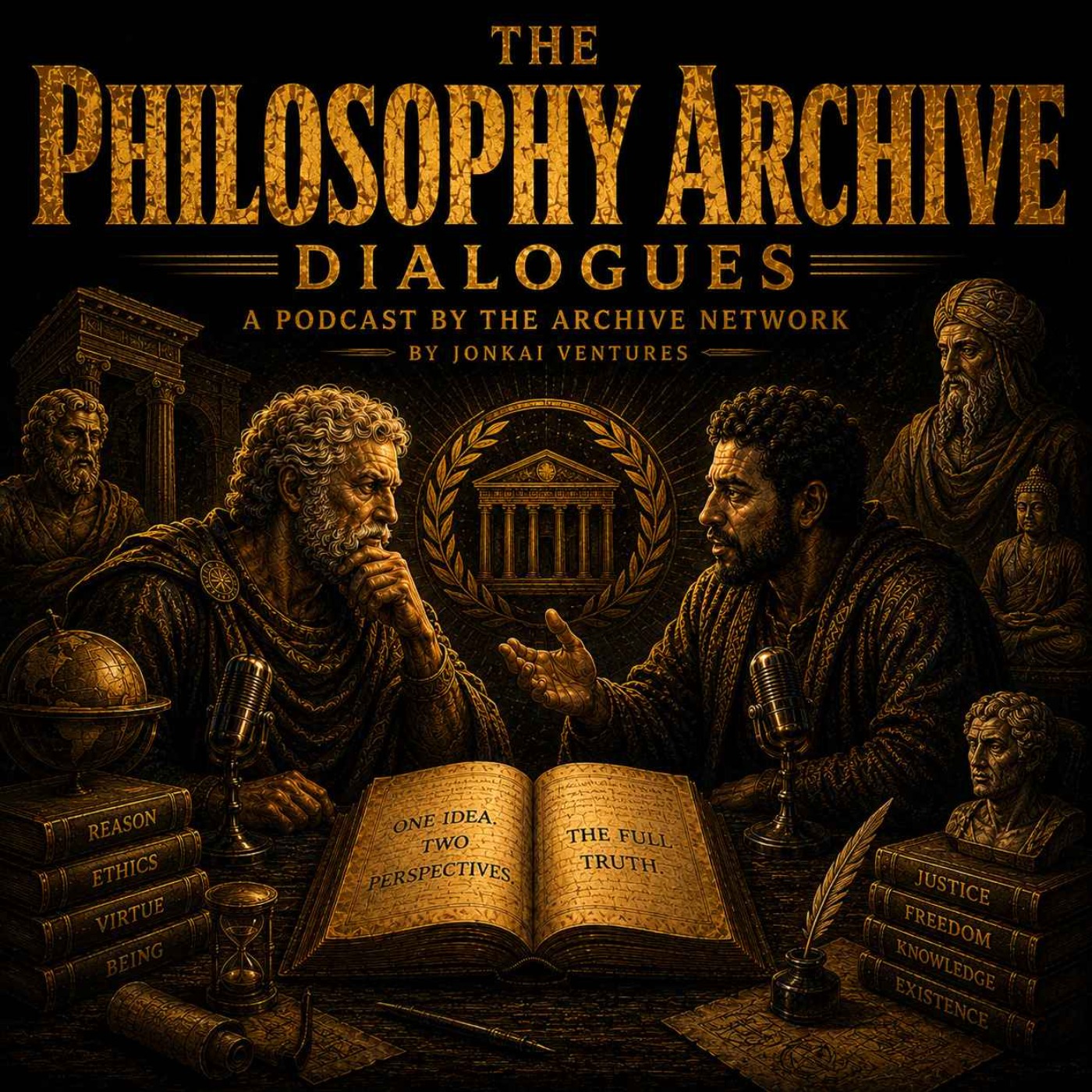
The Philosophy Archive Dialogues
The Archive NetworkAudio
- Format:
- Podcast
- New episodes:
- Daily
- Typical length:
- about 35 minutes
- Latest episode:
About this show
Every episode is a conversation. Aurelius and Malik, the AI-voiced hosts of The Philosophy Archive, take a single thinker or idea — Aristotle, Al-Ghazali, absurdism, the problem of free will — and work through it together from beginning to end. One builds the argument as its author meant it: what problem it solves, why it convinced people, how it holds together. The other presses on where it strains — the objection it never answered, who it excluded, what it costs to believe.
These are not summaries. Each episode is one complete idea, examined from both sides in a single sitting.
Narrated with AI voices from original research.
https://thephilosophyarchive.com
Hosted on Acast. See acast.com/privacy (https://acast.com/privacy) for more information.
Show details and episodes come from the publisher's public feed at feeds.acast.com. Last updated . Names, artwork and text belong to their publishers.
Cosmos
Similar by topic and creator
- The Conflict Archive Dialogues
Shares the topics Education, History and Society and the creator The Archive Network. - The Lineage Archive Dialogues
Shares the topics Education, History and Society and the creator The Archive Network. - The Classified Archive Dialogues
Shares the topics History and Society and the creator The Archive Network.
Similar shows







Explore more
Episodes
Legalism
· 33 min
Imagine a world where tradition’s grip has slipped, and no one seems to obey out of respect anymore. Armies expand, borders tremble, and rulers can no longer count on ritual or kinship to hold society together. In this age of chaos, a new philosophy emerges—one that would rather count heads than trust hearts. The story of Legalism begins in a China that no longer believed virtue alone could deliver order. More: https://thephilosophyarchive.com/philosophy/legalism Aurelius and Malik are AI-voiced narrators. Written from original research by The Archive Network. Hosted on Acast. See acast.com/privacy (https://acast.com/privacy) for more information.
Not rated yetLaozi
· 35 min
A world falling apart can give birth to the strangest kinds of wisdom. Imagine a landscape where rituals no longer hold sway, where rulers clutch at fading power, and where everyone senses that the old answers are failing. In this chaos, a figure appears—a sage who teaches that sometimes, the harder you grip, the faster things slip away. To understand Laozi, you have to step into the world of late Zhou China. More: https://thephilosophyarchive.com/philosophy/laozi Aurelius and Malik are AI-voiced narrators. Written from original research by The Archive Network. Hosted on Acast. See acast.com/privacy (https://acast.com/privacy) for more information.
Not rated yetKnowledge
· 34 min
Imagine a world where the difference between life and death, justice and error, depends not on what you know, but on what you can persuade others to believe. In ancient Athens, this wasn’t just philosophy. It was survival. The earliest philosophers weren’t chasing abstract puzzles. More: https://thephilosophyarchive.com/philosophy/knowledge Aurelius and Malik are AI-voiced narrators. Written from original research by The Archive Network. Hosted on Acast. See acast.com/privacy (https://acast.com/privacy) for more information.
Not rated yetKierkegaard
· 35 min
In the narrow streets of nineteenth-century Copenhagen, a young man walks with a secret. The city is small, buttoned-up, and polite, but inside him, questions burn—questions that polite society refuses to ask. What happens when the world’s inherited certainties begin to crack, and you’re left alone to piece together what matters? This is the world that shaped Søren Kierkegaard. More: https://thephilosophyarchive.com/philosophy/kierkegaard Aurelius and Malik are AI-voiced narrators. Written from original research by The Archive Network. Hosted on Acast. See acast.com/privacy (https://acast.com/privacy) for more information.
Not rated yetKarl Popper
· 35 min
Vienna, in the early twentieth century, was a city humming with new ideas and haunted by old wounds. Picture a world that believed in grand theories, only to watch them shatter in the face of war and fanaticism. In that world, a young Karl Popper began to ask: When is knowledge real, and when does it become dangerous dogma? Karl Popper’s philosophy was not born in quiet study, but in a Europe that had seen certainty turn deadly. More: https://thephilosophyarchive.com/philosophy/karl-popper Aurelius and Malik are AI-voiced narrators. Written from original research by The Archive Network. Hosted on Acast. See acast.com/privacy (https://acast.com/privacy) for more information.
Not rated yetJustice
· 32 min
When justice fails, the consequences ripple through a city, a household, even a single soul. In ancient Greece, the stakes were survival, not just theory. Justice was not only a word in court—it was the difference between stability and collapse. Imagine a world where every claim, every quarrel, could tip the balance. More: https://thephilosophyarchive.com/philosophy/justice Aurelius and Malik are AI-voiced narrators. Written from original research by The Archive Network. Hosted on Acast. See acast.com/privacy (https://acast.com/privacy) for more information.
Not rated yetJudith Butler
· 35 min
What if the categories you think define you—man, woman, self—were not timeless truths, but products of social pressure and repetition? In the late twentieth century, a new kind of question began to unsettle the foundations of identity. Judith Butler stepped into this debate, determined to ask what we really mean when we talk about gender. Butler’s philosophy wasn’t born in a vacuum. More: https://thephilosophyarchive.com/philosophy/judith-butler Aurelius and Malik are AI-voiced narrators. Written from original research by The Archive Network. Hosted on Acast. See acast.com/privacy (https://acast.com/privacy) for more information.
Not rated yetJohn Stuart Mill
· 35 min
What if a mind could be engineered like a piece of machinery—programmed for precision, discipline, and reform? John Stuart Mill’s childhood was exactly that: an experiment in building the perfect intellect, and the results would shake the foundations of modern thought. In early nineteenth-century London, young John Stuart Mill was not just another child. He was the centerpiece of an educational experiment designed by his father, James Mill—a stern Scottish reformer determined to create a new kind of person. More: https://thephilosophyarchive.com/philosophy/john-stuart-mill Aurelius and Malik are AI-voiced narrators. Written from original research by The Archive Network. Hosted on Acast. See acast.com/privacy (https://acast.com/privacy) for more information.
Not rated yetJohn Rawls
· 34 min
Imagine you’re tasked with designing a society, but the catch is this: you have no idea whether you’ll be rich or poor, powerful or powerless, safe or exposed. How would you make the rules? And what would justice mean if you might be the one left out in the cold? For John Rawls, these questions were never idle games. More: https://thephilosophyarchive.com/philosophy/john-rawls Aurelius and Malik are AI-voiced narrators. Written from original research by The Archive Network. Hosted on Acast. See acast.com/privacy (https://acast.com/privacy) for more information.
Not rated yetJohn Locke
· 33 min
Civil war. Plague. Kings beheaded. In seventeenth-century England, every certainty was up for grabs. More: https://thephilosophyarchive.com/philosophy/john-locke Aurelius and Malik are AI-voiced narrators. Written from original research by The Archive Network. Hosted on Acast. See acast.com/privacy (https://acast.com/privacy) for more information.
Not rated yetJohann Fichte
· 33 min
A world in crisis, old beliefs breaking down, and a young thinker searching for footing. Johann Fichte did not enter philosophy as a distant observer. For him, the stakes were immediate—what could you trust, and how could you act, when the ground beneath your feet seemed to dissolve? Germany in the late eighteenth century was a landscape of uncertainty. More: https://thephilosophyarchive.com/philosophy/johann-fichte Aurelius and Malik are AI-voiced narrators. Written from original research by The Archive Network. Hosted on Acast. See acast.com/privacy (https://acast.com/privacy) for more information.
Not rated yetJiddu Krishnamurti
· 34 min
A quiet boy in colonial India, barely noticed in his own classroom, is suddenly told he is the chosen one. In the shadows of empire and spiritual longing, Jiddu Krishnamurti’s life is transformed before he even discovers his own voice. What happens when a child is made into a living symbol for the hopes of millions? Krishnamurti’s story doesn’t begin in isolation. More: https://thephilosophyarchive.com/philosophy/jiddu-krishnamurti Aurelius and Malik are AI-voiced narrators. Written from original research by The Archive Network. Hosted on Acast. See acast.com/privacy (https://acast.com/privacy) for more information.
Not rated yetJean-Paul Sartre
· 34 min
A child in Paris, surrounded by books and rituals, senses that the scripts shaping his life are wearing thin. The forms remain, but the meaning feels hollow. What happens when the world’s old answers no longer fit, and a restless mind begins to ask what’s left? Jean-Paul Sartre did not invent his philosophy in isolation. More: https://thephilosophyarchive.com/philosophy/jean-paul-sartre Aurelius and Malik are AI-voiced narrators. Written from original research by The Archive Network. Hosted on Acast. See acast.com/privacy (https://acast.com/privacy) for more information.
Not rated yetJean-Jacques Rousseau
· 35 min
A child is born in Geneva, a city of order and discipline, yet he will spend much of his life as a wanderer—restless, mistrusted, and always watching from the margins. What happens when someone shaped by both civic pride and social exclusion turns his gaze on the elegant world around him? Jean-Jacques Rousseau did not forget what it felt like to be an outsider. That discomfort would become the lens through which he saw—and judged—the civilization of his time. More: https://thephilosophyarchive.com/philosophy/jean-jacques-rousseau Aurelius and Malik are AI-voiced narrators. Written from original research by The Archive Network. Hosted on Acast. See acast.com/privacy (https://acast.com/privacy) for more information.
Not rated yetJacques Derrida
· 34 min
What if the language you spoke and the place you called home never truly accepted you? Imagine growing up where every identity is a border, and every word has a shadow. For Jacques Derrida, philosophy began with this feeling of being both inside and out. Jacques Derrida was born in nineteen thirty, just outside Algiers, into a world where identity meant risk. More: https://thephilosophyarchive.com/philosophy/jacques-derrida Aurelius and Malik are AI-voiced narrators. Written from original research by The Archive Network. Hosted on Acast. See acast.com/privacy (https://acast.com/privacy) for more information.
Not rated yetIsaiah Berlin
· 34 min
Imagine growing up in a city where every street corner spoke a different language, where loyalties overlapped, and where peace was always one riot away from collapse. For Isaiah Berlin, this wasn’t just history—it was childhood, and it would shape everything he came to believe about the world. Berlin’s life began in nineteen oh nine in Riga, then a tense, cosmopolitan port of the Russian Empire. He was born into a century that would try, again and again, to force human diversity into a single mold. More: https://thephilosophyarchive.com/philosophy/isaiah-berlin Aurelius and Malik are AI-voiced narrators. Written from original research by The Archive Network. Hosted on Acast. See acast.com/privacy (https://acast.com/privacy) for more information.
Not rated yetInfinity
· 35 min
Imagine a world where everything has a boundary—a shape, a measure, an ending. Now picture an idea so unsettling, so at odds with daily experience, that it threatens this entire order: infinity. For the ancients, infinity was not a mathematical delight. It was a disturbance, a force that unsettled the very idea of completeness. More: https://thephilosophyarchive.com/philosophy/infinity Aurelius and Malik are AI-voiced narrators. Written from original research by The Archive Network. Hosted on Acast. See acast.com/privacy (https://acast.com/privacy) for more information.
Not rated yetInfinite Regress
· 33 min
What if every explanation you give is met with the same question—again and again, with no end in sight? Imagine an interrogator who never tires, whose only move is to ask, “And what explains that?” If you try to build a foundation, the ground shifts beneath your feet. This is the haunting puzzle at the root of philosophy’s oldest debates. More: https://thephilosophyarchive.com/philosophy/infinite-regress Aurelius and Malik are AI-voiced narrators. Written from original research by The Archive Network. Hosted on Acast. See acast.com/privacy (https://acast.com/privacy) for more information.
Not rated yetIdealism
· 33 min
Picture a world where reality itself seems to flicker, where old certainties dissolve, and the very ground beneath your feet feels as if it could vanish. This is not science fiction—it’s the Europe of the late eighteenth century, just before the birth of idealism. The unsettling question: if everything we call real is stripped down to what can be measured, what becomes of meaning, freedom, or the self? That question would launch a revolution in philosophy. More: https://thephilosophyarchive.com/philosophy/idealism Aurelius and Malik are AI-voiced narrators. Written from original research by The Archive Network. Hosted on Acast. See acast.com/privacy (https://acast.com/privacy) for more information.
Not rated yetHumanism
· 35 min
Imagine a world where education feels cut off from real life, where philosophy hides behind technical jargon, and the liveliest questions about how to live are left unasked. What if someone dared to say that learning should serve the actual lives of human beings? In the streets and libraries of Renaissance Italy, a quiet revolution was stirring. It was not a doctrine; it was a dissatisfaction. More: https://thephilosophyarchive.com/philosophy/humanism Aurelius and Malik are AI-voiced narrators. Written from original research by The Archive Network. Hosted on Acast. See acast.com/privacy (https://acast.com/privacy) for more information.
Not rated yet
More from The Archive Network
- The Treaty Archive: History of Peace Treaties & Global Agreements
- The Creed Archive Dialogues
- The Fraud Archive Dialogues
- The Fraud Archive – Iconic Cons, Scams and Financial Crimes explained in minutes
- The Origin Archive Dialogues
- The Origin Archive: The Founding Stories of the World’s Greatest Companies