

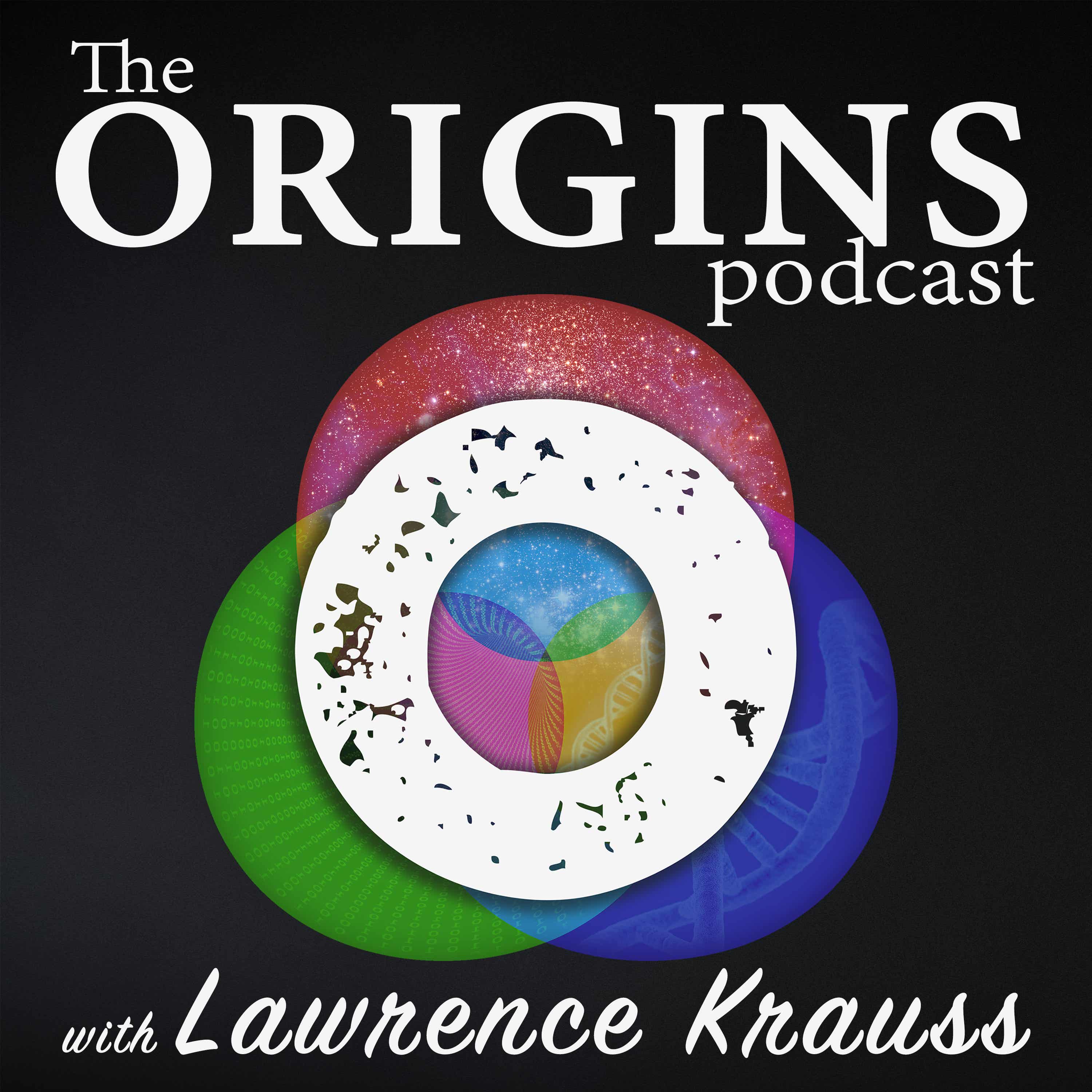
The Origins Podcast with Lawrence Krauss
Lawrence M. KraussAudio
- Format:
- Podcast
- New episodes:
- Monthly
- Typical length:
- about 1 hour 10 minutes
- Latest episode:
About this show
The Origins Podcast features in-depth conversations with some of the most interesting people in the world about the issues that impact all of us in the 21st century. Host, theoretical physicist, lecturer, and author, Lawrence M. Krauss, will be joined by guests from a wide range of fields, including science, the arts, and journalism. The topics discussed on The Origins Podcast reflect the full range of the human experience - exploring science and culture in a way that seeks to entertain, educate, and inspire. lawrencekrauss.substack.com
lawrencekrauss.substack.com (https://lawrencekrauss.substack.com?utm_medium=podcast)
Covers: physics, cosmology, science, astrophysics, history of science, search for extraterrestrial intelligence, artificial intelligence, science communication
Show details and episodes come from the publisher's public feed at api.substack.com. Last updated . Names, artwork and text belong to their publishers.
Recently on this show
Summary of recent episodes, drawn from the publisher's feed.
The Origins Podcast, hosted by physicist Lawrence Krauss, features in-depth talks with guests from science, arts and journalism. Recent episodes cover the first 20th-century physics revolution, the search for alien life, and AI hype in science news.
Cosmos
Rated alike
- Stated Clearly
Often rated the same way.
Similar in subject
- Kurzgesagt – In a Nutshell
Both cover: astrophysics, science communication, physics - Into the Impossible With Brian Keating
Both cover: science communication, cosmology, physics - PBS Space Time
Both cover: astrophysics, science communication, cosmology
Similar shows

Explore more
Episodes
Abigail Thompson | The War on Science Interviews | Day 5
· 50 min
To celebrate the release on July 29th of The War on Science, we have recorded 20 podcast interviews with authors from the book. Starting on July 22nd, with Richard Dawkins, we will be releasing one interview per day. Interviewees in order, will be: Richard Dawkins July 23rd Niall Ferguson July 24th Nicholas Christakis July 25th Maarten Boudry July 26th Abigail Thompson July 27th John Armstrong July 28th Sally Satel July 29th Elizabeth Weiss July 30th Solveig Gold and Joshua Katz July 31st Frances Widdowson August 1st Carole Hooven August 2nd Janice Fiamengo August 3rd Geoff Horsman August 4th Alessandro Strumia August 5th Roger Cohen and Amy Wax August 6th Peter Boghossian August 7th Lauren Schwartz and Arthur Rousseau August 8th Alex Byrne and Moti Gorin August 9th Judith Suissa and Alice Sullivan August 10th Karleen Gribble August 11th Dorian Abbot August 12th The topics these authors discuss range over ideas including the ideological corruption of science, historical examples of the demise of academia, free speech in academia, social justice activism replacing scholarship in many disciplines, disruptions of science from mathematics to medicine, cancel culture, the harm caused by DEI bureaucracies at universities, distortions of biology, disingenous and dangerous distortions of the distinctions between gender and sex in medicine, and false premises impacting on gender affirming care for minors, to, finally, a set of principles universities should adopt to recover from the current internal culture war. The dialogues are blunt, and provocative, and point out the negative effects that the current war on science going on within universities is having on the progress of science and scholarship in the west. We are hoping that the essays penned by this remarkable group of scholars will help provoke discussion both within universities and the public at large about how to restore trust, excellence, merit, and most important sound science, free speech and free inquiry on university campuses. Many academics have buried their heads in the sand hoping this nonsense will go away. It hasn’t and we now need to become more vocal, and unified in combatting this modern attack on science and scholarship. The book was completed before the new external war on science being waged by the Trump administration began. Fighting this new effort to dismantle the scientific infrastructure of the country is important, and we don’t want to minimized that threat. But even if the new attacks can be successfully combatted in Congress, the Courts, and the ballot box, the longstanding internal issues we describe in the new book, and in the interviews we are releasing, will still need to be addressed to restore the rightful place of science and scholarship in the west. I am hoping that you will find the interviews enlightening and encourage you to look at the new book when it is released, and help become part of the effort to restore sound science and scholarship in academia. With no further ado, The War on Science interviews… As always, an ad-free video version of this podcast is also available to paid Critical Mass subscribers. Your subscriptions support the non-profit Origins Project Foundation, which produces the podcast. The audio version is available free on the Critical Mass site and on all podcast sites, and the video version will also be available on the Origins Project YouTube. Get full access to Critical Mass at lawrencekrauss.substack.com/subscribe (https://lawrencekrauss.substack.com/subscribe?utm_medium=podcast&utm_campaign=CTA_4)
Not rated yetMaarten Boudry | The War on Science Interviews | Day 4
· 49 min
To celebrate the release on July 29th of The War on Science, we have recorded 20 podcast interviews with authors from the book. Starting on July 22nd, with Richard Dawkins, we will be releasing one interview per day. Interviewees in order, will be: Richard Dawkins July 23rd Niall Ferguson July 24th Nicholas Christakis July 25th Maarten Boudry July 26th Abigail Thompson July 27th John Armstrong July 28th Sally Satel July 29th Elizabeth Weiss July 30th Solveig Gold and Joshua Katz July 31st Frances Widdowson August 1st Carole Hooven August 2nd Janice Fiamengo August 3rd Geoff Horsman August 4th Alessandro Strumia August 5th Roger Cohen and Amy Wax August 6th Peter Boghossian August 7th Lauren Schwartz and Arthur Rousseau August 8th Alex Byrne and Moti Gorin August 9th Judith Suissa and Alice Sullivan August 10th Karleen Gribble August 11th Dorian Abbot August 12th The topics these authors discuss range over ideas including the ideological corruption of science, historical examples of the demise of academia, free speech in academia, social justice activism replacing scholarship in many disciplines, disruptions of science from mathematics to medicine, cancel culture, the harm caused by DEI bureaucracies at universities, distortions of biology, disingenous and dangerous distortions of the distinctions between gender and sex in medicine, and false premises impacting on gender affirming care for minors, to, finally, a set of principles universities should adopt to recover from the current internal culture war. The dialogues are blunt, and provocative, and point out the negative effects that the current war on science going on within universities is having on the progress of science and scholarship in the west. We are hoping that the essays penned by this remarkable group of scholars will help provoke discussion both within universities and the public at large about how to restore trust, excellence, merit, and most important sound science, free speech and free inquiry on university campuses. Many academics have buried their heads in the sand hoping this nonsense will go away. It hasn’t and we now need to become more vocal, and unified in combatting this modern attack on science and scholarship. The book was completed before the new external war on science being waged by the Trump administration began. Fighting this new effort to dismantle the scientific infrastructure of the country is important, and we don’t want to minimized that threat. But even if the new attacks can be successfully combatted in Congress, the Courts, and the ballot box, the longstanding internal issues we describe in the new book, and in the interviews we are releasing, will still need to be addressed to restore the rightful place of science and scholarship in the west. I am hoping that you will find the interviews enlightening and encourage you to look at the new book when it is released, and help become part of the effort to restore sound science and scholarship in academia. With no further ado, The War on Science interviews… As always, an ad-free video version of this podcast is also available to paid Critical Mass subscribers. Your subscriptions support the non-profit Origins Project Foundation, which produces the podcast. The audio version is available free on the Critical Mass site and on all podcast sites, and the video version will also be available on the Origins Project YouTube. Get full access to Critical Mass at lawrencekrauss.substack.com/subscribe (https://lawrencekrauss.substack.com/subscribe?utm_medium=podcast&utm_campaign=CTA_4)
Not rated yetNicholas Christakis | The War on Science Interviews | Day 3
· 38 min
To celebrate the release on July 29th of The War on Science, we have recorded 20 podcast interviews with authors from the book. Starting on July 22nd, with Richard Dawkins, we will be releasing one interview per day. Interviewees in order, will be: Richard Dawkins July 23rd Niall Ferguson July 24th Nicholas Christakis July 25th Maarten Boudry July 26th Abigail Thompson July 27th John Armstrong July 28th Sally Satel July 29th Elizabeth Weiss July 30th Solveig Gold and Joshua Katz July 31st Frances Widdowson August 1st Carole Hooven August 2nd Janice Fiamengo August 3rd Geoff Horsman August 4th Alessandro Strumia August 5th Roger Cohen and Amy Wax August 6th Peter Boghossian August 7th Lauren Schwartz and Arthur Rousseau August 8th Alex Byrne and Moti Gorin August 9th Judith Suissa and Alice Sullivan August 10th Karleen Gribble August 11th Dorian Abbot August 12th The topics these authors discuss range over ideas including the ideological corruption of science, historical examples of the demise of academia, free speech in academia, social justice activism replacing scholarship in many disciplines, disruptions of science from mathematics to medicine, cancel culture, the harm caused by DEI bureaucracies at universities, distortions of biology, disingenous and dangerous distortions of the distinctions between gender and sex in medicine, and false premises impacting on gender affirming care for minors, to, finally, a set of principles universities should adopt to recover from the current internal culture war. The dialogues are blunt, and provocative, and point out the negative effects that the current war on science going on within universities is having on the progress of science and scholarship in the west. We are hoping that the essays penned by this remarkable group of scholars will help provoke discussion both within universities and the public at large about how to restore trust, excellence, merit, and most important sound science, free speech and free inquiry on university campuses. Many academics have buried their heads in the sand hoping this nonsense will go away. It hasn’t and we now need to become more vocal, and unified in combatting this modern attack on science and scholarship. The book was completed before the new external war on science being waged by the Trump administration began. Fighting this new effort to dismantle the scientific infrastructure of the country is important, and we don’t want to minimized that threat. But even if the new attacks can be successfully combatted in Congress, the Courts, and the ballot box, the longstanding internal issues we describe in the new book, and in the interviews we are releasing, will still need to be addressed to restore the rightful place of science and scholarship in the west. I am hoping that you will find the interviews enlightening and encourage you to look at the new book when it is released, and help become part of the effort to restore sound science and scholarship in academia. With no further ado, The War on Science interviews… As always, an ad-free video version of this podcast is also available to paid Critical Mass subscribers. Your subscriptions support the non-profit Origins Project Foundation, which produces the podcast. The audio version is available free on the Critical Mass site and on all podcast sites, and the video version will also be available on the Origins Project YouTube. Get full access to Critical Mass at lawrencekrauss.substack.com/subscribe (https://lawrencekrauss.substack.com/subscribe?utm_medium=podcast&utm_campaign=CTA_4)
Not rated yetNiall Ferguson | The War on Science Interviews | Day 2
· 1 hr 17 min
To celebrate the release on July 29th of The War on Science, we have recorded 20 podcast interviews with authors from the book. Starting on July 22nd, with Richard Dawkins, we will be releasing one interview per day. Interviewees in order, will be: Richard Dawkins July 23rd Niall Ferguson July 24th Nicholas Christakis July 25th Maarten Boudry July 26th Abigail Thompson July 27th John Armstrong July 28th Sally Satel July 29th Elizabeth Weiss July 30th Solveig Gold and Joshua Katz July 31st Frances Widdowson August 1st Carole Hooven August 2nd Janice Fiamengo August 3rd Geoff Horsman August 4th Alessandro Strumia August 5th Roger Cohen and Amy Wax August 6th Peter Boghossian August 7th Lauren Schwartz and Arthur Rousseau August 8th Alex Byrne and Moti Gorin August 9th Judith Suissa and Alice Sullivan August 10th Karleen Gribble August 11th Dorian Abbot August 12th The topics these authors discuss range over ideas including the ideological corruption of science, historical examples of the demise of academia, free speech in academia, social justice activism replacing scholarship in many disciplines, disruptions of science from mathematics to medicine, cancel culture, the harm caused by DEI bureaucracies at universities, distortions of biology, disingenous and dangerous distortions of the distinctions between gender and sex in medicine, and false premises impacting on gender affirming care for minors, to, finally, a set of principles universities should adopt to recover from the current internal culture war. The dialogues are blunt, and provocative, and point out the negative effects that the current war on science going on within universities is having on the progress of science and scholarship in the west. We are hoping that the essays penned by this remarkable group of scholars will help provoke discussion both within universities and the public at large about how to restore trust, excellence, merit, and most important sound science, free speech and free inquiry on university campuses. Many academics have buried their heads in the sand hoping this nonsense will go away. It hasn’t and we now need to become more vocal, and unified in combatting this modern attack on science and scholarship. The book was completed before the new external war on science being waged by the Trump administration began. Fighting this new effort to dismantle the scientific infrastructure of the country is important, and we don’t want to minimized that threat. But even if the new attacks can be successfully combatted in Congress, the Courts, and the ballot box, the longstanding internal issues we describe in the new book, and in the interviews we are releasing, will still need to be addressed to restore the rightful place of science and scholarship in the west. I am hoping that you will find the interviews enlightening and encourage you to look at the new book when it is released, and help become part of the effort to restore sound science and scholarship in academia. With no further ado, The War on Science interviews… As always, an ad-free video version of this podcast is also available to paid Critical Mass subscribers. Your subscriptions support the non-profit Origins Project Foundation, which produces the podcast. The audio version is available free on the Critical Mass site and on all podcast sites, and the video version will also be available on the Origins Project YouTube. Get full access to Critical Mass at lawrencekrauss.substack.com/subscribe (https://lawrencekrauss.substack.com/subscribe?utm_medium=podcast&utm_campaign=CTA_4)
Not rated yetThe Origins Podcast: The War on Science Interviews: Day 1, Richard Dawkins
· 1 hr 1 min
To celebrate the release on July 29th of The War on Science, we have recorded 20 podcast interviews with authors from the book. Starting on July 22nd, with Richard Dawkins, we will be releasing one interview per day. Interviewees in order, will be: Richard Dawkins July 23rd Niall Ferguson July 24th Nicholas Christakis July 25th Maarten Boudry July 26th Abigail Thompson July 27th John Armstrong July 28th Sally Satel July 29th Elizabeth Weiss July 30th Solveig Gold and Joshua Katz July 31st Frances Widdowson August 1st Carole Hooven August 2nd Janice Fiamengo August 3rd Geoff Horsman August 4th Alessandro Strumia August 5th Roger Cohen and Amy Wax August 6th Peter Boghossian August 7th Lauren Schwartz and Arthur Rousseau August 8th Alex Byrne and Moti Gorin August 9th Judith Suissa and Alice Sullivan August 10th Karleen Gribble August 11th Dorian Abbot August 12th The topics these authors discuss range over ideas including the ideological corruption of science, historical examples of the demise of academia, free speech in academia, social justice activism replacing scholarship in many disciplines, disruptions of science from mathematics to medicine, cancel culture, the harm caused by DEI bureaucracies at universities, distortions of biology, disingenous and dangerous distortions of the distinctions between gender and sex in medicine, and false premises impacting on gender affirming care for minors, to, finally, a set of principles universities should adopt to recover from the current internal culture war. The dialogues are blunt, and provocative, and point out the negative effects that the current war on science going on within universities is having on the progress of science and scholarship in the west. We are hoping that the essays penned by this remarkable group of scholars will help provoke discussion both within universities and the public at large about how to restore trust, excellence, merit, and most important sound science, free speech and free inquiry on university campuses. Many academics have buried their heads in the sand hoping this nonsense will go away. It hasn’t and we now need to become more vocal, and unified in combatting this modern attack on science and scholarship. The book was completed before the new external war on science being waged by the Trump administration began. Fighting this new effort to dismantle the scientific infrastructure of the country is important, and we don’t want to minimized that threat. But even if the new attacks can be successfully combatted in Congress, the Courts, and the ballot box, the longstanding internal issues we describe in the new book, and in the interviews we are releasing, will still need to be addressed to restore the rightful place of science and scholarship in the west. I am hoping that you will find the interviews enlightening and encourage you to look at the new book when it is released, and help become part of the effort to restore sound science and scholarship in academia. With no further ado, The War on Science interviews… As always, an ad-free video version of this podcast is also available to paid Critical Mass subscribers. Your subscriptions support the non-profit Origins Project Foundation, which produces the podcast. The audio version is available free on the Critical Mass site and on all podcast sites, and the video version will also be available on the Origins Project YouTube. Get full access to Critical Mass at lawrencekrauss.substack.com/subscribe (https://lawrencekrauss.substack.com/subscribe?utm_medium=podcast&utm_campaign=CTA_4)
Not rated yetWhat's New in Science With Sabine and Lawrence
· 1 hr 12 min
I’m excited to announce the fifth episode of our new series, What’s New in Science, co-hosted by Sabine Hossenfelder. Once again, Sabine and I each brought a few recent science stories to the table, and we took turns introducing them before diving into thoughtful discussions. It’s a format that continues to spark engaging exchanges, and based on the feedback we’ve received, it’s resonating well with listeners. In this month’s episode Sabine first explored the possibility that huge terrestrial accessible reservoirs of hydrogen may exist that could provide the basis for a viable hydrogen fuel economy. Then we turned to the results from the wonderful new Vera C. Rubin Telescope in Chile, and what that telescope could do for our evolving picture of the cosmos. After that Sabine introduced a discussion of a scientific paper I wrote with colleagues on implications of mathematical incompleteness theorems for the possible existence of a physical Theory of Everything. Then on to the newly released results from a muon g-2 experiment at Fermilab, which after almost 2 decades of efforts, seems to have demonstrated that predictions from the the Standard Model of Particle Physics, alas, continue to agree with experiments, showing no signs of new physics. After that, we explored a new claim by DeepMind about the abilities of AI systems to design and test new coding algorithms, which might be used to train future systems. Besides the science-fiction sounding nature of this, it could also help reduce the amount of energy needed to build and train LLMs. Finally, returning to my own interest in new results related to the cosmic origin of life, we discussed anew result showing why polycyclic hydrocarbons, which one might expect would be destroyed by radiation in space, seem to survive. This could be important for understanding how organic seeds for life managed to survive long enough to arrive on the early Earth. As always, an ad-free video version of this podcast is also available to paid Critical Mass subscribers. Your subscriptions support the non-profit Origins Project Foundation, which produces the podcast. The audio version is available free on the Critical Mass site and on all podcast sites, and the video version will also be available on the Origins Project YouTube. Get full access to Critical Mass at lawrencekrauss.substack.com/subscribe (https://lawrencekrauss.substack.com/subscribe?utm_medium=podcast&utm_campaign=CTA_4)
Not rated yetFruitful Disagreement in an Age of Division with Robert George and Cornel WestRobert George and Cornel West
· 2 hr 29 min
One of the great pleasures of hosting the Origins Podcast is talking with fascinating thinkers who challenge my perspectives and with whom I can have frank, if provocative, discussions. My recent conversation with Robert George and Cornel West was particularly enjoyable. These two distinguished intellectuals embody the spirit of respectful and meaningful dialogue that the Origins Project Foundation aims to foster. Robert George is a renowned conservative legal scholar and Catholic professor at Princeton University, while Cornel West is a leading progressive philosopher and Protestant scholar at Union Theological Seminary, and an academic celebrity. Together, they've authored a timely new book, Truth Matters, exploring how fruitful dialogue can bridge ideological divides even during polarized times. In our conversation, we tackled subjects including philosophy, theology, politics, and the crucial role respectful disagreement plays in uncovering deeper truths. Joining the discussion as a scientist, atheist, and someone raised in a Jewish tradition, I brought a viewpoint to our exchange that differed from those of both Robert and Cornell, who in spite of their political differences are both Christians, and scholars in the humanities . It was especially rewarding to find common ground with Robert and Cornel despite our differing starting points. All told, I found it one of the most fascinating discussions to date, and the first with more than one person. It worked. :) This kind of rich and thoughtful engagement is precisely what inspired me to start the Origins Podcast. Robert George and Cornel West remind us that disagreements are valuable, as they help us move closer to understanding not only each other, but also ourselves. As always, an ad-free video version of this podcast is also available to paid Critical Mass subscribers. Your subscriptions support the non-profit Origins Project Foundation, which produces the podcast. The audio version is available free on the Critical Mass site and on all podcast sites, and the video version will also be available on the Origins Project YouTube. Get full access to Critical Mass at lawrencekrauss.substack.com/subscribe (https://lawrencekrauss.substack.com/subscribe?utm_medium=podcast&utm_campaign=CTA_4)
Not rated yetWhat's New in Science With Sabine and Lawrence
· 50 min
I’m excited to announce the fourth episode of our new series, What’s New in Science, co-hosted by Sabine Hossenfelder. Once again, Sabine and I each brought a few recent science stories to the table, and we took turns introducing them before diving into thoughtful discussions. It’s a format that continues to spark engaging exchanges, and based on the feedback we’ve received, it’s resonating well with listeners. It was a bit of a slow month for science news, but we did find six stories worth examining, including what sounds like a preposterous claim, turning rain into electricity! It turns out it doesn’t violate any laws of physics, but is not likely to address our energy needs. The Hype of the Month award goes to the claim of biosignatures on planet K2-18, which got worldwide coverage, even though experts were pretty certain it was wrong from the get go, and subsequent analysis finds no such evidence. A claim that gravity is just a computation is examined, and dismissed, while evidence for exotic antimatter nuclei at CERN is sound science, even if it is not earth shattering. It reminds us that exotic physics must be considered in exotic locations like the early big bang, or the cores of neutron stars. Sabine was excited about a new result regarding laser fusion, even if it is more likely to be useful for weapons production than commercial energy production, and this time, I was the one to bring up a new result in Quantum Computing, this time using ‘qu-quints’ to simulate an actual physics system, although a simple one in two dimensions. It was another lively and thoughtful exchange, and I hope you’ll enjoy it as much as we did. As always, an ad-free video version of this podcast is also available to paid Critical Mass subscribers. Your subscriptions support the non-profit Origins Project Foundation, which produces the podcast. The audio version is available free on the Critical Mass site and on all podcast sites, and the video version will also be available on the Origins Project YouTube. Get full access to Critical Mass at lawrencekrauss.substack.com/subscribe (https://lawrencekrauss.substack.com/subscribe?utm_medium=podcast&utm_campaign=CTA_4)
Not rated yetNeil Shubin: Science, Exploration, Patience, and Survival at the Ends of the Earth
· 2 hr 26 min
One of the best parts of hosting the Origins podcast is talking with remarkable scientists whose ideas have changed the way we understand ourselves and our world. My recent conversation with Neil Shubin was particularly enjoyable, not only because Neil is a friend whose insights I admire, but because our dialogue ranged across some of the most fascinating questions at the intersection of evolution, exploration, and human curiosity. Neil became widely known for discovering Tiktaalik, the fossil fish whose fins contain bones remarkably similar to the limbs of land animals, including us. He is currently the Robert R. Bensley Distinguished Service Professor of Organismal Biology and Anatomy at the University of Chicago and the bestselling author of Your Inner Fish and, most recently, The Ends of the Earth. But beyond his credentials, Neil embodies the careful, patient, and humble approach to discovery that value in science. Our discussion began with the unexpected paths scientists take, including Neil's own formative experiences. He described how museum visits and planetarium shows ignited his childhood fascination, and we talked about how a single course on vertebrate evolution at Harvard redirected his career from veterinary medicine to fossil hunting. Neil recounted, and we discussed at length, the meticulous thought and considerable risk that led him and his colleague, Ted Daeschler, to choose the Canadian Arctic for their famous expedition. It took six summers of tough fieldwork before their gamble yielded Tiktaalik, transforming our understanding of how life transitioned from water to land. But our conversation wasn't just about past discoveries. Neil and I explored broader themes about the nature of science itself: how hypotheses are formed, the patience and courage it takes to test bold ideas, and the critical importance of embracing failure. We agreed that stepping outside one's comfort zone is almost always necessary to achieve scientific breakthroughs, and Neil shared how his own career exemplifies precisely that. This kind of deeper dialogue, going beyond the headlines to explore the very human stories behind scientific discoveries, is one of the reasons I started the Origins podcast. I hope you find this conversation with Neil Shubin as enjoyable and thought-provoking as I did. As always, an ad-free video version of this podcast is also available to paid Critical Mass subscribers. Your subscriptions support the non-profit Origins Project Foundation, which produces the podcast. The audio version is available free on the Critical Mass site and on all podcast sites, and the video version will also be available on the Origins Project YouTube. Get full access to Critical Mass at lawrencekrauss.substack.com/subscribe (https://lawrencekrauss.substack.com/subscribe?utm_medium=podcast&utm_campaign=CTA_4)
Not rated yetStephanie Canizales on the human tragedy of undocumented and unaccompanied migrant youth in the US.
· 1 hr 56 min
Six months or so ago, I had a fascinating interview/discussion with Stephanie Canizales about her book, Sin Padres, Ni Papeles, which described her five year PhD project interviewing young people who had migrated from Central America as undocumented and unaccompanied minors in pursuit of a better future. These children were sent by their parents because they had no other choice, either to protect their lives from violence or because they had no means to support them at home. Once these children arrived in the US they were met by either impoverished relatives who often couldn’t support them. With no access to education or any legal means of supporting themselves they were forced to take low-wage jobs just to survive. I believe our society should be judged not by how well we keep people out, but how well we treat people when they are here. The story of these children is heart wrenching, and raises many complex issues, which may challenge previous notions you may have about such things as child welfare laws, about how we treat these young people who were driven here not out of choice, but through necessity, and who our society largely abandons once they arrive. Because of the vicissitudes of international affairs and other unexpected factors, we were not able to release this dialogue before now. But perhaps there could be no more opportune time to address this issue. Kilmar Armando Abrego Garcia came to this country as a 16 year old, a minor sent by his family to protect him from local gangs. In the intervening 14 years in the United States he was never charged or convicted of a crime, just as he had never been so charged or convicted in his home country of El Salvador. He had a job, and had several children with his US citizen wife. Nevertheless, he was recently illegally deported, without any trial, back to a maximum security prison in El Salvador, leading to a vigorous public debate. During the public discussions, Kilmar, and other illegal immigrants have been vilified for the acts of desperation that led them to enter the US illegally. But very little has been discussed about the harrowing challenges people like Kilmar met when they arrived here, alone, as children. My discussion with Stephanie will hopefully add a new dimension to the current public debate on this issue, focusing on real people rather than statistics, and on both the causes for the recent illegal migration to the US, and also the actual impact both on the country and on the immigrants while they live in the US. In so doing, I hope this expands your perspective of this complex problem, which is, after all, one of the purposes of this podcast, and of the Origins Project Foundation. As always, an ad-free video version of this podcast is also available to paid Critical Mass subscribers. Your subscriptions support the non-profit Origins Project Foundation, which produces the podcast. The audio version is available free on the Critical Mass site and on all podcast sites, and the video version will also be available on the Origins Project YouTube. Get full access to Critical Mass at lawrencekrauss.substack.com/subscribe (https://lawrencekrauss.substack.com/subscribe?utm_medium=podcast&utm_campaign=CTA_4)
Not rated yet