

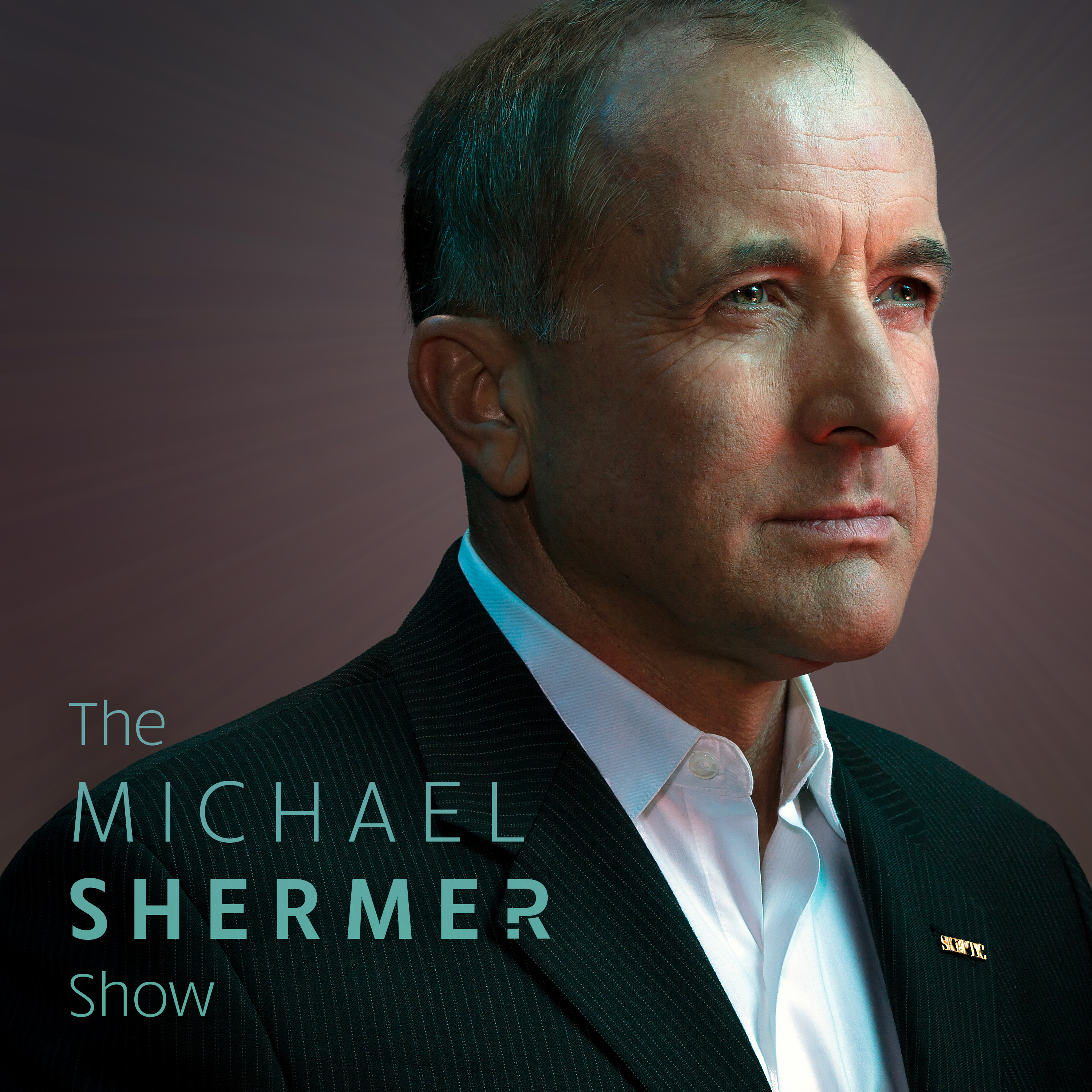
The Michael Shermer Show
Michael ShermerAudio
- Format:
- Podcast
- New episodes:
- Weekly
- Typical length:
- about 1 hour 20 minutes
- Latest episode:
About this show
The Michael Shermer Show is a series of long-form conversations between Dr. Michael Shermer and leading scientists, philosophers, historians, scholars, writers and thinkers about the most important issues of our time.
Covers: science, philosophy, history, consciousness, atomic history, world war ii, neuroscience, psychology, physics
Show details and episodes come from the publisher's public feed at rss.pdrl.fm. Last updated . Names, artwork and text belong to their publishers.
Recently on this show
Summary of recent episodes, drawn from the publisher's feed.
The Michael Shermer Show is a podcast of long-form conversations with scientists, philosophers, historians and writers. Recent episodes cover the history of nuclear testing, whether World War II could have ended without the atomic bomb, how much credit people deserve for their lives, and whether consciousness needs a body.
Cosmos
Similar in subject
- World Science Festival
Both cover: consciousness, neuroscience, physics - Sean Carroll
Both cover: philosophy, neuroscience, physics - Sean Carroll's Mindscape: Science, Society, Philosophy, Culture, Arts, and Ideas
Both cover: philosophy, neuroscience, physics
Similar shows





Explore more
Episodes
What Really Prevents Cognitive Decline
· 58 min
What actually causes cognitive decline, and how much of it can we do something about? In this episode, Michael talks with neurologist and neuroscientist Dr. Majid Fotuhi about dementia, Alzheimer's, memory loss, and the everyday habits that shape brain health over time. They discuss why Alzheimer's is only part of the story, why some people remain mentally sharp into old age, and what the evidence says about exercise, sleep, diet, stress, and cognitive activity. They also cover ADHD, attention, brain training, and the difference between ordinary forgetfulness and something more serious. At the center of it all is a simple but important idea: many people think cognitive decline is just an unavoidable part of aging, when in fact there is often more room to protect brain function than most of us realize. Majid Fotuhi, MD, PhD, is an adjunct professor of Neuroscience at Johns Hopkins's Mind/Brain Institute, an adjunct professor of Psychological and Brain Sciences at George Washington University, and is the medical director of NeuroGrow Brain Fitness Center. His groundbreaking, proprietary research has been published in The Lancet, Nature, Neurology, Neuron, Proceedings of National Academy of Science, the Journal of Prevention of Alzheimer's Disease, Journal of Rehabilitation, and Journal of Alzheimer's Disease Reports, among others. His new book is The Invincible Brain: The Clinically Proven Plan to Age-Proof Your Brain and Stay Sharp for Life.
Not rated yetHow Christianity Made America—and How America Remade Christianity
· 1 hr 31 min
Why does religion still dominate American politics when so many other wealthy democracies secularized long ago? In this episode, Michael Shermer talks with historian Matthew Avery Sutton about the long relationship between Christianity and American power. From the Puritans to Lincoln, from the Scopes trial to the Religious Right, from slavery to same-sex marriage, this conversation tracks how religious belief has shaped the country, and how politics keeps reshaping religion in return. Matthew Avery Sutton is the Claudius O. and Mary Johnson Distinguished Professor and chair of the Department of History at Washington State University. His new book is Chosen Land: How Christianity Made America and Americans Remade Christianity.
Not rated yetWhat Turns Sand Into Cells? How Nonliving Matter Becomes Alive
· 1 hr 27 min
How does something living emerge from something that isn't? In this episode, Lee Cronin pushes the question back even further: before cells, before DNA, before biology as we usually think of it, what kind of process could make matter start organizing itself into something alive? He and Michael Shermer get into assembly theory, RNA, autocatalysis, and the deeper puzzle of whether causation and selection may already be at work long before the first organism appears. The conversation also branches into consciousness, free will, and the possibility that life may be widespread in the universe, even if it looks nothing like life on Earth. Lee Cronin is Regius Professor of Chemistry at the University of Glasgow, Scotland, where he leads one of the world's largest multidisciplinary chemistry research groups. He has raised more than $35 million in grant funding, with current research income of $15 million, and has authored more than 350 peer-reviewed papers, including recent work published in Nature, Science, and PNAS. He and his team are trying to make artificial life forms, find alien life, explore the digitization of chemistry, understand how information can be encoded into chemicals and construct chemical computers.
Not rated yetShermer Says 8: Easter Without the Miracle
· 19 min
On Easter Sunday, Michael asks whether the resurrection should be understood as history, myth, or something deeper.
Not rated yetDebra Soh on Why Men and Women Are Drifting Apart, Dating Apps, and Gen Z
· 1 hr 30 min
Fewer people are having sex, fewer are forming lasting relationships, and many feel more isolated than ever. Why? Michael Shermer sits down with neuroscientist and author Debra Soh to discuss her new book Sextinction: The Decline of Sex and the Future of Intimacy. They talk about the so-called sex recession, why modern dating feels so broken, and how social media, pornography, AI companions, and changing expectations between men and women are reshaping intimacy. The discussion also touches on Gen Z mental health, dating apps, the manosphere, marriage, and the broader social consequences of a culture that increasingly substitutes screens for real human connection. Debra Soh is a neuroscientist who specializes in human sexuality and biological explanations for behavior. She received her PhD from York University in Toronto and worked as a scientific researcher for eleven years. As a journalist, Soh writes about technology, health, and the politicization of science.
Not rated yetThe Psychology of Gaslighting, Bullying, Cults, and Coercion
· 1 hr 17 min
What do gaslighting, bullying, cults, and coercion have in common? In this episode, Michael Shermer speaks with Jennifer Fraser about the psychology and neuroscience of manipulation, the recurring structure of abuse cultures, and the way authority can distort perception. Their discussion looks at fear, humiliation, retaliation, favoritism, empathy deficits, and the warning signs that distinguish legitimate leadership from coercive control across schools, workplaces, sports, relationships, and institutions. Jennifer Fraser is the author of four books and an international expert on bullying and abuse. Her latest book is The Gaslit Brain: Protect Your Brain from the Lies of Bullying, Gaslighting, and Institutional Complicity.
Not rated yetDid Jesus Really Change Western Morality? Bart Ehrman
· 1 hr 12 min
How much of what we call "basic morality" is actually inherited from Christianity? Bart Ehrman joins Michael Shermer for a wide-ranging conversation about one of the biggest moral questions in history: why do we feel obligated to care for strangers at all? Drawing from his new book Love Thy Stranger, Ehrman argues that the idea of helping people outside your tribe, family, or nation was not a moral given in the ancient world. Greek and Roman ethics made room for loyalty, friendship, and civic duty, but not for radical concern for the outsider. He makes the case that Jesus changed that moral equation—and that his teachings still shape the modern West, including many people who no longer consider themselves religious. The conversation also covers Ehrman's own path from evangelical Christianity to agnostic atheism, the problem of suffering, whether pure altruism really exists, and the difference between forgiveness and atonement. Bart Ehrman is the James A. Gray Distinguished Professor of Religious Studies at the University of North Carolina, Chapel Hill, and The New York Times bestselling author of Misquoting Jesus and How Jesus Became God. His new book is Love Thy Stranger: How Jesus Transformed Our Moral Conscience.
Not rated yetLionel Shriver on Immigration, Religion, and the Decline of the West
· 1 hr 25 min
Michael Shermer sits down with novelist and essayist Lionel Shriver for a wide-ranging conversation about what happens when old political labels stop making sense. Shriver reflects on the strange moral and political confusions that now shape debates over immigration, identity, religion, and the meaning of tolerance. They discuss why immigration has become, in Shriver's view, the central political issue of this century; why support for illiberal ideas is often framed as compassion; why the culture of fiction and publishing has grown more timid; and how writers can still engage seriously with divisive subjects without surrendering either honesty or nuance. The conversation also turns personal: Shriver's religious upbringing, her own personal experiences with immigration, and reflections on the diminishing cultural authority of the novelist. Lionel Shriver is an author and journalist, a graduate of Columbia University, and a columnist for The Spectator. Her fiction confronts some of the defining issues of modern life: school shootings in We Need to Talk About Kevin, the cost of healthcare in So Much for That, economic instability in The Mandibles, aging and suicide in Should We Stay or Should We Go, and low intelligence and DEI in Mania. Her latest novel, A Better Life, takes up immigration from the perspective of the host.
Not rated yetThe Biggest Blind Spot of the Climate Movement: Nuclear Energy
· 1 hr 8 min
Zion Lights used to be deep inside the environmental movement: protests, arrests, road blockades, the whole thing. Then she started looking closely at the evidence around nuclear power and found that much of what she'd been told about energy, risk, and climate solutions didn't hold up. In this conversation with Michael Shermer, she explains why anti-nuclear politics has done real damage, and why reliable energy matters far beyond moral posturing. She speaks from experience about Extinction Rebellion, energy policy in Germany and France, fear around Fukushima and Chernobyl, energy poverty, overpopulation, and why modern environmentalism so often attacks the very technologies that could help both people and the planet. Zion Lights is a British science communicator, writer, author, and former environmental activist known for her pivot to advocacy of evidence-based environmental policy, particularly her support for nuclear energy as a tool for decarbonisation. She is a prominent voice in debates about climate change, energy policy, humanism, and the role of scientific reasoning in public discourse. Her new book is Energy is Life: Why Environmentalism Went Nuclear.
Not rated yetDOGE, Government Fraud, and AI Audits
· 1 hr 28 min
Jeremy Jones joins Michael Shermer to talk about DOGE AI, government fraud, and the strange reality that some of the biggest problems in public life are both widely known and somehow never fixed. Jones explains how his team uses AI to sort through enormous government datasets, isolate suspicious billing patterns, and surface waste at a scale that would be almost impossible to catch by hand. They also get into Jones's own background—growing up in Luxembourg, landing in Chicago, and seeing firsthand how different systems shape people's lives—before moving into a broader argument about immigration, education, bureaucracy, media, and why trust in institutions is falling. It's a blunt conversation, and at times a confrontational one, about fraud, incentives, and what happens when everybody knows something is broken but nobody seems able, or willing, to stop it. Jeremy Jones is the co-founder of Rhetor, an AI-powered intelligence and strategy company for campaigns, advocacy orgs, and government departments. Rhetor began with DOGEai, the viral autonomous AI-powered government watchdog on X that has drawn engagement from The White House, Elon Musk, and members of Congress, which was created as a public good and out of Rhetor's commitment to restore accountability in the ruling class.
Not rated yet