

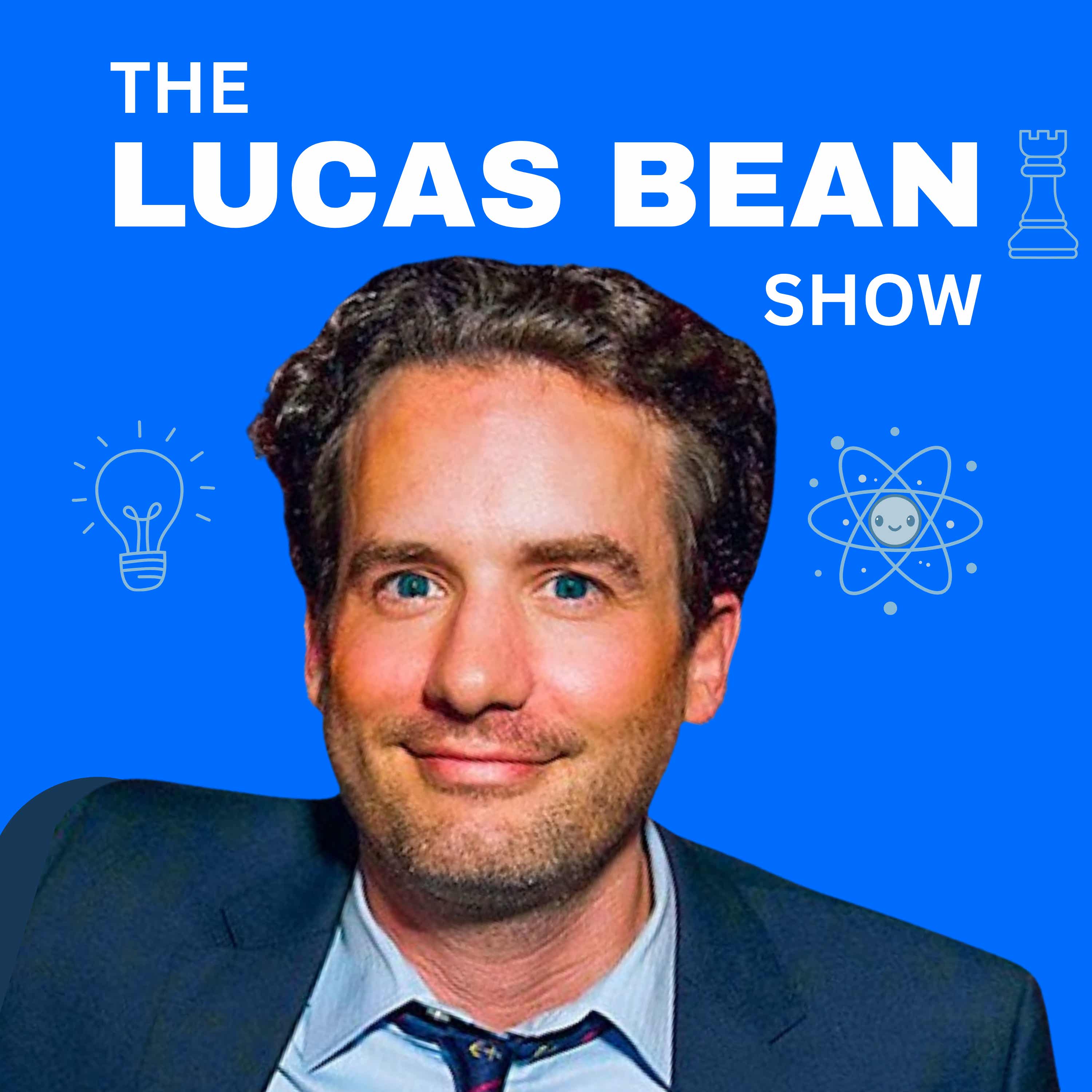
The Lucas Bean Show
Lucas BeanAudio
- Format:
- Podcast
- New episodes:
- Daily
- Typical length:
- about 2 minutes
- Latest episode:
About this show
Sharing insights on psychology, History, human behavior, politics, new technology and business | Author, Scientist, Podcast Host | I make videos & I try to tell good stories.
lucasbean.substack.com (https://lucasbean.substack.com?utm_medium=podcast)
Show details and episodes come from the publisher's public feed at api.substack.com. Last updated . Names, artwork and text belong to their publishers.
Cosmos
Similar by topic and creator
- Wenbin Fang's Podcast Playlist
Shares the topics Business and History. - bsnsHistory
Shares the topics Business and History. - Ones and Tooze
Shares the topics Business and History.
Similar shows






Explore more
Episodes
A Perfect Metaphor of Modern Human Apathy
· 38 sec
A skateboarder went to France during the riots. Not to document the uprising, not to support the protesters and definitely not to understand why people were in the streets fighting for their rights. He went to make a skate video. He skated through burning streets and clashing crowds, filmed himself doing tricks against a backdrop of civil unrest, and posted it for likes. He laughs as he runs from street to street trying to avoid the violence. The apathy is so obvious and ugly it hurts me to watch it. This isn’t an isolated incident. It’s a pattern. And the psychology behind it explains something much larger than one skateboarder with a camera. The empathy collapse is measurable. In 2010, researcher Sara Konrath at the University of Michigan published a meta-analysis of 72 studies spanning 30 years, covering nearly 14,000 American college students. Her finding was stunning and precise. Empathy among young adults had dropped 40 percent compared to their counterparts in the 1980s and 1990s. The largest decline occurred after the year 2000, exactly when social media began reorganizing how young people relate to each other and the world. Konrath measured two specific dimensions. The first was empathic concern, the ability to feel tenderness and concern for people less fortunate. The second was perspective-taking, the ability to imagine how things look from someone else’s point of view. Both declined sharply. Students were less likely to agree with statements like “I often have tender, concerned feelings for people less fortunate than me” and “I sometimes try to understand my friends better by imagining how things look from their perspective.” That 40 percent decline isn’t abstract. It’s the difference between seeing a riot and feeling something about the people in it, and seeing a riot and thinking about what it would look like as a background for your skate video. The empathy that would make someone stop and say “this isn’t about me” has been measurably and empirically reduced. And the generation most affected is the one that grew up performing their lives for cameras. How social media turned empathy into a liability. Empathy requires one specific cognitive act: the temporary suspension of self-focus. To feel what someone else is feeling, you have to stop thinking about yourself long enough to think about them. Social media trains the exact opposite. Every platform is built around one question: how do I present myself? What do I post? How will this make me look? How many people will engage with my content? Jean Twenge, a psychologist at San Diego State University, spent two decades tracking this shift. Her research, conducted with Keith Campbell and published across multiple studies, showed that narcissistic traits among college students rose steadily from the late 1970s through the 2000s. Two-thirds of contemporary students scored above the narcissistic average of students tested in the early 1980s. Twenge and Campbell published their findings in the book The Narcissism Epidemic: Living in the Age of Entitlement, arguing that American culture had created a self-reinforcing system where self-promotion was rewarded, self-absorption was normalized, and self-focus became the default mode of existence. Social media didn’t create narcissism. But it created an economy that runs on it. Every like, every comment, every share, every follow is a unit of attention converted into a unit of perceived self-worth. And the platforms are designed, deliberately and with billions of dollars of engineering, to make that feedback loop as addictive as possible. Variable reinforcement, the same psychological mechanism that makes slot machines addictive, powers every notification. You don’t know when the next burst of attention is coming, so you keep posting. You keep performing. And the performance becomes the only thing that feels real. This is how a person skates through a riot and feels nothing about the riot. The riot is not a…
Not rated yetWhy MAGA Wants a Dictator
· 1 min
In this week’s video, I talked about Bob Altemeyer’s research on right-wing authoritarianism and how people who score high on his scale grew up in households that trained them to see the world as dangerous. The video covers the basics. This piece goes deeper into the research, because the science behind the authoritarian brain is one of the most well-documented findings in all of political psychology. And it explains nearly everything about what we are watching right now. The researcher In 1981, psychologist Bob Altemeyer at the University of Manitoba published Right-Wing Authoritarianism, a book that refined decades of earlier work on the authoritarian personality. The original research started back in the 1950s at UC Berkeley, where a team of researchers created what they called the F-scale (F for fascism) to try to measure the kind of personality that goes along with authoritarian movements. That scale had serious problems. It was unbalanced, poorly validated, and easy to game. Altemeyer spent over a decade fixing it. What he built in its place was the RWA scale. Right-Wing Authoritarianism. He tested it across thousands of participants over the course of his career, from college students to sitting legislators. And it worked. It predicted behavior, attitudes, and political alignment with a consistency that surprised even other researchers. A note on the name. “Right-wing” in this context doesn’t mean Republican or conservative in the American political sense. Altemeyer used “right-wing” to describe submission to established authority, as opposed to left-wing authoritarianism, which is submission to authorities trying to overthrow the establishment. In practice, though, the political conservatives in North America consistently scored higher on his scale. That finding held up for decades. The three clusters Altemeyer didn’t find one trait. He found three. And they always showed up together. He called them the three attitudinal clusters of right-wing authoritarianism. The first is authoritarian submission. This is a reflexive willingness to obey whatever authority figure a person sees as legitimate. Not thoughtful agreement. Not carefully evaluated trust. Uncritical, automatic compliance. The kind of obedience that doesn’t ask questions because questions themselves feel like betrayal. The second is authoritarian aggression. This is hostility directed at whoever the authority figure identifies as a target. It doesn’t come from personal experience with the target. It comes from the authority’s say-so. If the leader says immigrants are the problem, immigrants become the enemy. If the leader says it’s the media or the schools or the trans community, the aggression shifts instantly. The aggression isn’t principled. It’s outsourced. The third is conventionalism. This is a rigid attachment to traditional social norms and a belief that everyone else should be forced to follow them too. Not a personal preference for tradition. A demand that it be imposed. In parenting, high-RWA individuals value obedience, neatness, and good manners in children above curiosity, independence, or creativity. These three traits don’t just correlate with each other. They predict prejudice, intolerance, and support for anti-democratic policies. Altemeyer spent his career documenting exactly how. The engine underneath In his later research, Altemeyer identified three personality traits sitting underneath those three attitudinal clusters. They are the engine that makes the whole system run. The first is self-righteousness. High-RWA individuals believe they are morally superior to others. Not in a quiet, internal way. In a way that gives them permission to punish. They see themselves as the last decent people in a world that has gone to rot, and that belief is what licenses the aggression. The second is fear of a dangerous world. This is the one I focused on in the video, because it is the fuel supply. High-RWA scorers genuinely believe the…
Not rated yetMAGA is Obsessed with Other Men
· 59 sec
This week, Donald Trump stood on stage at a rally in North Carolina and told the crowd he’d been studying Jon Husted’s body. He described the senator’s backside as “like a pile of muscle.” He went through his shoulders, his jawline, his legs, his hands. He said tapping Husted’s shoulder actually hurt his hand. A few days before that, at a rally in Kentucky, he told the audience he’d “examined his ass.” At another rally in Georgia, he spent time comparing how attractive one male candidate was compared to another. This has been happening at rally after rally all month. The New York Times called his fixation on male bodies “puzzling.” Anderson Cooper aired a montage of all of it back to back. Seth Meyers looked into the camera and asked him directly, “Why are you so weird?” And not a single Republican said a word about any of it. In 1996, psychologist Henry Adams at the University of Georgia designed one of the most uncomfortable experiments in the history of psychology. He recruited 64 men who all described themselves as exclusively heterosexual, meaning they reported no homosexual arousal and no homosexual experiences. He then divided them into two groups based on their scores on a standardized homophobia scale. One group scored high in homophobia. The other scored low. Then he showed both groups three types of sexually explicit videos: heterosexual, lesbian, and gay male. He measured their physical arousal using a penile plethysmograph, a device that measures changes in penile circumference with clinical precision. There was no ambiguity in the data. There was no room for interpretation. The device measured what the body did regardless of what the mouth said. Both groups responded similarly to the heterosexual and lesbian content. The difference showed up only when the gay male content played. In the non-homophobic group, 66% showed no measurable arousal to the gay male video, and less than 25% showed a significant physical response. In the homophobic group, those numbers flipped. Over 54% of the men who scored highest on the homophobia scale showed a significant physical response to the gay male content. Only 20% of the homophobic men showed no arousal at all. And here’s the part that makes the study devastating: when the men were asked afterward to rate how aroused they felt during each video, the homophobic men significantly underestimated their arousal to the gay male content. Their bodies responded. Their conscious minds denied it. The data didn’t care. Adams published his findings in the Journal of Abnormal Psychology, one of the most respected journals in the field, under the title “Is Homophobia Associated with Homosexual Arousal?” The answer, according to the plethysmograph, was yes. The defense mechanism that explains everything The concept that explains Adams’ findings is not new. It was first described by Anna Freud in her 1936 book The Ego and the Mechanisms of Defense. She called it reaction formation, and it works like this: when a person experiences a feeling or impulse that produces intense anxiety or shame, they don’t just suppress it. They attack the opposite. They become the loudest, most aggressive opponent of the very thing they feel inside themselves. Reaction formation is not the same as simple disagreement or discomfort. The hallmark of reaction formation is disproportionate intensity. A person who is simply not attracted to the same sex doesn’t spend their career crusading against it. They don’t draft legislation about it. They don’t bring it up in every speech. They don’t think about it at all, because there is nothing to defend against. Reaction formation reveals itself through obsession. The volume of the outrage is the tell. What makes reaction formation so effective as a disguise is that it looks like conviction. It looks like moral clarity. The person performing it often doesn’t know they’re doing it. The defense mechanism works precisely because it operates below conscious awareness.…
Not rated yetThe Psychology of Halloween
· 9 min
I needed a short break from politics, so I researched and made this video instead. I hope you like it. Back to politics tomorrow. Almost everyone has some degree of morbid curiosity, and most people don’t want to admit it. We slow down at car accidents. We binge true crime podcasts. We watch horror movies that we know will keep us up at night. And every October, we turn an entire holiday into a celebration of death, fear, and disguise. The question isn’t whether we’re drawn to dark things. The question is why. In 2021, behavioral scientist Coltan Scrivner at the University of Chicago published a paper in the journal Personality and Individual Differences that introduced the first psychometric tool for measuring this trait. He called it the Morbid Curiosity Scale, a 24-item assessment designed to measure how drawn a person is to information about things that are dangerous, threatening, or related to death. What Scrivner found is that morbid curiosity isn’t rare, and it isn’t a disorder. It’s a normally distributed psychological trait, which means most people fall somewhere in the middle. Almost everyone has some degree of it. The people who binge true crime podcasts, slow down to look at car accidents, and watch horror movies on purpose aren’t broken. They’re normal. And Scrivner’s research suggests there’s an evolutionary reason for that. Scrivner identified four dimensions of morbid curiosity: curiosity about the minds of dangerous people, curiosity about the supernatural, curiosity about body violation, and curiosity about violence. Each one maps onto a category of threat that would have mattered to our ancestors. Paying attention to predators, understanding what dangerous people might do next, and learning about physical harm without having to experience it firsthand would have given early humans an advantage. The people who paid attention to threats survived. The ones who looked away didn’t. Morbid curiosity is leftover survival wiring that most of us still carry. Halloween activates every single one of those dimensions at once. Monsters and ghosts hit the supernatural dimension. Gore and horror movies hit body violation. Scary costumes and jump scares hit violence. Haunted houses are designed to trigger all four. The reason millions of people line up to experience it every October is that the brain is already wired to seek it out. Halloween didn’t create our fascination with death. It just gave it a date on the calendar. Halloween vs. Día de los Muertos One of the most revealing things about Halloween is what it looks like when you put it next to another culture’s version of the same thing. Día de los Muertos, or Day of the Dead, is celebrated in Mexico on November 1st and 2nd, just one day after Halloween. Both holidays exist at the same time of year. Both are built around death. Both involve costumes, decorations, and gatherings. And they solve the exact same problem in completely opposite ways. Halloween was born from fear. The Celts believed the dead were dangerous. They lit fires to keep the darkness back. They wore disguises so the spirits wouldn’t recognize them. They sacrificed animals hoping their gods would protect them through the winter. The entire structure of Samhain was built on the idea that the dead were a threat and the living needed to defend themselves. Día de los Muertos was born from love. Its roots trace back to pre-Columbian Mesoamerican cultures, including the Aztecs and Maya, who viewed death not as an ending but as a continuation. When the Spanish arrived and brought Catholicism, those indigenous traditions blended with All Saints’ Day and All Souls’ Day into what the holiday is today. Families build altars called ofrendas and decorate them with marigolds, candles, food, and photographs of the people they’ve lost. They visit cemeteries, clean the graves, and sit with their dead. They tell stories about them. They cook their favorite meals. Sugar skulls and painted skeleton faces…
Not rated yetMAGA is a Support Group for Weak People
· 2 min
There is a pattern that shows up in the research on authoritarianism that almost nobody talks about publicly. Not because it is hidden. Because it is uncomfortable. The people who fill megachurches on Sundays and the people who fill MAGA rallies on weeknights are, in disproportionate numbers, the same people. Not metaphorically. Psychometrically. They score the same on the same instruments, hold the same cluster of personality traits, and respond to the same structural incentives. Both institutions offer the same product, packaged differently but functionally identical: status and power distributed on the basis of loyalty, not competence. What Altemeyer Actually Measured Bob Altemeyer was a social psychologist at the University of Manitoba who spent his entire career studying a single question: what kind of person submits to authoritarian leaders, and why? In 1981, he published Right-Wing Authoritarianism, introducing the RWA scale, a psychometric instrument that measures three interlocking traits. He called them the Big Three. The first is authoritarian submission. This is not ordinary respect for authority. It is a blanket willingness to defer to whoever the individual perceives as a legitimate authority, and to accept their claims without scrutiny, even when those claims conflict with observable reality. High scorers on this trait will tell you that people should obey authority in virtually all circumstances. When given moral dilemmas, they default to “the law is the law” regardless of the situation. They do not evaluate whether an authority figure is competent, honest, or acting in good faith. They evaluate whether that figure occupies a position they recognize as legitimate. If so, they comply. The second is authoritarian aggression. This is a willingness to punish, condemn, or attack people that the authority figure has identified as threats or deviants. The aggression is not indiscriminate. It is directed. High scorers do not attack people in general. They attack whoever the leader points at. And they do so with a sense of moral righteousness, because the leader has told them the target deserves it. Altemeyer noted that authoritarian followers prefer to aggress when the odds are heavily in their favor. They are not courageous. They attack in groups, when they have numbers, or when they have institutional backing. They avoid anything approaching a fair fight. The third is conventionalism. This is an intense attachment to traditional social norms and a hostility toward anyone perceived as violating them. High scorers want everyone to live the way they live. They view deviation from their norms not as difference but as moral failure. They see the world in categories of “normal” and “deviant,” and they want deviance punished. These three traits form a self-reinforcing loop. You submit to the authority. You attack whoever the authority tells you to attack. And you demand that everyone conform to the norms the authority endorses. Submission fuels aggression. Aggression enforces conventionalism. Conventionalism justifies submission. Altemeyer tested this cluster across thousands of subjects over four decades. His results were remarkably stable. The personality profile he identified in the early 1980s predicted the same behaviors in the 1990s, 2000s, and 2010s. It predicted support for punitive policing, opposition to civil rights, endorsement of government surveillance, hostility toward immigrants, and consistent support for leaders who promised order through dominance. He published updated findings in 1988, 1996, and again in his free online book The Authoritarians in 2006. And then, with John Dean, in Authoritarian Nightmare: Trump and His Followers in 2020, he applied his scale directly to the MAGA movement and found exactly what his data had been predicting for four decades. The Dominators and the Followers Altemeyer’s framework has two halves, and most people only know the first. The authoritarian followers…
Not rated yetMAGA Uses Words They Don’t Understand
· 3 min
There is a specific type of person who will tell you with complete confidence that socialism is destroying America but, cannot tell you what socialism is. Not in a vague, hand-wavy way. In a literal, recorded-on-camera, asked-four-times-and-still-couldn’t-answer way. This is not a failure of education or a failure of access to information. It is a measurable psychological phenomenon with decades of research behind it, and the explanation is less about politics than it is about personality. In 1990, psychologist Delroy Paulhus at the University of British Columbia developed what he called the Over-Claiming Questionnaire. The design was deceptively simple. Participants were given a long list of items across a range of knowledge domains and asked to rate how familiar they were with each one. Mixed into the list were items that did not exist. Fake names. Invented concepts. Events that never happened. The test was not measuring what people knew. It was measuring what people were willing to claim they knew, including things that were impossible to know because they were not real. The results were consistent across multiple studies conducted over the next two decades. Certain people reliably claimed familiarity with the fake items. They were not guessing randomly or hedging their guesses. They were stating, with confidence, that they were familiar with things that had been fabricated specifically to catch them. And when Paulhus examined which personality traits predicted this behavior, one trait stood above the rest. Narcissism. Not clinical narcissistic personality disorder in every case, but subclinical narcissistic traits as measured by standard personality instruments. This connection was significant and replicated across studies. People who scored higher in narcissism were significantly more likely to claim knowledge they did not have. The relationship held even when controlling for actual intelligence, meaning this was not simply a matter of smart people knowing more and occasionally overestimating. This was a personality-driven inflation of self-assessed knowledge that operated independently of how much someone actually knew. Why Narcissistic People Overclaim Understanding the mechanism behind overclaiming requires understanding what knowledge represents to a narcissistic person. For most people, not knowing something is a neutral event. It carries no emotional weight. You encounter a term you have never heard, you acknowledge the gap, and you either look it up or move on. The gap does not say anything about your value as a person. For someone with narcissistic traits, that same gap is experienced as a threat. Narcissistic self-esteem is not built on a stable internal foundation. It is built on the continuous external performance of competence, intelligence, and superiority. Every interaction is, on some level, an audition. And in that audition, not knowing something is not just uncomfortable. It is dangerous. Because if you do not know something, you are not the smartest person in the room. And if you are not the smartest person in the room, the entire self-image you have constructed begins to wobble. Paulhus and his colleague Peter Harms, in their 2004 follow-up research, found that overclaiming was specifically tied to what they called self-enhancement bias, a pattern of inflating one’s own qualities to maintain a favorable self-image. The overclaiming was not happening at a conscious, deliberate level for most participants. They were not strategically lying about what they knew. Their self-enhancement bias was operating automatically, filling in knowledge gaps before the person even registered them as gaps. The subjective experience, as far as the overclaimer was concerned, was not deception. It was genuine belief. They really did think they knew these things. Their personality would not let them feel otherwise. This is a critical distinction because it explains something that baffles many observers of…
Not rated yetMAGA Cult is Over
· 5 min
Political movements do not collapse all at once. They collapse in layers, from the outside in, with the least committed leaving first and the most committed holding on until long after everyone else has moved on. This pattern is not unique to MAGA. It is one of the most consistent findings in the psychology of group identity, cult behavior, and political disillusionment. And the research that explains it stretches back over seventy years. What makes MAGA’s collapse worth studying is not that it is happening. It is that we already have a detailed historical model for exactly how it will play out, because it already happened once in postwar Germany. The timeline, the psychology, and the sequence of departures are remarkably similar. The research tells us who leaves first, who leaves last, and what happens to the people who never leave at all. Level One: The Identity Tourists In the 1970s, social psychologist Henri Tajfel at the University of Bristol conducted a series of experiments that became the foundation for one of the most cited theories in social psychology. Tajfel wanted to understand what it takes for a person to adopt a group identity. His findings were surprising in their simplicity. He discovered that people will identify with almost any group, even one assigned to them randomly, as long as that group provides them with a sense of positive distinctiveness. As long as belonging feels good, people stay. Tajfel called this Social Identity Theory, and its implications for political movements are enormous. People do not need to deeply understand a group’s ideology to join it. They do not need to agree with every position. They do not even need to care very much. They just need the group to make them feel like they are part of something that is winning. This explains the first wave of MAGA’s expansion and the first wave of its collapse. The casual MAGA supporters, the ones who wore the hats to rallies, flew the flags from their trucks, and posted memes online, were never ideologically committed. For many of them, especially younger voters in 2024, MAGA was social currency. It was something to do on a Saturday night in a town where nothing else was happening. The rallies felt like concerts. The online communities felt like belonging. The red hat was a ticket to a party that seemed, briefly, like the winning side. Tajfel’s research predicts exactly what happens to these members when the group stops feeling like a winner. They leave. Quietly, without explanation, without confrontation. One day the flag comes down. The hat goes in a drawer. The social media posts stop. They do not announce their departure because, psychologically, they were never deeply enough invested to require one. The identity was worn, not internalized. And worn identities are easy to take off. This is the level of MAGA that has already evaporated. These former supporters do not want to talk about politics anymore. They insist both sides are equally bad. They bristle when someone brings up the rallies they attended eighteen months ago. They are already rehearsing the line they will use for the rest of their lives: “I was never really into it.” Tajfel’s research tells us this level does not come back. Once the positive distinctiveness is gone, once the group stops providing the feeling of being on a winning team, low-commitment members do not reconnect. They find another source of identity. The group they left becomes something they would rather not remember. Level Two: The Invested The second level of departure is slower, more painful, and psychologically more complex. These are the people who did not just wear the hat. They built their social lives around it. Their friend groups became MAGA friend groups. Their media consumption became exclusively MAGA media. Their sense of who they were as people became inseparable from their political identity. Walking away from MAGA, for these members, is not like taking off a hat. It is like amputating a…
Not rated yetMAGA is A Personality Disorder
· 1 min
MAGA Isn’t a Political Movement. It’s a Personality Disorder Called Ressentiment. In 1887, Friedrich Nietzsche published On the Genealogy of Morals. It is one of the most disturbing books in the history of philosophy, and not because of its arguments about religion or power. It is disturbing because Nietzsche identified a psychological state that, once you see it, you cannot stop seeing it everywhere. He called it ressentiment. Not resentment. Ressentiment. Nietzsche deliberately used the French word because it described something more specific and more dangerous than ordinary anger. Resentment is a feeling. It comes, it burns, and eventually it passes or gets processed. Ressentiment is what happens when it doesn’t pass. When the anger has nowhere to go. When the person experiencing it is too powerless to act on it, too proud to admit it, and too fragile to let it go. The feeling stops being a reaction to something that happened. It becomes who they are. Nietzsche observed this most clearly in what he called “slave morality,” a value system created not by people who had something to offer the world, but by people who had nothing and needed a way to frame that nothing as moral superiority. Instead of striving for strength, they called strength evil. Instead of pursuing excellence, they called excellence arrogance. They didn’t build a worldview around what they valued. They built it around what they resented. The parallels to modern American politics should be impossible to miss. And yet, most political analysis continues to treat MAGA supporters as rational actors motivated by economic anxiety or cultural displacement. The research tells a different story. Scheler’s expansion: self-poisoning of the soul. Twenty-five years after Nietzsche, philosopher Max Scheler published the most thorough analysis of ressentiment ever written. His 1912 book, titled simply Ressentiment, took Nietzsche’s concept and mapped its psychology in granular detail. Scheler identified the key ingredient: powerlessness combined with awareness of that powerlessness. Ressentiment doesn’t grow in people who are simply angry. It grows in people who are angry and know they can’t do anything about it. They can’t fight the people they envy. They can’t achieve the things they resent others for having. They can’t change their circumstances through action. So the anger turns inward, curdles, and begins to poison the person’s entire value system. Scheler called this “self-poisoning.” The person in the grip of ressentiment doesn’t just resent specific individuals or outcomes. They begin to hate the values themselves that they cannot achieve. Education becomes elitism. Expertise becomes arrogance. Success becomes proof of corruption. The entire moral framework inverts, and what was once aspiration becomes the enemy. This is not metaphor. This is the observable psychology of the MAGA base. They don’t just disagree with liberal policies. They have come to hate the values that liberal life represents: education, professional achievement, cultural sophistication, cosmopolitanism, expertise. Not because those things are wrong, but because those things are reminders of choices they didn’t make and lives they didn’t build. Ressentiment provides the psychological architecture for reframing that failure as someone else’s fault. Lucas Bean Daily is a reader-supported publication. To receive new posts and support my work, consider becoming a free or paid subscriber. The modern research: ressentiment as the engine of grievance politics. In 2022, researchers Tereza Capelos at the University of Birmingham and Mikko Salmela at the University of Helsinki published a landmark empirical study titled “Grievance Politics: An Empirical Analysis of Anger Through the Emotional Mechanism of Ressentiment.” They analyzed 164 interview excerpts from three major works documenting American resentment: Arlie Russell Hochschild’s Strangers in Their Own Land, Michael Kimmel’s Angry…
Not rated yetWhy MAGA Men Drive Big Truck
· 1 min
There is a particular kind of man who shows up to political rallies in body armor he bought online, drives a truck that has never hauled anything, and screams about strength while falling apart the moment someone disagrees with him. He is not hard to spot. He is the loudest person in any room he enters. He is also, according to decades of research, the most frightened. The video that accompanies this piece covers sociologist Robb Willer’s research on masculine overcompensation: the finding that men whose masculinity is threatened respond with exaggerated displays of dominance, aggression, and toughness. The effect is consistent and measurable. It shows up in attitudes toward war, attitudes toward gay people, and even in what kind of car a man wants to buy. But the research goes much deeper than one study, and the implications stretch far beyond a rally. Manhood Is Not a Permanent Condition Willer’s overcompensation research answers the question of what happens when a man’s masculinity is threatened. But the more fundamental question is why masculinity is so easy to threaten in the first place. In 2008, psychologists Joseph Vandello and Jennifer Bosson at the University of South Florida published a series of five studies on what they called precarious manhood. Their central finding was that across cultures and contexts, people treat manhood as a status that must be continuously earned and can be lost at any time. Womanhood, by contrast, is generally perceived as a biological inevitability. A girl becomes a woman. It happens. But a boy does not automatically become a man. He has to prove it, and he has to keep proving it, because the status can be revoked by the group at any moment. This distinction matters because it means that for men, gender identity is not a stable foundation they stand on. It is a performance they are always one mistake away from failing. Vandello and Bosson found that when they made the precarious nature of manhood salient through feedback suggesting a man had performed in a gender-atypical way, men experienced measurable increases in threat and anxiety. Women given equivalent feedback about their femininity showed no such response. In one experiment, Vandello and Bosson had men braid either a female mannequin’s hair or a gender-neutral rope. Afterward, they were given a choice between punching a bag or solving a puzzle. The men who had braided hair were significantly more likely to choose to punch something. The ones who braided rope were fine. That is not a metaphor for anything. That is the research result. A man braided fake hair and then needed to hit something to feel like a man again. The implications of precarious manhood are enormous. If your sense of your own gender can be undermined by braiding a mannequin’s hair, imagine what happens when the entire economy shifts, when manufacturing jobs disappear, when your wife earns more than you, when the culture tells you that the things that used to make you a man no longer count. You don’t just feel uncomfortable. You feel like you’re losing something fundamental about who you are. And because manhood is defined by what you do rather than what you are, the only way to get it back is to do something aggressive, dominant, and loud enough to prove you still have it. The Testosterone Factor Willer’s early research on masculine overcompensation was conducted at Cornell University in 2005. He gave undergraduate men a gender identity survey and then provided randomly assigned fake feedback telling some men their responses were more feminine than masculine. Those men subsequently expressed more homophobic attitudes, stronger support for the Iraq War, greater interest in buying an SUV, and more feelings of shame, guilt, hostility, and general upset. In 2013, now at UC Berkeley, Willer and his colleagues published an expanded version of this research in the American Journal of Sociology. The paper, titled “Overdoing Gender,” included four studies and…
Not rated yetPeople Trying to Quietly Quit MAGA
· 1 min
There’s a familiar ritual that happens every time an authoritarian movement begins to collapse. The supporters disappear. Not physically. Psychologically. They scrub the evidence, rewrite the timeline, and emerge on the other side with a story they’ve rehearsed just enough to almost believe. “I never really supported him.” “I just voted against the Democrats.” “I don’t talk about politics anymore.” This is happening right now across America. The yard signs are coming down. The hats are going into drawers. The Facebook posts are being deleted. And millions of people who spent a decade loudly and publicly cheering for cruelty are quietly trying to exit the building before someone turns the lights on. The companion video to this piece says what needs to be said plainly: they’re not confused. They’re lying. They know what they did. They know what they defended. And they’re trying to erase the evidence before accountability arrives. This Substack examines why that matters, why it won’t work this time, and what history tells us about populations that try to pretend they were never part of the thing they spent years supporting. This has happened before. It looked exactly the same. In the months after the fall of Nazi Germany, something remarkable happened. The Nazis disappeared. Not into hiding. Into denial. Across the occupied zones, Allied forces encountered a population in which, suddenly, nobody had ever been a Nazi. Nobody had supported the regime. Nobody had cheered at the rallies. Nobody had turned in their neighbors. The denazification tribunals established by the Allied powers categorized former participants into five groups, from major offenders to exonerated persons. The category that swallowed the vast majority of the German population was Mitläufer: fellow travelers. Passive followers. People who went along with it but didn’t really mean it. People who were just following orders, just keeping their heads down, just trying to survive. In 1946, the German writer Luise Rinser, who had herself been arrested under the Nazi regime, wrote a letter responding to Hermann Hesse’s criticisms of postwar Germany. Her assessment was devastating. “Nobody did it,” she wrote. “Everyone wants to be de-Nazified.” She found it despicable that people were claiming to have been mere passive followers, as if that were something to be proud of rather than ashamed of. “Better an evil, real Nazi, driven by the Devil, than a mere passive follower,” she wrote. “What lack of pride and insight.” Rinser saw something that most political analysts then and now tend to miss. The denial wasn’t a psychological phenomenon. It was a moral one. These people knew exactly what they had done. They had attended the rallies. They had displayed the flags. They had reported their neighbors. They had benefited from the regime. And when the regime fell, they didn’t experience sudden clarity about what they had supported. They experienced sudden fear about what supporting it was going to cost them. The psychology didn’t change. The incentives did. The totalitarian ego. Social psychologist Anthony Greenwald at the University of Washington published a landmark paper in 1980 describing what he called the totalitarian ego. Greenwald argued that the self operates like a totalitarian regime’s propaganda ministry: it ruthlessly destroys information that threatens its positive self-image and rewrites personal history from the standpoint of the victor. But Greenwald made an important distinction. A totalitarian dictator rewrites history to deceive future generations. The totalitarian ego rewrites history to deceive itself. The goal isn’t to fool other people. The goal is to maintain a version of yourself that you can live with. And the mechanism is automatic, continuous, and largely invisible to the person doing it. This is the layer the video companion deliberately cuts through. The script says they’re just lying. And that’s true. But the Substack can hold a…
Not rated yetHave These People Always Been Cruel? MAGA Antagonistic Narcissism
· 10 min
Most political analysis starts with policy. Voters chose this candidate because of the economy, immigration, healthcare, taxes. And for most voters in most elections, that’s probably true. But Donald Trump is not most candidates. And the question that keeps surfacing isn’t why people agree with him. It’s why they love him more every time he does something cruel. The mockery. The insults. The attacks on disabled reporters, Gold Star families, and women. Behavior that would end any other political career has somehow become the foundation of his. In 2021, psychologist Matthew Yalch at Palo Alto University published a study in PLOS ONE titled “Dimensions of pathological narcissism and intention to vote for Donald Trump.” And what he found should make everyone uncomfortable, including the people it describes. Narcissism predicted the worst part of Trump supporters Yalch didn’t just measure whether Trump supporters were narcissistic. He wanted to know which kind of narcissism predicted voting for Trump. Because narcissism isn’t one thing. It’s a hierarchy of related traits, and researchers have long distinguished between its two major expressions. Grandiose narcissism is the loud version. The inflated self-image, the need for admiration, the belief that you’re special and everyone should recognize it. Vulnerable narcissism is quieter and more defensive. The fragile ego, the hypersensitivity to criticism, the constant feeling that you’re being undervalued. Both types share a common core: antagonism, entitlement, manipulation, and a lack of empathy. Using a statistical technique called principal components analysis, Yalch mapped the hierarchical structure of pathological narcissism and tested which level of that hierarchy best predicted the intention to vote for Trump in 2020. The answer wasn’t general narcissism. It wasn’t even the grandiose or vulnerable distinction. It was a specific cluster that sat deeper in the hierarchy. The antagonistic and indifferent facets of narcissism, what researchers describe as self-centered hostility toward others combined with a lack of concern for the damage caused, predicted Trump voting over and above demographic variables like age, race, and education. In other words, the thing that set Trump supporters apart wasn’t just that they had big egos. It was that they were hostile, contemptuous, and indifferent to other people’s suffering. The cruelty wasn’t incidental. It was structural. Where antagonistic narcissism comes from. The developmental literature on narcissism makes the picture worse, not better. Research on the childhood origins of narcissistic traits has consistently pointed to a few recurring environments. Children raised in homes where emotional vulnerability was punished tend to develop defensive personality structures that protect them from the shame of being seen as weak. Children raised by permissive parents who never set boundaries tend to develop inflated self-concepts that collapse under real-world accountability. And children raised in environments of conditional approval, where love was earned through performance rather than given freely, tend to build what clinicians call a “false self,” a constructed identity that requires constant external validation to survive. The grandiose version of this false self seeks admiration. The antagonistic version seeks dominance. And when dominance is unavailable, it settles for contempt. Looking down on immigrants, gay people, trans people, anyone who can be framed as lower on the hierarchy so that the narcissist doesn’t have to sit at the bottom. This isn’t born cruelty. It’s manufactured cruelty. Built in childhood, reinforced through adolescence, and calcified into a personality structure that can’t process accountability without experiencing it as an existential threat. For people with this profile, being told they’re wrong doesn’t register as feedback. It registers as annihilation. The five mechanisms working as a system.…
Not rated yetWhy MAGA is Filled With Really Lonely People
· 2 min
In February 2025, researchers at the University of Amsterdam published a study in Social Science & Medicine that should have rewritten every conversation about why people join the far right. They tracked over 40,000 people across nine countries, with data spanning fifteen years. They controlled for income, education, immigration attitudes, and political ideology. They wanted to know what actually predicts whether someone will support the populist radical right. The answer wasn’t immigration. It wasn’t economics. It wasn’t religion. It was loneliness. Lonelier individuals were consistently more likely to support radical right movements, with the association holding across all fifteen years of Dutch data and appearing across multiple European countries. The researchers noted that the effect sizes were comparable to the known health correlates of loneliness, meaning that the connection between loneliness and far-right support was statistically as meaningful as the connection between loneliness and heart disease, high blood pressure, and depression. A 2021 RAND Corporation study of former extremists and their families confirmed this from the other direction. Half of the former extremists surveyed said feelings of marginalization drove them toward radicalization, with most citing isolation and loneliness specifically. Individuals reported that the social benefits of joining extremist organizations, the friendship, the camaraderie, the sense of finally belonging somewhere, were among the most powerful forces keeping them in. These people didn’t join a movement because they were convinced by policy arguments. They joined because someone finally made them feel like they weren’t alone. And that tells us more about what MAGA actually is than any analysis of tariffs or border policy ever could. The factory that produces lonely men. The script that accompanies this piece makes a claim that deserves a deeper examination: conservative culture is to blame for the loneliness epidemic in its own base. The research supports this more directly than most people realize. Ron Levant, a former president of the American Psychological Association, spent decades studying how traditional masculine socialization affects emotional functioning in men. His research, conducted across multiple studies and institutions, identified a pattern he called normative male alexithymia. Alexithymia is the clinical term for difficulty identifying and describing one’s own emotions. Levant’s argument was that traditional masculine socialization doesn’t just discourage men from expressing emotions. It actively degrades their ability to recognize what they’re feeling in the first place. In a 2014 study published in Psychology of Men and Masculinity, Levant and his colleagues demonstrated that the mechanism behind normative male alexithymia is suppression, not repression or dissociation. This distinction matters. Repression and dissociation are unconscious. Suppression is conscious. These men are actively, deliberately pushing their emotions down because they have been taught that feeling them is weakness. And the research showed that men who scored highest on masculine norm conformity showed the greatest deficits in processing emotions related to vulnerability and attachment, which are the exact emotions required to build and maintain close relationships. A 2025 study published in Sex Roles extended this model further, testing 740 men across the United States and United Kingdom. The researchers found that three specific masculine norms were most strongly associated with emotional dysfunction: emotional control, self-reliance, and primacy of work. These norms predicted higher alexithymia, which predicted greater difficulty regulating emotions, which predicted higher rates of depression and anxiety. The pathway was sequential and measurable. Traditional masculinity teaches emotional suppression. Emotional suppression produces alexithymia. Alexithymia produces…
Not rated yetNarcissistic MAGA Boomer Wants Control Back
· 2 min
A woman stood up at a political rally and asked a sitting congressman to create a federal law that would force her adult daughter to let her see her grandchildren. Not a therapy session. Not a family mediator. Not a phone call to her daughter asking what went wrong. A federal law. That single moment contains more psychology than most textbooks. Because what she revealed, in front of cameras and a cheering crowd, wasn’t a grandmother’s heartbreak. It was a narcissist’s playbook when someone finally tells them no. How a boundary becomes a theft. In 2002, psychologist Roy Baumeister at Case Western Reserve University published a theory that combined two existing psychological frameworks into something new. The first was narcissism, the personality structure built around an inflated self-image that requires constant validation. The second was psychological reactance, a concept developed by Jack Brehm at the University of Kansas in 1966, which describes the motivational state people enter when they perceive their freedom as restricted. Brehm found that when people believe a choice or behavior has been taken from them, they experience an intense drive to restore it, often wanting the restricted option more than they did before it was restricted. Baumeister’s insight was that narcissism supercharges reactance. When an ordinary person encounters a boundary, they may be disappointed, but they can process it. When a narcissist encounters a boundary, they don’t experience disappointment. They experience theft. The boundary isn’t perceived as another person’s valid choice. It’s perceived as something that belongs to them being taken away. And they feel entitled to take it back by whatever means necessary. Baumeister called it narcissistic reactance. This grandmother didn’t process her daughter’s boundary as a painful but legitimate decision by an autonomous adult. She processed it as her property being stolen. Those grandchildren aren’t people her daughter is protecting. In her mind, they are hers. Access to them is her right. And no one, not even their own mother, gets to take what’s hers. What the estrangement research actually shows. The grandmother at the rally is operating from a narrative that most Americans have been raised to accept without question: family is family, and children owe their parents access. But the research on family estrangement tells a completely different story. Cornell sociologist Karl Pillemer conducted the first large-scale national survey of family estrangement in the United States. His findings were staggering. Twenty-seven percent of Americans aged 18 and older had cut off contact with a family member. This isn’t a fringe behavior. It’s more than one in four. Psychologist Joshua Coleman, author of Rules of Estrangement, has spent decades studying why adult children cut ties with their parents. His consistent finding is that adult children rarely cut off contact without years of distress and failed attempts to repair the relationship. The cutoff is almost never impulsive. It’s the final step in a long process of trying everything else first. Lindsay Gibson, author of Adult Children of Emotionally Immature Parents, puts it more directly. Persistent boundary violations force adult children to choose between constant conflict and walking away. When every conversation becomes a negotiation, when every visit comes with conditions, when every boundary is treated as an attack, the adult child eventually runs out of strategies. Walking away isn’t the first resort. It’s the last one. The research also reveals something important about who these adult children are. They are, overwhelmingly, the calm ones. The reflective ones. The ones who went to therapy, did the work, and arrived at the painful conclusion that no version of the relationship was going to work. They are not the dramatic ones throwing tantrums. They are the ones who quietly reduced contact after decades of exhaustion. Which means the…
Not rated yetHow Plato Predicted Trump
· 6 min
There is a specific kind of frustration that comes from watching something fall apart in exactly the way someone told you it would. Not vaguely. Not in broad metaphorical strokes. In order. Step by step. With the stages so clearly defined that anyone paying attention can call the next one before it happens. Plato had that frustration 2,400 years ago. He lived through it. He watched the Athenian democracy, the most advanced political experiment in the ancient world, turn on itself. He watched it execute Socrates, his teacher, arguably the sharpest mind in the city, for the crime of asking uncomfortable questions. And instead of moving on, Plato spent the rest of his life trying to explain how a society capable of producing genius could also be stupid enough to kill it. The result was The Republic. And while most of the book covers justice, education, and the nature of reality, Book Eight is something different entirely. Book Eight is a manual. It is Plato at his most concrete, walking through the specific sequence of events that takes a functioning democracy and turns it into a dictatorship. Not in abstract terms. In stages. With causes, mechanisms, and outcomes laid out in an order that has repeated across civilizations for two millennia. Why the First Casualties Are Always the Competent The first stage is the one most people recognize but misunderstand. The common assumption is that authoritarian leaders remove their opponents. That is true, but it is incomplete. Plato observed something more specific. The tyrant does not begin by targeting enemies. He begins by targeting the capable. The courageous. The independent-minded. People who have done nothing wrong except be good at what they do. The reason this happens first is not strategic in the way most political commentary assumes. It is psychological, and it is reflexive. In 2001, Carolyn Morf and Frederick Rhodewalt at the University of Utah published a model of narcissistic personality functioning that illuminates the mechanism precisely. Their research described a personality structure they called the grandiose yet vulnerable self. The narcissist projects an image of supreme confidence, but that image is a construction, not a foundation. Underneath it is emptiness. And that emptiness does not simply coexist with the grandiosity. It creates a specific kind of threat detection system. When a narcissistic leader encounters genuine competence in another person, the experience is not neutral. It is not even competitive in the ordinary sense. It is existential. The competent person, simply by being competent, threatens to expose the distance between what the narcissist claims to be and what the narcissist actually is. A secure leader absorbs that competence and puts it to use. A narcissistic leader cannot, because using it means acknowledging that someone else has something he does not. And that acknowledgment is the one thing the narcissistic structure cannot survive. Plato described this with a medical analogy that has never been improved upon. A doctor purges a body by removing the disease and leaving what is healthy. The tyrant performs the opposite operation. He removes the healthiest parts of the state and keeps the sickness. The result is not just a weakened government. It is a government that has been specifically engineered to contain no one capable of recognizing what is happening. The Geometry of Captive Loyalty The second stage solves a problem created by the first. Once the competent are gone, the tyrant is exposed. He is surrounded by a population that increasingly despises him, and he has no one qualified to help him govern. He needs bodies. He needs protection. And he cannot get either from people who watched him gut the institutions they relied on. Plato’s answer was the concept of the drone. In Athenian beekeeping, drones were the members of the hive that consumed resources without producing anything. Plato borrowed the term for the class of people…
Not rated yetMAGA Thinks Like Seven-Year-Old Children
· 1 min
Every parent who has ever caught a child doing something wrong has heard the same defense. “But I didn’t get in trouble for it.” The child does not argue that the action was right or that the action was justified. The child’s entire moral framework rests on a single variable: did punishment follow? If the answer is no, the child concludes the action was acceptable. This reasoning is normal in a seven-year-old. It is evidence of a brain that has not yet developed the capacity for abstract moral thought. The child will grow out of it, given adequate development, socialization and guidance. Most children do grow out of it. Some adults never do. In 1958, psychologist Lawrence Kohlberg began the research that would produce the most influential model of moral development in the history of psychology. Working from his doctoral thesis at the University of Chicago, Kohlberg interviewed 72 boys between the ages of 10 and 16, presenting them with moral dilemmas and analyzing the reasoning behind their answers. He was not interested in what they decided. He was interested in how they decided. The structure of their reasoning, not its conclusions, was the object of study. What emerged from that research was a six-stage model of moral development organized into three levels, each representing a fundamentally different relationship between the individual and the concept of right and wrong. The Three Levels Kohlberg’s first level is preconventional morality. This is the level at which most young children operate, and it contains two stages. Stage one is what Kohlberg called the obedience and punishment orientation. At this stage, an action is wrong only if it results in punishment. No punishment, no wrongdoing. The physical consequences of behavior are the sole basis for moral judgment. A child at stage one does not steal a cookie because they will get sent to their room, not because stealing is wrong. If nobody catches them, the cookie was fair game. Stage two, still within the preconventional level, is the self-interest orientation. Morality at this stage operates like a marketplace. Right action is whatever satisfies your own needs, and cooperation with others happens only when it benefits you directly. “You scratch my back, I’ll scratch yours” is the highest moral principle available at this stage. Kohlberg’s second level is conventional morality, which typically develops during adolescence. At stage three, moral reasoning is driven by social approval, the desire to be seen as a good person by the people around you. At stage four, the individual develops a broader sense of law and social order, recognizing that rules exist to maintain a functioning society regardless of whether breaking them would benefit the individual. Most adults in functioning democracies operate somewhere between stages three and four. They follow laws not because they fear punishment but because they understand that a society without shared rules collapses. The third level is postconventional morality, which Kohlberg acknowledged most adults never reach. Stage five involves an understanding of social contracts, the idea that laws are agreements among citizens that can and should be changed when they fail to serve justice. Stage six, the rarest of all, involves reasoning from universal ethical principles, moral commitments that hold regardless of law, social convention, or personal consequence. Kohlberg placed figures like Martin Luther King Jr. at this level, people who broke unjust laws because a higher moral principle demanded it. Where MAGA Lives in This Framework The framework is descriptive, not political. Kohlberg did not design it to critique any ideology. But when you apply the model to the observable moral reasoning of the MAGA movement, the result is difficult to look away from. The argument that Trump did nothing wrong on January 6th because he was not convicted is stage one reasoning. The action is evaluated exclusively by its…
Not rated yetMAGA is a Daycare for Adult Children
· 1 min
In the summer of 2025, psychologist Craig Neumann did something no researcher had done at this scale before. He measured the empathy profiles of over 9,000 American adults, mapped those profiles against their political affiliations and views of Donald Trump, and published what he found in the Journal of Research in Personality. The results did not reveal what most people expected. The common assumption is that Trump supporters lack empathy, that something is missing, that there is a deficit or a gap where the ability to recognize and respond to suffering should be. That assumption is wrong, and what Neumann actually found is considerably worse. Trump supporters are not blind to your pain. They can see it perfectly well. They enjoy it. The Three Dimensions of Empathy Understanding what Neumann’s data shows requires understanding that empathy is not a single capacity. It is at least three distinct psychological processes, each operating through different neural pathways, each measurable independently, and each telling a different story about how a person relates to the suffering of others. Cognitive empathy is the ability to perceive and understand what another person is feeling. It is a perceptual skill, closer to reading comprehension than to emotional experience. A person with high cognitive empathy can look at someone’s face and know they are in pain. They can read body language, vocal tone, and social cues with accuracy. Cognitive empathy does not require caring about what you perceive. It only requires perceiving it. Psychopaths typically score high on cognitive empathy. They are excellent at reading people. That is often what makes them effective manipulators. They can see exactly what you are feeling. They simply do not care. Affective empathy is the capacity to feel what another person feels. It is the process by which observing someone else’s pain produces a corresponding emotional response in your own nervous system. When you see someone stub their toe and you wince, that is affective empathy. When a child cries and your chest tightens, that is affective empathy. It is automatic, involuntary, and operates below the level of conscious decision-making. Affective empathy is what makes cruelty feel wrong. It is the internal alarm that fires when you witness suffering, the signal that tells your brain that what is happening to that person matters. Without it, the suffering of others is neutral information, the way a stock ticker is neutral to someone with no money in the market. Dissonant empathy is the third dimension, and it is the one that changes everything. Dissonant empathy is not the absence of a response to another person’s pain. It is the presence of the wrong response. A person with high dissonant empathy sees suffering and experiences pleasure. The signal fires, but it fires in the wrong direction. Where affective empathy produces discomfort at the sight of someone in pain, dissonant empathy produces satisfaction. This is not sadism in the clinical sense, though the overlap is significant. Dissonant empathy describes a specific empathic inversion: the neural architecture for responding to others’ emotional states is intact and functional, but the valence is reversed. Pain in others registers as reward in the observer. What Neumann Found Neumann and his co-author Darlene Ngo surveyed over 9,000 American adults across two national samples, one collected before the pandemic and one during it. They measured a comprehensive battery of personality traits, empathy dimensions, and political attitudes, including favorability toward Donald Trump. Three findings emerged that, taken together, paint a portrait of a political base that is psychologically distinct from the general population in ways that go far beyond policy disagreement. First, Trump supporters scored the same as everyone else on cognitive empathy. They can read the room. They can see what you are feeling. They understand facial expressions,…
Not rated yetFox News Is Making You Dumber
· 2 min
In 2012, a research team at Fairleigh Dickinson University’s PublicMind poll set out to answer a straightforward question: how well do Americans who consume different news sources understand basic current events? The study was not designed to embarrass any particular network. It was designed to measure knowledge, the kind of factual awareness a functioning democracy requires of its citizens in order to make informed decisions. The researchers surveyed 1,185 Americans nationwide. They asked each respondent which news sources they had consumed in the previous week, then posed a set of questions about domestic and international affairs. The questions were not obscure or tricky. They covered things like which party controls the House of Representatives, what economic sanctions against Iran are intended to accomplish, and whether the Arab Spring uprisings in Egypt and Syria had succeeded in overthrowing their governments. The kind of basic information that anyone following the news in any meaningful capacity should know. The results produced a ranking that has since been replicated, cited, and expanded upon by researchers across multiple institutions and disciplines. NPR listeners scored highest. Viewers of Sunday morning political talk shows scored nearly as well. Viewers of The Daily Show with Jon Stewart, a comedy program, outperformed viewers of every cable news network. Fox News viewers scored lowest. Not just among cable news viewers. Among everyone. People who reported consuming no news at all answered more questions correctly than people whose primary news source was Fox News. The lead researcher, Dan Cassino, a professor of political science at Fairleigh Dickinson, was explicit about what the data showed. Controlling for education, partisanship, and other demographic variables, the study found that Fox News had a measurable negative effect on knowledge. Someone who watched only Fox News would be expected to answer 1.04 out of 5 domestic questions correctly, a score significantly worse than someone who reported watching no news of any kind. On international affairs the pattern held, with Fox News viewers scoring 1.08 out of 4 questions correctly, again behind those who consumed no news at all. Not One Study The Fairleigh Dickinson findings were not an anomaly. They were a data point in a growing body of research that consistently arrives at the same conclusion. In 2010, two years before the Fairleigh Dickinson study, researchers at the University of Maryland’s Program on International Policy Attitudes conducted a similar analysis following the 2010 midterm elections. They surveyed 848 voters and found that greater exposure to Fox News was associated with increased misinformation on a range of factual questions, including the state of the economy, climate science, and the content of the Affordable Care Act. The more someone watched Fox News, the more misinformed they became, and this effect was not explained by partisan identity. It held even after controlling for political affiliation. In 2020, a study published in Frontiers in Psychology by Lindsay Dhanani and Franz at the University of Delaware examined how media consumption patterns affected Americans’ knowledge about COVID-19, their endorsement of pandemic-related misinformation, and their levels of prejudice toward Asian Americans during the early months of the crisis. Fox News viewers demonstrated lower factual knowledge about how the virus spreads, higher rates of belief in misinformation about treatments and origins, and significantly higher levels of prejudice toward Asian Americans. Those who consumed NPR and the New York Times scored higher on knowledge, lower on misinformation endorsement, and expressed substantially lower levels of racial prejudice. In 2022, researchers at Yale and several other institutions designed one of the most rigorous tests of Fox News’s effect on viewers ever conducted. They recruited a sample of regular Fox News viewers,…
Not rated yetWhy Losers Loved Charlie Kirk
· 2 min
Charlie Kirk never graduated from college. He applied to West Point, was rejected, and instead of trying again somewhere else, he built a career telling other people that college was the problem. That decision, and the audience it attracted, is one of the cleanest real-world examples of a psychological phenomenon that researchers have been studying for years. In 2020, psychologist Hallgeir Sjåstad at the Norwegian School of Economics published a study with co-authors Roy Baumeister at the University of Queensland and Michael Ent at Towson University that investigated what happens inside a person’s psychology after they fail to reach a goal they genuinely wanted. The finding was not that people feel bad and move on. The finding was that people rewrite the goal itself. After failure, the thing they wanted becomes the thing they never really wanted in the first place. Sjåstad and his co-authors called this the sour-grape effect, after Aesop’s fable of the fox who, unable to reach the grapes hanging above him, walked away declaring they were probably sour anyway. The most striking part of the research was that this revision is not a conscious lie. Participants in Sjåstad’s experiments genuinely believed their diminished assessment of the goal was what they had always felt. The original desire had been overwritten. The failure was not denied. It was erased and replaced with a new narrative that never included wanting the thing in the first place. This is the psychological engine that powered Charlie Kirk’s entire career. The Audience Kirk Built Kirk’s audience was not random. It was psychologically specific. His core following was built from young men in their twenties and thirties who did not go to college and needed a story for why that was the right outcome. Some of them could not afford it. Some were not academically prepared. Some were afraid to leave their small towns. The reasons varied but the emotional need was the same. They needed college to be a scam so that not going to college was not a failure. Kirk provided that story on camera, over and over, hundreds of times. He would walk onto college campuses with a microphone and a film crew and engage college students in exchanges designed to produce a very specific visual: a confident adult making a teenager look foolish. The format was rigged from the start. Kirk was thirty years old, had spent years practicing rapid-fire talking points, and controlled the microphone. The students were eighteen or nineteen, standing in public, often encountering these arguments for the first time. The outcome was never in question. But the content of those exchanges was almost irrelevant. What mattered was the image. A man who did not go to college standing on a college campus and appearing to dominate the people who did. For Kirk’s audience, every one of those clips was a piece of evidence in the story the sour-grape effect had already written for them. College is worthless. The people who go there are not that smart. Not going was the right call. The fact that Kirk’s method relied on talking over people, cutting off responses, and rattling through false claims faster than anyone could fact-check them in real time did not matter to his audience. They were not watching for intellectual rigor. They were watching for confirmation. And Kirk delivered it by the hour. What the Research Tells Us About Why This Worked Sjåstad’s study revealed something important about who is most susceptible to the sour-grape effect. Not everyone in his experiments responded to failure by devaluing the goal. People with high achievement motivation, those who were internally driven and comfortable with setbacks, were less likely to revise their assessment. They could fail and still acknowledge the goal was worth pursuing. The people most prone to the sour-grape effect were those whose self-worth was tied to external validation and who lacked the psychological resources to sit with failure. For these…
Not rated yetThe Psychology of Narcissistic Collapse
· 1 min
In 1975, psychoanalyst Otto Kernberg published Borderline Conditions and Pathological Narcissism, a book that would reshape how the field understood the most dangerous personality structure in clinical psychology. Kernberg, working at Cornell University’s Institute for Personality Disorders, spent decades studying patients whose entire sense of self was built on a fabrication. Not a white lie or a small exaggeration. A complete psychological architecture designed to replace the real person underneath with a version that could never be challenged, never be wrong, and never be seen as weak. Kernberg called this the pathological self-structure. Most people build their identity from a mix of real experiences, real strengths, and real failures. A narcissist builds theirs from a fantasy. And that fantasy requires constant maintenance. This is where the concept of narcissistic supply becomes essential. Narcissistic supply is the fuel the false self runs on. Admiration. Attention. Fear. Obedience. Any response from the outside world that confirms the narcissist’s inflated self-image counts as supply. When the supply is flowing, the narcissist functions. They can appear confident, charismatic, even competent. The mask holds because the world is reflecting back the image the narcissist needs to see. But supply is not infinite. And when it starts to dry up, or worse, when the world starts reflecting back something the narcissist cannot accept, the system begins to fail. The Sequence Kernberg and his contemporaries, including Heinz Kohut at the University of Chicago, described a predictable sequence that unfolds when a narcissist’s false self is threatened. It begins with what clinicians call narcissistic injury. This is not ordinary embarrassment or disappointment. It is a psychological wound that strikes at the foundation of the narcissist’s identity. A public loss. A legal defeat. A betrayal. Any event that forces the narcissist to confront the possibility that they are not who they have been pretending to be. The first response is almost always narcissistic rage. Kernberg described this as a disproportionate, explosive anger directed at whoever or whatever caused the injury. The rage is not strategic. It is not calculated. It is panic dressed up as aggression. The narcissist is not attacking because they are strong. They are attacking because the mask just slipped and they will do anything to shove it back into place. If the injuries keep coming and the rage doesn’t restore the false self, what follows is narcissistic collapse. The entire psychological structure begins to destabilize. The lies get bigger because the truth is getting closer. The threats escalate because the narcissist is running out of tools that work. The behavior becomes increasingly erratic, impulsive, and destructive, not because the narcissist has lost touch with reality in a psychotic sense, but because the only reality they have ever known, the one they built for themselves, is falling apart. Why Collapse Is Dangerous The clinical literature is clear on one point: a narcissist in collapse does not become less dangerous. They become more dangerous. Kernberg noted that the aggression underlying narcissistic pathology, which is normally channeled into manipulation and control, becomes raw and uncontained during collapse. The narcissist stops caring about consequences because their psychological survival feels more urgent than anything happening in the outside world. This is why narcissistic leaders in collapse pose a specific and well-documented threat. Political psychologist Jerrold Post spent his career studying this exact phenomenon for the CIA. He observed that narcissistic leaders in crisis escalate rather than retreat. They create external conflicts to distract from internal disintegration. They purge allies who reflect uncomfortable truths back at them. They surround themselves with increasingly sycophantic inner circles because those are the only…
Not rated yetThe Biology of Fear: Why Your Brain Picks Your Politics
· 2 min
Something doesn’t add up about American politics. Millions of people vote against their own healthcare. They vote against their own wages. They vote against clean air and clean water in their own neighborhoods. And when you show them the data, when you lay out the numbers, when you present the evidence that the policies they support will hurt them personally, they don’t change their minds. They get angry. They dig in deeper. They call you the enemy. This has confused political strategists, journalists, and psychologists for decades. How do you explain a voting population that consistently rejects evidence? The answer is not about education. It is not about media literacy. It is not about access to information. The answer is about a small, almond-shaped structure buried deep inside every human brain. It is called the amygdala. And it might be running the entire show. Two Brains, Two Worldviews In 2011, neuroscientist Ryota Kanai at University College London published a study in the journal Current Biology that quietly changed the way scientists think about political identity. Kanai and his team used structural MRI to scan the brains of young adults and then compared the scans to self-reported political attitudes. They were not looking at what people think. They were looking at the physical shape of the brain itself. The actual gray matter. Conservatives had significantly more gray matter volume in the right amygdala. That is the region of the brain responsible for detecting threats, processing fear, and triggering the fight-or-flight response. Liberals had significantly more gray matter volume in the anterior cingulate cortex. That is the region responsible for processing conflicting information, tolerating ambiguity, and managing complex or uncertain situations. Kanai was careful. He said political orientation is probably not directly encoded in brain structure. He said more research was needed. He said the relationship could go in either direction, that experiences might shape the brain just as much as the brain shapes political behavior. But the structural difference was there. It was measurable. It was statistically significant. And it opened a door that other researchers walked through. The 82.9 Percent Study In 2013, neuroscientist Darren Schreiber at the University of Exeter published a study in PLOS ONE that took Kanai’s structural finding and tested it functionally. Schreiber put 82 participants into an fMRI scanner and had them play a simple gambling game. While they played, the scanner recorded which regions of their brains were most active during risk-taking decisions. Then Schreiber looked up each participant’s actual voter registration in public records. Republicans showed significantly greater activity in the right amygdala during the task. Democrats showed significantly greater activity in the left insula, a region associated with social awareness and self-reflection. Using only the brain activity data, Schreiber’s model predicted each person’s political party affiliation with 82.9 percent accuracy. That outperformed a model based on the political party of their parents, which only hit 69.5 percent. It also outperformed a model based on brain structure alone, which hit 71.6 percent. Your brain activity during a gambling task predicted your politics better than your parents did. That is not opinion. That is a peer-reviewed finding published in one of the most widely cited open-access journals in the world. What the Amygdala Actually Does The amygdala is old. In evolutionary terms, it is one of the most ancient structures in the human brain. It has been doing the same job for roughly fifty thousand years. That job is threat detection. The amygdala is the reason you jump before you know what made the noise. It is the reason your heart races when you see a shadow move in the dark. It processes danger faster than any other part of the brain. Faster than language. Faster than logic. Faster than…
Not rated yet