

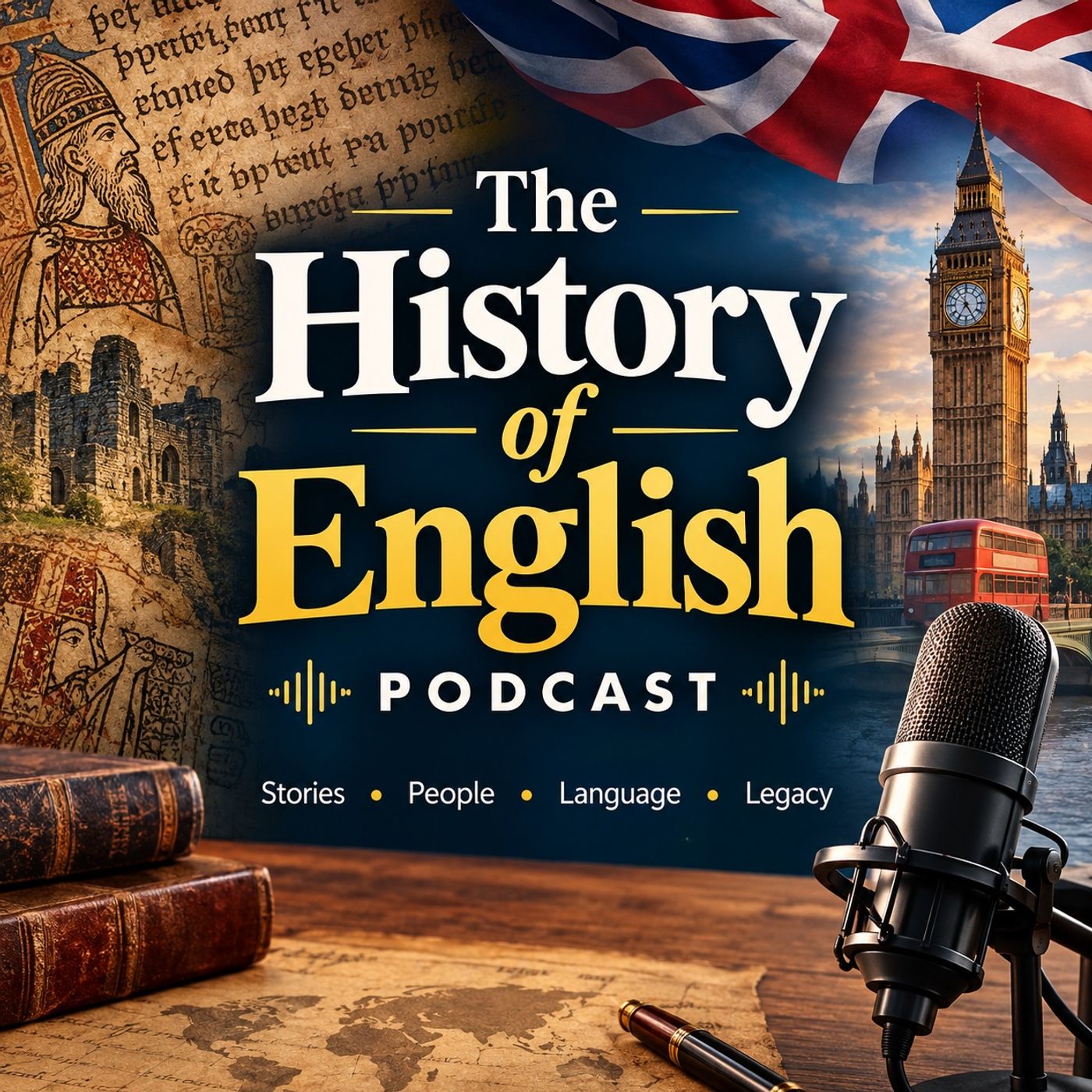
The History of English Podcast
Thomas JohnsonAudio
- Format:
- Podcast
- New episodes:
- Several times a week
- Typical length:
- about 50 minutes
- Latest episode:
About this show
Exploring forgotten stories, ancient civilizations, legendary figures, mysterious events, wars, empires, and the untold moments that shaped history.
Become a supporter of this podcast: https://www.spreaker.com/podcast/the-history-of-english-podcast--7438549/support (https://www.spreaker.com/podcast/the-history-of-english-podcast--7438549/support?utm_source=rss&utm_medium=rss&utm_campaign=rss).
Covers: history, language history, old English, anglo-saxon england, etymology, English spelling, Latin loanwords, medieval literature
Show details and episodes come from the publisher's public feed at spreaker.com. Last updated . Names, artwork and text belong to their publishers.
Recently on this show
Summary of recent episodes, drawn from the publisher's feed.
This podcast explores the history of the English language, from its Anglo-Saxon roots onward. Recent episodes cover how Old English created new words through compounds, prefixes and suffixes, how Latin words entered the language through monastic schools, and how the first English alphabet was developed.
Cosmos
Similar in subject
- Arroe Collins Something Our Parents Would Say
Both cover: language history, etymology - Words Unravelled with RobWords and Jess Zafarris
Both cover: language history, etymology - Ridiculous History
Both cover: etymology, history
Similar shows




Explore more
Episodes
Titanic — The Night History Changed
· 6 min
🎙️ The History Chronicles Podcast | Titanic: The Night History ChangedStep back into 1912 and discover the story of the RMS Titanic—one of the most famous maritime tragedies in history.In this episode, we explore Titanic’s historic first voyage, the warnings of ice in the Atlantic, the events of that unforgettable night, and the lessons the disaster left behind.From human ambition and technological confidence to courage, loss, and major changes in maritime safety, this episode explores the story behind the headlines and the people who experienced it.🎧 Listen now and discover the history behind one of the world’s most unforgettable stories.#TheHistoryChronicles #HistoryPodcast #Titanic #History #HistoricalStories #Podcast #RMS Titanic Become a supporter of this podcast: https://www.spreaker.com/podcast/the-history-of-english-podcast--7438549/support (https://www.spreaker.com/podcast/the-history-of-english-podcast--7438549/support?utm_source=rss&utm_medium=rss&utm_campaign=rss).
Not rated yetThe Day Pompeii Disappeared
· 4 min
What if an entire city vanished in a single day?In this episode of The History Chronicles Podcast, we travel back nearly 2,000 years to ancient Pompeii, a thriving Roman city that was suddenly destroyed by the catastrophic eruption of Mount Vesuvius in 79 AD.Discover what life was like in Pompeii, how the eruption unfolded, and how the buried city remained hidden for centuries before archaeologists uncovered its incredible secrets.From ancient streets and homes to the final moments of ordinary people, this episode explores the human story behind one of history's most fascinating archaeological discoveries.🎙️ The History Chronicles Podcast Where forgotten stories, ancient civilizations, mysteries, and extraordinary moments from history come back to life.Listen. Discover. Remember History.#TheHistoryChronicles #HistoryPodcast #Pompeii #AncientHistory #MountVesuvius #RomanHistory #History #HistoricalStories #AncientCivilizations #HistoryDocumentary Become a supporter of this podcast: https://www.spreaker.com/podcast/the-history-of-english-podcast--7438549/support (https://www.spreaker.com/podcast/the-history-of-english-podcast--7438549/support?utm_source=rss&utm_medium=rss&utm_campaign=rss).
Not rated yetThe Rise of the Pharaohs: Power, Religion, and Ancient Egypt
· 5 min
The History Chronicles Podcast — Episode 2 Title: The Rise of the Pharaohs: Power, Religion, and Ancient Egypt Welcome to The History Chronicles Podcast. In our first episode, we traveled back to the beginning of Ancient Egypt and discovered how the Nile River helped small farming communities grow into a powerful kingdom. Today, we continue that journey by exploring one of the most fascinating figures in Egyptian history: the pharaoh. For thousands of years, the pharaoh stood at the center of Egyptian society. But what exactly was a pharaoh? To understand the pharaoh, we need to understand how deeply religion was connected to everyday life in Ancient Egypt. The ancient Egyptians believed that the universe depended on balance and order. They called this principle Ma'at. Ma'at represented truth, justice, harmony, and order. The pharaoh was believed to have a special responsibility to maintain this balance. He was not simply a political leader. He was also a religious figure. The Egyptians believed that the pharaoh had a special connection with the gods and could help maintain harmony between the human world and the divine world. This belief gave the pharaoh enormous authority. But ruling a kingdom as large as Egypt required more than religious power. The pharaoh needed an organized government. Officials were appointed to manage different regions. Tax collectors gathered resources from farmers and communities. Scribes recorded information. Military leaders protected Egypt's borders. And thousands of workers helped build roads, monuments, temples, tombs, and other important structures. At the center of this system was the royal palace. The pharaoh's court was filled with officials, advisors, servants, and administrators. The kingdom depended on this complicated network of people. Most Egyptians, however, lived very different lives from the royal family. Farmers made up a large part of the population. Their lives followed the rhythm of the Nile. When the river flooded, farmers prepared their fields. When the water disappeared, they planted crops in the fertile soil. Harvesting was one of the most important periods of the year. The food produced by farmers supported the entire kingdom. Without agriculture, the temples could not function, the armies could not march, and the cities could not survive. But Egyptian society was not made up only of farmers. There were skilled craftsmen who produced pottery, jewelry, furniture, weapons, clothing, and tools. There were builders and stone workers who created enormous monuments. There were merchants who traded goods with neighboring regions. And there were scribes. Scribes were especially important because writing allowed the government to record taxes, trade, laws, religious texts, and other information. Learning to write was difficult, so scribes held an important position in society. Religion was also everywhere. The Egyptians worshipped many gods. Ra was associated with the sun. Osiris was connected with death and the afterlife. Isis was associated with motherhood and magic. Horus was connected with kingship and protection. Different gods became important in different periods and regions. Temples were built as sacred places where priests performed rituals and made offerings. The Egyptians believed that the gods could influence the natural world. They also believed that life continued after death. This belief would have a tremendous influence on Egyptian culture. The Egyptians spent enormous effort preparing for the afterlife. Important people were buried with objects they might need in the next world. Food, jewelry, furniture, weapons, and other possessions could be placed inside tombs. Over time, Egyptian rulers began constructing increasingly impressive tombs. These monuments were designed to protect the bodies of the dead and honor their memory. Eventually, this tradition would lead to the construction of the great pyramids. But the pyramids were not built simply because Egyptian…
Not rated yetThe Birth of Ancient Egypt: How a Civilization Began
· 4 min
In this first episode of The History Chronicles, we travel thousands of years into the past to discover how Ancient Egypt began. Explore the importance of the Nile River, the rise of early farming communities, the unification of Upper and Lower Egypt, and the emergence of the pharaohs. Discover how a civilization born along a river became one of the most influential cultures in human history. Become a supporter of this podcast: https://www.spreaker.com/podcast/the-history-of-english-podcast--7438549/support (https://www.spreaker.com/podcast/the-history-of-english-podcast--7438549/support?utm_source=rss&utm_medium=rss&utm_campaign=rss). This episode includes AI-generated content.
Not rated yet