

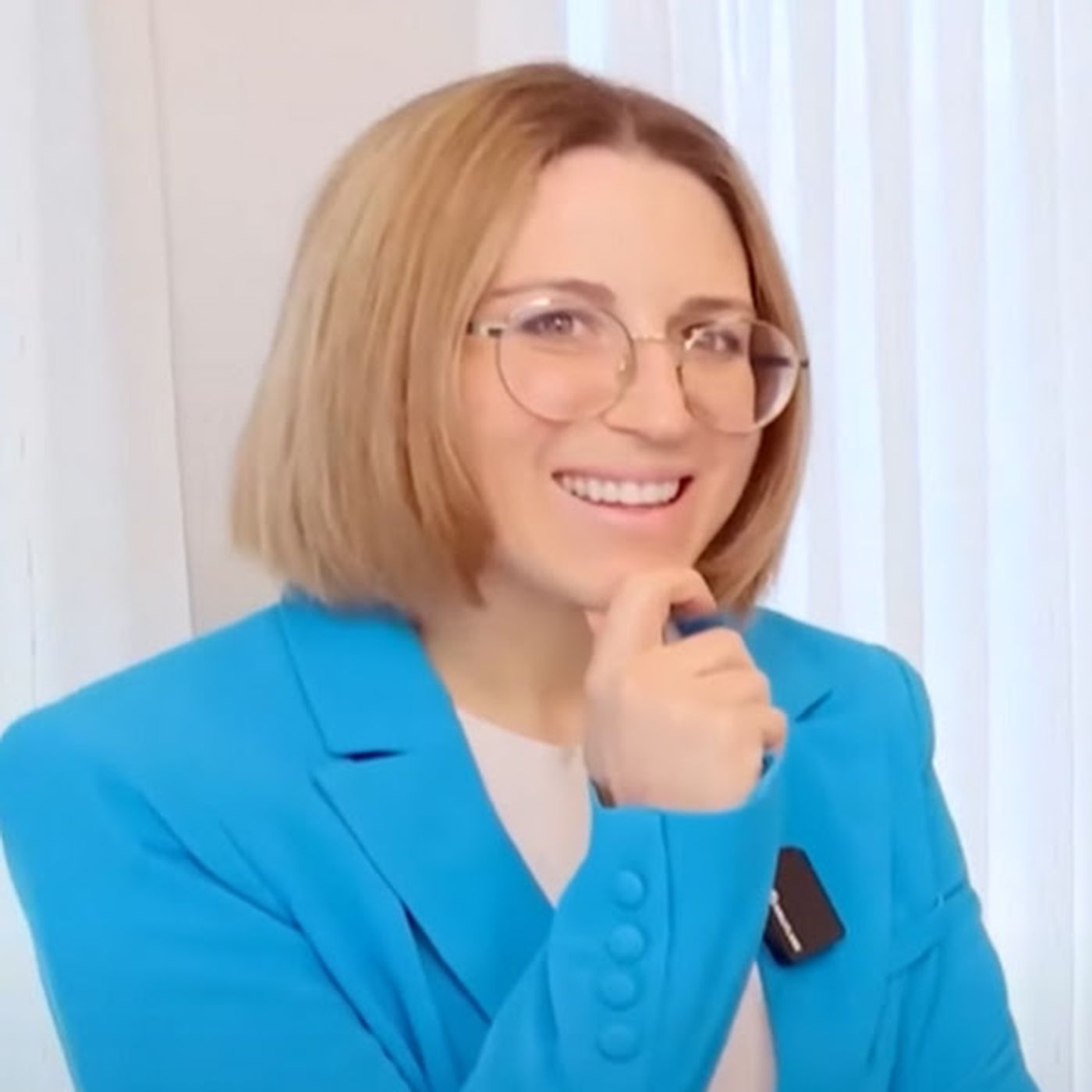
The Frieda Vizel Podcast
Frieda VizelAudio
- Format:
- Podcast
- New episodes:
- Weekly
- Typical length:
- about 50 minutes
- Latest episode:
About this show
Welcome to in-depth conversations on Hasidism, Judaism, NYC, culture, education, religion and more!
This podcast is hosted by popular Youtuber Frieda Vizel, who has been studying the Hasidic community for more than ten years.
This is the podcast version of the video conversations which are also published on Youtube. Please reach out with feedback.
Here's the youtube channel (https://www.youtube.com/@FriedaVizelBrooklyn) if you prefer to see the host and guests! :)
Become a supporter of this podcast: https://www.spreaker.com/podcast/the-frieda-vizel-podcast--5824414/support (https://www.spreaker.com/podcast/the-frieda-vizel-podcast--5824414/support?utm_source=rss&utm_medium=rss&utm_campaign=rss).
Covers: judaism, hasidic judaism, religion, satmar hasidim, jewish community life, orthodox judaism, new york city, religious leadership, personal testimony, health care
Show details and episodes come from the publisher's public feed at spreaker.com. Last updated . Names, artwork and text belong to their publishers.
Recently on this show
Summary of recent episodes, drawn from the publisher's feed.
This podcast holds in-depth conversations about Hasidic Judaism, religion, culture and education. Host Frieda Vizel has studied the Hasidic community for over ten years. Recent episodes cover Satmar school life, a postwar childhood in Hungary, filmmaking for Orthodox women, and the dispute over Satmar leadership.
Cosmos
Similar in subject
- Central Synagogue Podcast
Both cover: religious leadership, judaism - PragerU
Both cover: judaism, religion - The Atlantic Group
Both cover: personal testimony, new york city
Similar shows




Explore more
Episodes
Baily prepares for Passover [comedian Leah Forster]
· 45 min
video link to this episode: https://youtu.be/XLDwhIRumwU This is comedy. Baily is the character of the famous Jewish comedian Leah Forster. I love Baily. She is very kind to me and will help me find a husband soon. She also very willingly shares about her Hasidic life. She's now extremely busy preparing for passover. Hasidic Jews go all out cleaning, cooking, shopping for Passover. To make things easier, Baily went glutton free for a whole year. She has a lot of ideas of how to cut corners and make things easier while she juggles her busy household. She also has very particular ideas about what marriage should be about, and her approach to Passover is not conventional either. All of this is comedy. For a more serious take on Passover, I have done a video where I reflect on my Passover memories. Check that out here: https://youtu.be/S3c7Px2jMRo For more from Baily, see my 3 other interviews with Leah Forster here: https://www.youtube.com/playlist?list=PLhW2QoO54ycwOheypSNe9u6-MgzdEXO2A Become a supporter of this podcast: https://www.spreaker.com/podcast/the-frieda-vizel-podcast--5824414/support (https://www.spreaker.com/podcast/the-frieda-vizel-podcast--5824414/support?utm_source=rss&utm_medium=rss&utm_campaign=rss).
Not rated yet"My experience as a Pediatric Pulminologist with the Hasidic population" | Dr. Lynne Quittel
· 1 hr 15 min
Link to video version of this episode: https://youtu.be/kP_NgV7y_Cs What happens when modern medicine meets a tight-knit Hasidic world? In this long-form conversation, Frieda Vizel speaks with Dr. Lynne Quittell, a pediatric pulmonologist with more than 40 years of experience and decades of close work with Orthodox and Hasidic Jewish families. Dr. Quittell has practiced at world-renowned institutions, including Children’s Hospital of New York and Columbia University Irving Medical Center, and brings rare insight into how medical care unfolds inside insular religious communities. Much of the discussion centers on Dr. Quittell’s experience treating Hasidic patients and navigating the cultural realities that shape medical decisions. She reflects on what she deeply appreciated about the community, including its extraordinary sense of responsibility, mutual aid, and care for vulnerable children. At the same time, she speaks honestly about the challenges: stigma around genetic disease, tensions between medical transparency and communal norms, and the frustrations physicians face when science collides with deeply held cultural expectations. Dr. Quittell emphasizes that effective care requires humility, cultural literacy, and respect for patient autonomy rather than coercion. The conversation covers cystic fibrosis (CF), Dr. Quittell’s medical specialty and an area where she has seen enormous change over the course of her career. She explains how advances in treatment have dramatically improved life expectancy and quality of life for patients, while also exploring the social and emotional dimensions of living with CF. Particular attention is given to dating, marriage, fertility, and family planning, especially within Orthodox communities where childbearing is central to adult life. Dr. Quittell discusses the reality that most men with CF are infertile, the complexities surrounding IVF, and the heavy emotional burden young people carry when deciding whether and how to disclose a life-threatening illness. Throughout the interview, Dr. Quittell reflects on long-term relationships with patients and families, some spanning decades, and the emotional weight of caring for children with chronic illness. She shares how community support often functions as a form of medicine itself, while also acknowledging the toll such work takes on physicians. The discussion concludes with reflections on end-of-life decision-making, evolving physician-patient dynamics, and the ethical responsibility to meet patients where they are. Referenced in this interview: Dr. Bat Sheva Marcus on end-of-life decision-making https://www.instagram.com/reel/DTfxxSyDfzc/?utm_source=ig_web_button_share_sheet&igsh=MzRlODBiNWFlZA== Interview with pediatrician Dr. Howard Rosman https://youtu.be/TkUS0jzJci4?si=5DYx-4FTzSCBeXyP Sound Bites: “Community is its own medicine.” “Most men with CF are infertile.” “It taught me to be really accepting.” Keywords: Hasidic community, Orthodox Judaism, pediatric pulmonology, cystic fibrosis, genetic disease, cultural sensitivity, chronic illness, infertility, IVF, medical ethics, community support, physician-patient relationship Notable takeaways: -Cultural norms heavily influence medical decisions -The Hasidic community often provides extraordinary support for vulnerable children -Life expectancy for CF patients is now in the mid-50s -Dating and disclosure are major challenges for people living with CF -Long-term physician-patient relationships create deep emotional bonds Follow Frieda Vizel: Instagram: https://www.instagram.com/friedavizel Twitter/X: https://twitter.com/FriedaVizel Website: friedavizel.com An audio-only version of this interview is available on podcast platforms. Become a supporter of this podcast: https://www.spreaker.com/podcast/the-frieda-vizel-podcast--5824414/support (https://www.spreaker.com/podcast/the-frieda-vizel-podcast--5824414/support?utm_source=rss&utm_medium=rss&utm_campaign=rss).
Not rated yetFrom the hospital bedside
· 34 min
Video link to this episode: https://youtu.be/Biqnh3CZIFo I have so many thoughts and feelings about illness and being ex-Hasidic. About losing community support, about how my mother is fighting for her health, about returning to be at her bedside and wanting to be there but also fearing the ptsd of some rituals. This video cropped out of my high holiday season time spent with my mother. Many thanks to my editor Steve Milligan for the beautiful edit.https://www.instagram.com/shootitsteve/ Many thanks to the wonderful Youtuber Yiddishkeit for helping so much with this video. Follow him @_yiddishkeit (https://studio.youtube.com/channel/UCzLvmCdFKJNkhdGhpkyJ_VA) Thanks to all the kind and diligent medical professionals Thanks to Chesed 24/7, Satmar Bikur Cholim, and all the other wonderful Jewish charity organizations. Thanks to my family, for arranging everything and the love The period that my mother was in the hospital was the most unbelievably surreal and draining. It felt like one long, terrifying dream. I'm so grateful to everyone whose kindness touched us during that time. Become a supporter of this podcast: https://www.spreaker.com/podcast/the-frieda-vizel-podcast--5824414/support (https://www.spreaker.com/podcast/the-frieda-vizel-podcast--5824414/support?utm_source=rss&utm_medium=rss&utm_campaign=rss).
Not rated yetJust a messenger? A Jewish interpreter at international organizations
· 30 min
Video link to this conversation: https://youtu.be/n8g9RwmGwF8 Dan is a Jewish interpreter who immigrated from the Soviet Union. He believes his Soviet past taught him important lessons about recognizing when society takes a wrong turn. He reached out to me to share his story, and I invited him for an in-depth interview. We discussed his Soviet upbringing, his life journey, and his experiences as a Jewish interpreter. Dan has thoughtful criticisms of contemporary human rights organizations (alongside genuine appreciation for their work) and feels it's important to share his unique perspective. If you would like to get in touch with Dan, you can reach him here: pr.pleischner@gmail.com This video focuses specifically on our discussion about Dan's work as a Jewish interpreter. You can watch our complete interview here: From a Soviet upbringing to Jewish identity | Dan’s story https://youtu.be/Nmw9jZM2aYU Become a supporter of this podcast: https://www.spreaker.com/podcast/the-frieda-vizel-podcast--5824414/support (https://www.spreaker.com/podcast/the-frieda-vizel-podcast--5824414/support?utm_source=rss&utm_medium=rss&utm_campaign=rss).
Not rated yetFrom a Soviet upbringing to Jewish identity | Dan’s story
· 1 hr 52 min
Video link to this episode: https://youtu.be/Nmw9jZM2aYU The story of a Jew who grew up in the Soviet Union and learned little about his Judaism but some other hard lessons that would shape his life. Dan is a high-level interpreter and a thoughtful, intelligent man. He reached out to me after noticing how different his experience as a Soviet Jew was from mine. I grew up deeply engaged with my Jewishness, while he grew up almost entirely disconnected from it. Our conversation convinced me that Dan's story needed to be documented and shared, so I invited him onto my podcast. What I heard was remarkable: the horrors his family endured, the gripping archival material he inherited documenting his grandparents' ordeals, and his unique perspective from working inside contemporary human rights organizations and other governmental bodies. Dan believes the progressive mission, which he sees as well-intentioned, is nonetheless misguided and heading toward dangerous territory. He also reflects candidly on the antisemitism he's encountered in his work as a translator in a world increasingly hostile to Israel. If you would like to get in touch with Dan, you can write to him at: pr.pleischner@gmail.com Want more on Soviet Jewry? My interview with Anna Shternshis https://youtu.be/hKN0_75EuqE My interview with Igor Golyak https://youtu.be/E5_n3p3Oto0 Leave a comment with your thoughts! Become a supporter of this podcast: https://www.spreaker.com/podcast/the-frieda-vizel-podcast--5824414/support (https://www.spreaker.com/podcast/the-frieda-vizel-podcast--5824414/support?utm_source=rss&utm_medium=rss&utm_campaign=rss).
Not rated yetMayor Mamdani and the Jews | Jacob Kornbluh
· 53 min
Video link to this episode: https://youtu.be/4MPf67ftXME Jacob Kornbluh is a Hasidic reporter covering the Mamdani beat at a moment when Zohran Mamdani has become a lightning rod in Jewish communities. For many, Mamdani represents fear, anger, political anxiety, and deep uncertainty about where New York is headed. And in the middle of that storm is Kornbluh. Recently featured in The New York Times, Kornbluh occupies a complicated position. He reports on power while belonging to a community that often feels scrutinized by power. During COVID, some Hasidic critics accused him of “reporting on” the community to city officials. That tension hasn’t disappeared. If anything, it’s intensified. I went into this interview not knowing what to expect. As a Hasidic man speaking with me, and about issues that feel raw and personal. This conversation surprised me and left me with an invite to travel across the world to a wedding. You never know! You can follow Jacob Kornbluh here: 📰 Reporter at The Forward https://forward.com/author/jacob-kornbluh/ 🐦 Twitter / X https://twitter.com/jacobkornbluh 🗞 His recent feature in The New York Times https://www.nytimes.com/2026/02/01/nyregion/jacob-kornbluh-mamdani-hasidic-jewish-reporter.html?unlocked_article_code=1.I1A.Lkpv.51t0435BwIlj&smid=url-share As always, I’m curious what you think. Please leave a comment! Frieda. Become a supporter of this podcast: https://www.spreaker.com/podcast/the-frieda-vizel-podcast--5824414/support (https://www.spreaker.com/podcast/the-frieda-vizel-podcast--5824414/support?utm_source=rss&utm_medium=rss&utm_campaign=rss).
Not rated yetThe beloved bubby answers your questions | Pearl from Williamsburg
· 1 hr 14 min
Video link to this full Pearl repost: https://youtu.be/Uo5mf0_1izY Become a supporter of this podcast: https://www.spreaker.com/podcast/the-frieda-vizel-podcast--5824414/support (https://www.spreaker.com/podcast/the-frieda-vizel-podcast--5824414/support?utm_source=rss&utm_medium=rss&utm_campaign=rss).
Not rated yetLiving and leaving Jehova's Witness | Miriam Vidal
· 1 hr 4 min
Link to video version of this conversation: https://youtu.be/2iPiYwftPyg In this interview, I speak with Miriam Vidal about her childhood growing up as a Jehovah’s Witness, and her eventual decision to leave the faith. As a Hasidic child growing up in Kiryas Joel, there was a strange building behind my house that we simply called “the church.” Every Saturday, rows of cars would pull up, and we kids would stand by the gate, watching and waving. Only years later, after I had left my own religious community, did I learn that this building was actually a Jehovah’s Witness Kingdom Hall. Miriam was one of the people attending services there. In this conversation, Miriam shares what it was like to grow up inside the Jehovah’s Witness community: the rules, the rhythms of daily life, the sense of belonging, and the limitations placed on childhood, education, and social life. We talk about her memories of the Kingdom Hall in Kiryas Joel, the wider culture of Jehovah’s Witnesses, and what it meant; emotionally and psychologicall... to leave such a structured religious world. This interview is also about what comes after leaving: identity, belief, grief, freedom, and the slow work of figuring out who you are when the framework you grew up in falls away. As someone deeply interested in religious subcultures, exit narratives, and the sociology of faith, this conversation felt especially meaningful.... almost like closing a loop that began when I was a child in my Shabbos dress, waving at strangers I didn’t yet understand. Topics we cover include: -Growing up as a Jehovah’s Witness -Family life, schooling, holidays, and missionizing -The Kingdom Hall in Kiryas Joel and Miriam’s memories of it -Community, ritual, and belonging -Leaving a high-control religious environment -The emotional and psychological impact of exiting -Spiritual life and identity after leaving -Reflections on religion, culture, and comparison with other faith communities Want more? Watch my video about the Jehovah's Witness Church in Kiryas Joel https://youtu.be/naUJMITJ5sY Watch my interview with Martha Ross, who left the Amish: https://youtu.be/teadpfXWCO4 My own recounting of what it's like to grow up in Kiryas Joel https://youtu.be/uHu_17N9GdE The story of Anna Shternshis: https://youtu.be/hKN0_75EuqE Stay tuned for more stories of subcultures and religious groups. Become a supporter of this podcast: https://www.spreaker.com/podcast/the-frieda-vizel-podcast--5824414/support (https://www.spreaker.com/podcast/the-frieda-vizel-podcast--5824414/support?utm_source=rss&utm_medium=rss&utm_campaign=rss).
Not rated yetReading your comments and more stories, kinderlech #3
· 37 min
Video version: https://youtu.be/MyGxlBywfAc Become a supporter of this podcast: https://www.spreaker.com/podcast/the-frieda-vizel-podcast--5824414/support (https://www.spreaker.com/podcast/the-frieda-vizel-podcast--5824414/support?utm_source=rss&utm_medium=rss&utm_campaign=rss).
Not rated yetSurviving the Bondi Beach terror attack | Rabbi Yosef Eichenblatt
· 56 min
Video link to this episode: https://youtu.be/css7bPGITTE This video is le’ilui nishmas (dedicated to the souls) of the dear people lost at Bondi Beach, and dedicated to their loving families in mourning. May the families find moments of light in these unbearably hard days. My heart is with them. In this conversation, I speak with Sydney resident Rabbi Yosef Eichenblatt, who shares his oral history of the Chanukah 2025 attack in Sydney, an event his family lived through and one in which his daughter’s life was miraculously saved. Rabbi Eichenblatt speaks not only about fear and shock, but about what came after. He recalls the night following the attack, sitting at home with his family, shaken and uncertain, and consciously turning toward faith rather than retreat. Drawing deeply on the teachings of the Lubavitcher Rebbe, he describes an approach rooted in responsibility, hope, and the idea of being a messenger to spread light, especially after darkness. This is a testimony shaped by loss and danger, but also by profound optimism, a belief that light is not passive and that faith asks something active of us, even in the most fragile moments. Rabbi Yosef Eichenblatt on Instagram: https://www.instagram.com/mindfulrabbi/ Video from the day of the attack: https://www.instagram.com/reel/DSR06KeEg2i/ Become a supporter of this podcast: https://www.spreaker.com/podcast/the-frieda-vizel-podcast--5824414/support (https://www.spreaker.com/podcast/the-frieda-vizel-podcast--5824414/support?utm_source=rss&utm_medium=rss&utm_campaign=rss).
Not rated yet