

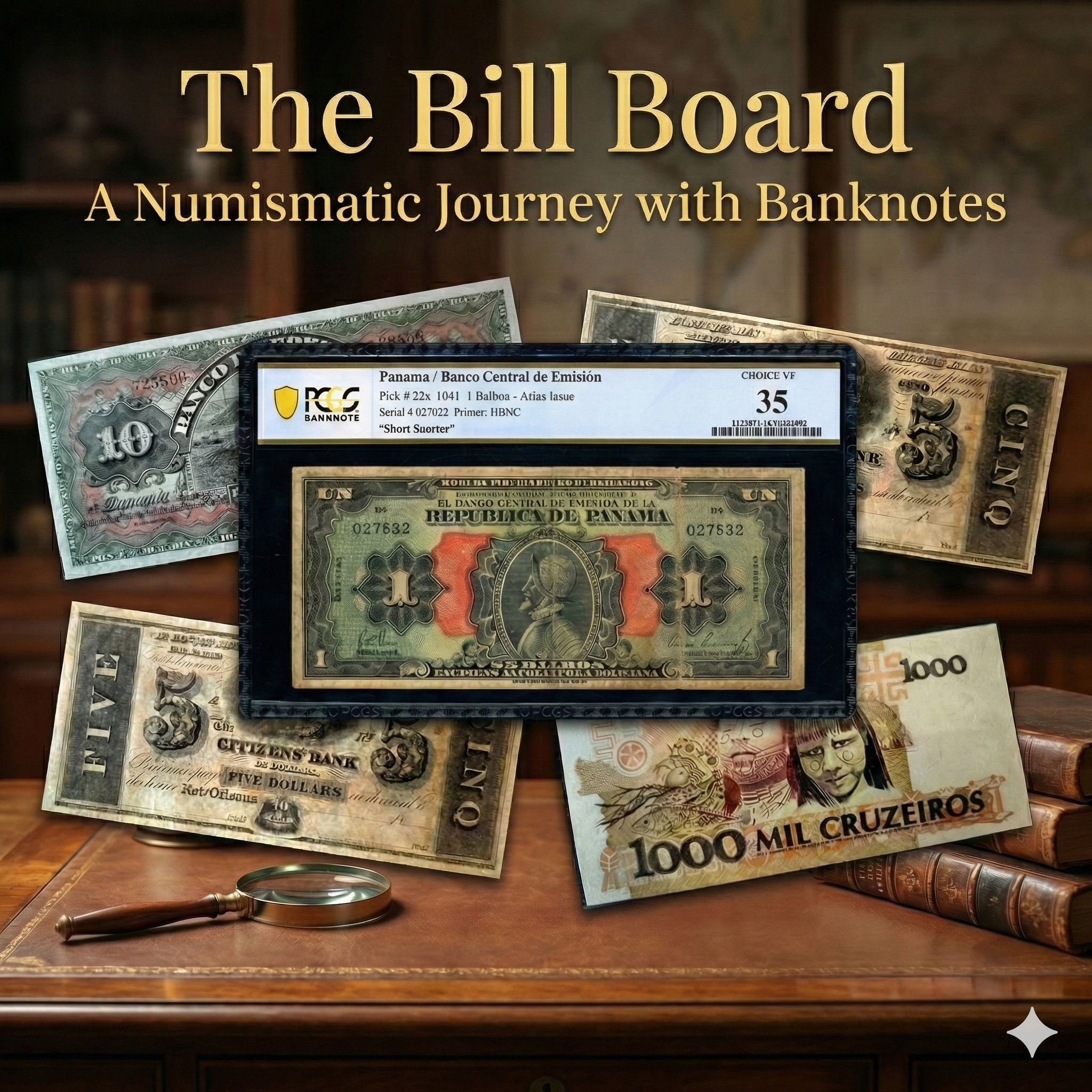
The Bill Board, a Numismatic Journey with Banknotes
Tim BakerAudio
- Format:
- Podcast
- New episodes:
- Daily
- Typical length:
- about 25 minutes
- Latest episode:
About this show
We will explore a wide number of topics, all dealing with banknotes. For individual banknotes, we will explore the history around the issuance of the banknote, including the series it belongs to, the images on the obverse and reverse, and their history, social, and numismatic implications. We will review all the key numismatic information, including the security details, the composition, serial and other identification numbers, and the latest market information. The goal is to appreciate what each banknote means and represents, not just the collecting value.
Covers: numismatics, world history, banknote collecting, Mexican revolution, brazilian economy, Chinese banking, banking history, currency reform, philippine history
Show details and episodes come from the publisher's public feed at media.rss.com. Last updated . Names, artwork and text belong to their publishers.
Recently on this show
Summary of recent episodes, drawn from the publisher's feed.
The Bill Board is a podcast by Tim Baker about individual banknotes, covering their history, designs, security features and identifying details. Recent episodes cover a 1914 Mexican Coahuila 5 Pesos note, a Brazilian 1967–1970 overprint, and a 1944 Philippine Victory Series 1 Peso.
Cosmos
Similar in subject
- World History Encyclopedia
Both cover: numismatics, world history - The British Museum
Both cover: numismatics, world history
Similar shows







Explore more
Episodes
Mexico: The Power and the Money The Mexican Financial System 1876 to 1932
· 55 min
The Power and the Money The Mexican Financial System 1876 to 1932 Edited by Stephen Haber and David Brady David Brady and Mathew D. McCubbins, Party, Process, and Political Change in Congress Jeffrey Bortz and Stephen Haber, The Mexican Economy, 1870-1930 Edward Beatty, Institutions and Investment Jeremy Baskes, Indians, Merchants, and Markets
Not rated yetMexico: El Banco Mercantil de Yucatán 10 Pesos (1904) Banknote Report
· 16 min
The State of Yucatan was distinct in the Mexican republic due to its immense concentrated wealth, making it one of the few regions capable of supporting multiple banks of issue simultaneously. The banking landscape was dominated by two primary, competing institutions: El Banco Yucateco and El Banco Mercantil de Yucatán. El Banco Mercantil de Yucatán was established by a coalition of traditional Yucatecan businessmen and landowners. The financial backbone of this institution was the powerful regional trading house, Eusebio Escalante é Hijo. The founding board of directors was headed by Eulogio Duarte and included prominent regional figures such as Eusebio Escalante Bates, Rafael Otero Dondé, Raimundo Cámara Luján, and Joaquín Peón. Eulogio Duarte secured the official government concession to establish the bank in the state capital of Mérida on September 18, 1889, and the institution opened its doors for business on March 4, 1890. The bank experienced rapid growth mirroring the broader henequen economy. Its original capitalization was set at $750,000 pesos. As operations expanded, this capital was officially increased to $1,000,000 on April 1, 1893, and further expanded to $1,750,000 on December 15, 1899. Following the implementation of Limantour's 1897 banking reforms, El Banco Mercantil de Yucatán successfully secured a new contract on September 18, 1897, allowing it to continue its highly profitable role as a bank of issue under the new federal guidelines.
Not rated yetMexico: A Discussion of the Banking Reform of 1908
· 26 min
Resena de la Reforma Bancaria de 1908 Toribio Esquival Obregon y Joaquin de Monica Blanco
Not rated yetMexico: José Yves Limantour and the Banking Dispute over Monetary Circulation (1897-1908) by Iliana Zárate
· 48 min
Jose Yves Limantour y la Disputa Bancaria por la Circulacion Monetaria (1897-1908) Iliana Zarate - José Yves Limantour: Served as Mexico's Secretary of Finance from 1893 to 1911 during the Porfiriato. - Disputa Bancaria (Banking Dispute): Refers to the regulatory conflicts between the federal government and state banks over the right to issue banknotes, culminating in the 1905 monetary reform that established the gold standard in Mexico.
Not rated yetThe History of the American Banknote Company by William Griffiths
· 1 hr 15 min
The book has illustrations, better source, I wanted to take a listen before I dive in
Not rated yetMexico: República Mexicana Gobierno Constitutionalista 50 Pesos "Infalsificable" Banknote (1915)
· 30 min
The 50 Pesos banknote of the Gobierno Constitucionalista, authorized under the decree of July 21, 1915, emerged as a direct result of Venustiano Carranza's consolidation of power during the Mexican Revolution1. Carranza's return to Mexico City and his establishment of a unified government were made possible by a series of decisive military victories engineered by General Álvaro Obregón. In the spring and summer of 1915, Obregón's Constitutionalist forces decimated Pancho Villa's División del Norte in the Bajío region, triumphing in the massive Battles of Celaya (April 1915), the protracted Battle of León or Trinidad (where Obregón notably lost his right arm), and finally at Aguascalientes in July2. These victories effectively broke Villa's military supremacy, allowing Carranza's Constitutionalist army to march triumphantly into Mexico City in August 1915 Upon securing the capital, Carranza immediately moved to stabilize a shattered economy plagued by hyperinflation and a chaotic mix of regional fiat currencies. He declared all previously issued paper money from rival factions void and decreed the creation of a single, unified national currency—Los Infalsificables4. However, because these high-quality notes were contracted to the American Bank Note Company (ABNC) in New York, they would take time to print and deliver. Prior to their arrival, the government relied on an interim currency printed domestically at the Oficina Impresora (Government Printing Office), which included small-denomination cardboard cartones and Obligaciones Provisionales del Erario Federal (provisional treasury obligations). To underwrite the creation of the Infalsificables and theoretically guarantee their circulation, Carranza decreed the establishment of a Fondo Regulador (regulatory fund) on April 3, 19168. The following day, April 4, 1916, he published a decree creating the Comisión Monetaria (Monetary Commission) to manage this fund and orchestrate the transition6. The Comisión Monetaria was originally run by a prominent group of Carranza's allies: the Minister of Finance, Luis Cabrera; the General Treasurer of the Nation, Nicéforo Zambrano; and presidentially appointed members Alberto Pani, Ignacio Rivero, Carlos B. Zetina, and Carlos Basave. The commission's daily operations were managed by Eduardo del Raso and Francisco Puga. The first sets of activities undertaken by the Comisión Monetaria focused aggressively on arranging the monetary circulation following the chaos of the revolutionary issues. This monumental task involved exchanging and destroying obsolete currency, officially issuing (and later attempting to withdraw) the Infalsificables, and taking steps to reintroduce metallic gold and silver coins into everyday commerce. To stabilize the money supply and centralize financial power, they also helped the Ministry of Finance wind up private banks of issue, performing credit and banking activities through a newly created network of branches throughout Mexico. As part of the transition mandated by the July 21, 1915 decree, the government required the public to exchange the previously issued Constitutionalist banknotes—primarily the Ejército Constitucionalista and Gobierno Provisional de México (Veracruz) issues. These older notes were mandated to be deposited and exchanged for the newly arriving Infalsificables at a legally established rate of 10 to 1 (ten old pesos for one Infalsificable)9. Despite this highly organized monetary rollout, the Infalsificables ultimately succumbed to the same macroeconomic pressures of the era, depreciating rapidly shortly after entering active circulation.
Not rated yetMexico: Ejército Constitucionalista de México 10 Pesos Banknote (1914)
· 28 min
The issuance of the 1914 10 Pesos banknote by the Ejército Constitucionalista de México represents a critical intersection of military logistics, sovereign financial policy, and economic survival during the Mexican Revolution1. To fund a massive, multi-front armed rebellion capable of defeating the entrenched federal army, Carranza faced an insurmountable logistical challenge. Financing a war required vast amounts of capital to procure food, clothing, livestock, and most importantly, arms and ammunition from international suppliers across the United States border. Requisitioning these supplies directly from the civilian populace through force or confiscation was politically untenable, as such actions would incite severe social unrest and rapidly erode the public support required to sustain the revolution The legal framework validating the creation and forced circulation of this rebel currency was established through a sequence of specific military decrees. The initial legislative authorization occurred on April 26, 1913, when Carranza issued a decree in Piedras Negras, Coahuila. The text of this decree asserted that it was the civic duty of all Mexicans to contribute proportionally to the army's expenses until constitutional order was restored. To enforce this, the decree mandated that all inhabitants of the Republic were legally obligated to accept the Constitutionalist paper money as legal tender, at absolute face value, for all civil and commercial transactions. The decree further promised that once constitutional order was re-established, formal laws would be promulgated to guarantee the redemption of the issued notes2. As the war expanded, the initial capital injections proved insufficient. On December 28, 1913, operating from Hermosillo, Sonora, Carranza issued Decree No. 14, which authorized a second massive issuance of fifteen million pesos. This legislation was particularly notable because it explicitly prohibited the continued use of alternative local scrip (known locally as fichas, tarjetas, or vales), establishing severe punitive measures for any civilian or merchant who issued or utilized unauthorized localized currency. The specific legislation authorizing the banknote under review was Decree No. 18. Signed by Carranza on February 12, 1914, while he was stationed in Culiacán, Sinaloa, this decree expanded the money supply by an additional ten million pesos, bringing the total authorized Constitutionalist fiat currency to thirty million pesos2. The thought process behind the design and physical creation of this specific issue, which eventually became known to the public and numismatists as the "Aguilas Viejas" (Old Eagles) series, was driven by an urgent need for psychological legitimacy. The earliest emergency issues produced by the Constitutionalists (often referred to as the Monclova issue) were poorly printed on low-quality paper and were viewed with deep skepticism by a populace accustomed to the highly secure, beautifully engraved banknotes of the pre-war era2. The leadership recognized that an army could not survive on a currency that looked like a temporary voucher. They required a banknote that possessed a firm, professional appearance and utilized deeply ingrained patriotic motifs to project absolute stability, state authority, and institutional permanence
Not rated yetMexico: Comisión Reguladora del Mercado de Henequén 20 Pesos Banknote (1914)
· 34 min
The 20 Pesos banknote issued by the Comisión Reguladora del Mercado de Henequén, bearing the printed date of November 20, 1914, represents a profound intersection of agricultural economics, military logistics, and regional sovereignty during the Mexican Revolution (1910–1920). To understand the issuance of this fiat currency, one must examine the collapse of the centralized Mexican monetary system. Following the ouster of President Porfirio Díaz and the subsequent assassination of Francisco I. Madero, the nation devolved into a fractured landscape controlled by competing military warlords. The federal banking apparatus ceased to function effectively, and hard metallic currency (gold and silver coinage) vanished from circulation due to extreme hoarding by a panicked public, a classic manifestation of Gresham’s Law. Faced with a total absence of liquidity required to pay soldiers, maintain government operations, and facilitate basic daily commerce, state governors and military commanders across Mexico were forced to issue their own regional paper money. The state of Yucatán, however, operated under a distinctly different economic paradigm than the rest of the republic. Rather than attempting to back its paper currency with promises of future silver redemption from a depleted treasury, the Yucatán government anchored the perceived value of its currency to its primary agricultural monopoly: henequén. The agave plant, whose fibers were transformed into sisal twine, was a globally strategic commodity. The mechanical grain reapers utilized across the agricultural heartlands of the United States and Europe required massive, uninterrupted supplies of binder twine, rendering the Yucatán economy exceptionally lucrative and highly autonomous The specific legislative pathway authorizing the 20 Pesos denomination was volatile and shifted rapidly with the tides of war. Historical documentation indicates that Governor Eleuterio Ávila initially expanded the printing limits of the Comisión Reguladora in late 19142. On January 11, 1915, Ávila officially authorized the specific $20 denomination via Decree núm. 57. However, the physical release and forced circulation of the Series C and Series D print runs were orchestrated by a subsequent, rebellious acting governor, Abel Ortiz Argumedo. Facing an imminent invasion by the Constitutionalist forces of General Salvador Alvarado, Argumedo required vast, immediate capital to acquire munitions from the United States On February 26, 1915, Argumedo enacted Decree núm. 3, officially placing the previously printed Series C notes into immediate circulation. The underlying thought process for the release was strictly driven by wartime extortion. Argumedo coerced the local agent for the International Harvester Company, Avelino Montes, into extending a $500,000 USD line of credit in New York to purchase arms. In exchange, Argumedo directed the state treasury to reimburse Montes with $3,550,000 in the newly authorized Series C and D paper notes. Consequently, the 20 Pesos banknote transitioned from a planned economic instrument into a desperate mechanism of military finance.
Not rated yetMexico: Comisión Reguladora del Mercado de Henequén 100 Pesos Banknote (1915)
· 26 min
The 1915 100 Pesos banknote issued by the Comisión Reguladora del Mercado de Henequén serves as a significant historical artifact of the Mexican Revolution, representing an emergency monetary measure by the short-lived breakaway administration of Colonel Abel Ortiz Argumedo in Yucatán. Designed to fund local military resistance against the Constitutionalist forces, the note features a portrait of Miguel Hidalgo y Costilla on the obverse and the architectural facade of the Casa de Montejo on the reverse, symbolizing regional identity and political legitimacy. Because the subsequent administration of General Salvador Alvarado systematically demonetized and destroyed this currency upon reclaiming the state, the note—particularly in uncirculated condition—is considered an exceptionally rare and valuable numismatic rarity, prized by collectors for its historical provenance and unique role as a localized economic instrument during a period of national upheaval.
Not rated yetMexico: El Banco del Estado de Chihuahua 5 Pesos Banknote(1914)
· 29 min
This podcast provides a comprehensive analysis of the 1914 5 Pesos banknote issued by El Banco del Estado de Chihuahua, an institution established by General Pancho Villa to stabilize the regional economy during the Mexican Revolution. Although commissioned through the American Bank Note Company in New York to project fiscal legitimacy, the shifting military landscape meant the majority of these high-quality, intaglio-engraved notes remained in vaults, never reaching general circulation. Featuring an obverse vignette of a miner with a pneumatic drill and the Mexican National Arms on the reverse, these notes transitioned from revolutionary currency to a unique numismatic fixture, frequently appearing as "movie money" in Hollywood Westerns. Today, they are primarily categorized as remainders, often preserved in exceptional uncirculated condition for modern collectors.
Not rated yetMexico: A Comprehensive History of the Banco de Zacatecas by María Guadalupe Noriega Caldera
· 47 min
This academic work serves as a comprehensive doctoral dissertation that reconstructs the history of the Banco de Zacatecas between 1891 and 1916. The text investigates the transition from informal credit systems, dominated by the Church and merchant-lenders, to the establishment of a modern institutional banking framework under the Porfiriato regime. By utilizing a neoinstitutionalist approach, the author explores how legal reforms, specifically the 1897 Law of Institutions of Credit, shaped the bank’s organizational structure, its issuance of currency, and its administrative strategies. The study provides a meticulous analysis of the local elite and business networks that controlled the bank, highlighting their strategic decision-making and their influence on the regional economy. Beyond simple financial history, the research tracks the bank's trajectory through phases of expansion, diversification into public services, and its eventual seizure and closure during the Mexican Revolution. Ultimately, the work aims to bridge a historiographical gap by detailing how this regional institution operated as both a symbol of modernization and a tool for the consolidation of wealth and power in central Mexico.
Not rated yetMexico: El Banco de Zacatecas 5 Pesos Banknote
· 21 min
This podcast provides a comprehensive analysis of the El Banco de Zacatecas 5 Pesos banknote (Pick number P-S475r), detailing its historical context as an unissued remainder from a private bank operating during Mexico's Porfiriato era. It explores the institution's history, the economic and political climate surrounding its creation, and the subsequent impact of the Mexican Revolution on local banking. Furthermore, the report includes a technical and artistic examination of the banknote’s design—featuring Francisco García Salinas and the Cerro de la Bufa—as well as an evaluation of its security features, rarity, market valuation, and numismatic significance.
Not rated yetMexico: El Estado de Chihuahua 50 Pesos Dos Caritas Series (1914)
· 17 min
To fund his rapidly expanding military campaigns, purchase munitions from suppliers in the United States, and restore commercial functionality within the vast northern territories he controlled, Pancho Villa required a sovereign currency. Following the capture of Chihuahua City by the División del Norte in late 1913, the revolutionary government seized the assets, properties, and metallic reserves of the state's wealthy elite, utilizing these confiscated estates as the theoretical backing for a new fiat currency The initial paper money issued by Villa's administration was produced locally and colloquially known as sábanas (bedsheets) due to their unusually large dimensions. These early notes were poorly printed, highly susceptible to counterfeiting, and viewed with deep suspicion by the public. Recognizing that political legitimacy necessitated a secure and aesthetically professional monetary system, Villa's government sought the services of commercial lithographers in the United States. The legal framework authorizing this sophisticated new currency was established by the Military Decree of February 10, 19143. This authorization is explicitly proclaimed on the obverse of the 50 Pesos note, which states that the state will pay the bearer in cash in accordance with the military decree of that exact date. The resulting banknote series became famously known as the "Dos Caritas" (Two Little Faces), representing one of the most successful and widely circulated fiat currencies of the revolutionary era.
Not rated yetMexico: Gobierno Provisional de Mexico 2 Pesos Banknote (1916)
· 33 min
By late 1915, Venustiano Carranza's Constitutionalist faction had achieved military dominance over a majority of the republic. However, his government inherited an economy paralyzed by hyperinflation and a populace deeply distrustful of any paper currency. Recognizing that political legitimacy required monetary stability, the Carranza administration engineered a sweeping financial reform intended to unify the currency and restore public confidence. - First was the decree of July 21, 1915 setting forth the establishment of The Infalsificables (uncounterfeitables) series. - Second, to orchestrate this massive macroeconomic transition, Carranza issued a foundational monetary reform decree on April 3, 1916, which established the Comisión Monetaria (Monetary Commission) and set a 500 million peso limit for the new fiat currency system. The program legally dictated that these new banknotes would be released into the hands of the public starting May 1, 1916, and they entered massive circulation throughout May and June of that year. The primary objective of this rollout was to unify the chaotic, fragmented money supply by absorbing older, highly counterfeited provisional currencies—such as the massive 599 million peso Veracruz issue and the 25 million Ejército Constitucionalista issue—and replacing them with the new, highly secure American Bank Note Company (ABNC) prints. On July 24, 1916, Carranza decreed that older, deposited revolutionary issues would be exchanged for the new Infalsificables at a highly discounted rate of ten to one. To assist the poorer classes, the government also issued a circular on June 5, 1916, specifically authorizing local treasury offices to exchange older 20, 50, and 100 peso notes for Infalsificables at a rate of eight to one (up to a maximum of 100 pesos), while lower denomination old notes were exchanged at the standard ten to one ratio. The Role of the 1916 "Gobierno Provisional" Interim Notes (Pick S-711) This specific banknote was not an older currency that needed to be exchanged for the Infalsificables. Rather, it was an integral, parallel component of the exact same 1916 monetary stabilization program. The Carranza administration faced a severe logistical nightmare. While the ultimate plan was to supply the entire economy with the magnificent, steel-plate intaglio Infalsificables printed in New York, the physical delivery, accounting, and massive distribution of these notes took significant time. To satisfy the pressing, immediate demand for fractional currency needed to pay troops, federal goverment employess and maintain basic daily commerce on the mandated May 1, 1916 release date, the government authorized the domestic printing of these 1 and 2 Peso "Gobierno Provisional" notes, which is the subject banknote. These domestically printed interim notes carried the exact same legal weight and theoretical guarantee of 20 centavos of national gold per paper peso as the ABNC Infalsificables.
Not rated yetMexico: Early policies on non-neutrality of money and confidence for economic growth, Alberto J. Pani: Monetary multipliers in Mexico, 1925-1940
· 48 min
For those deeply interested in monetary policy,. The economic recovery of Mexico following the Great Depression was primarily driven by deliberate, expansionary internal policies spearheaded by Secretary of Finance Alberto J. Pani between 1932 and 1933. This analysis challenges the traditional historiographical view that recovery was a byproduct of the external sector (exports). Instead, it demonstrates that Pani’s recognition of the "non-neutrality of money"—the idea that monetary supply directly impacts the real economy—was the catalyst for growth. By reversing the deflationary "Plan Calles" of 1931, Pani implemented a series of legal and financial reforms that restored public confidence, expanded the money supply through silver coinage and bank rediscounts, and funded public spending through seigniorage without increasing debt or tax rates. The result was a dramatic shift from a 14.8% GDP contraction in 1932 to a 10.9% expansion in 1933. Central to this success was the restoration of "confidence," which allowed fiduciary currency to be accepted and bank deposits to increase, effectively raising the monetary multiplier during the critical recovery years.
Not rated yetMexico: Why Mexico's 1916 unfalsifiable banknote failed by Monica Gomez and Luis Anaya
· 36 min
A review of the paper written by Monica Gomez titled Why Mexico's 1916 unfalsifiable banknote failed by Monica Gomez and Luis Anaya (El Infalsificable y el fracaso de la estabilización monetaria en el carrancismo. México, 1916) In 1916, the Constitutionalist government of Venustiano Carranza attempted to resolve Mexico's monetary chaos through the introduction of a new paper currency known as the Infalsificable (Unfalsifiable). Intended to unify more than 20 disparate revolutionary issues and establish economic stability, the reform sought to move the country toward a mixed metallic-fiduciary regime. The program ultimately failed within six months due to a combination of technical design flaws, insufficient metallic reserves, and deep-seated social distrust. The government’s inability to maintain convertibility led to a rapid depreciation of nearly 90% by November 1916. Consequently, the Carranza administration was forced to abandon fiduciary experiments and return to a strictly metallic circulation by December 1916. This economic failure left a lasting negative imprint on Carranza’s historical image and significantly influenced the Mexican lexicon, associating the revolutionary leadership with financial speculation and "theft."
Not rated yetMexico: La Tresoria General del Estado de Oaxaco 5 Pesos (1916) Bonus History of Oaxaca
· 43 min
This has added content of the social, political and economic history of Oaxaca from 1850s to 1920s, as it is my first introduction to the state. The study of regional Mexican currency during the decade-long civil conflict of 1910 to 1920 provides an unparalleled lens through which to view the macroeconomic collapse and political fragmentation of a modernizing nation. Among the most historically significant numismatic issues of this era are those originating from the State of Oaxaca. In 1915, to insulate itself from the factional violence tearing through the republic, the Oaxacan government declared state sovereignty.1 This political maneuver necessitated immediate financial independence. The 5 Pesos banknote issued by the Tesorería General del Estado de Oaxaca serves as a prime example of emergency fiat currency. This monetary instrument functioned simultaneously as a medium of daily exchange, a mechanism for state-building, a tool for military funding, and a physical declaration of regional autonomy. This analytical report provides an examination of the 1916 Oaxaca 5 Pesos banknote, focusing specifically on the Series Z specimen dated February 28, 1916. The analysis synthesizes the historical context of its issuance, the political economy of the State of Oaxaca during the revolution, the technical and physical specifications of the series, the biographical contexts of its imagery, and a precise valuation based on current market metrics and third-party grading standards.
Not rated yetMexico: The Presidential Succession of 1910 by Franciso Madero
· 46 min
The 2012 publication by the Instituto Electoral y de Participación Ciudadana del Estado de Jalisco serves as both a historical preservation of Francisco I. Madero’s seminal work, The Presidential Succession of 1910, and a pedagogical tool for modern civic education. The text honors the legacy of Mexican democratic thinkers who challenged absolute power and militarism, arguing that their stoic defense of republican values laid the necessary groundwork for the country's current institutional legitimacy. Within the excerpts, Madero reflects on his own transition from an indifferent businessman to a revolutionary leader, fueled by a conviction that the Mexican people were ready for representative democracy and an end to the Porfirian dictatorship. Ultimately, the source frames the effective suffrage and no re-election movement as an ongoing moral obligation, emphasizing that public instruction and active citizenship are the primary defenses against despotism.
Not rated yetMexico: Banco Nacional de Mexico 5 Pesos Banknote (1910)
· 44 min
The 5 Pesos banknote issued by El Banco Nacional de México, dated March 1, 1910 (Pick number P-S257c), is a critical artifact of financial history that encapsulates the economic maturation, political centralization, and societal complexities of late 19th and early 20th-century Mexico. The issuance of this specific banknote was not an isolated event but rather the culmination of decades of legislative maneuvering designed to modernize a fractured and highly localized agrarian economy into a unified, capital-driven state capable of attracting foreign investment. The legal framework authorizing the creation and continued circulation of these banknotes was firmly rooted in the financial policies of the Porfiriato—the era of President Porfirio Díaz's rule. Prior to the late 19th century, Mexico suffered from a severe lack of standardized currency. Various states and private entities issued their own notes, leading to a chaotic system of exchange rates and widespread mistrust of paper money. To remedy this, the Mexican government, largely under the guidance of Finance Minister José Yves Limantour, sought to implement a cohesive national banking structure.1 This effort culminated in the General Institutions of Credit Law (Ley General de Instituciones de Crédito) of 1897. This sweeping legislation formalized the rules for banks of issue (bancos de emisión), requiring them to hold specific metallic reserves—usually gold and silver—to back their circulating notes.1 Under this model, the government permitted a plural issuance system where each state in the Republic was allowed at least one private banknote issuance bank.2 However, the law was structured to heavily favor established monopolies. While the 1897 law restricted most provincial and state banks to issuing notes with a minimum denomination of 5 pesos, El Banco Nacional de México was granted a highly lucrative and unique exemption allowing it to issue notes in denominations of 1 and 2 pesos.1 The thought process behind the design and creation of this series was deeply entwined with the desire to project an image of European-style stability and modernization. The Mexican banking elite contracted the American Bank Note Company (ABNC) of New York to design, engrave, and print the currency.3 The ABNC was the premier security printing firm of the era, known for its intricate geometric lathe work and high-quality intaglio printing. By utilizing the ABNC, the Mexican government and the directors of El Banco Nacional de México ensured that their currency would be visually imposing, practically difficult to counterfeit, and aesthetically aligned with the currencies of global superpowers. The decision to employ classical allegories and standardized portraiture was a deliberate ideological choice, reflecting the prevailing philosophy of Positivism embraced by the Díaz regime, which valued order, progress, and scientific rationalism.
Not rated yetBermuda: Bermuda Monetary Authority 5 Dollar Polymer Banknote (2024)
· 51 min
The Bermuda 5 Dollars banknote, formally introduced into circulation in the fall of 2024, represents a pivotal technological evolution for the territory's currency system. Operating under the legal framework of the Bermuda Monetary Authority Act 1969, the Bermuda Monetary Authority (BMA) retains the exclusive mandate to issue and redeem the island’s national currency. Under this legislative authorization, the BMA periodically updates the physical medium of exchange to ensure structural integrity and public confidence.4 The 2024 issuance is a direct exercise of this authority, shifting the physical currency from traditional cotton-paper substrates to modern SAFEGUARD® polymer. The decision to redesign and issue this specific banknote was driven by the BMA's strategic goal to modernize the island's cash infrastructure.3 Polymer banknotes are manufactured from a thin, flexible synthetic plastic, typically biaxially oriented polypropylene (BOPP).2 The primary reason for this transition was economic and practical: polymer notes are estimated to last up to two and a half times longer than their cotton counterparts because they are highly resistant to moisture, dirt, and mechanical tearing. The thought process behind the specific design was heavily influenced by a desire to maintain public familiarity while upgrading the underlying technology. To achieve this, the BMA launched the "Same look, Smarter design" campaign, explicitly communicating that while the notes would feel different and contain advanced security protocols, the vibrant color palettes and vertical reverse orientations of the beloved 2009 series would remain largely intact. The note subsequently garnered international acclaim, winning the International Bank Note Society’s (IBNS) “Bank Note of the Year Award” for 2024, as well as the Best New Banknote award at the High Security Printing (HSP) Latin America conference.
Not rated yet