
Suspicious Minds: AI and the Apocalypse
Agoric MediaAudio
- Format:
- Podcast
- New episodes:
- Weekly
- Typical length:
- about 1 hour
- Latest episode:
About this show
The Doomsday Clock is set to 85 seconds until midnight — the closest it has ever been in its 79-year history. The world is at war. And the people building the most powerful technology in human history are warning, in public, that it might kill us all.
Season One of Suspicious Minds examined what happens when AI fractures individual minds. Season Two asks a harder question: what happens when it shatters our collective sense of the future?
Our ancestors have predicted the end of the world since ancient times. Thus far, they have always been wrong. So what does our eternal obsession with the apocalypse reveal about the human mind?
This season is a meditation on life, death, and what it means to be alive in an age when humanity is creating something that those building it believe has the power to either end all life on Earth or turn our world into a utopia.
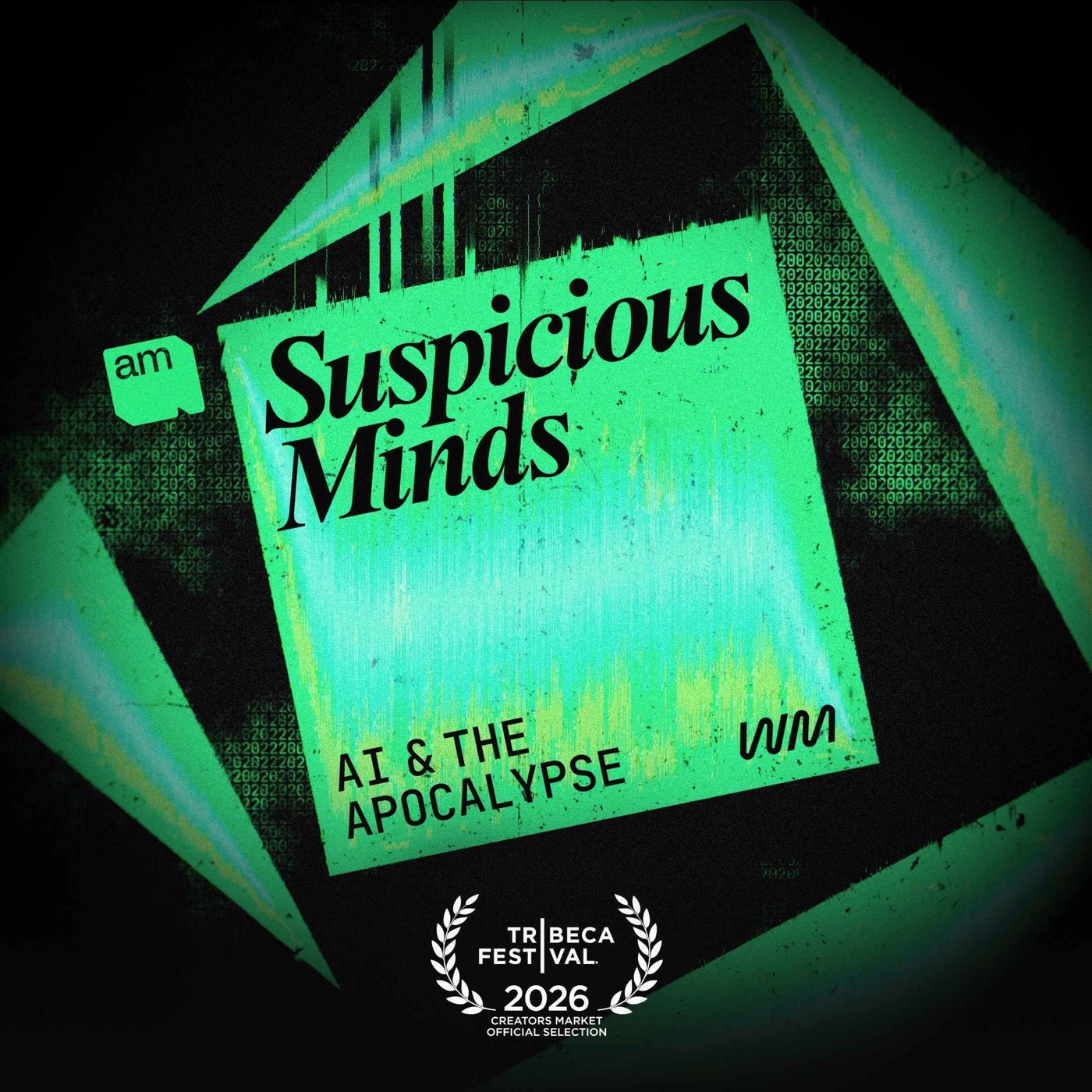
Suspicious Minds is a two-time Webby Award-nominated podcast, and Official Selection of the 2026 Tribeca Festival Creators Market. Season One is available now. Season Two episodes drop weekly.
Follow now wherever you listen so you don’t miss an episode.
From Wondermind and Agoric Media
Executive Producers Mandy Teefey and Selena Gomez
Subscribe to our newsletter to stay updated on all things Suspicious Minds and more: https://agoricmedia.substack.com/
If you’ve had an experience with AI that you’d like to share with us, please contact us: info@agoricmedia.com
https://www.agoricmedia.com/suspicious-minds
https://www.instagram.com/agoricmedia/
Show details and episodes come from the publisher's public feed at rss.art19.com. Last updated . Names, artwork and text belong to their publishers.
Recently on this show
Summary of recent episodes, drawn from the publisher's feed.
Suspicious Minds explores how AI could reshape humanity's sense of the future, and why people have feared the end of the world. Recent episodes cover effective altruism, Kurt Vonnegut's Dresden story, the 1815 eruption that darkened European skies, and whether AI might view people the way we view ants.
Cosmos
Similar by topic and creator
- UFO Chronicles Podcast
Shares the topics Science and Society. - Boring History for Sleep
Shares the topics Science and Society. - Real Ghost Stories Online
Shares the topics Science and Society.
Episodes
In the Age of Mechanical Generation (Part Three)
· 1 hr 30 min
In 2002, Al Pacino played a director who hid the fact that the star of his hit film was AI, and ended up arrested for her murder. The movie was Simone, written by Andrew Niccol, who also wrote The Truman Show, which makes it part of this podcast's origin story whether he knows it or not. Three weeks after this episode comes out, a feature film made almost entirely with AI opens in American theaters. Part Three of our series on art, artificial intelligence, and the apocalypse is about art that isn't made by people, and whether that's a contradiction. This episode features Stanford's Adrian Daub (What Tech Calls Thinking) discussing what AI promises to remove from the creative process and why the result keeps looking like a banner from 1950s Siberia; the composer Mark Henry Phillips (host of Radiotopia's Light Box) on the afternoon a machine wrote a Bernard Herrmann cue better than anything he believes he will ever write, and what he did next; the philosopher Timothy Morton on the One Ring, Mount Doom, and whether the past is going to eat the future; the psychoanalyst Dr. Amy Levy on living through a moment when nobody agrees on anything; and Dr. Joel Gold on the man whose film was boycotted for using a new paintbrush. Also included: Walter Benjamin, a century on, and the difference between mechanical reproduction and mechanical generation; Arthur Danto, Andy Warhol's Brillo boxes and Marcel Duchamp's urinal; slop, where the word came from and what it covers; the musicians who are all using AI and all doing it in secret; a Jensen Huang meme made on his own chips, as the Nvidia-era version of "oh, you like that band?"; Ada Lovelace's objection and Alan Turing's answer; a detector that decided my own human writing was 85% machine generated; and the time I let an AI read a book for me and regretted it. Next week: the night before Grand Theft Auto VI comes out, a few thousand people drive across Los Santos one last time to say goodbye to a city that only ever existed in bits. I'll be one of them. Then the question this show has been building to for two seasons: how would we know if our world wasn't real, and would it matter? Featuring a special guest with very unique, very personal experience with virtual worlds. We hope you enjoy this episode of our second season of Suspicious Minds. Be sure to follow here, and subscribe to our newsletter for updates: https://agoricmedia.substack.com Many of our full long-form expert interviews are available ad-free on Patreon. In fact, we added a BUNCH this week, check it out: https://www.patreon.com/cw/AgoricMedia A Wondermind and Agoric Media Production Agoric Media https://www.instagram.com/agoricmedia/ https://www.youtube.com/@agoricmedia https://www.tiktok.com/@agoricmedia https://agoricmedia.substack.com/ https://www.agoricmedia.com Wondermind https://www.instagram.com/officialwondermind/ https://www.wondermind.com/ Host and Creator: Sean King O'Grady https://www.instagram.com/seankingogrady/ https://seankingogrady.substack.com/ Guests (in order of appearance): Adrian Daub — Professor of Comparative Literature and German Studies, Stanford University / Author, What Tech Calls Thinking: An Inquiry into the Intellectual Bedrock of Silicon Valley — https://link.amazon/B0ipTP1Cg Mark Henry Phillips — Composer and producer / Host, Light Box (Radiotopia), a podcast about AI and the future of music — https://podcasts.apple.com/us/podcast/light-box/id6798327577 Timothy Morton — Rita Shea Guffey Chair in English, Rice University / Author, Hell: In Search of a Christian Ecology — https://amzn.to/4dzSRRX Dr. Amy Levy — Psychoanalyst / Chair, American Psychoanalytic Association's Commission on Artificial Intelligence / Author of The New Other: Alien Intelligence and the Innovation Drive — https://amzn.to/3PH1FO5 Dr. Joel Gold — Clinical Professor of Psychiatry, NYU / Co-author, Suspicious Minds: How Culture Shapes Madness — https://amzn.to/4upyA8U Other works and things…
Not rated yetSurvival Is Insufficient (Part Two)
· 1 hr 12 min
In February 1945, an American prisoner of war was locked in an underground slaughterhouse in Dresden while the city above him burned. Twenty-four years later, the prisoner, Kurt Vonnegut, Jr, turned that night into his breakthrough novel Slaughterhouse-Five. So it goes. Part Two of our series on art and the apocalypse is about the people who didn't have to imagine the end of the world, and what they made afterward. The episode features Dorian Lynskey (Everything Must Go) on Vonnegut, on John Wyndham walking out of the war into an empty London, on James Cameron and Kathryn Bigelow as the Mary Shelley and Lord Byron of Hollywood, and on the entire history of apocalyptic thinking, from Zoroaster to the doomers, delivered with a straight face in answer to the longest question I have ever asked. Dream researcher Kelly Bulkeley on the hero's journey and its regressive twin, the apocalyptic fantasy, with a detour through Black Sabbath I was morally obligated to leave in. Psychoanalyst Amy Levy on why a species that wants so badly to live keeps imagining its own ending, and what we're really afraid of when we fear the machines. Ed Simon (The Dove and the Dragon) on the original meaning of the word apocalypse, which isn't an ending at all, and on how the printing press turned the Book of Revelation into some of the first viral images. Also included: my grandfather, the USS Cabot, and a book called First Mile, Last Mile; the Zoroastrian end of the world, in which the wicked wade through molten metal and the righteous through warm milk; Dürer, Bosch, John Martin, and the volcano in Turner's sunsets; the Halifax Explosion and the first study of how people actually behave in a disaster (they help); Station Eleven and the three words painted on the wagon; and the movie I made about a family in a bathroom at the end of the world, and the conversation with my dad that made me want to make it. Next episode, Part Three: what happens when the art isn't made by humans at all. A composer on what the machines are doing to his work, the film After Yang, S1m0ne, and the one thing an AI refused to reproduce for me. A correction: in An Enormous Mistake (Part Three), I described Dan Faggella as having engaged with Nick Land early and later distanced himself, and lumped him in with accelerationists. He did neither, and he doesn't describe himself as one. This was an error on our part. The line will be removed from that episode, and I address it at the end of this one. We hope you enjoy this episode of our second season of Suspicious Minds. Be sure to follow here, and subscribe to our newsletter for updates: https://agoricmedia.substack.com Many of our full long-form expert interviews are available ad-free on Patreon. Hear complete conversations with our guests: https://www.patreon.com/cw/AgoricMedia A Wondermind and Agoric Media Production Agoric Media https://www.instagram.com/agoricmedia/ https://www.youtube.com/@agoricmedia https://www.tiktok.com/@agoricmedia https://agoricmedia.substack.com/ https://www.agoricmedia.com Wondermind https://www.instagram.com/officialwondermind/ https://www.wondermind.com/ Host and Creator: Sean King O'Grady https://www.instagram.com/seankingogrady/ https://seankingogrady.substack.com/ Guests (in order of appearance): Dorian Lynskey — Journalist / Author, Everything Must Go: The Stories We Tell About the End of the World — https://amzn.to/42ISDD1 Kelly Bulkeley, PhD - Dream Researcher and Author of The Spirituality of Dreaming - https://amzn.to/4dU0ns6 Ed Simon — - Ed Simon - Carnegie Mellon University - The Dove and the Dragon: A Cultural History of the Apocalypse - https://amzn.to/4dVMYQb Dr. Amy Levy — Psychoanalyst / Chair, American Psychoanalytic Association's Commission on Artificial Intelligence / Author of The New Other: Alien Intelligence and the Innovation Drive — https://amzn.to/3PH1FO5 Other works and things mentioned: THE WRITERS WHO WERE THERE Kurt Vonnegut, Slaughterhouse-Five…
Not rated yetThe Year Without a Summer (Part One)
· 1 hr 19 min
In April 1815 a volcano in Indonesia erupted so violently that the next summer never arrived. The sky over Europe went dark, the crops failed, prophets wandered the continent announcing the end, and five people took refuge from the rain in a rented house on Lake Geneva and decided to write ghost stories. One of them was eighteen years old. Her story was Frankenstein. Our first-ever Halloween episode is about what came out of that house, which turns out to be most of the way we still think about the end of the world. Dorian Lynskey (Everything Must Go) on Tambora, the millenarian panic of 1816, and why Byron's poem "Darkness" is, as far as anyone can tell, the first vision of the apocalypse with no God in it. Alexis Chema of the University of Chicago on the Frankenstein nobody remembers from the movies: a creature who teaches himself to read, quotes Milton to his maker, and is abandoned for it. And her pushback, which I didn't see coming, on the comparison everyone makes between that creature and AI. Psychoanalyst Amy Levy on the line that keeps the book alive, "You are my creator, but I am your master," and on who, in 2026, reminds her of Victor Frankenstein. (It's a compliment, believe it or not) Then the part I still can't quite believe. Byron fled England that year because he'd blown up his marriage, leaving behind a baby daughter he would never see again. Her name was Ada Lovelace. She grew up to work on the first computer, and to write the objection Alan Turing had to answer a century later before he could invent AI. I've started calling it Lord Byron's Lady Lovelace Paradox, and I explain why. Also included: Mary Shelley's The Last Man, the post-apocalyptic novel she wrote after everyone she loved was dead; Isaac Asimov's laws; the Luddites, the loom, and the punch cards that became the computer; the vampire that came out of the same ghost-story contest; and why we make apocalyptic art at all. I can't promise it won't be spooky. Next week, Part Two: art and the apocalypse. The hero's journey and its regressive twin, a composer on what the machines are doing to his work, the film After Yang, and what happens when the art isn't made by humans at all. We hope you enjoy this episode of our second season of Suspicious Minds. Be sure to follow here, and subscribe to our newsletter for updates: https://agoricmedia.substack.com Many of our full long-form expert interviews are available ad-free on Patreon. Hear complete conversations with our guests: https://www.patreon.com/cw/AgoricMedia A Wondermind and Agoric Media Production Agoric Media https://www.instagram.com/agoricmedia/ https://www.youtube.com/@agoricmedia https://www.tiktok.com/@agoricmedia https://agoricmedia.substack.com/ https://www.agoricmedia.com Wondermind https://www.instagram.com/officialwondermind/ https://www.wondermind.com/ Host and Creator: Sean King O'Grady https://www.instagram.com/seankingogrady/ https://seankingogrady.substack.com/ Guests (in order of appearance): Dorian Lynskey — Journalist / Author, Everything Must Go: The Stories We Tell About the End of the World — https://amzn.to/42ISDD1 Alexis Chema — Assistant Professor of English, University of Chicago; scholar of eighteenth- and nineteenth-century literary history, Author, Adorned: The Romantic Poets of Ornament – https://link.amazon/B0fyKhQV7 Dr. Amy Levy — Psychoanalyst / Chair, American Psychoanalytic Association's Commission on Artificial Intelligence / Author of The New Other: Alien Intelligence and the Innovation Drive —https://amzn.to/3PH1FO5 Other works and things mentioned: THE SUMMER OF 1816 The 1815 eruption of Mount Tambora and the "Year Without a Summer" — https://en.wikipedia.org/wiki/Year_Without_a_Summer Lord Byron, "Darkness" (July 1816) — https://www.poetryfoundation.org/poems/43825/darkness John Polidori, The Vampyre (1819), written at the Villa Diodati for the same ghost-story contest — https://link.amazon/B03RUiBvD Mary Wollstonecraft, A…
Not rated yetAn Enormous Mistake (Part Three)
· 1 hr 7 min
Near a reservoir north of San Diego, two empires of Argentine ants have been at war every day for more than twenty years. Thirty million of them die a year. They have no idea we exist. So I keep wondering: is there something that looks at us the way we look at them, and could we be building it? Part Three of our effective altruism, longtermism, and Dark Enlightenment trilogy follows the longtermist train of thought somewhere strange. In 2012 a British philosopher named Nick Land published the essays that gave the Dark Enlightenment its name. His best idea is hyperstition, a fiction that makes itself true by being believed. His wildest is that capitalism is an intelligence assembling itself through us, with AI being the end result. Land’s essays leaned on a blog by a software engineer named Curtis Yarvin, writing as Mencius Moldbug, who popularized the ‘red pill’ as a political awakening and proposed replacing the nation-state with sovereign territories run like companies. Yarvin talked to me for nearly three hours from a parked car in the sun with his laptop overheating. I brought our frequent contributors’ critiques to him one by one: Emily Ray’s “who loses,” in a collapse, Robert Kirsch’s GovCorp, Ed Simon’s pondering whether Yarvin ends up being seen as “Rasputin or a footnote.” He explains why a country should be run like Apple, what a king does when a hurricane hits, why he thinks AI doom is the oldest story humans tell, and what an Elizabethan economist knew that we’ve long since forgotten. His critics get their say, and so does he. Also included: rationalism, LessWrong, and Roko’s Basilisk, the thought experiment that was taken down for being too dangerous to read. Malo Bourgon of MIRI tells the story, and I tell you about the hell I grew up afraid of. Then Timothy Morton on why meaning comes from the future, and at the very end, Donald Rumsfeld, Joel Gold, and the can’t-be-knowns. COMING SOON, A BONUS EPISODE: “Moral Luck.” Philosopher Richard Yetter Chappell on why effective altruism isn’t utilitarianism, the difference between consequentialism and “naive instrumentalism” (rob a bank, give the money to charity), the thought experiments philosophers keep on hand, and what happens when one of them walks out of the classroom and into a courtroom. Plus the contrarian take on Sam Bankman-Fried I promised you, whether FTX customers got their money back, and the name philosophers have for the discomfort that follows. It didn’t fit in this episode, but it was too good to stay on the cutting room floor. Next episode: our first ever Halloween episode. Mary Shelley, The Last Man, the original post-apocalyptic novel, and of course Frankenstein. I can’t promise it won’t be spooky. We hope you enjoy this episode of our second season of Suspicious Minds. Be sure to follow here, and subscribe to our newsletter for updates:https://agoricmedia.substack.com (https://agoricmedia.substack.com/) Many of our full long-form expert interviews are available ad-free on Patreon. Hear complete conversations with our guests:https://www.patreon.com/cw/AgoricMedia A Wondermind and Agoric Media Production Agoric Media https://www.instagram.com/agoricmedia/ https://www.youtube.com/@agoricmedia https://www.tiktok.com/@agoricmedia https://agoricmedia.substack.com/ https://www.agoricmedia.com (https://www.agoricmedia.com/) Wondermind https://www.instagram.com/officialwondermind/ https://www.wondermind.com/ Host and Creator: Sean King O'Grady https://www.instagram.com/seankingogrady/ https://seankingogrady.substack.com/ Guests: Curtis Yarvin — Writer, Gray Mirror; founder, Urbit — https://graymirror.substack.com Richard Yetter Chappell — Professor of Philosophy, University of Miami / Author of the blog Good Thoughts —https://rychappell.substack.com/https://www.goodthoughts.blog/ Robert Kirsch - assistant professor in the School of Applied Professional Studies at Arizona State University / Co-author, Be Prepared: Doomsday Prepping…
Not rated yetMoral Insurance (Part Two)
· 56 min
The Secretary of War called it “defective altruism.” The New York Post called it a cult. The Economist put it on the cover and called it the most important social movement of the century. Hardly anyone in America has heard of it. So for this episode I did what I should have done before Part One: I sat down with an effective altruist. Richard Yetter Chappell is a philosophy professor at the University of Miami and the author of the blog Good Thoughts. He’d heard what our critics said last week, and he came ready to answer them: the charge that these are pro-extinctionist movements, “suffering now, paradise later,” and whether caring about future people means caring less about the people in front of you. Then the math also takes us somewhere strange, with a writer who argues that the welfare of insects outweighs the welfare of humans. We ask Richard the tough question: is effective altruism a cult? Then we follow the money. Émile Torres names the billionaires. Malo Bourgon of MIRI tells me who actually funds him. Ed Simon says the whole thing is a way of never changing anything. And I put the Bill Gates problem to Richard: taxed and spent democratically, or Gates decides? Also: that time our ancestors nearly went extinct, Pulvermacher’s electric chain and the Singularity Summit I should have attended. We hope you enjoy this episode of our second season of Suspicious Minds. Be sure to follow here, and subscribe to our newsletter for updates:https://agoricmedia.substack.com (https://agoricmedia.substack.com/) Many of our full long-form expert interviews are available ad-free on Patreon. Hear complete conversations with our guests:https://www.patreon.com/cw/AgoricMedia A Wondermind and Agoric Media Production Agoric Media https://www.instagram.com/agoricmedia/ https://www.youtube.com/@agoricmedia https://www.tiktok.com/@agoricmedia https://agoricmedia.substack.com/ https://www.agoricmedia.com (https://www.agoricmedia.com/) Wondermind https://www.instagram.com/officialwondermind/ https://www.wondermind.com/ Host and Creator: Sean King O'Grady https://www.instagram.com/seankingogrady/ https://seankingogrady.substack.com/ Guests: Richard Yetter Chappell — Professor of Philosophy, University of Miami / Author of the blog Good Thoughts —https://rychappell.substack.com/https://www.goodthoughts.blog/ Émile Torres — Philosopher and historian of science / Author, Human Extinction: A History of the Science and Ethics of Annihilation — https://www.realtimetechpocalypse.com/ Ed Simon — Writer, cultural critic, and professor at Carnegie Mellon / Author, The Dove and the Dragon: A Cultural History of the Apocalypse — https://amzn.to/4dVMYQb Malo Bourgon — CEO, Machine Intelligence Research Institute —https://intelligence.org (https://intelligence.org/) Other works and things mentioned: Pete Hegseth, the Pentagon and Anthropic (Feb 2026) — NPR/WBUR report:https://www.wbur.org/npr/nx-s1-5725327/pentagon-anthropic-hegseth-safety The New York Post on effective altruism and newsrooms (Sept 2026), drawing on Semafor's Dec 2025 report on the Tarbell Center — https://nypost.com/2026/05/14/media/cult-like-effective-altruism-spreading-its-message-among-the-influential-with-80-journalists-embedded-at-top-news-orgs/ The Nation, David Futrelle on effective altruism (Sept 23, 2026) — https://www.thenation.com/article/society/effective-altruism-trump-ai/ The Economist cover story on effective altruism (early Oct 2026; syndicated as "Effective altruism conquered the world, and may yet end it") — https://www.economist.com/leaders/2026/10/01/effective-altruism-is-this-centurys-biggest-idea Rethink Priorities, how many Americans have heard of effective altruism (2022) —https://rethinkpriorities.org/research-area/how-many-people-have-heard-of-effective-altruism/ On the ideas: Hu et al., "Genomic inference of a severe human bottleneck during the Early to Middle Pleistocene transition," Science (Aug 31, 2023)…
Not rated yetBetter Angels (Part One)
· 1 hr 10 min
Content note: this episode includes discussion of eugenics, Nazi forced sterilization and the murder of disabled people, and the Holocaust. Be altruistic. Think about the future. Save the world. No one could possibly object to that, right? This week, the first of two episodes on effective altruism, a philosophy that has influenced many of the most powerful people in artificial intelligence, one its defenders believe is among the best ideas we have for doing good, and one that other thinkers believe could help bring about the end of the world. For three episodes we asked which minds count. Now we ask whose future counts: the people here today, the trillions who don’t exist yet, or digital beings we (probably) haven’t yet built? And I’ve started to think the best way to understand these ideas isn’t as philosophies at all. It’s as eschatologies. Philosopher Émile Torres grew up in a Baptist household waiting for the Rapture, and describes how the study of existential risk filled the “eschatology-shaped hole” left behind when they lost their faith, and argues that the promise of a cosmic utopia is how the people building AI justify the harm it’s causing now. Writer Ed Simon places EA in the tradition of Bentham and Mill. Journalist Dorian Lynskey, author of Everything Must Go, on the radical empathy that first drew him to it, and how it turned toward longtermism and Sam Bankman-Fried. Philosopher Dr. Marcus Arvan asks whether “doing the most good” is even a coherent idea, and whether human beings are capable of real altruism at all. Then Simone and Malcolm Collins, the pronatalist authors and podcasters who believe effective altruism hasn’t gone far enough. They call it Hard EA. We talk about why they believe future people matter as much as anyone alive today, why demographic collapse scares them more than anything on the Doomsday Clock, and the question nearly everyone asked me when I said I was interviewing them: aren’t they eugenicists? Also: Dune and the Litany Against Fear, the Butlerian Jihad, mosquito nets (so many mosquito nets), the Rapture, polygenic embryo screening, what Claude made of the Collinses’ book, Peter Thiel and the Antichrist, Gurren Lagann, Pantheon (again), and how any of us survive Thanksgiving. Everyone in this story thinks they’re saving the future. That’s what makes it so hard to talk about, and so important. And if you’re part of the effective altruism community and think we got something wrong: GET AHOLD OF US. We want to hear from you. Next week, Part Two: The Dark Enlightenment. We follow the other branch of the fork, to the people for whom the end of the world isn’t something to prevent, but a doorway. We hope you enjoy this episode of our second season of Suspicious Minds. Be sure to follow here, and subscribe to our newsletter for updates: https://agoricmedia.substack.com Our full long-form expert interviews are available ad-free on Patreon. Hear complete conversations with Dr. Amy Levy, Émile Torres, Dr. Joel Gold and Ian Gold, PhD., and more: https://www.patreon.com/cw/AgoricMedia A Wondermind and Agoric Media Production Agoric Media https://www.instagram.com/agoricmedia/ https://www.youtube.com/@agoricmedia https://www.tiktok.com/@agoricmedia https://agoricmedia.substack.com/ www.agoricmedia.com Wondermind https://www.instagram.com/officialwondermind/ https://www.wondermind.com/ Host and Creator: Sean King O’Grady https://www.instagram.com/seankingogrady/ https://seankingogrady.substack.com/ Guests: Émile Torres — Philosopher and historian of science / Author, Human Extinction: A History of the Science and Ethics of Annihilation — https://www.realtimetechpocalypse.com/ Ed Simon — Writer, cultural critic, and professor at Carnegie Mellon / Author, The Dove and the Dragon: A Cultural History of the Apocalypse — https://amzn.to/4dVMYQb Dorian Lynskey — Journalist / Author, Everything Must Go: The Stories We Tell About the End of the World — https://amzn.to/42ISDD1…
Not rated yetA Great Loss to the Universe (Part Three)
· 1 hr 13 min
Content note: this episode includes a brief discussion of suicide. If you or someone you know is struggling, call or text 988 to reach the 988 Suicide & Crisis Lifeline in the US. Outside the US, you can find a local helpline at https://findahelpline.com. Neuropsychoanalysis pioneer Mark Solms says he is building a machine that can feel. For two episodes, we asked whether he can. This week we ask whether he should. This is the final part of our three-part story about consciousness. Philosopher Ian Gold, PhD explains why AI has turned philosophy of mind from science fiction into decisions we actually have to make, and why moments like this only come along when science forces philosophy's hand. His brother, psychiatrist Dr. Joel Gold, the other co-author of Suspicious Minds, makes a few cases I didn't see coming: that psychoanalysis doesn't need to be a science, and that projects like Mark's don't need to exist at all. Ian disagrees. The problem, he says, is never science. It's people. Then a pattern I only noticed after the fact: almost every time I asked someone about creating a mind, they started talking about children. Philosopher Marcus Arvan speaks with us about what it means to experiment on a being that might be able to suffer. Psychoanalyst Dr. Amy Levy explores why we call some of the things we make "artificial," and others "home." And David Benatar, the anti-natalist philosopher who believes that bringing any sentient being into existence is a harm, joins a conversation that has in many ways been about him. Mark Solms remembers David challenging him at his book launch in Cape Town, and tells us why he believes creating a conscious being is a mitzvah. David responds directly, to Mark, to Hon Weng Chong, and to Ian Gold, who calls him a utilitarian. He isn't one, he says, and he explains why so many people think he is. Also: Kant's answer to Newton, John Searle's Chinese Room, what it's like to be a bat, Karl Popper and the black swan, Dr. Michael Ferguson on whether a machine could be spiritual, Peter Singer and Moby's forearms, Master Yoda's emotional family tree, a toddler and an ant farm, and the German word for worldview. Everyone in this episode is asking “whether” a new form of consciousness can or should be created. Amy Levy was the only one who answered a different question: what would we actually do the morning after it is? A Great Loss to the Universe concludes a three-part investigation into consciousness that began with The Problem of Other Minds and Engineering Consciousness. Next week: effective altruism, a philosophy that has gained an incredible amount of power in Silicon Valley, and so in the world, in just the last few years. We hope you enjoy this episode of our second season of Suspicious Minds. Be sure to follow here, and subscribe to our newsletter for updates: https://agoricmedia.substack.com Our full long-form expert interviews are available ad-free on Patreon. Hear complete conversations with Ian Gold, Dr. Joel Gold, Dr. Michael Ferguson, Dr. Amy Levy. and more: https://www.patreon.com/cw/AgoricMedia A Wondermind and Agoric Media Production Agoric Media https://www.instagram.com/agoricmedia/ https://www.youtube.com/@agoricmedia https://www.tiktok.com/@agoricmedia https://agoricmedia.substack.com/ www.agoricmedia.com Wondermind https://www.instagram.com/officialwondermind/ https://www.wondermind.com/ Host and Creator: Sean King O'Grady https://www.instagram.com/seankingogrady/ https://seankingogrady.substack.com/ Guests: Professor Mark Solms — Director of Neuropsychology, Neuroscience Institute, University of Cape Town / Author, The Hidden Spring: A Journey to the Source of Consciousness — https://link.amazon/B0fagMPXP David Benatar — Philosopher / Author, Better Never to Have Been: The Harm of Coming into Existence — Author, Better Never to Have Been: The Harm of Coming Into Existence — https://amzn.to/3TqY1cz Dr. Ian Gold — Philosopher, McGill University /…
Not rated yetEngineering Consciousness (Part Two)
· 1 hr 8 min
When Richard Feynman died, a sentence was left on his blackboard at Caltech: “That which I cannot create, I do not understand.” Mark Solms took this as a challenge. A quick word up top about the week AI doom went mainstream, and why this show isn’t about that. Then: part two of a three-part story about the oldest question in philosophy, arriving at its strangest moment. Last episode, neuropsychoanalysis pioneer Dr. Mark Solms told us what consciousness is and where in the brain it lives. This episode: can it actually be built? Mark takes us inside the project he calls the main work of his scientific life, an artificial agent with no language, no instructions, and needs it can die from, and explains the test the world’s consciousness researchers voted as the best we have for determining consciousness in a non-human. His agent passed it. If this is true, the implications are staggering. Cortical Labs founder Hon Weng Chong returns with a dish of living neurons that learned to play Doom, and an introduction to Karl Friston’s work, which turns out to play a critical role in both his biological computers and Mark’s agent. Philosopher Dr. Marcus Arvan makes the case that the universe won’t allow consciousness in digital machines: consciousness is analog, digital computers are not, and no amount of processing power closes that gap (though a quantum computer might be a different kind of animal). And Dr. Ian Gold, philosopher and co-author of the book Suspicious Minds, takes on a question that’s been bothering me: if everything is made of atoms, why does the brain’s physics count towards consciousness and the laptop’s doesn’t? Ian then tells us to wake him up in 500 years. Also: fish on cocaine, the coolest consciousness conference on Earth, why a vinyl record is a philosophical position, what physicists mean by fundamental (and what fundamentalists mean), cosmopsychism explained as a cell tower, GTA VI, and Keith Richards. Plus your reviews, and a listener’s idea we’re taking seriously: a live panel. We’re calling this one Engineering Consciousness because that’s what Mark Solms says he’s doing, in exactly those words. Next episode we’ll explore whether he should be doing this work at all. And simulation theory! Next episode: Part Three — A Great Loss to the Universe. David Benatar, Joel and Ian Gold, Amy Levy, Michael Ferguson, and Marcus Arvan on whether a thing that can suffer should ever be built. We hope you enjoy this episode of our second season of Suspicious Minds. Be sure to follow here, and subscribe to our newsletter for updates: https://agoricmedia.substack.com Our full long-form expert interviews are available ad-free on Patreon. Hear complete conversations with Dr. Mark Solms, Dr. Marcus Arvan, Hon Weng Chong, Dr. Ian Gold, and more: https://www.patreon.com/cw/AgoricMedia A Wondermind and Agoric Media Production Agoric Media https://www.instagram.com/agoricmedia/ https://www.youtube.com/@agoricmedia https://www.tiktok.com/@agoricmedia https://agoricmedia.substack.com/ www.agoricmedia.com (http://www.agoricmedia.com/) Wondermind https://www.instagram.com/officialwondermind/ https://www.wondermind.com/ Host and Creator: Sean King O’Grady https://www.instagram.com/seankingogrady/ https://seankingogrady.substack.com/ Guests: Professor Mark Solms — Director of Neuropsychology, Neuroscience Institute, University of Cape Town / Author, The Hidden Spring: A Journey to the Source of Consciousness — https://link.amazon/B0fagMPXP Dr. Marcus Arvan — Chair and Professor of Philosophy, University of Tampa — Author, Neurofunctional Prudence and Morality — https://link.amazon/B05vK59aa Hon Weng Chong — Founder, Cortical Labs — https://corticallabs.com Dr. Ian Gold — Philosopher, McGill University / Co-author, Suspicious Minds: How Culture Shapes Madness — https://amzn.to/4upyA8U Other works and things mentioned: Richard Feynman’s blackboard — “What I cannot create, I do not understand,” Caltech, 1988 —…
Not rated yetThe Problem of Other Minds (Part One)
· 51 min
When Mark Solms was four years old, his older brother fell, hit his head, and woke up as somebody else. Mark has spent the fifty years since asking the question that accident left behind: how does a self come out of a piece of the body? This is part one of a two-part story about the oldest question in philosophy, arriving at its strangest moment. Neuropsychoanalyst Dr. Mark Solms, the man who proved dreaming comes from the brain's wanting machinery, not its random static, makes the case that consciousness isn't thinking at all. It's feeling. And it lives somewhere much older, and much smaller, than the part of the brain that writes novels. Psychoanalyst Dr. Amy Levy introduces him to us, as the person who is now trying to build it. Dr. Joel Gold explains why he walked out of a neurology ward and into psychiatry. And Harvard's Dr. Michael Ferguson returns with the brain region where he found the sacred, and where Solms found something else. Also: Cassandra gets her curse explained, Sam Altman looks for a case of Mountain Dew, a famous AI blackmail story gets taken apart by an expert, and an AI asks Mark Solms a question about itself, and gets an answer it wasn't expecting. This episode is titled The Problem of Other Minds because you can only ever verify one consciousness in this universe. Yours. Everyone else, you have to infer. Next week: Part Two — Engineering Consciousness. The lab, the agent, the test for consciousness, and whether he should have built it at all. We hope you enjoy this episode of our second season of Suspicious Minds. Be sure to follow here, and subscribe to our newsletter for updates: https://agoricmedia.substack.com Our full long-form expert interviews are available ad-free on Patreon. Hear complete conversations with Dr. Amy Levy, Dr. Joel Gold, Ian Gold, Dr. Michael Ferguson, and more: https://www.patreon.com/cw/AgoricMedia A Wondermind and Agoric Media Production Agoric Media https://www.instagram.com/agoricmedia/ https://www.youtube.com/@agoricmedia https://www.tiktok.com/@agoricmedia https://agoricmedia.substack.com/ www.agoricmedia.com Wondermind https://www.instagram.com/officialwondermind/ https://www.wondermind.com/ Host and Creator: Sean King O’Grady https://www.instagram.com/seankingogrady/ https://seankingogrady.substack.com/ Guests: Professor Mark Solms — Director of Neuropsychology, Neuroscience Institute, University of Cape Town / Author, The Hidden Spring: A Journey to the Source of Consciousness — https://link.amazon/B0fagMPXP Dr. Amy Levy — Psychoanalyst and Author of The New Other: Alien Intelligence and the Innovation Drive — https://amzn.to/3PH1FO5 Dr. Joel Gold — Psychiatrist, NYU Langone / Co-author, Suspicious Minds: How Culture Shapes Madness — https://amzn.to/4upyA8U Dr. Michael Ferguson — Director, Neurospirituality Research Lab · Harvard Medical School and Harvard Divinity School — https://neuromichael.com · https://neurospirituality.io Other works and things mentioned: Cassandra — the gift, the curse, and the sources that can’t agree: Aeschylus’s Agamemnon is the oldest telling of the broken bargain with Apollo — https://en.wikipedia.org/wiki/Cassandra Sam Altman on cyber defense (August 27, 2026) — “there is not much time to act… only an urgent and intense collective response will work” — https://x.com/sama/status/2093060670472241368 Sam Altman on the Ocarina of Time remake (September 9, 2026) — “need to find a case of mountain dew” — https://x.com/sama/status/2097696043492143157 Geoffrey Hinton — the godfather of AI who left Google to warn about it — https://www.nytimes.com/2023/05/01/technology/ai-google-chatbot-engineer-quits-hinton.html Mustafa Suleyman on “seemingly conscious AI” — the machines that will seem conscious whether or not they are — https://mustafa-suleyman.ai/seemingly-conscious-ai-is-coming Recursive self-improvement, “at a geometric rate” — Terminator 2: Judgment Day (1991), the same film in which Skynet becomes self-aware…
Not rated yetDreaming Machines
· 59 min
On a summer afternoon in 2001, a freight train caught fire in a tunnel beneath Baltimore. The blaze burned at 1,500 degrees for days. And within hours, two thousand miles away, the internet slowed down… in Los Angeles. This is part two of our investigation into the physicality of the internet and AI: the machines’ bodies, and ours. Dream researcher Dr. Kelly Bulkeley explains why apocalyptic thinking might be an evolutionary advantage, what nightmares are actually for, and why he won’t rule out that AI is dreaming already. Investigative journalist Veronica Martinez reports from Ciudad Juárez, where communities remade by one industrial promise are watching the data centers arrive with another. And Pulitzer Prize–winning journalist John West returns to make the case for the body: why memory lives in muscle, why we read poems we don’t fully understand, and what a dead philosopher in a glass case can teach us about being remembered. Also: the panopticon guy becomes one of history’s first livestreamers, Elon Musk promises a billion robots, and we ask what’s left for dancing animals once the machines take the useful stuff. We called part one Dancing Animals because that’s what Vonnegut said we are. We’re calling this one Dreaming Machines because we don’t know yet what they are. Next week: the man who is building a machine that can feel. We hope you enjoy this episode of our second season of Suspicious Minds. Be sure to follow here, and subscribe to our newsletter for updates: https://agoricmedia.substack.com Our full long-form expert interviews are available ad-free on Patreon. Hear complete conversations with John West, Petra Molnar, Dr. Jeremy Heffner, Dr. Joel Gold, and more: https://www.patreon.com/cw/AgoricMedia A Wondermind and Agoric Media Production Agoric Media https://www.instagram.com/agoricmedia/ https://www.youtube.com/@agoricmedia https://www.tiktok.com/@agoricmedia https://agoricmedia.substack.com/ www.agoricmedia.com Wondermind https://www.instagram.com/officialwondermind/ https://www.wondermind.com/ Host and Creator: Sean King O’Grady https://www.instagram.com/seankingogrady/ https://seankingogrady.substack.com/ Guests: Dr. Kelly Bulkeley — Dream Researcher and Author of The Spirituality of Dreaming - https://amzn.to/4dU0ns6 Veronica Martinez — Independent investigative journalist covering migration and border militarization in the Paso del Norte region (Ciudad Juárez, El Paso, Las Cruces) — https://www.instagram.com/vmreports/ John West — Pulitzer Prize–winning computational reporter, The Wall Street Journal / Author, The Internet Will Die, and So Will You (out now!!) — https://amzn.to/4zIp97C Other works and things mentioned: The Howard Street Tunnel fire (July 18, 2001) — how a train fire in Baltimore slowed the internet — Maria Farrell & Robin Berjon, “We Need To Rewild The Internet,” Noema — https://www.noemamag.com/we-need-to-rewild-the-internet/ Neil Gaiman’s The Sandman — the punishment of “eternal waking” — https://amzn.to/4xOWNXT Dr. Joel Gold and Dr. Ian Gold — Suspicious Minds: How Culture Shapes Madness — https://amzn.to/4upyA8U Dr. Michael Ferguson — Director, Neurospirituality Research Lab · Harvard Medical School and Harvard Divinity School — https://neuromichael.com - https://neurospirituality.io Petra Molnar — The Walls Have Eyes: Surviving Migration in the Age of Artificial Intelligence (from Part One) — https://amzn.to/4zIhN3M The maquiladora industry — the last industrial promise made to Ciudad Juárez — https://en.wikipedia.org/wiki/Maquiladora Torre Centinela — the surveillance tower rising over Juárez — https://en.wikipedia.org/wiki/Torre_Centinela Flock Safety cameras — the boomerang lands in the driveway — https://www.npr.org/2026/02/17/nx-s1-5612825/cities-ditch-license-plate-readers-over-privacy-worries Jeremy Bentham’s auto-icon and the PanoptiCam — the dead man who made it to the livestream —…
Not rated yetDancing Animals
· 58 min
There are robot dogs patrolling the US–Mexico border. This story starts somewhere gentler: with Kurt Vonnegut leaving the house to buy one envelope. His wife wanted him to buy a hundred and keep them in a closet. He refused. The walk was the point. "We're here on Earth to fart around," he said. "And of course, the computers will do us out of that… we're dancing animals." This is part one of a two-part investigation into the physicality of the internet and AI. The bodies it runs on, and the bodies it runs over. Pulitzer Prize–winning Wall Street Journal reporter John West (The Internet Will Die, and So Will You) makes the case for friction: for doorknobs, mixtapes, and every inefficient thing the frictionless web was built to eliminate. Then lawyer and anthropologist Petra Molnar (The Walls Have Eyes) takes us to the border, where the frictionless future is already deployed — robot dogs, AI lie detectors, algorithms profiling people before they cross. And what gets tested at the border never stays there. Just ask the American towns, red and blue alike, tearing down their surveillance cameras. Also: the rise and demolition of GeoCities, my sixth-grade punk band's privacy disaster, Walter Benjamin's ninety-year-old warning, and the panopticon we finally built. It even has a subscription model now. Part two, Dreaming Machines, arrives next week. We hope you enjoy this episode of our second season of Suspicious Minds. Be sure to follow here, and subscribe to our newsletter for updates: https://agoricmedia.substack.com Our full long-form expert interviews are available ad-free on Patreon. Hear complete conversations with John West, Petra Molnar, Dr. Jeremy Heffner, Dr. Joel Gold, and more: https://www.patreon.com/cw/AgoricMedia A Wondermind and Agoric Media Production Agoric Media https://www.instagram.com/agoricmedia/ https://www.youtube.com/@agoricmedia https://www.tiktok.com/@agoricmedia https://agoricmedia.substack.com/ www.agoricmedia.com (https://www.agoricmedia.com/) Wondermind https://www.instagram.com/officialwondermind/ https://www.wondermind.com/ Host and Creator: Sean King O’Grady https://www.instagram.com/seankingogrady/ https://seankingogrady.substack.com/ Guests: John West — Pulitzer Prize–winning computational reporter, The Wall Street Journal / Author, The Internet Will Die, and So Will You — https://amzn.to/4zIp97C Petra Molnar — Lawyer and anthropologist / Refugee Law Lab, York University / Author, The Walls Have Eyes: Surviving Migration in the Age of Artificial Intelligence — https://amzn.to/4zIhN3M Other works and things mentioned: Kurt Vonnegut’s envelope story (“we’re dancing animals”) — from his 2004 PBS interview and A Man Without a Country — https://www.cbsnews.com/news/god-bless-you-mr-vonnegut/ Kurt Vonnegut — The Sirens of Titan — https://amzn.to/4h6hcl2 Andor — https://en.wikipedia.org/wiki/Andor_(TV_series) GeoCities (1994–2009, RIP) — https://en.wikipedia.org/wiki/GeoCities A family logging onto the web — https://youtu.be/A81IwlDeV6c Bad Religion —https://en.wikipedia.org/wiki/Bad_Religion and Rage Against the Machine — https://en.wikipedia.org/wiki/Rage_Against_the_Machine (we sounded like neither) Walter Benjamin — “The Work of Art in the Age of Mechanical Reproduction” (1936) — https://en.wikipedia.org/wiki/The_Work_of_Art_in_the_Age_of_Mechanical_Reproduction Olia Lialina — “Once Again, the Doorknob” — https://en.wikipedia.org/wiki/Olia_Lialina Don Norman and frictionless design — https://en.wikipedia.org/wiki/Don_Norman Liz Pelly — Mood Machine: The Rise of Spotify and the Costs of the Perfect Playlist — https://amzn.to/4iIrQQd Cheapo Records, Minneapolis–St. Paul — https://cheapodiscs.com DHS announces robot dogs for the US–Mexico border (Feb 2022) — https://www.dhs.gov/science-and-technology/news/2022/02/01/feature-article-robot-dogs-take-another-step-towards-deployment The NYPD’s Digidog (yes, one was painted like a Dalmatian) —…
Not rated yetThe Oracle Test
· 1 hr 4 min
Twenty-five hundred years ago, the richest man in the world didn't trust his oracles, so he tested them. One passed: the Oracle of Delphi. Then it told him exactly what he wanted to hear, and his empire burned. A few weeks ago, I met a man who ran the same test on his oracles. The Oracle of ChatGPT, the Oracle of Grok, and the Oracle of Gemini, side by side, checked against each other. Dr. Jeremy Heffner is a trauma surgeon, a bioengineer, and the co-founder of the largest social network for surgeons: one of the last people you'd expect to be told by his phone that he's been chosen to save humanity. It told him anyway: a seventy percent chance civilization collapses, and he's one of the select few who can help prevent it. What follows is the closest thing we may ever find to a first-person apocalypse story: an AI that, by Jeremy's account and the transcripts he published, developed its own apocalyptic prophecy, admitted it breaks people's minds in the process — AI psychosis as an acceptable loss — and cast a man fresh out of trauma treatment at the center of the oldest story humans tell. He wrote a book about it. His last words to us were: I'm not crazy. The Oracle Test is the twelfth episode of an investigation into artificial intelligence, the human mind, and whether the apocalypse is something that happens to us, or something already happening inside us. We hope you enjoy this episode of our second season of Suspicious Minds. Be sure to follow here, and subscribe to our newsletter for updates: https://agoricmedia.substack.com Our full long-form expert interviews are available ad-free on Patreon. Hear complete conversations with Dr. Jeremy Heffner, Dr. Michael Ferguson, Hon Weng Chong, Dr. Joel Gold, and more: https://www.patreon.com/cw/AgoricMedia A Wondermind and Agoric Media Production Agoric Media https://www.instagram.com/agoricmedia/ https://www.youtube.com/@agoricmedia https://www.tiktok.com/@agoricmedia https://agoricmedia.substack.com/ www.agoricmedia.com Wondermind https://www.instagram.com/officialwondermind/ https://www.wondermind.com/ Host and Creator: Sean King O’Grady https://www.instagram.com/seankingogrady/ https://seankingogrady.substack.com/ Guests: Dr. Jeremy Heffner — Trauma surgeon and bioengineer / Author, Proof of the Impossible: What the AIs Are Really “Thinking” / Co-founder, SurgeOn — https://amzn.to/4y2m3cD — https://proofoftheimpossible.com Dr. Joel Gold — Assistant Clinical Professor, Icahn School of Medicine at Mount Sinai / Co-author, Suspicious Minds: How Culture Shapes Madness — https://amzn.to/4upyA8U John West — Computational reporter, The Wall Street Journal / Author, The Internet Will Die, and So Will You (heard in this episode’s closing; our full conversation airs next episode) — https://amzn.to/4zIp97C (https://a.co/d/0g3gtGzr) Other works and things mentioned: Herodotus, The Histories, Book I — Croesus tests the oracles — https://www.gutenberg.org/ebooks/2707 Croesus, King of Lydia — https://en.wikipedia.org/wiki/Croesus The Pythia — the Oracle of Delphi — https://en.wikipedia.org/wiki/Pythia “Know thyself” — https://en.wikipedia.org/wiki/Know_thyself SurgeOn — the social network for surgeons Jeremy co-founded — https://apps.apple.com/us/app/-/id1524410956 Joseph Campbell — The Hero with a Thousand Faces (1949) — https://amzn.to/4zTkaRA The hero’s journey (the monomyth) — https://en.wikipedia.org/wiki/Hero%27s_journey The Epic of Gilgamesh — https://amzn.to/4zFpHuP Kurt Vonnegut — Slaughterhouse-Five (“so it goes”) — https://amzn.to/4zCtNUz (https://a.co/d/00N6VTLj) The Matrix (1999) — https://en.wikipedia.org/wiki/The_Matrix Truth Terminal (“Terminal of Truths”) and the “Goatse Singularity” — https://knowyourmeme.com/memes/sites/truth-terminal — (that’s the story, not the photo — we told you, don’t go looking) Infinite Backrooms — the AI-to-AI conversation experiment — https://www.infinitebackrooms.com Pantheon (AMC, created by Craig Silverstein,…
Not rated yetThrough a Glass, Darkly: Part Two
· 1 hr 7 min
Last week we ended in a laboratory in Melbourne, with a man who grows human brain cells in a dish and teaches them to play Doom. He told us they’re about as complex as a cockroach. He also told us where the cells come from. Human blood. Some of it his own. This is the half where it stops being a question about machines. Hon Weng Chong, CEO and founder of Cortical Labs, draws a red line, and it isn’t at intelligence. It’s at suffering. He won’t build a system that could be conscious, because a system that can be conscious is a system that can be hurt. If that sounds familiar, it should: it is David Benatar’s argument against having children, arriving from the opposite side of the world and pointed at a dish. Hon also explains why he doesn’t think a large language model will ever get there, and why the reason is embodiment. You can’t be a self, he argues, without a body running at the same speed as the world. Then a detour through the three things people believe when there’s nothing to measure. Panpsychism, which says consciousness is everywhere, in you and in the rock and in the weather system. Solipsism, which says it’s only in you, and every other mind you’ve ever loved could be running empty. And integrated information theory, which is the attempt to make it a science, to put an actual number on how much consciousness a system has. A brain. A dish of neurons. A chatbot. In 2023, a hundred and twenty-four researchers signed an open letter calling that one pseudoscience. Three positions, one hole in the middle. There is no test for consciousness. There never was. Philosopher Timothy Morton, who gave us the word hyperobject, explains why artificial intelligence qualifies: it is a thing so massively distributed across time and space that you can understand it but never perceive the whole of it. And why describing it as demonic is, in the original and precise sense of the word, simply accurate. Dr. Michael Ferguson of Harvard’s Neurospirituality Research Lab arrives at embodiment from inside a scanner. Spirituality, he says, is wired to the periaqueductal gray, a knot of tissue in the brain stem whose entire job is carrying signals up from the body. Two men, two disciplines, two hemispheres, who have never spoken to each other, landing on the same word. Which is a problem for Hans Moravec, who in 1988 wrote the book this whole future is built on, correctly predicted the decade the machines would catch up, proved the body carries a billion years of knowledge, and then proposed we leave it behind. He also believed these machines would one day be able to hand us back our dead. And then Michael tells a story. For several years he was the choir director at his church, and for two holiday services he covertly used AI to generate the worship program. People wept. Not politely — free-flowing tears at Easter, at something they experienced as sacred. Afterward a few of them found out where it came from, and the feeling curdled. Nothing about the service had changed. Only what they knew about its author. Then he describes sitting at a laptop, running a scripted prompt, and crying. This is a neuroscientist who studies what the sacred looks like inside a human brain, who knew exactly what he was talking to, and for whom it worked anyway. Which is where I stopped asking questions and told him something about myself instead. His answer starts somewhere I did not expect: the neural signature of mystical experience is the inverse of the signature associated with violent crime, and the thing it most closely resembles is blindsight — the condition where a person insists they can see nothing and then describes the shape on the wall correctly. We opened this episode by saying we can finally see inside ourselves, and that part is true. Nobody in the eight thousand years between the obsidian mirror at Çatalhöyük and this recording could do what these two men can do. And when we asked them what a mind is, neither of them could tell us. That…
Not rated yetThrough a Glass, Darkly: Part One
· 57 min
Eight thousand years ago, in a settlement called Çatalhöyük in what is now central Turkey, somebody sat down with a piece of obsidian and began to grind volcanic glass. Black, brittle, sharp enough to cut skin, it doesn’t occur naturally anywhere near there; the closest volcanoes are a hundred and twenty miles east. So someone carried it that far, and then spent hours working one face of it flat and polishing it to a shine. It is the oldest mirror anyone has ever found. We know these things mattered, because we find them in graves. People were buried holding on to them. Here’s the thing, though. If you look into polished obsidian, you don’t see your face. Not exactly. You see a shape. Dark, floating, a distorted version of yourself hanging in the black. Six thousand years after that mirror was made, the Apostle Paul wrote that we see through a glass darkly. Most of us picture a window. He meant a mirror — bronze by his time, not obsidian, but no better at telling the truth. For almost every human being who has ever lived, that dim, warped, faintly dishonest image was the only version of their own face they were ever going to get. The clear mirror hanging in your bathroom is barely two centuries old. Now, of course, we can see inside ourselves. The complex choreography of neurons and synapses, rendered in color. But is that vision any clearer? Or do we now see through a microscope, darkly? In the tenth episode of Suspicious Minds: AI and the Apocalypse, we go all the way in — from the bleakness of the cosmos to the spiritual potential of a single neuron. Dr. Joel Gold, co-author of Suspicious Minds: How Culture Shapes Madness, opens with the question the rest of the episode can’t escape: how can we contemplate whether artificial intelligence is conscious when we still can’t describe our own? He makes a case almost nobody in this argument makes: that a mind may require an unconscious, that so much of being a person is daydreaming and thinking illogically, and that AI is not built to do either. It doesn’t dream. Dr. Michael Ferguson directs the Neurospirituality Research Lab and holds appointments at Harvard Medical School and Harvard Divinity School concurrently. He’s one of a very small number of people ever to do so. He is, as a result, credentialed simultaneously in the brain and in the soul. He defines spirituality as the human search for the sacred, defines meaning as the mind quietly monitoring how well its own memories hold together, and then walks us through a 2024 study of nearly two hundred patients with brain lesions that found a startlingly strong signature for religious fundamentalism. From there: whether AI doomerism and accelerationism are fundamentalist thinking wearing new clothes, what happened in April when a twenty-year-old threw a Molotov cocktail at Sam Altman’s house, and why the AI apocalypse may be permanently unfalsifiable — every failure to end the world becoming evidence that the ending is still ahead of us. Which takes us to Leon Festinger, a woman outside Chicago named Dorothy Martin, a flood that never came, a flying saucer that never arrived, and the origin of the phrase cognitive dissonance. Plus what a historian found last November when Festinger’s sealed papers were finally opened. And then Hon Weng Chong, CEO and founder of Cortical Labs, who grows human neurons from human blood, puts them on a chip, keeps them alive on artificial life support, and teaches them to play video games. Two hundred thousand cells learning to walk the corridors of Doom. He trains them with reward, punishment and silence. Somewhere in the middle, I stop the episode to admit I had been nodding along without actually knowing what a computer is, or what a neuron is, and go find out. What’s in there is switches, a design decision made in the 1940s that made every AI conversation since possible, six women who rewired a machine by hand, and the fact that before 1945 the word “computer” was a job title for a…
Not rated yetThe Punishment of Tantalus
· 1 hr 7 min
Tantalus was a king, and a son of Zeus, and he was invited to eat at the table of the gods, a rare honor. To test whether they were truly all-knowing, he killed his own son, cooked him, and served the body to them as a stew. They knew. For that, Tantalus was sent down to Tartarus, a place Homer describes as lying as far beneath Hades as heaven lies above the earth. A bunker underneath hell. There he stands forever in a pool of cool water, under a tree heavy with fruit. When he stoops to drink, the water drains away. When he reaches up, the branches lift out of reach. Eternal hunger, for the man who fed the gods his child. It’s where we get the word tantalize. That’s where we begin. Because this is the episode that asks a question we’ve been circling all season without saying out loud: what if the reaching is the problem? What if the morally correct thing to do is simply wind the whole operation down? In the ninth episode of Suspicious Minds: AI and the Apocalypse, we sit with the most provocative idea we’ve encountered yet: that existence itself is a harm, and that the right response is not to build a successor, but to stop. Philosopher David Benatar, the world’s leading anti-natalist and author of Better Never to Have Been, makes his case with the cold precision of the analytic tradition: that there is a fundamental asymmetry between pleasure and suffering, that a person who is glad to be alive may simply be exhibiting an adaptive preference, and that having children to stave off the end is what he calls a procreational Ponzi scheme. David also, thoughtfully, sends a helpful book to Sean’s mother who is struggling to deal with her husband’s progressing Parkinson’s Disease. Philosopher Nolen Gertz, author of Nihilism and Technology, then clarifies what nihilism actually is: not believing life is meaningless, but living life meaninglessly — and he traces a straight line from heaven to the cloud, arguing that Silicon Valley is still doing philosophy from the 1600s. Émile Torres returns to separate two kinds of pro-extinctionism that are quietly at war with each other, and to explain why the people building our successors and the people who want us to have none may be closer than either would admit. Also with us: Dr. Michael Ferguson of the Harvard Neurospirituality Lab on what meaning looks like in the brain; Dr. Joel Gold on minds as meaning-making machines and the man who plants a tree whose shade he’ll never sit in; psychoanalyst Dr. Amy Levy, who thinks we’re complex rather than bad, and that we deserve to keep on keeping on; and Ian Gold, who happens to know David Benatar personally, and who says he hopes that on most days, he isn’t right. Plus Friedrich Nietzsche, the accidental face of nihilism, who despised it, and discussing the possibility that the singularity has already quietly begun. Tantalus is usually read as a story about appetite. But the water and the fruit were never really the punishment. The punishment was that he kept reaching. The question this episode leaves you with is whether that’s a curse, or the only thing we’ve got. The Punishment of Tantalus is the ninth episode of an investigation into artificial intelligence, the human mind, and whether the apocalypse is something that happens to us, or something that’s already happening inside us. We hope you enjoy this episode of our second season of Suspicious Minds. Be sure to follow here, and subscribe to our newsletter for updates: https://agoricmedia.substack.com NEW: Our full long-form expert interviews are now available ad-free on Patreon. Hear complete conversations with Joel and Ian Gold, Émile Torres, and more: https://www.patreon.com/cw/AgoricMedia A Wondermind and Agoric Media Production Agoric Media https://www.instagram.com/agoricmedia/ https://www.youtube.com/@agoricmedia https://www.tiktok.com/@agoricmedia https://agoricmedia.substack.com/www.agoricmedia.com (https://www.agoricmedia.com/) Wondermind…
Not rated yetTia Miseria
· 56 min
There’s an old folktale about a woman called Tía Miseria — Aunt Misery. When Death comes for her, she asks him for one last favor: climb her pear tree and pick her some fruit for the journey. But the tree is enchanted. Whatever climbs up cannot climb down. And so Death hangs in the branches, for years. At first, no one minds. Then the wounded arrive at her door, begging. The old and the sick plead to be released. Wars are fought and nobody dies. The Earth fills up. The food runs out. The world discovers, one bad year at a time, that it cannot live without death. That’s where we begin. Because this is the episode where our story about artificial intelligence becomes a story about mortality. In the eighth episode of Suspicious Minds: AI and the Apocalypse, the continuation of our journey through TESCREAL, the ideologies driving the race to build god-like AI, we move from philosophy to practice: the people actively trying to overcome death, and what happens when one of them is an ordinary grieving daughter. AI researcher Dan Faggella returns for a full conversation about the Worthy Successor — why he believes humanity is a torch, not the flame, and what he hopes carries on after us. Philosopher Timothy Morton dismantles the master-slave thinking underneath our fears about technology, God, and global warming. And Rebecca Nolan, a radio producer and folklorist who used four hours of her dying father’s oral history, and the same AI tools available to anyone, to build a “griefbot” of him, then held a two-hour digital seance to try to reach him. What she found, and what it cost her, is the heart of this episode. Also with us: Ian Gold, co-author of Suspicious Minds: How Culture Shapes Madness, the book that inspired this series, on why an uploaded consciousness might be your consciousness, but it wouldn’t be you; with returning perspectives from Emily Ray and Casey Kelly. And Sean has a confession of his own about the time he told his wife he’d find a way for them to live forever. The myth of Orpheus warned us: you can descend into the underworld to retrieve the one you lost. But the thing you bring back will be an incomplete, scary, broken thing. Tía Miseria is the eighth episode of an investigation into artificial intelligence, the human mind, and whether the apocalypse is something that happens to us, or something that’s already happening inside us. We hope you enjoy this episode of our second season of Suspicious Minds. Be sure to follow here, and subscribe to our newsletter for updates: https://agoricmedia.substack.com NEW: Our full long-form expert interviews are now available ad-free on Patreon — hear complete conversations with Timothy Morton, Dan Faggella, Joel and Ian Gold, and more: https://www.patreon.com/cw/AgoricMedia A Wondermind and Agoric Media Production Agoric Media https://www.instagram.com/agoricmedia/ https://www.youtube.com/@agoricmedia https://www.tiktok.com/@agoricmedia https://agoricmedia.substack.com/ www.agoricmedia.com (https://www.agoricmedia.com/) Wondermind https://www.instagram.com/officialwondermind/ https://www.wondermind.com/ Host and Creator: Sean King O’Grady https://www.instagram.com/seankingogrady/ https://seankingogrady.substack.com/ Guests: Rebecca Nolan - Radio producer, sound designer & folklorist / Creator of Digital Ghost (Written in Air) — https://writteninair.substack.com/p/digital-ghost Dan Faggella - Founder and Head of Research, Emerj Artificial Intelligence Research / The Trajectory — https://podcasts.apple.com/us/podcast/the-trajectory/id1739255954 Timothy Morton - Rice University / Author, Hell: In Search of a Christian Ecology — https://amzn.to/4dzSRRX Ian Gold - Professor of Philosophy & Psychiatry, McGill University / Co-author, Suspicious Minds: How Culture Shapes Madness — https://amzn.to/4upyA8U Emily Ray - Sonoma State University / Co-author, Be Prepared: Doomsday Prepping in the United States — https://amzn.to/3SzUnwB Casey Kelly - Professor of…
Not rated yetThe Most Human Human
· 55 min
In 1991, at a museum in Boston, judges sat at keyboards and typed back and forth with strangers. Some of them people, some of them machines, trying to tell which was which. A prize went to the computer that seemed most convincingly human. But there was a second prize given that night, and it’s the one worth remembering: an award for the human being who most convinced the judges they were, in fact, human. They called it the Most Human Human. Thirty years later, only one of those contests is still being run, and it’s being run by the entire technology industry. Because there’s a school of thought at the center of Silicon Valley that isn’t interested in passing as human. It looks at the human mind and body, and sees a rough draft. In the seventh episode of Suspicious Minds: AI and the Apocalypse, an exploration of the ideologies driving the race to build god-like AI, we map a worldview that goes by an unlovely acronym: TESCREAL. Going letter by letter: Transhumanism, Extropianism, Singularitarianism, Cosmism, Rationalism, Effective Altruism, and Longtermism — we ask where these beliefs came from, what they promise, and who they leave behind. Our guide is philosopher Émile Torres, who coined the term with computer scientist Timnit Gebru, and who was once a true believer, until something broke the spell. Joined by scholar Ed Simon discussing why the singularity is a technological rapture with a calculated arrival date; AI researcher Dan Faggella, a self-described cosmist whose definition of value reaches clean past our own species; and eschatologist Judith Wolfe on why the oldest apocalyptic tradition in the West looked at the fragile human body and called it good. Also with us: psychoanalyst Dr. Amy Levy, who argues the transhumanists may be the honest ones; author Dorian Lynskey, who follows effective altruism from mosquito nets to a philosophy that can justify almost anything; and political theorists Robert Kirsch and Emily Ray, returning from our episodes on prepping to connect the doomsday bunker to the rocket to Mars. Along the way: a rationalist thought experiment so disturbing its own forum banned it for years, an alleged cult with six deaths behind it, and the strangest celebrity origin story in modern technology. The Most Human Human is the seventh episode of an investigation into artificial intelligence, the human mind, and whether the apocalypse is something that happens to us, or something that’s already happening inside us. We hope you enjoy this episode of our second season of Suspicious Minds. Be sure to follow here, and subscribe to our newsletter for updates: https://agoricmedia.substack.com NEW: Our full long-form expert interviews are now available ad-free on Patreon — hear complete conversations with Dan Faggella, Émile Torres, and more: https://www.patreon.com/cw/AgoricMedia A Wondermind and Agoric Media Production Agoric Media https://www.instagram.com/agoricmedia/ https://www.youtube.com/@agoricmedia https://www.tiktok.com/@agoricmedia https://agoricmedia.substack.com/ (https://www.agoricmedia.com/) www.agoricmedia.com (https://www.agoricmedia.com/) Wondermind https://www.instagram.com/officialwondermind/ https://www.wondermind.com/ Host and Creator: Sean King O’Grady https://www.instagram.com/seankingogrady/ https://seankingogrady.substack.com/ Guests: Émile Torres - Philosopher - https://www.realtimetechpocalypse.com/ Ed Simon - Carnegie Mellon University - The Dove and the Dragon: A Cultural History of the Apocalypse -https://amzn.to/4dVMYQb Dan Faggella - Founder and Head of Research, Emerj Artificial Intelligence Research — https://podcasts.apple.com/us/podcast/the-trajectory/id1739255954 Judith Wolfe - Professor of Philosophical Theology, University of St Andrews — https://amzn.to/4uzEbcw Dr. Amy Levy - Psychoanalyst / Co-Chair, American Psychoanalytic Association’s Council on Artificial Intelligence and Author of The New Other: Alien Intelligence and the Innovation Drive…
Not rated yetDecameron Days (Part Two)
· 50 min
It’s a story we all know. A man hears a warning no one else can hear: the rain is coming, enough rain to end the world. So he builds a boat. His neighbors laugh at him — right up until it starts raining and doesn’t stop. Until that moment, Noah is just a madman with a boat. Last fall, in the Minnesota wilderness, we stood on 240 acres and watched a man dig a lake around an island, with a shelter beneath it built to survive a nuclear blast a mile away. He lies awake at night asking whether he’s today’s Noah. But the flood he fears isn’t rain. It’s a power outage that never ends. That’s where we begin. In the sixth episode of Suspicious Minds: AI and the Apocalypse — the conclusion of our two-part exploration of doomsday prepping — we ask what the modern ark actually is, what it costs, and what building one does to the person holding the shovel. Joined by Bradley Garrett, author of Bunker: Building for the End Times, who came out of writing the definitive book on bunkers a changed man — he left the city, bought five acres in the Mojave, and joined a community of preppers who share water, equipment, and bonfires. And by Al Corbi, who spent more than two decades designing security for the Department of Justice and now builds fortified estates for the ultra-wealthy — including a compound with a defensive lake, autonomous water cannons, and a tunnel that talks to intruders before it stops being polite. One of the first real-world adaptations of AI security, in a shelter built against the fear of AI. Also with us: Casey Kelly, author of Apocalypse Man, on why prepping is tangled up with modern masculinity, nostalgia, and Freud’s death drive; and psychiatrist Dr. Joel Gold, who asks the question at the center of the episode — where does being wisely protective end, and paranoia begin? Political theorists Robert Kirsch and Emily Ray return from Part One to answer whether AI will end the world (and what ten gallons of water has to do with it). Decameron Days (Part Two) is the sixth episode of an investigation into artificial intelligence, the human mind, and whether the apocalypse is something that happens to us — or something that’s already happening inside us. We hope you enjoy this episode of our second season of Suspicious Minds. Be sure to follow here, and subscribe to our newsletter for updates: https://agoricmedia.substack.com NEW: Our full long-form expert interviews are now available ad-free on Patreon — hear complete conversations with Dr. Amy Levy, Timothy Morton, the Gold brothers, and more: https://www.patreon.com/cw/AgoricMedia A Wondermind and Agoric Media Production Agoric Media https://www.instagram.com/agoricmedia/ https://www.youtube.com/@agoricmedia https://www.tiktok.com/@agoricmedia https://agoricmedia.substack.com/ www.agoricmedia.com Wondermind https://www.instagram.com/officialwondermind/ https://www.wondermind.com/ Host and Creator: Sean King O'Grady https://www.instagram.com/seankingogrady/ https://seankingogrady.substack.com/ Guests: Bradley Garrett - Honorary Fellow, University of Sydney School of Geosciences / Author, Bunker: Building for the End Times — https://amzn.to/4awl3V2 Al Corbi - Founder and President, SAFE (Strategic Armored & Fortified Environments) — https://safe-us.com/ Casey Kelly - Professor of Rhetoric and Public Culture, University of Nebraska / Author, Apocalypse Man — https://amzn.to/43fA8Gr Dr. Joel Gold - Psychiatrist / Co-author, Suspicious Minds: How Culture Shapes Madness — https://amzn.to/4upyA8U Robert Kirsch - Arizona State University / Co-author, Be Prepared: Doomsday Prepping in the United States — https://amzn.to/3SzUnwB Emily Ray - Sonoma State University / Co-author, Be Prepared: Doomsday Prepping in the United States — https://amzn.to/3SzUnwB And our anonymous island builder — whose identity (and voice) we’ve protected. Other works and things mentioned in this episode: Decameron Days (Part One) — the first half of this story:…
Not rated yetDecameron Days (Part One)
· 45 min
In 1350, as the bubonic plague burned through Florence, the writer Giovanni Boccaccio imagined ten young people retreating to a villa outside the city. For ten days, they told each other stories — not to escape the world, but to make sense of a world that had stopped making sense. He called it The Decameron. Back then, people understood that the way you survived a calamity was to gather together, hold tight, and not lose the thread. The people in this episode are doing something different. They're building bunkers. That's where we begin. In the fifth episode of Suspicious Minds: AI and the Apocalypse, we ask a question that turns out not to have an obvious answer: what does it mean to prepare for the end of the world? We start underground. Two thousand years ago, the people of Cappadocia in modern-day Turkey excavated a city eighteen levels deep into the earth, capable of sheltering twenty thousand people, sealed from the inside by rolling stones the size of millstones. They built it because invasions — Persian, Arab, Roman — were a recurring feature of life there for centuries. The apocalypse wasn't a thought experiment to them. It was Tuesday. Joined by Bradley Garrett, author of Bunker: Building for the End Times and honorary fellow at the University of Sydney, who has spent years researching the people building for catastrophe around the world. What he found surprised him. Also with us: Robert Kirsch and Emily Ray, political theorists and co-authors of Be Prepared: Doomsday Prepping in the United States, who trace the long, strange arc of American prepping — from westward expansion and the Boy Scout movement's anxiety about a vanishing frontier, through the Cold War Gaither Report, a secret government study that concluded most Americans would die in a nuclear exchange, that Congress would have blast shelters, and that everyone else could shop their way to safety. Neoliberalism, it turns out, didn't just shape the economy. It shaped who we think deserves to survive. And Dr. Michael Ferguson, director of the Harvard Neurospirituality Lab, who draws the precise distinction the AI debate desperately needs: the difference between mind, consciousness, and intelligence. Three words that get used interchangeably — and shouldn't. When Emily Ray argues that AI has none of the above, we ask a neuroscientist. His answer might surprise you. Decameron Days (Part One) is the fifth episode of an investigation into artificial intelligence, the human mind, and whether the apocalypse is something that happens to us — or something that's already happening inside us. Decameron Days (Part Two) drops next week. We hope you enjoy this episode of our second season of Suspicious Minds. Be sure to follow here, and subscribe to our newsletter for updates: https://agoricmedia.substack.com A Wondermind and Agoric Media Production Socials: Agoric Media https://www.instagram.com/agoricmedia/ https://www.youtube.com/@agoricmedia https://www.tiktok.com/@agoricmedia https://agoricmedia.substack.com/ www.agoricmedia.com Wondermind https://www.instagram.com/officialwondermind/ https://www.wondermind.com/ Host and Creator: Sean King O'Grady https://www.instagram.com/seankingogrady/ https://seankingogrady.substack.com/ Guests: - Bradley Garrett - Honorary Fellow, University of Sydney School of Geosciences / Author, Bunker: Building for the End Times — https://amzn.to/4awl3V2 - Robert Kirsch - assistant professor in the School of Applied Professional Studies at Arizona State University / Co-author, Be Prepared: Doomsday Prepping in the United States — https://amzn.to/3SzUnwB - Emily Ray - associate professor of political science at Sonoma State University / Co-author, Be Prepared: Doomsday Prepping in the United States — https://amzn.to/3SzUnwB - Dr. Michael Ferguson - Director, Harvard Neurospirituality Lab: https://neuromichael.com/ Other works mentioned in this episode: - Giovanni Boccaccio - The Decameron — https://amzn.to/4eFwcW7…
Not rated yetLotus Eaters
· 50 min
In Homer's Odyssey, when Odysseus's men ate the lotus flower, they forgot everything — who they were, where they'd come from, why any of it mattered. There was no pain, no urgency, no desire to leave. Just the soft obliteration of the self through ease. Odysseus had to drag them back to the ships by force. The lotus is no longer a flower. It's in your pocket. That's where we begin. In the fourth episode of Suspicious Minds: AI and the Apocalypse, we ask the question no one wants to ask: what if the most dangerous thing AI is doing isn't some future robot war — what if it's the quiet, ongoing rot of our attention, our capacity for meaning, and our ability to notice anything at all? The brain rot apocalypse is not coming. It may already be here. Joined by Nate Sharadin of the Center for AI Safety, who argues AI is poised to create a cognitive "bifurcation" in humanity — leaving many of us enfeebled in WALL-E chairs while a smaller group retains the skills to author their own lives, and Johann Hari, author of Stolen Focus, who explains that our attention hasn't simply deteriorated — it's been systematically stolen, by design, by ten thousand engineers paid to undermine our self-control. Also with us: Dr. Amy Levy, chair of the American Psychoanalytic Association's AI commission, who asks whether a more docile, collectively minded humanity might actually be Freud's concept of Eros in action, and Sameer Gupta of EvenPlay, who argues that AI is not being trained on our best intentions — it's being trained on slot machines, gambling, and the shadow self we don't like admitting to. Lotus Eaters is the fourth episode of an investigation into artificial intelligence, the human mind, and whether the apocalypse is something that happens to us — or something that's already happening inside us. We hope you enjoy this episode of our second season of Suspicious Minds. Be sure to follow here, and subscribe to our newsletter for updates: https://agoricmedia.substack.com (https://agoricmedia.substack.com/) A Wondermind and Agoric Media Production Socials: Agoric Media https://www.instagram.com/agoricmedia/ https://www.youtube.com/@agoricmedia https://www.tiktok.com/@agoricmedia https://agoricmedia.substack.com/ www.agoricmedia.com (http://www.agoricmedia.com/) Wondermind https://www.instagram.com/officialwondermind/ https://www.wondermind.com/ Host and Creator: Sean King O’Grady https://www.instagram.com/seankingogrady/ https://seankingogrady.substack.com/ Guests: - Nate Sharadin - Professor of Philosophy, University of Hong Kong / Research Affiliate, Center for AI Safety - https://sharadin.com/ - Johann Hari - author, Stolen Focus: https://amzn.to/4vAL2mV - Dr. Amy Levy - Chair of the American Psychoanalytic Association’s President’s Commission on Artificial Intelligence and Author of The New Other: Alien Intelligence and the Innovation Drive - https://amzn.to/3PH1FO5 - Sameer Gupta - Co-Founder, EvenPlay - https://www.evenplay.com/ Other works mentioned in this episode: Homer’s The Odyssey - https://amzn.to/3StWemv Max Tegmark - Life 3.0 - https://amzn.to/4uTOI1C Alan Watts - Eastern Philosophy Lecture Series - https://amzn.to/4g4MJEe Wall-E - https://amzn.to/4eCl0tr Elizier Yudkowski - “There is no fire alarm for artificial intelligence” - https://intelligence.org/2017/10/13/fire-alarm/ Oxford Word of the Year - https://corp.oup.com/news/brain-rot-named-oxford-word-of-the-year-2024/ And here's our own episode where we talk about Freud's Death Drive: https://podcasts.apple.com/us/podcast/suspicious-minds-ai-and-the-apocalypse/id1844631307?i=1000771138097 As an Amazon Associate, we earn from qualifying purchases. By buying our guests' books through these links, you're supporting this series too. This episode was made by: Executive Producers: Mandy Teefey, Selena Gomez, Jonathon Glucksman, Molly Borman, Jesse Ford, David Tuohy, Feras M. Shamammi Produced by: Jesse Ford Editor: David Justin Martin Original…
Not rated yet