

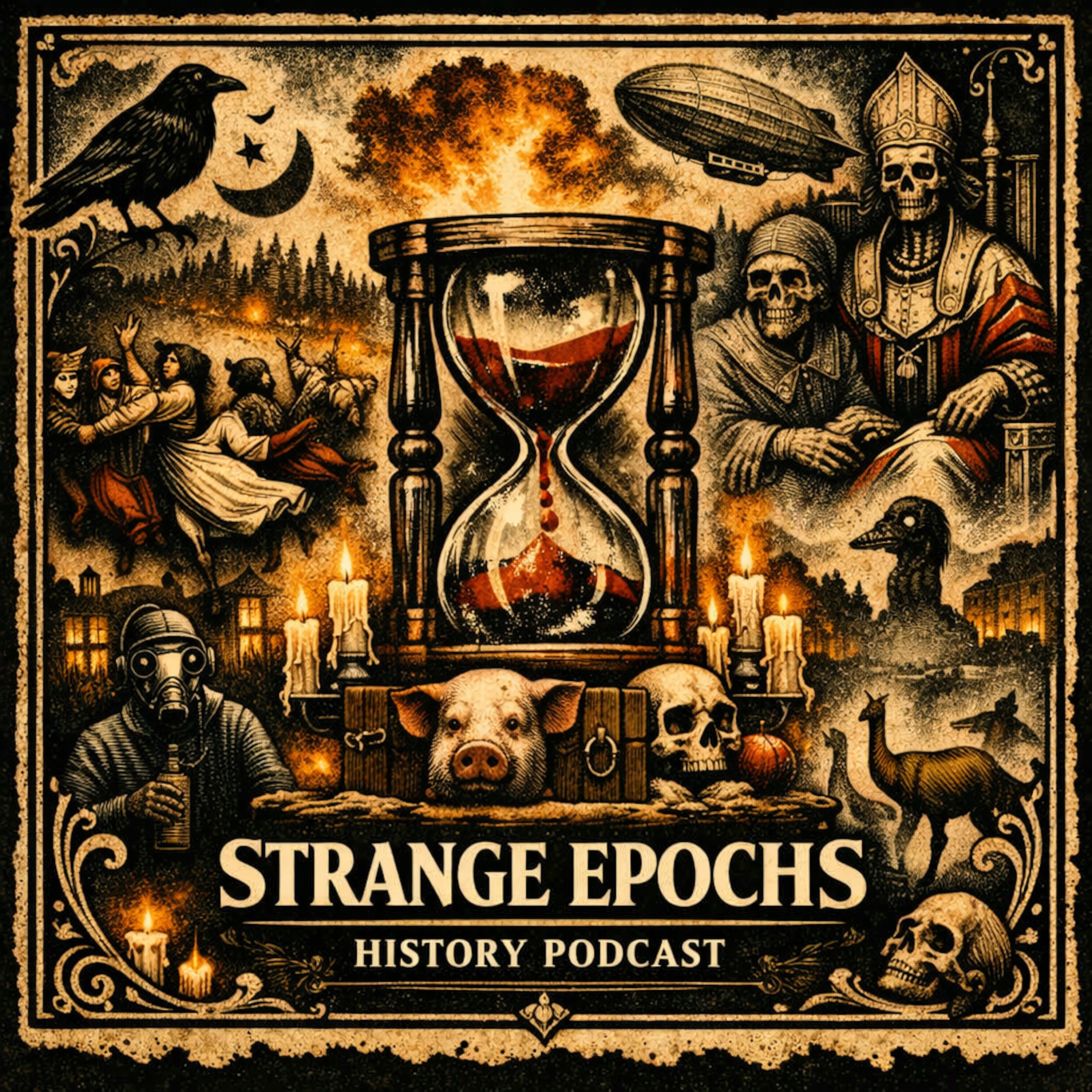
Strange Epochs • Weird History
Strange History • Sleep PodcastAudio
- Format:
- Podcast
- New episodes:
- Weekly
- Typical length:
- about 45 minutes
- Latest episode:
About this show
Strange Epochs: History's Most Extraordinary True Stories
History is full of events so remarkable, so inexplicable, that they seem like they couldn't possibly be real. And yet they are.
Every week, host Shawn Spainhour takes you deep inside one of history's most extraordinary true stories. Not the events you studied in school — the ones that got left out. The ones historians still argue about. The ones that make you question everything you thought you knew about the past.
From medieval mass hysteria to unsolved disappearances, from forgotten wars to events that defied every reasonable explanation — Strange Epochs brings history to life the way it actually felt to the people who lived it. Immersive. Atmospheric. Completely true.
This isn't a history lecture. It's an experience.
Episodes explore stories like:
- The Dancing Plague of 1518 — when hundreds of people danced uncontrollably for days and couldn't stop
- The Cadaver Synod — when a Pope put a dead man on trial
- The Great Emu War — when the Australian military lost a war against birds
- The Tunguska Event — the largest unexplained explosion in recorded history
- The Lost Colony of Roanoke — America's oldest unsolved mystery
- Hinterkaifeck — the farmstead murder that was never solved
- The Voynich Manuscript — a book no one has ever been able to read
- The Ghost Army of WWII — the secret unit that won battles with illusions
New episodes every Tuesday.
If you love history podcasts like Fall of Civilizations, Hardcore History, or Cautionary Tales — Strange Epochs is your next listen.
Subscribe now and never miss an episode.
Covers: history, unsolved mysteries, military history, medieval history, true crime, mass hysteria, world war ii, popular history
Show details and episodes come from the publisher's public feed at media.rss.com. Last updated . Names, artwork and text belong to their publishers.
Recently on this show
Summary of recent episodes, drawn from the publisher's feed.
Strange Epochs is a podcast retelling true, lesser-known episodes of history, from strange mass outbreaks to unexplained disappearances. Recent episodes cover the Anglo-Zanzibar War, London's 1858 Great Stink, the empty ship Mary Celeste, and the Dyatlov Pass incident.
Cosmos
Similar in subject
- The Twaddling Along Podcast
Both cover: mass hysteria, history, true crime - Forbidden History
Both cover: medieval history, world war ii, unsolved mysteries - The Eclectic: True Crime & Paranormal Stories
Both cover: medieval history, unsolved mysteries, history
Similar shows





Explore more
Episodes
The Anglo-Zanzibar War: The Shortest War in Recorded History — Zanzibar, 1896
· 41 min
On the morning of August 27th, 1896, five ships of the Royal Navy sat anchored in the harbor at Zanzibar Town, off the coast of East Africa. A new sultan, having occupied the palace only two days earlier, had just been told the British did not recognize his claim to the throne. He sent back a defiant message: he did not believe they would actually open fire. He was wrong. What followed became, by the careful and slightly competitive accounting of military historians, the shortest war ever recorded. Estimates of its exact length vary — thirty-eight minutes, forty, forty-five, depending on which shot you count as the first — but by any measure it was over faster than an episode of television. A palace was reduced to rubble. The sultan fled out a back door within two minutes of the first shot. More than five hundred people were killed or wounded on one side. On the other, exactly one minor injury. Host Shawn Spainhour takes you into the full story: the succession dispute and the poisoning rumors that set the crisis in motion, the ultimatum and its countdown, the bombardment itself, and the brutal, simple mathematics of what happens when one side has ironclad warships and the other has a wooden palace and a handful of ceremonial cannons. If you love history, true crime, or storytelling — or if you're just looking for something to listen to on a long drive or drift off to sleep — this one is for you. Strange Epochs is a weekly narrative history podcast hosted by Shawn Spainhour. Each episode takes one strange, true, documented moment from somewhere in the long span of human history and sits with it — slow, atmospheric, and built for deep listening. New episodes every Tuesday. If this is your first episode, there are thirty-two more waiting for you. Sources: - Wikipedia contributors. Anglo-Zanzibar War. Wikipedia, Wikimedia Foundation, 2024. - Britannica editors. Anglo-Zanzibar War. Encyclopaedia Britannica, updated 2026. - South African History Online. The Anglo-Zanzibar War of 1896. sahistory.org.za (http://sahistory.org.za). - The Collector. The Thirty-Eight-Minute Anglo-Zanzibar War: The Fastest War in History. September, 2023. - Historical Association. The Shortest War in History: The Anglo-Zanzibar War of 1896. historyeducation.org.uk (http://historyeducation.org.uk). - History Today. The Anglo-Zanzibar War. Pollard, Justin and Stephanie. Volume 68, Issue 8, August 2018. - Historic UK. The Shortest War in History. historic-uk.com (http://historic-uk.com). - Altezza Travel. The Shortest War in History: The Anglo-Zanzibar War of 1896. May, 2025.
Not rated yetThe Great Stink: How a Smell Forced Parliament to Act — London, 1858
· 45 min
In the summer of 1858, London — the largest city in the world at two and a half million people, the heart of the British Empire — was sitting on top of its own filth. For centuries the River Thames had served as the city's sewer. An exceptional heat wave arrived at exactly the wrong moment, baking the exposed riverbanks and accelerating years of accumulated waste into a smell so total, so inescapable, that it stopped the government of the most powerful nation on Earth from functioning. Members of Parliament hung curtains soaked in chloride of lime over the windows in a desperate attempt to filter the air. It did not work. Sittings were disrupted. Committee rooms were abandoned. There was serious discussion of relocating Parliament entirely, upriver, away from the smell. The Great Stink, as newspapers of the time called it, did what decades of public health warnings, cholera epidemics, and reformist campaigning had failed to do. Within eighteen days, the British government passed legislation and funded one of the great engineering achievements of the Victorian age — a sewer system so well built that most of it is still in use beneath London today. Host Shawn Spainhour takes you into the full story: the city that produced this crisis, the specific week Parliament could no longer ignore it, and the engineer whose sewer system quietly saved hundreds of thousands of lives from waterborne disease for generations afterward. If you love history, true crime, or storytelling — or if you're just looking for something to listen to on a long drive or drift off to sleep — this one is for you. Strange Epochs is a weekly narrative history podcast hosted by Shawn Spainhour. Each episode takes one strange, true, documented moment from somewhere in the long span of human history and sits with it — slow, atmospheric, and built for deep listening. New episodes every Tuesday. If this is your first episode, there are thirty-one more waiting for you. Sources: - Wikipedia contributors. Great Stink. Wikipedia, Wikimedia Foundation, 2024. - World Atlas. The Great Stink of London. worldatlas.com (http://worldatlas.com), January, 2025. - Historic England. The Story of London's Sewer System. heritagecalling.com (http://heritagecalling.com), June, 2025. - London Museum. The Great Stink of 1858. londonmuseum.org.uk (http://londonmuseum.org.uk). - London Museum. How Bazalgette Built London's First Super-Sewer. londonmuseum.org.uk (http://londonmuseum.org.uk). - Historic England. The Great Stink: A Victorian Solution to the Problem of London's Waste. historicengland.org.uk (http://historicengland.org.uk). - History Is Now Magazine. London's Great Stench in the Nineteenth Century, Part Two: Bazalgette, Sewers and Stench. April, 2022. - The Genealogist. The Great Stink. thegenealogist.co.uk (http://thegenealogist.co.uk).
Not rated yetThe Mary Celeste: A Ship Found Empty at Sea — Atlantic Ocean, 1872
· 41 min
On December 4th, 1872, roughly four hundred miles east of the Azores, the crew of a British ship called the Dei Gratia spotted another vessel wandering an erratic course, sails up, no one visibly at the helm. It was the Mary Celeste — an American brigantine that had left New York a month earlier bound for Genoa, captained by a man the Dei Gratia's own captain knew personally. They boarded her and found her completely deserted. Not the captain, not his wife, not their two-year-old daughter, not a single one of the seven crew members. The ship was seaworthy. Her cargo of seventeen hundred barrels of industrial alcohol was almost entirely intact. The crew's money and valuables were still in their quarters. There was food and fresh water aboard. The captain's log was current only to ten days earlier — when the ship should have been near the Azores, not four hundred miles further along. The only thing missing besides the ten people was the ship's single lifeboat. No bodies were ever found. No wreckage. No trace. More than a hundred and fifty years later, the Mary Celeste remains one of the most famous unsolved mysteries of the sea — not for lack of theories, but because every one of them requires imagining ten people making a single, catastrophic, irreversible decision together, for reasons that died with them. Host Shawn Spainhour takes you into the full story: the ship, the captain and his family, the discovery, and the long list of theories — from mutiny to sea monsters to a badly misjudged abandonment — that have tried and failed to fully explain what happened. If you love history, true crime, or storytelling — or if you're just looking for something to listen to on a long drive or drift off to sleep — this one is for you. Strange Epochs is a weekly narrative history podcast hosted by Shawn Spainhour. Each episode takes one strange, true, documented moment from somewhere in the long span of human history and sits with it — slow, atmospheric, and built for deep listening. New episodes every Tuesday. If this is your first episode, there are thirty more waiting for you. Sources: - Wikipedia contributors. Mary Celeste. Wikipedia, Wikimedia Foundation, 2024. - Royal Museums Greenwich. The Mystery of the Mary Celeste. rmg.co.uk (http://rmg.co.uk). - Britannica editors. Mary Celeste. Encyclopaedia Britannica, updated 2026. - Smithsonian Magazine. An Abandoned Merchant Ship Was Discovered Floating in the Atlantic in 1872. December, 2024. - All That's Interesting. The Chilling Mystery of the Mary Celeste. November, 2023. - Mental Floss. The Unsolved Mystery of the Mary Celeste. March, 2024. - Ancient Origins. The Mystery of the Mary Celeste: Crew Vanishes from Seaworthy Ship. September, 2020. - Seattle's Tall Ship. Haunted Ship: The Mysterious Disappearance of the Mary Celeste. October, 2024. - Doyle, Arthur Conan. J. Habakuk Jephson's Statement. Cornhill Magazine, 1884.
Not rated yetThe Miracle of Calanda: The Man Whose Amputated Leg Came Back — Aragon, Spain, 1640
· 43 min
In 1637, a wagon wheel crushed the leg of a young farmer named Miguel Juan Pellicer so badly that surgeons amputated it below the knee to save his life. The severed limb was buried in a hospital cemetery. For two and a half years, Pellicer begged for alms outside a basilica in Zaragoza on a wooden leg, a familiar and pitied figure to the people of the city. On the night of March 29th, 1640, his mother walked into the room where he was sleeping and saw two feet sticking out from under the blanket. This is not a story about a misdiagnosis or an amputation that never happened. Multiple surgeons who performed and witnessed the original operation testified under oath, before an ecclesiastical court, that they had removed Pellicer's leg years earlier. When investigators exhumed the burial site afterward, they found it empty. The Archbishop of Zaragoza opened a formal canonical investigation. Over one hundred witnesses testified across more than a year of hearings — doctors, surgeons, priests, neighbors, and Pellicer's own family. In 1641, the archbishop formally declared the restoration of his leg a miracle. The Catholic Church holds that position to this day. Host Shawn Spainhour takes you into the full story: Pellicer's accident and amputation, the night his leg reappeared, the extraordinary investigation that followed, and the specific fact that has kept this case alive for nearly four centuries — no natural explanation has ever been produced. If you love history, true crime, or storytelling — or if you're just looking for something to listen to on a long drive or drift off to sleep — this one is for you. Strange Epochs is a weekly narrative history podcast hosted by Shawn Spainhour. Each episode takes one strange, true, documented moment from somewhere in the long span of human history and sits with it — slow, atmospheric, and built for deep listening. New episodes every Tuesday. If this is your first episode, there are twenty-nine more waiting for you. Sources: - Wikipedia contributors. Miracle of Calanda. Wikipedia, Wikimedia Foundation, 2024. - Association of the Children of Mary Immaculate. Miracle of Calanda: Miguel Juan Pellicer. clairval.com (http://clairval.com). - Eucharistic Miracles of the World. Reported Eucharistic Miracle of the Miracle of All Miracles in Calanda, Spain, 1640. eucharisticmiracles.faith (http://eucharisticmiracles.faith). - ChurchPOP. When God Cured an Amputee: The Astonishing Miracle of Calanda. May, 2023. - Deeper Truth Catholics. The Guardian Angel: The Eucharistic Miracle of Calanda, Spain 1640. January, 2026. - Roma Locuta Est. The Historicity of the Miracle of Calanda. May, 2024. - Messori, Vittorio. Il Miracolo. Rizzoli, 1998. - Biblical Scholarship. Interview with Vittorio Messori Concerning the Miraculous Healing of Miguel Juan Pellicer's Severed Leg. March, 2022.
Not rated yetThe Dyatlov Pass Incident: Nine Hikers, One Tent Cut From Inside — Ural Mountains, 1959
· 44 min
In February of 1959, nine experienced hikers set out on a skiing expedition through the northern Ural Mountains of the Soviet Union. They never came home. When a search party finally found their camp three and a half weeks later, the tent had been cut open from the inside, and the hikers had fled into subzero temperatures without proper clothing — some in socks, some barefoot — running down the mountainside away from their shelter and, as far as anyone can tell, away from nothing at all. Some of the bodies had died of hypothermia, tragic but comprehensible. Others were not comprehensible at all: two had crushed chests with no external bruising, injuries typically associated with a serious car accident. One was missing his tongue and his eyes. Some of the clothing tested positive for radiation. The Soviet investigation closed the case within months, attributing the deaths to what the official report called "a compelling natural force," without specifying what that force was. The files were sealed. Host Shawn Spainhour takes you into the full story: the group and their expedition, the specific and deeply strange condition of the camp and the bodies, the six decades of theories ranging from avalanches to secret weapons to the Yeti, and the modern scientific explanation that may finally account for most — though not all — of what happened on that mountain. If you love history, true crime, or storytelling — or if you're just looking for something to listen to on a long drive or drift off to sleep — this one is for you. Strange Epochs is a weekly narrative history podcast hosted by Shawn Spainhour. Each episode takes one strange, true, documented moment from somewhere in the long span of human history and sits with it — slow, atmospheric, and built for deep listening. New episodes every Tuesday. If this is your first episode, there are twenty-eight more waiting for you. Sources: - Wikipedia contributors. Dyatlov Pass incident. Wikipedia, Wikimedia Foundation, 2024. - History.com (http://History.com) editors. The Dyatlov Pass Incident: Why the Hiker Deaths Remain a Mystery. A and E Television Networks, 2025. - Science History Institute. The Russian Roswell. sciencehistory.org (http://sciencehistory.org), 2024. - All That's Interesting. We May Finally Know Why Nine Soviet Hikers Lost Their Lives in the Dyatlov Pass Incident. 2024. - History Chronicles. The Dyatlov Pass Incident: What Really Happened in 1959? 2026. - École Polytechnique Fédérale de Lausanne. Using Science to Explore a Sixty-Year-Old Russian Mystery. epfl.ch (http://epfl.ch), 2021. - Gaume, Johan and McElwaine, Alexander. Reconstructing the Dyatlov Pass Incident through a re-evaluation of a slab avalanche. Communications Earth and Environment, 2021. - Lost in History. The Mystery of the Dyatlov Pass Incident. 2024.
Not rated yetThe Great Molasses Flood: A Twenty-Five-Foot Wave in Boston — Boston, 1919
· 43 min
On January 15th, 1919, on an unseasonably warm day in Boston's North End, a steel storage tank containing more than two million gallons of molasses failed catastrophically. The tank had been leaking for years — the company that owned it painted it brown so the drips wouldn't show, rather than fix it. When it finally gave way, the rivets shot out with enough force that men who had just returned from the trenches of the First World War mistook the sound for machine-gun fire. What followed was a wave of molasses twenty-five feet high, moving at thirty-five miles an hour, through one of the most densely packed immigrant neighborhoods in America. It swept away buildings. It knocked a firehouse off its foundation. It tore a support beam out from under the elevated railway. And because molasses cools and thickens, it trapped the people and animals caught in it the way flypaper traps a fly — rescuers spent days afterward pulling victims from a substance that would not let them go. Twenty-one people died. A hundred and fifty were injured. The six-year legal battle that followed would help invent, in the modern American sense, the idea that engineers could be held legally responsible for their calculations. Host Shawn Spainhour takes you into the full story: the neighborhood the tank stood over, the company that ignored years of warning signs, the wave itself, and the courtroom fight that changed how an entire country thought about engineering accountability. If you love history, true crime, or storytelling — or if you're just looking for something to listen to on a long drive or drift off to sleep — this one is for you. Strange Epochs is a weekly narrative history podcast hosted by Shawn Spainhour. Each episode takes one strange, true, documented moment from somewhere in the long span of human history and sits with it — slow, atmospheric, and built for deep listening. New episodes every Tuesday. If this is your first episode, there are twenty-seven more waiting for you. Sources: - Wikipedia contributors. Great Molasses Flood. Wikipedia, Wikimedia Foundation, 2024. - Britannica editors. Great Molasses Flood. Encyclopaedia Britannica, updated 2026. - History.com (http://History.com) editors. Boston shocked by deadly molasses flood. A and E Television Networks, 2025. - History.com (http://History.com) editors. Why the Great Molasses Flood Was So Deadly. A and E Television Networks, 2025. - Boston.com (http://Boston.com). There Was No Escape from the Wave: These Are the Twenty-One Victims of the Great Boston Molasses Flood. January, 2019. - Boston.gov (http://Boston.gov). One Hundred Years Ago Today: Molasses Crashes Through Boston's North End. 2025. - Puleo, Stephen. Dark Tide: The Great Boston Molasses Flood of 1919. Beacon Press, 2003. - Chambers Associate. Boston Legal History: The Great Molasses Disaster. chambers-associate.com (http://chambers-associate.com). - Historians for History. The Great Molasses Flood of 1919. March, 2024.
Not rated yetThe Tanganyika Laughter Epidemic: When an Entire Region Could Not Stop — Tanzania, 1962
· 46 min
On January 30th, 1962, three girls at a boarding school in Kashasha, on the western shore of Lake Victoria in what was then Tanganyika, began laughing uncontrollably. By the end of the week, nearly sixty percent of the school's one hundred and fifty-nine pupils were affected — fits of laughter lasting hours, sometimes days, accompanied by crying, fainting, rashes, and difficulty breathing. No joke had been told. No toxin was found. No physiological cause was identified. The school was closed. The students went home. The laughter went with them. Over the following eighteen months the epidemic spread to at least fourteen schools and villages across the region, affecting nearly a thousand people. Schools closed for months. The local government and the medical community were baffled. The colonial administration found the situation both scientifically inexplicable and politically inconvenient. The Tanganyika Laughter Epidemic of 1962 is documented, investigated, and written up in medical journals. It was not funny. It was terrifying. And it remains, more than sixty years later, stubbornly not fully explained. Host Shawn Spainhour takes you into the full story: the mission school where it started, the specific pressures of colonial Tanganyika that may have made a population vulnerable, the medical response that failed to contain it, and what the best current science says about how fear and stress can move through a community like a contagion with no pathogen at all. If you love history, true crime, or storytelling — or if you're just looking for something to listen to on a long drive or drift off to sleep — this one is for you. Strange Epochs is a weekly narrative history podcast hosted by Shawn Spainhour. Each episode takes one strange, true, documented moment from somewhere in the long span of human history and sits with it — slow, atmospheric, and built for deep listening. New episodes every Tuesday. If this is your first episode, there are twenty-six more waiting for you. Sources: - Wikipedia contributors. Tanganyika laughter epidemic. Wikipedia, Wikimedia Foundation, 2024. - Rankin, A.M. and Philip, P.J. An epidemic of laughing in the Bukoba District of Tanganyika. Transcultural Psychiatric Research, 1963. - Atlas Obscura. The 1962 Laughter Epidemic of Tanganyika Was No Joke. atlasobscura.com (http://atlasobscura.com), 2025. - HowStuffWorks. Not So Funny: The Mysterious 1962 Tanganyika Laughter Epidemic. health.howstuffworks.com (http://health.howstuffworks.com), 2023. - Commonplace Fun Facts. The Tanganyika Laughter Epidemic of 1962: When Giggles Shut Down a Nation. January, 2026. - Mental Floss. The Strange Months-Long Laughing Epidemic of 1962 No One Could Stop. May, 2026. - Owaahh. The Tanganyika Laughing Epidemic of 1962. owaahh.com (http://owaahh.com), 2024. - Provine, Robert R. Laughter: A Scientific Investigation. Viking, 2000. - Bartholomew, Robert E. and Wessely, Simon. Protean nature of mass sociogenic illness. British Journal of Psychiatry, 2002.
Not rated yetThe Great Impostor: The Man Who Became Everyone — 1951
· 45 min
Ferdinand Waldo Demara Jr. was born in Lawrence, Massachusetts in 1921. Over the course of his life he impersonated, among other things, a Trappist monk, a cancer researcher, a prison warden, a civil engineer, a college dean of philosophy, and a surgeon in the Royal Canadian Navy during the Korean War. He had no formal qualifications for any of them. He had never been to medical school. He simply read the relevant books, absorbed the vocabulary, and became — convincingly, sometimes brilliantly — whatever he needed to be. He did not do it for money. He did not do it primarily to avoid justice. He did it, as best as anyone could ever determine, because he could. Because performance felt more real to him than identity itself. And then nineteen wounded soldiers were brought aboard his ship off the coast of Korea, one of them needing emergency chest surgery, and the man who was not a doctor had to operate. Every patient survived. Host Shawn Spainhour takes you through the full story: the restless, rootless early life that produced Demara, the string of impersonations that preceded the Navy, the afternoon on the HMCS Cayuga that made him famous, and the specific question his life keeps raising — what is identity, really, if a man with no credentials can perform it better than the people who earned them? If you love history, true crime, or storytelling — or if you're just looking for something to listen to on a long drive or drift off to sleep — this one is for you. Strange Epochs is a weekly narrative history podcast hosted by Shawn Spainhour. Each episode takes one strange, true, documented moment from somewhere in the long span of human history and sits with it — slow, atmospheric, and built for deep listening. New episodes every Tuesday. If this is your first episode, there are twenty-five more waiting for you. Sources: - Wikipedia contributors. Ferdinand Waldo Demara. Wikipedia, Wikimedia Foundation, 2024. - Crichton, Robert. The Great Impostor. Random House, 1960. - UPI Archives. Ferdinand Waldo Demara Jr., The Great Impostor. June 9, 1982. - War History Online. The Great Impostor — Fred Demara Pretended to Be a Ship's Surgeon and Didn't Lose a Soul. July, 2022. - Soyummy.com (http://Soyummy.com). The Great Impostor Who Faked His Way Into History. June, 2025. - Academic Block. Ferdinand Waldo Demara: His Biography and Scams. November, 2025. - Time Magazine. Ferdinand Demara. Top Ten Imposters. time.com (http://time.com). - Lessons from History. The Fascinating Story of the Great Imposter Who Fooled the World. January, 2023.
Not rated yetThe Lost Colony of Roanoke: One Hundred and Fifteen People, One Word, No Answers — North Carolina, 1590
· 44 min
In August of 1590, a supply ship finally reached Roanoke Island off the coast of what is now North Carolina. The governor, John White, had been away for three years — delayed by war, politics, and circumstances always just beyond his control. He had left behind one hundred and fifteen English men, women, and children, including his daughter, his son-in-law, and his infant granddaughter Virginia Dare, the first child born in the Americas to English parents. He landed. He walked through the gate of the palisade wall. The settlement was empty. No people. No bodies. No signs of violent struggle. The houses had been carefully dismantled, the timber removed. The colonists' possessions were buried in chests, as if waiting to be recovered. Whatever happened, it was not a sudden attack in the night. It was a deliberate departure. Carved into the post of the gate, in capital letters: CROATOAN. On a nearby tree: CRO. That is all that remains of them. A word and three letters. Host Shawn Spainhour takes you into the full story: the ambitions and failures that produced the Roanoke Colony, the people who lived on that island and what their lives actually looked like, the theories that have been proposed across four centuries of searching, and what the archaeology and the documentary record actually tell us — and don't tell us — about where they went. If you love history, true crime, or storytelling — or if you're just looking for something to listen to on a long drive or drift off to sleep — this one is for you. Strange Epochs is a weekly narrative history podcast hosted by Shawn Spainhour. Each episode takes one strange, true, documented moment from somewhere in the long span of human history and sits with it — slow, atmospheric, and built for deep listening. New episodes every Tuesday. If this is your first episode, there are twenty-four more waiting for you. Sources: - Wikipedia contributors. Roanoke Colony. Wikipedia, Wikimedia Foundation, 2024. - Britannica editors. Lost Colony. Encyclopaedia Britannica, updated 2024. - History.com (http://History.com) editors. Did the Lost Colony of Roanoke Disappear or Just Assimilate? A and E Television Networks, 2025. - National Geographic. The Search for the Lost Colony of Roanoke. nationalgeographic.com (http://nationalgeographic.com), 2021. - National Park Service, Fort Raleigh National Historic Site. Major Theories of the Lost Colony. nps.gov (http://nps.gov), 2024. - History Guild. What We Now Know About the Lost Colony of Roanoke. historyguild.org (http://historyguild.org), 2021. - All That's Interesting. Archaeologists Say They've Just Solved the Four-Hundred-Year-Old Mystery of the Lost Colony of Roanoke. 2025. - Kupperman, Karen Ordahl. Roanoke: The Abandoned Colony. Rowman and Littlefield, 2007. - Miller, Lee. Roanoke: Solving the Mystery of the Lost Colony. Penguin, 2002.
Not rated yetThe Black Death Flagellants: When Europe Bled for God — Germany, 1349
· 44 min
Between 1348 and 1350, the Black Death killed one in three people in Europe. In some cities, half the population. In some villages, everyone. The priests were dying alongside their congregations. The doctors had nothing. And into this catastrophe, a movement emerged. Groups of men — sometimes hundreds, sometimes thousands — walked from town to town across Europe in white robes marked with red crosses. When they arrived at the town square, they stripped to the waist and beat themselves with leather whips tipped with metal spikes until the blood ran down their backs and spattered the walls. Three times a day. For thirty-three and a half days. In front of everyone who had gathered to watch. They were the Flagellants. The Brothers of the Cross. They believed that their blood would wash away the collective sin of humanity and stop the plague. They also believed they did not need the Church — that their sacrifice superseded the sacraments entirely. That last belief is why the Pope condemned them. Host Shawn Spainhour takes you into the full story: the specific scale of devastation that produced the movement, the theology that drove it, the crowds that welcomed them and the authorities that feared them, and what happens when a civilization's entire framework for understanding suffering stops being sufficient. If you love history, true crime, or storytelling — or if you're just looking for something to listen to on a long drive or drift off to sleep — this one is for you. Strange Epochs is a weekly narrative history podcast hosted by Shawn Spainhour. Each episode takes one strange, true, documented moment from somewhere in the long span of human history and sits with it — slow, atmospheric, and built for deep listening. New episodes every Tuesday. If this is your first episode, there are twenty-three more waiting for you. Sources: - Wikipedia contributors. Flagellant. Wikipedia, Wikimedia Foundation, 2024. - Wikipedia contributors. Black Death. Wikipedia, Wikimedia Foundation, 2024. - History in Numbers. Flagellants. historyinnumbers.com (http://historyinnumbers.com), 2024. - Catholic Encyclopedia. Flagellants. newadvent.org (http://newadvent.org), 2024. - Grokipedia. Flagellant. grokipedia.com (http://grokipedia.com), 2026. - Fitzwilliam Museum, Cambridge. The Flagellants. fitzmuseum.cam.ac.uk (http://fitzmuseum.cam.ac.uk), 2024. - Boccaccio, Giovanni. The Decameron. Circa 1353. - Ziegler, Philip. The Black Death. Collins, 1969. - Kelly, John. The Great Mortality: An Intimate History of the Black Death. HarperCollins, 2005.
Not rated yetThe Mad Parliament: The Day Barons Cornered a King — Oxford, England, 1258
· 42 min
Here's the full package for Episode 23: The Mad Parliament: The Day Barons Cornered a King — Oxford, England, 1258 In June of 1258, a group of English barons rode into Oxford wearing armor, surrounded their king, and forced him to accept something no English monarch had ever accepted before: that he could not govern without their permission. Henry III needed money. The barons had it. The price was a document called the Provisions of Oxford — a set of constitutional reforms that stripped the crown of its personal authority and distributed it among a council of fifteen barons who would supervise his ministers, control his treasury, and oversee the administration of his kingdom. Parliament would meet three times a year to monitor them. The king had been cornered, outmaneuvered, and systematically dismantled in a single afternoon. Henry's supporters called it the Parliamentum Insanum. The Mad Parliament. Host Shawn Spainhour takes you into the full story: the financial disasters and foreign favorites that had made Henry III one of the most resented kings in English history, the French-born baron Simon de Montfort who led the reform faction against his own brother-in-law, and the specific afternoon in Oxford that — in a direct and traceable line — became one of the ancestors of every modern democratic legislature. The men in that hall were acting entirely out of self-interest. History didn't care. If you love history, true crime, or storytelling — or if you're just looking for something to listen to on a long drive or drift off to sleep — this one is for you. Strange Epochs is a weekly narrative history podcast hosted by Shawn Spainhour. Each episode takes one strange, true, documented moment from somewhere in the long span of human history and sits with it — slow, atmospheric, and built for deep listening. New episodes every Tuesday. If this is your first episode, there are twenty-two more waiting for you. Sources: - Wikipedia contributors. Oxford Parliament (1258). Wikipedia, Wikimedia Foundation, 2024. - Wikipedia contributors. Provisions of Oxford. Wikipedia, Wikimedia Foundation, 2024. - Wikipedia contributors. Simon de Montfort, sixth Earl of Leicester. Wikipedia, Wikimedia Foundation, 2024. - Britannica editors. Provisions of Oxford. Encyclopaedia Britannica, updated 2024. - UK Parliament. The Provisions of Oxford. parliament.uk (http://parliament.uk), 2024. - The National Archives. The Mad Parliament, 1258. nationalarchives.gov.uk (http://nationalarchives.gov.uk), 2024. - Britain Express. The Provisions of Oxford. britainexpress.com (http://britainexpress.com), 2024. - Carpenter, David. The Struggle for Mastery: The Penguin History of Britain 1066 to 1284. Penguin, 2004. - Maddicott, J.R. Simon de Montfort. Cambridge University Press, 1994.
Not rated yetThe Ghost Army: Inflatable Tanks, Sound Effects, and the Artists Who Fooled the Nazis — Europe, 1944
· 44 min
In the spring of 1944, the United States Army assembled a unit unlike any other in the history of warfare. Eleven hundred men — painters, illustrators, designers, architects, sound engineers, and radio operators recruited from art schools, advertising agencies, and theater companies — were given inflatable tanks, a collection of sound effects records, and one mission: make the Germans believe they were somewhere they weren't. The 23rd Headquarters Special Troops. The Ghost Army. They carried out twenty-one deception operations in ten months across France, Luxembourg, and Germany. They impersonated entire divisions. They broadcast the sounds of massed tank columns through speakers mounted on half-tracks. They painted fake unit insignia on real vehicles and staged them where German reconnaissance aircraft would photograph them. They saved an estimated fifteen thousand to thirty thousand American lives. Their existence was classified for fifty years. Most of the men came home, had careers and families, grew old, and never told anyone what they had done. Host Shawn Spainhour takes you into the full story: how the unit was conceived, how it operated, the men who served in it, and the specific audacity required to conduct a deception operation within earshot of the enemy with nothing more lethal than a paintbrush and a recording of tank engines. If you love history, true crime, or storytelling — or if you're just looking for something to listen to on a long drive or drift off to sleep — this one is for you. Strange Epochs is a weekly narrative history podcast hosted by Shawn Spainhour. Each episode takes one strange, true, documented moment from somewhere in the long span of human history and sits with it — slow, atmospheric, and built for deep listening. New episodes every Tuesday. If this is your first episode, there are twenty-one more waiting for you. Sources: - Wikipedia contributors. Ghost Army. Wikipedia, Wikimedia Foundation, 2024. - Ghost Army Legacy Project. Official History of the Twenty-Third Headquarters Special Troops. ghostarmy.org (http://ghostarmy.org), 2024. - Smithsonian Magazine. How the Ghost Army of World War II Used Art to Deceive the Nazis. November, 2023. - National World War II Museum. Ghost Army: The Combat Con Artists of World War II. Traveling Exhibition, 2023. - War History Online. Ghost Army of World War II: They Fought with Art, Not Guns — and It Worked. February, 2026. - Beyer, Rick. The Ghost Army of World War II. Princeton Architectural Press, 2015. - Reit, Seymour. Masquerade: The Amazing Camouflage Deceptions of World War II. Hawthorn Books, 1978. - United States Army. Fort Leonard Wood examines World War II Ghost Army deception tactics. army.mil (http://army.mil), 2021.
Not rated yetThe Somerton Man: A Body, a Code, and a Mystery That Won't Close — Adelaide, Australia, 1948
· 43 min
On the morning of December 1st, 1948, the body of a well-dressed man was found propped against a seawall on Somerton Beach in Adelaide, Australia. He had no wallet. No identification of any kind. The labels had been cut from every item of his clothing. The cause of death could not be determined. The only unusual item found on his person was a small scrap of paper tucked into a hidden pocket in his trousers, printed with two words in Persian. Tamám Shud. It is finished. What followed is one of the most famous cold cases in history. There is a book of Persian poetry with a phone number penciled in the back. There is a woman who knew more than she ever admitted. There is a coded message that no one has ever deciphered. There is a suitcase at the train station containing items labelled with a name that is not the dead man's. There is a plaster cast that, when shown to the woman with the phone number, made her physically faint. Seventy-four years after the body was found, DNA analysis gave the man a name. It did not explain the code, or the woman, or how he died, or why he came to Adelaide at all. Host Shawn Spainhour takes you through the full story — every thread, every dead end, and the parts that remain, in all the ways that matter most, completely open. If you love history, true crime, or storytelling — or if you're just looking for something to listen to on a long drive or drift off to sleep — this one is for you. Strange Epochs is a weekly narrative history podcast hosted by Shawn Spainhour. Each episode takes one strange, true, documented moment from somewhere in the long span of human history and sits with it — slow, atmospheric, and built for deep listening. New episodes every Tuesday. If this is your first episode, there are twenty more waiting for you. Sources: - Wikipedia contributors. Somerton Man. Wikipedia, Wikimedia Foundation, 2024. - Smithsonian Magazine. The Enduring Mystery of the Somerton Man. February, 2025. - CNN. Somerton Man mystery solved as DNA points to man's identity, professor claims. July 26, 2022. - InDaily. Somerton Man's identity revealed, professor says. July 27, 2022. - UPI. Identity mystery of Australia's Somerton Man solved with DNA after seventy-four years. July 27, 2022. - Abbott, Derek A. and Fitzpatrick, Colleen M. Forensic genetic genealogy identification of the Somerton Man. Research announcement, University of Adelaide, 2022. - PR Newswire. The Somerton Man Identified. July 26, 2022. - Explore the Archive. The Mystery of the Somerton Man. 2023.
Not rated yetThe London Beer Flood: When a Wave of Porter Killed Eight People — St. Giles, London, 1814
· 44 min
On the afternoon of October 17th, 1814, an iron hoop on a twenty-two-foot fermentation vat at a London brewery snapped. The pressure triggered a chain reaction. The back wall of the brewery collapsed. Between one hundred and twenty-eight thousand and three hundred and twenty-three thousand gallons of dark porter ale poured into the streets of St. Giles — one of the most overcrowded and desperately poor neighborhoods in the city — at the speed of a wave. Eight people died. Five of them were mourners at an Irish wake for a two-year-old boy who had died the day before. A mother and her daughter taking tea were killed when the flood collapsed their house. A girl died in the street. An elderly woman died of the shock. The brewery was taken to court. The court ruled it was an act of God. The brewery avoided paying any compensation to the victims' families — and received a refund from Parliament for the lost beer. Host Shawn Spainhour takes you into the full story: the specific poverty of St. Giles, the industrial brewery that towered over it, the people who died on an ordinary Monday afternoon, and the specific geometry of who bears the cost when the law has not yet caught up with the industry that caused the harm. If you love history, true crime, or storytelling — or if you're just looking for something to listen to on a long drive or drift off to sleep — this one is for you. Strange Epochs is a weekly narrative history podcast hosted by Shawn Spainhour. Each episode takes one strange, true, documented moment from somewhere in the long span of human history and sits with it — slow, atmospheric, and built for deep listening. New episodes every Tuesday. If this is your first episode, there are nineteen more waiting for you. Sources: - Wikipedia contributors. London Beer Flood. Wikipedia, Wikimedia Foundation, 2024. - History.com (http://History.com) editors. The London Beer Flood. A and E Television Networks, 2025. - Historic UK. The London Beer Flood of 1814. 2023. - The History Press. The London Beer Flood. 2024. - The History Reader. The London Beer Flood of 1814. 2025. - Explore the Archive. The Tragic and Bizarre London Beer Flood of 1814. 2023. - The Social Historian. London Beer Flood of 1814. 2018. - Cornell, Martyn. So What Really Happened on October 17th, 1814? Zythophile Blog, 2009.
Not rated yetThe Taiping Rebellion: The Bloodiest Civil War You've Never Heard Of — China, 1850
· 45 min
In 1836, a young man named Hong Xiuquan failed the imperial civil service examination and walked home carrying a packet of Christian pamphlets a missionary had handed him on the street. Two years later he suffered a complete mental breakdown — forty days of fever and visions. When he finally read those pamphlets six years after receiving them, he understood with complete and terrible clarity what the visions had meant. He was the younger brother of Jesus Christ. The second son of God. Sent to China to destroy demons, overthrow the Qing dynasty, and establish the Heavenly Kingdom of Great Peace on earth. What followed was the bloodiest civil war in human history. The Taiping Rebellion lasted fourteen years. Estimates of the death toll range from twenty million to fifty million people. More people may have died in this conflict than in the First World War. Most people in the Western world have never heard of it. Host Shawn Spainhour takes you into the full story: the examination culture that broke Hong Xiuquan, the theology he built from a fever dream and a borrowed pamphlet, the Heavenly Kingdom he actually governed for fourteen years, and the coalition of forces that eventually destroyed it — leaving behind a death toll that still staggers the imagination. If you love history, true crime, or storytelling — or if you're just looking for something to listen to on a long drive or drift off to sleep — this one is for you. Strange Epochs is a weekly narrative history podcast hosted by Shawn Spainhour. Each episode takes one strange, true, documented moment from somewhere in the long span of human history and sits with it — slow, atmospheric, and built for deep listening. New episodes every Tuesday. If this is your first episode, there are eighteen more waiting for you. Sources: - Wikipedia contributors. Taiping Rebellion. Wikipedia, Wikimedia Foundation, 2024. - Wikipedia contributors. Hong Xiuquan. Wikipedia, Wikimedia Foundation, 2024. - Britannica editors. Taiping Rebellion. Encyclopaedia Britannica, updated 2024. - Britannica editors. Hong Xiuquan. Encyclopaedia Britannica, updated 2024. - Platt, Stephen R. Autumn in the Heavenly Kingdom: China, the West, and the Epic Story of the Taiping Civil War. Knopf, 2012. - Spence, Jonathan D. God's Chinese Son: The Taiping Heavenly Kingdom of Hong Xiuquan. Norton, 1996. - History Sensei. The Taiping Rebellion: When Jesus Christ's Brother Led the Deadliest War in Human History. 2025. - Cosmundus. How a Christian Cult Almost Took Over China: The Taiping Rebellion. 2024. - New World Encyclopedia. Taiping Rebellion. 2023.
Not rated yetThe Mad Monk of Portugal: The Hidden King Who Never Came Back — Morocco, 1578
· 46 min
In August of 1578, King Sebastian of Portugal rode into battle in the African desert against the advice of his commanders, the King of Spain, and the Pope. He was twenty-four years old. He led fourteen thousand men deep into Morocco in the heat of an African summer, toward a waiting army he could not defeat, because he believed — genuinely, completely believed — that he was the Hidden King of prophecy, destined to conquer Africa and usher in a new age of divine justice. He did not come back. Eight thousand of his men died with him. His body was never conclusively identified. Portugal lost its king, its independence, and sixty years of its sovereignty in a single afternoon. Host Shawn Spainhour takes you into the full story: a shoemaker in a small walled town who wrote prophecies that were banned by the Inquisition and copied illegally for centuries, the disastrous Battle of Alcácer Quibir, the false kings who rose up in Sebastian's name, and the messianic cult of Sebastianism — the belief that the Hidden King would return on a foggy morning, riding in from the sea, to restore Portugal to greatness. The greatest Portuguese poet of the twentieth century built his masterwork around it. Portugal waited for four hundred years. He has not come back yet. If you love history, true crime, or storytelling — or if you're just looking for something to listen to on a long drive or drift off to sleep — this one is for you. Strange Epochs is a weekly narrative history podcast hosted by Shawn Spainhour. Each episode takes one strange, true, documented moment from somewhere in the long span of human history and sits with it — slow, atmospheric, and built for deep listening. New episodes every Tuesday. If this is your first episode, there are seventeen more waiting for you. Sources: - Wikipedia contributors. Sebastianism. Wikipedia, Wikimedia Foundation, 2024. - Wikipedia contributors. Gonçalo Anes Bandarra. Wikipedia, Wikimedia Foundation, 2024. - Wikipedia contributors. Battle of Alcácer Quibir. Wikipedia, Wikimedia Foundation, 2024. - Wikipedia contributors. Sebastian, King of Portugal. Wikipedia, Wikimedia Foundation, 2024. - Berlin, Henry. Gonçalo Anes Bandarra: The Craft of Prophecy and the Literature of Apocalypse. Writing in the End Times: Apocalyptic Imagination in the Hispanic World. University of Minnesota Press, 2019. - Da Cunha, Euclides. Os Sertões. Laemmert, 1892. English translation: Rebellion in the Backlands. University of Chicago Press, 1944. - Pessoa, Fernando. Mensagem. Parceria António Maria Pereira, 1934. - Algarve History Association. Portugal: Land of Myth and Legend — Of Sebastianismo. 2022. - Brewminate. Sebastianism: The Calabrian Charlatan and Medieval Messianic Nationalism. 2024. - Visit Portugal. Casa do Bandarra, Trancoso. Portuguese Tourism Board, 2024.
Not rated yetThe Bell Witch: America's Most Documented Supernatural Case — Robertson County, Tennessee, 1817
· 43 min
In 1817, a farming family in Robertson County, Tennessee, began hearing sounds in the walls of their log house at night. Knocking. Scratching. Chains being dragged. Over four years, whatever it was grew into something that spoke. That sang hymns. That quoted scripture. That slapped, pinched, and pulled hair. That drove the man of the house to his death and, according to the accounts, took credit for it. The Bell Witch is considered America's most documented supernatural case. Not the most famous — though it is extremely famous. The most documented. There are accounts from dozens of witnesses, including neighbors, visiting clergymen, and at least one future President of the United States. The events ran from 1817 to 1821, and they were written about and argued about for the rest of the nineteenth century and well into the twentieth. Nobody has ever explained them. Host Shawn Spainhour takes you into the full story: the Bell family; the enslaved people who worked their land; the four years of escalating events; the explanations that have been proposed and the reasons none of them fully close the case; and what it means that a documented paper trail with named witnesses and primary sources still leaves so much unanswered. If you love history, true crime, or storytelling — or if you're just looking for something to listen to on a long drive or drift off to sleep — this one is for you. Strange Epochs is a weekly narrative history podcast hosted by Shawn Spainhour. Each episode takes one strange, true, documented moment from somewhere in the long span of human history and sits with it, slow, atmospheric, and built for deep listening. New episodes every Tuesday. If this is your first episode, there are sixteen more waiting for you. Sources: - Wikipedia contributors. Bell Witch. Wikipedia, Wikimedia Foundation, 2024. - Ingram, Martin V. An Authenticated History of the Famous Bell Witch. Clarksville, Tennessee, 1894. - Bell, Richard. Our Family Trouble. Manuscript diary, circa 1820 to 1846. Referenced in Ingram. - Appalachian Historian. The Bell Witch of Tennessee: Legend, History, and Memory. 2026. - Mental Floss. The Bell Witch of Tennessee. 2023. - Explore Southern History. The Bell Witch Haunting — Adams, Tennessee. 2024. - Tennessee State Museum. Tennessee Legends: The Bell Witch. 2023. - Nashville Adventures. The Bell Witch: Tennessee's Darkest Haunting. 2025.
Not rated yetThe Great Moon Hoax: Bat-Men, Blue Unicorns, and the Newspaper That Fooled New York — 1835
· 45 min
In August of 1835, a New York newspaper called The Sun published a story claiming that the British astronomer Sir John Herschel, using a powerful new telescope in South Africa, had discovered life on the moon. Not signs of habitability. Life. Lush forests, rushing rivers, herds of blue unicorns, bipedal beavers who carried their young under their arms, and a race of winged humanoids — bat-men — who lived in communities, built temples, and appeared to practice agriculture. The story ran across six articles over two weeks, cited a real astronomer, and deployed the vocabulary of nineteenth-century science with enough precision to sound credible. The New York Times called the discoveries probable. Religious groups began planning missionary expeditions. The Sun's circulation shot from eight thousand to nearly twenty thousand copies a day, making it briefly the most widely read newspaper in the world. Every word of it was fabricated. Host Shawn Spainhour takes you into the full story: the cutthroat world of the penny press, the reporter who wrote it, the city that believed it, and the specific question the Great Moon Hoax has never stopped raising, when we want something to be true badly enough, how hard do we actually look to see if it isn't? If you love history, true crime, or storytelling — or if you're just looking for something to listen to on a long drive or drift off to sleep — this one is for you. Strange Epochs is a weekly narrative history podcast hosted by Shawn Spainhour. Each episode takes one strange, true, documented moment from somewhere in the long span of human history and sits with it, slow, atmospheric, and built for deep listening. New episodes every Tuesday. If this is your first episode, there are fifteen more waiting for you. Sources: - Wikipedia contributors. Great Moon Hoax. Wikipedia, Wikimedia Foundation, 2024. - Goodman, Matthew. The Sun and the Moon: The Remarkable True Account of Hoaxers, Showmen, Dueling Journalists, and Lunar Man-Bats in Nineteenth-Century New York. Basic Books, 2008. - Locke, Richard Adams. Great Astronomical Discoveries Lately Made by Sir John Herschel. The Sun, New York, August 25 through September 16, 1835. - Britannica editors. Great Moon Hoax. Encyclopaedia Britannica, 2026. - History.com (http://History.com) editors. The Great Moon Hoax is published in the New York Sun. A and E Television Networks, 2025. - The Saturday Evening Post. The Great Moon Hoax of 1835. August 26, 2020. - The Conversation. Batmen and Unicorns: Inside the Original Moon Hoax. 2021. - EarthSky. The Great Moon Hoax of 1835: Would you have believed it? August 25, 2023. - MIT Deepfakes and Media. The Great Moon Hoax as an early example of viral misinformation. 2023.
Not rated yetThe Cottingley Fairies: The Hoax That Fooled Sherlock Holmes — Yorkshire, 1917
· 43 min
In the summer of 1917, two girls in a village in Yorkshire cut fairy figures out of a book, propped them up with hatpins in the grass beside a stream, and took a photograph. The photograph eventually reached Arthur Conan Doyle, the creator of the most famously rational fictional detective in the history of literature, who announced publicly, in the Christmas issue of The Strand Magazine, that it was the most important photographic evidence of supernatural phenomena ever produced. He staked his considerable reputation on it. He was wrong. He would not discover he was wrong for years. Host Shawn Spainhour takes you into the full story: Frances Griffiths, newly arrived from South Africa and homesick in an English village, and her older cousin Elsie Wright, the girl who knew how to use a camera. The specific grief of a world at war that made millions of people desperate to believe in something beyond the material. The decades of interviews, investigations, and expert analyses that failed to expose what two girls had done with scissors and hatpins. And the ending — sixty-six years later, when both women were old, when they finally admitted what they had done. One of them added a caveat: the fifth photograph, she said, was real. If you love history, true crime, or storytelling — or if you're just looking for something to listen to on a long drive or drift off to sleep — this one is for you. Strange Epochs is a weekly narrative history podcast hosted by Shawn Spainhour. Each episode takes one strange, true, documented moment from somewhere in the long span of human history and sits with it, slow, atmospheric, and built for deep listening. New episodes every Tuesday. If this is your first episode, there are fourteen more waiting for you. Sources: - Wikipedia contributors. Cottingley Fairies. Wikipedia, Wikimedia Foundation, 2024. - Cooper, Joe. The Case of the Cottingley Fairies. Robert Hale, 1990. - Conan Doyle, Arthur. Fairies Photographed: An Epoch-Making Event. The Strand Magazine, December 1920. - Conan Doyle, Arthur. The Coming of the Fairies. Hodder and Stoughton, 1922. - University of Leeds. The Cottingley Fairies: A Study in Deception. Google Arts and Culture Exhibition, 2021. - Historic UK. The Cottingley Fairies. 2023. - Time Magazine. Fairies and Fake News: Lessons of the 1917 Cottingley Hoax. 2017. - National Science and Media Museum, Bradford. Cottingley Fairies collection. - Google Arts and Culture. The Cottingley Fairies — A Study in Deception. University of Leeds Special Collections.
Not rated yetThomas Jefferson Still Survives: A Fourth of July Special — July 4th, 1826
· 45 min
On July 4th, 1826 — fifty years to the day after the Declaration of Independence was adopted — two of the men who wrote it, signed it, and spent their lives arguing about what it meant died on the same day. Within five hours of each other. John Adams in Quincy, Massachusetts. Thomas Jefferson at Monticello in Virginia. Adams' last words, spoken in the failing light of that afternoon, were these: Thomas Jefferson still survives. He was wrong. Jefferson had died five hours earlier. Host Shawn Spainhour takes you into the full story: the friendship between Adams and Jefferson, the bitter political falling out that silenced them for years, the remarkable fifteen-year correspondence that brought them back together, and the two old men, separated by five hundred miles, writing to each other about death as it slowly approached. This is not a patriotic episode. It is a story about what it means to outlive your era, to reconcile with your oldest enemy, and to die on the most symbolically loaded day in the history of the country you helped create. If you love history, true crime, or storytelling — or if you're just looking for something to listen to on a long drive or drift off to sleep — this one is for you. Strange Epochs is a weekly narrative history podcast hosted by Shawn Spainhour. Each episode takes one strange, true, documented moment from somewhere in the long span of human history and sits with it, slow, atmospheric, and built for deep listening. New episodes every Tuesday. If this is your first episode, there are thirteen more waiting for you. Sources: - McCullough, David. John Adams. Simon and Schuster, 2001. - Meacham, Jon. Thomas Jefferson: The Art of Power. Random House, 2012. - Cappon, Lester J., ed. The Adams-Jefferson Letters: The Complete Correspondence Between Thomas Jefferson and Abigail and John Adams. University of North Carolina Press, 1959. - Wikipedia contributors. Deaths of John Adams and Thomas Jefferson. Wikipedia, Wikimedia Foundation, 2024. - Massachusetts Historical Society. Thomas Jefferson Survives: The Last Letters of Jefferson and Adams. Beehive Blog, 2016. - Monticello.org (http://Monticello.org). Jefferson and Adams. Thomas Jefferson Foundation, 2024. - History.com (http://History.com) editors. Thomas Jefferson and John Adams die. A and E Television Networks, 2024. - Library of Congress. Deaths of John Adams and Thomas Jefferson on July Fourth. Headlines and Heroes Blog, 2022. - All That's Interesting. Inside the Death of President John Adams. 2025.
Not rated yet