

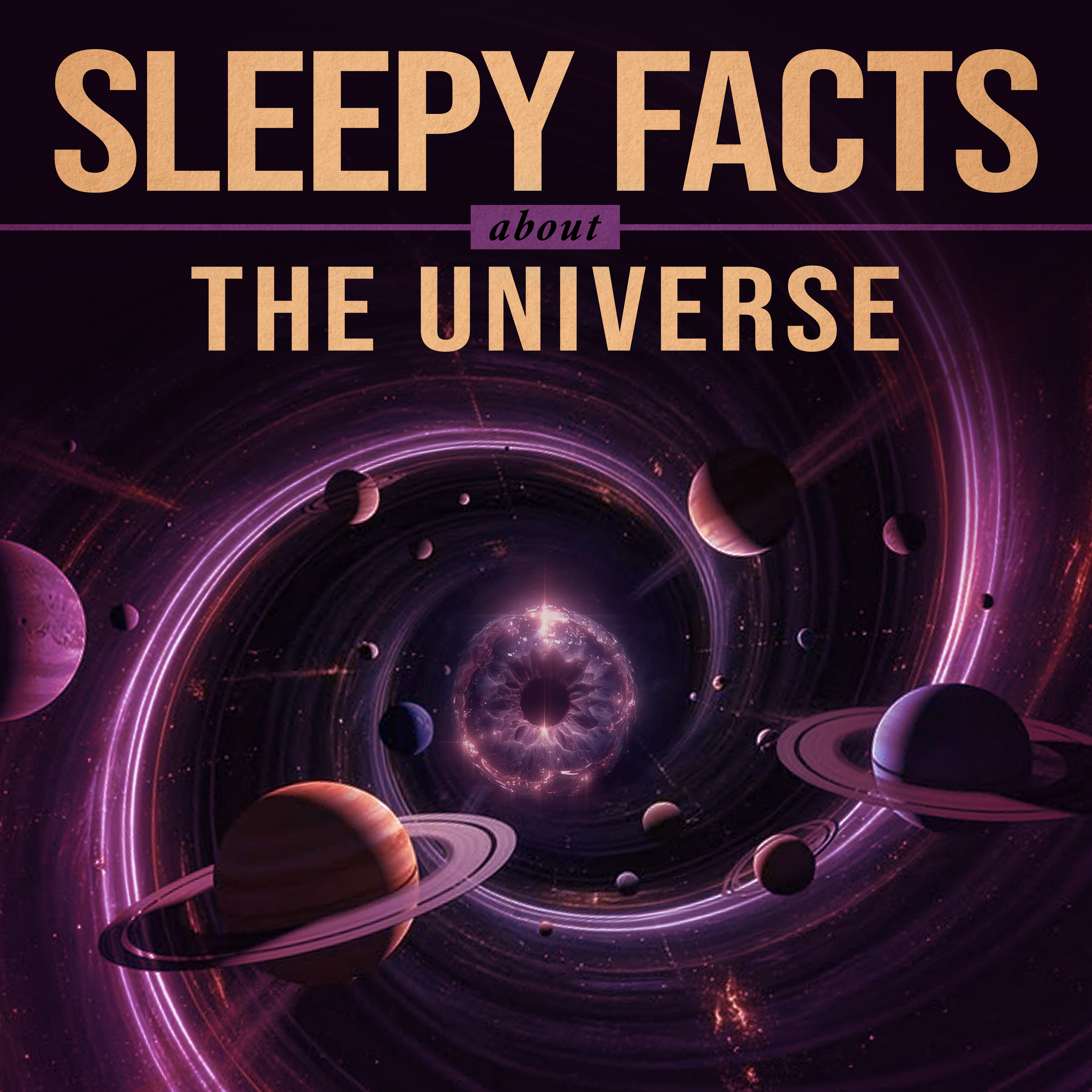
Sleepy Facts About the Universe
sciflix.one - Sleepy AstronomyAudio
- Format:
- Podcast
- New episodes:
- Daily
- Typical length:
- about 25 minutes
- Latest episode:
About this show
Sleepy Facts About the Universe is a calm astronomy and space science podcast for sleep, relaxation, and quiet curiosity.
Each episode explores the universe in a gentle documentary style: stars, planets, galaxies, black holes, nebulae, the Moon, the Sun, cosmic history, space missions, and simple explanations of astrophysics without loud drama or stressful narration.
If you enjoy relaxing science podcasts, space facts for sleep, astronomy explained, or peaceful documentaries about the cosmos, this show is designed to keep you curious while letting your mind slow down.
Sleepy Facts About the Universe is produced by the small team at sciflix.one (http://sciflix.one). Each episode is built from human-researched facts and written exclusively for this channel by science fiction author Sascha Schmidt and co-authored by Kyle Smith, with a steady focus on factual care, clear explanation, and a soothing bedtime tone.
The episodes are narrated by Kyle Smith’s synthetic voice, the familiar anchor voice of our Sleepy Facts series.
We are always interested in the questions that keep listeners curious. If there is a space topic, astronomy question, cosmic mystery, or scientific idea you would like us to cover, tell us what you would love to hear next.
For topic suggestions, feedback, or collaboration inquiries, contact us at [sleepyfacts@sciflix.one](mailto:sleepyfacts@sciflix.one).
Covers: astronomy, space science, astrophysics, space exploration, spacecraft propulsion, relativity, lunar science, history of astronomy
Show details and episodes come from the publisher's public feed at media.rss.com. Last updated . Names, artwork and text belong to their publishers.
Recently on this show
Summary of recent episodes, drawn from the publisher's feed.
This podcast explores space science and astronomy in a calm, gentle style for relaxation and quiet curiosity. Recent episodes cover tractor beams, relativity of simultaneity, ion engines, moonquake monitoring, and water recovery in space habitats.
Cosmos
Similar in subject
- The LIUniverse with Dr. Charles Liu
Both cover: lunar science, astrophysics, space science - Ask a Spaceman!
Both cover: relativity, astrophysics, space science - Looking Up
Both cover: astrophysics, space science, space exploration
Similar shows





Explore more
Episodes
How Does a Single Particle Interfere With Itself? - Quantum Amplitudes and the Superposition of Paths | Sleepy Facts About the Universe
· 34 min
Got something to say to this podcast? Send a voicemail, and you might hear yourself on the next episode! (https://rss.com/podcasts/sleepy-facts-about-the-universe/voicemail) When a single particle is sent through a device with two available routes, classical intuition suggests it must choose one path or the other. Yet the accumulated pattern of thousands of individual detections reveals an interference structure that no single, definite trajectory could ever produce. This episode examines what quantum theory actually says about this phenomenon, focusing specifically on the two-path interferometer and the mathematics of superposition without forcing the particle into a miniature traveler's narrative. We look at how probability amplitudes evolve, combine, and produce detectable interference patterns based on relative phase shifts. The discussion also covers why obtaining reliable which-path information destroys this interference, not through physical disturbance, but because the alternatives become distinguishable. From the Mach-Zehnder interferometer to the broader path integral formulation, the episode traces how classical trajectories emerge from the quantum sum, and how these principles underpin modern technologies like atomic clocks, electron microscopes, and gravitational sensors. I wanted to understand what happens when the familiar language of solid objects traveling definite routes fails to describe the experimental results. Some questions sound simple until you try to answer them carefully, and the behavior of a single particle in a two-path device forces us to examine how nature actually works at this scale, relying on amplitudes rather than hidden classical stories.
Not rated yetAre Coordinates the Same as Reality? - The Operational Meaning of a Reference Frame | Sleepy Facts About the Universe
· 35 min
Got something to say to this podcast? Send a voicemail, and you might hear yourself on the next episode! (https://rss.com/podcasts/sleepy-facts-about-the-universe/voicemail) If a cup of coffee sits on a train table, a passenger might say it is perfectly still, while someone on the platform insists it is moving at seventy miles per hour. Both are entirely correct, but neither statement is complete until they specify their reference frame. This episode examines what a reference frame actually is in physics, moving beyond the casual idea of a point of view to explore a rigorous system of coordinates, synchronized clocks, and distributed observers. The discussion covers the essential components required to build a frame, from clock synchronization conventions to the physical measurement procedures that anchor our descriptions of reality. It also distinguishes between inertial, accelerating, rotating, and freely falling frames, explaining how each type introduces different complexities, such as the fictitious forces we feel when a train brakes or the Coriolis effect that shapes a hurricane. By separating coordinate labels from invariant physical facts, the episode clarifies why changing a frame changes our mathematical descriptions without altering the underlying physics. Some questions sound simple until you try to answer them. I kept returning to the fundamental question of what makes a physical description complete, and I realized how often we confuse a subjective perspective with a rigorous measurement system. Understanding the operational reality of a reference frame reveals why no single frame is the absolute truth, and why the enduring, invariant relationships in physics are what truly matter.
Not rated yetWhy Is Gold Yellow and Mercury Liquid? - Einstein's Theory of Absolutes | Sleepy Facts About the Universe
· 25 min
Got something to say to this podcast? Send a voicemail, and you might hear yourself on the next episode! (https://rss.com/podcasts/sleepy-facts-about-the-universe/voicemail) Albert Einstein’s theory of relativity is usually associated with extreme cosmic phenomena like black holes, bent starlight, and spacecraft approaching the speed of light. Yet this abstract framework is quietly operating all around us, acting as an invisible infrastructure for daily life. This episode explores how the principles of relativity explain everything from the color of a gold ring to the liquid state of mercury in an old thermometer, and the precision of the satellite navigation system in your car. The episode examines how relativistic effects govern the behavior of fast-moving electrons in heavy atoms, altering the energy gaps they can bridge and fundamentally changing the physical properties of the metals we handle routinely. It also unpacks the practical necessity of relativistic corrections in Global Positioning System satellites, where uncorrected time dilation and gravitational shifts would quickly render the technology useless. By tracing these effects through electromagnetism, older television displays, and even the supernovae that forged the iron in our blood, the episode reveals a theory that is transparent in its foundations and inexhaustible in its consequences. I wanted to understand why a theory that sounds so difficult to approach explains so many things we encounter without thinking. Some questions sound simple until you try to answer them, and exploring the absolute constancy of the speed of light provided a fascinating way to bridge the gap between cosmic physics and ordinary experience. It is a calm, clear look at how the most profound scientific framework of the twentieth century structures the world right in front of us.
Not rated yetWhy Is a Dying Star the Coldest Natural Place in the Universe? - Breaking the Cosmic Temperature Floor | Sleepy Facts About the Universe
· 27 min
Got something to say to this podcast? Send a voicemail, and you might hear yourself on the next episode! (https://rss.com/podcasts/sleepy-facts-about-the-universe/voicemail) Most of us carry a simple picture of space as uniformly frigid, a void where nothing warms anything and temperature simply sinks toward some ultimate low. But space is not a single temperature. It is a radiation environment, and the Boomerang Nebula breaks what appears to be a universal thermal floor. Roughly five thousand light-years away in the constellation Centaurus, this cloud of ejected gas has a measured temperature of approximately one Kelvin, colder than the cosmic microwave background and the deepest intergalactic voids. This episode examines how the Boomerang Nebula achieves this extreme cold through a process called adiabatic expansion. As the dying red giant star at its center sheds its outer layers, the material expands rapidly into the near-vacuum of space. The gas does work on itself as it spreads outward, converting internal kinetic energy into bulk motion and causing its temperature to plummet. By exploring the distinction between temperature and heat, the episode reveals how a dynamic, rapidly changing system can temporarily fall below the universal background radiation. I wanted to understand why our everyday intuitions about temperature fail so completely in space. While working on this episode, I kept returning to one question: how can an object sitting inside a galaxy, surrounded by starlight, become colder than the emptiness between galaxies? The Boomerang Nebula provides a fascinating answer, reminding us that the universe's most extreme conditions are often found not in passive isolation, but in the active, violent processes of stellar death.
Not rated yetWhat Happens to Your Internal Clock Without Sunlight? - When the Body Generates Its Own Time | Sleepy Facts About the Universe
· 27 min
Got something to say to this podcast? Send a voicemail, and you might hear yourself on the next episode! (https://rss.com/podcasts/sleepy-facts-about-the-universe/voicemail) In September 1962, a young geologist emerged from a subterranean glacier cave in the French Alps, put on dark glasses to protect his eyes from the unfamiliar sun, and confidently informed his support team that the date was August 20th. In reality, it was September 14th. He had not simply forgotten the calendar. His body had been keeping its own time in the total darkness, and his internal clock had silently drifted nearly a month away from the world above. This episode explores the pioneering self-experiments of Michel Siffre, who deliberately lived in deep caves without clocks, sunlight, or temperature cues to understand how human time perception functions when stripped of all external references. We examine what his data revealed about the endogenous circadian rhythm, the biological mechanism that regulates our sleep-wake cycles independently of the sun, and how his subjective experience of duration stretched and slowed without his conscious awareness. I wanted to understand why a person could live through sixty-three days and genuinely not feel the passage of nearly a month. Siffre's methods were extreme and his conditions uncontrolled, but his willingness to use his own body as a scientific instrument provided the first direct evidence that humans generate their own internal time. It is a reminder that we are not merely creatures who respond to the passing hours, but biological timekeepers carrying our own hidden rhythms deep within our cells.
Not rated yetCan the Relativity of Simultaneity Reverse Cause and Effect? - Einstein's Train and the Geometry of Spacetime | Sleepy Facts About the Universe
· 29 min
Got something to say to this podcast? Send a voicemail, and you might hear yourself on the next episode! (https://rss.com/podcasts/sleepy-facts-about-the-universe/voicemail) Two observers stand at the exact same point in space just as lightning strikes the front and rear of a passing train. Both are careful, both correct for the travel time of light, and both use the same synchronized clocks. Yet they reach opposite conclusions about whether the strikes happened at the same time. This episode explores the relativity of simultaneity, the conceptual core of Einstein’s special relativity, to explain why this disagreement is not an error or an illusion, but a geometric consequence of spacetime. We look at how we actually assign a time to a distant event, why Einstein’s clock synchronization procedure depends on the constant speed of light, and how Hermann Minkowski’s four-dimensional spacetime allows different observers to slice the universe into entirely different planes of "now." We also examine why this frame-dependent timing never reverses cause and effect for events that can physically influence one another. Some questions sound simple until you try to answer them. I kept returning to one fundamental issue while working on this episode: what do we actually mean when we say two things happened "at the same time" across a distance? Exploring how the universal present dissolves into a relative, observer-dependent slicing of spacetime reveals a physical reality that is far more precise and structured than the popular idea that time is simply a matter of opinion.
Not rated yetWhy Do Gravitational Waves Travel at the Speed of Light? - The Geometric Boundary of Cause and Effect | Sleepy Facts About the Universe
· 25 min
Got something to say to this podcast? Send a voicemail, and you might hear yourself on the next episode! (https://rss.com/podcasts/sleepy-facts-about-the-universe/voicemail) We call it the speed of light, as if this fundamental constant belongs exclusively to photons. But the number 299,792,458 meters per second is not actually a property of light. It is the invariant causal speed built into spacetime itself, the geometric boundary that dictates what can influence what and how the universe is woven together. This episode examines the true nature of the constant we call c. Starting with the historical puzzle of Maxwell's equations and the Michelson-Morley experiment, the narrative moves through Einstein’s special relativity to reveal why space and time must mix. Light travels at this speed simply because photons are massless, but the speed itself belongs to the geometry of cause and effect. It is the same conversion factor that relates mass to energy in E=mc² and connects electricity to magnetism. By looking at massless gravitational waves detected by LIGO, we see how this single invariant speed governs all massless disturbances. Some questions sound simple until you try to answer them. I kept returning to one idea while working on this episode: why does the universe have a speed limit at all? Exploring the geometry of spacetime reveals that this limit is not a traffic law imposed on objects, but the structural foundation of cause and effect. I find it deeply fascinating that light is merely one phenomenon probing this boundary, and I wanted to understand what it means for the shape of possibility itself.
Not rated yetHow Does the Universe Cool as Space Expands? - Heat Death and the End of Cosmic Gradients | Sleepy Facts About the Universe
· 28 min
Got something to say to this podcast? Send a voicemail, and you might hear yourself on the next episode! (https://rss.com/podcasts/sleepy-facts-about-the-universe/voicemail) The familiar image of the universe's end is a frozen cosmos, locked in eternal stillness at absolute zero. But this common picture misses the actual physics of how the universe will die. Heat death is not about reaching a specific temperature; it is about reaching a state where nothing useful can happen anymore. This episode examines the complex thermal evolution of the cosmos, explaining how the cosmic microwave background cools through the stretching of space rather than by losing energy to a colder environment. It explores the different cooling mechanisms of stellar remnants like white dwarfs and neutron stars, the eventual evaporation of black holes through Hawking radiation, and the thermal floor set by dark energy and cosmological event horizons. Ultimately, the universe approaches a state of maximum entropy at a finite, unimaginably small temperature, where the absence of temperature gradients means no work can ever be done again. I wanted to understand why the universe's death is often described as a freeze when the physics points toward a warm, uniform sameness. Some questions sound simple until you try to answer them, and exploring the difference between reaching absolute zero and reaching thermodynamic equilibrium completely changed how I think about the end of all things.
Not rated yetCan a Universe Begin Inside an Already-Inflating Spacetime? - False Vacuum Decay and the Birth of a Cosmos | Sleepy Facts About the Universe
· 21 min
Got something to say to this podcast? Send a voicemail, and you might hear yourself on the next episode! (https://rss.com/podcasts/sleepy-facts-about-the-universe/voicemail) Theoretical physics proposes that our universe might not be a singular, miraculous event, but rather an ongoing process embedded within a larger, eternally inflating spacetime. This episode explores the rigorous mathematical framework of how a bubble universe could be born from a field trapped in a false vacuum. By examining the mechanics of quantum tunneling, we look at how a microscopic transition through a classically forbidden energy barrier can nucleate a new region of true vacuum, producing an expanding boundary that propagates at nearly the speed of light. Inside this localized bubble, the energy released by the vacuum decay drives a period of reheating, generating fundamental particles and thermal radiation in an event remarkably similar to a local Big Bang. The episode also examines the counterintuitive interior geometry of these bubbles, explaining how an open, negatively curved spacetime can make a region that begins microscopically appear boundless and potentially infinite to observers within it. This episode began with a deceptively simple question about cosmic origins, and I kept returning to the distinction between creating space from nothing and transitioning between field states. I wanted to understand how a cosmos like ours could emerge not as a unique creation event, but as a localized quantum fluctuation in a pre-existing geometry. While no bubble universe has ever been observed, the theoretical architecture underlying this model offers a fascinating, mathematically precise way to reconsider what cosmic birth actually means.
Not rated yetWhat Is the True Edge of the Observable Universe? - Beyond the Cosmic Microwave Background | Sleepy Facts About the Universe
· 21 min
Got something to say to this podcast? Send a voicemail, and you might hear yourself on the next episode! (https://rss.com/podcasts/sleepy-facts-about-the-universe/voicemail) When we look out into the cosmos, the farthest light we can see has traveled for roughly 13.8 billion years. It seems logical to assume that the edge of the observable universe is therefore 13.8 billion light-years away. This episode explores why that intuitive picture is entirely wrong, and why the true boundary of our observable universe—the particle horizon—currently sits about 47 billion light-years away. The answer lies in the fact that space itself is not a static stage. While light has been traveling toward us at a fixed speed since the hot early phase of the universe, the geometry of space has been continuously stretching underneath that journey. This episode examines the particle horizon not as a physical wall or a barrier of galaxies, but as a dynamic boundary in spacetime that defines exactly how much of cosmic history has ever been able to send us a message. We also look at the difference between this mathematical causal limit and the practically observable universe, which is currently bounded by the opaque plasma of the early cosmos and the faint glow of the cosmic microwave background. Some questions sound simple until you try to answer them. I kept returning to the puzzle of how distance and time interact when the very fabric of space is expanding. Understanding the particle horizon completely changes how we measure the scale of everything that exists around us, and I wanted to share that shift in perspective. It is a humbling reminder that our view of the universe is shaped entirely by the finite speed of light and the stretching geometry of spacetime.
Not rated yetWhy Do Stars at the Edge of Galaxies Orbit So Fast? - Dark Matter Halos and Modified Newtonian Dynamics | Sleepy Facts About the Universe
· 25 min
Got something to say to this podcast? Send a voicemail, and you might hear yourself on the next episode! (https://rss.com/podcasts/sleepy-facts-about-the-universe/voicemail) When we look at a galaxy, we naturally expect it to behave like our own Solar System. Because the Sun holds nearly all the mass at the center, planets closer to it orbit quickly, while distant Neptune crawls slowly along its path. If galaxies worked the same way, the stars at their faint outer edges should barely move. Yet for half a century, astronomers have observed that they do not slow down. Instead, the orbital speeds of outer stars remain remarkably constant, creating what is known as a flat rotation curve. This episode examines why galactic rotation defies our expectations and how astronomers actually measure the motion of invisible edges. By tracking the faint radio whisper of neutral hydrogen gas using the 21-centimeter line, scientists can map orbital speeds far beyond where starlight fades. The episode explores the two primary interpretations of this persistent data: the dominant theory of dark matter halos, which postulates a vast sea of unseen mass, and Modified Newtonian Dynamics, or MOND, which suggests that gravity itself behaves differently in regions of extremely low acceleration. I wanted to understand why a simple observation about how galaxies spin has kept astrophysicists debating for decades. It is fascinating how measuring the speed of something in darkness forces us to question what we know about mass and the fundamental laws of physics. Whether the answer lies in hidden matter or altered forces, the flat rotation curve reveals a universe far more complex than our everyday intuition suggests.
Not rated yetWhy Is the Universe’s Expansion Hidden Nearby? - Peculiar Velocities and the Hidden Hubble Flow | Sleepy Facts About the Universe
· 29 min
Got something to say to this podcast? Send a voicemail, and you might hear yourself on the next episode! (https://rss.com/podcasts/sleepy-facts-about-the-universe/voicemail) When astronomers look at nearby galaxies, the data looks like pure chaos. Some galaxies are rushing toward us, others are drifting away, and there seems to be no organizing principle. Only when the catalogue of observed galaxies stretches into the hundreds of millions of light-years does a clear pattern emerge: the farther away a galaxy sits, the faster it recedes. This is the Hubble flow, the foundational observation of our expanding universe. But seeing this calm cosmic current requires stripping away the local gravitational eddies that obscure it. This episode explores how astronomers disentangle cosmic expansion from local motion. It examines the cosmic distance ladder, the redshift measurements pioneered by Edwin Hubble and Georges Lemaître, and the gravitational pull of massive structures like the Great Attractor and the Shapley Supercluster. It also explains how the cosmic microwave background provides a practical rest frame, allowing scientists to subtract our own complex motion through space and reveal the underlying expansion. I wanted to understand why a pattern as fundamental as the expansion of the universe could be completely invisible in our own backyard. While working on this episode, I kept returning to one question: what does it actually take to see the cosmos clearly when we are constantly moving through it? The answer requires patience, precise measurement, and a willingness to account for every gravitational tug pulling on our local group of galaxies.
Not rated yetIs the Big Bang Singularity a Real Physical Event? - The Physics of Before the Big Bang | Sleepy Facts About the Universe
· 27 min
Got something to say to this podcast? Send a voicemail, and you might hear yourself on the next episode! (https://rss.com/podcasts/sleepy-facts-about-the-universe/voicemail) The question of what came before the Big Bang feels entirely natural, largely because human experience assumes time is a continuous line stretching endlessly in both directions. This episode examines why that seemingly simple inquiry becomes extraordinarily complicated when we look closely at what the Big Bang model actually says, what time itself might be, and how different physical theories handle the earliest moments of the universe. The hot Big Bang model is supported by multiple independent lines of evidence, including the expansion of the universe, the cosmic microwave background, and primordial nucleosynthesis. However, the model describes the evolution of an already-existing hot, dense state rather than an absolute beginning. When classical general relativity is extrapolated backward, it predicts a singularity—a mathematical breakdown rather than a physical object. At this boundary, the question of what came before depends entirely on which theory of quantum gravity or cosmological model, such as cosmic inflation or bounce cosmologies, turns out to be correct. I wanted to understand why asking what happened before the Big Bang is so difficult to answer responsibly. While working on this episode, I kept returning to one question: are we asking about the limits of our theories, or the limits of time itself? It is a profound inquiry that reveals how carefully we must distinguish between established science, theoretical proposals, and the everyday grammar that shapes our assumptions about reality.
Not rated yetAre Moon Phases Caused by Earth's Shadow? - The Daytime Moon and the Geometry of Lunar Visibility | Sleepy Facts About the Universe
· 22 min
Got something to say to this podcast? Send a voicemail, and you might hear yourself on the next episode! (https://rss.com/podcasts/sleepy-facts-about-the-universe/voicemail) The Moon is above the horizon roughly half the time, distributed across daylight and darkness without preference. Yet most of us file its daytime appearances away as anomalies, a quiet demonstration of how powerfully our categories constrain what we are prepared to see. This episode explores the geometry of the Earth-Moon-Sun system to explain why the Moon is often visible in a blue afternoon sky and how its orbital position dictates its shifting presence throughout the day and night. The discussion examines the mechanics of lunar visibility, including angular separation, the low reflectivity of the lunar surface, and the role of Rayleigh scattering in creating the sky contrast necessary for daytime observation. It also addresses a widespread misconception about the lunar cycle, clarifying why the monthly progression of phases is caused by the changing angle of sunlight rather than by Earth's shadow. Some questions sound simple until you try to answer them. I recently found myself wondering why a pale disk in the afternoon sky feels quietly wrong, when it is actually the Moon following its ordinary orbit. I wanted to understand how our assumptions about the night sky shape our perception, and how a corrected mental model of the Earth-Moon-Sun system can change the way we look up.
Not rated yetHow Does a Broken Egg Connect to the Origin of Time? - Gravitational Entropy and the Cosmic Past | Sleepy Facts About the Universe
· 28 min
Got something to say to this podcast? Send a voicemail, and you might hear yourself on the next episode! (https://rss.com/podcasts/sleepy-facts-about-the-universe/voicemail) Every broken egg and cooling cup of coffee carries an unspoken assumption: that time moves forward, never back. This everyday irreversibility is governed by the second law of thermodynamics, which states that entropy tends to increase in isolated systems. But this law describes how systems change without explaining why entropy was ever low enough to increase in the first place. The answer lies in the universe's earliest moments, a starting condition so exceptionally ordered that its ongoing unravelling defines the difference between past and future. This episode examines the cosmological puzzle of the arrow of time, focusing on how gravity inverts our usual understanding of disorder. While a smooth, uniform gas might seem like a state of maximum entropy, a smooth distribution of matter under gravity is actually a highly special, low-entropy arrangement. The near-perfect smoothness of the early cosmos, evidenced by the cosmic microwave background, set up a cosmic gradient. As gravity amplified tiny density differences, it formed galaxies, stars, and supermassive black holes, driving the universe toward higher gravitational entropy and fueling the forward flow of time. I wanted to understand why everyday processes like aging, memory, and the fading of a photograph are not just local curiosities, but physical consequences of this grand cosmic history. Exploring the boundary condition of the early universe reveals that the familiar arrow of time is not a fundamental force, but the local experience of a cosmic inheritance being gradually spent. It is a profound reminder that the simplest daily observations are deeply connected to the largest structures in the cosmos.
Not rated yetHow Did We Discover the Universe Is Expanding? - From Spiral Nebulae to Cosmic Expansion | Sleepy Facts About the Universe
· 20 min
Got something to say to this podcast? Send a voicemail, and you might hear yourself on the next episode! (https://rss.com/podcasts/sleepy-facts-about-the-universe/voicemail) For centuries, the night sky offered a quiet promise of permanence. Stars moved, but they did so within a fixed, eternal hall. When Einstein completed his general theory of relativity, the math described a cosmos that could not sit still, yet observational astronomy saw only stillness. To reconcile his equations with the apparent stability of the heavens, Einstein introduced the cosmological constant—a mathematical fudge factor to hold the universe in place. But in Flagstaff, Arizona, astronomer Vesto Slipher was spending freezing nights photographing spiral nebulae, discovering they were fleeing at speeds that made no local sense. This episode traces the path from that tolerated anomaly to the discovery of cosmic expansion. We explore how Henrietta Leavitt’s Cepheid variable stars provided a cosmic yardstick, and how Edwin Hubble used the 100-inch Hooker telescope at Mount Wilson to prove these nebulae were distant galaxies, not local gas clouds. By combining distance measurements with Slipher's velocity data, Hubble revealed a linear relationship: the further away a galaxy, the faster it recedes. The universe was not static; it was stretching. I wanted to understand why a single observational discrepancy could overturn an entire cosmological framework. While working on this episode, I kept returning to the human element—the patience required at the telescope, the reluctance to abandon a beautiful theory, and the eventual realization that an anomaly is not an error, but a signal waiting to be understood.
Not rated yetHow Do Astronomers Read Spectral Fingerprints From the Early Universe? - Translating the Redshifted Light of the Early Universe | Sleepy Facts About the Universe
· 30 min
Got something to say to this podcast? Send a voicemail, and you might hear yourself on the next episode! (https://rss.com/podcasts/sleepy-facts-about-the-universe/voicemail) When the intense ultraviolet light of a newborn galaxy from twelve billion years ago finally reaches our detectors, it no longer arrives as ultraviolet. It has been stretched into infrared radiation by the expansion of space itself. This translation across the electromagnetic spectrum is not a corruption of information, but the foundational fact that makes modern cosmology possible. This episode explores how a photon's wavelength lengthens over cosmic time, examining the distinct physical mechanisms of cosmological, Doppler, and gravitational redshift. To recover evidence from the ancient universe, astronomers must learn to read light in the band where it arrives rather than the band where it was emitted. By tracking the displaced spectral fingerprints of elements like hydrogen, scientists can identify the age, distance, and composition of distant objects. This same principle explains why the James Webb Space Telescope was built to observe infrared light, and why the visible light of the cosmic microwave background now arrives as radio waves. I wanted to understand why a telescope designed to see the earliest stars must be effectively blind to visible light. Some questions sound simple until you try to answer them, and tracing the journey of a single photon across an expanding universe reveals just how much information is preserved when light is stretched, rather than lost.
Not rated yetHow Would a Four-Dimensional Object Appear in Our World? - Hyperspheres and Hypercubes in Three-Dimensional Space | Sleepy Facts About the Universe
· 28 min
Got something to say to this podcast? Send a voicemail, and you might hear yourself on the next episode! (https://rss.com/podcasts/sleepy-facts-about-the-universe/voicemail) A point appears from nowhere, swells into a perfectly round sphere, and then shrinks back to nothing before vanishing entirely. This is not a trick of magic, but the exact geometric trace a four-dimensional object would leave if it ever intersected our world. This episode explores the thought experiment of how a hypersphere or a hypercube would appear to us, using Edwin Abbott Abbott's Flatland as a guide to understand how lower-dimensional observers perceive higher-dimensional structures. While working on this episode, I kept returning to one question: where exactly does the mathematics of higher dimensions end and the physics of our universe begin? It is easy to assume that if a shape can be described with rigorous geometry, it must somehow exist physically. Yet the distinction is crucial. The geometry of a four-dimensional object passing through our space is as certain as the Pythagorean theorem, but physics tells a different story. Even if extra dimensions exist at the microscopic scales proposed by string theory, the familiar matter of our world may be permanently confined to a three-dimensional membrane. I wanted to understand why this separation matters, not just for theoretical physics, but for how we evaluate scientific claims in popular culture. By separating what geometry genuinely permits from what physics actually allows, we can appreciate the profound limits of our perception and the rigorous clarity of dimensional reasoning.
Not rated yetCan a Visual Pattern Unlock a New State of Quantum Matter? - The Bosonic Correlated Insulator | Sleepy Facts About the Universe
· 24 min
Got something to say to this podcast? Send a voicemail, and you might hear yourself on the next episode! (https://rss.com/podcasts/sleepy-facts-about-the-universe/voicemail) A moiré pattern is a familiar visual curiosity, the shimmering geometry that appears when two window screens overlap and rotate slightly against each other. Recently, physicists have translated this accidental visual effect into an atomic-scale architecture, using twisted layers of material to construct a completely new state of matter known as a bosonic correlated insulator. This episode explores how scientists built this crystalline structure out of excitons, which are composite quasiparticles formed when an electron binds to the hole it leaves behind. We look at how these engineered lattices trap the excitons, causing them to lock into an immobile, ordered phase much like cars in a traffic jam. Along the way, the episode also clarifies several common misconceptions about quantum mechanics, taking a clear look at what superposition, entanglement, and the speed of light actually mean. While working on this episode, I kept returning to one question: how can something defined by an absence, a hole where an electron used to be, behave as a real physical particle? I wanted to understand how the fundamental rules of fermions and bosons allow us to assemble entirely new phases of matter from these elusive components. It is a subject that challenges our intuition about physical substance, and I found it deeply fascinating to trace the path from a simple overlapping mesh to a genuine quantum breakthrough.
Not rated yetWhere Does Charge Go When a Black Hole Evaporates? - The Exterior Field of a Charged Black Hole | Sleepy Facts About the Universe
· 26 min
Got something to say to this podcast? Send a voicemail, and you might hear yourself on the next episode! (https://rss.com/podcasts/sleepy-facts-about-the-universe/voicemail) When an electron crosses the event horizon of a black hole, it vanishes from the observable universe. Yet the electric field it generated persists, measurable by any outside observer, as if the black hole itself has become the charge. This raises a fundamental question about the extremes of physical law: if black holes eventually evaporate, what happens to the electric charge they swallow? This episode examines how classical electromagnetism, general relativity, and quantum field theory converge to answer this puzzle. We explore how Gauss's law allows us to measure the total charge of a black hole from the outside, and how the no-hair theorem reduces a black hole's identity to just mass, spin, and charge. We then look at Hawking radiation, vacuum polarization, and the deep structural difference between local gauge symmetries, which protect electric charge, and global symmetries, which may not survive quantum gravity. I wanted to understand why electric charge is so robustly preserved in these extreme environments, especially when other quantum numbers might be lost. Some questions sound simple until you try to answer them, and tracing the journey of a single electron into a gravitational singularity reveals just how deeply conservation laws are woven into the structure of spacetime itself.
Not rated yet