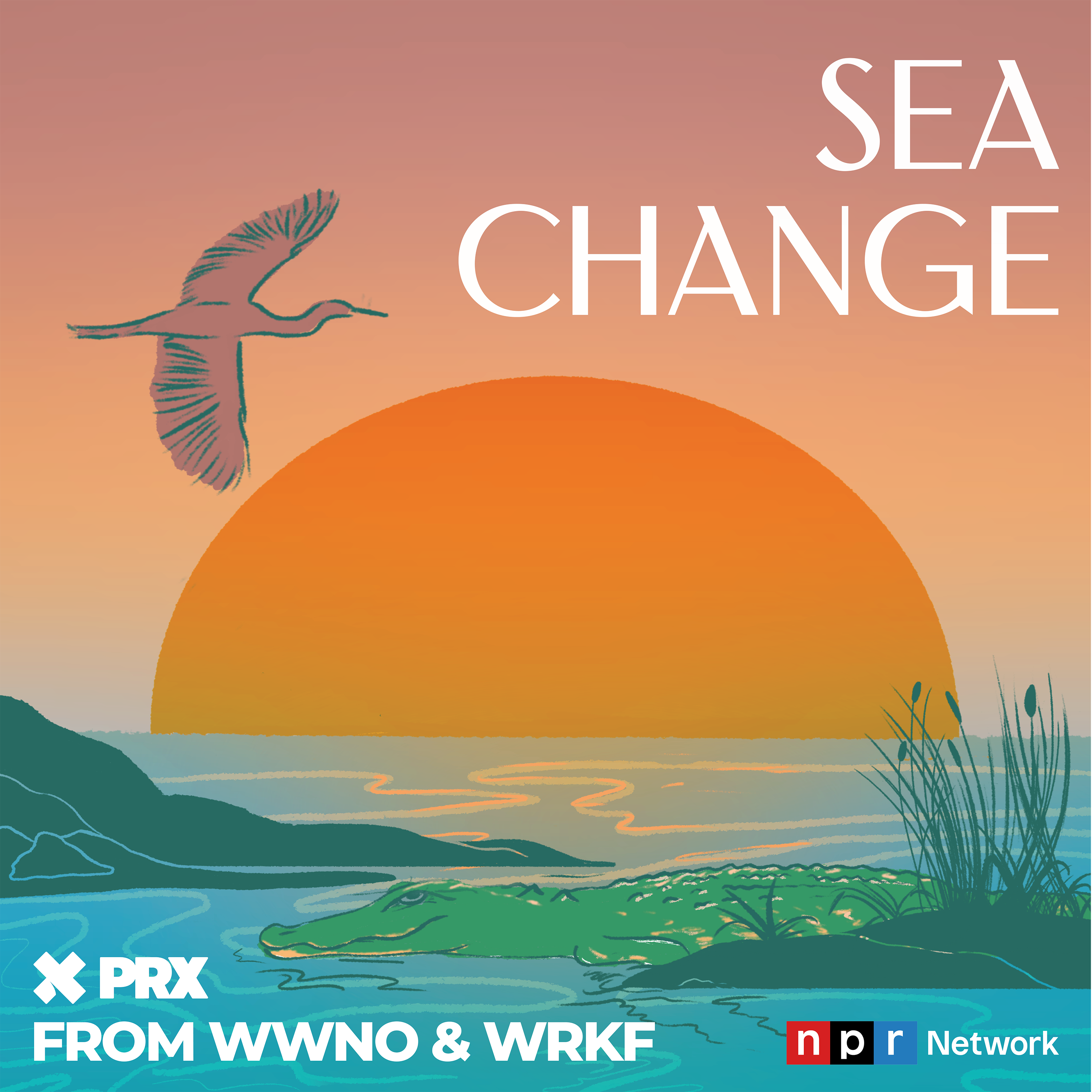
Sea Change
WWNO & WRKFAudio
- Format:
- Podcast
- New episodes:
- Every two weeks
- Typical length:
- about 35 minutes
- Latest episode:
About this show
Living on the coast means living on the front lines of a rapidly changing planet. And as climate change transforms our coasts, that will transform our world.
Every two weeks, we bring you stories that illuminate, inspire, and sometimes enrage, as we dive deep into the environmental issues facing coastal communities on the Gulf Coast and beyond. We have a lot to save, and we have a lot of solutions. Join us as we investigate and celebrate life on a changing coast. It’s time to talk about a Sea Change.
Based in New Orleans, Sea Change is a production of WWNO New Orleans Public Radio and WRKF Baton Rouge Public Radio. Sea Change is a part of the NPR Podcast Network and is distributed by PRX. Hosted by Carlyle Calhoun. Our theme song is by Jon Batiste.
Sea Change is made possible with major support provided by The Gulf Research Program of the National Academies of Sciences, Engineering, and Medicine and The Water Collaborative. The Coastal Desk is supported by the Walton Family Foundation, the Greater New Orleans Foundation, and the Meraux Foundation.
Covers: climate change, coastal communities, environmental policy, wetlands conservation, sea level rise, marine pollution, wildlife conservation, science journalism
Show details and episodes come from the publisher's public feed at publicfeeds.net. Last updated . Names, artwork and text belong to their publishers.
Recently on this show
Summary of recent episodes, drawn from the publisher's feed.
Sea Change is a podcast about environmental issues facing coastal communities, especially on the Gulf Coast, as climate change reshapes shorelines. Recent episodes cover flood-adapting island life in Germany, the Dutch relationship with the sea, a proposed SpaceX spaceport in Louisiana, and efforts to bring back puffins and pelicans.
Cosmos
Similar in subject
- The Science Show
Both cover: science journalism, wildlife conservation, climate change - Living Planet
Both cover: sea level rise, climate change - Breaking Down: Collapse
Both cover: sea level rise, climate change
Similar shows


Explore more
Episodes
Wetlands Radio: Part 2
· 33 min
The media is full of stories about the coastal land loss crisis in Louisiana, dire predictions of climate change and sea level rise, and polarizing accounts of controversial projects. What's less known is that Louisiana is really good at something. A world leader, in fact. When it comes to coastal restoration, some say Louisiana is number one. Because project by project, Louisiana is piecing this ragged shoreline back together. Over the next four episodes of Sea Change, we're going to feature Wetlands Radio. The series is a deep dive into Louisiana's coast - both how it came to be imperiled and also the incredible things a mighty group of people is doing to fight land loss. In part 2, we’re going to talk about building land, a vital part of coastal restoration, and often a very controversial one. We get into the thorny politics of human-led land building projects, but first, we look at how the river builds land when left to its own devices. A process many are trying to imitate. EPISODE CREDITS This episode was hosted by Executive Producer Carlyle Calhoun and Wetlands Radio producer Eve Abrams. Wetlands Radio is produced by Eve Abrams and funded by BTNEP, the Barataria Terrebonne National Estuary Program through the Environmental Protection Agency's National Estuary Program. To hear Wetlands Radio episodes in their entirety, visit btnep.org (https://btnep.org/2025/10/10/wetlands-radio-show/). Sea Change is a WWNO and WRKF production. We are part of the NPR Podcast Network and distributed by PRX. Sea Change is made possible with major support from the Gulf Research Program of the National Academy of Sciences, Engineering, and Medicine. Sea Change is also supported by the Water Collaborative of Greater New Orleans. WWNO’s Coastal Desk is supported by the Walton Family Foundation, the Meraux Foundation, and the Greater New Orleans Foundation.
Not rated yetWetlands Radio: Part 1
· 33 min
Louisiana is a world leader in coastal restoration. Many would even say number one. The media is full of stories about the coastal land loss crisis in Louisiana, the dire predictions of climate change and sea level rise, and polarizing accounts of controversial projects, but what is also true is that Louisiana is making tremendous strides piecing this ragged shoreline back together little by little. Over the next four episodes of Sea Change, we're going to feature Wetlands Radio. The series is a deep dive into Louisiana's coast - both how it came to be imperiled and also, the incredible things a mighty group of people are doing to fight land loss. In part one, how did we get here? From deep geology, to efforts to control the Mississippi River, to the boom days of oil and gas, we discover the backstory that led to the start of coastal restoration. EPISODE CREDITS This episode was hosted by Executive Producer Carlyle Calhoun and Wetlands Radio producer Eve Abrams. Wetlands Radio is produced by Eve Abrams and funded by BTNEP, the Barataria Terrebonne National Estuary Program through the Environmental Protection Agency's National Estuary Program. To hear Wetlands Radio episodes in their entirety, visit btnep.org (https://btnep.org/2025/10/10/wetlands-radio-show/). Sea Change is a WWNO and WRKF production. We are part of the NPR Podcast Network and distributed by PRX. Sea Change is made possible with major support from the Gulf Research Program of the National Academy of Sciences, Engineering, and Medicine. Sea Change is also supported by the Water Collaborative of Greater New Orleans. WWNO’s Coastal Desk is supported by the Walton Family Foundation, the Meraux Foundation, and the Greater New Orleans Foundation.
Not rated yetUnderstanding the Mysterious Loop Current
· 37 min
The amazing science behind understanding mysterious but critical ocean currents. And specifically, understanding the current in our backyard, the Gulf’s Loop Current. We talk with scientists leading a huge multi-country research collaboration that is going to great lengths and depths to understand the especially unknown Loop Current. We talk about how currents connect us, how they are basically a thermostat for the globe, and why, more than ever before, we need to understand them. EPISODE CREDITS This episode was hosted by executive producer Carlyle Calhoun. Our theme music is by Jon Batiste, and our sound designer is Emily Jankowski. Scientists featured in this episode are paleo oceanographer Audrey Morley (https://research.universityofgalway.ie/en/persons/audrey-morley/) from the University of Galway, oceanographer Amy Bower (https://www.whoi.edu/profile/abower/%20) from the Woods Hole Oceanographic Institution, oceanographer Steve DiMarco (https://artsci.tamu.edu/oceanography/contact/profiles/steve-dimarco.html%20)from Texas A&M, and oceanographer Scott Glenn (https://marine.rutgers.edu/team/scott-glenn/) from Rutgers University. Sea Change is a WWNO and WRKF production. We are part of the NPR Podcast Network and distributed by PRX. Sea Change is made possible with major support from the Gulf Research Program of the National Academy of Sciences, Engineering, and Medicine. Sea Change is also supported by the Water Collaborative of Greater New Orleans. WWNO’s Coastal Desk is supported by the Walton Family Foundation, the Meraux Foundation, and the Greater New Orleans Foundation.
Not rated yetFarming the Ocean: Part 2
· 23 min
This is part 2 of a 2-part series exploring the future of farming seafood in the Gulf. We know this: demand for seafood is soaring. We won't be able to sustainably meet that demand from wild-caught fisheries. And there’s a growing global movement to farm more and more of our seafood. The Gulf is one of the LAST places in the world where there is still a major wild oyster harvest. Lately, though, that harvest…is in trouble. In this episode, we ask: What can the downfall and resurrection of the oyster tell us about a future of farming the ocean? EPISODE CREDITS This series is produced in partnership with the Food and Environment Reporting Network. This episode was hosted by Carlyle Calhoun and Boyce Upholt. Boyce also reported this episode. Editing by Jack Rodolico. Carlyle Calhoun is the executive producer. The episode was fact-checked by Garrett Hazelwood. Our theme music is by Jon Batiste, and our sound designer is Emily Jankowski. Sea Change is a WWNO and WRKF production. We are part of the NPR Podcast Network and distributed by PRX. Sea Change is made possible with major support from the Gulf Research Program of the National Academy of Sciences, Engineering, and Medicine. Sea Change is also supported by the Water Collaborative of Greater New Orleans. WWNO’s Coastal Desk is supported by the Walton Family Foundation, the Meraux Foundation, and the Greater New Orleans Foundation.
Not rated yetFarming the Ocean: Part 1
· 30 min
This is part 1 of a 2-part series exploring the future of farming seafood in the Gulf. Americans eat a lot of farmed seafood — but the vast majority of it comes from overseas. We just don’t farm fish on a big scale in U.S. waters. Now that might start to change. There are proposals to build massive fish farms in U.S. federal waters. And guess which coast is likely to be the first home for these new farms? You guessed it, the Gulf. So is this a miracle cure or a looming ecological disaster? EPISODE CREDITS This series is produced in partnership with the Food and Environment Reporting Network. This episode was hosted by Carlyle Calhoun and Boyce Upholt. Boyce also reported this episode. Editing by Jack Rodolico. Carlyle Calhoun is the executive producer. The episode was fact-checked by Garrett Hazelwood. Our theme music is by Jon Batiste, and our sound designer is Emily Jankowski. Voices featured at the top of the episode in order of appearance: Melvin Jackman in Newfoundland, Fay Orfanidou in Greece, Nick Underdown in Scotland, and Leticia Caro and Claudio Carocca in Chile. Sea Change is a WWNO and WRKF production. We are part of the NPR Podcast Network and distributed by PRX. Sea Change is made possible with major support from the Gulf Research Program of the National Academy of Sciences, Engineering, and Medicine. Sea Change is also supported by the Water Collaborative of Greater New Orleans. WWNO’s Coastal Desk is supported by the Walton Family Foundation, the Meraux Foundation, and the Greater New Orleans Foundation.
Not rated yetClassic Episode: Riddle of the Kemp's Ridley Sea Turtle
· 37 min
The story we are bringing you today is about sea turtles. In fact, it’s about the smallest and most endangered of sea turtles, called the Kemp’s Ridley. It’s a surprising and optimistic tale about a turtle’s return to Louisiana. We reported this episode back in 2023, but we wanted to revisit it because who doesn’t need more sea turtles in their life right now? And also because there has been some big news for sea turtles recently. This episode was hosted and produced by Carlyle Calhoun. Sea Change's theme music is by Jon Batiste, and our sound designer is Emily Jankowski. Carlyle Calhoun is the executive producer. Sea Change is a WWNO and WRKF production. We are part of the NPR Podcast Network and distributed by PRX. And to help others find our podcast, hit subscribe wherever you get your podcasts. Sea Change is made possible with major support from the Gulf Research Program of the National Academy of Sciences, Engineering, and Medicine. Sea Change is also supported by the Water Collaborative of Greater New Orleans. WWNO’s Coastal Desk is supported by the Walton Family Foundation, the Meraux Foundation, and the Greater New Orleans Foundation.
Not rated yetNo Matter the Water
· 28 min
What does it take to stay rooted on the Gulf Coast, even as the land and weather change around us? We meet individuals, from a poet to a minister to a computer programmer, each finding their own creative ways to adapt and fight for the future of their communities. From amphibious homes to inland retreats to processing our changing environment through poetry, we hear how people's ingenuity is helping chart a new path forward. To hear more from Rachel Nederveld's oral history series, No Matter the Water, click here (https://thecurrentla.com/podcasts/no-matter-the-water/) or find it wherever you get your podcasts. This episode was hosted and produced by Carlyle Calhoun. Sea Change's theme music is by Jon Batiste, and our sound designer is Emily Jankowski. Carlyle Calhoun is the executive producer. Sea Change is a WWNO and WRKF production. We are part of the NPR Podcast Network and distributed by PRX. And to help others find our podcast, hit subscribe wherever you get your podcasts. Sea Change is made possible with major support from the Gulf Research Program of the National Academy of Sciences, Engineering, and Medicine. Sea Change is also supported by the Water Collaborative of Greater New Orleans. WWNO’s Coastal Desk is supported by the Walton Family Foundation, the Meraux Foundation, and the Greater New Orleans Foundation.
Not rated yetThe Quiet Revolution Saving Fish and Fishermen
· 31 min
There was a time back in the 1980s when overfishing had decimated popular fish like red snapper and grouper in the Gulf. But then, there was a dramatic turning point, when both fish and fishermen in the Gulf were kind of saved. Today, we hear the remarkable success story of how unlikely partners joined forces to save an industry and an ecosystem. In this episode, Environmental Defense Fund's Executive Director, Amanda Leland, water resilience author, James Workman, and fisherman, Buddy Guidon, talk about how catch shares created a quiet revolution. To learn more, check out Amanda and James' book, Sea Change: Unlikely Allies and a Success Story of Oceanic Proportions. (https://www.torreyhouse.org/product-page/sea-change-paperback-edf) This episode was hosted by Carlyle Calhoun and Michael McEwen. Michael conducted the interview. Our sound designer is Emily Jankowski, and our theme music is by Jon Batiste. Carlyle Calhoun is the executive producer. Sea Change is a WWNO and WRKF production. We are part of the NPR Podcast Network and distributed by PRX. Sea Change is made possible with major support from the Gulf Research Program of the National Academy of Sciences, Engineering, and Medicine. Sea Change is also supported by the Water Collaborative of Greater New Orleans. WWNO’s Coastal Desk is supported by the Walton Family Foundation, the Meraux Foundation, and the Greater New Orleans Foundation.
Not rated yetThe Trojan Seahorse
· 32 min
Today, we’re bringing you a wild story. It’s about a covert ocean adventure from back in the Cold War days that inadvertently set off a brand new industry. And it’s an industry that’s been in the news a lot lately: deep-sea mining. Earlier this year, President Trump signed an executive order to try to fast-track deep-sea mining, while many countries are calling for more research before any mining can proceed or an outright ban. The deep ocean is the least known place on Earth, and scientists say we are only beginning to understand the power of the deep. And to tell the incredible backstory of how the industry that could forever change our ocean got its start, we are bringing you an episode from one of our favorite public radio podcasts: Outside/In (https://outsideinradio.org/) from New Hampshire Public Radio. This episode was reported and produced by Daniel Ackerman. Sea Change is a WWNO and WRKF production. Carlyle Calhoun is Sea Change's executive producer. Emily Jankowski is our sound designer, and our theme music is by Jon Batiste. We are part of the NPR Podcast Network and distributed by PRX. Sea Change is made possible with major support from the Gulf Research Program of the National Academy of Sciences, Engineering, and Medicine. Sea Change is also supported by the Water Collaborative of Greater New Orleans. WWNO’s Coastal Desk is supported by the Walton Family Foundation, the Meraux Foundation, and the Greater New Orleans Foundation.
Not rated yetThe Next Big One: Are We Prepared?
· 37 min
Today, we bring you three stories exploring what it really takes to be ready for the next big storm. But at their core, these stories are about something deeper: the determination to keep living here on the Gulf Coast, and about the choices we’re making that will decide whether that’s possible. Thanks for listening to Sea Change. This episode was hosted by Carlyle Calhoun, Eva Tesfaye, and Michael McEwen. Eva and Michael reported the stories. Carlyle Calhoun is Sea Change's executive producer. Emily Jankowski is our sound designer, and our theme music is by Jon Batiste. Sea Change is a WWNO and WRKF production. We are part of the NPR Podcast Network and distributed by PRX. Sea Change is made possible with major support from the Gulf Research Program of the National Academy of Sciences, Engineering, and Medicine. Sea Change is also supported by the Water Collaborative of Greater New Orleans. WWNO’s Coastal Desk is supported by the Walton Family Foundation, the Meraux Foundation, and the Greater New Orleans Foundation.
Not rated yetA Train Ride Through Katrina's Legacy
· 27 min
For the first time since Hurricane Katrina made landfall 20 years ago, you can take a train ride across the Gulf Coast, from Mobile to New Orleans. And all these years later, the cities along that route are still living with the storm's aftermath. In this episode, we hop aboard the train and make four Gulf Coast stops along the way to share that story. About what happened during Katrina. How some places built back better, and how others are still trying to figure out how to rebuild. This episode was reported and hosted by Stephan Bisaha of the Gulf States Newsroom. Sea Change's executive producer, Carlyle Calhoun, co-hosted the episode. Sea Change is a WWNO and WRKF production. We are part of the NPR Podcast Network and distributed by PRX. For another great podcast serving up more great stories from the region, check out Gulf States Gumbo (https://www.npr.org/podcasts/1262176215/gulf-states-gumbo) wherever you get your podcasts. Sea Change is made possible with major support from the Gulf Research Program of the National Academy of Sciences, Engineering, and Medicine. Sea Change is also supported by the Water Collaborative of Greater New Orleans. WWNO’s Coastal Desk is supported by the Walton Family Foundation, the Meraux Foundation, and the Greater New Orleans Foundation.
Not rated yetSea Change Live! 20 Years After Katrina
· 43 min
Two decades after Hurricane Katrina and its devastating aftermath reshaped New Orleans and the Gulf Coast, we gathered to remember all that was lost, reflect on the lessons learned, and pay tribute to all the good that has been done in the two decades since. And, we look to the future: where do we go from here, and how can this region not just survive but thrive? Renowned jazz musician Dr. Michael White performs original music written in response to Katrina and reflects on connections between recovering from the tragedy and the city's jazz culture. (Dr. White on clarinet, Mitchell Claire on bass, and Sevva Bennet on banjo.) And we are joined by an esteemed panel: Troy Carter - US Congressman. He was previously a member of the Louisiana State Senate, served on the New Orleans City Council, and was a member of the Louisiana House of Representatives. Colette Pichon Battle - Lawyer and Climate Justice Organizer. She's the vision and initiatives partner for Taproot Earth, a frontline organizing project working across the Gulf and Global South. David Waggonner -Architect and founder of Waggonner and Ball, an award-winning, internationally active architecture and environment practice located in New Orleans. Josh Lewis - Scientist and Schwartz Professor of River and Coastal Studies at the Tulane Bywater Institute. We’d like to thank the Broadside for hosting us and Nikkei Izakaya for providing delicious, local seafood for the reception. This episode was hosted by Carlyle Calhoun and Eva Tesfaye. Sea Change's executive producer is Carlyle Calhoun. Our theme music is by Jon Batiste, and our sound designer is Emily Jankowski. Sea Change is a WWNO and WRKF production. We are part of the NPR Podcast Network and distributed by PRX. Sea Change is made possible with major support from the Gulf Research Program of the National Academy of Sciences, Engineering, and Medicine. Sea Change is also supported by the Water Collaborative of Greater New Orleans. WWNO’s Coastal Desk is supported by the Walton Family Foundation, the Meraux Foundation, and the Greater New Orleans Foundation.
Not rated yetClassic Episode: If I Get Called Resilient One More Time...
· 51 min
This August marks twenty years since Hurricane Katrina. Today, we are bringing you a story we first aired in 2023. It’s about a word heard everywhere after Hurricane Katrina. And people across the Gulf Coast have strong and complicated feelings about it. The word is resilient. A special thanks to Rob Verchick, author of The Octopus in the Parking Garage: A Call for Climate Resilience (https://cup.columbia.edu/book/the-octopus-in-the-parking-garage/9780231219013/). And, to everyone who spent time with us for this story, from a construction site in rural Alabama to the streets of New Orleans’ Gentilly neighborhood. Also, a big, big thank you to everyone who called in to give us their two cents on the word “resilient.” For more on the Strengthen Alabama Homes program, check out their website (https://strengthenalabamahomes.com/), along with more information (https://fortifiedhome.org/) on FORTIFIED homes from the Insurance Institute for Building and Home Safety. Want to see that video from inside the airplane hangar research facility, where they recreate hurricane conditions? (You do. Find it here (https://www.youtube.com/watch?v=2z18pilZ7DA)). Find out more on the New Orleans Resilience Corps here (https://resilienceforce.org/resilience-corps/). This episode was hosted by Carlyle Calhoun, Carly Berlin, and Halle Parker. Editing by Carlyle Calhoun, Rosemary Westwood, Halle Parker, Kezia Setyawan, and Eve Abrams. Our theme music is by Jon Batiste, and our sound designer for this episode was Maddie Zampanti, with additional mixing by Emily Jankowski. Sea Change's executive producer is Carlyle Calhoun. Sea Change is a WWNO and WRKF production. We are part of the NPR Podcast Network and distributed by PRX. Sea Change is made possible with major support from the Gulf Research Program of the National Academy of Sciences, Engineering, and Medicine. Sea Change is also supported by the Water Collaborative of Greater New Orleans. WWNO’s Coastal Desk is supported by the Walton Family Foundation, the Meraux Foundation, and the Greater New Orleans Foundation.
Not rated yetThe Unlikely Hero of El Bosque
· 33 min
El Bosque, Mexico, a tiny fishing village on Mexico’s Gulf Coast, is quickly vanishing into the sea. In this episode, we journey to El Bosque to meet the town’s unlikely hero—one woman determined to fight for a future for her community as her neighbors flee the encroaching waves. This episode was reported by Alvaro Céspedes. It was hosted by Carlyle Calhoun and Alvaro. Editing by Johanna Zorn, Carlyle Calhoun, with additional help from Ricardo Lopez Cordero. Translation by Elsa Gil (as Lupe Cobos) and Sofia Garfias (as Cristina Pacheco). Fact-checking by Garrett Hazelwood. Our theme music is by Jon Batiste, and our sound designer is Emily Jankowski. Carlyle Calhoun is the executive producer. Sea Change is a WWNO and WRKF production. We are part of the NPR Podcast Network and distributed by PRX. Sea Change is made possible with major support from the Gulf Research Program of the National Academy of Sciences, Engineering, and Medicine. Sea Change is also supported by the Water Collaborative of Greater New Orleans. WWNO’s Coastal Desk is supported by the Walton Family Foundation, the Meraux Foundation, and the Greater New Orleans Foundation.
Not rated yetSome Like It Hot, Especially Bull Sharks
· 29 min
Climate change is bad news for almost everyone. Emphasis on almost, because believe it or not, one marine species is absolutely thriving as the Gulf warms: Bull sharks! Get ready for some shark science as we learn why bull sharks are increasing in numbers across the Gulf and getting hungrier. This episode was hosted by Carlyle Calhoun and Katelyn Harrop. Katelyn conducted the interview. Our theme music is by John Batiste, and our sound designer is Emily Jankowski. Carlyle Calhoun is the executive producer. Sea Change is a WWNO and WRKF production. We're part of the NPR Podcast Network and distributed by PRX. Sea Change is made possible with major support from the Gulf Research Program of the National Academy of Sciences, Engineering, and Medicine. Sea Change is also supported by the Water Collaborative of Greater New Orleans. WWNO's Coastal Desk is supported by the Walton Family Foundation. The Meraux Foundation and the Greater New Orleans Foundation.
Not rated yetBetween Land and Water: Tribal Relocation and Resistance
· 35 min
Climate change is altering the land we live on, and Indigenous communities are on the frontline. In this episode, we bring you to Alaska, where rapid permafrost thaw is threatening the Native village of Nunapitchuk. Then, we head to Louisiana, where the Pointe-Au-Chien Indian Tribe is watching their land disappear underwater due to sea level rise. These threats are forcing these tribes to make the difficult decision: to stay and adapt, or to leave their ancestral home. This episode was produced in collaboration with the Economic Hardship Reporting Project (https://economichardship.org/). This episode was reported by Eva Tesfaye and KYUK News Director Sage Smiley. This episode was edited by Eve Abrams. Additional help from Carlyle Calhoun, Katie Basile, and Ryan Vasquez. The episode was fact-checked by Garrett Hazelwood. Sea Change's executive producer is Carlyle Calhoun. Our theme music is by Jon Batiste, and our sound designer is Emily Jankowski. Sea Change is a WWNO and WRKF production. We are part of the NPR Podcast Network and distributed by PRX. Sea Change is made possible with major support from the Gulf Research Program of the National Academy of Sciences, Engineering, and Medicine. Sea Change is also supported by the Water Collaborative of Greater New Orleans. WWNO’s Coastal Desk is supported by the Walton Family Foundation, the Meraux Foundation, and the Greater New Orleans Foundation.
Not rated yetSaving Sharks to Slave Trade Shipwrecks
· 39 min
If you’ve ever dreamed of what it would be like to be a marine biologist or marine ecologist, days spent scuba diving and swimming alongside sea turtles, all to better understand and protect our ocean, well then, you’re about to meet one of your heroes. Today, we are bringing you an episode of the podcast Going Wild with Dr. Rae Wynn-Grant (https://www.pbs.org/wnet/nature/podcast/). It’s an award-winning show from our friends at Nature on PBS featuring some of the coolest champions of nature, including someone you are about to meet: marine ecologist Alannah Vellacott. Sea Change is a WWNO and WRKF production. We are part of the NPR Podcast Network and distributed by PRX. Sea Change's executive producer is Carlyle Calhoun. Our theme music is by Jon Batiste, and our sound designer is Emily Jankowski. Sea Change is made possible with major support from the Gulf Research Program of the National Academy of Sciences, Engineering and Medicine. It’s also supported by the Water Collaborative of Greater New Orleans. WWNO’s Coastal Desk is supported by the Walton Family Foundation, the Meraux Foundation, and the Greater New Orleans Foundation.
Not rated yetThe True Cost of Fertilizer
· 34 min
The chemical industry is big business in Louisiana. Companies here manufacture plastics, fuels, pesticides, and cleaning products. But one part of the chemical industry that’s often overlooked is the fertilizer business. Today, you’re going to hear the story of modern fertilizer, and how this powerful concoction of chemicals has radically reshaped how we farm and what we eat. In this episode, we follow the journey of fertilizer from Louisiana to the Midwest, then back down along the Mississippi River to a place it creates in the Gulf. A place called: The Dead Zone. This episode was produced in collaboration with the Food & Environment Reporting Network (https://thefern.org/), an independent, nonprofit news organization. We also had support from the Mississippi River Basin Ag and Water Desk (https://agwaterdesk.org/). This episode was hosted by Carlyle Calhoun and reported by Garrett Hazelwood and Eric Schmid. This episode was edited by Eve Abrams. Additional help from Carlyle Calhoun, Eva Tesfaye, Ryan Vasquez, Ted Ross, and Brent Cunningham. The episode was fact-checked by Naomi Barr. Sea Change's executive producer is Carlyle Calhoun. Our theme music is by Jon Batiste, and our sound designer is Emily Jankowski. Sea Change is a WWNO and WRKF production. We are part of the NPR Podcast Network and distributed by PRX. Sea Change is made possible with major support from the Gulf Research Program of the National Academy of Sciences, Engineering and Medicine. It’s also supported by the Water Collaborative of Greater New Orleans. WWNO’s Coastal Desk is supported by the Walton Family Foundation, the Meraux Foundation, and the Greater New Orleans Foundation.
Not rated yetSea Change Live! Music & the Wetlands
· 50 min
Last week, we hosted a Sea Change live event at the New Orleans Jazz Museum. We wanted to talk about the science behind the massive land loss crisis we are experiencing, what it means to live in a vanishing landscape, and importantly, what we can do about it. But this is New Orleans, so we also wanted to celebrate! Celebrate the culture and joy of living in this special place. And while we can’t share food through the airwaves, we can share music. Join us for an incredible concert and conversation with musicians and scientists about the future of Louisiana’s coast. This episode was hosted by Carlyle Calhoun and Eva Tesfaye. We’d like to thank the New Orleans Jazz Museum for hosting us for this great event and the Bywater Bakery for providing everyone with delicious food. And thank you to our amazing guests: Louis Michot, Tommy Michot, Cocoa Creppel, and Sam Bentley. Sea Change’s sound designer is Emily Jankowski, and our theme music is by Jon Batiste. Our executive producer is Carlyle Calhoun. Sea Change is a WWNO and WRKF production. We are part of the NPR Podcast Network and distributed by PRX. And to help others find our podcast, hit subscribe wherever you get your podcasts. Sea Change is made possible with major support from the Gulf Research Program of the National Academy of Sciences, Engineering, and Medicine. Sea Change is also supported by the Water Collaborative of Greater New Orleans. WWNO’s Coastal Desk is supported by the Walton Family Foundation, the Meraux Foundation, and the Greater New Orleans Foundation.
Not rated yetPredicting the Ocean's Future
· 22 min
We are all affected by ocean conditions, and we're talking about huge things like global food security and human health, to fisheries we depend on, to the transport of a whopping 90% of the world's goods. So it's vitally important to understand ocean conditions. What can the fascinating field of ocean forecasting tell us about the future for us on land and for life under the sea? Want to learn even more? Click here (https://nap.nationalacademies.org/catalog/27846/forecasting-the-ocean-the-2025-2035-decade-of-ocean-science#:~:text=At%20the%20request%20of%20the,security%2C%20scientific%20leadership%2C%20and%20economic) to read the report "Forecasting the Ocean." This episode was hosted by Carlyle Calhoun, and Eva Tefaye conducted the interview. Our theme music is by John Batiste, and our sound designer is Emily Jankowski. Sea Change's managing producer is Carlyle Calhoun. Sea Change is a WWNO and WRKF production. We're a part of the NPR podcast network and distributed by PRX. SEA change is made possible with major support from the Gulf Research Program of the National Academy of Sciences, Engineering, and Medicine. It's also supported by the Water Collaborative of Greater New Orleans. WWNO’s Coastal Desk is supported by the Walton Family Foundation, the Mereaux Foundation, and the Greater New Orleans Foundation.
Not rated yet