

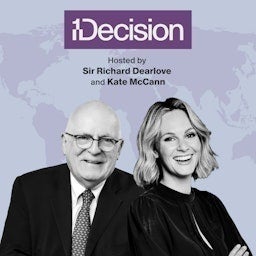
One Decision
Listen Now MediaAudio
- Format:
- Podcast
- New episodes:
- Weekly
- Typical length:
- about 1 hour
- Latest episode:
About this show
Tough decisions rattle us all to the core. But for our guests on One Decision— the choices they are up against can also shape history. No pressure! They take us through all of their doubts, emotions and—sometimes unexpected--consequences. A fresh take on foreign policy. Hear the former head of Mi6, Sir Richard Dearlove alongside international journalists as they analyse, interview, and discuss.
Show details and episodes come from the publisher's public feed at feeds.megaphone.fm. Last updated . Names, artwork and text belong to their publishers.
Cosmos
Similar by topic and creator
- Dialogue Works
Shares the topics History and News and Politics. - Perun
Shares the topics History and News and Politics. - When Rome Burns
Shares the topics History and News and Politics.
Similar shows







Explore more
Episodes
Trump Doubts the Nvidia Spy Story. Ex-MI6 Chief Doesn’t (w/ Matt Sheehan)
· 54 min
Matt Sheehan, senior fellow at the Carnegie Endowment for International Peace and co-director of its China AI Initiative, joins Sir Richard Dearlove and Kate McCann to explain how China sees the AI race. Sir Richard, the former chief of MI6, argues that NVIDIA’s Jensen Huang would have been a top-priority target for Chinese intelligence, and that the case fits a familiar pattern. Sheehan explains why Beijing sees AI first as a way to leap to the next level of economic development, and why it treats frontier safety with far less urgency than Silicon Valley, though that is starting to change. He also covers why people inside the US labs think AI that helps build its own successor is imminent, why chips are China’s hard limit, and whether the AI race raises the risk of Chinese pressure on Taiwan. Asked for his One Decision, he picks whether Washington and Beijing build a real incident notification mechanism for AI. In this episode: (00:00) China-US AI Race and Intelligence (02:01) How Large Language Models Work (03:39) Who Leads the Global AI Race? (04:34) Chinese Intelligence and IP Theft (08:19) Jensen Huang Targeted by Chinese Intelligence (13:52) How China Uses AI for Economy (16:15) AI Safety Risks in China (20:14) Global AI Regulation Challenges (25:24) Chips Limiting China AI Development? (31:11) AI Building Itself Recursive Improvement (35:03) China's Philosophy on AI Control (41:36) Taiwan Chips and Invasion Risk Show Notes: - Matt Sheehan at Carnegie: https://carnegieendowment.org/people/matt-sheehan Hosted by Sir Richard Dearlove (former MI6 Chief) and guest co-host Kate McCann (Political Editor at Times Radio). Learn more about your ad choices. Visit megaphone.fm/adchoices (https://megaphone.fm/adchoices)
Not rated yetHow Iran Outlasted Trump | Trita Parsi
· 57 min
Will Trump make a deal with Iran, escalate, or walk away? Trita Parsi, co-founder and Executive Vice President of the Quincy Institute for Responsible Statecraft, puts the odds of a deal at less than 50% and says the most likely outcome is a quiet walkaway, with the blockade and sanctions left to decay. But he warns the risk of escalation hasn't passed. Parsi was one of our first guests after the Iran war began, when he told us Tehran would drive up energy prices to swing the midterms against Trump. He's back to explain why the next four weeks matter, how Iran is cushioning the blockade, and whether the Gulf states and China could anchor a new regional security order. In this episode: (00:00) New Supreme Leader Rejects Gray Zone (00:46) Trita Parsi Returns to One Decision (01:54) Trump Three Iran Policy Options (05:22) Nuclear Enrichment as Iranian Leverage (08:50) Trump Legacy and Iran Vindictiveness (13:42) Military Escalation Warning Signs (15:28) What Finishing the Job Means (17:36) Israel Mowing the Lawn Strategy (21:58) Gulf States Pushback Against War (23:44) Iranian Economy Under Blockade (28:37) Why Status Quo Is Unsustainable (32:31) Houthis and Regional Ceasefire Challenge (37:04) Future Gulf Security Architecture Show Notes: Trita Parsi's Substack: https://tritaparsi.substack.com/ (https://tritaparsi.substack.com/%E2%81%A0) Hosted by Sir Richard Dearlove (former MI6 Chief) and co-host John Raine (International Institute for Strategic Studies) Learn more about your ad choices. Visit megaphone.fm/adchoices (https://megaphone.fm/adchoices)
Not rated yetIsrael Is Preparing for War With Iran. Will Trump Back It? | Ex-IDF Intel Chief Tamir HaymanTamir Hayman
· 1 hr 0 min
Israel is preparing for another war with Iran, and the decision rests with Donald Trump. Major General Tamir Hayman, former head of Israeli military intelligence, says Israel is swinging between an interim deal and a renewed strike on an hourly basis. Netanyahu wants regime change in Tehran, while Trump wants a deal. Hayman, a 34-year veteran of the IDF and Executive Director of the Institute for National Security Studies in Tel Aviv, joins Sir Richard Dearlove and John Raine to explain why Israel concluded that regime change in Iran was within reach, the three questions any joint US-Israeli operation must answer before it starts, and what Netanyahu’s legacy means for Israeli security. They also discuss the intelligence failures before October 7, the state of Hamas and Hezbollah, the stalled reconstruction of Gaza, how the Gulf states’ stance on the Iran war has shifted, and what Gadi Eisenkot would do differently. Prime Minister Benjamin Netanyahu led the bloc that received the most votes in last week’s Israeli elections. In this episode: (00:00) Israel Bracing for Renewed Iran War (00:48) Hosts Introduction Show Welcome (01:06) Netanyahu Elections After October 7th (02:45) October 7th Intelligence Security Failures (06:07) Hamas Deprioritized as Intelligence Target (15:55) Gaza Reconstruction and Security Redesign (19:55) Hamas and Hezbollah Military Capabilities (24:09) Gaza Reconstruction Stalled Political Options (33:58) Netanyahu Iran Regime Change Strategy (40:07) Israel Proactive Military Strategy Risks (45:49) Gulf States Iran War Position (49:22) Eisenkot's Alternative Security Vision for Israel (54:06) Trump Iran Strike or Deal Show Notes:A Second Wave of Popular Anger Is Building in Iran | Wall Street Journal: https://www.wsj.com/world/middle-east/a-second-wave-of-popular-anger-is-building-in-iran-ac51969c?reflink=desktopwebshare_permalink Hosted by Sir Richard Dearlove (former MI6 Chief) and guest co-host John Raine (International Institute for Strategic Studies). Photo credit: Western Wall in Jerusalem, October 2006, Hynek Moravec, Creative Commons Attribution 2.5 Generic license. Learn more about your ad choices. Visit megaphone.fm/adchoices (https://megaphone.fm/adchoices)
Not rated yetTrump Will Hit Iran After the Midterms. It's His Way Out | Ian Bremmer
· 53 min
Will Trump strike Iran after the 2026 midterm elections, and is a wider war his way out of lame-duck weakness? Eurasia Group founder and president Ian Bremmer explains why the Iran war may escalate after the US midterms, what a Democratic “blue wave” would mean for Trump’s foreign policy, and whether Trump has passed his peak. Bremmer also covers what a Democratic Congress would prioritize abroad, the investigations likely to follow the midterms, the future of Republican populism after Trump, and where the Ukraine war stands between Trump and Putin. Thank you to Incogni for sponsoring. Get 60% off the annual plan with code "onedecision" at https://incogni.com/onedecision In this episode: - (00:00) Iran War Worst Case Scenario - (03:55) Have We Passed Peak Trump? - (05:20) Trump Midterm Election Outlook - (06:08) Thwarted Trump Foreign Policy Risks - (08:20) Democrats Post-Midterm Investigation Strategy - (10:40) Trump's Vendetta Against Former Insiders - (11:05) Republican Party Populism After Trump - (17:39) Is Trump a Temporary Phenomenon? - (26:10) American Dream and Populist Pitchforks - (28:38) Democratic Geopolitical Priorities After Midterms - (31:16) Iran War: Best and Worst Scenarios - (38:00) Trump, Putin, and the Ukraine War Hosted by Sir Richard Dearlove (former MI6 Chief) and guest co-host John Raine (International Institute for Strategic Studies) Learn more about your ad choices. Visit megaphone.fm/adchoices (https://megaphone.fm/adchoices)
Not rated yetWho Is Really Running Iran Now? (w/ Karim Sadjadpour)
· 53 min
Eight months into the US-Iran war, the Revolutionary Guards (IRGC) have taken control of Iran, the Strait of Hormuz remains a flashpoint, and Trump faces a decision — before and after the midterms: escalate or negotiate? Carnegie Endowment senior fellow Karim Sadjadpour — a leading Western expert on Iranian politics — joins Kate McCann and former MI6 Chief Sir Richard Dearlove to explain the war from inside Tehran: why the clerics have been replaced by military hardliners, what Mojtaba Khamenei's personal losses mean for any peace deal, how Netanyahu pushed Trump into the conflict, and the one domestic decision that could be Iran's Gorbachev moment. They also discuss the legacy of Ayatollah Khamenei, Iran's nuclear program, and whether US sanctions can force a deal. In this episode: (00:00) Iran's Gangster Regime and Revenge (00:52) US-Iran War Eight Months In (02:49) Trump's Military Decision on Iran (04:43) Who Really Runs Iran Now (07:13) Trump's Legacy and Regime Change (14:55) Four Key Contention Points With Iran (16:20) Hardliners vs Pragmatists in Iran (19:04) How Netanyahu Pushed Trump to War (22:38) Axis of Resistance and the Houthis (27:53) Strait of Hormuz Crisis Explained (32:36) Finding a Solution to Iran Conflict (40:27) Gulf States React to Iran Conflict (46:40) The One Decision: Mandatory Hijab Hosted by Sir Richard Dearlove (former MI6 Chief) and guest co-host Kate McCann (Political Editor at Times Radio). Learn more about your ad choices. Visit megaphone.fm/adchoices (https://megaphone.fm/adchoices)
Not rated yetOpenAI Could Go Bust by Summer, Says Financial Expert Sebastian Mallaby
· 1 hr 2 min
#OpenAI #AI #ArtificialIntelligence Thank you to Incogni for sponsoring. Get 60% off the annual plan with code onedecision at https://incogni.com/onedecision OpenAI says it will burn $280 billion by 2030. Sebastian Mallaby gives it a 50/50 chance of running out of money by next summer. So what happens when the world's most prominent AI lab goes bust — and does the US government step in? Sebastian Mallaby — Senior Fellow at the Council on Foreign Relations and author of The Infinity Machine, a biography of DeepMind co-founder Demis Hassabis — joins Sir Richard Dearlove and John Raine. They discuss the financial fragility of the leading AI labs, why open-weight AI models are too dangerous to permit, how a US-China non-proliferation deal for AI might work, and what a war game about nuclear submarines revealed about where this is all heading. In this episode: (00:00) AI Race Between US and China (02:08) Sebastian Mallaby on AI Safety (02:51) Is AI a Blessing or Curse? (04:03) Who to Trust on AI Safety (05:35) Demis Hassabis and AI Regulation (08:23) Cold War Lessons for AI Safety (11:42) Trump Administration AI Policy (14:59) Private AI Safety Monitoring (20:57) Open Weight AI Models Debate (23:00) Does AI Replicate Consciousness? (33:24) Is AI Investment a Bubble? (45:39) AI War Game Nuclear Submarine Scenario (54:37) The One Decision Open Weight AI Hosted by Sir Richard Dearlove (former MI6 Chief) and guest co-host John Raine (International Institute for Strategic Studies). Learn more about your ad choices. Visit megaphone.fm/adchoices (https://megaphone.fm/adchoices)
Not rated yetJapan Is Rearming. Will It Build the Bomb? (w/ Ian Buruma)
· 52 min
#Germany #Japan #Rearmament Thank you to Incogni for sponsoring. Get 60% off the annual plan with code onedecision at https://incogni.com/onedecision For more than half a century, the two main Axis powers of WWII lived under strict limits on their militaries. Now both are rearming fast — driven by the threat of Russia in Europe and China in the Pacific, and by growing doubts about whether the US under Trump can still be relied upon. Germany is pouring money into defense and rebuilding its arms industry. Japan has created a new intelligence service, is expanding its Self-Defense Forces, and is debating whether to revise Article 9 of its pacifist constitution. Historian and journalist Ian Buruma — author of Stay Alive: Berlin 1939–1945 — joins former MI6 chief Sir Richard Dearlove and journalist Kate McCann to explain how wartime guilt shaped both countries' foreign and defense policy for generations, and why that influence is now fading fast. Thank you to Incogni for sponsoring. Get 60% off the annual plan with code onedecision at https://incogni.com/onedecision In this episode: (00:00) Intro (04:22) Sir Richard on ex-BND chief August Hanning (08:47) How Germany and Japan responded to WWII (13:11) Japan’s younger generation and Article 9 (22:11) Should Germany help fund Europe’s nuclear umbrella? (23:50) Could Japan go nuclear? (26:54) What is Article 9? (28:48) Japan’s new intelligence service and arms industry (32:55) The AfD, the firewall and German rearmament (36:34) A populist Europe and the end of Pax Americana (41:29) How the AfD weaponizes German history (45:06) The one decision to watch Join Sir Richard Dearlove and his co-hosts as they engage with leading figures in geopolitics, intelligence, and global affairs. They dissect the critical decisions behind the headlines, offering deep insights and expert analysis of the strategies that define international relations. From uncovering the implications of major geopolitical events to decoding the tactics of world leaders, One Decision is your gateway to understanding the complexities of global dynamics. Learn more about your ad choices. Visit megaphone.fm/adchoices (https://megaphone.fm/adchoices)
Not rated yetMohamed El-Erian: America Is Exporting Its Debt Crisis
· 54 min
War with Iran, record diesel prices, and a global bond sell-off: how much more can the world economy take? Mohamed El-Erian (Wharton, Allianz, former CEO of PIMCO) joins Sir Richard Dearlove (former head of MI6) and John Raine to explain what's driving the bond market sell-off, why the US is exporting instability to the UK, France, and Japan, and why AI is "80% asset, 20% liability." Plus: how PIMCO really navigated Lehman's collapse, and the one decision he's watching. In this episode: (00:00) Intro (03:07) Why this crisis is different (04:04) Permacrisis and "minilateralism" (05:46) What's driving the global bond sell-off (07:32) The hit to US households: mortgages, car loans, the K-shaped economy (10:10) "Our yields, your problem": UK, France and Japan (13:05) France, Mélenchon and Europe's leadership vacuum (17:59) AI: 80% asset, 20% liability (20:35) US-China AI Race (31:30) Did PIMCO predict Lehman Brothers collapse? (35:58) Who wins in today’s economy? (44:51) Can finance ministers fix what politicians can't? (46:32) How important are AI companies to the economy? Hosted by Sir Richard Dearlove (former MI6 Chief) and John Raine (International Institute for Strategic Studies). Learn more about your ad choices. Visit megaphone.fm/adchoices (https://megaphone.fm/adchoices)
Not rated yetIran Is Draining America’s Missile Defenses (w/ Paul Scharre, Former US Army Ranger)
· 1 hr 3 min
Between cheap-to-produce drones and artificial intelligence, the future of warfare may already be here. Paul Scharre, former US Army Ranger and executive vice president of the Center for a New American Strategy, joins former head of MI6 Sir Richard Dearlove and co-host John Raine to discuss how drones and AI are reshaping military conflict and militaries themselves. Scharre explains why cheap drones are beating expensive armies, how the cost asymmetry between offense and defense is reshaping the battlefield, and why the US may be losing its technological edge faster than it realizes. He also assesses Ukraine's drone revolution, the race between the US and China to adopt military AI, and why keeping humans in the loop may matter more than any weapon system. In this episode: (00:00) Cost Equation of Modern Warfare (02:39) Defining the Present State of Warfare (04:18) How Militaries Are Dealing with AI (06:24) Technology Reshaping US Military Education (09:11) Evolution of Drone Technology (14:45) Cost of Countermeasures (18:06) Likelihood of Protracted Warfare (20:38) Redefining Victory in Modern Warfare (22:20) Adversarial Distillation (25:15) Strategic Balance Between US and China (27:32) Culture of Superior Firepower (29:55) AI and the Ukraine War (33:06) How Drones Change Ground Combat (39:28) Outlook For Expensive Tech (43:00) Keeping Humans in the Loop (44:44) Drone Swarms (46:55) AI and Naval Warfare (48:52) Drones and Non-State Actors (54:32) One Decision: Xi-Trump Summit and AI (56:36) Takeaways and Wrap Up Hosted by Sir Richard Dearlove (former MI6 Chief) and co-host John Raine (International Institute for Strategic Studies) Learn more about your ad choices. Visit megaphone.fm/adchoices (https://megaphone.fm/adchoices)
Not rated yetIs Iran Secretly Building a Bomb at Pickaxe Mountain? A Nuclear Physicist Answers (w/ Ali Vaez)
· 1 hr 1 min
Israel and the US may have extraordinary intelligence on Iran. But intelligence isn't the same as comprehension, according to nuclear physicist and 2015 Iran deal negotiator Ali Vaez. Vaez joins John Raine and Sir Richard Dearlove to break down what Iran's nuclear capabilities really look like after the 12-day war. Plus, how Iran's Supreme National Security Council stays united under duress, how the Iran Revolutionary Guard Corps maintains primacy over the regular army, and why sanctions now at "nine out of ten" still won't force collapse. Iran doesn't need to win this standoff. It just needs not to lose. In this episode: (00:00) Ali Vaez on wartime Iran (02:39) Is Iran's leadership a monolith or divided? (03:55) Power centers: the SNSC, the Basij, and the IRGC (10:09) The mystery of Mojtaba Khamenei (12:00) Economic and military pressure on Iran (15:00) A forever war? Gulf States, Saudi Arabia, and the Houthis (27:47) What does the Iranian public actually think? (32:33) Iran's nuclear program: what do we really know? (42:18) Israeli intelligence, diplomacy, and the Ahmadinejad theory (52:19) The decision only Donald Trump can make Hosted by Sir Richard Dearlove (former MI6 Chief) and co-host John Raine (International Institute for Strategic Studies). Learn more about your ad choices. Visit megaphone.fm/adchoices (https://megaphone.fm/adchoices)
Not rated yetHow Real Is Netflix's The Diplomat? Ex-MI6 Chief Fact-Checks It (w/ Creator Debora Cahn)
· 43 min
Debora Cahn, the writer behind The Diplomat, Homeland, The West Wing, and Grey's Anatomy, joins Kate McCann and Sir Richard Dearlove to talk about writing political drama in an era when reality keeps outpacing fiction. Debora explains how "spy camp" research trips with real diplomats, spies, and generals shape her scripts, why she resists making her stories too close to current events, and what she learned about the strange double life of foreign service officers: the loneliness of constant relocation, the jockeying for a seat in the room, and the quiet patriotism that keeps them showing up. Sir Richard, a former head of MI6, adds his own view from the other side of the table, including a story about deliberately keeping a British ambassador out of the room in Washington. In this episode: 00:00 Cold Open 02:58 Russia Story Rewritten 04:11 Borgen Inspiration 06:15 Spy Camp Research 08:22 Diplomacy In The Dirt 09:35 Ambassadors Real And Fake 18:39 CIA And Embassy Dynamics 21:24 From West Wing To Diplomat 23:14 No Evil Characters 24:29 MI6 Reality Check 29:59 Demystifying Government Work 31:12 Female President Choice 33:51 Future Of Ambassadors Hosted by Sir Richard Dearlove (former MI6 Chief) and Kate McCann (Political Editor at Times Radio). Learn more about your ad choices. Visit megaphone.fm/adchoices (https://megaphone.fm/adchoices)
Not rated yetInside the CIA and MI6 on 9/11 (w/ John McLaughlin, CIA Deputy Director on September 11th)
· 1 hr 9 min
Part Two of our two-part series marking the 25th anniversary of 9/11 reunites former leaders of the US and UK intelligence services, both of whom were in high office on September 11, 2001. Former deputy director of the CIA John McLaughlin joins former MI6 chief Sir Richard Dearlove and co-host Kate McCann to give the insider’s perspective on the intelligence world’s response to the attacks. McLaughlin details what the CIA knew beforehand, the immediate aftermath inside CIA headquarters, and the rapid attribution to al-Qaeda. He also discusses the power of the US-UK "special relationship," the surge in CIA resources after 9/11, the Bush administration's push toward the Iraq War, the effects of the global war on terror on American civil liberties, and why the war in Ukraine is the single most important geopolitical issue today. In this episode: (00:00) Emotion is a Luxury in Intelligence (01:53) John McLaughlin Introduction (03:03) Pre-9/11 Threats (07:17) Why Was 9/11 A Surprise? (14:13) Considering the "What Ifs" (15:52) M16 Rushes to DC (22:46) CIA on 9/11 (25:12) Post-9/11 Intelligence Overhaul (34:16) Origins of the Iraq Focus (47:17) Legacy of 9/11 in America (57:42) One Decision: Importance of the Ukraine Conflict (01:03:00) Takeaways and Wrap Up Hosted by Sir Richard Dearlove (former MI6 Chief) and co-host Kate McCann (Political Editor at Times Radio). Learn more about your ad choices. Visit megaphone.fm/adchoices (https://megaphone.fm/adchoices)
Not rated yetThe Lessons of 9/11 & the Global War on Terror (w/ Peter Bergen, who Interviewed Bin Laden)
· 1 hr 7 min
In 1997, Peter Bergen found himself in the mountains of Afghanistan, face-to-face with al-Qaeda founder Osama bin Laden. During the ensuing landmark interview, bin Laden foreshadowed the terrorist attacks of September 11. In Part One of our two-part series commemorating the 25th anniversary of 9/11, journalist and author Peter Bergen sits down with former head of MI6 Sir Richard Dearlove and co-host John Raine to discuss the legacy of the 9/11 attacks, including the wars in Afghanistan and Iraq. Bergen talks about why negotiating with Osama bin Laden would have been a nonstarter and why the attacks bin Laden orchestrated generated shock, not surprise, within government intelligence agencies. Bergen and the hosts also discuss decisions after the attacks that Dearlove witnessesed firsthand, the proper relationship between intelligence and policy, how the war on terror reshaped the US view of coalitions and allies, and how the conflict in Ukraine points to the future of warfare. In this episode: (00:00) Lessons of Afghanistan and Iraq Wars (03:23) Would Negotiating with Osama bin Laden Have Worked? (06:21) Feeling in US Immediately Post-9/11 (11:29) Origins of Iraq War (15:55) Policy and Intelligence (17:08) Imperial Power of the Presidency (21:16) Why Were There No Major Attacks After 9/11? (25:13) Role of Coalitions and Allies (34:31) Legacy of Fighting Global War on Terror (41:10) Importance of Tribalism (46:54) Scale of Troop Presence and Outcome (50:41) Ukraine as Laboratory for Modern Warfare (54:38) One Decision: Why Trump Should Declare Victory in Iran (56:41) Takeaways and Wrap Up Hosted by Sir Richard Dearlove (former MI6 Chief) and guest co-host John Raine (International Institute for Strategic Studies) Learn more about your ad choices. Visit megaphone.fm/adchoices (https://megaphone.fm/adchoices)
Not rated yetWhy the US Lost in Afghanistan (w/Jon Lee Anderson, the Journalist Who Saw the Taliban Rise Twice)
· 1 hr 4 min
It has been five years since the US withdrew its forces from Afghanistan in August 2021, accepting defeat after a 20-year presence in the country. Was this ever a winnable war? War correspondent Jon Lee Anderson of The New Yorker walks former head of MI6 Sir Richard Dearlove and co-host John Raine through the Taliban resurgence. Anderson discusses why it was a strategic error to not allow Hamid Karzai to actually govern, and how that blunder facilitated both the return of opium production and the Taliban comeback. He also talks about what happened to the Northern Alliance, the complexities of Afghan allegiances and loyalties, lessons in counterinsurgency, the importance of winning the hearts and minds of a people, and what diplomatic relations with a Taliban-led Afghanistan could look like. In this episode: (00:00) Ceding an Aura of Invincibility (03:15) Was Afghanistan Ever a Winnable War? (07:26) Karzai and State Building (11:12) Opium Production and Taliban (18:43) Shadow Taliban Government (27:09) What Happened to the Northern Alliance? (33:39) Navigating US-Afghani Cultural Differences (39:14) Afghanistan’s Geography (42:45) Lessons in Counterinsurgency (48:26) Legacy of Afghanistan War (50:09) Persistence of Taliban Government (51:58) Diplomatic Relations with Taliban (55:28) One Decision: The West Must Engage Afghanistan (56:41) Takeaways and Wrap Up Hosted by Sir Richard Dearlove (former MI6 Chief) and guest co-host John Raine (International Institute for Strategic Studies) Learn more about your ad choices. Visit megaphone.fm/adchoices (https://megaphone.fm/adchoices)
Not rated yetMI6 Spymaster: Was Israel Serious About Regime Change in Iran? (Ft. Ronen Bergman & Mark Mazzetti)
· 1 hr 1 min
How did a Holocaust-denying, hardline former president of Iran become the centerpiece of an Israeli plan to topple the regime in Tehran? Former head of MI6 Sir Richard Dearlove and co-host John Raine sit down with New York Times investigative journalists Mark Mazzetti and Ronen Bergman to detail the high-stakes intelligence mission that preceded Operation Epic Fury. They explain how Israel’s Mossad groomed former Iranian President Mahmoud Ahmadinejad into an intelligence asset, and how Mossad director David Barnea Ahmadinejad to the White House in February 2026 as part of a plan for rapid regime change in Iran. They also discuss the plan’s collapse within days of the decapitation strikes, why the plan to use Kurdish forces as a ground proxy was a non-starter, how the political fallout from the war may forever change US-Israel relations, and the electoral implications for both US President Donald Trump and Israeli Prime Minister Benjamin Netanyahu this fall. (00:00) Legacy of the Iran War (02:30) Origins of Ahmadinejad Plot (05:10) Planning Iranian Regime Change (08:08) Was Ahmadinejad a Double Agent? (12:45) Why Recruit Ahmadinejad? (15:34) Selling Trump on Regime Change (25:12) Credibility of Kurdish Option (33:27) War Planning vs. Reality (35:32) Legacy of Ahmadinejad Plot (38:55) Did Israel Manipulate the US? (41:44) Mood of Iranian People (43:58) Deal Prospects (46:18) Maximum Pressure on Iran (48:05) Impact of Israel’s Coming Elections (49:03) Takeaways, Audience Comments, and Wrap Up Hosted by Sir Richard Dearlove (former MI6 Chief) and guest co-host John Raine (International Institute for Strategic Studies) Learn more about your ad choices. Visit megaphone.fm/adchoices (https://megaphone.fm/adchoices)
Not rated yetPutin's Russia, Ukraine's Reparations (ft. Jamison Firestone) | German Spies, Iceland-EU, Iran
· 1 hr 17 min
Vladimir Putin promised Russia a "dictatorship of law" when he took office in 2000. He delivered the dictatorship -- but not the law. This week, Russia expert, human rights lawyer, and founder of Russia's first independent foreign law firm Jamison Firestone joins journalist Rosanna Lockwood and former head of MI6 Sir Richard Dearlove to discuss his new book, Rule of Lies: My Wild Ride Through Chaos, Corruption, and Murder in Putin's Russia. Firestone lived through the upheaval of the early 1990s and worked alongside Sergei Magnitsky, who was murdered after exposing a Russian state built to loot itself. Firestone explains why Russia may now be close to a historical tipping point, how $300 billion in frozen Russian assets could be legally transferred to Ukraine to fund Kyiv;s war effort, and the ways in which Donald Trump has emulated Putin and Yeltsin. Plus, in Brief: changes coming to Germany's BND, the legacy of former Chinese Premier Zhu Rongji, Iceland's referendum on restarting EU membership talks, and the latest in the Iran War. In this episode: (00:00) Why Ukraine Matters (02:06) Germany Expands BND Powers (05:01) Zhu Rongji (07:52) Iceland EU Vote and NATO Role (11:46) Iran Deadline and Strait Tensions (15:11) Meet Jamison Firestone (16:42) Growing Up Around Gangsters (26:15) Loving Russia Despite Putin (30:46) Can Russia Reach a Tipping Point (34:32) Mobilization Pressure and Next Steps (36:15) Ukraine Aid and Frozen Funds (41:17) Legal Case For Seizure (43:57) Reparations Loan Explained (50:25) US Politics And Trump Parallels (54:24) How Putin Could Fall (57:06) Can Russia Be Democratic (59:03) Putin Isolation And Ukraine Motive (01:02:12) Life In London And Safety (01:05:08) Magnitsky Legacy And Costs (01:11:33) Drone Swarms And Future War Show Notes: - Rule of Lies: My Wild Ride Through Chaos, Corruption, and Murder in Putin's Russia | https://www.harpercollins.com/products/rule-of-lies-jamison-r-firestone?variant=44366648180770 - Website to learn more about Jamison Firestone’s advocacy: https://makeputinpay.org/ Hosted by Sir Richard Dearlove (former MI6 Chief) and guest co-host Rosanna Lockwood (International Journalist) Learn more about your ad choices. Visit megaphone.fm/adchoices (https://megaphone.fm/adchoices)
Not rated yetCIA Under Trump (ft. Tim Weiner) | China’s UK Spy Nest, US to Squeeze Cuba, Russia Tests NATO
· 1 hr 13 min
What role do intelligence services play under a president that does not heed their advice? That’s one of the questions Pulitzer Prize–winning reporter Tim Weiner posits in his most recent book, The Mission, which details how the modern Central Intelligence Agency (CIA) has evolved during the era of the global war on terror. Weiner describes the evolution of the missions undertaken by the CIA, which were historically driven by presidential desires to change the world through covert action, and contrasts them with the post-Cold War agency that grapples with trust and reputation in the information era. Weiner also discusses how the delicate interplay between betrayal and trust underwrites intelligence work, the common aim of pursuing secrets that intelligence and journalism share, and why he believes the cumulative effects of partisan purges within intelligence services under President Donald Trump leaves the United States in a dire state of danger. Sir Richard Dearlove and guest co-host Rosanna Lockwood dive into the news stories in geopolitics shaping the world this week: how a secret CIA task force in Cuba may be laying the groundwork for a more American-friendly government, why the construction of a new giant embassy for China is igniting political NIMBY-ism in London, and what US intelligence says about how stray Russian missiles and drones may be Putin’s way of testing NATO’s resolve. (03:07) Secret CIA Cuba Task Force (07:24) New Chinese Embassy in London (12:31) Will Putin Test NATO’s Resolve? (14:37) Interview with Tim Weiner (15:29) Difficulty of Writing About the CIA (20:07) Human Element of Espionage (22:56) Evolution of the CIA (25:57) Sir Richard’s Post-9/11 Intel Recollections (30:08) Journalists, Intelligence, and Secrecy (34:58) Intelligence and Policy (39:59) Modern CIA Missions Under Trump (48:31) Partisan Purges in US Intel Services (54:55) Can Institutional Trust Recover? (58:48) Trump’s Potential Paradoxical Legacy (01:02:47) One Decision to Watch (01:03:32) Takeaways, Audience Comments, and Wrap Up Hosted by Sir Richard Dearlove (former MI6 Chief) and guest co-host Rosanna Lockwood (international journalist). Learn more about your ad choices. Visit megaphone.fm/adchoices (https://megaphone.fm/adchoices)
Not rated yetRussia-Ukraine War Ground Truth (ft. Analyst Michael Kofman) | Swedish Spies, Iran Pause, AI Fears
· 1 hr 8 min
Is the Russian military actually losing ground, or adapting faster than Western allies realize? Fresh off a tour of the Ukrainian front lines, Senior Fellow in the Russia and Eurasia Program at the Carnegie Endowment for International Peace Michael Kofman delivers a realistic assessment of the latest developments in the Russia-Ukraine war. Kofman explains why Ukraine is in its strongest position since mid-2023, how Russian military commanders reporting false progress to Putin may lead to a mismatch between goals and means in the war, the strategic implications behind Ukraine’s recent command changes and political shifts in defense procurement, and why it’s critical that NATO learns what it can from Ukrainian force exercises to be prepared to face Russia’s next post-war threat. Sir Richard Dearlove and co-host Kate McCann unpack the latest and most significant news stories in geopolitics: the launch of Sweden’s own civilian intelligence service, whether President Trump’s rhetoric on Iran reflects uncertainty or strategic deception, and the data supporting the skeptical American attitude about AI. In this episode: (02:13) Sweden to Launch Its Own MI6 (06:01) Trump Hyperbole and Iran (09:18) America’s AI Skepticism (12:26) Interview with Michael Kofman (13:10) State of the Ukrainian-Russian Frontlines (15:30) Russian Military Goals vs. Means (19:43) Russia’s False Picture of Success (23:17) Evolution of Warfare on the Frontlines (28:58) Assessment of International Response (33:18) Patriot Missile Licensed Production Timeline (37:02) Changes in Ukrainian Defense Leadership (43:28) Corruption, Procurement, and Funding in Ukraine( 48:58) Russia’s Threat Post-War(54:50) Ukrainian Morale on the Frontlines\(57:18) Defining the Front Line of Fighting (01:00:21) One Decision to Watch (01:02:47) Takeaways, Audience Comments, and Wrap Up Show Notes: - The Next Russia Threat: Moscow’s Military Power After Ukraine | Foreign Affairs: www.foreignaffairs.com/russia/next-russia-threat-michael-kofman (http://www.foreignaffairs.com/russia/next-russia-threat-michael-kofman) Hosted by Sir Richard Dearlove (former MI6 Chief) and co-host Kate McCann (Political Editor at Times Radio). Learn more about your ad choices. Visit megaphone.fm/adchoices (https://megaphone.fm/adchoices)
Not rated yetUS-China AI Race (ft Gina Raimondo), Kyiv Shakeup, Kash to Moscow, Saudi Nuclear Deal, Iran Update
· 44 min
AI models in the United States may be ahead of China’s in terms of capability, but China far surpasses America in adoption and use. That’s what former US Secretary of Commerce Gina Raimondo says about the state of the AI race, and why she believes it's critical for the US and its allies to understand one thing: China is not our friend. She spells out how exactly China is creating technological dependencies, particularly in European countries, why it’s still important the West maintains continuous, managed economic competition with China, what social adoption of AI should look like in the US to curb anxieties around job loss, and why she remains optimistic about the promise of AI despite all this. Sir Richard Dearlove and guest co-host Sabrina Singh analyze the events making the biggest geopolitical headlines: FBI Director Kash Patel’s upcoming trip to Russia, a nuclear deal between the United States and Saudi Arabia, more changes in defense leadership in Ukraine, and the latest with the war in Iran. In this episode: (01:04) Kash Patel to Visit Russia (04:45) US-Saudi Nuclear Deal (09:39) Changes to Zelenskyy’s Cabinet (14:06) State of the Iran War (18:24) Interview with Gina Raimondo (19:17) US-China AI Race (23:00) Europe’s Vulnerability to China’s Influence (26:16) Managing Economic Competition between US/China (28:31) Why AI is a Geopolitical Net-Good (30:27) Social Adoption of AI (35:31) Regulation for AI (37:44) One Decision to Watch (38:58) Takeaways and Wrap Up Show Notes: - Iran’s New Grand Strategy: How a Remade Islamic Republic Will Reshape the Middle East | Foreign Affairs: www.foreignaffairs.com/iran/irans-new-grand-strategy (https://www.foreignaffairs.com/iran/irans-new-grand-strategy) Hosted by Sir Richard Dearlove (former MI6 Chief) and guest co-host Sabrina Singh (Former Deputy Pentagon Press Secretary) Learn more about your ad choices. Visit megaphone.fm/adchoices (https://megaphone.fm/adchoices)
Not rated yetIran's War Plan (ft. Vali Nasr), Burnham In, Fedorov Out, Japan's New Spy Agency, China's AI Grab
· 1 hr 4 min
Professor Vali Nasr argues that the single objective that's driven Tehran since 1979 has been defending its independence from the US. Author of Iran’s Grand Strategy, Nasr says that logic, more than ideology, explains the current war. He unpacks Iran's shift toward hard-nosed nationalism, what leverage it has left, and whether the country will take a more pragmatic approach to geopolitics. Sir Richard Dearlove and guest co-host John Raine talk through the headlines shaping today’s geopolitics: Japan's intelligence overhaul, the fallout from Zelensky's clash with his defense minister, China's new AI cooperation push, and the UK's untested new PM Andy Burnham. 03:16 Japan Builds Spy Agency07:35 Ukraine Defense Shakeup11:14 China Pushes AI Rules14:49 New UK Prime Minister18:24 Guest interview begins23:20 From Islam to Nationalism28:15 War Pragmatism and New Leaders32:27 Proxies and Forward Defense38:21 How the War Ends43:43 Gulf Markets and Hormuz48:12 Buying Peace49:49 Energy Shifts and Long Game55:37 One Decision to Watch56:23 Takeaways and Wrap Up Show Notes: - Iran’s New Grand Strategy: How a Remade Islamic Republic Will Reshape the Middle East | Foreign Affairs: www.foreignaffairs.com/iran/irans-new-grand-strategy (https://www.foreignaffairs.com/iran/irans-new-grand-strategy) Hosted by Sir Richard Dearlove (former MI6 Chief) and guest co-host John Raine (International Institute for Strategic Studies) Learn more about your ad choices. Visit megaphone.fm/adchoices (https://megaphone.fm/adchoices)
Not rated yet