

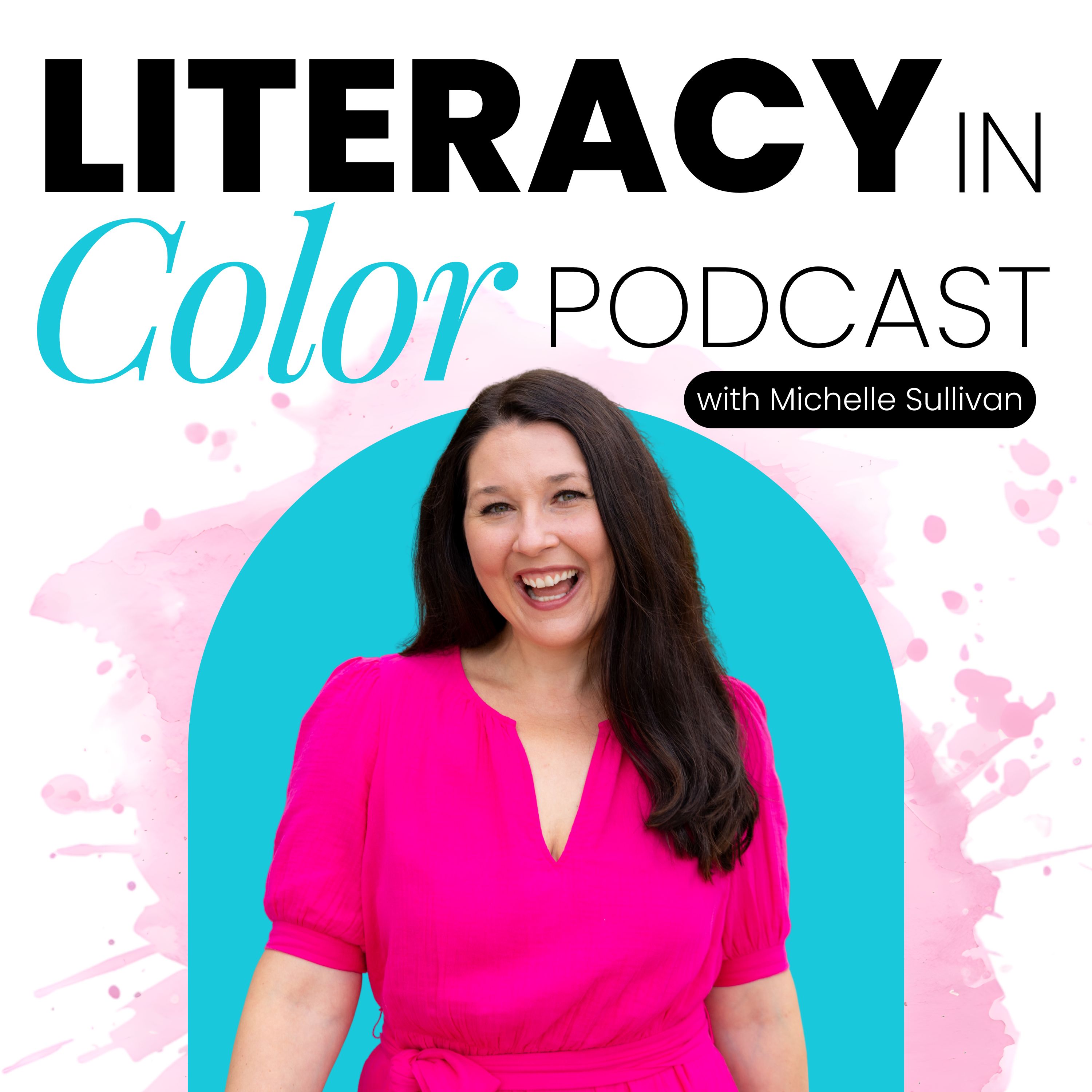
Literacy in Color: A Science of Reading Aligned Podcast for Educators
Michelle Sullivan • Literacy Coach & Science of Reading AdvocateAudio
- Format:
- Podcast
- New episodes:
- Several times a week
- Typical length:
- about 55 minutes
- Latest episode:
About this show
Literacy in Color is the go-to podcast for elementary teachers, literacy coaches, and reading interventionists who are passionate about bringing the Science of Reading to life in vibrant, engaging, and effective ways. Hosted by Michelle Sullivan — a seasoned literacy expert & Science of Reading advocate - with as a reading interventionist & literacy coach since 2013 — this show is designed to help you captivate your learners, boost reading fluency, and foster a deep understanding of language.
Each week, you’ll discover practical tips, proven strategies, and creative ideas to make your literacy instruction colorful and impactful. From phonics and morphology to vocabulary building and comprehension techniques, we’ll explore the full spectrum of evidence-based practices that support all learners on their journey to becoming confident readers.
Whether you’re a seasoned educator or just starting out, “Literacy in Color” will empower you with the tools, inspiration, and know-how to make literacy instruction not just effective, but truly unforgettable.
Are you ready to teach colorfully? Hit subscribe and join us each week for a splash of fun, insight, and colorful learning.
Connect with me on Instagram @michelle_thecolorfulclassroom & @logosliteracyacademy for more tips, resources, and community!
Show details and episodes come from the publisher's public feed at feeds.captivate.fm. Last updated . Names, artwork and text belong to their publishers.
Cosmos
Similar by topic and creator
- Life Hacks DIY & More - Transform Your Everyday With Simple Tricks and DIY Magic!
Shares the topics Education and How-To and DIY. - Foundations of Amateur Radio
Shares the topics Education and How-To and DIY. - Lets Talk Dubs Classic The Classic VW podcast
Shares the topics Education and How-To and DIY.
Similar shows





Explore more
Episodes
107. Stop Overcomplicating Big Words: How to Teach Polysyllabic Word Reading with Dr. Devin Kearns
· 57 min
What happens after students master single-syllable words in phonics, but the words in their books keep getting longer? Dr. Devin Kearns takes us for a deep dive into polysyllabic word reading and what the research tells us about helping students tackle increasingly complex words. He explains why the transition into longer words presents challenges that simply don't exist in single-syllable words, including the unpredictability of single-letter vowels, reduced vowels & schwa, and the growing prevalence of derivational suffixes. He also challenges some long-standing approaches to syllable division and explains why more rules and terminology aren't necessarily better for students. You'll learn about ESHALOV ("Every Syllable Has At Least One Vowel") as well as the “peeling-off strategy” for recognizing affixes and accessing the base of polymorphemic words. The conversation also explores lexical verification (i.e., set for variability): how readers adjust an initially decoded pronunciation until it connects with a word in their mental lexicon. Key Takeaways: - What the research suggests about traditional syllable division rules - How to use the strategy: ESHALOV for polysyllabic words - How to use the “Peeling-off” strategy for polymorphemic words - How lexical verification helps students move from a plausible pronunciation to a known spoken word - What advanced decoding instruction might look like in the upper elementary classrooms Resources Mentioned: - Phinder (https://www.devinkearns.com/phinder/) - High-Frequency Syllables & Morphemes (https://drive.google.com/file/d/1rfLpyJNXRrNdMflyboG-SYGKdlCt6jIt/view) (compiled by Dr. Devin Kearns) - The Word Complexity of Primary-Level Texts: Differences Between First and Third Grade in Widely Used Curricula (https://ila.onlinelibrary.wiley.com/doi/10.1002/rrq.429) by Devin Kearns & Elfrieda Hiebert - Helping Students With Dyslexia Read Long Words by Devin Kearns & Victoria Whaley (https://education.ufl.edu/patterson/files/2020/05/KearnsWhaley2019.pdf) - Building BRIDGES: A Design Experiment to Improve Reading and United States History Knowledge of Poor Readers in Eighth Grade - O’Connor, Beach, Sanchez, Bocian, & Flynn (https://journals.sagepub.com/doi/10.1177/0014402914563706) - ESHALOV principle (Every Syllable Has At Least One Vowel) - Components of effective remediation for developmental reading disabilities: Combining phonological and strategy-based instruction to improve outcomes (https://psycnet.apa.org/record/2000-07799-004?doi=1) - Lovett, M. et al. - “Peeling Off” Strategy Connect with Dr. Devin Kearns: - Website: https://www.devinkearns.com/ - LinkedIn (https://www.linkedin.com/in/devinkearns/) - Instagram: @devin.kearns (https://www.instagram.com/devin.kearns/) - X: @devin_kearns (https://x.com/devin_kearns) This podcast is brought to you byhttps://www.stephaniestollarconsulting.com/register?utm_source=podcast&utm_medium=show-notes&utm_campaign=literacy-in-colorReading Science Academy (https://www.stephaniestollarconsulting.com/register?utm_source=podcast&utm_medium=show-notes&utm_campaign=literacy-in-color), where our friend Stephanie Stollar is giving Literacy in Color listeners an exclusive, free grouping resource bundle to help you turn fall screening data into skill-based groups that actually move students forward. Get your FREE grouping resource bundle here. (https://www.stephaniestollarconsulting.com/groupingsheets?utm_source=podcast&utm_medium=show_notes&utm_campaign=podcast) Or, become a member of Reading Science Academy (https://www.stephaniestollarconsulting.com/register?utm_source=podcast&utm_medium=show-notes&utm_campaign=literacy-in-color) to learn in community and receive research-backed support alongside over 1,400 literacy educators. Connect with Michelle: - Visit: www.michelleandthecolorfulclassroom.com (http://www.michelleandthecolorfulclassroom.com/) - Follow me on Instagram: @michelle_thecolorfulclassroom…
Not rated yet106. How New York City Is Transforming Reading Instruction with Dr. Katie Pace Miles
· 43 min
What does it actually mean for a word to become "stored" in the brain – and how do we design instruction that helps that happen for every student? In this episode, I'm joined by Dr. Katie Pace Miles, associate professor at Brooklyn College, founder of The Reading Institute, co-founder of CUNY Reading Fellows, and one of today's leading voices in reading science. She not only shares about the cognitive process of orthographic mapping, but also why understanding how words become permanently stored in memory changes the way we think about reading instruction and intervention. Dr. Miles also shares the fascinating origin story behind Reading Ready, the structured literacy intervention she originally created while teaching her own daughter to read during the pandemic, and explains how both Reading Ready and Reading Go have expanded to support thousands of students through The Reading Institute and CUNY Reading Fellows. She shares the dramatic literacy shifts happening across New York City Public Schools: from increased use of structured literacy and decodable texts to high-impact tutoring, universal screening, and stronger teacher preparation – and what still lies ahead. Key Takeaways: - What orthographic mapping really is - Why oral language is foundational for orthographic mapping - The origin behind Reading Ready and Reading Go - Why intervention dosage matters more than many educators realize - How The Reading Institute and CUNY Reading Fellows are expanding access to high-quality literacy intervention - The biggest shifts happening across New York City Public Schools - Why teacher preparation must include authentic practice, not just coursework Resources Mentioned: - The Reading Institute (https://www.readinginstitutenyc.org/) - Reading Ready (https://www.readinginstitutenyc.org/our-programs) - Reading Go (https://www.readinginstitutenyc.org/our-programs#:~:text=READY%20EDUCATOR%20GUIDE-,READING%20GO!,-Reading%20Go%20is) - 10-hour Science of Reading Micro-Credential (https://www.readinginstitutenyc.org/our-programs#:~:text=SCIENCE%20OF%20READING%20%0A10%2DHOUR%C2%A0INTRO%20COURSE) - CUNY Reading Fellows (https://www.cuny.edu/academics/academic-programs/teacher-education-programs/cuny-reading-fellows/) - Brooklyn College: Advanced Certificate in Reading Science (https://www.brooklyn.edu/academics/programs/?query=Reading-Science°ree_level=Graduate) - Book: Making Words Stick (https://amzn.to/43BA4C0) by Dr. Katie Pace Miles & Dr. Molly Ness - Publications written by Dr. Katie Pace Miles (https://www.katiepacemilesphd.com/publications) This post may contain affiliate links, which means if you click on a link and make a purchase, I may earn a small commission at no additional cost to you. Thank you for supporting the podcast! Connect with Dr. Katie Pace Miles: - Instagram: @thereadinginstitutenyc (https://www.instagram.com/thereadinginstitutenyc/) - LinkedIn: The Reading Institute (https://www.linkedin.com/company/the-reading-institute/) - Facebook: The Reading Institute (https://www.facebook.com/share/nTJFNV8NfquW1cob/?mibextid=LQQJ4d) - Website: https://www.katiepacemilesphd.com/ This podcast is brought to you byhttps://www.stephaniestollarconsulting.com/register?utm_source=podcast&utm_medium=show-notes&utm_campaign=literacy-in-colorReading Science Academy (https://www.stephaniestollarconsulting.com/register?utm_source=podcast&utm_medium=show-notes&utm_campaign=literacy-in-color), where our friend Stephanie Stollar is giving Literacy in Color listeners an exclusive, free grouping resource bundle to help you turn fall screening data into skill-based groups that actually move students forward. Get your FREE grouping resource bundle here. (https://www.stephaniestollarconsulting.com/groupingsheets?utm_source=podcast&utm_medium=show_notes&utm_campaign=podcast) Or, become a member of Reading Science Academy…
Not rated yet105. From Imposter Syndrome to Impact: A Literacy Coach's Journey & the Power of SRSD for Writing Instruction with Leah Ruesink
· 47 min
Transitioning from classroom teacher to literacy coach is exciting, but it can also be overwhelming. How do you build trust? Support veteran teachers? Know when to offer advice...and when to simply listen? Today’s episode is part Coaching Conversation, as literacy coach Leah Ruesink shares about her transition to coach and what coaching really looks like behind the scenes. Leah shares some lessons she’s learned along the way, including how to build meaningful relationships, navigate imposter syndrome, and support teachers through instructional change. Then the conversation shifts into one of Leah's greatest passions: writing instruction. Leah introduces listeners to Self-Regulated Strategy Development (SRSD), an evidence-based writing framework that explicitly teaches students how to plan, organize, and write – all while regulating themselves throughout the writing process. So, while this episode speaks directly to a literacy coach’s heart, classroom teachers will walk away with some really practical ideas and valuable insights for explicitly teaching writing in your classrooms. Resources Mentioned: - Leah Ruesink's Literacy Coaching Hub (https://stan.store/theearlyliteracycoach/p/literacy-coaching-hub) - Book: The Impact Cycle by Jim Knight (https://amzn.to/4fNdTNV) - Book: Better Conversations by Jim Knight (https://amzn.to/4fOJI9g) - SRSD - Self-Regulated Strategy Development (https://srsdonline.org/) - Releasing Writers (Formerly Think SRSD) (https://thinksrsd.com/) - Releasing Writers Facebook Page (https://www.facebook.com/groups/1540221363136170/) - Book: Executive Skills and Writing Instruction by Dr. Leslie Laud (https://amzn.to/4g90Asy) - Book: Rock Your Literacy Block by Lindsay Kemeny (https://amzn.to/4xgQ6gv) - TIDE chant and writing routines - Book: The Writing Rope by Joan Sedita (https://amzn.to/4waoWqt) This post may contain affiliate links, which means if you click on a link and make a purchase, I may earn a small commission at no additional cost to you. Thank you for supporting the podcast! Connect with Leah Ruesink: - Instagram: @theearlyliteracycoach (https://www.instagram.com/theearlyliteracycoach) - TikTok: @theearlyliteracycoach (https://www.tiktok.com/@theearlyliteracycoach) - Literacy Coaching Hub (https://stan.store/theearlyliteracycoach/p/literacy-coaching-hub) - Leah’s Stan.Store (https://stan.store/theearlyliteracycoach) This podcast is brought to you byhttps://www.stephaniestollarconsulting.com/register?utm_source=podcast&utm_medium=show-notes&utm_campaign=literacy-in-colorReading Science Academy (https://www.stephaniestollarconsulting.com/register?utm_source=podcast&utm_medium=show-notes&utm_campaign=literacy-in-color), where our friend Stephanie Stollar is giving Literacy in Color listeners an exclusive, free grouping resource bundle to help you turn fall screening data into skill-based groups that actually move students forward. Get your FREE grouping resource bundle here. (https://www.stephaniestollarconsulting.com/groupingsheets?utm_source=podcast&utm_medium=show_notes&utm_campaign=podcast) Or, become a member of Reading Science Academy (https://www.stephaniestollarconsulting.com/register?utm_source=podcast&utm_medium=show-notes&utm_campaign=literacy-in-color) to learn in community and receive research-backed support alongside over 1,400 literacy educators. Connect with Michelle: - Visit: www.michelleandthecolorfulclassroom.com (http://www.michelleandthecolorfulclassroom.com/) - Follow me on Instagram: @michelle_thecolorfulclassroom (https://www.instagram.com/michelle_thecolorfulclassroom/) & @logosliteracyacademy (https://www.instagram.com/logosliteracyacademy/) - Join our Facebook (https://www.facebook.com/profile.php?id=61550901912611) Community - Sign up for my Newsletter (https://colorful-classroom.mykajabi.com/join-my-email-list) - Shop on TPT: The Colorful Classroom (https://www.teacherspayteachers.com/store/the-colorful-classroom-1711) - For Phonics…
Not rated yet104. Building the Biliterate Reading Brain: Multi-Component Instruction & Deep Reading with Dr. Maryanne Wolf
· 48 min
One of the most influential voices around “the reading brain”, Dr. Maryanne Wolf, joins the show to tackle that very subject. Our brains were never wired to read. Reading is a learned, plastic circuit that develops through instruction – and how we teach profoundly shapes how that circuitry is built. Dr. Wolf explains dyslexia, why fluency is much more than reading quickly, and why decoding alone is not enough for deep comprehension. She shares the research behind her POSSUM framework and explains why integrating phonology, orthography, semantics, syntax, and morphology creates stronger, more fluent readers. The conversation also turns toward one of today's biggest challenges: the digital age. Dr. Wolf discusses how technology and AI are reshaping the reading brain, why deep reading matters now more than ever, and how parents and educators can intentionally cultivate what she calls a biliterate brain: one that can thrive in both print and digital environments. This episode offers a hopeful vision for building readers who don't simply decode words, but think deeply, read thoughtfully, and engage fully with language. Key Takeaways: - How reading circuitry develops - The evolving understanding of dyslexia - Why fluency is the bridge between decoding and comprehension - The importance of multi-component literacy instruction - Dr. Wolf's POSSUM approach: Phonology, Orthography, Semantics, Syntax, Understanding, and Morphology - The research behind the RAVE-O intervention - Why vocabulary and oral language matter for reading success - The importance of deep reading in the age of AI - How technology is changing the reading brain - Practical advice for raising lifelong readers Resources Mentioned: - Book: Proust and the Squid (https://amzn.to/4wD0iQt) by Dr. Maryanne Wolf - Book: Reader, Come Hom (https://amzn.to/3SfCXp3)e by Dr. Maryanne Wolf - Program: RAVE-O (https://www.nidolearning.com/program/rave-o) - POSSUM (https://www.nidolearning.com/program/rave-o/reading-intervention-programs)Approach - Nido Learning (https://www.nidolearning.com/) - Reading Nest essays (https://www.nidolearning.com/program/reading-nest) This post may contain affiliate links, which means if you click on a link and make a purchase, I may earn a small commission at no additional cost to you. Thank you for supporting the podcast! Connect with Dr. Maryanne Wolf & Nido Learning: - Website: https://www.nidolearning.com/ - Email: david@nidolearning.com - LinkedIn (https://www.linkedin.com/in/maryanne-wolf-a4413b229/) This podcast is brought to you byhttps://www.stephaniestollarconsulting.com/register?utm_source=podcast&utm_medium=show-notes&utm_campaign=literacy-in-colorReading Science Academy (https://www.stephaniestollarconsulting.com/register?utm_source=podcast&utm_medium=show-notes&utm_campaign=literacy-in-color), where our friend Stephanie Stollar is giving Literacy in Color listeners an exclusive, free grouping resource bundle to help you turn fall screening data into skill-based groups that actually move students forward. Get your FREE grouping resource bundle here. (https://www.stephaniestollarconsulting.com/groupingsheets?utm_source=podcast&utm_medium=show_notes&utm_campaign=podcast) Or, become a member of Reading Science Academy (https://www.stephaniestollarconsulting.com/register?utm_source=podcast&utm_medium=show-notes&utm_campaign=literacy-in-color) to learn in community and receive research-backed support alongside over 1,400 literacy educators. Connect with Michelle: - Visit: www.michelleandthecolorfulclassroom.com (http://www.michelleandthecolorfulclassroom.com/) - Follow me on Instagram: @michelle_thecolorfulclassroom (https://www.instagram.com/michelle_thecolorfulclassroom/) & @logosliteracyacademy (https://www.instagram.com/logosliteracyacademy/) - Join our Facebook (https://www.facebook.com/profile.php?id=61550901912611) Community - Sign up for my Newsletter…
Not rated yet103. 5 Quick Tips for b/d Letter Reversals
· 16 min
Letter reversals are one of the most common concerns among parents and teachers. In this episode, we dive into what’s happening in the brain when it comes to letter reversals, when reversals may be expected, and 5 practical tips for fixing b/d reversals specifically. Resource Mentioned: - Forthcoming Book: Developing Proficient Writers by Amy Siracusano & Michelle Sullivan (Solution Tree, expected late Spring 2027) This podcast is brought to you byhttps://www.stephaniestollarconsulting.com/register?utm_source=podcast&utm_medium=show-notes&utm_campaign=literacy-in-colorReading Science Academy (https://www.stephaniestollarconsulting.com/register?utm_source=podcast&utm_medium=show-notes&utm_campaign=literacy-in-color), where our friend Stephanie Stollar is giving Literacy in Color listeners an exclusive, free grouping resource bundle to help you turn fall screening data into skill-based groups that actually move students forward. Get your FREE grouping resource bundle here. (https://www.stephaniestollarconsulting.com/groupingsheets?utm_source=podcast&utm_medium=show_notes&utm_campaign=podcast) Or, become a member of Reading Science Academy (https://www.stephaniestollarconsulting.com/register?utm_source=podcast&utm_medium=show-notes&utm_campaign=literacy-in-color) to learn in community and receive research-backed support alongside over 1,400 literacy educators. Connect with Michelle: - Visit: www.michelleandthecolorfulclassroom.com (http://www.michelleandthecolorfulclassroom.com/) - Follow me on Instagram: @michelle_thecolorfulclassroom (https://www.instagram.com/michelle_thecolorfulclassroom/) & @logosliteracyacademy (https://www.instagram.com/logosliteracyacademy/) - Join our Facebook (https://www.facebook.com/profile.php?id=61550901912611) Community - Sign up for my Newsletter (https://colorful-classroom.mykajabi.com/join-my-email-list) - Shop on TPT: The Colorful Classroom (https://www.teacherspayteachers.com/store/the-colorful-classroom-1711) - For Phonics Resources, grab: The COLORFUL Phonics Toolkit (https://colorful-classroom.mykajabi.com/phonics-toolkit) Want to Support the Podcast? - Make a Donation (https://literacy-in-color.captivate.fm/support) to Support Production Interested in Learning More about Morphology? - Logos Literacy Academy (https://www.logosliteracyacademy.com/) with Michelle Sullivan & Sarah Paul - Join: Beyond Phonics Club (https://beyond-phonics-club.circle.so/beyond-phonics-club) - our Membership Community
Not rated yet102. Powerful Fluency Instruction & Performance-Based Practices with Dr. Chase Young
· 59 min
Fluency serves as the critical bridge between accurate word reading and deep comprehension, so how can we build it? In this episode, Michelle sits down with literacy scholar, author, and educator, Dr. Chase Young shares what fluency really is, why it matters, and how teachers can transform fluency instruction from repetitive practice into engaging, meaningful learning experiences. Chase shares the research behind performance-based fluency instruction, including Reader’s Theater, Poetry Slams, Teddy Talks, and his evidence-based intervention framework, Read Like Us. We discuss how fluency supports comprehension, why repeated reading works, and how teachers can create classrooms where students want to practice reading. Key Takeaways: - What reading fluency actually is (and what it isn't) - Performance-based fluency instruction and the research behind it (like Reader’s Theater, Poetry Slams, and Teddy Talks) - The importance of complex texts during fluency instruction - The Read Like Us intervention framework - Ways to make fluency instruction engaging, authentic, and joyful Helpful Resources - Resources from Podcast (https://www.literacylive.org/signup) - Reader’s Theatre Scripts (The Best Class) (https://www.thebestclass.org/rtscripts.html) - Professional Development (http://www.literacylive.org) - Parent Resources (http://www.lfcreading.com) - Research Article: Read Like Me: An Intervention for Struggling Readers (https://www.semanticscholar.org/paper/Read-Like-Me%3A-An-Intervention-for-Struggling-Young-Lagrone/8da6be2e61b9bb775e47adc07b6dafc83ed6f48a) (Chase Young, Stacey Lagrone, Joyce K. McCauley) - Research Article: Promoting Fluency Through Challenge: Repeated Reading with Texts of Varying Complexity (https://ila.onlinelibrary.wiley.com/doi/epdf/10.1002/trtr.70024) (Jake Downs, Chase Young, Alycia Cole) - Research Article: Promoting Reading Accuracy and Fluency Outcomes with Complex Texts: A Grade 3 Intervention Comparison (https://ila.onlinelibrary.wiley.com/doi/full/10.1002/rrq.70117)(Jake Downs, Elfrieda Hiebert, Kristen Conradi Smith, Katie Martz) Connect with Dr. Chase Young: - Email: chaser@literrific.com - LinkedIn (https://www.linkedin.com/in/chase-young-68586625/) - X: @ChaseJYoung1 (https://x.com/ChaseJYoung1) - Website: https://www.thebestclass.org/ - Website: http://www.literacylive.org This podcast is brought to you byhttps://www.stephaniestollarconsulting.com/register?utm_source=podcast&utm_medium=show-notes&utm_campaign=literacy-in-colorReading Science Academy (https://www.stephaniestollarconsulting.com/register?utm_source=podcast&utm_medium=show-notes&utm_campaign=literacy-in-color), where our friend Stephanie Stollar is giving Literacy in Color listeners an exclusive, free grouping resource bundle to help you turn fall screening data into skill-based groups that actually move students forward. Get your FREE grouping resource bundle here. (https://www.stephaniestollarconsulting.com/groupingsheets?utm_source=podcast&utm_medium=show_notes&utm_campaign=podcast) Or, become a member of Reading Science Academy (https://www.stephaniestollarconsulting.com/register?utm_source=podcast&utm_medium=show-notes&utm_campaign=literacy-in-color) to learn in community and receive research-backed support alongside over 1,400 literacy educators. Connect with Michelle: - Visit: www.michelleandthecolorfulclassroom.com (http://www.michelleandthecolorfulclassroom.com/) - Follow me on Instagram: @michelle_thecolorfulclassroom (https://www.instagram.com/michelle_thecolorfulclassroom/) & @logosliteracyacademy (https://www.instagram.com/logosliteracyacademy/) - Join our Facebook (https://www.facebook.com/profile.php?id=61550901912611) Community - Sign up for my Newsletter (https://colorful-classroom.mykajabi.com/join-my-email-list) - Shop on TPT: The Colorful Classroom (https://www.teacherspayteachers.com/store/the-colorful-classroom-1711) - For Phonics Resources, grab: The COLORFUL Phonics Toolkit…
Not rated yet101. Science of Reading Hot Topics: Navigating the Nuance with Anna Geiger, Reach All Readers
· 57 min
The Science of Reading has transformed literacy instruction, but with that shift has come a new challenge: navigating the growing number of debates, disagreements, and hot topics within the field itself. Author, podcaster, and doctoral student Anna Geiger of Reach All Readers joins the show to explore the nuance behind some of the most talked-about conversations in literacy today. We discuss what research can (and cannot) tell us, why instructional decisions are not always black and white, and how educators can thoughtfully evaluate practices while keeping student outcomes at the center. From heart words and phonemic awareness to decodable texts, sound walls, and structured literacy approaches, this conversation offers a perspective that encourages teachers to think critically and embrace the complexity of literacy instruction. Whether you're new to the Science of Reading or deep into your own learning journey, this episode will leave you reflecting on what it means to be both evidence-informed and responsive to students. We Discuss: - How teachers can navigate conflicting opinions in literacy education - Heart words - Whether any English word is truly irregular (with the role of etymology and morphology) - The debate surrounding oral-only phonemic awareness - Structured Linguistic Literacy vs. traditional phonics approaches - Are we overdoing phonics? - Syllable division - Decodable texts versus authentic reading experiences - Sound walls - Why teaching remains both a science and an art - How educators can become wise consumers of literacy research Resources Mentioned: - Book: Reach All Readers by Anna Geiger (https://amzn.to/4gZ0Zi3) - The Right to Read Project (https://righttoreadproject.com/) - Blog Post: What Do I Do with All These Predictable Books? by Margaret Goldberg (https://righttoreadproject.com/2021/06/19/what-do-i-do-with-all-these-predictable-books/) - Reading Science Academy (https://www.stephaniestollarconsulting.com/register) with Dr. Stephanie Stollar (https://www.stephaniestollar.com/) This post may contain affiliate links, which means if you click on a link and make a purchase, I may earn a small commission at no additional cost to you. Thank you for supporting the podcast! Connect with Anna Geiger: - Email: anna@reachallreaders.com - Website: https://reachallreaders.com/ - Reach All Readers Podcast (https://reachallreaders.com/category/podcast/) - Reach All Readers Plus Membership (https://pages.reachallreaders.com/reach-all-readers-plus/) This podcast is brought to you byhttps://www.stephaniestollarconsulting.com/register?utm_source=podcast&utm_medium=show-notes&utm_campaign=literacy-in-colorReading Science Academy (https://www.stephaniestollarconsulting.com/register?utm_source=podcast&utm_medium=show-notes&utm_campaign=literacy-in-color), where our friend Stephanie Stollar is giving Literacy in Color listeners an exclusive, free grouping resource bundle to help you turn fall screening data into skill-based groups that actually move students forward. Get your FREE grouping resource bundle here. (https://www.stephaniestollarconsulting.com/groupingsheets?utm_source=podcast&utm_medium=show_notes&utm_campaign=podcast) Or, become a member of Reading Science Academy (https://www.stephaniestollarconsulting.com/register?utm_source=podcast&utm_medium=show-notes&utm_campaign=literacy-in-color) to learn in community and receive research-backed support alongside over 1,400 literacy educators. Connect with Michelle: - Visit: www.michelleandthecolorfulclassroom.com (http://www.michelleandthecolorfulclassroom.com/) - Follow me on Instagram: @michelle_thecolorfulclassroom (https://www.instagram.com/michelle_thecolorfulclassroom/) & @logosliteracyacademy (https://www.instagram.com/logosliteracyacademy/) - Join our Facebook (https://www.facebook.com/profile.php?id=61550901912611) Community - Sign up for my Newsletter (https://colorful-classroom.mykajabi.com/join-my-email-list) - Shop on…
Not rated yet100. A Literacy Manifesto After 100 Episodes: 3 Hills I'd Die On, 3 Things I Hope We Leave Behind, and 3 Things I'm Watching Closely
· 27 min
Happy 100th Episode!!! To celebrate this milestone episode, I share: - 3 literacy hills I’d die on - 3 things I hope we can leave behind, and - 3 things I’m watching closely Thank you for helping make the first 100 episodes possible. Here's to the next 100! Favorite Episodes Mentioned: - Playlist (if listening from your computer) (https://player.captivate.fm/collection/14962970-60ec-456a-9f23-6abc6a16cf92) - Playlist (if listening from a podcast player) (https://feeds.captivate.fm/literacy-in-color/after-100-episodes-your-favorite-episodes/) This podcast is brought to you byhttps://www.stephaniestollarconsulting.com/register?utm_source=podcast&utm_medium=show-notes&utm_campaign=literacy-in-colorReading Science Academy (https://www.stephaniestollarconsulting.com/register?utm_source=podcast&utm_medium=show-notes&utm_campaign=literacy-in-color), where our friend Stephanie Stollar is giving Literacy in Color listeners an exclusive, free grouping resource bundle to help you turn fall screening data into skill-based groups that actually move students forward. Get your FREE grouping resource bundle here. (https://www.stephaniestollarconsulting.com/groupingsheets?utm_source=podcast&utm_medium=show_notes&utm_campaign=podcast) Or, become a member of Reading Science Academy (https://www.stephaniestollarconsulting.com/register?utm_source=podcast&utm_medium=show-notes&utm_campaign=literacy-in-color) to learn in community and receive research-backed support alongside over 1,400 literacy educators. Connect with Michelle: - Visit: www.michelleandthecolorfulclassroom.com (http://www.michelleandthecolorfulclassroom.com/) - Follow me on Instagram: @michelle_thecolorfulclassroom (https://www.instagram.com/michelle_thecolorfulclassroom/) & @logosliteracyacademy (https://www.instagram.com/logosliteracyacademy/) - Join our Facebook (https://www.facebook.com/profile.php?id=61550901912611) Community - Sign up for my Newsletter (https://colorful-classroom.mykajabi.com/join-my-email-list) - Shop on TPT: The Colorful Classroom (https://www.teacherspayteachers.com/store/the-colorful-classroom-1711) - For Phonics Resources, grab: The COLORFUL Phonics Toolkit (https://colorful-classroom.mykajabi.com/phonics-toolkit) Want to Support the Podcast? - Make a Donation (https://literacy-in-color.captivate.fm/support) to Support Production Interested in Learning More about Morphology? - Logos Literacy Academy (https://www.logosliteracyacademy.com/) with Michelle Sullivan & Sarah Paul - Join: Beyond Phonics Club (https://beyond-phonics-club.circle.so/beyond-phonics-club) - our Membership Community
Not rated yet99. How PS 152Q Transformed Early Literacy with Reading Ready with Lisa Russo & the 1st Grade Team
· 37 min
What happens when a school decides that "business as usual" is no longer good enough? Principal Lisa Russo and the first-grade team at PS 152Q to discuss their remarkable literacy transformation. After years of using balanced literacy practices, the school shifted toward structured literacy, embraced the science of reading, and implemented a schoolwide intervention block supported by Dr. Katie Pace Miles' Reading Ready intervention program. The team shares their journey from seeing students struggle with foundational skills to creating a system that provides targeted instruction based on student needs. You'll hear how leadership, teacher buy-in, strategic grouping, and a commitment to following the research helped create meaningful change for young readers. Resources Mentioned: - Reading Ready (https://www.readinginstitutenyc.org/our-programs) (The Reading Institute (https://www.readinginstitutenyc.org/)) - Book: Making Words Stick (https://amzn.to/43BA4C0) by Dr. Katie Pace Miles & Dr. Molly Ness This post may contain affiliate links, which means if you click on a link and make a purchase, I may earn a small commission at no additional cost to you. Thank you for supporting the podcast! Connect with Lisa Russo & PS 152Q: - Website: https://www.ps152q.org/ - Instagram: @ps152q (https://www.instagram.com/ps152q) & @littleextraliteracy (https://www.instagram.com/littleextraliteracy/) This podcast is brought to you byhttps://www.stephaniestollarconsulting.com/register?utm_source=podcast&utm_medium=show-notes&utm_campaign=literacy-in-colorReading Science Academy (https://www.stephaniestollarconsulting.com/register?utm_source=podcast&utm_medium=show-notes&utm_campaign=literacy-in-color), where our friend Stephanie Stollar is giving Literacy in Color listeners an exclusive, free grouping resource bundle to help you turn fall screening data into skill-based groups that actually move students forward. Get your FREE grouping resource bundle here. (https://www.stephaniestollarconsulting.com/groupingsheets?utm_source=podcast&utm_medium=show_notes&utm_campaign=podcast) Or, become a member of Reading Science Academy (https://www.stephaniestollarconsulting.com/register?utm_source=podcast&utm_medium=show-notes&utm_campaign=literacy-in-color) to learn in community and receive research-backed support alongside over 1,400 literacy educators. Connect with Michelle: - Visit: www.michelleandthecolorfulclassroom.com (http://www.michelleandthecolorfulclassroom.com/) - Follow me on Instagram: @michelle_thecolorfulclassroom (https://www.instagram.com/michelle_thecolorfulclassroom/) & @logosliteracyacademy (https://www.instagram.com/logosliteracyacademy/) - Join our Facebook (https://www.facebook.com/profile.php?id=61550901912611) Community - Sign up for my Newsletter (https://colorful-classroom.mykajabi.com/join-my-email-list) - Shop on TPT: The Colorful Classroom (https://www.teacherspayteachers.com/store/the-colorful-classroom-1711) - For Phonics Resources, grab: The COLORFUL Phonics Toolkit (https://colorful-classroom.mykajabi.com/phonics-toolkit) Want to Support the Podcast? - Make a Donation (https://literacy-in-color.captivate.fm/support) to Support Production Interested in Learning More about Morphology? - Logos Literacy Academy (https://www.logosliteracyacademy.com/) with Michelle Sullivan & Sarah Paul - Join: Beyond Phonics Club (https://beyond-phonics-club.circle.so/beyond-phonics-club) - our Membership Community
Not rated yet98. Syntax is Everything: The Backbone of Comprehension with Dr. Julie Van Dyke
· 51 min
When educators discuss reading comprehension, the conversation often centers around vocabulary, background knowledge, and comprehension strategies, but what if we've been overlooking one of the most critical components of comprehension all along? Research scientist, Dr. Julie Van Dyke shares about the powerful role syntax plays in reading comprehension. Drawing from decades of research in cognitive psychology, neuroscience, linguistics, and language processing, Dr. Van Dyke explains why syntax is much more than word order; it's the system that helps readers determine who did what to whom and construct meaning moment by moment. We discuss what happens in the brain when we read, why comprehension occurs word by word rather than after a passage is finished, how Developmental Language Disorder (DLD) impacts reading, and practical ways teachers can begin supporting syntactic development in their classrooms. We also dive into Cascade Reading, an innovative tool designed to make sentence structure visible and support comprehension for all learners. Key Takeaways: - Syntax is not simply word order. - Comprehension happens continuously, word by word, as the brain integrates new information into what has already been processed. - The brain relies on multiple systems during reading, including perception, language, and thought networks. - Syntax serves as the foundation of language comprehension in much the same way phonology serves as the foundation of decoding. - Explicit attention to sentence structure can be embedded into existing literacy instruction. Resources Mentioned: - IDA Perspectives 2025: Volumes 1 & 2 - Syntax Comes First (Available through the IDA (https://dyslexiaida.org/perspectives/)) - FREE Tool: Cascade Reading (https://cascadereading.com/) - Syntax Usage Survey (https://docs.google.com/forms/d/e/1FAIpQLSfa8J7OOwD9NkqpEJQLp6JUUrJQDX7yNKTLlYu4L5GV5WlAPw/viewform) Connect with Dr. Julie Van Dyke: - Website: https://www.drjvandyke.net/ - LinkedIn (https://www.linkedin.com/in/drjvandyke/) - Stay tuned for her upcoming Substack: Decoding Syntax This podcast is brought to you byhttps://www.stephaniestollarconsulting.com/register?utm_source=podcast&utm_medium=show-notes&utm_campaign=literacy-in-colorReading Science Academy (https://www.stephaniestollarconsulting.com/register?utm_source=podcast&utm_medium=show-notes&utm_campaign=literacy-in-color), where our friend Stephanie Stollar is giving Literacy in Color listeners an exclusive, free grouping resource bundle to help you turn fall screening data into skill-based groups that actually move students forward. Get your FREE grouping resource bundle here. (https://www.stephaniestollarconsulting.com/groupingsheets?utm_source=podcast&utm_medium=show_notes&utm_campaign=podcast) Or, become a member of Reading Science Academy (https://www.stephaniestollarconsulting.com/register?utm_source=podcast&utm_medium=show-notes&utm_campaign=literacy-in-color) to learn in community and receive research-backed support alongside over 1,400 literacy educators. Connect with Michelle: - Visit: www.michelleandthecolorfulclassroom.com (http://www.michelleandthecolorfulclassroom.com/) - Follow me on Instagram: @michelle_thecolorfulclassroom (https://www.instagram.com/michelle_thecolorfulclassroom/) & @logosliteracyacademy (https://www.instagram.com/logosliteracyacademy/) - Join our Facebook (https://www.facebook.com/profile.php?id=61550901912611) Community - Sign up for my Newsletter (https://colorful-classroom.mykajabi.com/join-my-email-list) - Shop on TPT: The Colorful Classroom (https://www.teacherspayteachers.com/store/the-colorful-classroom-1711) - For Phonics Resources, grab: The COLORFUL Phonics Toolkit (https://colorful-classroom.mykajabi.com/phonics-toolkit) Want to Support the Podcast? - Make a Donation (https://literacy-in-color.captivate.fm/support) to Support Production Interested in Learning More about Morphology? - Logos Literacy Academy…
Not rated yet97. Effective Universal Instruction with Dr. Sarah Brown & Dr. Kimberly Gibbons
· 53 min
Drawing from decades of experience in literacy, school psychology, systems-level leadership, and MTSS implementation, Dr. Sarah Brown and Dr. Kimberly Gibbons explain why strong universal instruction is the true foundation of student success. They explore what Tier 1 actually includes, why intervention alone cannot solve widespread literacy struggles, and how leadership, collaboration, fidelity, coaching, and systems-thinking all work together to improve outcomes for students. Key Takeaways: - What Tier 1 really means inside an MTSS framework - Why MTSS is about resources and systems, not “Tier 2 kids” or “Tier 3 kids” - Why buying a new curriculum alone won’t solve literacy problems - The role of leadership in sustaining effective instruction - The importance of job-embedded coaching and ongoing support - Why fidelity data matters (...and why it shouldn’t feel punitive) - How collaborative teams build consensus and instructional coherence - The power of strong questioning to uncover root causes - Why prevention through effective Tier 1 instruction is more powerful than over-relying on intervention - Practical first steps schools can take immediately to strengthen instruction Resources: - Book: Effective Universal Instruction: An Action-Oriented Approach to Improving Tier 1 by Sarah Brown & Kimberly Gibbons (https://amzn.to/3QxIfeJ) - Book: MTSS for Reading Improvement by Stephanie Stollar & Sarah Brown from Solution Tree (https://www.solutiontree.com/mtss-for-reading-improvement.html?fbclid=IwY2xjawJDGWhleHRuA2FlbQIxMAABHUP-960cIRPM8GtId5aAtVu_9q66iu8JTIkjtTabWmNESbiMNEyxAU5YmQ_aem_l7r7NlbIrgqeFhIwi8eplw)(or on Amazon (https://amzn.to/4kogbEV)) This post may contain affiliate links, which means if you click on a link and make a purchase, I may earn a small commission at no additional cost to you. Thank you for supporting the podcast! Connect with Dr. Sarah Brown: - Website: https://systemimpactconsulting.com/ - Contact Dr. Sarah Brown (https://systemimpactconsulting.com/form-data-academies) on her Website - LinkedIn: Sarah Brown Ph.D. (https://www.linkedin.com/in/sarah-brown-ph-d-9177b516/) - Join Dr. Brown’s MTSS Data Academy (https://systemimpactconsulting.com/data-academy26-27) - Dr. Brown also offers Virtual Coaching Sessions! Connect with Dr. Kimberly Gibbons: - CAREI Director (https://carei.umn.edu/people/people/kim-gibbons) - CAREI at the University of Minnesota (https://carei.umn.edu/) This podcast is brought to you byhttps://www.stephaniestollarconsulting.com/register?utm_source=podcast&utm_medium=show-notes&utm_campaign=literacy-in-colorReading Science Academy (https://www.stephaniestollarconsulting.com/register?utm_source=podcast&utm_medium=show-notes&utm_campaign=literacy-in-color), where our friend Stephanie Stollar is giving Literacy in Color listeners an exclusive, free grouping resource bundle to help you turn fall screening data into skill-based groups that actually move students forward. Get your FREE grouping resource bundle here. (https://www.stephaniestollarconsulting.com/groupingsheets?utm_source=podcast&utm_medium=show_notes&utm_campaign=podcast) Or, become a member of Reading Science Academy (https://www.stephaniestollarconsulting.com/register?utm_source=podcast&utm_medium=show-notes&utm_campaign=literacy-in-color) to learn in community and receive research-backed support alongside over 1,400 literacy educators. Connect with Michelle: - Visit: www.michelleandthecolorfulclassroom.com (http://www.michelleandthecolorfulclassroom.com/) - Follow me on Instagram: @michelle_thecolorfulclassroom (https://www.instagram.com/michelle_thecolorfulclassroom/) & @logosliteracyacademy (https://www.instagram.com/logosliteracyacademy/) - Join our Facebook (https://www.facebook.com/profile.php?id=61550901912611) Community - Sign up for my Newsletter (https://colorful-classroom.mykajabi.com/join-my-email-list) - Shop on TPT: The Colorful Classroom…
Not rated yet96. Reading’s Dynamic Duo: How Fluency & Vocabulary Fuel Comprehension with Melissa Loftus & Lori Sappington
· 55 min
Melissa Loftus and Lori Sappington from the Melissa & Lori Love Literacy podcast (https://literacypodcast.com/) take their hosting hats off for the day to share their expertise around fluency, vocabulary, and comprehension – and why comprehension instruction is far more complex than simply teaching “strategies.” Melissa and Lori explain why comprehension is considered an unconstrained skill, how fluent word recognition frees up cognitive space for meaning-making, and why vocabulary and knowledge building are essential for students to truly understand text. Resources Mentioned: - Sign up for Melissa & Lori’s email list and grab a free, fun fluency resource pack (https://sorinpractice.myflodesk.com/da02lm7pze)! - Book: The Literacy 50 (https://amzn.to/4dWBHhA) by Melissa Loftus & Lori Sappington - Five Step Vocabulary Routine (https://www.scholastic.com/content/dam/PostPurchase/Downloads/LiteracyFifty16.pdf) (from the Literacy 50) - Research: Spencer, Quinn, and Wagner (https://journals.sagepub.com/doi/10.1111/ldrp.12024) tested 425,000 children from first through third grade on decoding, vocabulary, and comprehension. Among those who had adequate decoding and adequate vocabulary, fewer than one per cent scored poorly on comprehension. Fewer than one in a hundred. Once the word-level problems are solved, the decoding and the vocabulary, comprehension takes care of itself in virtually every case. This post may contain affiliate links, which means if you click on a link and make a purchase, I may earn a small commission at no additional cost to you. Thank you for supporting the podcast! Connect with Melissa Loftus & Lori Sappington: - Melissa & Lori Love Literacy Podcast (https://pod.link/1463219123) - Website: literacypodcast.com/ (https://literacypodcast.com/) - Instagram: @literacypodcast (https://www.instagram.com/literacypodcast/) - Website: sorinpractice.com/ (https://www.sorinpractice.com/) - Instagram: @sorinpractice (https://www.instagram.com/sorinpractice/) This podcast is brought to you byhttps://www.stephaniestollarconsulting.com/register?utm_source=podcast&utm_medium=show-notes&utm_campaign=literacy-in-colorReading Science Academy (https://www.stephaniestollarconsulting.com/register?utm_source=podcast&utm_medium=show-notes&utm_campaign=literacy-in-color), where our friend Stephanie Stollar is giving Literacy in Color listeners an exclusive, free grouping resource bundle to help you turn fall screening data into skill-based groups that actually move students forward. Get your FREE grouping resource bundle here. (https://www.stephaniestollarconsulting.com/groupingsheets?utm_source=podcast&utm_medium=show_notes&utm_campaign=podcast) Or, become a member of Reading Science Academy (https://www.stephaniestollarconsulting.com/register?utm_source=podcast&utm_medium=show-notes&utm_campaign=literacy-in-color) to learn in community and receive research-backed support alongside over 1,400 literacy educators. Connect with Michelle: - Visit: www.michelleandthecolorfulclassroom.com (http://www.michelleandthecolorfulclassroom.com/) - Follow me on Instagram: @michelle_thecolorfulclassroom (https://www.instagram.com/michelle_thecolorfulclassroom/) & @logosliteracyacademy (https://www.instagram.com/logosliteracyacademy/) - Join our Facebook (https://www.facebook.com/profile.php?id=61550901912611) Community - Sign up for my Newsletter (https://colorful-classroom.mykajabi.com/join-my-email-list) - Shop on TPT: The Colorful Classroom (https://www.teacherspayteachers.com/store/the-colorful-classroom-1711) - For Phonics Resources, grab: The COLORFUL Phonics Toolkit (https://colorful-classroom.mykajabi.com/phonics-toolkit) Want to Support the Podcast? - Make a Donation (https://literacy-in-color.captivate.fm/support) to Support Production Interested in Learning More about Morphology? - Logos Literacy Academy (https://www.logosliteracyacademy.com/) with Michelle Sullivan & Sarah Paul - Join: Beyond Phonics Club…
Not rated yet95. Affixes in Action: Our A4 Framework for Teaching Affixes with Sarah Paul and Michelle Sullivan of Logos Literacy Academy
· 30 min
Exciting news! Sarah & Michelle share their signature A4 Framework for teaching affixes inside of Logos Literacy Academy! Rather than treating prefixes and suffixes as isolated definitions to memorize, we explore how affixes function as meaningful structural units that help words grow and change across the English writing system. If you loved the BASE Framework episode (https://pod.link/1775547995/episode/NjkwNmE0ZTgtZDQwZi00ZGQ3LWFiZDUtOWZlZmFjMmQyNjE5), this conversation is the perfect companion episode! Key Takeaways: - Affixes, defined - Why affix instruction should connect meaning, structure, spelling, grammar, and pronunciation - Common practices they see in affix instruction – and how their approach differs - How they intentionally embedded affix instruction within a phonics progression - How their A4 Framework supports transfer into reading and writing Resources Mentioned: - K-2 Course & Curriculum (https://logosliteracyacademy.thrivecart.com/k2-morphology/) from Logos Literacy Academy - Save with a Bundle: Get Mastering Morphology AND our K-2 Course & Curriculum (https://logosliteracyacademy.thrivecart.com/bundle-mastering-morphology-k-2/) bundled together! Connect with Sarah & Michelle: - Website: https://www.logosliteracyacademy.com/ - Instagram: @logosliteracyacademy (https://www.instagram.com/logosliteracyacademy) - Logos Literacy Academy (https://beacons.ai/logosliteracyacademy) Beacons Page Connect with Michelle: - Visit: www.michelleandthecolorfulclassroom.com (http://www.michelleandthecolorfulclassroom.com/) - Follow me on Instagram: @michelle_thecolorfulclassroom (https://www.instagram.com/michelle_thecolorfulclassroom/) & @logosliteracyacademy (https://www.instagram.com/logosliteracyacademy/) - Join our Facebook (https://www.facebook.com/profile.php?id=61550901912611) Community - Sign up for my Newsletter (https://colorful-classroom.mykajabi.com/join-my-email-list) - Shop on TPT: The Colorful Classroom (https://www.teacherspayteachers.com/store/the-colorful-classroom-1711) - For Phonics Resources, grab: The COLORFUL Phonics Toolkit (https://colorful-classroom.mykajabi.com/phonics-toolkit) Want to Support the Podcast? - Make a Donation (https://literacy-in-color.captivate.fm/support) to Support Production Interested in Learning More about Morphology? - Logos Literacy Academy (https://www.logosliteracyacademy.com/) with Michelle Sullivan & Sarah Paul - Join: Beyond Phonics Club (https://beyond-phonics-club.circle.so/beyond-phonics-club) - our Membership Community
Not rated yet94. Inside 'The Megabook of Vocabulary' with Dr. Tim Rasinski, Melissa Cheesman Smith & Savannah Campbell
· 44 min
Dr. Timothy Rasinski, Melissa Cheesman Smith, and Savannah Campbell join the show to discuss their newest resource, The Megabook of Vocabulary (https://amzn.to/4eVUtaT). They unpack why vocabulary is far more than a list of words to memorize. This conversation explores the research behind vocabulary instruction, why background knowledge matters, and how teachers can intentionally build language-rich classrooms without making vocabulary “one more thing.” The authors also introduce their WISE framework from the book: - Word Consciousness - Individual Word Learning - Student Tools for Determining Meaning - Exploration of Word Relationships You’ll even hear practical classroom ideas for morphology instruction, context clues, nuanced word study, playful word exploration, and how to move beyond rote memorization toward deep, meaningful word learning. Whether you’re a classroom teacher, interventionist, literacy coach, or school leader, this episode is packed with strategies and joyful ideas to help students become truly word conscious. Resources Mentioned: - Book: The Megabook of Vocabulary (https://amzn.to/4eVUtaT) - FREE Download: Inside the Megabook of Vocabulary (https://drive.google.com/file/d/19qUNZAmsfeUCKp5igHeIDnC7EhYlfmde/view?usp=sharing) - Book: The Megabook of Fluency (https://amzn.to/42MfYDN) This post may contain affiliate links, which means if you click on a link and make a purchase, I may earn a small commission at no additional cost to you. Thank you for supporting the podcast! Connect with the Guests: - Dr. Tim Rasinski’s Website: https://timrasinski.com/ - Dr. Tim Rasinksi’s Email: trasinsk@kent.edu - Melissa Cheesman Smith on Instagram: @melissa.cheesman.smith (https://www.instagram.com/melissa.cheesman.smith/) - Savannah Campbell’s Website: https://www.campbellcreatesreaders.com/ - Savannah Campbell on Instagram: @campbellcreatesreaders (https://www.instagram.com/campbellcreatesreaders/) Connect with Michelle: - Visit: www.michelleandthecolorfulclassroom.com (http://www.michelleandthecolorfulclassroom.com/) - Follow me on Instagram: @michelle_thecolorfulclassroom (https://www.instagram.com/michelle_thecolorfulclassroom/) & @logosliteracyacademy (https://www.instagram.com/logosliteracyacademy/) - Join our Facebook (https://www.facebook.com/profile.php?id=61550901912611) Community - Sign up for my Newsletter (https://colorful-classroom.mykajabi.com/join-my-email-list) - Shop on TPT: The Colorful Classroom (https://www.teacherspayteachers.com/store/the-colorful-classroom-1711) - For Phonics Resources, grab: The COLORFUL Phonics Toolkit (https://colorful-classroom.mykajabi.com/phonics-toolkit) Want to Support the Podcast? - Make a Donation (https://literacy-in-color.captivate.fm/support) to Support Production Interested in Learning More about Morphology? - Logos Literacy Academy (https://www.logosliteracyacademy.com/) with Michelle Sullivan & Sarah Paul - Join: Beyond Phonics Club (https://beyond-phonics-club.circle.so/beyond-phonics-club) - our Membership Community
Not rated yet93. Foundations for Life with Lyn Stone, Lifelong Literacy
· 51 min
We hear an awful lot about the importance of foundational literacy skills, but exactly belongs in that foundation? Educational linguist and author Lyn Stone discusses her newest resource: Foundations for Life (https://expressreaders.org/lyn-stone/) — a structured literacy intervention manual designed for educators, interventionists, and parents supporting developing readers and writers. Lyn also shares her thoughts on the Science of Reading movement and considerations when it comes to thoughtful implementation. This conversation is equal parts intellectually rich, practical, and deeply hopeful for educators looking to better understand how the English writing system actually works – and how to teach it effectively. Key Takeaways - Phonics is necessary, but not sufficient. - Writing should begin immediately – not “later”, after reading develops. - Graphemes spell morphemes; morphemes spell words. - Word relatives help students build durable mental models of the writing system. - We also get to hear a live demonstration of one of her lessons, exploring the word family for: one Resources Mentioned: - Book: Foundations for Life (https://expressreaders.org/shop/decodable-books/foundations-for-life-structured-literacy-for-reading-and-writing/) - More About “Foundations for Life" (https://expressreaders.org/lyn-stone/) - Book: Spelling for Life (https://amzn.to/3RiciqJ) - Book: Language for Life (https://amzn.to/4dAUgsy) - Book: Reading for Life (https://amzn.to/4wiLw1v) - Lyn Stone’s Courses through Lifelong Literacy (https://lifelongliteracy.com/courses/) This post may contain affiliate links, which means if you click on a link and make a purchase, I may earn a small commission at no additional cost to you. Thank you for supporting the podcast! Connect with Lyn Stone: - Website: https://lifelongliteracy.com/ - LinkedIn: Lyn Stone (https://www.linkedin.com/in/lyn-stone-76930063/) - Instagram: @lynstone8 (https://www.instagram.com/lynstone8/) - Email: lynstone@lifelongliteracy.com Connect with Michelle: - Visit: www.michelleandthecolorfulclassroom.com (http://www.michelleandthecolorfulclassroom.com/) - Follow me on Instagram: @michelle_thecolorfulclassroom (https://www.instagram.com/michelle_thecolorfulclassroom/) & @logosliteracyacademy (https://www.instagram.com/logosliteracyacademy/) - Join our Facebook (https://www.facebook.com/profile.php?id=61550901912611) Community - Sign up for my Newsletter (https://colorful-classroom.mykajabi.com/join-my-email-list) - Shop on TPT: The Colorful Classroom (https://www.teacherspayteachers.com/store/the-colorful-classroom-1711) - For Phonics Resources, grab: The COLORFUL Phonics Toolkit (https://colorful-classroom.mykajabi.com/phonics-toolkit) Want to Support the Podcast? - Make a Donation (https://literacy-in-color.captivate.fm/support) to Support Production Interested in Learning More about Morphology? - Logos Literacy Academy (https://www.logosliteracyacademy.com/) with Michelle Sullivan & Sarah Paul - Join: Beyond Phonics Club (https://beyond-phonics-club.circle.so/beyond-phonics-club) - our Membership Community
Not rated yet92. From Ox Heads to Silent Letters: The History of the Alphabet with Dr. Danny Bate, author of "Why Q Needs U"
· 1 hr 10 min
Linguist and author, Dr. Danny Bate brilliantly shares the fascinating history of the alphabet, while also uncovering some of the logic behind English spelling. You’ll hear about the surprising origins of letters (yes, <A> was once an ox’s head!), that vowels weren’t originally part of the alphabet, how the Great Vowel Shift transformed pronunciation, and of course, “Why Q Needs U (https://amzn.to/4n6d1Hq)”. This episode is a must-listen for educators, language lovers, and anyone who has ever wondered: Why is English spelled this way? Key Takeaways: - The earliest alphabet was built on the acrophonic principle (symbols representing the first sound of a word) - Early alphabets represented consonants only (vowels were added later by the Greeks) - English spelling reflects both: Sound change over time AND Historical and cultural influences (i.e. Norman Conquest, Latin influence) - The Great Vowel Shift dramatically changed pronunciation, but spelling stayed mostly the same - So-called “irregularities” often preserve morphological and etymological meaning connections Connect with Danny Bate - Website: https://dannybate.com/ - Podcast: A Language I Love Is… (https://pod.link/1703401848) - Book: Why Q Needs U: A history of our letters and how we use them (https://amzn.to/4n6d1Hq) This post may contain affiliate links, which means if you click on a link and make a purchase, I may earn a small commission at no additional cost to you. Thank you for supporting the podcast! Connect with Michelle: - Visit: www.michelleandthecolorfulclassroom.com (http://www.michelleandthecolorfulclassroom.com/) - Follow me on Instagram: @michelle_thecolorfulclassroom (https://www.instagram.com/michelle_thecolorfulclassroom/) & @logosliteracyacademy (https://www.instagram.com/logosliteracyacademy/) - Join our Facebook (https://www.facebook.com/profile.php?id=61550901912611) Community - Sign up for my Newsletter (https://colorful-classroom.mykajabi.com/join-my-email-list) - Shop on TPT: The Colorful Classroom (https://www.teacherspayteachers.com/store/the-colorful-classroom-1711) - For Phonics Resources, grab: The COLORFUL Phonics Toolkit (https://colorful-classroom.mykajabi.com/phonics-toolkit) Want to Support the Podcast? - Make a Donation (https://literacy-in-color.captivate.fm/support) to Support Production Interested in Learning More about Morphology? - Logos Literacy Academy (https://www.logosliteracyacademy.com/) with Michelle Sullivan & Sarah Paul - Join: Beyond Phonics Club (https://beyond-phonics-club.circle.so/beyond-phonics-club) - our Membership Community
Not rated yet91. Why Vocabulary Changes Everything (and 3 Simple Shifts for Teachers)
· 14 min
Vocabulary may be just one pillar of literacy, but it’s also the thread that connects reading, writing, speaking, and thinking. In this episode, I’m breaking down why vocabulary truly changes everything when it comes to student learning – and why it deserves more intentional focus in our classrooms. I’ll also share 3 simple, high-impact shifts you can make right away to create a more language-rich environment for your students. Key Takeaways - You can decode every word on a page, but without vocabulary, comprehension falls apart. - Make Vocabulary Multisensory: Move beyond definitions and engage students’ senses (especially with images) to make meaningful connections - Prioritize Expressive Understanding: Use sentence stems and structured prompts to push students to think with words, not just repeat them. - Build Word Networks: Help students connect words through associations, morphology, and shades of meaning to deepen understanding and retention. Join us at the Science of Reading Mini-Con (https://www.scienceofreading101club.com/science-of-reading-mini-con) this June! Connect with Michelle: - Visit: www.michelleandthecolorfulclassroom.com (http://www.michelleandthecolorfulclassroom.com/) - Follow me on Instagram: @michelle_thecolorfulclassroom (https://www.instagram.com/michelle_thecolorfulclassroom/) & @logosliteracyacademy (https://www.instagram.com/logosliteracyacademy/) - Join our Facebook (https://www.facebook.com/profile.php?id=61550901912611) Community - Sign up for my Newsletter (https://colorful-classroom.mykajabi.com/join-my-email-list) - Shop on TPT: The Colorful Classroom (https://www.teacherspayteachers.com/store/the-colorful-classroom-1711) - For Phonics Resources, grab: The COLORFUL Phonics Toolkit (https://colorful-classroom.mykajabi.com/phonics-toolkit) Want to Support the Podcast? - Make a Donation (https://literacy-in-color.captivate.fm/support) to Support Production Interested in Learning More about Morphology? - Logos Literacy Academy (https://www.logosliteracyacademy.com/) with Michelle Sullivan & Sarah Paul - Join: Beyond Phonics Club (https://beyond-phonics-club.circle.so/beyond-phonics-club) - our Membership Community
Not rated yet90. Teach Your Child to Read at Home with Reading.com
· 34 min
Stephanie Barber (Learning Product Manager) and Molly Sullivan (Curriculum Manager) from Reading.com share how families can support early reading development at home, without needing a background in education. Together, they unpack what makes Reading.com different from typical literacy apps: it’s not a passive, screen-time experience. Instead, it’s built around co-learning, where a caregiver and child work together through short, structured lessons grounded in the Science of Reading. Stephanie and Molly share the “why” behind the platform, how research shaped its design, and the intentional features that support real reading development, from explicit phonics instruction to interactive sound sliders that help children bridge from sounding out to blending words. They also address common concerns around screen time, explain how the app avoids guessing habits like picture cueing, and highlight how even non-educators can confidently teach foundational literacy skills with the right support. Whether you’re a parent, teacher, or literacy advocate, this episode offers a powerful look at how thoughtful design can bring evidence-based reading instruction into everyday moments. More About Reading.com - Website:https://www.reading.com - Visit reading.com/color (http://reading.com/color) for 60% off the annual plan today. - Instagram: @_readingcom (https://www.instagram.com/_readingcom/) - YouTube (https://www.youtube.com/@_readingcom) - Reading.com’s ABC Song (https://www.youtube.com/watch?v=qKQAQc2NEuk) - Email: stephanie.m@teaching.com Connect with Michelle: - Visit: www.michelleandthecolorfulclassroom.com (http://www.michelleandthecolorfulclassroom.com/) - Follow me on Instagram: @michelle_thecolorfulclassroom (https://www.instagram.com/michelle_thecolorfulclassroom/) & @logosliteracyacademy (https://www.instagram.com/logosliteracyacademy/) - Join our Facebook (https://www.facebook.com/profile.php?id=61550901912611) Community - Sign up for my Newsletter (https://colorful-classroom.mykajabi.com/join-my-email-list) - Shop on TPT: The Colorful Classroom (https://www.teacherspayteachers.com/store/the-colorful-classroom-1711) - For Phonics Resources, grab: The COLORFUL Phonics Toolkit (https://colorful-classroom.mykajabi.com/phonics-toolkit) Want to Support the Podcast? - Make a Donation (https://literacy-in-color.captivate.fm/support) to Support Production Interested in Learning More about Morphology? - Logos Literacy Academy (https://www.logosliteracyacademy.com/) with Michelle Sullivan & Sarah Paul - Join: Beyond Phonics Club (https://beyond-phonics-club.circle.so/beyond-phonics-club) - our Membership Community
Not rated yet89. The Structured Literacy Playbook with Dr. Melissa Orkin & Sarah Gannon, Crafting Minds
· 1 hr 9 min
Dr. Melissa Orkin and Sarah Gannon, co-authors of The Structured Literacy Playbook, join Michelle to unpack what it really takes to move students from accurate decoding to fluent, meaningful reading. They explore how teachers can intentionally plan to build fluency using a backward design approach rooted in the brain science of reading. Drawing on the work of Dr. Maryanne Wolf, Melissa and Sarah introduce the POSSUM framework, a multi-component model that integrates phonology, orthography, semantics, syntax, and morphology within a single lesson. Rather than isolating skills, this approach connects them, reflecting how the reading brain actually works. Key Takeaways: - An explanation of the POSSUM Framework - The role of retrieval (RAN) in fluency and reading development - How to design small-group instruction using a backwards planning approach - What to try when students get “stuck” in sound-by-sound reading - “Winning strategies” and other high-leverage routines – like syntactic phrasing Resources Mentioned: - Book: The Structured Literacy Playbook (https://amzn.to/4sBe5UJ) by Dr. Melissa Orkin, Sarah Gannon, and Alexandria Osburn - Structured Literacy Game Plan Generator (One Month Trial) (https://www.craftingmindsgroup.com/offers/kzLahBVQ/checkout) - Backward planning tool that generates lessons! - Decoding Duo Resources (https://www.craftingmindsgroup.com/shop-decoding-duo) - Morphology Anthology (https://www.craftingmindsgroup.com/morphology-anthology) - RAVE-O Program (https://www.craftingmindsgroup.com/site/rave-o) (Intervention) This post may contain affiliate links, which means if you click on a link and make a purchase, I may earn a small commission at no additional cost to you. Thank you for supporting the podcast! Connect with Crafting Minds Group: - Website: https://www.craftingmindsgroup.com/ - Instagram: @craftingmindsgroup (https://www.instagram.com/craftingmindsgroup/) - Email: melissa@craftingmindsgroup.com & sarah@craftingmindsgroup.com Connect with Michelle: - Visit: www.michelleandthecolorfulclassroom.com (http://www.michelleandthecolorfulclassroom.com/) - Follow me on Instagram: @michelle_thecolorfulclassroom (https://www.instagram.com/michelle_thecolorfulclassroom/) & @logosliteracyacademy (https://www.instagram.com/logosliteracyacademy/) - Join our Facebook (https://www.facebook.com/profile.php?id=61550901912611) Community - Sign up for my Newsletter (https://colorful-classroom.mykajabi.com/join-my-email-list) - Shop on TPT: The Colorful Classroom (https://www.teacherspayteachers.com/store/the-colorful-classroom-1711) - For Phonics Resources, grab: The COLORFUL Phonics Toolkit (https://colorful-classroom.mykajabi.com/phonics-toolkit) Want to Support the Podcast? - Make a Donation (https://literacy-in-color.captivate.fm/support) to Support Production Interested in Learning More about Morphology? - Logos Literacy Academy (https://www.logosliteracyacademy.com/) with Michelle Sullivan & Sarah Paul - Join: Beyond Phonics Club (https://beyond-phonics-club.circle.so/beyond-phonics-club) - our Membership Community
Not rated yet88. Montessori Storytelling: The History of English Spelling with Zil Jaeger
· 37 min
In this episode of Literacy in Color, Michelle chats with Montessori educator and literacy advocate Zil Jaeger to explore a powerful instructional tool: storytelling. Zil shares how Montessori storytelling goes far beyond engagement; it’s a structured, intentional approach to building background knowledge, activating imagination, and anchoring learning in meaningful ways. Key Takeaways: - Why storytelling is foundational to Montessori education - The concept of cosmic education and helping students see the interconnectedness of knowledge - The “whole-to-parts” approach and how it supports schema-building and retrieval - How storytelling strengthens memory through curiosity, imagery, and repetition - Zil’s “Story of English Spelling” & why English spelling is not random and how history lives inside words - Through timelines, maps, and multisensory storytelling, students begin to understand why words are spelled the way they are. Zil also shares how Montessori & Structured Literacy can align with intention, bringing research-based practices into a Montessori framework in thoughtful, systematic ways. Resources Mentioned: - Zil’s Story of English Spelling: https://www.ziljaeger.com/shop/p/englishspelling - Etymonline (https://www.etymonline.com/) (Etymology Dictionary) - Book: The High Frequency Word Project (https://amzn.to/3JTfXrl) by Rebecca Loveless & Fiona Hamilton - Book: Dictionary of Word Origins (https://amzn.to/4sVYNv3) by John Ayto - Book: Oxford School Dictionary of Word Origins (https://amzn.to/41ebDbM) by John Ayto - Book: Spell It Out (https://amzn.to/4sjEarp) by David Crystal - Book: Language Visible (https://amzn.to/3NQRDZL) by David Sacks This post may contain affiliate links, which means if you click on a link and make a purchase, I may earn a small commission at no additional cost to you. Thank you for supporting the podcast! Connect with Zil Jaeger: - Website:www.ziljaeger.com (http://www.ziljaeger.com) - Instagram: @ziljaeger (https://www.instagram.com/ziljaeger/) Connect with Michelle: - Visit: www.michelleandthecolorfulclassroom.com (http://www.michelleandthecolorfulclassroom.com/) - Follow me on Instagram: @michelle_thecolorfulclassroom (https://www.instagram.com/michelle_thecolorfulclassroom/) & @logosliteracyacademy (https://www.instagram.com/logosliteracyacademy/) - Join our Facebook (https://www.facebook.com/profile.php?id=61550901912611) Community - Sign up for my Newsletter (https://colorful-classroom.mykajabi.com/join-my-email-list) - Shop on TPT: The Colorful Classroom (https://www.teacherspayteachers.com/store/the-colorful-classroom-1711) - For Phonics Resources, grab: The COLORFUL Phonics Toolkit (https://colorful-classroom.mykajabi.com/phonics-toolkit) Want to Support the Podcast? - Make a Donation (https://literacy-in-color.captivate.fm/support) to Support Production Interested in Learning More about Morphology? - Logos Literacy Academy (https://www.logosliteracyacademy.com/) with Michelle Sullivan & Sarah Paul - Join: Beyond Phonics Club (https://beyond-phonics-club.circle.so/beyond-phonics-club) - our Membership Community
Not rated yet