It Starts With...
ConnectSciAudio
- Format:
- Podcast
- New episodes:
- Weekly
- Typical length:
- about 25 minutes
- Latest episode:
About this show
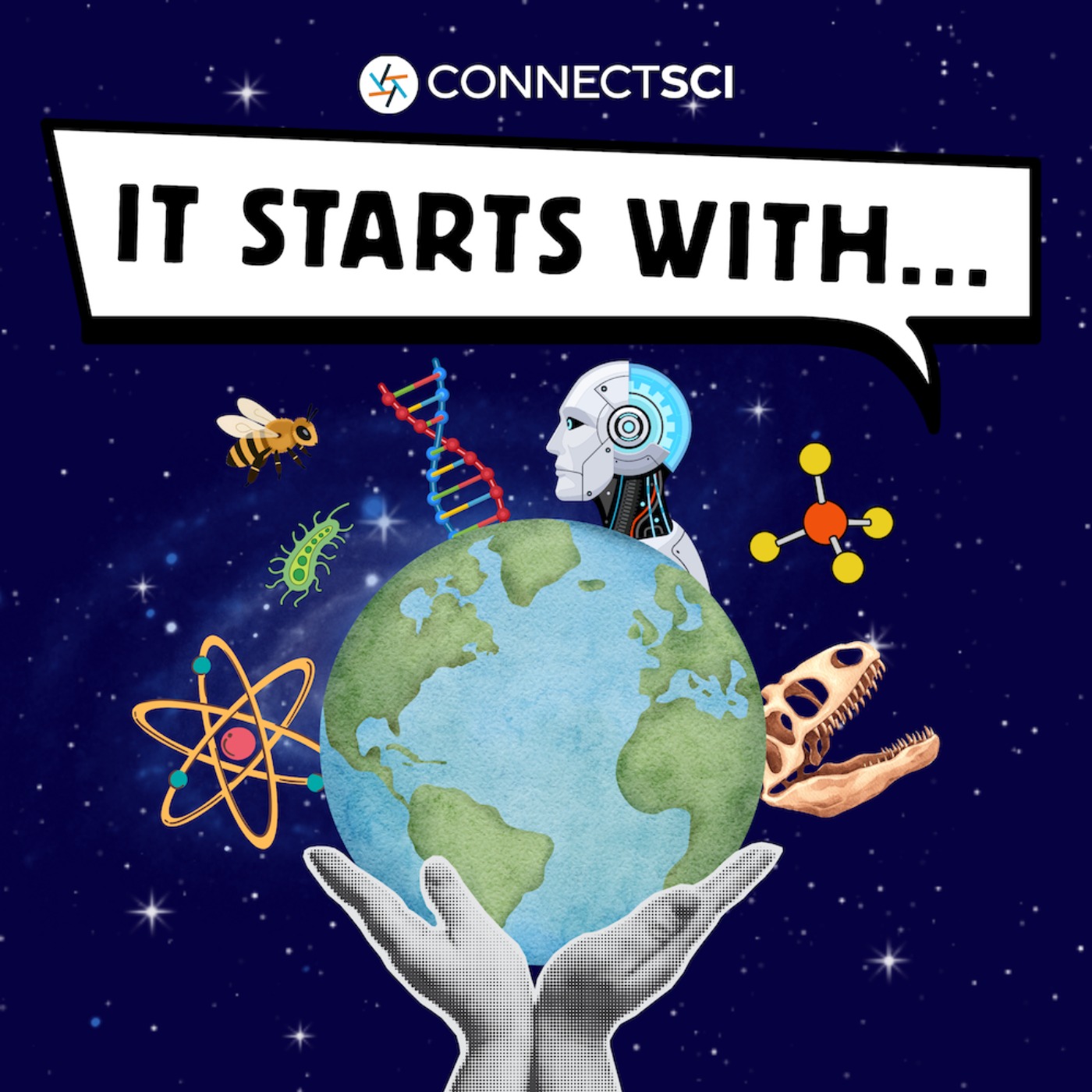
A weekly Australian science podcast exploring the people and stories behind discoveries. It Starts With... curiosity, ideas, accidents, problems, or a passion — and it leads everywhere, from fossils to AI, microplastics to Mars, the microscopic to the galactic.
David Boldeman talks to scientists, researchers and others about the journey behind the science and how they got there.
It Starts With... is a ConnectSci podcast, produced by CSIRO Publishing, Australia's trusted source for fact-based content.
Hosted on Acast. See acast.com/privacy (https://acast.com/privacy) for more information.
Show details and episodes come from the publisher's public feed at feeds.acast.com. Last updated . Names, artwork and text belong to their publishers.
Cosmos
Similar by topic and creator
- Contributions from the Smithsonian Museum of History
Shares the topics History, Science and Technology. - The Story of Nuclear Energy A Journey Through Science
Shares the topics History, Science and Technology. - Introduction to the History of Science
Shares the topics History, Science and Technology.
Similar shows







Explore more
Episodes
How much sleep does science say you really need?
· 22 min
Scientists and medical practitioners are increasingly aware of the importance of sleep for a healthy life. We’re given guidelines about number of hours per night we should be getting and what we should be doing to ensure a sound night’s sleep. Join host David Boldeman and science journalist Ellen Phiddian in this episode of the podcast It Starts With… as they sort through the fact and fiction about sleep. They tackle common questions all of us ask about what actually happens when we go to sleep, what to do when we don’t get enough and why some people seem to be able to function on less than the standard 8 hours a night. MORE YOU MIGHT LIKE: - Sleep deprived brains clean themselves while awake (https://connectsci.au/news/news-parent/6974/Sleep-deprived-brains-clean-themselves-while-awake?searchresult=1) - Free monthly newsletters: sign up now (https://connectsci.au/news/pages/newsletters) It (http://website.it/)Starts With... (https://connectsci.au/news/pages/podcasts) is a free, weekly podcast by ConnectSci. Connect Sci is the trusted home of content from the editorially independent CSIRO Publishing (https://www.publishing.csiro.au/). It Starts With... (https://connectsci.au/news/pages/podcasts) is a ConnectSci podcast. ConnectSci (https://connectsci.au/) delivers trusted, fact-based content, including peer-reviewed journal articles, eBooks and science news articles. It is operated by CSIRO Publishing (https://www.publishing.csiro.au/), a not-for-profit, editorially independent publisher based in Australia. Hosted on Acast. See acast.com/privacy (https://acast.com/privacy) for more information.
Not rated yetAtomic research in the Cold War age: an Australian physicist’s story
· 49 min
What was it like to be a nuclear physicist during the Cold War? Dr John Boldeman AO was there in the early days of Australia’s nuclear research program. He joined the Australian Atomic Energy Commission at Lucas Heights in 1960 and went on to work alongside scientists on both sides of the Iron Curtain. He talks about Australia's first nuclear research reactor (the High Flux Australian Reactor), visiting Los Alamos and other labs around the world, running overnight experiments on a particle accelerator with a roll-out bed beside the controls, and being surrounded by soldiers in Bangladesh during a military coup over a few tourist photos. He also addresses the question of whether Australia could ever have built a nuclear weapon, and explains why it never happened. It Starts With... (https://connectsci.au/news/pages/podcasts) is a ConnectSci podcast. ConnectSci (https://connectsci.au/) delivers trusted, fact-based content, including peer-reviewed journal articles, eBooks and science news articles. It is operated by CSIRO Publishing (https://www.publishing.csiro.au/), a not-for-profit, editorially independent publisher based in Australia. Hosted on Acast. See acast.com/privacy (https://acast.com/privacy) for more information.
Not rated yetWhy do some diseases spread faster than others?
· 21 min
It might start with just one person. One becomes two, two becomes four, and under the right circumstances a single infection can become an epidemic. But why do some diseases spread so much faster than others, and is there a limit to how contagious a disease can become? David Boldeman is joined by science journalist Ellen Phiddian to explore patient zero, why measles is the most contagious disease, and how measles can have a big affect on your immune system. Read more: https://connectsci.au/news/news-parent/5031/Explainer-how-contagious-can-a-disease-get It Starts With... (https://connectsci.au/news/pages/podcasts) is a ConnectSci podcast. ConnectSci (https://connectsci.au/) delivers trusted, fact-based content, including peer-reviewed journal articles, eBooks and science news articles. It is operated by CSIRO Publishing (https://www.publishing.csiro.au/), a not-for-profit, editorially independent publisher based in Australia. Hosted on Acast. See acast.com/privacy (https://acast.com/privacy) for more information.
Not rated yetCan AI improve your mental health?
· 27 min
Content warning: this episode discusses suicide and mental health. If you need urgent support in Australia call Lifeline (https://www.lifeline.org.au/) 24/7 on 13 11 14 or text 0477 13 11 14. Support is also available at Beyond Blue on 1300 22 4636, or Kids Helpline on 1800 551 800. In the UK and Ireland, Samaritans can be contacted on freephone 116 123. In the US, you can call or text the 988 Suicide & Crisis Lifeline at 988 or chat at 988lifeline.org. Many people wait months to see a psychologist, while clinicians are stretched thin and burning out. Psychologist and Ecko Health (https://www.eckohealth.ai/) founder Marika Conomos (https://marikaconomos.com/) joins David Boldeman to explain why there aren't enough psychologists to meet demand, what led her to build an AI platform to support both clinicians and patients. They also discuss how Ecko differs from general-purpose chatbots like ChatGPT, the limits of AI and what it can't yet see in a session. It Starts With... (https://connectsci.au/news/pages/podcasts) is a ConnectSci podcast. ConnectSci (https://connectsci.au/) delivers trusted, fact-based content, including peer-reviewed journal articles, eBooks and science news articles. It is operated by CSIRO Publishing (https://www.publishing.csiro.au/), a not-for-profit, editorially independent publisher based in Australia. Hosted on Acast. See acast.com/privacy (https://acast.com/privacy) for more information.
Not rated yetAre the dinosaurs in our museums out of date?
· 26 min
Palaeontology has changed enormously in recent decades, but many museum and theme park dinosaurs still look like they came straight out of last century. Palaeontologist James Ronan joins David Boldeman to explain why that matters, how his Dinosaur Accuracy Audit grades exhibits on everything from posture to feathers, and why Jurassic Park's raptors are still shaping what we see today. For more information on James' work visit james-ronan.co.uk It Starts With... (https://connectsci.au/news/pages/podcasts) is a ConnectSci podcast. ConnectSci (https://connectsci.au/) delivers trusted, fact-based content, including peer-reviewed journal articles, eBooks and science news articles. It is operated by CSIRO Publishing (https://www.publishing.csiro.au/), a not-for-profit, editorially independent publisher based in Australia. Hosted on Acast. See acast.com/privacy (https://acast.com/privacy) for more information.
Not rated yetDigital cows: how AI is reshaping farms
· 27 min
Can AI tell when a cow is getting sick before a farmer? An Australian team is working on using farm data to create a digital version of each cow and look for signs of illness before they become obvious. The technology can help prevent issues to improve milk production and keep animals healthy. David Boldeman discusses the future of farming with Alex Barakat from Digibus AI (https://www.digibus.ai/), who is helping build the technology, and dairy industry consultant Peter Best from Agstrat (https://agstrat.co/). It Starts With... (https://connectsci.au/news/pages/podcasts) is a ConnectSci podcast. ConnectSci (https://connectsci.au/) delivers trusted, fact-based content, including peer-reviewed journal articles, eBooks and science news articles. It is operated by CSIRO Publishing (https://www.publishing.csiro.au/), a not-for-profit, editorially independent publisher based in Australia. Hosted on Acast. See acast.com/privacy (https://acast.com/privacy) for more information.
Not rated yetRobot boats set sail around the Southern Ocean on 9-month journey
· 21 min
The first of a new fleet of uncrewed surface vehicles (USVs) has set off from Tasmania, Australia, on a nine-month mission to monitor the Southern Ocean. CSIRO’s Dr Elizabeth Shadwick discusses with host David Boldeman how the project will help us to better understand how much carbon dioxide from the atmosphere is absorbed by the ocean surface. The USVs have no crew and will be transported on its journey by the high winds of the Southern Ocean. It could face waves up to 9 metres high but it is designed for the conditions. The project is part of an international collaboration between CSIRO, Australia’s national science agency and partner of the Australian Antarctic Program Partnership (https://aappartnership.org.au/), the US National Oceanic and Atmospheric Administration (https://www.noaa.gov/) (NOAA), South Africa’s Southern Ocean Carbon-Climate Observatory (SOCCO), CSIR (https://socco.org.za/), Columbia University (https://www.columbia.edu/), University of Washington (https://www.washington.edu/), and Schmidt Sciences, through the Virtual Institute for the Carbon Cycle (https://www.schmidtsciences.org/vicc/) (VICC) program, and Saildrone (https://www.saildrone.com/platform/explorer), to capture data on ocean carbon sinks. For more info on the project: https://coco2-vicc.github.io/about Elizabeth also appeared on our Ultramarine podcast: 4500m deep - remote observatory expands climate knowledge (https://connectsci.au/news/news-parent/8093/4500m-deep-remote-observatory-expands-climate) It Starts With... (https://connectsci.au/news/pages/podcasts) is a ConnectSci podcast. ConnectSci (https://connectsci.au/) delivers trusted, fact-based content, including peer-reviewed journal articles, eBooks and science news articles. It is operated by CSIRO Publishing (https://www.publishing.csiro.au/), a not-for-profit, editorially independent publisher based in Australia. Hosted on Acast. See acast.com/privacy (https://acast.com/privacy) for more information.
Not rated yetIs white really the coolest colour to wear?
· 20 min
We're told white keeps you cool and black soaks up the heat — but where does purple fit in? Imma Perfetto joins David Boldeman to unpack the surprising physics of colour and heat after a new purple fabric was found to keep you cooler than white cotton. The discovery (https://connectsci.au/news/news-parent/9983/New-purple-fabric-is-cooler-than-wearing-white?searchresult=1) was made by researchers at Adelaide University. They discuss why purple absorbs more light than you'd think, how passive radiative cooling works, and what this could mean for beating extreme heat as the planet warms. It (http://website.it/)Starts With... (https://connectsci.au/news/pages/podcasts) is a free, weekly podcast by ConnectSci. ConnectSci is the trusted home of content from the editorially independent CSIRO Publishing (https://www.publishing.csiro.au/). It Starts With... (https://connectsci.au/news/pages/podcasts) is a ConnectSci podcast. ConnectSci (https://connectsci.au/) delivers trusted, fact-based content, including peer-reviewed journal articles, eBooks and science news articles. It is operated by CSIRO Publishing (https://www.publishing.csiro.au/), a not-for-profit, editorially independent publisher based in Australia. Hosted on Acast. See acast.com/privacy (https://acast.com/privacy) for more information.
Not rated yetWhy pleasure — not fear — should drive sex education
· 33 min
New research shows that making sexual health services pleasure-inclusive for young people returns $23 for every $1 spent. Across 99 countries, that's 30.7 million more people protected, 4.3 million unintended pregnancies avoided, and over 90,000 lives saved by 2050. It turns out the missing piece in sexual health programming wasn't complicated. It was pleasure, and it was there the whole time. David Boldeman speaks with Anne Philpott, founder and co-director of The Pleasure Project (https://thepleasureproject.org/) that commissioned the study. Anne is also the associate editor of the CSIRO Publishing journal Sexual Health (https://connectsci.au/sh). Anne and David discuss the impact of a more positive approach to sexual education and whether or not it makes people less responsible and take more risks. They also chat about how normalising pleasure in sex education and health contexts can also have a positive impact on the use of contraception. MORE YOU MIGHT LIKE: - Women with high levels of ‘interoception’ orgasm more often (https://connectsci.au/news/news-parent/2576/Women-with-high-levels-of-interoception-orgasm) - Free monthly newsletter: sign up now (https://connectsci.au/news/pages/newsletters) It (http://website.it/)Starts With... (https://connectsci.au/news/pages/podcasts) is a free, weekly podcast by ConnectSci. ConnectSci is the trusted home of content from the editorially independent CSIRO Publishing (https://www.publishing.csiro.au/). It Starts With... (https://connectsci.au/news/pages/podcasts) is a ConnectSci podcast. ConnectSci (https://connectsci.au/) delivers trusted, fact-based content, including peer-reviewed journal articles, eBooks and science news articles. It is operated by CSIRO Publishing (https://www.publishing.csiro.au/), a not-for-profit, editorially independent publisher based in Australia. Hosted on Acast. See acast.com/privacy (https://acast.com/privacy) for more information.
Not rated yet90 years after extinction, could the Tasmanian tiger come back?
· 40 min
The last Tasmanian tiger died 90 years ago. Could de-extinction science bring it back? Professor Andrew Pask explains how. September 7, 1936, was the last confirmed sighting of a thylacine (Tasmanian tiger). It was named “Benjamin” and died at Beaumaris Zoo in Hobart, Australia. Now, 90 years on, a team of researchers have teamed up with US-based company Colossal Biosciences (https://colossal.com/) to bring the thylacine back to life, along with other extinct animals including the woolly mammoth, dodo and dire wolf. In this episode of the It Starts With… podcast, David Boldeman speaks with University of Melbourne geneticist Professor Andrew Pask (https://findanexpert.unimelb.edu.au/profile/4401-andrew-pask) about the thylacine de-extinction project. They discuss the big questions: How do you bring extinct animals back? Can you stop extinction before it happens? Are scientists “playing God”? It Starts With... (https://connectsci.au/news/pages/podcasts) is a ConnectSci podcast. ConnectSci (https://connectsci.au/) delivers trusted, fact-based content, including peer-reviewed journal articles, eBooks and science news articles. It is operated by CSIRO Publishing (https://www.publishing.csiro.au/), a not-for-profit, editorially independent publisher based in Australia. Hosted on Acast. See acast.com/privacy (https://acast.com/privacy) for more information.
Not rated yetYour tongue is lying to you: the hidden science of flavour
· 16 min
Why does mint make your mouth feel like it's full of ice even though it doesn't change the temperature in your mouth? In this episode, host David Boldeman sits down with science journalist Ellen Phiddian to unpack the strange sensory science hiding behind everyday flavors. They dig into the trigeminal nerve, the hidden receptors that mix up heat, cold, and pain, and why your tongue is doing a lot more than just tasting. And you'll get the answers to a whole lot more: - Why does wasabi shoot up your nose? - Why are fizzy drinks not really about the bubbles? - Why do garlic and mustard have a spicy kick? - Can you build up a tolerance to chilli? READ MORE: https://connectsci.au/news/news-parent/4296/Why-does-mint-make-your-mouth-feel-cold-and-why-do It Starts With... (https://connectsci.au/news/pages/podcasts) is a ConnectSci podcast. ConnectSci (https://connectsci.au/) delivers trusted, fact-based content, including peer-reviewed journal articles, eBooks and science news articles. It is operated by CSIRO Publishing (https://www.publishing.csiro.au/), a not-for-profit, editorially independent publisher based in Australia. Hosted on Acast. See acast.com/privacy (https://acast.com/privacy) for more information.
Not rated yetResilience, crisis leadership & AI with former pilot Richard de Crespigny
· 44 min
Knowledge built over time, skills practiced and risks taken help prepare us for the challenges of life. Resilience, therefore, is not something that emerges when things go wrong but takes a lifetime to develop according to this week’s podcast guest Richard de Crespigny (https://www.linkedin.com/in/richard-de-crespigny-am-3bb33/). Richard de Crespigny knows all about resilience in challenging situations. He was captain of Qantas Flight 32 (https://qf32.aero/), the Airbus A380 that in 2010 suffered a catastrophic, uncontained explosion in its engine on a flight from Singapore to Sydney. Despite more than 50 cascading system failures and severe wing damage, the 5-pilot crew landed safely. All of the 469 people on board disembarked without a single injury. In this episode of It Stars With… David Boldeman speaks to Richard about how resilience is built and why it is more important than ever in an age of AI and automation. Richard de Crespigny has written a book on the topic, Fly! The Elements of Resilience (https://www.penguin.com.au/books/fly-9780670078738). It Starts With... (https://connectsci.au/news/pages/podcasts) is a ConnectSci podcast. ConnectSci (https://connectsci.au/) delivers trusted, fact-based content, including peer-reviewed journal articles, eBooks and science news articles. It is operated by CSIRO Publishing (https://www.publishing.csiro.au/), a not-for-profit, editorially independent publisher based in Australia. Hosted on Acast. See acast.com/privacy (https://acast.com/privacy) for more information.
Not rated yetWhat will we eat if we live on the Moon or Mars?
· 26 min
Professor Volker Hessel (https://plants4space.com/team/volker-hessel) is working on one of the biggest challenge in future space exploration, how do we support human life beyond Earth. Volker is a chief investigator at the ARC Center of Excellence in Plants for Space (https://plants4space.com/). Plants for Space brings together researchers who are looking at we can eat and drink in space, and how we could grow food. He is also looking at how this research can be used back on earth, including droughts, vertical farming and personalised farming. It Starts With... (https://connectsci.au/news/pages/podcasts) is a ConnectSci podcast. ConnectSci (https://connectsci.au/) delivers trusted, fact-based content, including peer-reviewed journal articles, eBooks and science news articles. It is operated by CSIRO Publishing (https://www.publishing.csiro.au/), a not-for-profit, editorially independent publisher based in Australia. Hosted on Acast. See acast.com/privacy (https://acast.com/privacy) for more information.
Not rated yetWhat is a bee and why do they need the right bee hotel in your garden?
· 41 min
Explore Australia’s hidden world of native bees with Dr Kit Prendergast (https://www.patreon.com/cw/TheBeeBabette) and Clancy Lester (https://beesandblossoms.org/). Kit is a native bee scientist, ecologist and passionate advocate for Australia’s bee diversity. Clancy is a science communicator helping Australians discover the extraordinary pollinators living all around us. They discuss with David how to make a good bee hotel (https://nativebeehotels.com/bee-hotel-diy) for native species and the surprising answer to what is a bee. Want to know more? - Follow Kit on Insta (https://www.instagram.com/dr.beebabette) - Follow Clancy on Insta (https://www.instagram.com/beesandblossoms.aus/) or Linkedin (https://www.linkedin.com/in/george-clancy-lester/) - Watch Kit's Birds & the Bees show (https://www.patreon.com/TheBeeBabette/posts/158735543?utm_campaign=postshare_creator) - Buy Kit's book Creating a Haven for Native Bees (https://www.patreon.com/TheBeeBabette/shop/creating-haven-for-native-bees-72294) - Facebook group The Buzz on Wild Bees (https://www.facebook.com/share/g/1cDJ4CQ8Uv/?mibextid=wwXIfr) It Starts With... (https://connectsci.au/news/pages/podcasts) is a ConnectSci podcast. ConnectSci (https://connectsci.au/) delivers trusted, fact-based content, including peer-reviewed journal articles, eBooks and science news articles. It is operated by CSIRO Publishing (https://www.publishing.csiro.au/), a not-for-profit, editorially independent publisher based in Australia. Hosted on Acast. See acast.com/privacy (https://acast.com/privacy) for more information.
Not rated yetMicroplastics: what are they and how dangerous are they really?
· 19 min
Microplastics are everywhere – in water (https://connectsci.au/news/news-parent/4324/Removing-microplastics-from-drinking-water-as), food, air and even our bodies. But are microplastics as scary as some news headlines would have us believe? In this episode of the It Stars With… podcast, David Boldeman chats with science journalist Ellen Phiddian (https://connectsci.au/news/search-results?page=1&q=ellen%20phiddian&fl_SiteID=1000095) about microplastics. Ellen gives us the latest facts and figures on microplastics: where they’ve been found and how much have polluted our planet. Everywhere microplastics have been found – oceans (https://connectsci.au/news/news-parent/2101/Microplastics-even-infiltrate-the-world-s-most), soil and even the human body – scientists are beginning to build a picture of the damage they can cause to the ecosystem and organisms that encounter the tiny fragments. Understanding these microscopic fragments of plastic – where they come from, why they don’t break down, where they’re appearing, how they affect organisms – is the key to being able to resolve an increasingly complex environmental and health (https://connectsci.au/news/news-parent/1908/Are-microplastics-causing-a-new-public-health) problem brought on by their proliferation. It Starts With... (https://connectsci.au/news/pages/podcasts) is a ConnectSci podcast. ConnectSci (https://connectsci.au/) delivers trusted, fact-based content, including peer-reviewed journal articles, eBooks and science news articles. It is operated by CSIRO Publishing (https://www.publishing.csiro.au/), a not-for-profit, editorially independent publisher based in Australia. Hosted on Acast. See acast.com/privacy (https://acast.com/privacy) for more information.
Not rated yetFrom Fukushima to bushfires: the robots humans can't live without
· 38 min
Science journalist and author Smriti Daniel explains what actually separates a robot from a smart toaster and why the most useful robots don't look human at all. Smriti also discussed with host David Boldeman how robots are already fighting bushfires, working inside Fukushima, and collecting whale snot. She also shares her five favourite robots, some are quite bizarre. Smriti has written the book Robot Responders (https://www.publishing.csiro.au/book/8165/#details) aimed at kids aged 8 to 12. It is published by CSIRO Publishing and is available in print or eBook (https://www.publishing.csiro.au/book/8165/#details). CSIRO has created the online game CSIRO Robot Responders (https://www.csiro.au/en/education/Resource-Library/Robot-Responders-HTML-game) and unplugged card game, where players design, test and refine robots to complete missions inspired by real-world science and engineering. It is recommended for 10 to 14 year olds. It Starts With... (https://connectsci.au/news/pages/podcasts) is a ConnectSci podcast. ConnectSci (https://connectsci.au/) delivers trusted, fact-based content, including peer-reviewed journal articles, eBooks and science news articles. It is operated by CSIRO Publishing (https://www.publishing.csiro.au/), a not-for-profit, editorially independent publisher based in Australia. Hosted on Acast. See acast.com/privacy (https://acast.com/privacy) for more information.
Not rated yetDo mosquitoes pollinate flowers? The hidden world of pollination
· 29 min
Bees aren't the only pollinators. There’s a whole host of birds and insects, from flies and beetles to moths and even mosquitoes, which move between and feed on flowers while helping plants proliferate. In this episode of the It Starts With… podcast, David Boldeman is joined by biologist and naturalist Peter Bernhardt to discuss the thousands of species of insects and other creatures which pollinate. They are, as he calls them, the “unsung heroes” of pollination. This even includes mosquitoes. Not only do these blood-sucking insects feed on our vital fluids, but one species gets its energy from sugars in a specific orchid’s nectar. Many plants have a special relationship with particular pollinators. David and Peter discuss how understanding those relationships is key to protecting biodiversity and native species. This could even be as simple as choosing which plants to plant in your garden. It all has an impact on the pollinators and their symbiotic relationship with flowering plants. Peter is author of the book Unsung Heroes of Pollination, published by CSIRO Publishing. It is available in print or eBook (https://www.publishing.csiro.au/book/8200/). It Starts With... (https://connectsci.au/news/pages/podcasts) is a ConnectSci podcast. ConnectSci (https://connectsci.au/) delivers trusted, fact-based content, including peer-reviewed journal articles, eBooks and science news articles. It is operated by CSIRO Publishing (https://www.publishing.csiro.au/), a not-for-profit, editorially independent publisher based in Australia. Hosted on Acast. See acast.com/privacy (https://acast.com/privacy) for more information.
Not rated yetThe Great Southern Reef: Australia's hidden rival to the Great Barrier Reef
· 25 min
The Great Southern Reef wraps around most of southern Australia and rivals the Great Barrier Reef in size and biodiversity — yet most Australians have never heard of it. David Boldeman speaks with marine ecologist Scott Bennett in this episode of It Starts With… to understand the hidden world of the Great Southern Reef. Scott is Chair of the Great Southern Reef Foundation (https://greatsouthernreef.com/) which aims to promote understanding and protection of this marine environment. The Great Southern Reef itself was only identified by science in 2015. It’s not an interconnected coral reef like the tropical Great Barrier Reef, but a temperate collection of rocky reefs. It is home to a stunning array of biodiversity, including the vulnerable kelp forests (https://connectsci.au/news/news-parent/5204/Forecast-for-sea-off-south-east-Australia-spells) off Tasmania’s coast. It Starts With... (https://connectsci.au/news/pages/podcasts) is a ConnectSci podcast. ConnectSci (https://connectsci.au/) delivers trusted, fact-based content, including peer-reviewed journal articles, eBooks and science news articles. It is operated by CSIRO Publishing (https://www.publishing.csiro.au/), a not-for-profit, editorially independent publisher based in Australia. Hosted on Acast. See acast.com/privacy (https://acast.com/privacy) for more information.
Not rated yetWhy does alcohol affect your body the way it does?
· 19 min
Alcohol has been socially lubricating, intoxicating and relaxing humans for thousands of years. But the chemistry behind alcohol and the biological effects it has on the human body are still being understood. Join David Boldeman and science journalist Ellen Phiddian in this episode of the It Starts With… podcast as they take a sip from the chalice of knowledge to get to the gurgling heart of what alcohol is and how it affects the body. Ellen and David explore the properties of ethanol, why we get drunk, as well as the harmful effects of overconsumption of alcohol on the human body. It Starts With... (https://connectsci.au/news/pages/podcasts) is a ConnectSci podcast. ConnectSci (https://connectsci.au/) delivers trusted, fact-based content, including peer-reviewed journal articles, eBooks and science news articles. It is operated by CSIRO Publishing (https://www.publishing.csiro.au/), a not-for-profit, editorially independent publisher based in Australia. Hosted on Acast. See acast.com/privacy (https://acast.com/privacy) for more information.
Not rated yetFound a fossil? Here's what to do next
· 27 min
About 70% of Australia’s dinosaur holotype fossils were not discovered by palaeontologists. They were found by members of the public with a keen eye. It begs the question: what should you do if you stumble on a fossil or ancient artefact? In this podcast, David Boldeman speaks with archaeologist and palaeontologist Sally Hurst who is founder of the “Found A Fossil” project which provides all the answers to these questions and more about what to do if you find remains of ancient animals or artefacts from human settlements. Who do you tell? Can you take the object? What kind of pictures should you take? Join Sally and David as they discuss these questions. Sally is author of the book Found a Fossil is published by CSIRO Publishing and is available in print or eBook (https://www.publishing.csiro.au/book/8203/). It Starts With... (https://connectsci.au/news/pages/podcasts) is a ConnectSci podcast. ConnectSci (https://connectsci.au/) delivers trusted, fact-based content, including peer-reviewed journal articles, eBooks and science news articles. It is operated by CSIRO Publishing (https://www.publishing.csiro.au/), a not-for-profit, editorially independent publisher based in Australia. Hosted on Acast. See acast.com/privacy (https://acast.com/privacy) for more information.
Not rated yet