

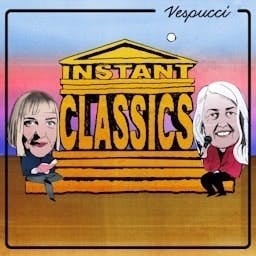
Instant Classics
VespucciAudio
- Format:
- Podcast
- New episodes:
- Weekly
- Typical length:
- about 55 minutes
- Latest episode:
About this show
Join world-renowned classicist Mary Beard and Guardian chief culture writer Charlotte Higgins for Instant Classics — the weekly podcast that proves ancient history is still relevant. Ancient stories, modern twists… and no degree in Classics required.
Discover The Odyssey and join the book club at: https://www.exploringtheodyssey.com
Show details and episodes come from the publisher's public feed at feeds.megaphone.fm. Last updated . Names, artwork and text belong to their publishers.
Cosmos
Similar by topic and creator
- Cautionary Tales of History
Shares the topic History. - Hardcore Stories
Shares the topic History. - History: Hits and Stories
Shares the topic History.
Similar shows






Explore more
Episodes
The Great Plague of Athens
· 52 min
In 430 BCE, Athens was hit by a terrible plague that ultimately claimed around a third of the population. All the social niceties we associate with Ancient Athens collapsed. Citizens turned on one another. The dead were left unburied. Mary and Charlotte both recount and question the ‘facts’ of the epidemic as told by historian, eyewitness and plague survivor Thucydides. Thucydides’ account is remarkable in that it aligns with the emerging science of medicine in ancient Athens by focusing on the symptoms and natural causes rather than framing it as divine retribution from the gods. Yet, for all this, the truth is hard to pin down. We still don’t know what exactly the plague was. And Thucydides’ claims to be an objective historian are undermined by the way he presents the plague as a possible response to Athenian arrogance and hubris. Yet for all the gaps, we see many of the social characteristics of epidemics that have recurred throughout history. Social collapse, finger pointing, moralising, and arguments about which ‘truth’ to believe. Mary and Charlotte recommend some further reading: Thucydides describes the plague in his History 2, 47 - 55 Plutarch describes Pericles’ death from the plague in his Life of Pericles 38. There are plenty of translations of Thucydides available online. But NB one of the most often used (a nineteenth-century version by Richard Crawley) is also one of the least reliable. Thucydides, Apollo, the Plague and the War, Lisa Kallet, The American Journal of Philology, Fall 2013, Vol. 134, No. 3, pp. 355-382 (an interesting article in which Kallet casts doubt on the purely objective, scientific account Thucydides purports to give of the plague) A Plague Like no Other: Beyond the Buboes in Thucydides' account of the Plague of Athens, by Pere Domingo, Paula Prieto, Lluis Pons, Clinical Microbiology and Infection, May 2025 (a useful round-up of the latest medical thinking on the Athenian plague) J Longrigg, ‘Death and Epidemic Disease in Classical Athens’ in V Hope and E Marshall, Death and Disease in the ancient city (Routledge, 2000) Emily Greenwood: https://yalereview.org/article/thucydides-times-trouble (a classicist reflects on the Athenian plague and Covid) @instaclassicpod for Insta, TikTok and YouTube @insta_classics for X email: instantclassicspod@gmail.com Instant Classics handmade by Vespucci Producer: Jonty Claypole Video Editor: Jak Ford Theme music: Casey Gibson Learn more about your ad choices. Visit podcastchoices.com/adchoices (https://podcastchoices.com/adchoices)
Not rated yetWhat Did the Romans Eat? Part 2: Plebs’ Food
· 44 min
Think Roman food and we imagine extravagant banquets involving rare delicacies. There’s some truth in this, but only for the few. In this episode, Mary and Charlotte ask: what did your average Roman eat? Cooking at home was only for the very rich - you had to have not only a kitchen, but the staff to manage it. For this reason, most Romans ate on the hoof or at fast food outlets. In Pompeii, for instance, there is surviving evidence of many such establishments: places where citizens could access a pre-cooked meal straight away. While we know that most Romans ate out, and the sorts of places where they ate, until recently there was very little evidence showing what such establishments served. Modern archaeological techniques are starting to provide answers through the analysis of excrement in Roman lavatories. Comparing the evidence from lavatories in Herculaneum and modern day Scotland, a faeces - sorry, thesis - emerges of people surviving on whatever the local countryside could provide - varying dramatically from region to region - with a few luxury imports for special occasions. Forget dormice and think cabbage. Lots of it. In myriad ways. Mary and Charlotte recommend some further reading: There is a good overview of the Herculaneum cesspit here: https://www.cambridgeamarantus.com/topics/topic-vi/63/63-evidence And detailed scientific analysis here: https://link.springer.com/article/10.1007/s11457-018-9218-y For a brief account of the menu at an ordinary Pompeian bar, see: https://www.smithsonianmag.com/smart-news/fast-food-joint-pompeii-served-snails-fish-and-wine-new-finds-suggest-180976651/ Cato’s On Agriculture – complete with its praise of cabbage – can be found in English translation here (https://penelope.uchicago.edu/Thayer/E/Roman/Texts/Cato/De_Agricultura/home.html). And some information (https://www.digitscotland.com/bearsden-roman-fort-the-story-of-an-excavation/) on the Bearsden latrine analysis @instaclassicpod for Insta, TikTok and YouTube@insta_classics for Xemail: instantclassicspod@gmail.com Instant Classics handmade by Vespucci Producer: Jonty Claypole Video Editor: Jak Ford Theme music: Casey Gibson Learn more about your ad choices. Visit podcastchoices.com/adchoices (https://podcastchoices.com/adchoices)
Not rated yetWhat Did the Romans Eat? Part 1: Posh Food
· 54 min
When we think about Roman food, most of us imagine wealthy citizens stuffing their faces with rare delicacies while reclining on their sides and taking occasional breaks to use the vomitorium (urban myth alert). In this two-part special, Mary and Charlotte cut through the fermented fish sauce to look at what the Romans really ate. And no, the vomitorium was not a place where they made themselves vomit. In this first episode, Mary and Charlotte look at posh food, beginning right at the top - in the imperial palace. Happily, there are some stories of jaw-dropping extravagance, including Elagabalus (a fave of the show) hiding pearls in the rice as a surprise for his guests. And the favourite dish of the Emperor Vitellius involved pike liver, peacock brain, flamingo tongue and lamprey sperm - all mixed together. But just as many emperors favoured a martial diet and household economy. Augustus - a snack guy - boasted about his ascetic preference for with cheese, figs and bread. Tiberius was criticised by the elite for serving leftovers. You can never trust anecdotes about the emperors, but most of the stories have a plausibility when you read them alongside a surviving cookbook - Apicius’ De re culinaria. Here we find out about garum - or fermented fish sauce (which Mary thinks is less disgusting than it sounds), animal wombs, dormice as well as a lot of vegetarian dishes (more to Charlotte’s taste). Mary and Charlotte recommend some further reading: Emperors’ reported eating habits are discussed in Mary’s Emperor of Rome (Profile pb, 2024) You can find a complete (rather lumpy) translation of Apicius online here: https://www.gutenberg.org/files/29728/29728-h/29728-h.htm Several modern writers collect some of Apicius’ recipes and adapt them for “the modern kitchen”: eg John Edwards (Rider pb, 2009), Sally Grainger (Prospect pb, 2015) and Andrew Dalby (British Museum pb, 2012) @instaclassicpod for Insta, TikTok and YouTube @insta_classics for X email: instantclassicspod@gmail.com Instant Classics handmade by Vespucci Producer: Jonty Claypole Video Editor: Jak Ford Theme music: Casey Gibson Learn more about your ad choices. Visit podcastchoices.com/adchoices (https://podcastchoices.com/adchoices)
Not rated yetClassic Chats: Tom Holland
· 56 min
Mary and Charlotte talk to Tom Holland, co-host of the Rest is History. As well as being a podcasting megastar, Tom is a brilliant historian of Ancient Rome. His books include Rubicon: The Last Years of the Roman Republic, Pax: War and Peace in Rome’s Golden Age and his recent translation of Suetonius’ The Lives of the Caesars. In the first half of this episode, Tom talks about why Suetonius, with his interest in court gossip and trivia, is the historian for the current age. In the second half, he talks about his lifelong fascination with the Romans - from discovering the Asterix books as a boy, the poetry of Catullus as a teenager, and how writing a series of novels about vampires led him to write Rubicon. @instaclassicpod for Insta, TikTok and YouTube @insta_classics for X email: instantclassicspod@gmail.com Instant Classics handmade by Vespucci Producer: Jonty Claypole Video Editor: Jak Ford Theme music: Casey Gibson Learn more about your ad choices. Visit podcastchoices.com/adchoices (https://podcastchoices.com/adchoices)
Not rated yetWho's Afraid of Lupercalia?
· 47 min
If you were to go back in time to 15 February in Ancient Rome, you might see marauding packs of naked men surging through the streets. If you were particularly unlucky one of them might whip you with a piece of goat skin. This was the Roman festival of Lupercalia. In this episode, Mary and Charlotte ask: what on earth was all this about? What did Lupercalia mean to the Romans? And what was the real purpose of any festival to the Romans? Despite its mind-boggling oddness, Lupercalia is better documented than many other Roman festivals. This is partly because the Romans themselves didn’t know really what it was about. Lupercalia was something that seemed to have always been celebrated, but opinions varied - then as now - as to what it meant. The wolfiness of lupercalia, and the suggestion the ritual began in the cave where Romulus and Remus were believed to have been suckled, implies it may have been a way for the Romans to connect with their murky origins - an example of the city performing its own past. But even this is contested. One thing is clear: despite the date, Lupercalia had nothing to do with modern Valentine’s Day - unless, of course, your idea of romance is running naked through the streets flailing a piece of animal skin… @instaclassicpod for Insta, TikTok and YouTube @insta_classics for X email: instantclassicspod@gmail.com Mary and Charlotte recommend some further reading: The Lupercalia is one of Roman religious festivals discussed in Mary’s book, with John North and Simon Price, Religions of Rome (Cambridge UP pb, 1998) volume 2 (with translation of the main ancient texts, including a section of Pope Gelasius’ pamphlet). Mary also discusses how to understand Roman festivals more widely in her chapter in C. Ando (ed.), Roman Religion, Edinburgh Readings in the Ancient World (Edinburgh UP, pb, 2003). Shakespeare’s Lupercalia is in his Julius Caesar Act 1, scene 2 Instant Classics handmade by Vespucci Producer: Jonty Claypole Video Editor: Jak Ford Theme music: Casey Gibson Learn more about your ad choices. Visit podcastchoices.com/adchoices (https://podcastchoices.com/adchoices)
Not rated yetVillain, Victim... Double Agent? The Many Lives of Helen of Troy pt 4
· 55 min
Greece gave way to Rome and the Roman Empire too declined, but Helen of Troy survived. Forever young and relevant, she has been reimagined by generation after generation. In the last episode of this mini-series, Mary and Charlotte look at Helen’s enduring appeal in the modern age. They show how she appeared in the poetry of medieval bards, inspired playwright Christopher Marlowe to create one of the most famous lines in English literature (the face that launched a thousand ships) - and how Shakespeare, not wanting to be outdone by Marlowe, said her face launched ‘over’ a thousand ships. Mary describes some of her favourite 19th century paintings of Helen - and discusses the problem of how you paint a face that, by definition, is more beautiful than the face of any artist model. Charlotte talks about how that problem continues in cinema (with a side anecdote about asking Brad Pitt the wrong question at the launch of the film Troy). Finally, Charlotte and Mary compare some of their favourite Helens in modern literature, including Margaret Atwood’s Penelopiad (2005), Pat Barker’s The Silence of the Girls (2018) and Natalia Haynes’ A Thousand Ships (2019) @instaclassicpod for Insta, TikTok and YouTube @insta_classics for X email: instantclassicspod@gmail.com Paintings referred to: G Moreau, Helen at the Scaean Gates https://commons.wikimedia.org/wiki/File:Helene_a_la_porte_scee_-_gustave_moreau_-_2.jpg F. A Sandys, Helen of Troy https://www.liverpoolmuseums.org.uk/artifact/helen-of-troy (The original magazine illustration from which the painting is excerpted: https://collections.vam.ac.uk/item/O783702/illustration-to-helen-and-cassandra-print-sandys-frederick/ ) E de Morgan, Helen of Troy: https://www.demorgan.org.uk/collection/helen-of-troy/ Instant Classics handmade by Vespucci Producer: Jonty Claypole Video Editor: Jak Ford Theme music: Casey Gibson Learn more about your ad choices. Visit podcastchoices.com/adchoices (https://podcastchoices.com/adchoices)
Not rated yetVillain, Victim... Double Agent? The Many Lives of Helen of Troy pt 3
· 44 min
What happened to Helen after the Trojan War? Mary and Charlotte pick up the trail of mythology’s most famous femme fatale as she makes the long journey home from Troy. The big question at the end of the previous episode was whether her husband Menelaus would kill her as revenge for betraying him with Paris. Needless to say, her charms win out and, after a long stop in Egypt, where she acquires some amazing accessories, they return home to Sparta. Just in time for Telemachus, son of Odysseus, to arrive and ask them if he knows where his father is? The Helen of The Odyssey Book 4 takes us by surprise. She and Menelaus have settled into a rather humdrum domestic companionship. And it raises the question: was all that fighting and bloodshed worth it? For this? Just as fascinating as Homer’s surprise depiction is a theory embedded in Greek texts that Helen never actually went to Troy, but sat out the whole affair in relative safety in Egypt. The Helen people saw on the ramparts of Troy was simply an eidolon - an image. Mary and Charlotte show how the true nature of Helen - villain, victim or double agent? - provided an endless source of debate, and opportunities for creative flights of fancy, in the ancient world. Finally, they look at a few of the different accounts of her final years. @instaclassicpod for Insta, TikTok and YouTube @insta_classics for X email: instantclassicspod@gmail.com Mary and Charlotte recommend some further reading: In addition to the reading recommended for the earlier episodes: The whole tradition of the phantom of Helen is discussed in detail by Norman Austin in Helen of Troy and her Shameless Phantom (Cornell UP, 2018) Helen and Menelaus in Sparta feature in Book 4 of the Odyssey (with a detailed recent discussion by J Burgess in The Oxford Critical Guide to Homer’s Odyssey, ed Christensen (Oxford UP, pb, 2025)) Herodotus’ account is at his Histories 2, 112 ff Euripides’ play Helen is available online here https://www.perseus.tufts.edu/hopper/text?doc=Perseus%3Atext%3A1999.01.0100 though it is a rather old-fashioned translation (be warned!) and there is a full performance (by students) on YouTube here: https://www.youtube.com/watch?v=-MVyAZbRaK0 Emily Wilson translated Euripides’ Helen as part of a recommended (if you want to go for it) fat selection of Greek plays in recent translation: The Greek Plays: Sixteen Plays by Aeschylus, Sophocles, and Euripides (Modern Library Classics, pbck, 2017) edited by Mary Lefkowitz and James Romm Instant Classics handmade by Vespucci Producer: Jonty Claypole Video Editor: Jak Ford Theme music: Casey Gibson Learn more about your ad choices. Visit podcastchoices.com/adchoices (https://podcastchoices.com/adchoices)
Not rated yetBONUS Mary & Charlotte on the trailer for Christopher Nolan’s Odyssey
· 7 min
Christopher Nolan’s adaptation of The Odyssey is set to be the blockbuster event of the summer. With the first trailers now coming online, Mary and Charlotte take a look to get a sense if the hype is worth it. Have your say at… @instaclassicpod for Insta, TikTok and YouTube @insta_classics for X email: instantclassicspod@gmail.com Instant Classics handmade by Vespucci Producer: Jonty Claypole Video Editor: Jak Ford Theme music: Casey Gibson Learn more about your ad choices. Visit podcastchoices.com/adchoices (https://podcastchoices.com/adchoices)
Not rated yetVillain, Victim... Double Agent? The Many Lives of Helen of Troy pt2
· 49 min
When Paris, a Trojan prince, abducted Helen of Sparta, the Greeks came in hot pursuit and besieged Troy for ten years. But what was Helen’s role in all this? Was she really kidnapped, or did she elope? And whose side was she really on during the ensuing war? Mary and Charlotte turn to a variety of ancient texts to explore these questions. In Homer’s The Iliad - the longest and greatest account of the war - Helen isn’t even one of the main characters. She watches Paris and Menelaus fight a duel in her name, draws the admiration of old men, and spends some sexy time with Paris. In The Odyssey, we find out about her role in the final episode of the war - the Trojan Horse. Here she appears more of a double agent: secretly communicating with Odysseus, but also tormenting his soldiers. In Virgil’s Aeneid, she is a hate figure and a focus of murderous fantasies for the hero Aeneas. Finally, Mary and Charlotte look at The Trojan Women by Euripides, where Helen defends herself as a victim of the gods and her own beauty. Menelaus plans to slaughter her, but we know by the end of this play that is unlikely. What happens next is the focus of the next episode! @instaclassicpod for Insta, TikTok and YouTube @insta_classics for X email: instantclassicspod@gmail.com Mary and Charlotte recommend some further reading: The key sections of the Iliad that feature Helen are Book 3 (where she appears 4 times), Book 6, 342 ff and towards the very end of Book 24. Helen herself and Menelaus tell her story of the war in Odyssey Book 4, esp. 220ff. Aeneas’s outburst against Helen is in Virgil Aeneid Book 2, 567 ff. Key modern works on Helen and her role in myth and literature are: Ruby Blondell, Helen of Troy: Beauty, Myth, Devastation (Oxford UP, pb, 2015) Bettany Hughes, Helen of Troy: Goddess, Princess, Whore (Pimlico, pb, 2013) Instant Classics handmade by Vespucci Producer: Jonty Claypole Video Editor: Jak Ford Theme music: Casey Gibson Learn more about your ad choices. Visit podcastchoices.com/adchoices (https://podcastchoices.com/adchoices)
Not rated yetVillain, Victim... Double Agent? The Many Lives of Helen of Troy pt 1
· 41 min
Sex goddess. Whore. Temptress. Adulteress. Victim. Helen of Troy has been called many things. In the run-up to Christopher Nolan’s adaptation of The Odyssey later this year, amidst swirling rumours about who is playing Helen, Mary and Charlotte look beyond the labels and ask: who was Helen really and what role does she play in myth? This isn’t an easy question to answer. Accounts of Helen’s character and life come from myriad sources - many of which contradict one another. In the first episode of our four-part series, Mary and Charlotte look at Helen’s early years. She was born of a rape, when Zeus, disguised as a swan, forced himself upon Leda, Queen of Sparta. The young Helen was married to Menelaus, brother of Agamemnon, and became queen of Sparta. The trouble began hundreds of miles away and the so-called Judgement of Paris. Paris was the son of King Priam of Troy. In a high-stakes wedding game (think opening scene of The Godfather), he was asked to choose which of the goddesses Hera, Athena and Aphrodite was most beautiful. Aphrodite bribed him by promising he could have the most beautiful mortal woman in the world, conveniently forgetting that Helen was already married. Paris went to Sparta to collect his prize. He waited for Menelaus to depart the scene, then took Helen to Troy. Whether she eloped or was abducted has been debated ever since. And so… the Trojan War. @instaclassicpod for Insta, TikTok and YouTube @insta_classics for X email: instantclassicspod@gmail.com Mary and Charlotte recommend some further reading: There are many ancient accounts of the Judgement of Paris and the events leading up to it. You can find the parody of Lucian here (it’s the last of his Dialogues of the Gods): https://www.theoi.com/Text/LucianDialoguesGods1.html A more standard ancient account of Helen’s back story, her marriage and the judgement of Paris is given by Apollodorus (or Pseudo-Apollodorus!), writing during the Roman empire, see esp. 3. 10. 7 ff and Epitome 3: https://www.theoi.com/Text/Apollodorus3.html#10 and https://www.theoi.com/Text/ApollodorusE.html#3 For modern discussions of Helen (relevant to this and our later episodes): Ruby Blondell, Helen of Troy: Beauty, Myth, Devastation (Oxford UP, pb, 2015) Bettany Hughes, Helen of Troy: Goddess, Princess, Whore (Pimlico, pb, 2013) Instant Classics handmade by Vespucci Producer: Jonty Claypole Video Editor: Jak Ford Theme music: Casey Gibson Learn more about your ad choices. Visit podcastchoices.com/adchoices (https://podcastchoices.com/adchoices)
Not rated yet