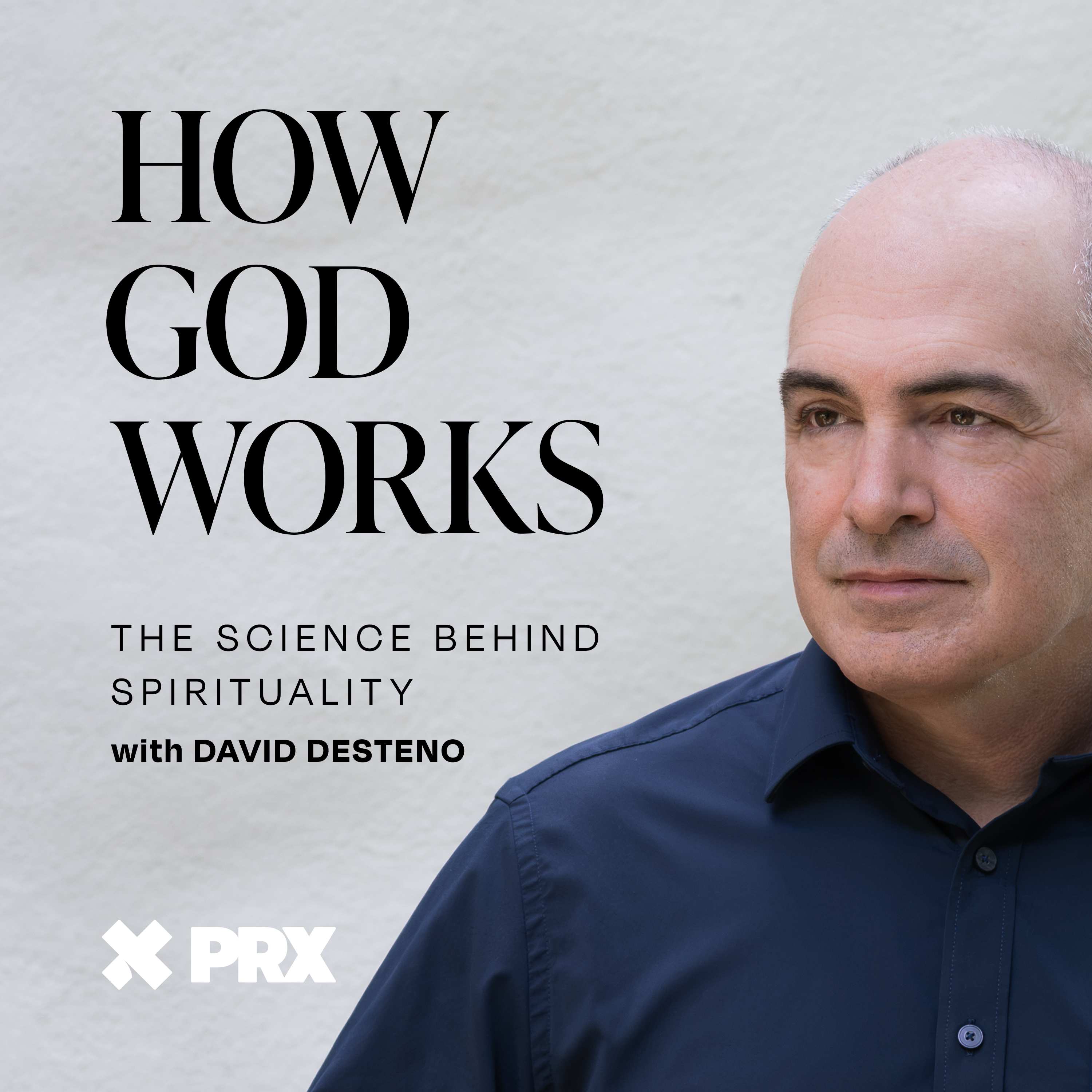
How God Works: The Science Behind Spirituality
PRXAudio
- Format:
- Podcast
- New episodes:
- Every two weeks
- Typical length:
- about 45 minutes
- Latest episode:
About this show
While religion and science often seem at odds, there’s one thing they can agree on: people who take part in spiritual practices tend to live longer, healthier, and happier lives. The big question is: Why? In How God Works, professor Dave DeSteno takes us on a journey to find out how spirituality impacts our minds and bodies, as well as the world in which we live.
He speaks to leading scientists and philosophers, religious thinkers, and thought leaders to explore what we can learn from the world’s faith traditions to help us meet some of life’s biggest challenges. Along the way, he’ll look at how we can adapt and use spiritual practices in our own lives, whatever our beliefs, including none at all.
It’s by working across the boundaries that usually divide us – science versus religion, one faith versus another – that we’ll find new ways to make life better for everyone.
Covers: religion and science, spirituality, psychology of religion, wellbeing, economic inequality, US politics, fashion, purpose, artificial intelligence
Show details and episodes come from the publisher's public feed at podcast.davedesteno.com. Last updated . Names, artwork and text belong to their publishers.
Recently on this show
Summary of recent episodes, drawn from the publisher's feed.
How God Works is a podcast from PRX, hosted by professor Dave DeSteno, that examines how spiritual practices shape minds, bodies and society, drawing on science and faith traditions. Recent episodes explore sensing the sacred, faith and fashion, economic inequality, and rethinking purpose.
Cosmos
Rated alike
- Scared To Death
Often rated the same way. - BBC Radio 4
Often rated the same way. - Family Fun Pack
Often rated the same way.
Similar in subject
- The Prof G Pod with Scott Galloway
Both cover: economic inequality, us politics - Better Than Happy
Both cover: purpose - The Happiness Lab with Dr. Laurie Santos
Both cover: wellbeing, artificial intelligence
Similar shows





Explore more
Episodes
Found By Faith
· 35 min
People find faith or change faiths for many reasons: marriage, raising a family, dealing with grief or crisis. But sometimes it happens the other way around… faith finds you. A believing takes hold, a sense that something divine is there. And maybe not in the way or role that you might have expected. It’s not uncommon. Data show that these types of experiences happen to about 30% of people. On this episode we’ll talk to one of these people –New York Times columnist (https://www.nytimes.com/column/david-brooks) and best selling author David Brooks– about his unexpected encounter with faith and what came after. Find out more about Weave: The Social Fabric Project (https://weavers.org/), the non-profit David founded at the Aspen Institute.
Not rated yetFasting for the Soul
· 31 min
Many would agree there are few things better than sharing a delicious meal with the people you love, which is one reason why breaking bread together is a cornerstone of religions the world over. But so too is the opposite - going without food. From Ramadan to Yom Kippur to Lent, fasting is an important ritual in many faiths. But why do so many religions periodically take away the very thing that nourishes our bodies and souls? On this episode we'll talk with Khalil-Abdur Rashid about the role fasting plays in Islam, and why not eating and drinking is actually the easy part. And we'll talk to Adam Cohen about some new research that suggests even one day of fasting could help deepen religious commitment and overall well being. Imam Dr. Khalil Abdur-Rashid is the first full-time University Muslim Chaplain at Harvard University (https://www.hks.harvard.edu/faculty/khalil-abdur-rashid), Instructor of Muslim Studies at Harvard Divinity School, and Public Policy Lecturer at the Harvard Kennedy School of Government. Adam Cohen is a Professor of Psychology at Arizona State University. Learn more about his research here (https://search.asu.edu/profile/970085).
Not rated yetOrigins of Belief
· 35 min
We often think of belief as a religious or cultural idea that is a hallmark of modern humans. But what if the early sparks of belief burned in our ancestors’ minds long before modern humans walked the earth? What if beliefs about some of the biggest questions out there, like what happens after death, weren’t just pondered by Homo sapiens? On this episode, evolutionary anthropologist Agustín Fuentes takes us on a journey spanning millions of years, from our primate relatives in the deep past to the complex spiritual and cultural traditions we know today. Along the way, we’ll learn how the capacity for belief has helped shape our species and why it remains a powerful force in our lives today. Agustín Fuentes is a Professor of Anthropology at Princeton University and the author of the books Why We Believe: Evolution and the Human Way of Being and The Creative Spark: How Imagination Made Humans Exceptional. Learn more about his work on his website (https://afuentes.com/), and be sure to check out his forthcoming book (https://press.princeton.edu/books/hardcover/9780691249414/sex-is-a-spectrum) Sex is a Spectrum: The Biological Limits of the Binary, due out in May 2025.
Not rated yetMarriage, Monogamy and the Modern Mind
· 36 min
When it comes to finding happiness, many religions see marriage as the gold standard: a path to love, stability, and fulfillment. But is that really true? And if so, why are marriage rates plummeting in so many parts of the world? In this episode, we’ll talk to anthropologist Joseph Henrich about the surprising history of marriage and monogamy, including how these institutions helped lay the groundwork for much of our modern way of life. We’ll also speak with psychologist Geoff MacDonald about what it means to live a happy, single life in a world that often prioritizes partnership, and why marriage might not offer the best road to fulfillment for everyone. Joseph Henrich is the Ruth Moore Professor of Human Evolutionary Biology at Harvard University, and the author of The WEIRDest People in the World (https://weirdpeople.fas.harvard.edu/): How the West Became Psychologically Peculiar and Particularly Prosperous. Geoff MacDonald is a Professor of Psychology at the University of Toronto, where he leads the MacDonald Social Psychology Research Laboratory (https://www.macdonaldlab.ca/), which aims to study well-being in singlehood.
Not rated yet- Not rated yet
Every Breath You Take (From the Archive)
· 39 min
We'll be back with a whole new season of How God Works on March 9th. But in the meantime, we wanted to share shows from our archives that speak to some of the most pressing challenges we're all facing today. It’s only February, and already this has been an intense year. So if you’re feeling stressed today, how about… a breather? It’s no accident that the Hebrew word for breath is the same as the word for spirit (ruach). Breath doesn’t just give us life: it helps regulate everything from vital organ functions to cognition and emotional states. That’s why spiritual traditions the world over incorporate it as a practice to help heal body and mind and walk the path towards peace. Join us as we explore the breath’s connection to our nervous system with psychologist and neuroscientist Stephen Porges, creator of Polyvagal Theory. We’ll also learn about the spiritual roots of breathwork and try out a few techniques with noted yoga, qigong and meditation teacher Amelia Barili. Learn more about Dr. Stephen Porges’s work and Polyvagal Theory on his website (https://www.stephenporges.com), and be sure to check out his new book, co-authored with Seth Porges: Our Polyvagal World: How Safety and Trauma Change Us (https://www.barnesandnoble.com/w/our-polyvagal-world-seth-porges/1142948876). Dr. Amelia Barili is faculty at the UCB Osher Lifelong Learning Institute and professor emerita from the University of California at Berkeley. Learn more about her work on her website (https://ameliabarili.com) and check out her YouTube channel the new paradigms (https://www.youtube.com/@thenewparadigms). We also highly recommend the book Breath: The New Science of a Lost Art (https://www.mrjamesnestor.com/breath-book), by James Nestor.
Not rated yetMoving Beyond Us vs Them (From the Archive)
· 38 min
We'll be back with a whole new season of How God Works starting in early March. But in the meantime, we wanted to share a few shows from our archives that speak to some of the most pressing challenges we're all facing today. Hate and prejudice based on ethnicity, religion, gender and sexual orientation are all too common in our world. But are we doomed to be this way? Or is it possible to create a world where cooperation and peace are the norm? Join Dave as he talks to NYU professor Jay van Bavel about the deeper mechanisms at work when it comes to group conflict (and how to avoid it), and with Zen Buddhism teacher Larry Ward about how the teachings of Thich Nhat Hanh and the Plum Village Tradition (https://plumvillage.org#filter=.region-sa) can help all of us to heal and foster a more equitable and caring world. Jay Van Bavel is co-author (with Dominic Packer) of The Power of Us: Harnessing Our Shared Identities to Improve Performance, Increase Cooperation, and Promote Social Harmony (https://www.powerofus.online). Find out more about Jay’s work on his website (https://www.jayvanbavel.com). Larry Ward is a co-founder of The Lotus Institute (https://www.thelotusinstitute.org/about-us) and host of the podcast Beyond the News (https://podcasts.apple.com/ca/podcast/beyond-the-news/id1667359480), which explores current events through the lens of Buddhism and neuroscience. He is also the author of America’s Racial Karma: An Invitation to Heal (https://www.penguinrandomhouse.com/books/651864/americas-racial-karma-by-larry-ward/). The gathas heard in this episode are taken from Thich Nhat Hanh’s book Peace Is Every Breath: A Practice for Our Busy Lives (https://www.barnesandnoble.com/w/peace-is-every-breath-thich-nhat-hanh/1100258633). Dave also makes reference to the 14 mindfulness trainings, which can be found in the book Interbeing, 4th Edition: The 14 Mindfulness Trainings of Engaged Buddhism (https://books.google.cl/books/about/Interbeing_4th_Edition.html?id=eMWyDwAAQBAJ&redir_esc=y).
Not rated yetReligion and Robots and AI … Oh My! (From the Archive)
· 36 min
Artificial Intelligence, and its possible applications to religion, have been in the news a lot lately, so while we're busy working on Season 8, we thought we'd share this episode from 2022 with you. Can you pray with a robot? Will people worship AI like a god? It’s not science fiction. It’s starting to happen now. But what does it mean if robots become priests, or AIs start offering ethical advice? And how do we know when to trust them? We’ll talk to MIT social roboticist Cynthia Breazeal about how technology can manipulate our minds and emotions for good or ill, and with religion professor Robert Geraci about how technology is being used in religion, and why AI may need some spiritual training itself. Watch Cynthia Breazeal’s TED talk here (https://www.ted.com/speakers/cynthia_breazeal), and find out about her work on the MIT Media Lab website (https://www.media.mit.edu/people/cynthiab/overview/). Find out more about Robert Geraci’s work on his website (https://robertgeraci.com). Meet the robots: Nexi (https://www.media.mit.edu/videos/labcast-23-nexi-mds-robot/?autoplay=true), Mindar (https://www.youtube.com/watch?v=hLoF5_-OUKY), and SanTO (https://www.wsj.com/articles/deus-ex-machina-religions-use-robots-to-connect-with-the-public-11553782825).
Not rated yetWhy Spirituality is Important in our Increasingly Secular World (Dave on the How to Be a Better Human Podcast)
· 39 min
Faith has always been a strong force in human history – but in modern times, it may feel antiquated to have it. This is an episode of the How to Be a Better Human podcast in which Dave talks about his research exploring questions of faith, his findings, and why we shouldn’t leave spiritual wisdom behind, even in the age of science. Hosted by comedian Chris Duffy, How to Be a Better Human features conversations that uncover sharp insights and give clear takeaways on how you can improve your life. From your work to your home and your head to your heart, How to Be a Better Human looks in unexpected places for new ways to improve and show up for one another. If you liked this episode, you can find How to Be a Better Human wherever you get your podcasts
Not rated yetFinding Holiday Happiness
· 36 min
The holidays are supposed to be a time of joy. But all too often, the darker, colder days of winter, and even the stress of preparing for the holidays themselves, can lead people to feel something else: rushed, stressed, lonely, or even hopeless. How can you make sure this year is bright? Science shows that there's a wisdom to parts of traditional winter celebrations – a wisdom that's been honed over centuries to help us all find light, joy, and connection during the darkest and coldest time of the year. Join Dave as he chats with Laurie Santos about how to unpack the psychological secrets of celebrations from Christmas, to Hanukkah, to Yule, and more. They’ll also discuss how we can put that wisdom into practice, whatever our beliefs, to make this season a happier and healthier one for all. Laurie Santos hosts the podcast The Happiness Lab (https://podcasts.apple.com/us/podcast/the-happiness-lab-with-dr-laurie-santos/id1474245040) and is a Professor of Psychology at Yale, where she teaches the most popular class in the university’s history. Learn more about her work at her website (https://www.drlauriesantos.com/).
Not rated yet