

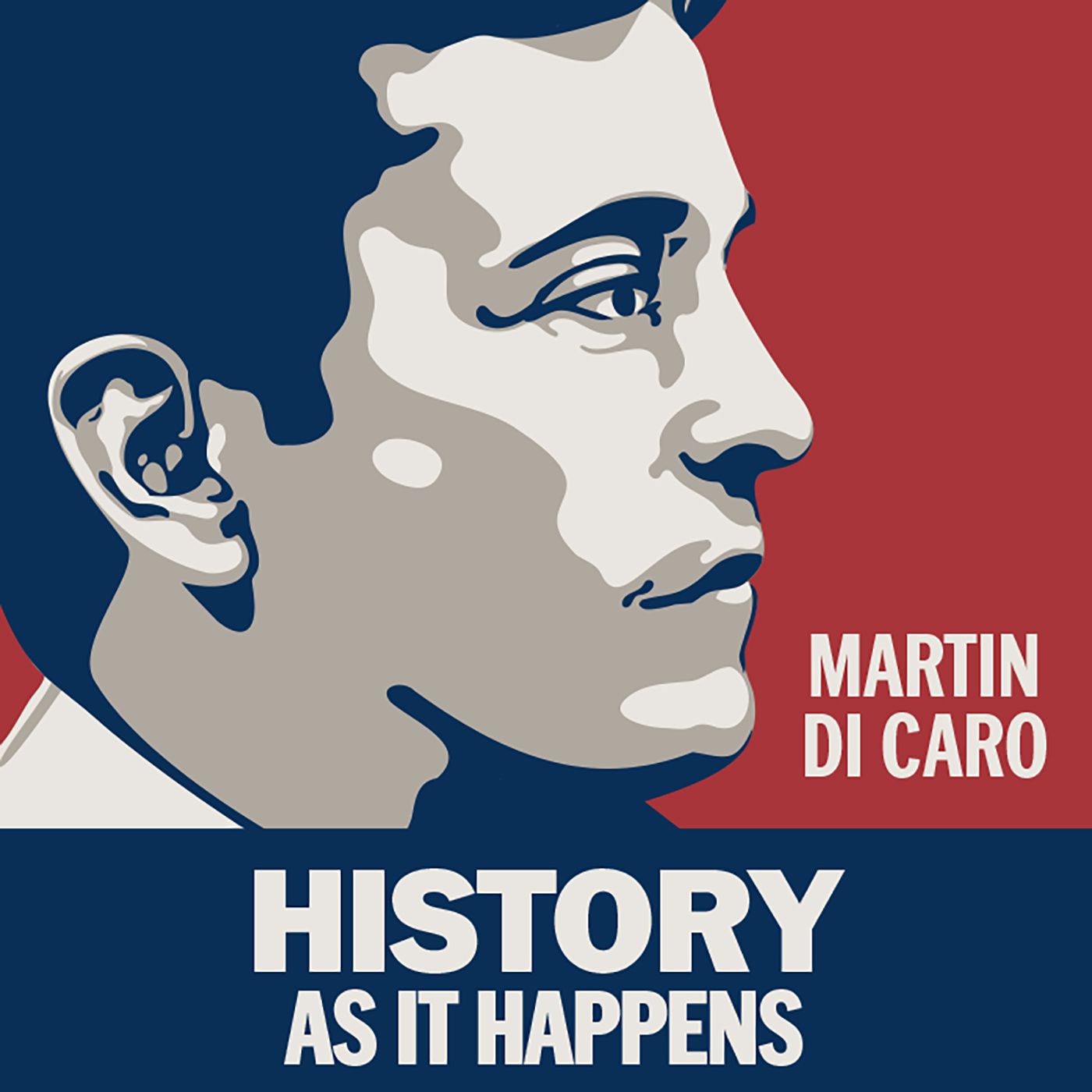
History As It Happens
Martin Di CaroAudio
- Format:
- Podcast
- New episodes:
- Several times a week
- Typical length:
- about 40 minutes
- Latest episode:
About this show
Discover how the past shapes the present with the best historians in the world. Everything happening today comes from something, somewhere. History As It Happens features interviews with today's top scholars and thinkers, interwoven with audio from history's archive.
Subscribe for ad-free episodes, early access, and bonus content. https://historyasithappens.supercast.com/
Covers: history, US politics, US foreign policy, cold war, soviet union, middle east conflict, nuclear arms control, economic history, US presidency
Show details and episodes come from the publisher's public feed at feeds.simplecast.com. Last updated . Names, artwork and text belong to their publishers.
Recently on this show
Summary of recent episodes, drawn from the publisher's feed.
History As It Happens is a podcast that explores how earlier events influence current affairs, pairing interviews with leading scholars and thinkers alongside archival audio. Recent episodes have covered Russians in Afghanistan, the midterms and Iran, Trumpism, Kaliningrad, and the Reagan-Gorbachev Reykjavík summit.
Cosmos
Similar in subject
- Cheap Talk
Both cover: nuclear arms control, us foreign policy, us politics - Cautionary Tales of History
Both cover: soviet union, us foreign policy, cold war - Shield of the Republic
Both cover: us presidency, middle east conflict, us politics
Similar shows




Explore more
Episodes
Russians in Afghanistan
· 1 hr 2 min
Subscribe now (https://historyasithappens.supercast.com/) to skip ads, get early access, and listen to all of our bonus content! Why do superpowers squander their prestige, spill their blood, and waste their treasure in countries where they have no vital national interests? The question is as old as superpowers and empires themselves. In late 1979, the Soviet Union invaded neighboring Afghanistan ostensibly to save a communist regime in Kabul and put down a jihadist insurgency. It proved to be a mistake of epic proportions, producing negative consequences that ripple to this day. Historian Mark Galeotti is an honorary professor at University College London and runs the UK-based research firm Mayak Intelligence. He’s written many books on Russian and Soviet history, including Afghanistan: The Soviet Union's Last War (https://www.amazon.com/Afghanistan-Soviet-Unions-Last-War-ebook/dp/B0FCCW6ZCF/ref=sr_1_35?crid=3EDEI63J3QW4D&dib=eyJ2IjoiMSJ9.h89PMcvyE8uDP-_zjmt-o_szNReVk-Cq2RFOMhfA-bC2TdJ1hWEsxcEetPVeiR5zZeIFJGbb1T48ix8C9OmP90mqD379wXDEnOkwuChmO9_EkUUjMUVASP7Xz1w0JprKHwzCmEHmEJ7MCI4-4yxKkmffchIvCHhacZC9Iki1sWeE3lHGszifIzZ5_3lVs8ErePwneAZaFnRDhyjNkhzQsoXnDRcOovF7U1KvrQXIVN277CuUl3RuddLNFTwmK83mQFUoZsjz4Q8SSq3-e_LZSm7kZmdQpdU-JZqk1u9JYvw.J1g4lAdm5weihTSBZRHOnbZLNUv9qhM08twy-1ppdr8&dib_tag=se&keywords=mark+galeotti+books&qid=1794928988&sprefix=mark+galeoti%2Caps%2C99&sr=8-35), and he hosts In Moscow's Shadows (https://podcasts.apple.com/us/podcast/in-moscows-shadows/id1510124746) podcast. Artemy Kalinovsky teaches history at Temple University. He’s an expert on the Cold War and superpower interventions in the Global South, which led to his first book: A Long Goodbye: The Soviet Withdrawal from Afghanistan (https://www.hup.harvard.edu/catalog.php?isbn=9780674058668). Go to historyasithappens.com (https://historyasithappens.supercast.com/) to learn more. Hosted by Simplecast, an AdsWizz company. See pcm.adswizz.com (https://pcm.adswizz.com) for information about our collection and use of personal data for advertising.
Not rated yetThe Midterms and Iran (Bonus)
· 14 min
Subscribe now (https://historyasithappens.supercast.com/) to listen to the full 25-minute episode (or preview 14 minutes). Democrats trounced Republicans in the midterm elections, winning back control of Congress on a wave of public disgust with President Trump and his party. A major reason for that disgust is the Iran war disaster. How will the election results influence the Trump administration's approach to resolving the war, if at all? How will Democrats treat their responsibility to end the war in Congress? What is the status of negotiations over ending the blockade and reopening the Strait of Hormuz? Our guest is Trita Parsi, the co-founder and executive vice president of the Quincy Institute for Responsible Statecraft. Further reading: The Swiss Cheese Solution: How Trump May Walk Away From Iran (https://substack.com/@tritaparsi/p-224261814) by Trita Parsi Go to historyasithappens.com (https://historyasithappens.supercast.com/) to learn more. Hosted by Simplecast, an AdsWizz company. See pcm.adswizz.com (https://pcm.adswizz.com) for information about our collection and use of personal data for advertising.
Not rated yetThe Rise and Fall of Trumpism, Revisited
· 55 min
Subscribe (https://historyasithappens.supercast.com/) for ad-free listening, early access, and all of our bonus content! Now that Americans have rebuked the president and his party in the midterm elections, is Trumpism a spent force? The Republican Party — and the conservative movement more broadly — have been counted out before: in 1964 when Goldwater crashed and burned, in 1974 because of Watergate, and in 2008 when the Obama wave swept into the White House. Donald Trump is a lame duck whose priorities and policies are deeply unpopular. Will historians mark this moment as the beginning of the end for his populist movement? Our guest is Damon Linker. Damon Linker teaches political science at the University of Pennsylvania and writes the Notes From the Middleground (https://damonlinker.substack.com/) newsletter. Recommended reading: New Top Dog (https://damonlinker.substack.com/p/new-top-dog) by Damon Linker (Notes From the Middleground) Go to historyasithappens.com (https://historyasithappens.supercast.com/) to learn more. Hosted by Simplecast, an AdsWizz company. See pcm.adswizz.com (https://pcm.adswizz.com) for information about our collection and use of personal data for advertising.
Not rated yetImperial Overstretch
· 40 min
Subscribe now (https://historyasithappens.supercast.com/) to skip ads! When do empires decline and why? Today, the United States is stuck in another unwinnable war in the Persian Gulf, its military and economic might insufficient to force Iran's surrender. This humiliation is part of a pattern: the U.S. fights many wars but wins few. Washington's security commitments sprawl the globe, yet where the U.S. chooses to intervene, legitimate national security interests are often not on the line. The Iran war disaster has exposed the limits of power, a case of overstretch that historians may compare to past empires that accelerated their own declines. Historian Jeffrey Engel is our guest. Jeffrey Engel teaches at Southern Methodist University, where he is the founding director of the Center for Presidential History. He's the author of When the World Seemed New: George H. W. Bush and the End of the Cold War (https://www.amazon.com/When-World-Seemed-New-George/dp/0547423063/ref=tmm_hrd_swatch_0). Go to historyasithappens.com (https://historyasithappens.supercast.com/) to learn more. Hosted by Simplecast, an AdsWizz company. See pcm.adswizz.com (https://pcm.adswizz.com) for information about our collection and use of personal data for advertising.
Not rated yetThe Kaliningrad Question
· 42 min
Subscribe today (https://historyasithappens.supercast.com/) to skip ads, get early access, and enjoy all of our bonus content. Only $5 per month! Are the NATO allies in Eastern Europe risking war with Russia over a piece of Russian national territory wedged between Lithuania and Poland? Russia has warned NATO it is prepared to use its entire arsenal, including nuclear weapons, if the Western alliance attempts to cut off the Baltic exclave of Kaliningrad. Once part of East Prussia and home to the beautiful German city of Königsberg, the Soviet Union annexed the territory after WWII, renamed it Kaliningrad, and it was settled by Russians after the German population was expelled. A Soviet strategic foothold on the Baltic Sea, Kaliningrad would be surrounded by the NATO allies after 1991, setting the stage for today's dangerous tensions. Anatol Lieven is our guest. Anatol Lieven is the director of the Eurasia Program and the Andrew Bacevich Chair in American Diplomatic History at the Quincy Institute for Responsible Statecraft. Further reading: Slouching Toward Kaliningrad (https://responsiblestatecraft.org/kaliningrad-nato-russia/) by Anatol Lieven for Responsible Statecraft Go to historyasithappens.com (https://historyasithappens.supercast.com/) to learn more. Hosted by Simplecast, an AdsWizz company. See pcm.adswizz.com (https://pcm.adswizz.com) for information about our collection and use of personal data for advertising.
Not rated yetBiden, Israel, and Gaza's Destruction
· 36 min
Support the show and get ad-free listening as part of the deal! Subscribe now (https://historyasithappens.supercast.com/). The story of how and why the Biden administration enabled Israel’s genocidal brutality in Gaza and beyond has been written by the journalist Akbar Shahid Ahmed, revealing the callousness and incompetence of an enfeebled president and his top aides, who exercised a default deference to Israel — in defiance of U.S. and international law — after the Hamas-led attack on Oct. 7, 2023. The Biden team's failure to restrain Israel from committing mass murder will shadow them for the rest of their lives, as the consequences ripple across a Middle East upended by war and genocide. Recommended reading: Crossing the Red Line (https://wwnorton.com/books/9781324118190) by Akbar Shahid Ahmed Biden's Israel Catastrophe (https://www.theamericanconservative.com/bidens-israel-catastrophe/) by Martin Di Caro (The American Conservative) Go to historyasithappens.com (https://historyasithappens.supercast.com/) to learn more. Hosted by Simplecast, an AdsWizz company. See pcm.adswizz.com (https://pcm.adswizz.com) for information about our collection and use of personal data for advertising.
Not rated yetReagan, Gorbachev, and Reykjavík
· 47 min
Subscribe now (https://historyasithappens.supercast.com/) — only $5 per month — for ad-free listening and all of our bonus content! 40 Octobers ago, the superpowers' leaders met in a distant capital and came within a whisker of agreeing to eliminate all nuclear weapons. The Reykjavík summit ended without a breakthrough, but it was not a failure. Soon the world would witness the high tide of arms control treaties and superpower detente. However, that time is long over. In our age of budget-busting nuclear modernization and potential proliferation, superpower hostility and anarchy are the norms. Where’s the spirit of Reagan, Gorbachev, and Reykjavík? Our guest is historian Michael Kimmage. Michael Kimmage is the director of the Kennan Institute in Washington, an expert on the Cold War and U.S.-Russia relations. He's the author of 'Collisions: The Origins of the War in Ukraine and the New Global Instability (https://global.oup.com/academic/product/collisions-9780197751794).' Further reading: Reykjavik at 40 (https://responsiblestatecraft.org/reagan-gorbachev-reykjavik/) by Martin Di Caro (Responsible Statecraft) Go to historyasithappens.com (https://historyasithappens.supercast.com/) to learn more. Hosted by Simplecast, an AdsWizz company. See pcm.adswizz.com (https://pcm.adswizz.com) for information about our collection and use of personal data for advertising.
Not rated yetThe Owl of Minerva Flies Again
· 52 min
Subscribe now (https://historyasithappens.supercast.com/) for ad-free listening and all of our bonus content! The Cold War began about 80 years ago. It ended more than 35 years ago, leading to triumphalist attitudes in the West. Who started it? Who really "won"? Why are we still debating this? Because Cold War history continues to shape our world — and our minds. Our guests are historians Daniel Bessner and Vladislav Zubok. Bessner teaches history at the University of Washington. He’s the co-host of American Prestige (https://americanprestigepod.com/) and the co-editor, with Michael Brenes, of Cold War Liberalism: Power in a Time of Emergency (https://www.cambridge.org/core/books/cold-war-liberalism/4CE8BFF1CF908A8F481B55F2043A88F7). Vladislav Zubok is an eminent historian of international relations at the London School of Economics and the author of The World of the Cold War, 1945 to 1991 (https://www.amazon.com/Cold-War-New-History/dp/0241696143/ref=tmm_hrd_swatch_0). Go to historyasithappens.com (https://historyasithappens.supercast.com/) to learn more. Hosted by Simplecast, an AdsWizz company. See pcm.adswizz.com (https://pcm.adswizz.com) for information about our collection and use of personal data for advertising.
Not rated yetThe Israeli Elections (Bonus)
· 10 min
Subscribe now (https://historyasithappens.supercast.com/) to listen to the full 20-minute episode (or preview 10 minutes). On Tuesday, Oct. 27, Israelis will vote in what some consider the most consequential election in the country's history. It is the first election since Oct. 7, 2023, the day of the Hamas onslaught in southern Israel, and Benjamin Netanyahu, 77, hopes to remain in power despite having been indicted for war crimes by the ICC. In this episode, Israeli political scientist and leading pollster Dahlia Scheindlin discusses the country's mood and which parties are best positioned to form a new government. Further reading: Explained: How can Israelis still vote for Netanyahu? (https://www.haaretz.com/israel-news/elections/2026-10-15/ty-article-magazine/.premium/explained-how-can-israelis-still-vote-for-netanyahu/000001a1-3ff9-da29-abbd-7fffa2f50000) by Dahlia Scheindlin (Haaretz) Go to historyasithappens.com (https://historyasithappens.supercast.com/) to learn more. Hosted by Simplecast, an AdsWizz company. See pcm.adswizz.com (https://pcm.adswizz.com) for information about our collection and use of personal data for advertising.
Not rated yetThe Inflation Dragon
· 46 min
Subscribe now (https://historyasithappens.supercast.com/) to skip ads and support the show! As inflation fuels a cost-of-living crisis, millions of Americans are getting a bitter taste of what past generations dealt with. From the mid-1960s into the Age of Reagan, high inflation (or stagflation) bedeviled economists, frustrated presidents, and shrank the horizons of middle-class Americans. And not just inflation! Policy-makers' responses also caused pain. In this episode, historian Nelson Lichtenstein delves into inflation's historical causes and pokes holes in the conventional wisdom that interest rate adjustments by an independent Federal Reserve are the wisest way to tame inflation. Nelson Lichtenstein teaches labor and economic history at U.C. Santa Barbara. He's the author of Why Labor Unions Matter (https://yalebooks.yale.edu/book/9780300272550/why-labor-unions-matter/) (2026). Go to historyasithappens.com (https://historyasithappens.supercast.com/) to learn more. Hosted by Simplecast, an AdsWizz company. See pcm.adswizz.com (https://pcm.adswizz.com) for information about our collection and use of personal data for advertising.
Not rated yetThe Worst President? Meet Andrew Johnson
· 47 min
Subscribe now (https://historyasithappens.supercast.com/) to skip ads! Keep the narrative flow going with ad-free listening. When John Wilkes Booth assassinated Abraham Lincoln in April 1865, the United States would have its third accidental president. The Southern unionist and Democrat Andrew Johnson of Tennessee at first seemed to be an ally of Republicans in the monumental task of Reconstruction, for he agreed that the Southern states could not come back unless they ratified the Thirteenth Amendment abolishing slavery. But Johnson's presidency quickly spiraled as he bitterly fought Congress over Reconstruction's control and sought to obstruct all efforts at achieving Black equality. In this episode, historian Jim Oakes (https://www.amazon.com/Freedom-National-Destruction-Slavery-1861-1865/dp/0393065316/ref=tmm_hrd_swatch_0?_encoding=UTF8&dib_tag=se&dib=eyJ2IjoiMSJ9.YQRt3Ji2v8BfGZmZPtXGhhhDT3I03WNlF0q2UR0NryWj83hEHXejvGRCt8am-eMJ3law5LUEhHHIIXrml9OsazGOptbVVmU500vKgBNoY1RzmyZMsy9emcGK1gU-jjvf.DHl5m8atAjtWpYdIE3eVPuQ9xKtt8qVmIvJiq2i1cMg&qid=1792444793&sr=8-1) tells us what made Andrew Johnson arguably the worst president in U.S. history. Further listening: The Worst President? Meet James Buchanan (https://history-as-it-happens.simplecast.com/episodes/the-worst-president-meet-james-buchanan) w/ Jim Oakes Go to historyasithappens.com (https://historyasithappens.supercast.com/) to learn more. Hosted by Simplecast, an AdsWizz company. See pcm.adswizz.com (https://pcm.adswizz.com) for information about our collection and use of personal data for advertising.
Not rated yetInside Trump's Mind (Bonus)
· 14 min
Subscribe now (https://historyasithappens.supercast.com/) to listen to the full 28-minute episode (or preview 14 minutes without a subscription). If any Washington journalist can take us inside President Donald Trump's mind, it's Edward Luce (https://www.ft.com/edward-luce). The Financial Times columnist and astute observer of American politics has frequently talked to Trump over the phone about the Iran war, the U.S. economy, and much else. Does the president have a plan, or is he winging it? Luce explains Trump's thinking as his second term collapses around him. Go to historyasithappens.com (https://historyasithappens.supercast.com/) to learn more. Hosted by Simplecast, an AdsWizz company. See pcm.adswizz.com (https://pcm.adswizz.com) for information about our collection and use of personal data for advertising.
Not rated yetAn Antiwar Speech For the Ages
· 33 min
Subscribe now (https://historyasithappens.supercast.com/) for ad-free listening, early access, and all of our bonus content! On April 4, 1967, Martin Luther King Jr. delivered a powerful address at a New York City church. "Beyond Vietnam — A Time to Break Silence (https://www.americanrhetoric.com/speeches/mlkatimetobreaksilence.htm)" was a searing indictment of a U.S. war on a poor country. King's expansive critique of militarism and violence explained how the war was "devastating the hopes of the poor at home" by draining resources from LBJ's Great Society programs. The cause of civil rights, argued King, was not separate from antiwar activism. Where are such voices today? Our guest is historian Michael Kazin. Michael Kazin is a distinguished historian of U.S. political and social movements at Georgetown University and the author of "What It Took To Win: A History of the Democratic Party (https://read.dukeupress.edu/labor/article-abstract/20/1/127/351941/What-It-Took-to-Win-A-History-of-the-Democratic)." Go to historyasithappens.com (https://historyasithappens.supercast.com/) to learn more. Hosted by Simplecast, an AdsWizz company. See pcm.adswizz.com (https://pcm.adswizz.com) for information about our collection and use of personal data for advertising.
Not rated yetWhat the Saudis Knew About 9/11 (Bonus)
· 13 min
Subscribe now (https://historyasithappens.supercast.com/) to listen to the full 28-minute episode (or preview 13 minutes without a subscription). The 9/11 families are still awaiting their day in court. In lawsuits, hundreds of victims’ relatives and injured survivors claim that Saudi government employees directly and knowingly assisted Osama bin Laden's hijackers and fueled al-Qaeda’s development by funding Islamic charities that exported a radical strain of Islam to places like Afghanistan. What did the Saudi government know, if anything, about the plot? Why did Islamic charities export Wahhabism to the Muslim world? Who was Omar al-Bayoumi, a Saudi intelligence asset who befriended two of the hijackers? Our guest is Peter Bergen, the author of All the Presidents’ Wars (https://www.peterbergen.com/all-the-presidents-wars/). Bergen is a journalist, documentary producer, and vice president for global studies at New America, a D.C. think tank. He’s a national security analyst for CNN and professor of practice at Arizona State University. Further listening: Who Was Osama bin Laden? (https://history-as-it-happens.simplecast.com/episodes/who-was-osama-bin-laden) (podcast w/ Peter Bergen) Go to historyasithappens.com (https://historyasithappens.supercast.com/) to learn more. Hosted by Simplecast, an AdsWizz company. See pcm.adswizz.com (https://pcm.adswizz.com) for information about our collection and use of personal data for advertising.
Not rated yetDaniel Ortega and the Sandinistas
· 45 min
Subscribe now (https://historyasithappens.supercast.com/) to skip ads, get early access, and enjoy all of our bonus content. Nicaragua has a dictator for life. President Daniel Ortega (https://apnews.com/hub/daniel-ortega), 80, announced the country won’t hold elections anytime soon, underscoring his effort to extend his nearly 20-year rule and dashing the opposition's hopes that he might allow a modicum of democracy, according to the Associated Press. Few expected next year's election to be free and fair, but Ortega won't even uphold the pretense. Who are Daniel Ortega and the Sandinistas, a leftist revolutionary movement founded in the early 1960s? Why is Ortega, who was first elected in 1984, still on the Central American political scene? Our guest is historian Jeffrey Gould. Jeffrey Gould is a Distinguished Professor Emeritus at the University of Indiana. He's an expert on Nicaragua as well as Central American social movements, ethnic conflicts, and political violence. Go to historyasithappens.com (https://historyasithappens.supercast.com/) to learn more. Hosted by Simplecast, an AdsWizz company. See pcm.adswizz.com (https://pcm.adswizz.com) for information about our collection and use of personal data for advertising.
Not rated yetWho's Running Iran? (Bonus)
· 6 min
Subscribe now (https://historyasithappens.supercast.com/) to listen to the full 18-minute episode (or preview the first 6 minutes). Iran's new Supreme Leader Mojtaba Khamenei remains invisible more than 7 months into an existential war for the regime's survival. He's yet to be seen in public and was reportedly seriously wounded on the war's first day in an air strike that killed his father. So, who is running Iran? Who is directing the war or making decisions at the negotiating table? Our guest is Trita Parsi, the executive vice president of the Quincy Institute. He is an expert on U.S.-Iranian relations, Iranian foreign policy, and Middle East geopolitics. Parsi discusses Iran's leadership, the state of negotiations with the Trump administration, and whether a return to major combat is possible. Go to historyasithappens.com (https://historyasithappens.supercast.com/) to learn more. Hosted by Simplecast, an AdsWizz company. See pcm.adswizz.com (https://pcm.adswizz.com) for information about our collection and use of personal data for advertising.
Not rated yetFDR's Fight With Fascism
· 1 hr 5 min
Subscribe now (https://historyasithappens.supercast.com/) to skip ads, get early access, and listen to all of our bonus content. When Franklin Delano Roosevelt entered the White House in 1933, the country was paralyzed by the Great Depression and fascist jackboots were trampling democracy in Europe. As the 1930s wore on, the president and the American people came to see fascism as not only a threat to societies on the other side of the Atlantic, but as a danger to the American way of life, too. But what to do about it? How did FDR prepare the country for what he correctly foresaw as an inevitable war against the fascist powers? How did public opinion compel the president to leave neutrality behind? Americans then tangled with the same questions we’re grappling with today, although under a dramatically different set of circumstances. When do problems in faraway places necessitate U.S. involvement? Does our democracy depend on the survival of other democracies? Our guest is University of Virginia historian William Hitchcock, the author of "A Shadow Over the World: Franklin D. Roosevelt, the Rise of Fascism, and the Making of America's World War II. (https://www.simonandschuster.com/books/A-Shadow-Over-the-World/William-I-Hitchcock/9781982157722)" Go to historyasithappens.com (https://historyasithappens.supercast.com/) to learn more. Hosted by Simplecast, an AdsWizz company. See pcm.adswizz.com (https://pcm.adswizz.com) for information about our collection and use of personal data for advertising.
Not rated yetThe Rise and Fall of Political Islam
· 38 min
Subscribe now (https://historyasithappens.supercast.com/) to skip ads, get early access, and listen to all of our bonus content. The Middle East is undergoing transformative changes. It's difficult, if not impossible, to see where things will end up. What is clear, however, is that political Islam — what the scholar Mohammed Ayoob says was "the dominant ideological challenger to the region’s authoritarian political systems" — is declining. Public confidence that Islamist movements, whether radical or pragmatic, can affect positive change for their societies is low. What might emerge instead? Our guest is Nathan Brown, who teaches political science and international affairs at George Washington University. He's an expert on religion and politics, authoritarianism, constitutionalism, and the Israeli-Palestinian conflict. Further reading: The End of Political Islam? Not Quite (https://nationalinterest.org/blog/middle-east-watch/the-end-of-political-islam-not-quite) by Mohammad Ayoob (The National Interest) Go to historyasithappens.com (https://historyasithappens.supercast.com/) to learn more. Hosted by Simplecast, an AdsWizz company. See pcm.adswizz.com (https://pcm.adswizz.com) for information about our collection and use of personal data for advertising.
Not rated yetThomas Jefferson's DNA (Bonus)
· 9 min
Subscribe (https://historyasithappens.supercast.com/) to listen to the full 28-minute episode (or preview the first 9 minutes). Scientists sequenced Thomas Jefferson’s genome from three strands of his hair for a project led by the Smithsonian Institution to prove that Jefferson fathered children with his slave Sally Hemings. According to The New York Times, researchers used cutting-edge techniques to extract and sequence the DNA, then compared it with DNA samples from 13 living Hemings and Jefferson family descendants. This story is, in some ways, old news. The allegations that Jefferson had an enslaved mistress appeared when he was president in 1802. Books written decades ago by Fawn Brodie and Annette Gordon-Reed delved into their relationship. Yet the story still fascinates, and now has a new chapter for us to talk about. Our guest is Alan Taylor, the Thomas Jefferson Foundation Chair, Emeritus, in the Department of History at the University of Virginia. He’s the author of Thomas Jefferson’s Education (https://www.amazon.com/dp/0393652424?lv=shuf&channelId=500&plpRedirect=mhFallback) and the new Tower Hill: A Plantation on the Edge of Rebellion (https://www.amazon.com/Tower-Hill-Plantation-Edge-Rebellion/dp/1324117346/ref=pd_lpo_d_sccl_1/130-4959427-4240464?pd_rd_w=F64R4&content-id=amzn1.sym.4c8c52db-06f8-4e42-8e56-912796f2ea6c&pf_rd_p=4c8c52db-06f8-4e42-8e56-912796f2ea6c&pf_rd_r=TV8NC5Y2VAZF6TA6QW2H&pd_rd_wg=e50kE&pd_rd_r=ff5badb1-a4ed-48fc-aa24-aa815b74b82b&pd_rd_i=1324117346&psc=1). Go to historyasithappens.com (https://historyasithappens.supercast.com/) to learn more. Hosted by Simplecast, an AdsWizz company. See pcm.adswizz.com (https://pcm.adswizz.com) for information about our collection and use of personal data for advertising.
Not rated yetThe Worst President? Meet James Buchanan
· 42 min
Subscribe (https://historyasithappens.supercast.com/) for ad-free listening, early access, and all of our bonus content! In leafy Meridian Hill Park in Washington, D.C., there stands a bronze statue of the fifteenth president of the United States. Only an inscription etched in the surrounding marble identifies its subject: BUCHANAN. Yes, a statue to the terrible James Buchanan, who interfered in a notorious Supreme Court ruling, consistently took the side of the Southern Slave Power, and barely lifted a finger to save the Union after seven states seceded on his watch. Is it fair to lambast this hapless figure? What could Buchanan have done differently to avert the Civil War? Historian James Oakes is our guest. Recommended reading: Freedom National: The Destruction of Slavery in the United States, 1861-1865 (https://www.amazon.com/Freedom-National-Destruction-Slavery-1861-1865/dp/0393347753/ref=sr_1_1?adgrpid=186839645216&dib=eyJ2IjoiMSJ9.YQRt3Ji2v8BfGZmZPtXGhsJ6QYyV3Ar1lwjG6DDUvt-vCgVjVrWbPj2M-Dy07exNS0QE3PH8Mc90htTyWsnMQBreqc1Ooy-IPyHEj8JYECL3q2bZ2PWAzfb-ivJOdXXR.IUCtY9Ts2bVKyulRILXYB1re8i6TpI0NWuVzMOQbmp8&dib_tag=se&hvadid=779616035716&hvdev=c&hvexpln=0&hvlocphy=9007533&hvnetw=g&hvocijid=10172520082135432436--&hvqmt=e&hvrand=10172520082135432436&hvtargid=kwd-57860817428&hydadcr=15517_13657462_2352529&keywords=freedom+national+james+oakes&mcid=26b9732075843653bfcac46ad5aa995a&qid=1790796631&sr=8-1) by James Oakes Go to historyasithappens.com (https://historyasithappens.supercast.com/) to learn more. Hosted by Simplecast, an AdsWizz company. See pcm.adswizz.com (https://pcm.adswizz.com) for information about our collection and use of personal data for advertising.
Not rated yet