

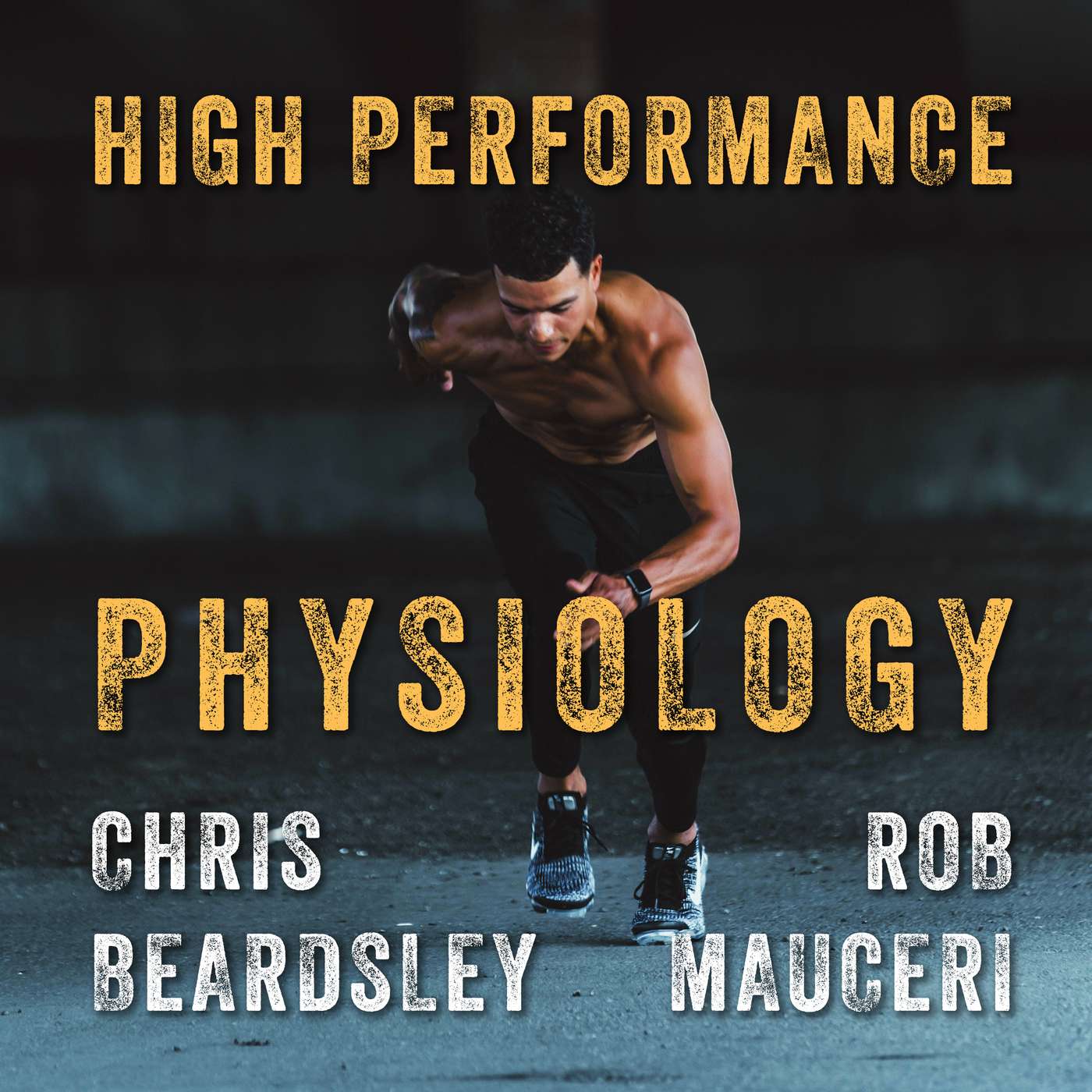
High Performance Physiology
Chris Beardsley and Rob MauceriAudio
- Format:
- Podcast
- New episodes:
- Weekly
- Typical length:
- about 40 minutes
- Latest episode:
About this show
The High Performance Physiology Podcast is co-hosted by Chris Beardsley and Rob Mauceri. Each episode showcases an example of how muscle physiology and biomechanics can be used to identify the best ways to train for athletic performance.
Covers: sports science, strength training, exercise physiology, athletic performance, periodization, plyometrics, warm-up, sports conditioning
Show details and episodes come from the publisher's public feed at feeds.transistor.fm. Last updated . Names, artwork and text belong to their publishers.
Recently on this show
Summary of recent episodes, drawn from the publisher's feed.
The show looks at muscle science and movement mechanics to work out effective approaches for improving athletes' training results. Recent episodes cover a strength workout framework, plyometrics compared with fast concentric lifts, training while on vacation, exercise periodization, warm-up purpose, and velocity-based training.
Cosmos
Similar in subject
- Some Work, All Play
Both cover: exercise physiology, athletic performance, sports science - Barbell Shrugged
Both cover: athletic performance, sports science, strength training - The Dan John Podcast
Both cover: sports conditioning, strength training
Similar shows








Explore more
Episodes
23 Muscle strain injury
· 39 min
Chris and Rob talk about how muscle strain injuries happen, and what we can do in strength training programs to help reduce the risk of them happening.
Not rated yet22 Sprinting muscles
· 36 min
Chris and Rob talk through what the literature says about the relationship between track sprinting performance and the muscle volumes of the hip extensors, hip flexors, knee extensors, knee flexors, and ankle plantar-flexors.
Not rated yet021 Speed training frequency
· 31 min
Chris and Rob continue describing how their proposed workout plan template (speed, maximum strength, stretch-shortening cycle, and eccentric strength) can work even when speed exercises are varied greatly over the week.
Not rated yet20 Strength qualities
· 35 min
Chris and Rob talk about the popular strength and conditioning idea that there multiple strength qualities across the force-velocity spectrum, from maximum strength to strength-speed to power to speed-strength to maximum speed. They also introduce the High Performance Physiology method for building strength training workouts for athletes.
Not rated yet019 Running economy
· 23 min
Endurance running performance is determined by three components: [1] maximal aerobic capacity, [2] lactate threshold, and [3] running economy. In this episode, Chris and Rob talk about how strength training can contribute to improvements in running economy.
Not rated yet018 Structural balance
· 32 min
Chris and Rob chat through what strength ratios between exercises can tell us (and what they cannot tell us) about writing athletic training programs.
Not rated yet017 Work capacity
· 31 min
Continuing from the previous two episodes about powerlifting, Chris and Rob tackle the problem of "work capacity" in this context. What does work capacity mean? What are the underlying physiological adaptations that contribute to changes in work capacity? How should we train to improve work capacity?
Not rated yet016 Powerlifting part 2
· 42 min
In this episode, Chris and Rob continue the powerlifting theme from the previous week. While the previous episode covered the main lifts, this episode is dedicated to accessory lifts to support gains in squat, bench press, and deadlift performance.
Not rated yet015 Powerlifting part 1
· 41 min
In this introductory episode, Chris and Rob explain the underlying adaptations that contribute to powerlifting performance in general terms, and then discuss basic concepts like sets and reps, progression models, potentiation prior to the lifts, and the basic purpose of the training programs from a physiological point of view.
Not rated yet014 Transfer of training
· 33 min
How do strength training programs transfer to sporting movements? What is the role of different exercises? Chris and Rob unpack the physiology and then go on to provide both positive and negative examples from existing training programs.
Not rated yet013 Rate of force development
· 35 min
Chris and Rob explain the definitions of rate of force development and explosiveness in sporting contexts before going on to talk about how to develop these qualities in strength training programs.
Not rated yet012 Periodization
· 40 min
In this long-awaited episode, Chris and Rob talk about periodization. While periodization itself is somewhat overrated, there are some benefits associated with aspects of it that can be replicated in other ways.
Not rated yet011 Deloads and tapers
· 33 min
After a short break for the holidays, Chris and Rob are back for their first episode of 2026 talking about deloads. There are two scenarios in which deloads are taken: planned and unplanned. Planned deloads are written into a training program when fatigue is expected to accumulate. Unplanned deloads are taken when fatigue accidentally accumulates.
Not rated yet010 One arm chin ups
· 37 min
Chris and Rob change the format for this episode. Rather than covering physiology and biomechanics and then talking about how that information guides strength training programs for athletic performance, they talk about their own experiences in training for a one arm chin up.
Not rated yet009 Sprinting
· 46 min
Continuing on from the previous episodes discussing vertical jumping and throwing, Chris and Rob break down the way in which we can support the sprinting movement through targeted strength training.
Not rated yet008 Throwing and punching
· 38 min
Building once again on previous episodes in which they talked about strength, speed, and power, the proximal to distal sequence, and vertical jumping, Chris and Rob now tackle how throwing and punching work, and discuss how to train to improve performance in those activities.
Not rated yet007 Vertical jumping
· 37 min
In this episode, Chris and Rob build on previous podcast discussions about strength, speed, and power as well as on the proximal to distal sequence to explain [1] how vertical jumping works, and [2] how we can structure training programs to improve vertical jump height.
Not rated yet006 Eccentric training
· 40 min
In this episode, Chris and Rob introduce eccentric training, starting with the underlying physiological adaptations and then going on to provide some commentary on practical programming. Contrary to what you will likely hear elsewhere, the important (transferable) adaptations caused by eccentric training are peripheral and not neural.
Not rated yet005 Stretch-shortening cycle
· 36 min
In this episode, Chris and Rob introduce the stretch-shortening cycle and its underlying mechanisms, focusing on how it works in fast movements. This builds on previous episodes in which they talked about speed, power, strength, and the proximal to distal sequence. Learn more about how tendons work to store and release elastic energy in fast movements.
Not rated yet004 Proximal to distal sequencing
· 37 min
After covering the basics of strength, speed, and power, Chris and Rob now address how the proximal to distal sequence works. This is a key feature of human movement and has been observed in running, jumping, and throwing, as well as more complex activities. Understanding how it works is essential for interpreting the transfer of training to sporting performance.
Not rated yet